By: Bhaskar H. Narula Proper Disposal of Waste Material
Hazardous and special waste Waste Legislation Contents
Hazardous and special waste PART 1 Hazardous waste is waste which may cause hazard or harm to  health or the environment because of its chemical or  physical or some other property.
Waste categories Infectious waste GMO waste  ( Genetically Modified Organism waste) Carcasses Biological waste Radioactive waste Chemical waste
INFECTIOUS WASTE Infectious waste cultures, samples, and  stocks of infectious agents  contaminated animals, materials, and equipment  Classification of Biological Hazards (bacteria, viruses, parasites, and fungal agents)  agents presenting a risk or potential risk to the well-being of man, or other animals  infection either directly or indirectly through disruption of the environment classes 1 through 4 on the basis of the hazards they present Class 1: no special treatment  (not mentioned in classification) Classes 2 - 4 -> pre-processing before waste disposal Chemical disinfection  Steam sterilization (Autoclaving)   Incineration (burning to ash)
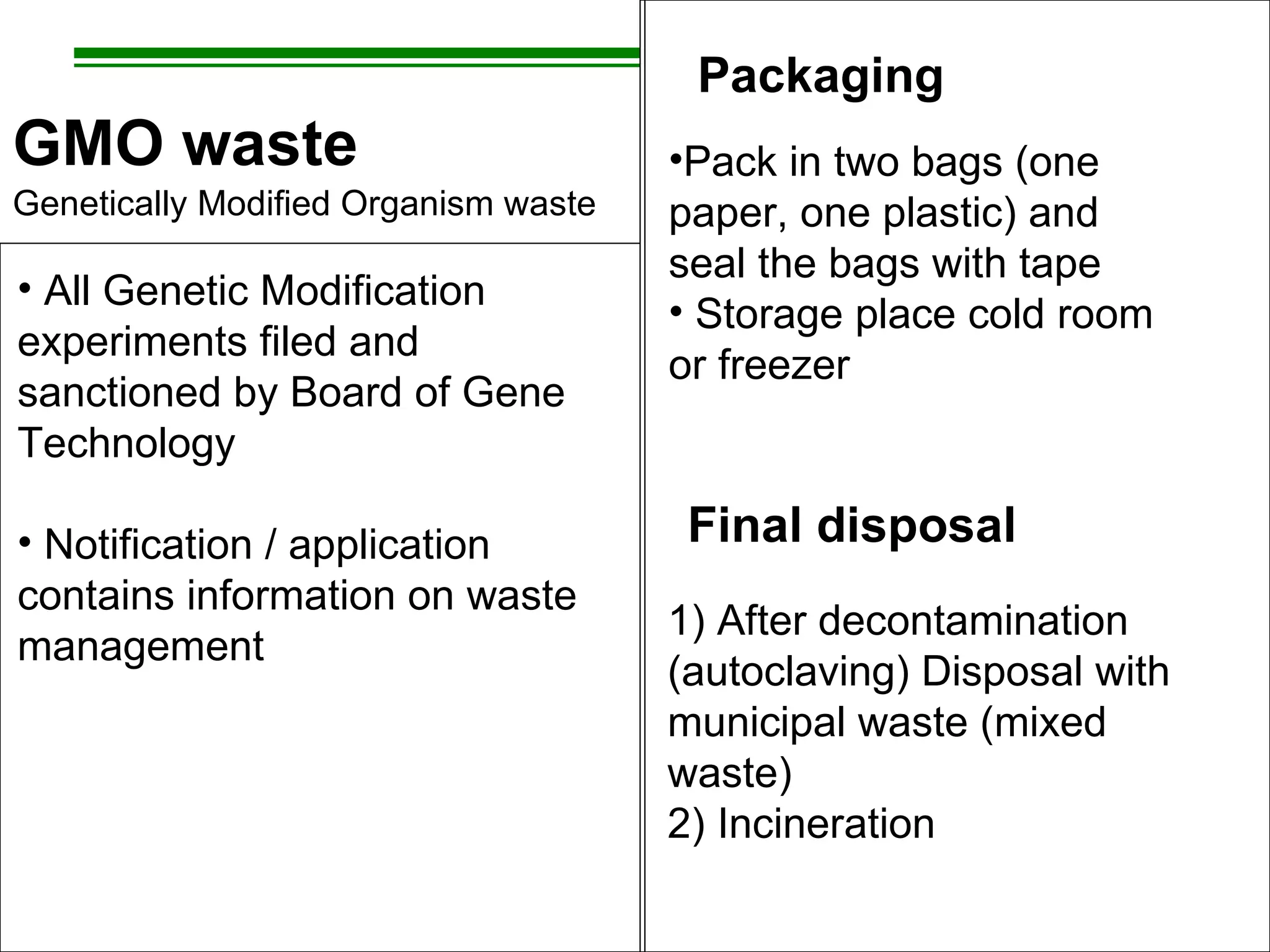
GMO waste  Genetically Modified Organism waste All Genetic Modification experiments filed and sanctioned by Board of Gene Technology  Notification / application contains  information on waste management Packaging Final disposal Pack in two bags (one paper, one plastic)  and  seal the bags with tape  Storage place cold room or freezer 1) After decontamination (autoclaving) Disposal with municipal waste (mixed waste) 2) Incineration
Infectious and GMO Waste Treatment (3 alternatives)   Chemical Disinfection 1) Decontaminating by liquid and gaseous chemicals  alcohol (ethyl or isopropyl), chlorine compounds, ethylene oxide Steam Sterilization   1) Autoclaving Incineration   1) Packaging -   Safety marks   ( UN 3291  ) - ADR transportation - UN accepted package 2) Hazardous waste  disposal plant 2) Disposal with municipal waste  (mixed waste) 2) Disposal with municipal waste  (mixed waste)
Dead laboratory animals (Carcasses)   Carcasses Dead laboratory animals (mice, rats, moles, fishes, pigs etc)   Biohazardous carcasses  (infected with organisms pathogenic to humans or animal) must be autoclaved before delivered the Honkajoki Animal waste treatment plant or incinirate at a hazardous waste plant (Ekokem Oy).  Packaging Final disposal Destroyed in the hazardous animal waste treatment plant (Honkajoki Oy) Leak-proof plastic bag  Storage in a cold room or a freezer
BIOLOGICAL WASTE Biological waste Materials and equipments contaminated by blood and other secretions Packaging Final disposal leak-proof plastic bag or container (red colour) storage place cold room or freezer landfilling as a special waste (Incineration or autoclaving)
SHARP WASTE Radioactive waste Regulated and guided by  STUK – Radiation and Nuclear Safety Authority in Finland Radioactive Wastes and Discharges ST 6.2  Guidelines Packaging Packages shall be marked appropriately, mentioning the primary radionuclides and their activity.  the   storage area or the waste packages must be marked with a sign indicating a danger of radiation. Final disposal After completion of the necessary storage period, the waste will be disposed of as ordinary waste (Remove signs indicating a danger of radiation)
CHEMICAL WASTE  VIILTÄVÄ JA PISTÄVÄ JÄTE SHARP WASTE Chemical waste explosive oxidising highly flammable / flammable irritating damaging very toxic/  toxic  carcinogenic corrosive teratogenic mutagenic ecotoxic Segregation and Packaging Segregation of different waste Storage of incompatible chemicals in different cabinets / room Final disposal Ekokem Oy Ab  hazardous waste disposal plant Waste, which has one or more of the following characteristics:
Old labelling of dangerous chemicals This labelling can be used for substances until 1. of December  2010 or for mixtures until 1. June 2015. Explosive  E Flammable    F Highly flammable F+ Oxidizing  0 Toxic T Very toxic T Corrosive C Harmful  Xn  Irritant Xi   Dangerous for environment N
Acutely toxic Serious impacts  on health Oxcidizing Corrosive Flammable Mild impacts  on health Dangerous  for environment Pressured  gas Explosive New labelling of hazardous chemicals CLP-decree ( Classification, Labelling and Packaging of substances and mixtures)   New labelling is to be used for chemical substances from 1. of December 2010  And for mixtures from 1. of June 2015.
Labelling Chemical Waste The name of the department and of a contact person The composition of chemical waste (all chemicals, impurities, and their concentrations) The amount of chemical (fullness degree 90 %) Hazard Symbols  Risk and Safety Phrases R 14  Reacts violently with water. R 23/24/25  Toxic by inhalation, in contact with skin and if swallowed. S 39  Wear eye/face protection.  S 30 Never add water to this product. USE ORGINAL CONTAINERS, IF POSSIBLE!
Obliges producers to organize the reuse, recovery or suitable treatment or disposal of their products and to cover the related costs.  Producer responsibility covers the following product types:  electronic and electrical appliances,  cars, vans and comparable vehicles, tyres newspapers, magazines, copy paper, and other comparable paper products,  packaging  Producer responsibility
Waste Legislation PART 2 § § § § § § § §
Prevent Re-use Recycle or compost Recover energy Dispose safely Waste hierarchy
How to prevent waste Favour good quality, durability and less packaging Favour long-lasting and repairable products of good quality Replace purchased goods with services
Waste segregation Do not mix different types of wastes together   mixing may make recycling impossible,  cause a chemical reaction, or  create a mixture that needs to be managed as a hazardous waste
Duty to keep record Producers of  hazardous wastes  must keep a record of   quantity, type, quality and origin of all waste arising from their operations method of disposal and date of removal
Transport of Dangerous Goods 1. Explosives 2. Gases 3. Flammable and combustible liquids 4.1 Combustible and self-reactive 4.2 Spontaneously combustible 4.3  Water Reactive 5.1 Oxidizing substances  5.2 Organic peroxides 6.1 Poisonous (toxic) sustances 6.2 Infectious substances 7. Radioactive materials 8. Corrosives 9. Miscellaneous dangerous s ubstances
THANK YOU ! HAVE A NICE DAY

Disposal Of Waste Material

  • 1.
    By:Bhaskar H. Narula Proper Disposal of Waste Material
  • 2.
    Hazardous and specialwaste Waste Legislation Contents
  • 3.
    Hazardous and specialwaste PART 1 Hazardous waste is waste which may cause hazard or harm to health or the environment because of its chemical or physical or some other property.
  • 4.
    Waste categories Infectiouswaste GMO waste ( Genetically Modified Organism waste) Carcasses Biological waste Radioactive waste Chemical waste
  • 5.
    INFECTIOUS WASTE Infectiouswaste cultures, samples, and stocks of infectious agents contaminated animals, materials, and equipment Classification of Biological Hazards (bacteria, viruses, parasites, and fungal agents) agents presenting a risk or potential risk to the well-being of man, or other animals infection either directly or indirectly through disruption of the environment classes 1 through 4 on the basis of the hazards they present Class 1: no special treatment (not mentioned in classification) Classes 2 - 4 -> pre-processing before waste disposal Chemical disinfection Steam sterilization (Autoclaving) Incineration (burning to ash)
  • 6.
    GMO waste Genetically Modified Organism waste All Genetic Modification experiments filed and sanctioned by Board of Gene Technology Notification / application contains information on waste management Packaging Final disposal Pack in two bags (one paper, one plastic) and seal the bags with tape Storage place cold room or freezer 1) After decontamination (autoclaving) Disposal with municipal waste (mixed waste) 2) Incineration
  • 7.
    Infectious and GMOWaste Treatment (3 alternatives) Chemical Disinfection 1) Decontaminating by liquid and gaseous chemicals alcohol (ethyl or isopropyl), chlorine compounds, ethylene oxide Steam Sterilization 1) Autoclaving Incineration 1) Packaging - Safety marks ( UN 3291 ) - ADR transportation - UN accepted package 2) Hazardous waste disposal plant 2) Disposal with municipal waste (mixed waste) 2) Disposal with municipal waste (mixed waste)
  • 8.
    Dead laboratory animals(Carcasses) Carcasses Dead laboratory animals (mice, rats, moles, fishes, pigs etc) Biohazardous carcasses (infected with organisms pathogenic to humans or animal) must be autoclaved before delivered the Honkajoki Animal waste treatment plant or incinirate at a hazardous waste plant (Ekokem Oy). Packaging Final disposal Destroyed in the hazardous animal waste treatment plant (Honkajoki Oy) Leak-proof plastic bag Storage in a cold room or a freezer
  • 9.
    BIOLOGICAL WASTE Biologicalwaste Materials and equipments contaminated by blood and other secretions Packaging Final disposal leak-proof plastic bag or container (red colour) storage place cold room or freezer landfilling as a special waste (Incineration or autoclaving)
  • 10.
    SHARP WASTE Radioactivewaste Regulated and guided by STUK – Radiation and Nuclear Safety Authority in Finland Radioactive Wastes and Discharges ST 6.2 Guidelines Packaging Packages shall be marked appropriately, mentioning the primary radionuclides and their activity. the storage area or the waste packages must be marked with a sign indicating a danger of radiation. Final disposal After completion of the necessary storage period, the waste will be disposed of as ordinary waste (Remove signs indicating a danger of radiation)
  • 11.
    CHEMICAL WASTE VIILTÄVÄ JA PISTÄVÄ JÄTE SHARP WASTE Chemical waste explosive oxidising highly flammable / flammable irritating damaging very toxic/ toxic carcinogenic corrosive teratogenic mutagenic ecotoxic Segregation and Packaging Segregation of different waste Storage of incompatible chemicals in different cabinets / room Final disposal Ekokem Oy Ab hazardous waste disposal plant Waste, which has one or more of the following characteristics:
  • 12.
    Old labelling ofdangerous chemicals This labelling can be used for substances until 1. of December 2010 or for mixtures until 1. June 2015. Explosive  E Flammable  F Highly flammable F+ Oxidizing  0 Toxic T Very toxic T Corrosive C Harmful  Xn Irritant Xi Dangerous for environment N
  • 13.
    Acutely toxic Seriousimpacts on health Oxcidizing Corrosive Flammable Mild impacts on health Dangerous for environment Pressured gas Explosive New labelling of hazardous chemicals CLP-decree ( Classification, Labelling and Packaging of substances and mixtures) New labelling is to be used for chemical substances from 1. of December 2010 And for mixtures from 1. of June 2015.
  • 14.
    Labelling Chemical WasteThe name of the department and of a contact person The composition of chemical waste (all chemicals, impurities, and their concentrations) The amount of chemical (fullness degree 90 %) Hazard Symbols Risk and Safety Phrases R 14 Reacts violently with water. R 23/24/25 Toxic by inhalation, in contact with skin and if swallowed. S 39 Wear eye/face protection. S 30 Never add water to this product. USE ORGINAL CONTAINERS, IF POSSIBLE!
  • 15.
    Obliges producers toorganize the reuse, recovery or suitable treatment or disposal of their products and to cover the related costs. Producer responsibility covers the following product types: electronic and electrical appliances, cars, vans and comparable vehicles, tyres newspapers, magazines, copy paper, and other comparable paper products, packaging  Producer responsibility
  • 16.
    Waste Legislation PART2 § § § § § § § §
  • 17.
    Prevent Re-use Recycleor compost Recover energy Dispose safely Waste hierarchy
  • 18.
    How to preventwaste Favour good quality, durability and less packaging Favour long-lasting and repairable products of good quality Replace purchased goods with services
  • 19.
    Waste segregation Donot mix different types of wastes together mixing may make recycling impossible, cause a chemical reaction, or create a mixture that needs to be managed as a hazardous waste
  • 20.
    Duty to keeprecord Producers of hazardous wastes must keep a record of quantity, type, quality and origin of all waste arising from their operations method of disposal and date of removal
  • 21.
    Transport of DangerousGoods 1. Explosives 2. Gases 3. Flammable and combustible liquids 4.1 Combustible and self-reactive 4.2 Spontaneously combustible 4.3 Water Reactive 5.1 Oxidizing substances 5.2 Organic peroxides 6.1 Poisonous (toxic) sustances 6.2 Infectious substances 7. Radioactive materials 8. Corrosives 9. Miscellaneous dangerous s ubstances
  • 22.
    THANK YOU !HAVE A NICE DAY