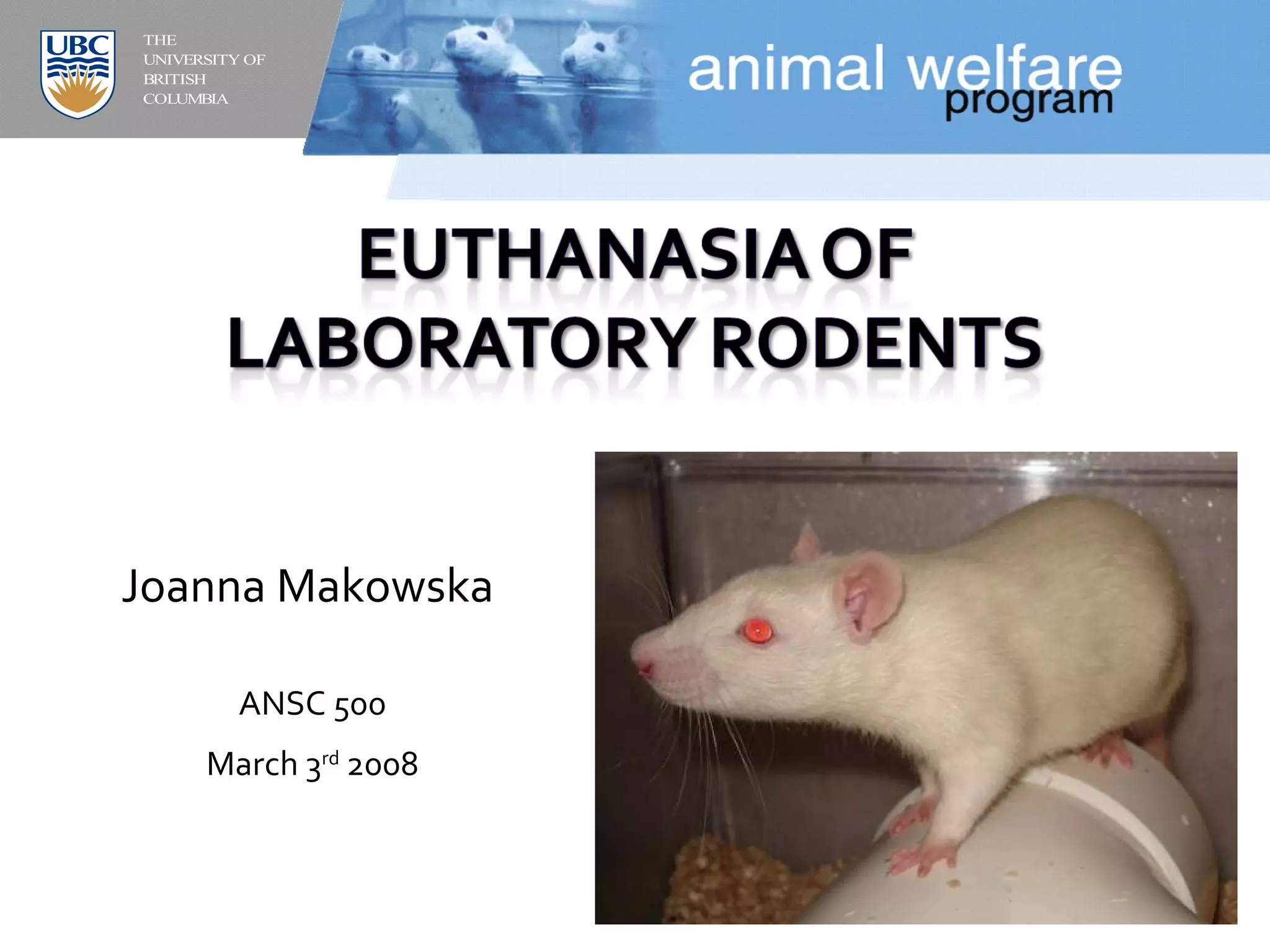
Joanna Makowska UBC Animal Welfare Program ANSC 500 March 3 rd  2008
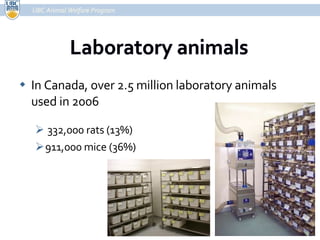
In Canada, over 2.5 million laboratory animals used in 2006 332,000 rats (13%) 911,000 mice (36%) UBC Animal Welfare Program
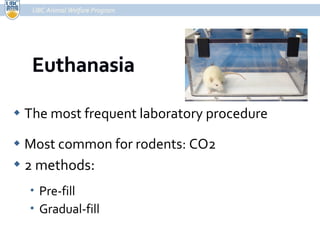
The most frequent laboratory procedure Most common for rodents: CO2 2 methods : Pre-fill Gradual-fill UBC Animal Welfare Program
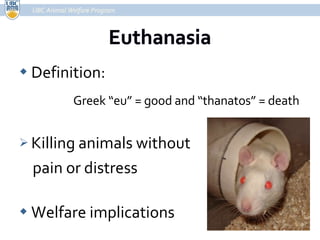
Definition:   Greek “eu” = good and “thanatos” = death Killing animals without  pain or distress Welfare implications UBC Animal Welfare Program
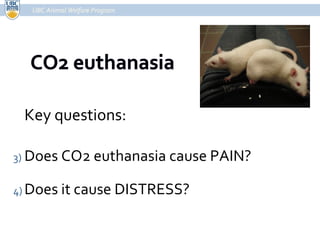
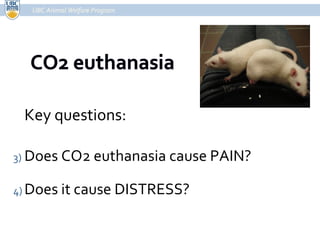
Key questions: Does CO2 euthanasia cause PAIN? Does it cause DISTRESS? UBC Animal Welfare Program
Humans:  pain at > 40% CO2 Rats:  activation of nasal nociceptors at > 40% CO2 CO2 converted to carbonic acid in mucosa Acid causes burning sensation CO 2  + H 2 O     H +  + HCO 3 - UBC Animal Welfare Program
Humans: nasal irritants cause bradycardia (slow heart rate) at >40% Does it occur during CO2 euthanasia? UBC Animal Welfare Program
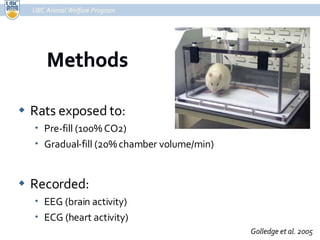
Rats exposed to:  Pre-fill (100% CO2) Gradual-fill (20% chamber volume/min) Recorded:  EEG (brain activity) ECG (heart activity) UBC Animal Welfare Program Golledge et al. 2005
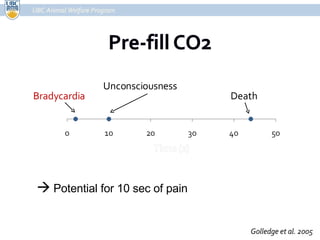
UBC Animal Welfare Program Bradycardia Unconsciousness Death Golledge et al. 2005    Potential for 10 sec of pain
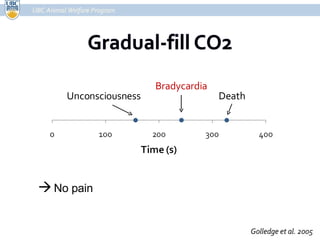
UBC Animal Welfare Program Bradycardia Unconsciousness Death Golledge et al. 2005    No pain
Key questions: Does CO2 euthanasia cause PAIN? Does it cause DISTRESS? UBC Animal Welfare Program
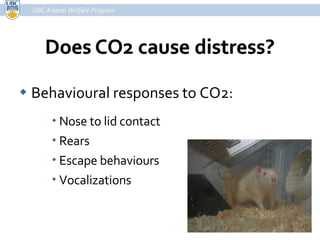
Behavioural responses to CO2: Nose to lid contact Rears Escape behaviours Vocalizations UBC Animal Welfare Program
(Video of a rat’s behavioural response to CO2) UBC Animal Welfare Program Niel & Weary 2006
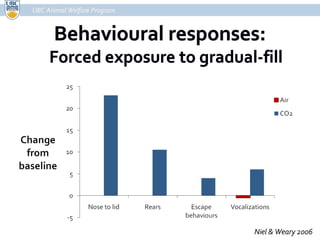
Niel & Weary 2006 UBC Animal Welfare Program
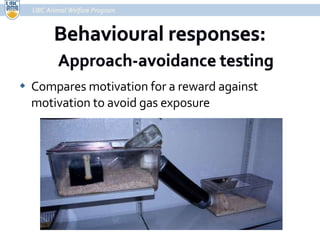
Compares motivation for a reward against motivation to avoid gas exposure UBC Animal Welfare Program
(Video of a rat running the task) UBC Animal Welfare Program
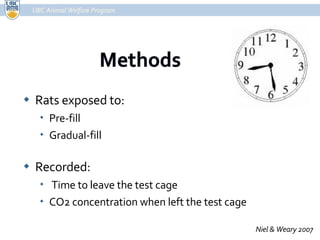
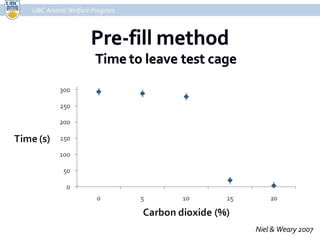
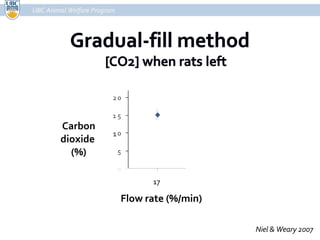
Rats exposed to: Pre-fill Gradual-fill Recorded: Time to leave the test cage  CO2 concentration when left the test cage Niel & Weary 2007 UBC Animal Welfare Program
UBC Animal Welfare Program Niel & Weary 2007
UBC Animal Welfare Program Niel & Weary 2007 17 Carbon dioxide  (%) Flow rate (%/min)
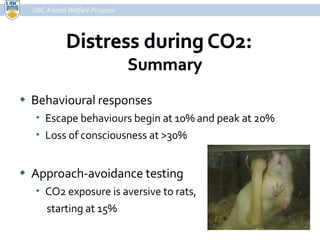
Behavioural responses Escape behaviours begin at 10% and peak at 20% Loss of consciousness at >30% Approach-avoidance testing CO2 exposure is aversive to rats, starting at 15% UBC Animal Welfare Program
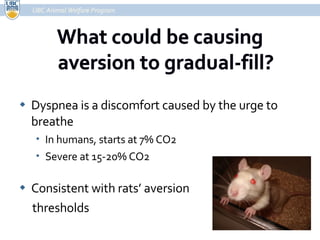
Dyspnea is a discomfort caused by the urge to breathe In humans, starts at 7% CO2 Severe at 15-20% CO2 Consistent with rats’ aversion  thresholds UBC Animal Welfare Program
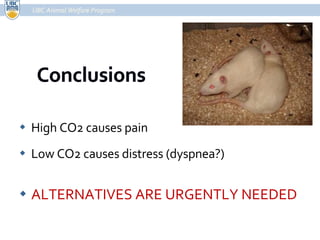
High CO2 causes pain Low CO2 causes distress (dyspnea?) ALTERNATIVES ARE URGENTLY NEEDED UBC Animal Welfare Program UBC Animal Welfare Program
Any questions?

Pain and distress during CO2 euthanasia

  • 1.
    Joanna Makowska UBCAnimal Welfare Program ANSC 500 March 3 rd 2008
  • 2.
    In Canada, over2.5 million laboratory animals used in 2006 332,000 rats (13%) 911,000 mice (36%) UBC Animal Welfare Program
  • 3.
    The most frequentlaboratory procedure Most common for rodents: CO2 2 methods : Pre-fill Gradual-fill UBC Animal Welfare Program
  • 4.
    Definition: Greek “eu” = good and “thanatos” = death Killing animals without pain or distress Welfare implications UBC Animal Welfare Program
  • 5.
    Key questions: DoesCO2 euthanasia cause PAIN? Does it cause DISTRESS? UBC Animal Welfare Program
  • 6.
    Humans: painat > 40% CO2 Rats: activation of nasal nociceptors at > 40% CO2 CO2 converted to carbonic acid in mucosa Acid causes burning sensation CO 2 + H 2 O  H + + HCO 3 - UBC Animal Welfare Program
  • 7.
    Humans: nasal irritantscause bradycardia (slow heart rate) at >40% Does it occur during CO2 euthanasia? UBC Animal Welfare Program
  • 8.
    Rats exposed to: Pre-fill (100% CO2) Gradual-fill (20% chamber volume/min) Recorded: EEG (brain activity) ECG (heart activity) UBC Animal Welfare Program Golledge et al. 2005
  • 9.
    UBC Animal WelfareProgram Bradycardia Unconsciousness Death Golledge et al. 2005  Potential for 10 sec of pain
  • 10.
    UBC Animal WelfareProgram Bradycardia Unconsciousness Death Golledge et al. 2005  No pain
  • 11.
    Key questions: DoesCO2 euthanasia cause PAIN? Does it cause DISTRESS? UBC Animal Welfare Program
  • 12.
    Behavioural responses toCO2: Nose to lid contact Rears Escape behaviours Vocalizations UBC Animal Welfare Program
  • 13.
    (Video of arat’s behavioural response to CO2) UBC Animal Welfare Program Niel & Weary 2006
  • 14.
    Niel & Weary2006 UBC Animal Welfare Program
  • 15.
    Compares motivation fora reward against motivation to avoid gas exposure UBC Animal Welfare Program
  • 16.
    (Video of arat running the task) UBC Animal Welfare Program
  • 17.
    Rats exposed to:Pre-fill Gradual-fill Recorded: Time to leave the test cage CO2 concentration when left the test cage Niel & Weary 2007 UBC Animal Welfare Program
  • 18.
    UBC Animal WelfareProgram Niel & Weary 2007
  • 19.
    UBC Animal WelfareProgram Niel & Weary 2007 17 Carbon dioxide (%) Flow rate (%/min)
  • 20.
    Behavioural responses Escapebehaviours begin at 10% and peak at 20% Loss of consciousness at >30% Approach-avoidance testing CO2 exposure is aversive to rats, starting at 15% UBC Animal Welfare Program
  • 21.
    Dyspnea is adiscomfort caused by the urge to breathe In humans, starts at 7% CO2 Severe at 15-20% CO2 Consistent with rats’ aversion thresholds UBC Animal Welfare Program
  • 22.
    High CO2 causespain Low CO2 causes distress (dyspnea?) ALTERNATIVES ARE URGENTLY NEEDED UBC Animal Welfare Program UBC Animal Welfare Program
  • 23.