Bio Medical Waste Management
Rules 2016 &
(Amendment) Rules, 2018
State Quality Assurance Medical Officer
State Quality Improvement Unit
Commissionerate of Health
Gandhinagar
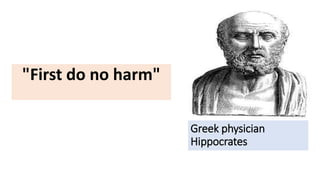
Greek physician
Hippocrates
"First do no harm"
Definition of Biomedical Waste
Biomedical waste has been defined as “any waste, which is generated during
the diagnosis, treatment or immunization of human beings or animals or in
research activities pertaining thereto or in the production or testing of
biological or in health camps, including the categories mentioned in
ScheduleI appendedtotheseRules”as perBiomedicalWasteRules2016.
Why BMW Management is Important ?
• 80% non infectious (kitchen waste, paper)
• 15% is infectious (dressings, anatomical wastes, blood bags)
• 5% is non infectious but hazardous,(chemicals, drugs and
mercury)
• When this 20% of the hospital infectious material is mixed
with 80% Then all the 100% waste becomes hazardous and
infectious, hence segregation should be at source.
Biomedical waste rules 2016
• Gazetted on 28th March 2016
• Replaces Biomedical Waste (Management & handling) Rules 1998
• Major Changes –
Scope – also includes Ayush Health Facilities, Vaccination Camps, medical or
surgical camp, First-Aid Rooms of Schools, Forensic Labs, etc.
SALIENT FEATURES
• The ambit of the rules has been expanded to include vaccination camps, blood
donation camps, surgical camps or any other healthcare activity
• Phase-out the use of chlorinated plastic bags, gloves and blood bags within two years
• Pre-treatment of the laboratory waste, microbiological waste, blood samples and
blood bags through disinfection or sterilization on-site in the manner as prescribed
by WHO or NACO
• Provide training to all its health care workers and immunize all health workers
regularly (Hepatitis B and TT)
SALIENT FEATURES
• Establish a Bar-Code System for bags or containers containing bio-medical
waste for disposal
• Report major accidents
• Bio-medical waste has been classified in to 4 categories instead 10 to improve
the segregation of waste at source
• Procedure to get authorization simplified. Automatic authorization for
bedded hospitals. The validity of authorization synchronized with validity of
consent orders for Bedded HCFs. One time Authorization for Non-bedded
HCFs
• Dispose off the waste with in 48 hrs.
• No healthcare facility shall setup onsite BMW treatment facilities if a
CBMWTF exists within 75 kms of distance, to setup if no such facility.
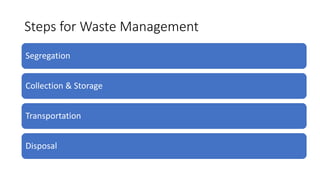
Steps for Waste Management
Segregation
Collection & Storage
Transportation
Disposal
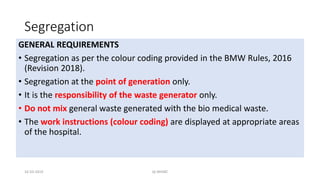
Segregation
GENERAL REQUIREMENTS
• Segregation as per the colour coding provided in the BMW Rules, 2016
(Revision 2018).
• Segregation at the point of generation only.
• It is the responsibility of the waste generator only.
• Do not mix general waste generated with the bio medical waste.
• The work instructions (colour coding) are displayed at appropriate areas
of the hospital.
16-03-2019 QI-NHSRC
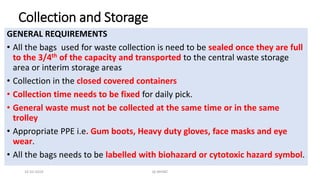
Collection and Storage
GENERAL REQUIREMENTS
• All the bags used for waste collection is need to be sealed once they are full
to the 3/4th of the capacity and transported to the central waste storage
area or interim storage areas
• Collection in the closed covered containers
• Collection time needs to be fixed for daily pick.
• General waste must not be collected at the same time or in the same
trolley
• Appropriate PPE i.e. Gum boots, Heavy duty gloves, face masks and eye
wear.
• All the bags needs to be labelled with biohazard or cytotoxic hazard symbol.
16-03-2019 QI-NHSRC
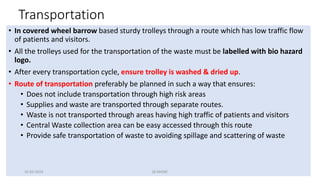
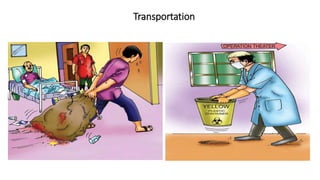
Transportation
• In covered wheel barrow based sturdy trolleys through a route which has low traffic flow
of patients and visitors.
• All the trolleys used for the transportation of the waste must be labelled with bio hazard
logo.
• After every transportation cycle, ensure trolley is washed & dried up.
• Route of transportation preferably be planned in such a way that ensures:
• Does not include transportation through high risk areas
• Supplies and waste are transported through separate routes.
• Waste is not transported through areas having high traffic of patients and visitors
• Central Waste collection area can be easy accessed through this route
• Provide safe transportation of waste to avoiding spillage and scattering of waste
16-03-2019 QI-NHSRC
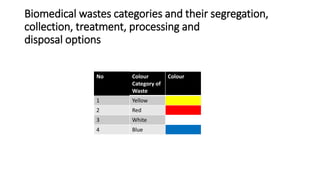
Biomedical wastes categories and their segregation,
collection, treatment, processing and
disposal options
No Colour
Category of
Waste
Colour
1 Yellow
2 Red
3 White
4 Blue
16-03-2019 QI-NHSRC
S. No.
Category Type of waste Colour & Type of Container
1. Yellow
Category
 Human Anatomical
Waste
 Soiled Waste
 Discarded or Expired
Medicine
 Chemical Liquid
Waste
 Chemical Laboratory
Waste
Yellow colour Non Chlorinated Plastic Bags or
containers
2. Red Category Contaminated Waste
(Recyclable)
Red Colour Non Chlorinated Plastic Bags and
Containers
3. White Category Waste Sharps including
metals
White Colour puncture proof, leak proof,
Temper Proof containers
4. Blue Category  Glassware
 Metallic Body
Implants
Cardboard boxes with blue colour marking or
blue colour puncture proof, temper proof
containers
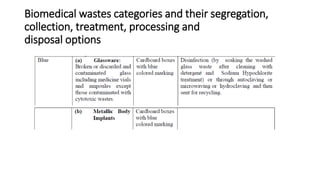
Biomedical wastes categories and their segregation,
collection, treatment, processing and
disposal options
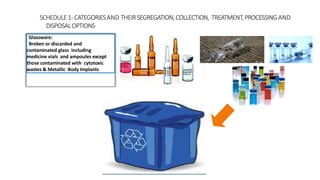
SCHEDULE1-CATEGORIESAND THEIRSEGREGATION,COLLECTION, TREATMENT,PROCESSINGAND
DISPOSALOPTIONS
Glassware:
Broken or discarded and
contaminated glass including
medicine vials and ampoules except
those contaminated with cytotoxic
wastes & Metallic Body Implants
Biomedical wastes categories and their segregation,
collection, treatment, processing and
disposal options
SHARP CONTAINERS
Puncture proof, Tamper proof, Leak proof containers!!
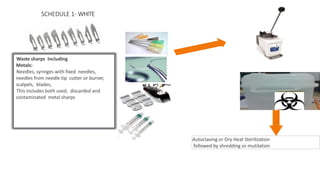
SCHEDULE 1- WHITE
Waste sharps Including
Metals:
Needles, syringes with fixed needles,
needles from needle tip cutter or burner,
scalpels, blades,
This includes both used, discarded and
contaminated metal sharps
Autoclaving or Dry Heat Sterilization
followed by shredding or mutilation
Biomedical wastes categories and their segregation,
collection, treatment, processing and
disposal options
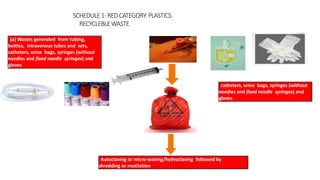
SCHEDULE1-REDCATEGORY:PLASTICS
RECYCLEBLEWASTE
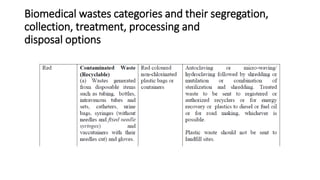
(a) Wastes generated from tubing,
bottles, intravenous tubes and sets,
catheters, urine bags, syringes (without
needles and fixed needle syringes) and
gloves
Red coloured non-
chlorinated plastic
bags or containers
Autoclaving or micro-waving/hydroclaving followed by
shredding or mutilation
catheters, urine bags, syringes (without
needles and fixed needle syringes) and
gloves
Biomedical wastes categories and their segregation,
collection, treatment, processing and
disposal options
Biomedical wastes categories and their segregation,
collection, treatment, processing and
disposal options
Biomedical wastes categories and their segregation,
collection, treatment, processing and
disposal options
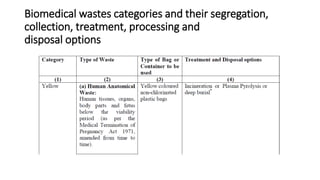
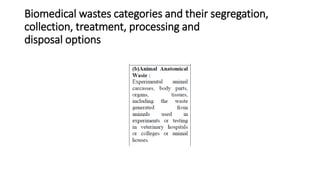
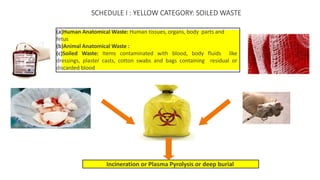
SCHEDULE I : YELLOW CATEGORY: SOILED WASTE
(a)Human Anatomical Waste: Human tissues, organs, body parts and
fetus
(b)Animal Anatomical Waste :
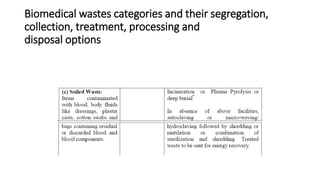
(c)Soiled Waste: Items contaminated with blood, body fluids like
dressings, plaster casts, cotton swabs and bags containing residual or
discarded blood
Incineration or Plasma Pyrolysis or deep burial
Biomedical wastes categories and their segregation,
collection, treatment, processing and
disposal options
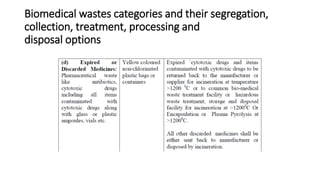
DRUGS
(d) Expired or Discarded
Medicines including antibiotics
Common bio-medical waste treatment
facility: Incineration
(d) CYTOTOXIC DRUGS: including all
items contaminated with cytotoxic drugs
along
with glass or plastic ampoules,
vials etc.
Biomedical wastes categories and their segregation,
collection, treatment, processing and
disposal options
Biomedical wastes categories and their segregation,
collection, treatment, processing and
disposal options
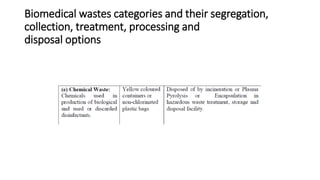
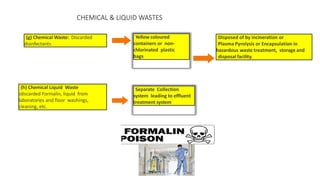
CHEMICAL & LIQUID WASTES
(g) Chemical Waste: Discarded
disinfectants
Yellow coloured
containers or non-
chlorinated plastic
bags
Disposed of by incineration or
Plasma Pyrolysis or Encapsulation in
hazardous waste treatment, storage and
disposal facility.
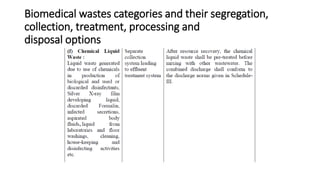
(h) Chemical Liquid Waste
:discarded Formalin, liquid from
laboratories and floor washings,
cleaning, etc.
Separate Collection
system leading to effluent
treatment system
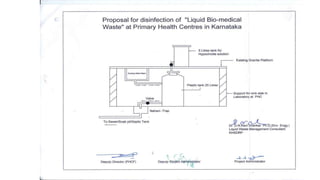
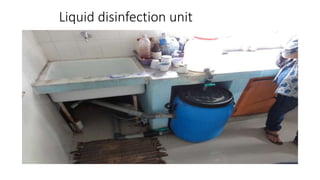
Liquid disinfection unit
Biomedical wastes categories and their segregation,
collection, treatment, processing and
disposal options
Biomedical wastes categories and their segregation,
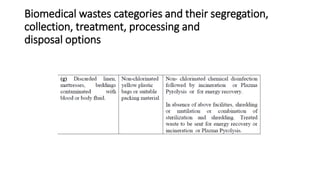
collection, treatment, processing and
disposal options
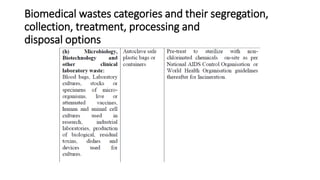
Microbiology, Biotechnology and other
clinical laboratory waste: Laboratory
cultures, stocks or specimens of
microorganisms
Pre-treat to sterilize with
nonchlorinated chemicals on-site as
per NACO or World Health
Organization
LINEN: linen, mattresses,
contaminated with blood or body
fluid.
LABORATORY WASTES & LINEN
MONITORING OF IMPLEMENTATION OF THE RULES: ANNUAL REPORT
Every occupier shall submit an annual report to the prescribed authority by 30th of June every year
The prescribed authority shall compile, review, analyze and report to the CPCB by 31st July every year
The CPCB shall submit a report on the same to the MoEFCC by 31st August every year
The Annual reports shall be available on the websites of the occupier, SPCB and the CPCB
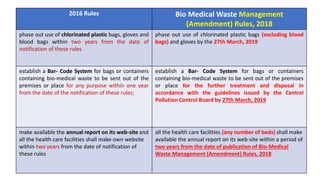
2016 Rules Bio Medical Waste Management
(Amendment) Rules, 2018
phase out use of chlorinated plastic bags, gloves and
blood bags within two years from the date of
notification of these rules
phase out use of chlorinated plastic bags (excluding blood
bags) and gloves by the 27th March, 2019
establish a Bar- Code System for bags or containers
containing bio-medical waste to be sent out of the
premises or place for any purpose within one year
from the date of the notification of these rules;
establish a Bar- Code System for bags or containers
containing bio-medical waste to be sent out of the premises
or place for the further treatment and disposal in
accordance with the guidelines issued by the Central
Pollution Control Board by 27th March, 2019
make available the annual report on its web-site and
all the health care facilities shall make own website
within two years from the date of notification of
these rules
all the health care facilities (any number of beds) shall make
available the annual report on its web-site within a period of
two years from the date of publication of Bio-Medical
Waste Management (Amendment) Rules, 2018
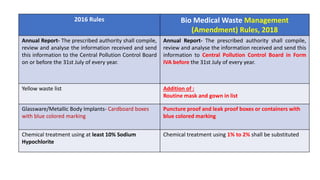
2016 Rules Bio Medical Waste Management
(Amendment) Rules, 2018
Annual Report- The prescribed authority shall compile,
review and analyse the information received and send
this information to the Central Pollution Control Board
on or before the 31st July of every year.
Annual Report- The prescribed authority shall compile,
review and analyse the information received and send this
information to Central Pollution Control Board in Form
IVA before the 31st July of every year.
Yellow waste list Addition of :
Routine mask and gown in list
Glassware/Metallic Body Implants- Cardboard boxes
with blue colored marking
Puncture proof and leak proof boxes or containers with
blue colored marking
Chemical treatment using at least 10% Sodium
Hypochlorite
Chemical treatment using 1% to 2% shall be substituted
Transportation
Waste handler with PPE
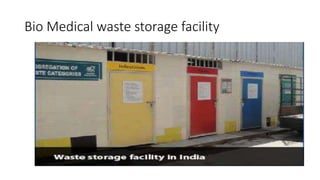
Bio Medical waste storage facility
Bmw mgmt rules 2016 with amend 2018

Bmw mgmt rules 2016 with amend 2018

  • 1.
    Bio Medical WasteManagement Rules 2016 & (Amendment) Rules, 2018 State Quality Assurance Medical Officer State Quality Improvement Unit Commissionerate of Health Gandhinagar
  • 2.
  • 3.
    Definition of BiomedicalWaste Biomedical waste has been defined as “any waste, which is generated during the diagnosis, treatment or immunization of human beings or animals or in research activities pertaining thereto or in the production or testing of biological or in health camps, including the categories mentioned in ScheduleI appendedtotheseRules”as perBiomedicalWasteRules2016.
  • 4.
    Why BMW Managementis Important ? • 80% non infectious (kitchen waste, paper) • 15% is infectious (dressings, anatomical wastes, blood bags) • 5% is non infectious but hazardous,(chemicals, drugs and mercury) • When this 20% of the hospital infectious material is mixed with 80% Then all the 100% waste becomes hazardous and infectious, hence segregation should be at source.
  • 5.
    Biomedical waste rules2016 • Gazetted on 28th March 2016 • Replaces Biomedical Waste (Management & handling) Rules 1998 • Major Changes – Scope – also includes Ayush Health Facilities, Vaccination Camps, medical or surgical camp, First-Aid Rooms of Schools, Forensic Labs, etc.
  • 6.
    SALIENT FEATURES • Theambit of the rules has been expanded to include vaccination camps, blood donation camps, surgical camps or any other healthcare activity • Phase-out the use of chlorinated plastic bags, gloves and blood bags within two years • Pre-treatment of the laboratory waste, microbiological waste, blood samples and blood bags through disinfection or sterilization on-site in the manner as prescribed by WHO or NACO • Provide training to all its health care workers and immunize all health workers regularly (Hepatitis B and TT)
  • 7.
    SALIENT FEATURES • Establisha Bar-Code System for bags or containers containing bio-medical waste for disposal • Report major accidents • Bio-medical waste has been classified in to 4 categories instead 10 to improve the segregation of waste at source • Procedure to get authorization simplified. Automatic authorization for bedded hospitals. The validity of authorization synchronized with validity of consent orders for Bedded HCFs. One time Authorization for Non-bedded HCFs • Dispose off the waste with in 48 hrs. • No healthcare facility shall setup onsite BMW treatment facilities if a CBMWTF exists within 75 kms of distance, to setup if no such facility.
  • 8.
    Steps for WasteManagement Segregation Collection & Storage Transportation Disposal
  • 9.
    Segregation GENERAL REQUIREMENTS • Segregationas per the colour coding provided in the BMW Rules, 2016 (Revision 2018). • Segregation at the point of generation only. • It is the responsibility of the waste generator only. • Do not mix general waste generated with the bio medical waste. • The work instructions (colour coding) are displayed at appropriate areas of the hospital. 16-03-2019 QI-NHSRC
  • 10.
    Collection and Storage GENERALREQUIREMENTS • All the bags used for waste collection is need to be sealed once they are full to the 3/4th of the capacity and transported to the central waste storage area or interim storage areas • Collection in the closed covered containers • Collection time needs to be fixed for daily pick. • General waste must not be collected at the same time or in the same trolley • Appropriate PPE i.e. Gum boots, Heavy duty gloves, face masks and eye wear. • All the bags needs to be labelled with biohazard or cytotoxic hazard symbol. 16-03-2019 QI-NHSRC
  • 12.
    Transportation • In coveredwheel barrow based sturdy trolleys through a route which has low traffic flow of patients and visitors. • All the trolleys used for the transportation of the waste must be labelled with bio hazard logo. • After every transportation cycle, ensure trolley is washed & dried up. • Route of transportation preferably be planned in such a way that ensures: • Does not include transportation through high risk areas • Supplies and waste are transported through separate routes. • Waste is not transported through areas having high traffic of patients and visitors • Central Waste collection area can be easy accessed through this route • Provide safe transportation of waste to avoiding spillage and scattering of waste 16-03-2019 QI-NHSRC
  • 13.
    Biomedical wastes categoriesand their segregation, collection, treatment, processing and disposal options No Colour Category of Waste Colour 1 Yellow 2 Red 3 White 4 Blue
  • 14.
    16-03-2019 QI-NHSRC S. No. CategoryType of waste Colour & Type of Container 1. Yellow Category  Human Anatomical Waste  Soiled Waste  Discarded or Expired Medicine  Chemical Liquid Waste  Chemical Laboratory Waste Yellow colour Non Chlorinated Plastic Bags or containers 2. Red Category Contaminated Waste (Recyclable) Red Colour Non Chlorinated Plastic Bags and Containers 3. White Category Waste Sharps including metals White Colour puncture proof, leak proof, Temper Proof containers 4. Blue Category  Glassware  Metallic Body Implants Cardboard boxes with blue colour marking or blue colour puncture proof, temper proof containers
  • 15.
    Biomedical wastes categoriesand their segregation, collection, treatment, processing and disposal options
  • 16.
    SCHEDULE1-CATEGORIESAND THEIRSEGREGATION,COLLECTION, TREATMENT,PROCESSINGAND DISPOSALOPTIONS Glassware: Brokenor discarded and contaminated glass including medicine vials and ampoules except those contaminated with cytotoxic wastes & Metallic Body Implants
  • 17.
    Biomedical wastes categoriesand their segregation, collection, treatment, processing and disposal options
  • 18.
    SHARP CONTAINERS Puncture proof,Tamper proof, Leak proof containers!!
  • 19.
    SCHEDULE 1- WHITE Wastesharps Including Metals: Needles, syringes with fixed needles, needles from needle tip cutter or burner, scalpels, blades, This includes both used, discarded and contaminated metal sharps Autoclaving or Dry Heat Sterilization followed by shredding or mutilation
  • 20.
    Biomedical wastes categoriesand their segregation, collection, treatment, processing and disposal options
  • 21.
    SCHEDULE1-REDCATEGORY:PLASTICS RECYCLEBLEWASTE (a) Wastes generatedfrom tubing, bottles, intravenous tubes and sets, catheters, urine bags, syringes (without needles and fixed needle syringes) and gloves Red coloured non- chlorinated plastic bags or containers Autoclaving or micro-waving/hydroclaving followed by shredding or mutilation catheters, urine bags, syringes (without needles and fixed needle syringes) and gloves
  • 22.
    Biomedical wastes categoriesand their segregation, collection, treatment, processing and disposal options
  • 23.
    Biomedical wastes categoriesand their segregation, collection, treatment, processing and disposal options
  • 24.
    Biomedical wastes categoriesand their segregation, collection, treatment, processing and disposal options
  • 25.
    SCHEDULE I :YELLOW CATEGORY: SOILED WASTE (a)Human Anatomical Waste: Human tissues, organs, body parts and fetus (b)Animal Anatomical Waste : (c)Soiled Waste: Items contaminated with blood, body fluids like dressings, plaster casts, cotton swabs and bags containing residual or discarded blood Incineration or Plasma Pyrolysis or deep burial
  • 26.
    Biomedical wastes categoriesand their segregation, collection, treatment, processing and disposal options
  • 27.
    DRUGS (d) Expired orDiscarded Medicines including antibiotics Common bio-medical waste treatment facility: Incineration (d) CYTOTOXIC DRUGS: including all items contaminated with cytotoxic drugs along with glass or plastic ampoules, vials etc.
  • 28.
    Biomedical wastes categoriesand their segregation, collection, treatment, processing and disposal options
  • 29.
    Biomedical wastes categoriesand their segregation, collection, treatment, processing and disposal options
  • 30.
    CHEMICAL & LIQUIDWASTES (g) Chemical Waste: Discarded disinfectants Yellow coloured containers or non- chlorinated plastic bags Disposed of by incineration or Plasma Pyrolysis or Encapsulation in hazardous waste treatment, storage and disposal facility. (h) Chemical Liquid Waste :discarded Formalin, liquid from laboratories and floor washings, cleaning, etc. Separate Collection system leading to effluent treatment system
  • 32.
  • 33.
    Biomedical wastes categoriesand their segregation, collection, treatment, processing and disposal options
  • 34.
    Biomedical wastes categoriesand their segregation, collection, treatment, processing and disposal options
  • 35.
    Microbiology, Biotechnology andother clinical laboratory waste: Laboratory cultures, stocks or specimens of microorganisms Pre-treat to sterilize with nonchlorinated chemicals on-site as per NACO or World Health Organization LINEN: linen, mattresses, contaminated with blood or body fluid. LABORATORY WASTES & LINEN
  • 36.
    MONITORING OF IMPLEMENTATIONOF THE RULES: ANNUAL REPORT Every occupier shall submit an annual report to the prescribed authority by 30th of June every year The prescribed authority shall compile, review, analyze and report to the CPCB by 31st July every year The CPCB shall submit a report on the same to the MoEFCC by 31st August every year The Annual reports shall be available on the websites of the occupier, SPCB and the CPCB
  • 37.
    2016 Rules BioMedical Waste Management (Amendment) Rules, 2018 phase out use of chlorinated plastic bags, gloves and blood bags within two years from the date of notification of these rules phase out use of chlorinated plastic bags (excluding blood bags) and gloves by the 27th March, 2019 establish a Bar- Code System for bags or containers containing bio-medical waste to be sent out of the premises or place for any purpose within one year from the date of the notification of these rules; establish a Bar- Code System for bags or containers containing bio-medical waste to be sent out of the premises or place for the further treatment and disposal in accordance with the guidelines issued by the Central Pollution Control Board by 27th March, 2019 make available the annual report on its web-site and all the health care facilities shall make own website within two years from the date of notification of these rules all the health care facilities (any number of beds) shall make available the annual report on its web-site within a period of two years from the date of publication of Bio-Medical Waste Management (Amendment) Rules, 2018
  • 38.
    2016 Rules BioMedical Waste Management (Amendment) Rules, 2018 Annual Report- The prescribed authority shall compile, review and analyse the information received and send this information to the Central Pollution Control Board on or before the 31st July of every year. Annual Report- The prescribed authority shall compile, review and analyse the information received and send this information to Central Pollution Control Board in Form IVA before the 31st July of every year. Yellow waste list Addition of : Routine mask and gown in list Glassware/Metallic Body Implants- Cardboard boxes with blue colored marking Puncture proof and leak proof boxes or containers with blue colored marking Chemical treatment using at least 10% Sodium Hypochlorite Chemical treatment using 1% to 2% shall be substituted
  • 39.
  • 40.
  • 41.
    Bio Medical wastestorage facility

Editor's Notes

  • #6 Advisory committee state with Health Secretary chairperson oversee the implementation of rules. & other person like health department, urban develipment environment IMA, urban local bodies, UC r member