BIOMEDICAL WASTE MANAGEMENT
Dr. Hemali Parmar
MBBS, MD (Microbiology)
Tutor Microbiology
Baroda Medical College, Gujarat
OBJECTIVES
 Classification of bio medical waste (various
waste categories)
 Segregation of waste (colour coding system
for waste disposal)
 Pre treatment & decontamination
 Final disposal
 General safety practices to be used in the
laboratory (standard work precautions)
 Importance of hand washing
 Spill management
2
INTRODUCTION OF WASTE MANAGEMENT
 Hospital waste is a potential reservoir of
pathogenic micro-organisms.
 Decontamination of waste and their ultimate
disposal are closely interrelated.
 Laboratory wastes are of different category.
3
CLASSIFICATION OF WASTE
 To streamline over all handling of hospital waste, it has
been classified into several categories.
 Each laboratory should have a working estimate of non-
hazardous and hazardous waste produced there on day-
to-day basis.
 The waste segregation with an ultimate aim of safe
handling and disposal has been classified into various
categories.
 They have been given colour coding for collection i.e. in a
specified container only a specified type of waste should
be collected.
 Segregation at the point of generation of waste must be in
accordance with this colour coding. Categories waste
segregation and collection is a mandatory legal
requirement.
4
CONT…
 The table in next slides comes as product of
schedule I of Rule 4 and 7 of Bio-medical
waste (Management and handling) Rules
2011.
5
CONT…
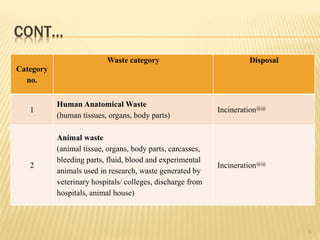
Category
no.
Waste category Disposal
1
Human Anatomical Waste
(human tissues, organs, body parts)
Incineration@@
2
Animal waste
(animal tissue, organs, body parts, carcasses,
bleeding parts, fluid, blood and experimental
animals used in research, waste generated by
veterinary hospitals/ colleges, discharge from
hospitals, animal house)
Incineration@@
6
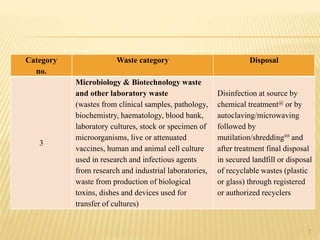
Category
no.
Waste category Disposal
3
Microbiology & Biotechnology waste
and other laboratory waste
(wastes from clinical samples, pathology,
biochemistry, haematology, blood bank,
laboratory cultures, stock or specimen of
microorganisms, live or attenuated
vaccines, human and animal cell culture
used in research and infectious agents
from research and industrial laboratories,
waste from production of biological
toxins, dishes and devices used for
transfer of cultures)
Disinfection at source by
chemical treatment@ or by
autoclaving/microwaving
followed by
mutilation/shredding## and
after treatment final disposal
in secured landfill or disposal
of recyclable wastes (plastic
or glass) through registered
or authorized recyclers
7
CONT…
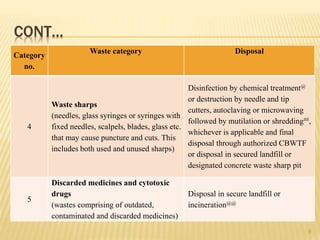
Category
no.
Waste category Disposal
4
Waste sharps
(needles, glass syringes or syringes with
fixed needles, scalpels, blades, glass etc.
that may cause puncture and cuts. This
includes both used and unused sharps)
Disinfection by chemical treatment@
or destruction by needle and tip
cutters, autoclaving or microwaving
followed by mutilation or shredding##,
whichever is applicable and final
disposal through authorized CBWTF
or disposal in secured landfill or
designated concrete waste sharp pit
5
Discarded medicines and cytotoxic
drugs
(wastes comprising of outdated,
contaminated and discarded medicines)
Disposal in secure landfill or
incineration@@
8
CONT…
Category
no.
Waste category Disposal
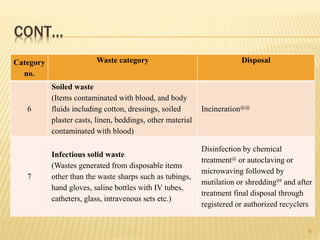
6
Soiled waste
(Items contaminated with blood, and body
fluids including cotton, dressings, soiled
plaster casts, linen, beddings, other material
contaminated with blood)
Incineration@@
7
Infectious solid waste
(Wastes generated from disposable items
other than the waste sharps such as tubings,
hand gloves, saline bottles with IV tubes,
catheters, glass, intravenous sets etc.)
Disinfection by chemical
treatment@ or autoclaving or
microwaving followed by
mutilation or shredding## and after
treatment final disposal through
registered or authorized recyclers
9
CONT…
Category
no.
Waste category Disposal
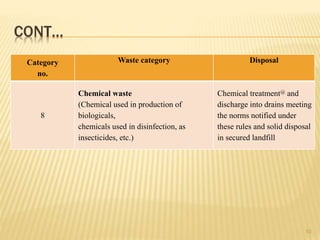
8
Chemical waste
(Chemical used in production of
biologicals,
chemicals used in disinfection, as
insecticides, etc.)
Chemical treatment@ and
discharge into drains meeting
the norms notified under
these rules and solid disposal
in secured landfill
10
CONT…
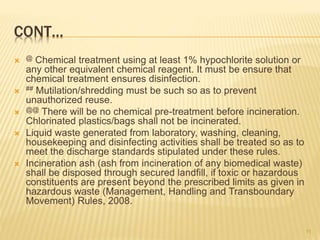
 @ Chemical treatment using at least 1% hypochlorite solution or
any other equivalent chemical reagent. It must be ensure that
chemical treatment ensures disinfection.
 ## Mutilation/shredding must be such so as to prevent
unauthorized reuse.
 @@ There will be no chemical pre-treatment before incineration.
Chlorinated plastics/bags shall not be incinerated.
 Liquid waste generated from laboratory, washing, cleaning,
housekeeping and disinfecting activities shall be treated so as to
meet the discharge standards stipulated under these rules.
 Incineration ash (ash from incineration of any biomedical waste)
shall be disposed through secured landfill, if toxic or hazardous
constituents are present beyond the prescribed limits as given in
hazardous waste (Management, Handling and Transboundary
Movement) Rules, 2008.
11
SEGREGATION OF WASTE
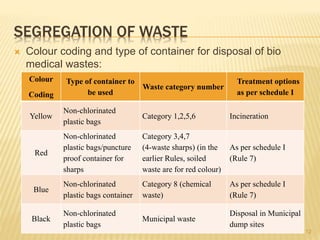
 Colour coding and type of container for disposal of bio
medical wastes:
Colour
Coding
Type of container to
be used
Waste category number
Treatment options
as per schedule I
Yellow
Non-chlorinated
plastic bags
Category 1,2,5,6 Incineration
Red
Non-chlorinated
plastic bags/puncture
proof container for
sharps
Category 3,4,7
(4-waste sharps) (in the
earlier Rules, soiled
waste are for red colour)
As per schedule I
(Rule 7)
Blue
Non-chlorinated
plastic bags container
Category 8 (chemical
waste)
As per schedule I
(Rule 7)
Black
Non-chlorinated
plastic bags
Municipal waste
Disposal in Municipal
dump sites
12
CONT…
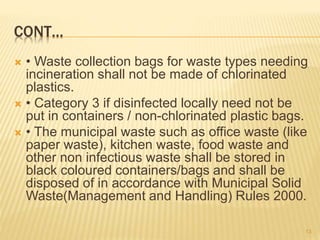
 • Waste collection bags for waste types needing
incineration shall not be made of chlorinated
plastics.
 • Category 3 if disinfected locally need not be
put in containers / non-chlorinated plastic bags.
 • The municipal waste such as office waste (like
paper waste), kitchen waste, food waste and
other non infectious waste shall be stored in
black coloured containers/bags and shall be
disposed of in accordance with Municipal Solid
Waste(Management and Handling) Rules 2000.
13
GENERAL GUIDELINES
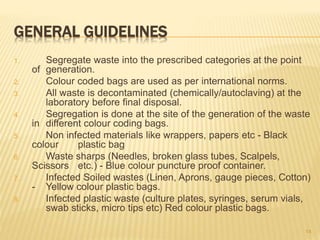
1. Segregate waste into the prescribed categories at the point
of generation.
2. Colour coded bags are used as per international norms.
3. All waste is decontaminated (chemically/autoclaving) at the
laboratory before final disposal.
4. Segregation is done at the site of the generation of the waste
in different colour coding bags.
5. Non infected materials like wrappers, papers etc - Black
colour plastic bag
6. Waste sharps (Needles, broken glass tubes, Scalpels,
Scissors etc.) - Blue colour puncture proof container.
7. Infected Soiled wastes (Linen, Aprons, gauge pieces, Cotton)
- Yellow colour plastic bags.
8. Infected plastic waste (culture plates, syringes, serum vials,
swab sticks, micro tips etc) Red colour plastic bags.
14
EXERCISE:-
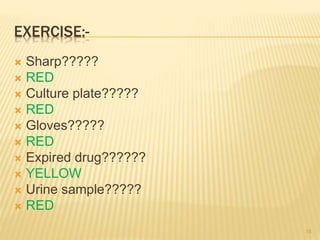
 Sharp?????
 RED
 Culture plate?????
 RED
 Gloves?????
 RED
 Expired drug??????
 YELLOW
 Urine sample?????
 RED
15
EXERCISE
16
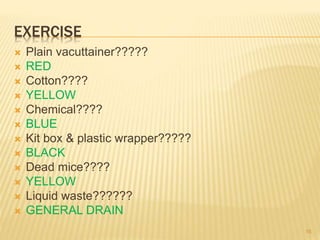
 Plain vacuttainer?????
 RED
 Cotton????
 YELLOW
 Chemical????
 BLUE
 Kit box & plastic wrapper?????
 BLACK
 Dead mice????
 YELLOW
 Liquid waste??????
 GENERAL DRAIN
PRE-TREATMENT & DECONTAMINATION
 Each blood sample is handled carefully and discarded after
serum separation by in discarding container of 1% hypochlorite.
 Used micro tips are discarded in containers of freshly prepared 1
% hypochlorite lying on working benches.
 They are autoclaved and disposed in Red bags in hospital waste.
 Remains of kits reagents are discarded by autoclaving and
disposed in Red bags in hospital waste.
 All the cotton swabs used as tops are discarded in yellow bags
and sent for disposal in hospital waste.
 All the used gloves are cut and discarded in discarding container
of 1 % Na. hypochlorite. They are autoclaved and discarded in
red bag.
 After the end of each days work, discarding container is
autoclaved (121°C x ½ hours).
17
DECONTAMINATION AND DISPOSAL OF SHARPS
 After use, needles and syringes should be locally
destroyed/ cut by a needle destroyer and these should be
collected in a rigid container preferably immersed in1%
freshly prepared sodium hypochlorite solution till disposal.
 Locate sharps disposal containers close to the point of
use e.g. in patient room, on the medicine trolley and in the
treatment room etc.
 Dispose used sharps in a puncture resistant container
into the blue bag.
 Prevent overflow by sending sharps disposal containers
for autoclaving and shredding when they are three
quarters full.
18
FINAL DISPOSAL
 The black bags and waste therein is
dispensed along with other municipal waste.
 The bio-medical waste is collected and
disposed off.
 All the waste generated in the department is
sent to common waste collection site after
decontamination.
19
POLICY FOR SAFETY IN THE LABORATORY
 Employees themselves for their own
protection are responsible for adhering to all
biosafety guidelines and regulations set out
by the laboratory management as well as
demonstrate competency in laboratory safety
techniques
20
STANDARD WORK PRECAUTIONS
 Standard work precautions refer to the precautions
consistently used on the presumption that all blood
and body fluids are potentially infectious for blood
borne pathogens.
 Similarly, all instruments and other equipment that
come in contact with blood are assumed to be
potentially infectious and must be properly handled,
cleaned, sterilized/ disinfected or safely disposed off.
21
STANDARD WORK PRECAUTIONS
 Hand washing with soap & water
 Barrier protection. For example effective use of
gloves, gowns, masks, goggles, foot cover, etc.
 Safe handling of sharp items and prevention of
accidents with sharps
 Safe handling of specimens (blood etc.) during
collection, processing and transport
 Safe handling of spills of blood
 Safe waste disposal
 Immunization with hepatitis B vaccine
22
CONT…
 Take protective measures
 Ensure proper use of gloves
 Dispose infectious waste in appropriate
container
 Gowns should be closed in front (neck to knees)
and with cuffed sleeves
 Hand washing before & after work
23
CONT…
 Do not touch eyes, nose, mouth or any
uncovered body parts, telephone receiver, door
handles, tap with gloved hands
 Do not interchange equipment between
laboratories
 Do not open laboratory doors with gloved hands
 Do not wear open shoes
 Do not eat or drink in laboratory
 Do not smoke in laboratory
24
HAND WASHING
 Hand washing is the best defense against all
pathogens
 Wash hands after handling all materials
known or suspected to be contaminated
 Good hand washing = 15 seconds with
running water, soap, and friction
25
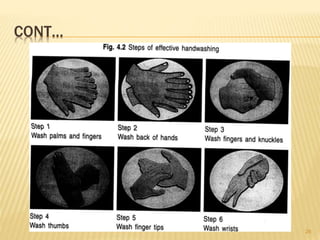
CONT…
26
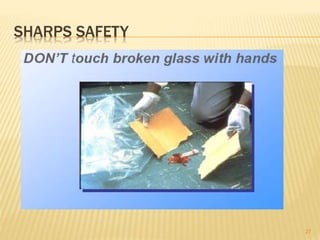
SHARPS SAFETY
27
SPLASHES TO THE EYE
 Flush the eye for 5 minutes with normal
saline (for microorganisms)
 Flush at least for 15 minutes (for chemicals)
28
COMMONLY USED DISINFECTANTS IN THE
LABORATORY
 Ethyl alcohol (70%)
 Gluteraldehyde (2%)
 Sodium hypochlorite solution (1%, 4%)
 Povidone iodine (pvi) 10%
29
MANAGEMENT OF SPILLS
• Put absorbent material down on spillage area
• Flood with available concentrated sodium
hypochlorite solution upon & around the spill and
leave for 30 minutes
• Place the absorbent material in the biohazard bag
meant for infectious waste
• Reapply the disinfectant solution to all exposed
surfaces
• Thorough wash of the area with soap and water
30
SUMMARY
 Bio medical waste categories are reduced
from 10 to 8.
 Change in color coding system
 Do’s & Don’t’s of bio safety measures
 Hand washing steps
 Spill management
31
THANK YOU
32

Biomedical waste management

  • 1.
    BIOMEDICAL WASTE MANAGEMENT Dr.Hemali Parmar MBBS, MD (Microbiology) Tutor Microbiology Baroda Medical College, Gujarat
  • 2.
    OBJECTIVES  Classification ofbio medical waste (various waste categories)  Segregation of waste (colour coding system for waste disposal)  Pre treatment & decontamination  Final disposal  General safety practices to be used in the laboratory (standard work precautions)  Importance of hand washing  Spill management 2
  • 3.
    INTRODUCTION OF WASTEMANAGEMENT  Hospital waste is a potential reservoir of pathogenic micro-organisms.  Decontamination of waste and their ultimate disposal are closely interrelated.  Laboratory wastes are of different category. 3
  • 4.
    CLASSIFICATION OF WASTE To streamline over all handling of hospital waste, it has been classified into several categories.  Each laboratory should have a working estimate of non- hazardous and hazardous waste produced there on day- to-day basis.  The waste segregation with an ultimate aim of safe handling and disposal has been classified into various categories.  They have been given colour coding for collection i.e. in a specified container only a specified type of waste should be collected.  Segregation at the point of generation of waste must be in accordance with this colour coding. Categories waste segregation and collection is a mandatory legal requirement. 4
  • 5.
    CONT…  The tablein next slides comes as product of schedule I of Rule 4 and 7 of Bio-medical waste (Management and handling) Rules 2011. 5
  • 6.
    CONT… Category no. Waste category Disposal 1 HumanAnatomical Waste (human tissues, organs, body parts) Incineration@@ 2 Animal waste (animal tissue, organs, body parts, carcasses, bleeding parts, fluid, blood and experimental animals used in research, waste generated by veterinary hospitals/ colleges, discharge from hospitals, animal house) Incineration@@ 6
  • 7.
    Category no. Waste category Disposal 3 Microbiology& Biotechnology waste and other laboratory waste (wastes from clinical samples, pathology, biochemistry, haematology, blood bank, laboratory cultures, stock or specimen of microorganisms, live or attenuated vaccines, human and animal cell culture used in research and infectious agents from research and industrial laboratories, waste from production of biological toxins, dishes and devices used for transfer of cultures) Disinfection at source by chemical treatment@ or by autoclaving/microwaving followed by mutilation/shredding## and after treatment final disposal in secured landfill or disposal of recyclable wastes (plastic or glass) through registered or authorized recyclers 7
  • 8.
    CONT… Category no. Waste category Disposal 4 Wastesharps (needles, glass syringes or syringes with fixed needles, scalpels, blades, glass etc. that may cause puncture and cuts. This includes both used and unused sharps) Disinfection by chemical treatment@ or destruction by needle and tip cutters, autoclaving or microwaving followed by mutilation or shredding##, whichever is applicable and final disposal through authorized CBWTF or disposal in secured landfill or designated concrete waste sharp pit 5 Discarded medicines and cytotoxic drugs (wastes comprising of outdated, contaminated and discarded medicines) Disposal in secure landfill or incineration@@ 8
  • 9.
    CONT… Category no. Waste category Disposal 6 Soiledwaste (Items contaminated with blood, and body fluids including cotton, dressings, soiled plaster casts, linen, beddings, other material contaminated with blood) Incineration@@ 7 Infectious solid waste (Wastes generated from disposable items other than the waste sharps such as tubings, hand gloves, saline bottles with IV tubes, catheters, glass, intravenous sets etc.) Disinfection by chemical treatment@ or autoclaving or microwaving followed by mutilation or shredding## and after treatment final disposal through registered or authorized recyclers 9
  • 10.
    CONT… Category no. Waste category Disposal 8 Chemicalwaste (Chemical used in production of biologicals, chemicals used in disinfection, as insecticides, etc.) Chemical treatment@ and discharge into drains meeting the norms notified under these rules and solid disposal in secured landfill 10
  • 11.
    CONT…  @ Chemicaltreatment using at least 1% hypochlorite solution or any other equivalent chemical reagent. It must be ensure that chemical treatment ensures disinfection.  ## Mutilation/shredding must be such so as to prevent unauthorized reuse.  @@ There will be no chemical pre-treatment before incineration. Chlorinated plastics/bags shall not be incinerated.  Liquid waste generated from laboratory, washing, cleaning, housekeeping and disinfecting activities shall be treated so as to meet the discharge standards stipulated under these rules.  Incineration ash (ash from incineration of any biomedical waste) shall be disposed through secured landfill, if toxic or hazardous constituents are present beyond the prescribed limits as given in hazardous waste (Management, Handling and Transboundary Movement) Rules, 2008. 11
  • 12.
    SEGREGATION OF WASTE Colour coding and type of container for disposal of bio medical wastes: Colour Coding Type of container to be used Waste category number Treatment options as per schedule I Yellow Non-chlorinated plastic bags Category 1,2,5,6 Incineration Red Non-chlorinated plastic bags/puncture proof container for sharps Category 3,4,7 (4-waste sharps) (in the earlier Rules, soiled waste are for red colour) As per schedule I (Rule 7) Blue Non-chlorinated plastic bags container Category 8 (chemical waste) As per schedule I (Rule 7) Black Non-chlorinated plastic bags Municipal waste Disposal in Municipal dump sites 12
  • 13.
    CONT…  • Wastecollection bags for waste types needing incineration shall not be made of chlorinated plastics.  • Category 3 if disinfected locally need not be put in containers / non-chlorinated plastic bags.  • The municipal waste such as office waste (like paper waste), kitchen waste, food waste and other non infectious waste shall be stored in black coloured containers/bags and shall be disposed of in accordance with Municipal Solid Waste(Management and Handling) Rules 2000. 13
  • 14.
    GENERAL GUIDELINES 1. Segregatewaste into the prescribed categories at the point of generation. 2. Colour coded bags are used as per international norms. 3. All waste is decontaminated (chemically/autoclaving) at the laboratory before final disposal. 4. Segregation is done at the site of the generation of the waste in different colour coding bags. 5. Non infected materials like wrappers, papers etc - Black colour plastic bag 6. Waste sharps (Needles, broken glass tubes, Scalpels, Scissors etc.) - Blue colour puncture proof container. 7. Infected Soiled wastes (Linen, Aprons, gauge pieces, Cotton) - Yellow colour plastic bags. 8. Infected plastic waste (culture plates, syringes, serum vials, swab sticks, micro tips etc) Red colour plastic bags. 14
  • 15.
    EXERCISE:-  Sharp?????  RED Culture plate?????  RED  Gloves?????  RED  Expired drug??????  YELLOW  Urine sample?????  RED 15
  • 16.
    EXERCISE 16  Plain vacuttainer????? RED  Cotton????  YELLOW  Chemical????  BLUE  Kit box & plastic wrapper?????  BLACK  Dead mice????  YELLOW  Liquid waste??????  GENERAL DRAIN
  • 17.
    PRE-TREATMENT & DECONTAMINATION Each blood sample is handled carefully and discarded after serum separation by in discarding container of 1% hypochlorite.  Used micro tips are discarded in containers of freshly prepared 1 % hypochlorite lying on working benches.  They are autoclaved and disposed in Red bags in hospital waste.  Remains of kits reagents are discarded by autoclaving and disposed in Red bags in hospital waste.  All the cotton swabs used as tops are discarded in yellow bags and sent for disposal in hospital waste.  All the used gloves are cut and discarded in discarding container of 1 % Na. hypochlorite. They are autoclaved and discarded in red bag.  After the end of each days work, discarding container is autoclaved (121°C x ½ hours). 17
  • 18.
    DECONTAMINATION AND DISPOSALOF SHARPS  After use, needles and syringes should be locally destroyed/ cut by a needle destroyer and these should be collected in a rigid container preferably immersed in1% freshly prepared sodium hypochlorite solution till disposal.  Locate sharps disposal containers close to the point of use e.g. in patient room, on the medicine trolley and in the treatment room etc.  Dispose used sharps in a puncture resistant container into the blue bag.  Prevent overflow by sending sharps disposal containers for autoclaving and shredding when they are three quarters full. 18
  • 19.
    FINAL DISPOSAL  Theblack bags and waste therein is dispensed along with other municipal waste.  The bio-medical waste is collected and disposed off.  All the waste generated in the department is sent to common waste collection site after decontamination. 19
  • 20.
    POLICY FOR SAFETYIN THE LABORATORY  Employees themselves for their own protection are responsible for adhering to all biosafety guidelines and regulations set out by the laboratory management as well as demonstrate competency in laboratory safety techniques 20
  • 21.
    STANDARD WORK PRECAUTIONS Standard work precautions refer to the precautions consistently used on the presumption that all blood and body fluids are potentially infectious for blood borne pathogens.  Similarly, all instruments and other equipment that come in contact with blood are assumed to be potentially infectious and must be properly handled, cleaned, sterilized/ disinfected or safely disposed off. 21
  • 22.
    STANDARD WORK PRECAUTIONS Hand washing with soap & water  Barrier protection. For example effective use of gloves, gowns, masks, goggles, foot cover, etc.  Safe handling of sharp items and prevention of accidents with sharps  Safe handling of specimens (blood etc.) during collection, processing and transport  Safe handling of spills of blood  Safe waste disposal  Immunization with hepatitis B vaccine 22
  • 23.
    CONT…  Take protectivemeasures  Ensure proper use of gloves  Dispose infectious waste in appropriate container  Gowns should be closed in front (neck to knees) and with cuffed sleeves  Hand washing before & after work 23
  • 24.
    CONT…  Do nottouch eyes, nose, mouth or any uncovered body parts, telephone receiver, door handles, tap with gloved hands  Do not interchange equipment between laboratories  Do not open laboratory doors with gloved hands  Do not wear open shoes  Do not eat or drink in laboratory  Do not smoke in laboratory 24
  • 25.
    HAND WASHING  Handwashing is the best defense against all pathogens  Wash hands after handling all materials known or suspected to be contaminated  Good hand washing = 15 seconds with running water, soap, and friction 25
  • 26.
  • 27.
  • 28.
    SPLASHES TO THEEYE  Flush the eye for 5 minutes with normal saline (for microorganisms)  Flush at least for 15 minutes (for chemicals) 28
  • 29.
    COMMONLY USED DISINFECTANTSIN THE LABORATORY  Ethyl alcohol (70%)  Gluteraldehyde (2%)  Sodium hypochlorite solution (1%, 4%)  Povidone iodine (pvi) 10% 29
  • 30.
    MANAGEMENT OF SPILLS •Put absorbent material down on spillage area • Flood with available concentrated sodium hypochlorite solution upon & around the spill and leave for 30 minutes • Place the absorbent material in the biohazard bag meant for infectious waste • Reapply the disinfectant solution to all exposed surfaces • Thorough wash of the area with soap and water 30
  • 31.
    SUMMARY  Bio medicalwaste categories are reduced from 10 to 8.  Change in color coding system  Do’s & Don’t’s of bio safety measures  Hand washing steps  Spill management 31
  • 32.