SINGEING PROCESS OF COTTON FABRIC
LECTURE - 2
By Robel L.
Faculty of Textile and Fashion Technology
Aksum University
2020
2/20/2020 1
SINGEING
2/20/2020 2
INTRODUCTION
Singeing is a process of removal of protruding/projecting fibers from yarns/fabrics
 Singeing is done by passing fabric rapidly through a heat source to remove the
protruding fibers, then rapidly lowering the temperature through quenching or
steaming.
 Depending on how thermal energy is transferred to the fabric in singeing, two
different singeing systems are used: Direct and Indirect
 In, direct singeing there is direct contact of the heat source and the fabric to be
singed.
 The heat source can be in the form of flame, heated plate or rotary cylinder.
 Indirect singeing utilizes infrared radiation for the required thermal energy.
 The fabric passes through heated ceramic bodies with emitted radiation.
2/20/2020 3
2/20/2020 4
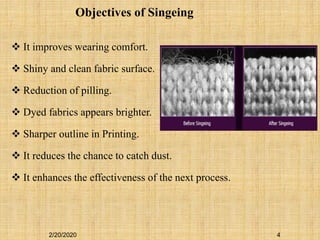
 It improves wearing comfort.
 Shiny and clean fabric surface.
 Reduction of pilling.
 Dyed fabrics appears brighter.
 Sharper outline in Printing.
 It reduces the chance to catch dust.
 It enhances the effectiveness of the next process.
Objectives of Singeing
Limitations of Singeing
 Uneven singeing effect can cause streaks when the fabric is dyed.
 In the cotton system singeing is done on the grey cloth, but for
blended fabrics containing synthetic fibers grey state singeing is
not advisable because small globules of melted synthetic fibers
absorb dye preferentially, giving cloth a speckled appearance.
 There is a possibility of thermal damage to temperature sensitive
fibers, for instance polyester.
Singeing machineries
Plate singeing machine
Rotary cylinder machine
Gas singeing machine
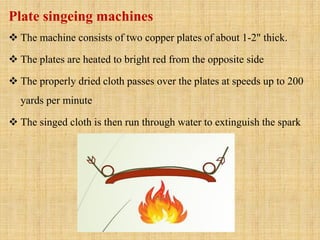
Plate singeing machines
 The machine consists of two copper plates of about 1-2" thick.
 The plates are heated to bright red from the opposite side
 The properly dried cloth passes over the plates at speeds up to 200
yards per minute
 The singed cloth is then run through water to extinguish the spark
2/20/2020 8
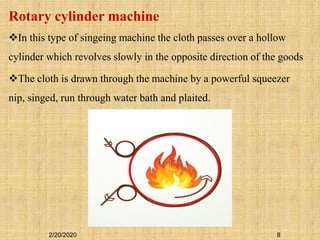
Rotary cylinder machine
In this type of singeing machine the cloth passes over a hollow
cylinder which revolves slowly in the opposite direction of the goods
The cloth is drawn through the machine by a powerful squeezer
nip, singed, run through water bath and plaited.
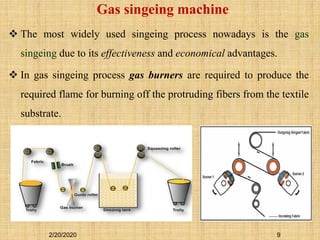
Gas singeing machine
 The most widely used singeing process nowadays is the gas
singeing due to its effectiveness and economical advantages.
 In gas singeing process gas burners are required to produce the
required flame for burning off the protruding fibers from the textile
substrate.
2/20/2020 9
2/20/2020 10
Depending on the position of gas burner relative to
the fabric three different singeing methods are possible.
i. Tangential singeing
ii. Singeing onto water cooled roller
iii. Singeing into the fabric/controlled flame
Cont.…
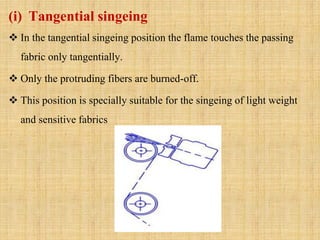
(i) Tangential singeing
 In the tangential singeing position the flame touches the passing
fabric only tangentially.
 Only the protruding fibers are burned-off.
 This position is specially suitable for the singeing of light weight
and sensitive fabrics
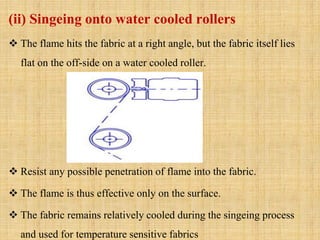
(ii) Singeing onto water cooled rollers
 The flame hits the fabric at a right angle, but the fabric itself lies
flat on the off-side on a water cooled roller.
 Resist any possible penetration of flame into the fabric.
 The flame is thus effective only on the surface.
 The fabric remains relatively cooled during the singeing process
and used for temperature sensitive fabrics
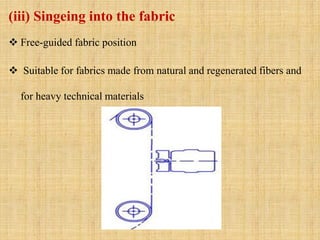
(iii) Singeing into the fabric
 Free-guided fabric position
 Suitable for fabrics made from natural and regenerated fibers and
for heavy technical materials
 Flame intensity
 Machine speed
 Distance between the flame and fabric
 Method of singeing
Conventional gas singeing:
 Movement of fabric over flame (1.5-4mm) away at 50-200 m/min.
 The temperature of the flame is 13000C (Exposure time = 0.1sec)
 The method of singeing is controlled flame.
SINGEING PARAMETERS
2/20/2020 14
 Insufficient singeing, uneven singeing, or over singeing are
common problem in singeing.
EFFECTS OF SINGEING
2/20/2020 15
 Too low flame intensity
 Too fast singeing speed
 Too far distance between the flame and fabric
 Inappropriate (less severe) singeing position
 Too much moisture in the incoming fabric
INSUFFICIENT SINGEING
 Non uniform moisture content
 Non uniform flame intensity
 Non uniform distance between the flame and fabric
 Inappropriate (less severe) singeing position
 Uneven smoke evacuation over the burner
 Change in fabric speed during singeing
UNEVEN SINGEING
2/20/2020 16
 Too high flame intensity
 Too slow fabric speed or too long contact between fabric and flame
 Too close contact between fabric and flame [deep penetration of flame]
 Inappropriate (too severe) singeing position
 Over singeing results thermal damage of cotton
 Horizontal singeing strips due sudden increase in tension
 Vertical singeing strips due blocking of flame output
OVER SINGEING
2/20/2020 17
YARN SINGEING
 Singeing is also done at yarn stage.
 For the yarn singeing it is an operation carried out in order to
eliminate yarn hairiness.
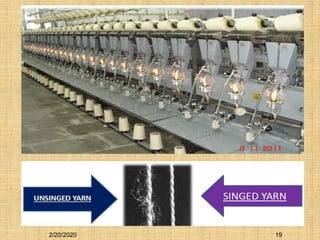
 The singeing system consists of a package to package winder and
a gas burner.
 The yarn is passed through the flame, which singes the protruding
fibers that cause the hairiness.
 It runs at a rate of 400 to 1000 m/min.
2/20/2020 18
2/20/2020 19
Testing singeing performance
 By looking at the singed fabric with magnifying glass and
comparing it’s hairiness with that of the un-singed fabric
 By testing the singed fabric for pilling performance and
comparing it with that of un-singed fabric
2/20/2020 20
2/20/2020 21
END

Singeing lecture 2

  • 1.
    SINGEING PROCESS OFCOTTON FABRIC LECTURE - 2 By Robel L. Faculty of Textile and Fashion Technology Aksum University 2020 2/20/2020 1
  • 2.
  • 3.
    INTRODUCTION Singeing is aprocess of removal of protruding/projecting fibers from yarns/fabrics  Singeing is done by passing fabric rapidly through a heat source to remove the protruding fibers, then rapidly lowering the temperature through quenching or steaming.  Depending on how thermal energy is transferred to the fabric in singeing, two different singeing systems are used: Direct and Indirect  In, direct singeing there is direct contact of the heat source and the fabric to be singed.  The heat source can be in the form of flame, heated plate or rotary cylinder.  Indirect singeing utilizes infrared radiation for the required thermal energy.  The fabric passes through heated ceramic bodies with emitted radiation. 2/20/2020 3
  • 4.
    2/20/2020 4  Itimproves wearing comfort.  Shiny and clean fabric surface.  Reduction of pilling.  Dyed fabrics appears brighter.  Sharper outline in Printing.  It reduces the chance to catch dust.  It enhances the effectiveness of the next process. Objectives of Singeing
  • 5.
    Limitations of Singeing Uneven singeing effect can cause streaks when the fabric is dyed.  In the cotton system singeing is done on the grey cloth, but for blended fabrics containing synthetic fibers grey state singeing is not advisable because small globules of melted synthetic fibers absorb dye preferentially, giving cloth a speckled appearance.  There is a possibility of thermal damage to temperature sensitive fibers, for instance polyester.
  • 6.
    Singeing machineries Plate singeingmachine Rotary cylinder machine Gas singeing machine
  • 7.
    Plate singeing machines The machine consists of two copper plates of about 1-2" thick.  The plates are heated to bright red from the opposite side  The properly dried cloth passes over the plates at speeds up to 200 yards per minute  The singed cloth is then run through water to extinguish the spark
  • 8.
    2/20/2020 8 Rotary cylindermachine In this type of singeing machine the cloth passes over a hollow cylinder which revolves slowly in the opposite direction of the goods The cloth is drawn through the machine by a powerful squeezer nip, singed, run through water bath and plaited.
  • 9.
    Gas singeing machine The most widely used singeing process nowadays is the gas singeing due to its effectiveness and economical advantages.  In gas singeing process gas burners are required to produce the required flame for burning off the protruding fibers from the textile substrate. 2/20/2020 9
  • 10.
    2/20/2020 10 Depending onthe position of gas burner relative to the fabric three different singeing methods are possible. i. Tangential singeing ii. Singeing onto water cooled roller iii. Singeing into the fabric/controlled flame Cont.…
  • 11.
    (i) Tangential singeing In the tangential singeing position the flame touches the passing fabric only tangentially.  Only the protruding fibers are burned-off.  This position is specially suitable for the singeing of light weight and sensitive fabrics
  • 12.
    (ii) Singeing ontowater cooled rollers  The flame hits the fabric at a right angle, but the fabric itself lies flat on the off-side on a water cooled roller.  Resist any possible penetration of flame into the fabric.  The flame is thus effective only on the surface.  The fabric remains relatively cooled during the singeing process and used for temperature sensitive fabrics
  • 13.
    (iii) Singeing intothe fabric  Free-guided fabric position  Suitable for fabrics made from natural and regenerated fibers and for heavy technical materials
  • 14.
     Flame intensity Machine speed  Distance between the flame and fabric  Method of singeing Conventional gas singeing:  Movement of fabric over flame (1.5-4mm) away at 50-200 m/min.  The temperature of the flame is 13000C (Exposure time = 0.1sec)  The method of singeing is controlled flame. SINGEING PARAMETERS 2/20/2020 14
  • 15.
     Insufficient singeing,uneven singeing, or over singeing are common problem in singeing. EFFECTS OF SINGEING 2/20/2020 15  Too low flame intensity  Too fast singeing speed  Too far distance between the flame and fabric  Inappropriate (less severe) singeing position  Too much moisture in the incoming fabric INSUFFICIENT SINGEING
  • 16.
     Non uniformmoisture content  Non uniform flame intensity  Non uniform distance between the flame and fabric  Inappropriate (less severe) singeing position  Uneven smoke evacuation over the burner  Change in fabric speed during singeing UNEVEN SINGEING 2/20/2020 16
  • 17.
     Too highflame intensity  Too slow fabric speed or too long contact between fabric and flame  Too close contact between fabric and flame [deep penetration of flame]  Inappropriate (too severe) singeing position  Over singeing results thermal damage of cotton  Horizontal singeing strips due sudden increase in tension  Vertical singeing strips due blocking of flame output OVER SINGEING 2/20/2020 17
  • 18.
    YARN SINGEING  Singeingis also done at yarn stage.  For the yarn singeing it is an operation carried out in order to eliminate yarn hairiness.  The singeing system consists of a package to package winder and a gas burner.  The yarn is passed through the flame, which singes the protruding fibers that cause the hairiness.  It runs at a rate of 400 to 1000 m/min. 2/20/2020 18
  • 19.
  • 20.
    Testing singeing performance By looking at the singed fabric with magnifying glass and comparing it’s hairiness with that of the un-singed fabric  By testing the singed fabric for pilling performance and comparing it with that of un-singed fabric 2/20/2020 20
  • 21.