1
1
MERCERIZATION PROCESS OF COTTON FABRIC
LECTURE - 7
By Robel L.
Faculty of Textile and Fashion Technology
Aksum University
2020
3/18/2020
MERCERIZATION
3/18/2020 2
 Mercerization is named after John Mercer (1850), who discovered
cotton fabric immersed in aqueous solution of cold caustic soda
exhibited swelling and shrinkage.
 Mercerization is defined as the treatment of cotton with a
concentrated solution of caustic soda (NaOH).
 Conventional mercerization requires high concentration of
caustic soda (18% - 24%), treatment near RT (15 – 18 C) for an
average dwell period of 55sec applying tension.
INTRODUCTION
3/18/2020 3
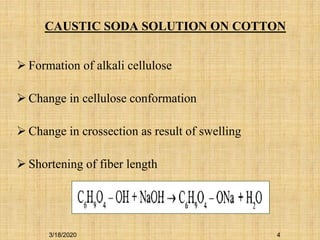
CAUSTIC SODA SOLUTION ON COTTON
 Formation of alkali cellulose
 Change in cellulose conformation
 Change in crossection as result of swelling
 Shortening of fiber length
3/18/2020 4
5
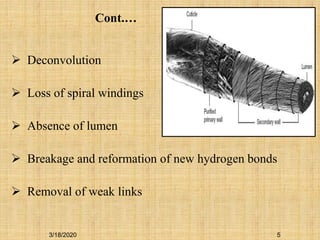
 Deconvolution
 Loss of spiral windings
 Absence of lumen
 Breakage and reformation of new hydrogen bonds
 Removal of weak links
3/18/2020
Cont.…
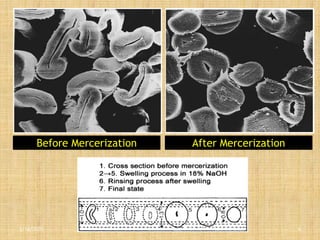
Before Mercerization After Mercerization
3/18/2020 6
CONDITIONS FOR MERCERIZATION
 Concentration of caustic soda
 Temperature and time
 Tension
 Addition of wetting agent (particularly in grey mercerization)
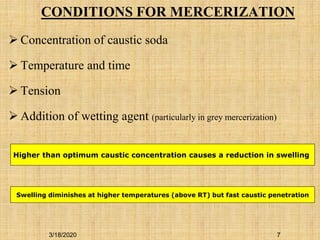
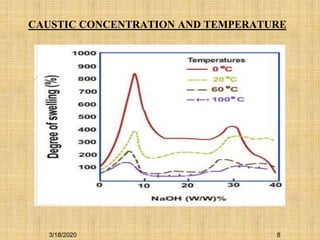
Higher than optimum caustic concentration causes a reduction in swelling
Swelling diminishes at higher temperatures (above RT) but fast caustic penetration
3/18/2020 7
CAUSTIC CONCENTRATION AND TEMPERATURE
3/18/2020 8
9
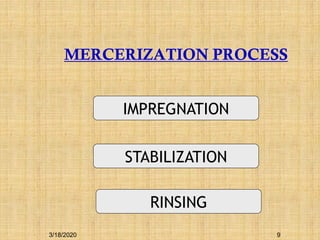
MERCERIZATION PROCESS
IMPREGNATION
STABILIZATION
RINSING
3/18/2020
10
(a) Application of caustic soda solution around (18 to 24%)
at a temperature of 15 to 18 C.
(b) A dwell period of 55 sec on an average, so as to permit
diffusion of alkali into the fiber.
(c) Warp tension during alkali treatment and stretching
the weft (width) of the fabric during washing are
necessary to prevent excessive shrinkage.
(d) Washing-off of the traces of alkali
3/18/2020
Types of Mercerization
Tension (chain)Mercerization
Slack (chainless) Mercerization
3/18/2020 11
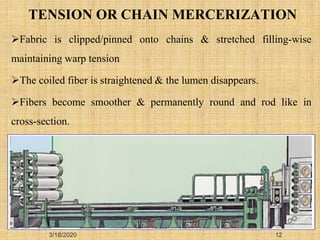
TENSION OR CHAIN MERCERIZATION
3/18/2020 12
Fabric is clipped/pinned onto chains & stretched filling-wise
maintaining warp tension
The coiled fiber is straightened & the lumen disappears.
Fibers become smoother & permanently round and rod like in
cross-section.
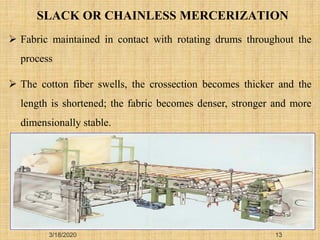
SLACK OR CHAINLESS MERCERIZATION
3/18/2020 13
 Fabric maintained in contact with rotating drums throughout the
process
 The cotton fiber swells, the crossection becomes thicker and the
length is shortened; the fabric becomes denser, stronger and more
dimensionally stable.
CHANGES DUE TO MERCERIZATION
 Swelling and shrinkage
 Structural modification
 Increased luster
 Increased tensile strength
 Increase moisture absorption, dye ability
 Dimensional stability
 Improved hand
3/18/2020 14
15
 Water and alkali penetration into cellulose
 Conversion of cellulose into alkali/soda cellulose
 Swelling of cotton with a corresponding shrinkage
 Deconvolution and more round fiber diameter
SWELLING AND SHRINKAGE
3/18/2020
STRUCTURAL MODIFICATION
 Due to swelling, hydrogen bonds in cellulose are broken
 Molecular chains move apart from each other
 Molecular rearrangement & formation of newer bonds
Caustic soda solution swells cotton fibers breaking hydrogen
bonds and weak Van der Waal forces between cellulose chains.
The expanded chains rearrange and re-orient and when the
caustic soda is removed, chains form new hydrogen bonds in the
reorganized state.
3/18/2020 16
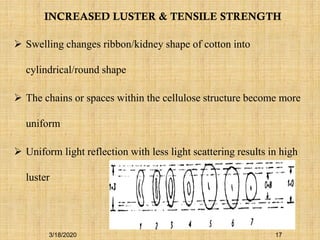
INCREASED LUSTER & TENSILE STRENGTH
 Swelling changes ribbon/kidney shape of cotton into
cylindrical/round shape
 The chains or spaces within the cellulose structure become more
uniform
 Uniform light reflection with less light scattering results in high
luster
3/18/2020 17
18
 Mercerization increases the tensile strength of cotton fibers by
eliminating the weakest links in the fiber.
 Increased density also enhances the strength.
 The increase in orientation of the crystallites with respect to
fiber axis attributed the decrease in lengths of crystallites and
fiber deconvolution.
Reduced light scattering due to lower surface area
LUSTURE
3/18/2020
ABSORPTION, REACTIVITY AND DYEABILITY
 Breakage of hydrogen bonds increases number of
available hydroxyl groups
 Amorphousity due to decrystallization
 Increase in moisture absorption, dye uptake & reactivity
 Increase in depth of shade due to lusturity
 Level dyeing due to removal of immature cotton
3/18/2020 19
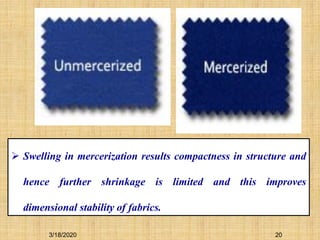
 Swelling in mercerization results compactness in structure and
hence further shrinkage is limited and this improves
dimensional stability of fabrics.
3/18/2020 20
STAGES OF MERCERIZATION
Mercerization can be carried out at different stages:
 Grey mercerization [Addition of wetting agents]
 After Desizing
 After scouring [Sufficient washing off of caustic liquor]
 After bleaching
 Mercerization before bleaching can be disadvantage due to
contamination of caustic recovery --- Problem in caustic recovery
 Mercerization after bleaching can also be a disadvantage -
Tendency of yellowness
3/18/2020 21
Why yarn mercerization?
 To produce lustrous and strong sewing thread
 To produce yarns for constructions that are difficult to
mercerize
 To produce yarns for special construction effects
 For complete mercerization for luster and strength
 To produce yarn dyed fabrics
 To produce knit goods
Yarns are mercerized in hank form or as a continuous run of yarn
3/18/2020 22
MODIFICATIONS ON CONVENTIONAL MERCERIZATION
 When mercerization is carried out at lower
concentration of caustic soda (10 – 18%) it is called
CAUSTICIZATION.
 Highly hydrated NaOH penetrates into the cellulose
structure causing high degree of swelling and
enhancement of dye ability.
CAUSTICIZATION
3/18/2020 23
24
HOT MERCERIZATION
3/18/2020
 In conventional cold mercerization fast swelling results increase in
outer edge density; inhibits further penetration of alkali into the inner
core.
 When mercerization is carried at higher temperature above RT it is
known as hot mercerization:
FAST & UNIFORM ALKALI PENETRATION
 Impregnation at 1000C – Controlled hot stretching – Cooling –
Washing
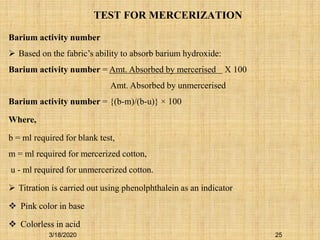
TEST FOR MERCERIZATION
Barium activity number
 Based on the fabric’s ability to absorb barium hydroxide:
Barium activity number = Amt. Absorbed by mercerised X 100
Amt. Absorbed by unmercerised
Barium activity number = {(b-m)/(b-u)} × 100
Where,
b = ml required for blank test,
m = ml required for mercerized cotton,
u - ml required for unmercerized cotton.
 Titration is carried out using phenolphthalein as an indicator
 Pink color in base
 Colorless in acid
3/18/2020 25
 Umercerized fabric - 100 to 105.
 Completely mercerized fabric - 150.
 Commercially treated fabrics - 115 to 130.
 Example
 One gram of mercerized and unmercerized cotton fabric were each
treated with 30 ml of 0.25 N barium hydroxide solution in 100 ml
conical flasks. Blank solution contain only Ba(OH)2 were also
prepared for a test. After 2h, 10 ml of the solution from each samples
are titrated against 0.1 N hydrochloric acid. The volume of HCL
used for titration of blank, mercerized and unmercerized samples
were 10 ml, 5 ml and 6 ml respectively.
 Calculate the amount of barium activity number?
26
Cont.…
3/18/2020
END
27
3/18/2020

Mercerization lecture 7

  • 1.
    1 1 MERCERIZATION PROCESS OFCOTTON FABRIC LECTURE - 7 By Robel L. Faculty of Textile and Fashion Technology Aksum University 2020 3/18/2020
  • 2.
  • 3.
     Mercerization isnamed after John Mercer (1850), who discovered cotton fabric immersed in aqueous solution of cold caustic soda exhibited swelling and shrinkage.  Mercerization is defined as the treatment of cotton with a concentrated solution of caustic soda (NaOH).  Conventional mercerization requires high concentration of caustic soda (18% - 24%), treatment near RT (15 – 18 C) for an average dwell period of 55sec applying tension. INTRODUCTION 3/18/2020 3
  • 4.
    CAUSTIC SODA SOLUTIONON COTTON  Formation of alkali cellulose  Change in cellulose conformation  Change in crossection as result of swelling  Shortening of fiber length 3/18/2020 4
  • 5.
    5  Deconvolution  Lossof spiral windings  Absence of lumen  Breakage and reformation of new hydrogen bonds  Removal of weak links 3/18/2020 Cont.…
  • 6.
    Before Mercerization AfterMercerization 3/18/2020 6
  • 7.
    CONDITIONS FOR MERCERIZATION Concentration of caustic soda  Temperature and time  Tension  Addition of wetting agent (particularly in grey mercerization) Higher than optimum caustic concentration causes a reduction in swelling Swelling diminishes at higher temperatures (above RT) but fast caustic penetration 3/18/2020 7
  • 8.
    CAUSTIC CONCENTRATION ANDTEMPERATURE 3/18/2020 8
  • 9.
  • 10.
    10 (a) Application ofcaustic soda solution around (18 to 24%) at a temperature of 15 to 18 C. (b) A dwell period of 55 sec on an average, so as to permit diffusion of alkali into the fiber. (c) Warp tension during alkali treatment and stretching the weft (width) of the fabric during washing are necessary to prevent excessive shrinkage. (d) Washing-off of the traces of alkali 3/18/2020
  • 11.
    Types of Mercerization Tension(chain)Mercerization Slack (chainless) Mercerization 3/18/2020 11
  • 12.
    TENSION OR CHAINMERCERIZATION 3/18/2020 12 Fabric is clipped/pinned onto chains & stretched filling-wise maintaining warp tension The coiled fiber is straightened & the lumen disappears. Fibers become smoother & permanently round and rod like in cross-section.
  • 13.
    SLACK OR CHAINLESSMERCERIZATION 3/18/2020 13  Fabric maintained in contact with rotating drums throughout the process  The cotton fiber swells, the crossection becomes thicker and the length is shortened; the fabric becomes denser, stronger and more dimensionally stable.
  • 14.
    CHANGES DUE TOMERCERIZATION  Swelling and shrinkage  Structural modification  Increased luster  Increased tensile strength  Increase moisture absorption, dye ability  Dimensional stability  Improved hand 3/18/2020 14
  • 15.
    15  Water andalkali penetration into cellulose  Conversion of cellulose into alkali/soda cellulose  Swelling of cotton with a corresponding shrinkage  Deconvolution and more round fiber diameter SWELLING AND SHRINKAGE 3/18/2020
  • 16.
    STRUCTURAL MODIFICATION  Dueto swelling, hydrogen bonds in cellulose are broken  Molecular chains move apart from each other  Molecular rearrangement & formation of newer bonds Caustic soda solution swells cotton fibers breaking hydrogen bonds and weak Van der Waal forces between cellulose chains. The expanded chains rearrange and re-orient and when the caustic soda is removed, chains form new hydrogen bonds in the reorganized state. 3/18/2020 16
  • 17.
    INCREASED LUSTER &TENSILE STRENGTH  Swelling changes ribbon/kidney shape of cotton into cylindrical/round shape  The chains or spaces within the cellulose structure become more uniform  Uniform light reflection with less light scattering results in high luster 3/18/2020 17
  • 18.
    18  Mercerization increasesthe tensile strength of cotton fibers by eliminating the weakest links in the fiber.  Increased density also enhances the strength.  The increase in orientation of the crystallites with respect to fiber axis attributed the decrease in lengths of crystallites and fiber deconvolution. Reduced light scattering due to lower surface area LUSTURE 3/18/2020
  • 19.
    ABSORPTION, REACTIVITY ANDDYEABILITY  Breakage of hydrogen bonds increases number of available hydroxyl groups  Amorphousity due to decrystallization  Increase in moisture absorption, dye uptake & reactivity  Increase in depth of shade due to lusturity  Level dyeing due to removal of immature cotton 3/18/2020 19
  • 20.
     Swelling inmercerization results compactness in structure and hence further shrinkage is limited and this improves dimensional stability of fabrics. 3/18/2020 20
  • 21.
    STAGES OF MERCERIZATION Mercerizationcan be carried out at different stages:  Grey mercerization [Addition of wetting agents]  After Desizing  After scouring [Sufficient washing off of caustic liquor]  After bleaching  Mercerization before bleaching can be disadvantage due to contamination of caustic recovery --- Problem in caustic recovery  Mercerization after bleaching can also be a disadvantage - Tendency of yellowness 3/18/2020 21
  • 22.
    Why yarn mercerization? To produce lustrous and strong sewing thread  To produce yarns for constructions that are difficult to mercerize  To produce yarns for special construction effects  For complete mercerization for luster and strength  To produce yarn dyed fabrics  To produce knit goods Yarns are mercerized in hank form or as a continuous run of yarn 3/18/2020 22
  • 23.
    MODIFICATIONS ON CONVENTIONALMERCERIZATION  When mercerization is carried out at lower concentration of caustic soda (10 – 18%) it is called CAUSTICIZATION.  Highly hydrated NaOH penetrates into the cellulose structure causing high degree of swelling and enhancement of dye ability. CAUSTICIZATION 3/18/2020 23
  • 24.
    24 HOT MERCERIZATION 3/18/2020  Inconventional cold mercerization fast swelling results increase in outer edge density; inhibits further penetration of alkali into the inner core.  When mercerization is carried at higher temperature above RT it is known as hot mercerization: FAST & UNIFORM ALKALI PENETRATION  Impregnation at 1000C – Controlled hot stretching – Cooling – Washing
  • 25.
    TEST FOR MERCERIZATION Bariumactivity number  Based on the fabric’s ability to absorb barium hydroxide: Barium activity number = Amt. Absorbed by mercerised X 100 Amt. Absorbed by unmercerised Barium activity number = {(b-m)/(b-u)} × 100 Where, b = ml required for blank test, m = ml required for mercerized cotton, u - ml required for unmercerized cotton.  Titration is carried out using phenolphthalein as an indicator  Pink color in base  Colorless in acid 3/18/2020 25
  • 26.
     Umercerized fabric- 100 to 105.  Completely mercerized fabric - 150.  Commercially treated fabrics - 115 to 130.  Example  One gram of mercerized and unmercerized cotton fabric were each treated with 30 ml of 0.25 N barium hydroxide solution in 100 ml conical flasks. Blank solution contain only Ba(OH)2 were also prepared for a test. After 2h, 10 ml of the solution from each samples are titrated against 0.1 N hydrochloric acid. The volume of HCL used for titration of blank, mercerized and unmercerized samples were 10 ml, 5 ml and 6 ml respectively.  Calculate the amount of barium activity number? 26 Cont.… 3/18/2020
  • 27.