Jotish roy
8th Intake
ID:12132107059
WARP AND WEFT KNITTINGWARP AND WEFT KNITTING
BASIC KNITTINGBASIC KNITTING
WEAVINGWEAVING--WARPING PROCESSWARPING PROCESS
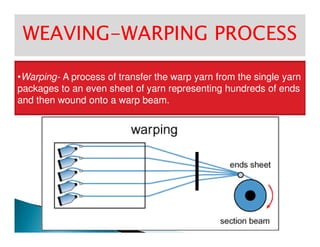
••WarpingWarping-- A process of transfer the warp yarn from the single yarnA process of transfer the warp yarn from the single yarn
packages to an even sheet of yarn representing hundreds of endspackages to an even sheet of yarn representing hundreds of ends
and then wound onto a warp beam.and then wound onto a warp beam.
WEAVINGWEAVING--SIZING PROCESSSIZING PROCESS
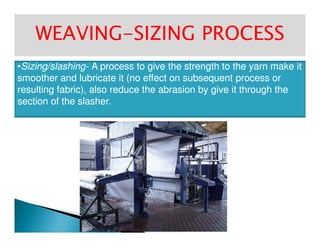
••Sizing/slashingSizing/slashing-- A process to give the strength to the yarn make itA process to give the strength to the yarn make it
smoother and lubricate it (no effect on subsequent process orsmoother and lubricate it (no effect on subsequent process or
resulting fabric), also reduce the abrasion by give it through theresulting fabric), also reduce the abrasion by give it through the
section of thesection of the slasherslasher..
WEAVINGWEAVING--DRAW IN PROCESSDRAW IN PROCESS
DrawDraw--inin-- A process of draw every warp yarns through itsA process of draw every warp yarns through its
dropper,dropper, headleheadle eyes and reed dent. [3]eyes and reed dent. [3]
WEAVINGWEAVING--TIE IN PROCESSTIE IN PROCESS
••TieTie--inin-- A process of tying each of a new beam to itsA process of tying each of a new beam to its
corresponding end of the old beam when mass producing thecorresponding end of the old beam when mass producing the
same fabric.same fabric.
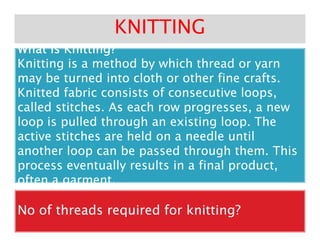
What is Knitting?What is Knitting?What is Knitting?What is Knitting?What is Knitting?What is Knitting?What is Knitting?What is Knitting?What is Knitting?What is Knitting?What is Knitting?What is Knitting?What is Knitting?What is Knitting?What is Knitting?What is Knitting?
Knitting is a method by which thread or yarnKnitting is a method by which thread or yarn
may be turned into cloth or other fine crafts.may be turned into cloth or other fine crafts.
Knitted fabric consists of consecutive loops,Knitted fabric consists of consecutive loops,
called stitches. As each row progresses, a newcalled stitches. As each row progresses, a new
loop is pulled through an existing loop. Theloop is pulled through an existing loop. The
KNITTINGKNITTING
often a garment.often a garment.
loop is pulled through an existing loop. Theloop is pulled through an existing loop. The
active stitches are held on a needle untilactive stitches are held on a needle until
another loop can be passed through them. Thisanother loop can be passed through them. This
process eventually results in a final product,process eventually results in a final product,
often a garment.often a garment.
No of threads required for knitting?No of threads required for knitting?
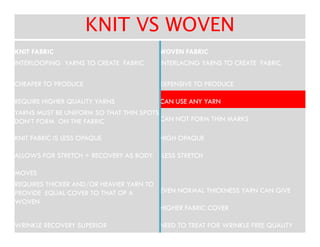
KNIT VS WOVENKNIT VS WOVEN
KNIT FABRICKNIT FABRIC WOVEN FABRICWOVEN FABRIC
INTERLOOPING YARNS TO CREATE FABRICINTERLOOPING YARNS TO CREATE FABRIC INTERLACING YARNS TO CREATE FABRICINTERLACING YARNS TO CREATE FABRIC
CHEAPER TO PRODUCECHEAPER TO PRODUCE EXPENSIVEEXPENSIVE TO PRODUCETO PRODUCE
REQUIRE HIGHER QUALITY YARNSREQUIRE HIGHER QUALITY YARNS CAN USE ANY YARNCAN USE ANY YARN
YARNS MUST BE UNIFORM SO THAT THIN SPOTSYARNS MUST BE UNIFORM SO THAT THIN SPOTS
DON’T FORM ON THE FABRICDON’T FORM ON THE FABRIC CAN NOT FORM THIN MARKSCAN NOT FORM THIN MARKSDON’T FORM ON THE FABRICDON’T FORM ON THE FABRIC
KNIT FABRIC IS LESS OPAQUEKNIT FABRIC IS LESS OPAQUE HIGH OPAQUEHIGH OPAQUE
ALLOWS FOR STRETCH + RECOVERY AS BODYALLOWS FOR STRETCH + RECOVERY AS BODY
MOVESMOVES
LESS STRETCHLESS STRETCH
REQUIRES THICKER AND/OR HEAVIER YARN TOREQUIRES THICKER AND/OR HEAVIER YARN TO
PROVIDE EQUAL COVER TO THAT OF APROVIDE EQUAL COVER TO THAT OF A
WOVENWOVEN
EVEN NORMALEVEN NORMAL THICKNESS YARN CAN GIVETHICKNESS YARN CAN GIVE
HIGHER FABRIC COVERHIGHER FABRIC COVER
WRINKLE RECOVERY SUPERIORWRINKLE RECOVERY SUPERIOR NEEDNEED TO TREAT FOR WRINKLE FREE QUALITYTO TREAT FOR WRINKLE FREE QUALITY
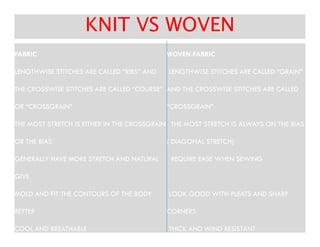
KNIT VS WOVENKNIT VS WOVEN
FABRICFABRIC WOVEN FABRICWOVEN FABRIC
LENGTHWISE STITCHES ARE CALLED “RIBS” ANDLENGTHWISE STITCHES ARE CALLED “RIBS” AND
THE CROSSWISE STITCHES ARE CALLED “COURSE”THE CROSSWISE STITCHES ARE CALLED “COURSE”
OR “CROSSGRAIN”OR “CROSSGRAIN”
LENGTHWISE STITCHES ARE CALLED “GRAIN”LENGTHWISE STITCHES ARE CALLED “GRAIN”
AND THE CROSSWISE STITCHES ARE CALLEDAND THE CROSSWISE STITCHES ARE CALLED
“CROSSGRAIN”“CROSSGRAIN”
THE MOST STRETCH IS EITHER IN THE CROSSGRAINTHE MOST STRETCH IS EITHER IN THE CROSSGRAIN THE MOST STRETCH IS ALWAYS ON THE BIASTHE MOST STRETCH IS ALWAYS ON THE BIASTHE MOST STRETCH IS EITHER IN THE CROSSGRAINTHE MOST STRETCH IS EITHER IN THE CROSSGRAIN
OR THE BIASOR THE BIAS
THE MOST STRETCH IS ALWAYS ON THE BIASTHE MOST STRETCH IS ALWAYS ON THE BIAS
( DIAGONAL STRETCH)( DIAGONAL STRETCH)
GENERALLY HAVE MORE STRETCH AND NATURALGENERALLY HAVE MORE STRETCH AND NATURAL
GIVEGIVE
REQUIRE EASE WHEN SEWINGREQUIRE EASE WHEN SEWING
MOLD AND FIT THE CONTOURS OF THE BODYMOLD AND FIT THE CONTOURS OF THE BODY
BETTERBETTER
LOOK GOOD WITH PLEATS AND SHARPLOOK GOOD WITH PLEATS AND SHARP
CORNERSCORNERS
COOL AND BREATHABLECOOL AND BREATHABLE THICK AND WIND RESISTANTTHICK AND WIND RESISTANT
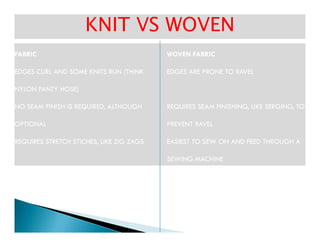
KNIT VS WOVENKNIT VS WOVEN
FABRICFABRIC WOVEN FABRICWOVEN FABRIC
EDGES CURL AND SOME KNITS RUN (THINKEDGES CURL AND SOME KNITS RUN (THINK
NYLON PANTY HOSE)NYLON PANTY HOSE)
EDGES ARE PRONE TO RAVELEDGES ARE PRONE TO RAVEL
NO SEAM FINISH IS REQUIRED, ALTHOUGHNO SEAM FINISH IS REQUIRED, ALTHOUGH
OPTIONALOPTIONAL
REQUIRES SEAM FINISHING, LIKE SERGING, TOREQUIRES SEAM FINISHING, LIKE SERGING, TO
PREVENT RAVELPREVENT RAVELOPTIONALOPTIONAL PREVENT RAVELPREVENT RAVEL
REQUIRES STRETCH STICHES, LIKE ZIG ZAGSREQUIRES STRETCH STICHES, LIKE ZIG ZAGS EASIEST TO SEW ON AND FEED THROUGH AEASIEST TO SEW ON AND FEED THROUGH A
SEWING MACHINESEWING MACHINE
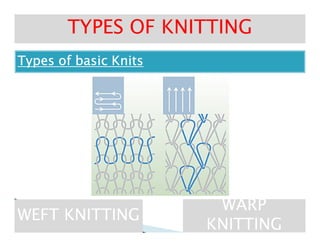
Types of basic KnitsTypes of basic KnitsTypes of basic KnitsTypes of basic KnitsTypes of basic KnitsTypes of basic KnitsTypes of basic KnitsTypes of basic Knits
TYPES OF KNITTINGTYPES OF KNITTING
WARPWARP
KNITTINGKNITTING
WEFT KNITTINGWEFT KNITTING
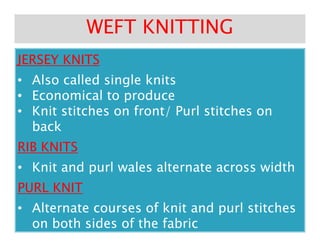
JERSEY KNITSJERSEY KNITS
•• Also called single knitsAlso called single knits
•• Economical to produceEconomical to produce
•• Knit stitches on front/ Purl stitches onKnit stitches on front/ Purl stitches on
backback
WEFT KNITTINGWEFT KNITTING
backback
RIB KNITSRIB KNITS
•• Knit and purl wales alternate across widthKnit and purl wales alternate across width
PURL KNITPURL KNIT
•• Alternate courses of knit and purl stitchesAlternate courses of knit and purl stitches
on both sides of the fabricon both sides of the fabric
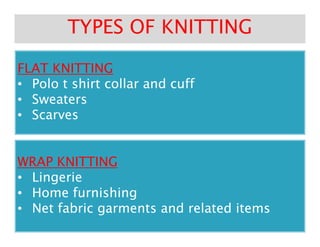
FLAT KNITTINGFLAT KNITTING
•• Polo t shirt collar and cuffPolo t shirt collar and cuff
•• SweatersSweaters
•• ScarvesScarves
TYPES OF KNITTINGTYPES OF KNITTING
ScarvesScarves
WRAP KNITTINGWRAP KNITTING
•• LingerieLingerie
•• Home furnishingHome furnishing
•• Net fabric garments and related itemsNet fabric garments and related items
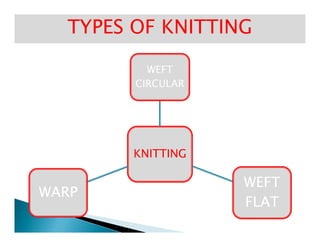
WEFTWEFT
CIRCULARCIRCULAR
TYPES OF KNITTINGTYPES OF KNITTING
KNITTINGKNITTING
WEFTWEFT
FLATFLAT
WARPWARP
Flat bed machine canFlat bed machine canFlat bed machine canFlat bed machine can
manufacture,manufacture,
••Woolen fabricWoolen fabric
••Full cardiganFull cardigan
FLAT BED KNITTINGFLAT BED KNITTING
••Full cardiganFull cardigan
••Half cardiganHalf cardigan
••MilanoMilano
••Half MilanoHalf Milano
••Rib structureRib structure
Circular knitting machine canCircular knitting machine canCircular knitting machine canCircular knitting machine can
manufacture,manufacture,
••T shirt jersey fabricT shirt jersey fabric
••Pique fabricPique fabric
CIRCULAR KNITTINGCIRCULAR KNITTING
••Pique fabricPique fabric
••RibRib
••InterlockInterlock
••SocksSocks
••Lycra blend fabricLycra blend fabric
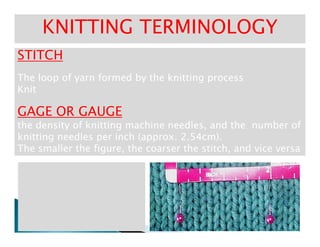
STITCHSTITCH
The loop of yarn formed by the knitting processThe loop of yarn formed by the knitting process
KnitKnit
GAGE OR GAUGEGAGE OR GAUGE
the density of knitting machine needles, and the number ofthe density of knitting machine needles, and the number of
KNITTING TERMINOLOGYKNITTING TERMINOLOGY
the density of knitting machine needles, and the number ofthe density of knitting machine needles, and the number of
knitting needles per inch (approx. 2.54cm).knitting needles per inch (approx. 2.54cm).
The smaller the figure, the coarser the stitch, and vice versaThe smaller the figure, the coarser the stitch, and vice versa
COURSESCOURSES
A series of successive loops laying crosswiseA series of successive loops laying crosswise
COURSESCOURSES
A series of successive loops laying crosswiseA series of successive loops laying crosswise
in thein the
FabricFabric
FACE/BACKFACE/BACK
Just like a woven fabric, there is a face and aJust like a woven fabric, there is a face and a
back toback to
KNITTING TERMINOLOGYKNITTING TERMINOLOGY
Just like a woven fabric, there is a face and aJust like a woven fabric, there is a face and a
back toback to
the knitted fabricthe knitted fabric
CUTCUT
The fineness of weft knits made on a circularThe fineness of weft knits made on a circular
knittingknitting
MachineMachine
The higher the gauge or cut number, theThe higher the gauge or cut number, the
The knitted loop structureThe knitted loop structureThe knitted loop structureThe knitted loop structureThe knitted loop structureThe knitted loop structureThe knitted loop structureThe knitted loop structureThe knitted loop structureThe knitted loop structureThe knitted loop structureThe knitted loop structureThe knitted loop structureThe knitted loop structureThe knitted loop structureThe knitted loop structure
KNITTED LOOP STRUCTUREKNITTED LOOP STRUCTURE
The knitted loop structureThe knitted loop structureThe knitted loop structureThe knitted loop structureThe knitted loop structureThe knitted loop structureThe knitted loop structureThe knitted loop structureThe knitted loop structureThe knitted loop structureThe knitted loop structureThe knitted loop structureThe knitted loop structureThe knitted loop structureThe knitted loop structureThe knitted loop structure
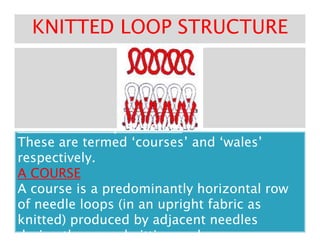
These are termed ‘courses’ and ‘wales’These are termed ‘courses’ and ‘wales’
respectively.respectively.
A COURSEA COURSE
A course is a predominantly horizontal rowA course is a predominantly horizontal row
of needle loops (in an upright fabric asof needle loops (in an upright fabric as
knitted) produced by adjacent needlesknitted) produced by adjacent needles
during the same knitting cycleduring the same knitting cycle
KNITTED LOOP STRUCTUREKNITTED LOOP STRUCTURE
The knitted loop structureThe knitted loop structureThe knitted loop structureThe knitted loop structureThe knitted loop structureThe knitted loop structureThe knitted loop structureThe knitted loop structureThe knitted loop structureThe knitted loop structureThe knitted loop structureThe knitted loop structureThe knitted loop structureThe knitted loop structureThe knitted loop structureThe knitted loop structure
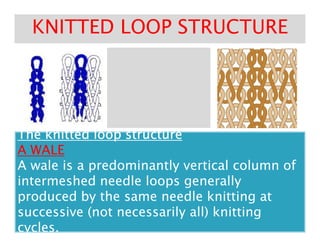
A WALEA WALE
A wale is a predominantly vertical column ofA wale is a predominantly vertical column of
intermeshed needle loops generallyintermeshed needle loops generally
produced by the same needle knitting atproduced by the same needle knitting at
successive (not necessarily all) knittingsuccessive (not necessarily all) knitting
cycles.cycles.
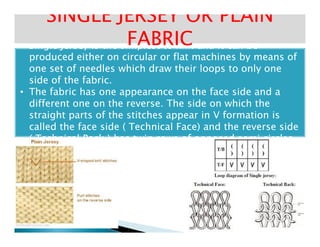
•• Single jersey is the simplest to knit and it can beSingle jersey is the simplest to knit and it can be•• Single jersey is the simplest to knit and it can beSingle jersey is the simplest to knit and it can be
produced either on circular or flat machines by means ofproduced either on circular or flat machines by means of
one set of needles which draw their loops to only oneone set of needles which draw their loops to only one
side of the fabric.side of the fabric.
•• The fabric has one appearance on the face side and aThe fabric has one appearance on the face side and a
different one on the reverse. The side on which thedifferent one on the reverse. The side on which the
straight parts of the stitches appear in V formation isstraight parts of the stitches appear in V formation is
called the face side ( Technical Face) and the reverse sidecalled the face side ( Technical Face) and the reverse side
SINGLE JERSEY OR PLAINSINGLE JERSEY OR PLAIN
FABRICFABRIC
( Technical Back ) has twin rows of opposed semi circles.( Technical Back ) has twin rows of opposed semi circles.
called the face side ( Technical Face) and the reverse sidecalled the face side ( Technical Face) and the reverse side
( Technical Back ) has twin rows of opposed semi circles.( Technical Back ) has twin rows of opposed semi circles.
•• Simplest knit structure.Simplest knit structure.
•• Face side smooth and sheen.Face side smooth and sheen.
•• Back side rough and dull.Back side rough and dull.
•• Lighter fabric.Lighter fabric.
•• Economical.Economical.
•• Easily ravels at both the ends.Easily ravels at both the ends.
PROPERTIES OF SINGLE JERSEYPROPERTIES OF SINGLE JERSEY
•• Easily ravels at both the ends.Easily ravels at both the ends.
•• Highly extensible in length and width.Highly extensible in length and width.
•• The fabric curls towards the face at the top andThe fabric curls towards the face at the top and
bottom and towards the back at the sides.bottom and towards the back at the sides.
•• Laddering is very common in these fabrics.Laddering is very common in these fabrics.
•• Knitted loops in plain knit fabrics tend to distortKnitted loops in plain knit fabrics tend to distort
easily under tension which helps to give a formeasily under tension which helps to give a form
fitting and comfort due to property of elastic.fitting and comfort due to property of elastic.
End Uses of JerseyEnd Uses of Jersey
Knits;Knits;
•• SheetsSheets
•• SweatersSweaters
USE OF SINGLE JERSEYUSE OF SINGLE JERSEY
•• SweatersSweaters
•• TT-- s h i r t ss h i r t s
•• Men’s underwearMen’s underwear
•• DressesDresses
•• HosieryHosiery
Jersey KnitJersey KnitJersey KnitJersey Knit
VariationsVariations
FleeceFleece
IntarsiaIntarsia
Jacquard knitsJacquard knits
VARIATIONS OF SINGLEVARIATIONS OF SINGLE
JERSEYJERSEY
Jacquard knitsJacquard knits
Knitted terryKnitted terry
Knitted velourKnitted velour
LisleLisle
Plaited knitsPlaited knits
SilverSilver--pile knitspile knits
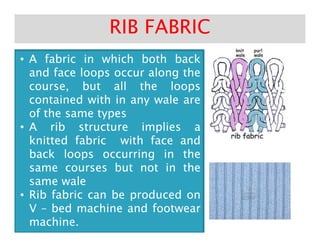
•• AA fabricfabric inin whichwhich bothboth backback
andand faceface loopsloops occuroccur alongalong thethe
course,course, butbut allall thethe loopsloops
containedcontained withwith inin anyany walewale areare
ofof thethe samesame typestypes
•• AA ribrib structurestructure impliesimplies aa
RIB FABRICRIB FABRIC
•• AA ribrib structurestructure impliesimplies aa
knittedknitted fabricfabric withwith faceface andand
backback loopsloops occurringoccurring inin thethe
samesame coursescourses butbut notnot inin thethe
samesame walewale
•• RibRib fabricfabric cancan bebe producedproduced onon
VV –– bedbed machinemachine andand footwearfootwear
machinemachine..
•• Rib is produced by two sets of needles beingRib is produced by two sets of needles being•• Rib is produced by two sets of needles beingRib is produced by two sets of needles being
alternately set orated between each other.alternately set orated between each other.
•• The simplest rib in (1 * 1) ribThe simplest rib in (1 * 1) rib
•• It is now normally knitted with two sets of latchIt is now normally knitted with two sets of latch
needles and known as double jersey fabric.needles and known as double jersey fabric.
•• Rib has a vertical cord appearanceRib has a vertical cord appearance
•• Relaxed 1 x 1 rib is twice as thick and half theRelaxed 1 x 1 rib is twice as thick and half the
PROPERTIES OF RIB FABRICPROPERTIES OF RIB FABRIC
•• Relaxed 1 x 1 rib is twice as thick and half theRelaxed 1 x 1 rib is twice as thick and half the
width of an equivalent plain fabric.width of an equivalent plain fabric.
•• 1 x 1 rib normally relaxes by 30% compound with its1 x 1 rib normally relaxes by 30% compound with its
knitting width.knitting width.
•• Rib cannot be unroved from the end knitted firstRib cannot be unroved from the end knitted first
because the sinker loops are securely anchored bybecause the sinker loops are securely anchored by
the cross meshing between face and reverse loop.the cross meshing between face and reverse loop.
•• It is used for loops for socks, cuffs of sleeves, ribIt is used for loops for socks, cuffs of sleeves, rib
borderybordery for garments.for garments.
End Uses of RibEnd Uses of Rib
KnitsKnits
CollarsCollars
NecklinesNecklines
USE OF RIB FABRICUSE OF RIB FABRIC
NecklinesNecklines
CuffsCuffs
Bottom edges ofBottom edges of
sweaterssweaters
Knit hatsKnit hats
Men’s hosieryMen’s hosiery
Double knitsDouble knits
Sometimes calledSometimes called
double jerseysdouble jerseys
Thicker than jerseyThicker than jersey
knitsknits
USE OF RIB FABRICUSE OF RIB FABRIC
Thicker than jerseyThicker than jersey
knitsknits
TwoTwo--way stretchway stretch
Very stableVery stable –– will notwill not
ladderladder
Apparel andApparel and
Upholstery usedUpholstery used
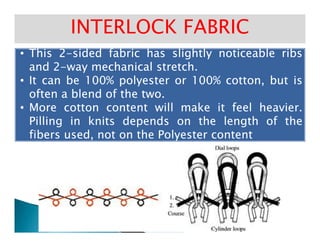
•• ThisThis 22--sidedsided fabricfabric hashas slightlyslightly noticeablenoticeable ribsribs•• ThisThis 22--sidedsided fabricfabric hashas slightlyslightly noticeablenoticeable ribsribs
andand 22--wayway mechanicalmechanical stretchstretch..
•• ItIt cancan bebe 100100%% polyesterpolyester oror 100100%% cotton,cotton, butbut isis
oftenoften aa blendblend ofof thethe twotwo..
•• MoreMore cottoncotton contentcontent willwill makemake itit feelfeel heavierheavier..
PillingPilling inin knitsknits dependsdepends onon thethe lengthlength ofof thethe
INTERLOCK FABRICINTERLOCK FABRIC
PillingPilling inin knitsknits dependsdepends onon thethe lengthlength ofof thethe
fibersfibers used,used, notnot onon thethe PolyesterPolyester contentcontent
•• Both sides of the fabric have an appearance like face sideBoth sides of the fabric have an appearance like face side•• Both sides of the fabric have an appearance like face sideBoth sides of the fabric have an appearance like face side
of the single jersey fabric.of the single jersey fabric.
•• The structure do nor curl at edges when laid flat onThe structure do nor curl at edges when laid flat on
surfacesurface
•• Horizontal and vertical stripes can be produced by usingHorizontal and vertical stripes can be produced by using
coloured yarnscoloured yarns
•• The fabric ravels only from the end knitted lastThe fabric ravels only from the end knitted last
•• The rate of production is low.The rate of production is low.
PROPERTIES OF INTERLOCKPROPERTIES OF INTERLOCK
FABRICFABRIC
•• The rate of production is low.The rate of production is low.
•• Interlock the technical face of plain on both sides so theInterlock the technical face of plain on both sides so the
appearance of face and back are same.appearance of face and back are same.
•• The Wales of each side re exactly apposite to each otherThe Wales of each side re exactly apposite to each other
and are locked together.and are locked together.
•• Widthwise and length elongations are approximately theWidthwise and length elongations are approximately the
same as single jersey .same as single jersey .
•• The fabric can be unraveled from the knitted last.The fabric can be unraveled from the knitted last.
•• Fabric thickness is approximately twice than that ofFabric thickness is approximately twice than that of
single jerseysingle jersey..
Double knitsDouble knits
USE OF INTERLOCK FABRICUSE OF INTERLOCK FABRIC
Double knitsDouble knits
Sweat shirtsSweat shirts
Table matTable mat
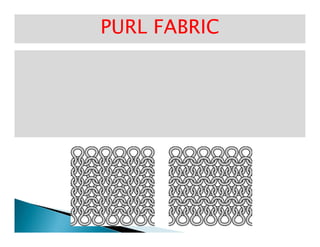
PURL FABRICPURL FABRIC
PROPERTIES OF PURLPROPERTIES OF PURL•• Both sides of the fabric are similar in appearance to theBoth sides of the fabric are similar in appearance to the
reverse side of the single jersey fabricreverse side of the single jersey fabric
•• Both sides of the fabric are similar in appearance to theBoth sides of the fabric are similar in appearance to the
reverse side of the single jersey fabricreverse side of the single jersey fabric
•• Ravels from both endsRavels from both ends
•• Twice the thickness of the plain jerseyTwice the thickness of the plain jersey
•• Rate of production is lowRate of production is low
•• Almost equal extensibility in length and widthAlmost equal extensibility in length and width
•• Most suitable for children’s garments, blankets shawlsMost suitable for children’s garments, blankets shawls
and scarf etc.and scarf etc.
•• Purl is reversible structure the both side appearance arePurl is reversible structure the both side appearance are•• Purl is reversible structure the both side appearance arePurl is reversible structure the both side appearance are
same.same.
•• Extensibility is same as all direction.Extensibility is same as all direction.
•• There is no curling tendency.(it does not curl at theThere is no curling tendency.(it does not curl at the
edges.edges.
•• The fabric will run in the wale direction starting fromThe fabric will run in the wale direction starting from
either end.either end.
•• The fabric tends to be two or three times thicker thanThe fabric tends to be two or three times thicker than
single jersey.single jersey.
•• There are two types of purl needle bed machine: flat bedThere are two types of purl needle bed machine: flat bed
End Uses for PurlEnd Uses for Purl
KnitsKnits
USE OF PURL FABRICUSE OF PURL FABRIC
Infant andInfant and
children’s wearchildren’s wear
SweatersSweaters
ScarvesScarves
Warp KnitsWarp KnitsWarp KnitsWarp Knits
•• Second major category of knit fabricsSecond major category of knit fabrics
•• Characterized by vertical loopsCharacterized by vertical loops
•• More resistant to laddering than weftMore resistant to laddering than weft
knitsknits
WARP KNITTINGWARP KNITTING
knitsknits
•• Usually done on flat knitting machineUsually done on flat knitting machine
•• Two main types of warp knittingTwo main types of warp knitting
machinemachine
(name = machine and fabric name)(name = machine and fabric name)
** TrTr i c o ti c o t
* Raschel* Raschel
Characteristics of Tricot KnitsCharacteristics of Tricot Knits
Good elasticityGood elasticity
Best of warp knitsBest of warp knits
Inexpensive and quick to produceInexpensive and quick to produce
WARP KNITTINGWARP KNITTING
Inexpensive and quick to produceInexpensive and quick to produce
Curls along crosswise edgeCurls along crosswise edge
Good air and water permeabilityGood air and water permeability
SoftSoft
Crease resistantCrease resistant
GoodGood drapeabilitydrapeability
End Uses for Tricot KnitsEnd Uses for Tricot Knits
LingerieLingerie
NightwearNightwear
BlousesBlouses
WARP KNITTINGWARP KNITTING
BlousesBlouses
DressesDresses
Used as a backing fabric in multiUsed as a backing fabric in multi--
component structurescomponent structures
Limited interior uses because of highLimited interior uses because of high
elongationelongation
Tricot Knit VariationsTricot Knit Variations
Brushed tricotBrushed tricot
Satin tricotSatin tricot
WARP KNITTINGWARP KNITTING
Satin tricotSatin tricot
TricotTricot--net fabricsnet fabrics
Tricot upholsteryTricot upholstery
TulleTulle
Raschel KnitsRaschel Knits
Similar to Tricot KnitsSimilar to Tricot Knits
Greater diversity in designGreater diversity in design
Differences between Raschel and TricotDifferences between Raschel and Tricot
WARP KNITTINGWARP KNITTING
Differences between Raschel and TricotDifferences between Raschel and Tricot
KnitsKnits
Raschel has:Raschel has:
More textureMore texture
Open spacesOpen spaces
Made from heavier yarnsMade from heavier yarns
Variations and End Uses of RaschelVariations and End Uses of Raschel
KnitsKnits
Variations and End Uses of RaschelVariations and End Uses of Raschel
KnitsKnits
Warp knittedWarp knitted
Fine laces and netsFine laces and nets
Heavy carpetsHeavy carpets
Thermal underwear with a waffleThermal underwear with a waffle
WARP KNITTINGWARP KNITTING
Heavy carpetsHeavy carpets
Thermal underwear with a waffleThermal underwear with a waffle
effecteffect
PowerPower--net fabrics for swimsuits andnet fabrics for swimsuits and
foundationsfoundations
Heavy blanketsHeavy blankets
May resemble hand crochetedMay resemble hand crocheted
Made by BUBT’s StudentMade by BUBT’s Student

Warp and weft knitting 131225225127-phpapp02 [compatibility mode]

  • 1.
  • 2.
    WARP AND WEFTKNITTINGWARP AND WEFT KNITTING BASIC KNITTINGBASIC KNITTING
  • 3.
    WEAVINGWEAVING--WARPING PROCESSWARPING PROCESS ••WarpingWarping--A process of transfer the warp yarn from the single yarnA process of transfer the warp yarn from the single yarn packages to an even sheet of yarn representing hundreds of endspackages to an even sheet of yarn representing hundreds of ends and then wound onto a warp beam.and then wound onto a warp beam.
  • 4.
    WEAVINGWEAVING--SIZING PROCESSSIZING PROCESS ••Sizing/slashingSizing/slashing--A process to give the strength to the yarn make itA process to give the strength to the yarn make it smoother and lubricate it (no effect on subsequent process orsmoother and lubricate it (no effect on subsequent process or resulting fabric), also reduce the abrasion by give it through theresulting fabric), also reduce the abrasion by give it through the section of thesection of the slasherslasher..
  • 5.
    WEAVINGWEAVING--DRAW IN PROCESSDRAWIN PROCESS DrawDraw--inin-- A process of draw every warp yarns through itsA process of draw every warp yarns through its dropper,dropper, headleheadle eyes and reed dent. [3]eyes and reed dent. [3]
  • 6.
    WEAVINGWEAVING--TIE IN PROCESSTIEIN PROCESS ••TieTie--inin-- A process of tying each of a new beam to itsA process of tying each of a new beam to its corresponding end of the old beam when mass producing thecorresponding end of the old beam when mass producing the same fabric.same fabric.
  • 7.
    What is Knitting?Whatis Knitting?What is Knitting?What is Knitting?What is Knitting?What is Knitting?What is Knitting?What is Knitting?What is Knitting?What is Knitting?What is Knitting?What is Knitting?What is Knitting?What is Knitting?What is Knitting?What is Knitting? Knitting is a method by which thread or yarnKnitting is a method by which thread or yarn may be turned into cloth or other fine crafts.may be turned into cloth or other fine crafts. Knitted fabric consists of consecutive loops,Knitted fabric consists of consecutive loops, called stitches. As each row progresses, a newcalled stitches. As each row progresses, a new loop is pulled through an existing loop. Theloop is pulled through an existing loop. The KNITTINGKNITTING often a garment.often a garment. loop is pulled through an existing loop. Theloop is pulled through an existing loop. The active stitches are held on a needle untilactive stitches are held on a needle until another loop can be passed through them. Thisanother loop can be passed through them. This process eventually results in a final product,process eventually results in a final product, often a garment.often a garment. No of threads required for knitting?No of threads required for knitting?
  • 8.
    KNIT VS WOVENKNITVS WOVEN KNIT FABRICKNIT FABRIC WOVEN FABRICWOVEN FABRIC INTERLOOPING YARNS TO CREATE FABRICINTERLOOPING YARNS TO CREATE FABRIC INTERLACING YARNS TO CREATE FABRICINTERLACING YARNS TO CREATE FABRIC CHEAPER TO PRODUCECHEAPER TO PRODUCE EXPENSIVEEXPENSIVE TO PRODUCETO PRODUCE REQUIRE HIGHER QUALITY YARNSREQUIRE HIGHER QUALITY YARNS CAN USE ANY YARNCAN USE ANY YARN YARNS MUST BE UNIFORM SO THAT THIN SPOTSYARNS MUST BE UNIFORM SO THAT THIN SPOTS DON’T FORM ON THE FABRICDON’T FORM ON THE FABRIC CAN NOT FORM THIN MARKSCAN NOT FORM THIN MARKSDON’T FORM ON THE FABRICDON’T FORM ON THE FABRIC KNIT FABRIC IS LESS OPAQUEKNIT FABRIC IS LESS OPAQUE HIGH OPAQUEHIGH OPAQUE ALLOWS FOR STRETCH + RECOVERY AS BODYALLOWS FOR STRETCH + RECOVERY AS BODY MOVESMOVES LESS STRETCHLESS STRETCH REQUIRES THICKER AND/OR HEAVIER YARN TOREQUIRES THICKER AND/OR HEAVIER YARN TO PROVIDE EQUAL COVER TO THAT OF APROVIDE EQUAL COVER TO THAT OF A WOVENWOVEN EVEN NORMALEVEN NORMAL THICKNESS YARN CAN GIVETHICKNESS YARN CAN GIVE HIGHER FABRIC COVERHIGHER FABRIC COVER WRINKLE RECOVERY SUPERIORWRINKLE RECOVERY SUPERIOR NEEDNEED TO TREAT FOR WRINKLE FREE QUALITYTO TREAT FOR WRINKLE FREE QUALITY
  • 9.
    KNIT VS WOVENKNITVS WOVEN FABRICFABRIC WOVEN FABRICWOVEN FABRIC LENGTHWISE STITCHES ARE CALLED “RIBS” ANDLENGTHWISE STITCHES ARE CALLED “RIBS” AND THE CROSSWISE STITCHES ARE CALLED “COURSE”THE CROSSWISE STITCHES ARE CALLED “COURSE” OR “CROSSGRAIN”OR “CROSSGRAIN” LENGTHWISE STITCHES ARE CALLED “GRAIN”LENGTHWISE STITCHES ARE CALLED “GRAIN” AND THE CROSSWISE STITCHES ARE CALLEDAND THE CROSSWISE STITCHES ARE CALLED “CROSSGRAIN”“CROSSGRAIN” THE MOST STRETCH IS EITHER IN THE CROSSGRAINTHE MOST STRETCH IS EITHER IN THE CROSSGRAIN THE MOST STRETCH IS ALWAYS ON THE BIASTHE MOST STRETCH IS ALWAYS ON THE BIASTHE MOST STRETCH IS EITHER IN THE CROSSGRAINTHE MOST STRETCH IS EITHER IN THE CROSSGRAIN OR THE BIASOR THE BIAS THE MOST STRETCH IS ALWAYS ON THE BIASTHE MOST STRETCH IS ALWAYS ON THE BIAS ( DIAGONAL STRETCH)( DIAGONAL STRETCH) GENERALLY HAVE MORE STRETCH AND NATURALGENERALLY HAVE MORE STRETCH AND NATURAL GIVEGIVE REQUIRE EASE WHEN SEWINGREQUIRE EASE WHEN SEWING MOLD AND FIT THE CONTOURS OF THE BODYMOLD AND FIT THE CONTOURS OF THE BODY BETTERBETTER LOOK GOOD WITH PLEATS AND SHARPLOOK GOOD WITH PLEATS AND SHARP CORNERSCORNERS COOL AND BREATHABLECOOL AND BREATHABLE THICK AND WIND RESISTANTTHICK AND WIND RESISTANT
  • 10.
    KNIT VS WOVENKNITVS WOVEN FABRICFABRIC WOVEN FABRICWOVEN FABRIC EDGES CURL AND SOME KNITS RUN (THINKEDGES CURL AND SOME KNITS RUN (THINK NYLON PANTY HOSE)NYLON PANTY HOSE) EDGES ARE PRONE TO RAVELEDGES ARE PRONE TO RAVEL NO SEAM FINISH IS REQUIRED, ALTHOUGHNO SEAM FINISH IS REQUIRED, ALTHOUGH OPTIONALOPTIONAL REQUIRES SEAM FINISHING, LIKE SERGING, TOREQUIRES SEAM FINISHING, LIKE SERGING, TO PREVENT RAVELPREVENT RAVELOPTIONALOPTIONAL PREVENT RAVELPREVENT RAVEL REQUIRES STRETCH STICHES, LIKE ZIG ZAGSREQUIRES STRETCH STICHES, LIKE ZIG ZAGS EASIEST TO SEW ON AND FEED THROUGH AEASIEST TO SEW ON AND FEED THROUGH A SEWING MACHINESEWING MACHINE
  • 11.
    Types of basicKnitsTypes of basic KnitsTypes of basic KnitsTypes of basic KnitsTypes of basic KnitsTypes of basic KnitsTypes of basic KnitsTypes of basic Knits TYPES OF KNITTINGTYPES OF KNITTING WARPWARP KNITTINGKNITTING WEFT KNITTINGWEFT KNITTING
  • 12.
    JERSEY KNITSJERSEY KNITS ••Also called single knitsAlso called single knits •• Economical to produceEconomical to produce •• Knit stitches on front/ Purl stitches onKnit stitches on front/ Purl stitches on backback WEFT KNITTINGWEFT KNITTING backback RIB KNITSRIB KNITS •• Knit and purl wales alternate across widthKnit and purl wales alternate across width PURL KNITPURL KNIT •• Alternate courses of knit and purl stitchesAlternate courses of knit and purl stitches on both sides of the fabricon both sides of the fabric
  • 13.
    FLAT KNITTINGFLAT KNITTING ••Polo t shirt collar and cuffPolo t shirt collar and cuff •• SweatersSweaters •• ScarvesScarves TYPES OF KNITTINGTYPES OF KNITTING ScarvesScarves WRAP KNITTINGWRAP KNITTING •• LingerieLingerie •• Home furnishingHome furnishing •• Net fabric garments and related itemsNet fabric garments and related items
  • 14.
    WEFTWEFT CIRCULARCIRCULAR TYPES OF KNITTINGTYPESOF KNITTING KNITTINGKNITTING WEFTWEFT FLATFLAT WARPWARP
  • 15.
    Flat bed machinecanFlat bed machine canFlat bed machine canFlat bed machine can manufacture,manufacture, ••Woolen fabricWoolen fabric ••Full cardiganFull cardigan FLAT BED KNITTINGFLAT BED KNITTING ••Full cardiganFull cardigan ••Half cardiganHalf cardigan ••MilanoMilano ••Half MilanoHalf Milano ••Rib structureRib structure
  • 16.
    Circular knitting machinecanCircular knitting machine canCircular knitting machine canCircular knitting machine can manufacture,manufacture, ••T shirt jersey fabricT shirt jersey fabric ••Pique fabricPique fabric CIRCULAR KNITTINGCIRCULAR KNITTING ••Pique fabricPique fabric ••RibRib ••InterlockInterlock ••SocksSocks ••Lycra blend fabricLycra blend fabric
  • 17.
    STITCHSTITCH The loop ofyarn formed by the knitting processThe loop of yarn formed by the knitting process KnitKnit GAGE OR GAUGEGAGE OR GAUGE the density of knitting machine needles, and the number ofthe density of knitting machine needles, and the number of KNITTING TERMINOLOGYKNITTING TERMINOLOGY the density of knitting machine needles, and the number ofthe density of knitting machine needles, and the number of knitting needles per inch (approx. 2.54cm).knitting needles per inch (approx. 2.54cm). The smaller the figure, the coarser the stitch, and vice versaThe smaller the figure, the coarser the stitch, and vice versa
  • 18.
    COURSESCOURSES A series ofsuccessive loops laying crosswiseA series of successive loops laying crosswise COURSESCOURSES A series of successive loops laying crosswiseA series of successive loops laying crosswise in thein the FabricFabric FACE/BACKFACE/BACK Just like a woven fabric, there is a face and aJust like a woven fabric, there is a face and a back toback to KNITTING TERMINOLOGYKNITTING TERMINOLOGY Just like a woven fabric, there is a face and aJust like a woven fabric, there is a face and a back toback to the knitted fabricthe knitted fabric CUTCUT The fineness of weft knits made on a circularThe fineness of weft knits made on a circular knittingknitting MachineMachine The higher the gauge or cut number, theThe higher the gauge or cut number, the
  • 19.
    The knitted loopstructureThe knitted loop structureThe knitted loop structureThe knitted loop structureThe knitted loop structureThe knitted loop structureThe knitted loop structureThe knitted loop structureThe knitted loop structureThe knitted loop structureThe knitted loop structureThe knitted loop structureThe knitted loop structureThe knitted loop structureThe knitted loop structureThe knitted loop structure KNITTED LOOP STRUCTUREKNITTED LOOP STRUCTURE The knitted loop structureThe knitted loop structureThe knitted loop structureThe knitted loop structureThe knitted loop structureThe knitted loop structureThe knitted loop structureThe knitted loop structureThe knitted loop structureThe knitted loop structureThe knitted loop structureThe knitted loop structureThe knitted loop structureThe knitted loop structureThe knitted loop structureThe knitted loop structure These are termed ‘courses’ and ‘wales’These are termed ‘courses’ and ‘wales’ respectively.respectively. A COURSEA COURSE A course is a predominantly horizontal rowA course is a predominantly horizontal row of needle loops (in an upright fabric asof needle loops (in an upright fabric as knitted) produced by adjacent needlesknitted) produced by adjacent needles during the same knitting cycleduring the same knitting cycle
  • 20.
    KNITTED LOOP STRUCTUREKNITTEDLOOP STRUCTURE The knitted loop structureThe knitted loop structureThe knitted loop structureThe knitted loop structureThe knitted loop structureThe knitted loop structureThe knitted loop structureThe knitted loop structureThe knitted loop structureThe knitted loop structureThe knitted loop structureThe knitted loop structureThe knitted loop structureThe knitted loop structureThe knitted loop structureThe knitted loop structure A WALEA WALE A wale is a predominantly vertical column ofA wale is a predominantly vertical column of intermeshed needle loops generallyintermeshed needle loops generally produced by the same needle knitting atproduced by the same needle knitting at successive (not necessarily all) knittingsuccessive (not necessarily all) knitting cycles.cycles.
  • 21.
    •• Single jerseyis the simplest to knit and it can beSingle jersey is the simplest to knit and it can be•• Single jersey is the simplest to knit and it can beSingle jersey is the simplest to knit and it can be produced either on circular or flat machines by means ofproduced either on circular or flat machines by means of one set of needles which draw their loops to only oneone set of needles which draw their loops to only one side of the fabric.side of the fabric. •• The fabric has one appearance on the face side and aThe fabric has one appearance on the face side and a different one on the reverse. The side on which thedifferent one on the reverse. The side on which the straight parts of the stitches appear in V formation isstraight parts of the stitches appear in V formation is called the face side ( Technical Face) and the reverse sidecalled the face side ( Technical Face) and the reverse side SINGLE JERSEY OR PLAINSINGLE JERSEY OR PLAIN FABRICFABRIC ( Technical Back ) has twin rows of opposed semi circles.( Technical Back ) has twin rows of opposed semi circles. called the face side ( Technical Face) and the reverse sidecalled the face side ( Technical Face) and the reverse side ( Technical Back ) has twin rows of opposed semi circles.( Technical Back ) has twin rows of opposed semi circles.
  • 22.
    •• Simplest knitstructure.Simplest knit structure. •• Face side smooth and sheen.Face side smooth and sheen. •• Back side rough and dull.Back side rough and dull. •• Lighter fabric.Lighter fabric. •• Economical.Economical. •• Easily ravels at both the ends.Easily ravels at both the ends. PROPERTIES OF SINGLE JERSEYPROPERTIES OF SINGLE JERSEY •• Easily ravels at both the ends.Easily ravels at both the ends. •• Highly extensible in length and width.Highly extensible in length and width. •• The fabric curls towards the face at the top andThe fabric curls towards the face at the top and bottom and towards the back at the sides.bottom and towards the back at the sides. •• Laddering is very common in these fabrics.Laddering is very common in these fabrics. •• Knitted loops in plain knit fabrics tend to distortKnitted loops in plain knit fabrics tend to distort easily under tension which helps to give a formeasily under tension which helps to give a form fitting and comfort due to property of elastic.fitting and comfort due to property of elastic.
  • 23.
    End Uses ofJerseyEnd Uses of Jersey Knits;Knits; •• SheetsSheets •• SweatersSweaters USE OF SINGLE JERSEYUSE OF SINGLE JERSEY •• SweatersSweaters •• TT-- s h i r t ss h i r t s •• Men’s underwearMen’s underwear •• DressesDresses •• HosieryHosiery
  • 24.
    Jersey KnitJersey KnitJerseyKnitJersey Knit VariationsVariations FleeceFleece IntarsiaIntarsia Jacquard knitsJacquard knits VARIATIONS OF SINGLEVARIATIONS OF SINGLE JERSEYJERSEY Jacquard knitsJacquard knits Knitted terryKnitted terry Knitted velourKnitted velour LisleLisle Plaited knitsPlaited knits SilverSilver--pile knitspile knits
  • 25.
    •• AA fabricfabricinin whichwhich bothboth backback andand faceface loopsloops occuroccur alongalong thethe course,course, butbut allall thethe loopsloops containedcontained withwith inin anyany walewale areare ofof thethe samesame typestypes •• AA ribrib structurestructure impliesimplies aa RIB FABRICRIB FABRIC •• AA ribrib structurestructure impliesimplies aa knittedknitted fabricfabric withwith faceface andand backback loopsloops occurringoccurring inin thethe samesame coursescourses butbut notnot inin thethe samesame walewale •• RibRib fabricfabric cancan bebe producedproduced onon VV –– bedbed machinemachine andand footwearfootwear machinemachine..
  • 26.
    •• Rib isproduced by two sets of needles beingRib is produced by two sets of needles being•• Rib is produced by two sets of needles beingRib is produced by two sets of needles being alternately set orated between each other.alternately set orated between each other. •• The simplest rib in (1 * 1) ribThe simplest rib in (1 * 1) rib •• It is now normally knitted with two sets of latchIt is now normally knitted with two sets of latch needles and known as double jersey fabric.needles and known as double jersey fabric. •• Rib has a vertical cord appearanceRib has a vertical cord appearance •• Relaxed 1 x 1 rib is twice as thick and half theRelaxed 1 x 1 rib is twice as thick and half the PROPERTIES OF RIB FABRICPROPERTIES OF RIB FABRIC •• Relaxed 1 x 1 rib is twice as thick and half theRelaxed 1 x 1 rib is twice as thick and half the width of an equivalent plain fabric.width of an equivalent plain fabric. •• 1 x 1 rib normally relaxes by 30% compound with its1 x 1 rib normally relaxes by 30% compound with its knitting width.knitting width. •• Rib cannot be unroved from the end knitted firstRib cannot be unroved from the end knitted first because the sinker loops are securely anchored bybecause the sinker loops are securely anchored by the cross meshing between face and reverse loop.the cross meshing between face and reverse loop. •• It is used for loops for socks, cuffs of sleeves, ribIt is used for loops for socks, cuffs of sleeves, rib borderybordery for garments.for garments.
  • 27.
    End Uses ofRibEnd Uses of Rib KnitsKnits CollarsCollars NecklinesNecklines USE OF RIB FABRICUSE OF RIB FABRIC NecklinesNecklines CuffsCuffs Bottom edges ofBottom edges of sweaterssweaters Knit hatsKnit hats Men’s hosieryMen’s hosiery
  • 28.
    Double knitsDouble knits SometimescalledSometimes called double jerseysdouble jerseys Thicker than jerseyThicker than jersey knitsknits USE OF RIB FABRICUSE OF RIB FABRIC Thicker than jerseyThicker than jersey knitsknits TwoTwo--way stretchway stretch Very stableVery stable –– will notwill not ladderladder Apparel andApparel and Upholstery usedUpholstery used
  • 29.
    •• ThisThis 22--sidedsidedfabricfabric hashas slightlyslightly noticeablenoticeable ribsribs•• ThisThis 22--sidedsided fabricfabric hashas slightlyslightly noticeablenoticeable ribsribs andand 22--wayway mechanicalmechanical stretchstretch.. •• ItIt cancan bebe 100100%% polyesterpolyester oror 100100%% cotton,cotton, butbut isis oftenoften aa blendblend ofof thethe twotwo.. •• MoreMore cottoncotton contentcontent willwill makemake itit feelfeel heavierheavier.. PillingPilling inin knitsknits dependsdepends onon thethe lengthlength ofof thethe INTERLOCK FABRICINTERLOCK FABRIC PillingPilling inin knitsknits dependsdepends onon thethe lengthlength ofof thethe fibersfibers used,used, notnot onon thethe PolyesterPolyester contentcontent
  • 30.
    •• Both sidesof the fabric have an appearance like face sideBoth sides of the fabric have an appearance like face side•• Both sides of the fabric have an appearance like face sideBoth sides of the fabric have an appearance like face side of the single jersey fabric.of the single jersey fabric. •• The structure do nor curl at edges when laid flat onThe structure do nor curl at edges when laid flat on surfacesurface •• Horizontal and vertical stripes can be produced by usingHorizontal and vertical stripes can be produced by using coloured yarnscoloured yarns •• The fabric ravels only from the end knitted lastThe fabric ravels only from the end knitted last •• The rate of production is low.The rate of production is low. PROPERTIES OF INTERLOCKPROPERTIES OF INTERLOCK FABRICFABRIC •• The rate of production is low.The rate of production is low. •• Interlock the technical face of plain on both sides so theInterlock the technical face of plain on both sides so the appearance of face and back are same.appearance of face and back are same. •• The Wales of each side re exactly apposite to each otherThe Wales of each side re exactly apposite to each other and are locked together.and are locked together. •• Widthwise and length elongations are approximately theWidthwise and length elongations are approximately the same as single jersey .same as single jersey . •• The fabric can be unraveled from the knitted last.The fabric can be unraveled from the knitted last. •• Fabric thickness is approximately twice than that ofFabric thickness is approximately twice than that of single jerseysingle jersey..
  • 31.
    Double knitsDouble knits USEOF INTERLOCK FABRICUSE OF INTERLOCK FABRIC Double knitsDouble knits Sweat shirtsSweat shirts Table matTable mat
  • 32.
  • 33.
    PROPERTIES OF PURLPROPERTIESOF PURL•• Both sides of the fabric are similar in appearance to theBoth sides of the fabric are similar in appearance to the reverse side of the single jersey fabricreverse side of the single jersey fabric •• Both sides of the fabric are similar in appearance to theBoth sides of the fabric are similar in appearance to the reverse side of the single jersey fabricreverse side of the single jersey fabric •• Ravels from both endsRavels from both ends •• Twice the thickness of the plain jerseyTwice the thickness of the plain jersey •• Rate of production is lowRate of production is low •• Almost equal extensibility in length and widthAlmost equal extensibility in length and width •• Most suitable for children’s garments, blankets shawlsMost suitable for children’s garments, blankets shawls and scarf etc.and scarf etc. •• Purl is reversible structure the both side appearance arePurl is reversible structure the both side appearance are•• Purl is reversible structure the both side appearance arePurl is reversible structure the both side appearance are same.same. •• Extensibility is same as all direction.Extensibility is same as all direction. •• There is no curling tendency.(it does not curl at theThere is no curling tendency.(it does not curl at the edges.edges. •• The fabric will run in the wale direction starting fromThe fabric will run in the wale direction starting from either end.either end. •• The fabric tends to be two or three times thicker thanThe fabric tends to be two or three times thicker than single jersey.single jersey. •• There are two types of purl needle bed machine: flat bedThere are two types of purl needle bed machine: flat bed
  • 34.
    End Uses forPurlEnd Uses for Purl KnitsKnits USE OF PURL FABRICUSE OF PURL FABRIC Infant andInfant and children’s wearchildren’s wear SweatersSweaters ScarvesScarves
  • 35.
    Warp KnitsWarp KnitsWarpKnitsWarp Knits •• Second major category of knit fabricsSecond major category of knit fabrics •• Characterized by vertical loopsCharacterized by vertical loops •• More resistant to laddering than weftMore resistant to laddering than weft knitsknits WARP KNITTINGWARP KNITTING knitsknits •• Usually done on flat knitting machineUsually done on flat knitting machine •• Two main types of warp knittingTwo main types of warp knitting machinemachine (name = machine and fabric name)(name = machine and fabric name) ** TrTr i c o ti c o t * Raschel* Raschel
  • 36.
    Characteristics of TricotKnitsCharacteristics of Tricot Knits Good elasticityGood elasticity Best of warp knitsBest of warp knits Inexpensive and quick to produceInexpensive and quick to produce WARP KNITTINGWARP KNITTING Inexpensive and quick to produceInexpensive and quick to produce Curls along crosswise edgeCurls along crosswise edge Good air and water permeabilityGood air and water permeability SoftSoft Crease resistantCrease resistant GoodGood drapeabilitydrapeability
  • 37.
    End Uses forTricot KnitsEnd Uses for Tricot Knits LingerieLingerie NightwearNightwear BlousesBlouses WARP KNITTINGWARP KNITTING BlousesBlouses DressesDresses Used as a backing fabric in multiUsed as a backing fabric in multi-- component structurescomponent structures Limited interior uses because of highLimited interior uses because of high elongationelongation
  • 38.
    Tricot Knit VariationsTricotKnit Variations Brushed tricotBrushed tricot Satin tricotSatin tricot WARP KNITTINGWARP KNITTING Satin tricotSatin tricot TricotTricot--net fabricsnet fabrics Tricot upholsteryTricot upholstery TulleTulle
  • 39.
    Raschel KnitsRaschel Knits Similarto Tricot KnitsSimilar to Tricot Knits Greater diversity in designGreater diversity in design Differences between Raschel and TricotDifferences between Raschel and Tricot WARP KNITTINGWARP KNITTING Differences between Raschel and TricotDifferences between Raschel and Tricot KnitsKnits Raschel has:Raschel has: More textureMore texture Open spacesOpen spaces Made from heavier yarnsMade from heavier yarns
  • 40.
    Variations and EndUses of RaschelVariations and End Uses of Raschel KnitsKnits Variations and End Uses of RaschelVariations and End Uses of Raschel KnitsKnits Warp knittedWarp knitted Fine laces and netsFine laces and nets Heavy carpetsHeavy carpets Thermal underwear with a waffleThermal underwear with a waffle WARP KNITTINGWARP KNITTING Heavy carpetsHeavy carpets Thermal underwear with a waffleThermal underwear with a waffle effecteffect PowerPower--net fabrics for swimsuits andnet fabrics for swimsuits and foundationsfoundations Heavy blanketsHeavy blankets May resemble hand crochetedMay resemble hand crocheted
  • 41.
    Made by BUBT’sStudentMade by BUBT’s Student