Lecture 7 (Knitting Introduction)
Knitting
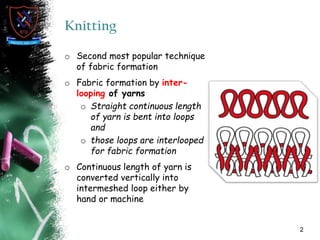
o Second most popular technique
of fabric formation
o Fabric formation by inter-
looping of yarns
o Straight continuous length
of yarn is bent into loops
and
o those loops are interlooped
for fabric formation
o Continuous length of yarn is
converted vertically into
intermeshed loop either by
hand or machine
2
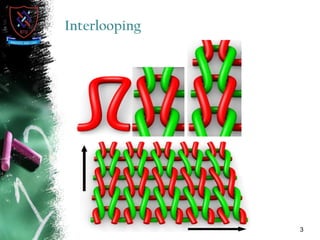
Interlooping
3
Knitting Status
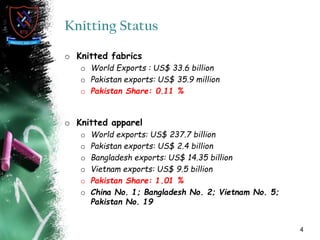
o Knitted fabrics
o World Exports : US$ 33.6 billion
o Pakistan exports: US$ 35.9 million
o Pakistan Share: 0.11 %
o Knitted apparel
o World exports: US$ 237.7 billion
o Pakistan exports: US$ 2.4 billion
o Bangladesh exports: US$ 14.35 billion
o Vietnam exports: US$ 9.5 billion
o Pakistan Share: 1.01 %
o China No. 1; Bangladesh No. 2; Vietnam No. 5;
Pakistan No. 19
4
Knitting Status of Pakistan
o 12,000 knitting machines
o The main export destinations are
o European,
o American and
o UAE markets.
5
Major Knitting Industry
6
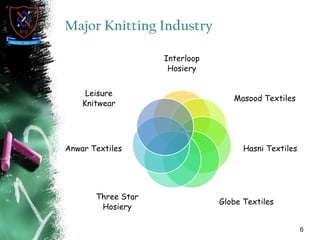
Interloop
Hosiery
Masood Textiles
Hasni Textiles
Globe Textiles
Three Star
Hosiery
Anwar Textiles
Leisure
Knitwear
Knitting Status (Imports & Exports)
7
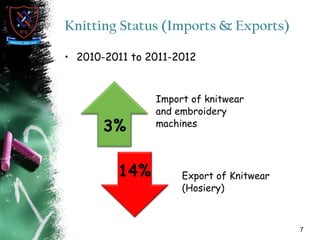
• 2010-2011 to 2011-2012
Import of knitwear
and embroidery
machines
Export of Knitwear
(Hosiery)
14%
3%
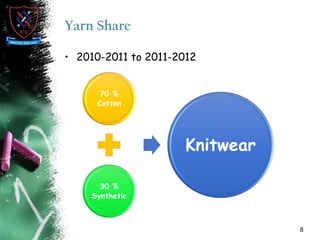
Yarn Share
8
• 2010-2011 to 2011-2012
70 %
Cotton
30 %
Synthetic
Knitwear
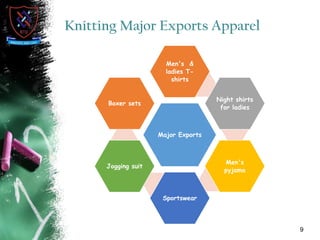
Knitting Major Exports Apparel
9
Major Exports
Men's &
ladies T-
shirts
Night shirts
for ladies
Men's
pyjama
Sportswear
Jogging suit
Boxer sets
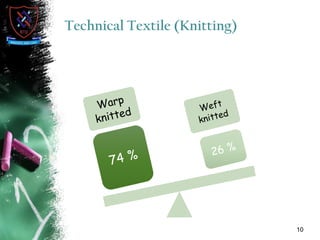
Technical Textile (Knitting)
10
BASIC TERMINOLOGIES
11
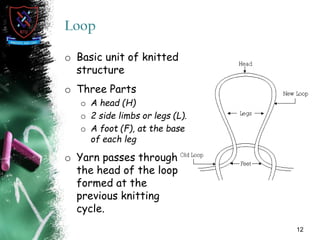
Loop
o Basic unit of knitted
structure
o Three Parts
o A head (H)
o 2 side limbs or legs (L).
o A foot (F), at the base
of each leg
o Yarn passes through
the head of the loop
formed at the
previous knitting
cycle.
12
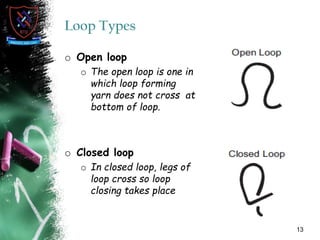
o Open loop
o The open loop is one in
which loop forming
yarn does not cross at
bottom of loop.
o Closed loop
o In closed loop, legs of
loop cross so loop
closing takes place
13
Loop Types
14
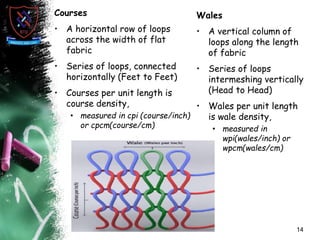
Courses
• A horizontal row of loops
across the width of flat
fabric
• Series of loops, connected
horizontally (Feet to Feet)
• Courses per unit length is
course density,
• measured in cpi (course/inch)
or cpcm(course/cm)
Wales
• A vertical column of
loops along the length
of fabric
• Series of loops
intermeshing vertically
(Head to Head)
• Wales per unit length
is wale density,
• measured in
wpi(wales/inch) or
wpcm(wales/cm)
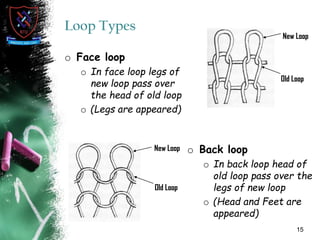
o Face loop
o In face loop legs of
new loop pass over
the head of old loop
o (Legs are appeared)
15
New Loop
Old Loop
New Loop
Old Loop
o Back loop
o In back loop head of
old loop pass over the
legs of new loop
o (Head and Feet are
appeared)
Loop Types
16
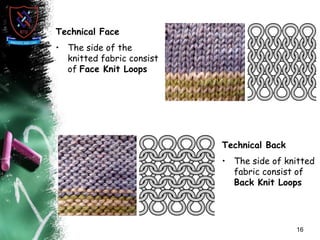
Technical Face
• The side of the
knitted fabric consist
of Face Knit Loops
Technical Back
• The side of knitted
fabric consist of
Back Knit Loops
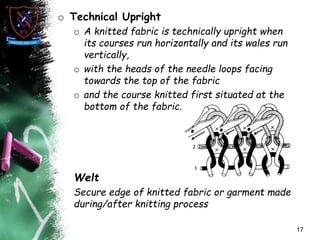
o Technical Upright
o A knitted fabric is technically upright when
its courses run horizontally and its wales run
vertically,
o with the heads of the needle loops facing
towards the top of the fabric
o and the course knitted first situated at the
bottom of the fabric.
Welt
Secure edge of knitted fabric or garment made
during/after knitting process
17
o Stitch length
o length of the yarn in the knitted loop.
o measured in millimetre
o control properties of knitted fabrics
o generally longer the stitch length, the
more open and lighter the fabric.
o Stitch density
o Total number of loops in a given area.
o Is the product of Courses and Wales per
unit length
o measured in units of loops per square
centimetre or loops per square inch.
o CPC x WPC = Loops/Sq. cm
o CPI x WPI = Loops/Sq. in
18
Knitting
o First hand knitting machine was developed
in 5th century.
o Actual Knitting machine was made in 1589
by Willian Lee.
Needle
o Instrument used for intermeshing of loops
Gauge
o Number of needles per unit length of
knitting machine is called gauge
19
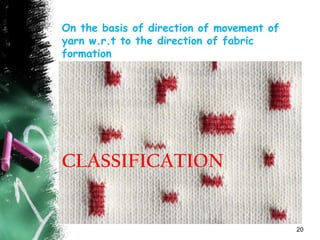
CLASSIFICATION
On the basis of direction of movement of
yarn w.r.t to the direction of fabric
formation
20
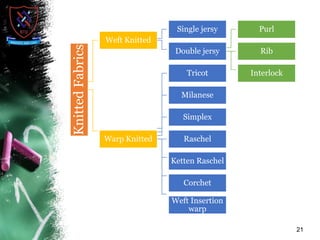
21
Knitted
Fabrics
Weft Knitted
Single jersy
Double jersy
Purl
Rib
Interlock
Warp Knitted
Tricot
Milanese
Simplex
Raschel
Ketten Raschel
Corchet
Weft Insertion
warp
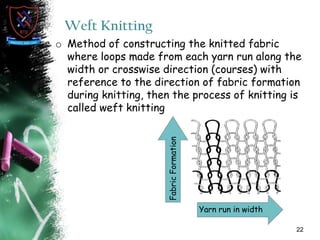
Weft Knitting
o Method of constructing the knitted fabric
where loops made from each yarn run along the
width or crosswise direction (courses) with
reference to the direction of fabric formation
during knitting, then the process of knitting is
called weft knitting
22
Fabric
Formation
Yarn run in width
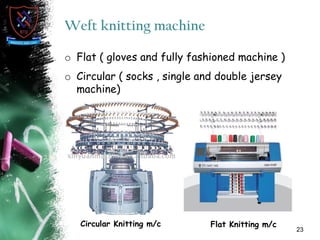
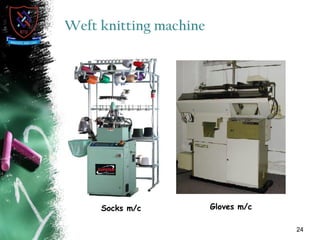
Weft knitting machine
o Flat ( gloves and fully fashioned machine )
o Circular ( socks , single and double jersey
machine)
23
Circular Knitting m/c Flat Knitting m/c
Weft knitting machine
24
Socks m/c Gloves m/c
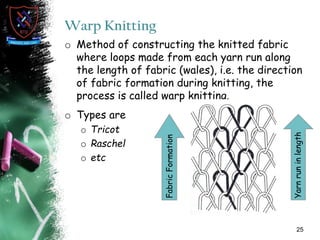
Warp Knitting
o Method of constructing the knitted fabric
where loops made from each yarn run along
the length of fabric (wales), i.e. the direction
of fabric formation during knitting, the
process is called warp knitting.
o Types are
o Tricot
o Raschel
o etc
25
Fabric
Formation
Yarn
run
in
length
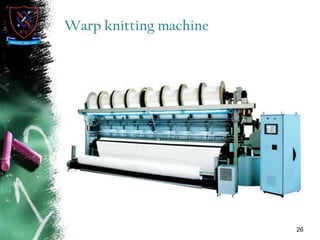
Warp knitting machine
26
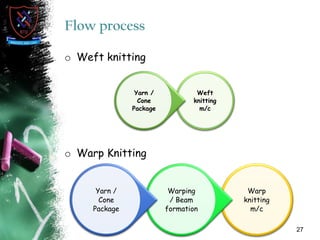
Flow process
o Weft knitting
o Warp Knitting
27
Weft
knitting
m/c
Yarn /
Cone
Package
Warp
knitting
m/c
Warping
/ Beam
formation
Yarn /
Cone
Package
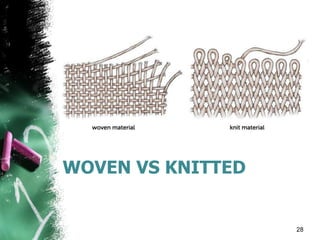
WOVEN VS KNITTED
28
29
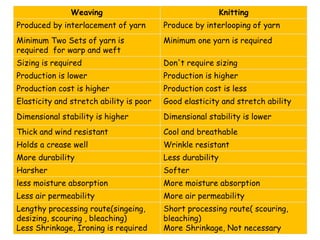
Weaving Knitting
Produced by interlacement of yarn Produce by interlooping of yarn
Minimum Two Sets of yarn is
required for warp and weft
Minimum one yarn is required
Sizing is required Don't require sizing
Production is lower Production is higher
Production cost is higher Production cost is less
Elasticity and stretch ability is poor Good elasticity and stretch ability
Dimensional stability is higher Dimensional stability is lower
Thick and wind resistant Cool and breathable
Holds a crease well Wrinkle resistant
More durability Less durability
Harsher Softer
less moisture absorption More moisture absorption
Less air permeability More air permeability
Lengthy processing route(singeing,
desizing, scouring , bleaching)
Less Shrinkage, Ironing is required
Short processing route( scouring,
bleaching)
More Shrinkage, Not necessary
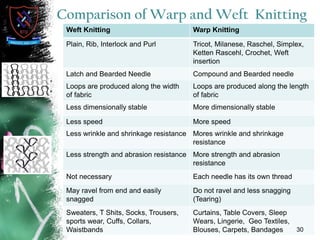
Comparison of Warp and Weft Knitting
Weft Knitting Warp Knitting
Plain, Rib, Interlock and Purl Tricot, Milanese, Raschel, Simplex,
Ketten Rascehl, Crochet, Weft
insertion
Latch and Bearded Needle Compound and Bearded needle
Loops are produced along the width
of fabric
Loops are produced along the length
of fabric
Less dimensionally stable More dimensionally stable
Less speed More speed
Less wrinkle and shrinkage resistance Mores wrinkle and shrinkage
resistance
Less strength and abrasion resistance More strength and abrasion
resistance
Not necessary Each needle has its own thread
May ravel from end and easily
snagged
Do not ravel and less snagging
(Tearing)
Sweaters, T Shits, Socks, Trousers,
sports wear, Cuffs, Collars,
Waistbands
Curtains, Table Covers, Sleep
Wears, Lingerie, Geo Textiles,
Blouses, Carpets, Bandages 30
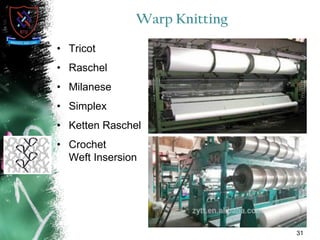
Warp Knitting
31
• Tricot
• Raschel
• Milanese
• Simplex
• Ketten Raschel
• Crochet
Weft Insersion
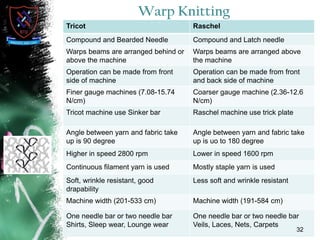
Warp Knitting
Tricot Raschel
Compound and Bearded Needle Compound and Latch needle
Warps beams are arranged behind or
above the machine
Warps beams are arranged above
the machine
Operation can be made from front
side of machine
Operation can be made from front
and back side of machine
Finer gauge machines (7.08-15.74
N/cm)
Coarser gauge machine (2.36-12.6
N/cm)
Tricot machine use Sinker bar Raschel machine use trick plate
Angle between yarn and fabric take
up is 90 degree
Angle between yarn and fabric take
up is uo to 180 degree
Higher in speed 2800 rpm Lower in speed 1600 rpm
Continuous filament yarn is used Mostly staple yarn is used
Soft, wrinkle resistant, good
drapability
Less soft and wrinkle resistant
Machine width (201-533 cm) Machine width (191-584 cm)
One needle bar or two needle bar
Shirts, Sleep wear, Lounge wear
One needle bar or two needle bar
Veils, Laces, Nets, Carpets
32
PROPERTIES &
APPLICATIONS
33
Properties
o Knitted Fabric are popular for their
o Shape fitting property,
o Soft handle,
o Bulkier nature and
o High extension at low tension.
34
35
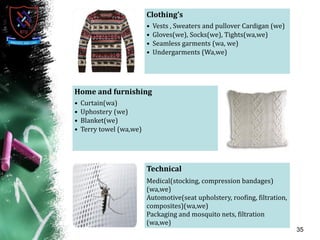
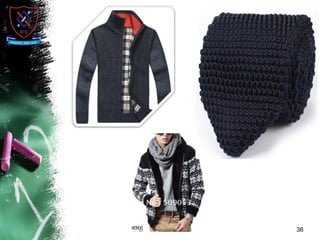
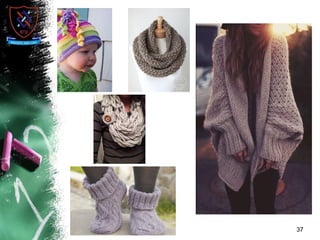
Clothing’s
• Vests , Sweaters and pullover Cardigan (we)
• Gloves(we), Socks(we), Tights(wa,we)
• Seamless garments (wa, we)
• Undergarments (Wa,we)
Home and furnishing
• Curtain(wa)
• Uphostery (we)
• Blanket(we)
• Terry towel (wa,we)
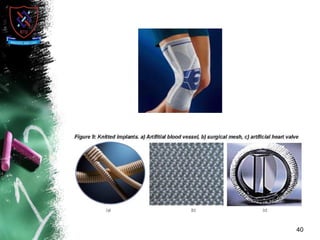
Technical
Medical(stocking, compression bandages)
(wa,we)
Automotive(seat upholstery, roofing, filtration,
composites)(wa,we)
Packaging and mosquito nets, filtration
(wa,we)
36
37
38
39
40

07 knitting basics

  • 1.
    Lecture 7 (KnittingIntroduction)
  • 2.
    Knitting o Second mostpopular technique of fabric formation o Fabric formation by inter- looping of yarns o Straight continuous length of yarn is bent into loops and o those loops are interlooped for fabric formation o Continuous length of yarn is converted vertically into intermeshed loop either by hand or machine 2
  • 3.
  • 4.
    Knitting Status o Knittedfabrics o World Exports : US$ 33.6 billion o Pakistan exports: US$ 35.9 million o Pakistan Share: 0.11 % o Knitted apparel o World exports: US$ 237.7 billion o Pakistan exports: US$ 2.4 billion o Bangladesh exports: US$ 14.35 billion o Vietnam exports: US$ 9.5 billion o Pakistan Share: 1.01 % o China No. 1; Bangladesh No. 2; Vietnam No. 5; Pakistan No. 19 4
  • 5.
    Knitting Status ofPakistan o 12,000 knitting machines o The main export destinations are o European, o American and o UAE markets. 5
  • 6.
    Major Knitting Industry 6 Interloop Hosiery MasoodTextiles Hasni Textiles Globe Textiles Three Star Hosiery Anwar Textiles Leisure Knitwear
  • 7.
    Knitting Status (Imports& Exports) 7 • 2010-2011 to 2011-2012 Import of knitwear and embroidery machines Export of Knitwear (Hosiery) 14% 3%
  • 8.
    Yarn Share 8 • 2010-2011to 2011-2012 70 % Cotton 30 % Synthetic Knitwear
  • 9.
    Knitting Major ExportsApparel 9 Major Exports Men's & ladies T- shirts Night shirts for ladies Men's pyjama Sportswear Jogging suit Boxer sets
  • 10.
  • 11.
  • 12.
    Loop o Basic unitof knitted structure o Three Parts o A head (H) o 2 side limbs or legs (L). o A foot (F), at the base of each leg o Yarn passes through the head of the loop formed at the previous knitting cycle. 12
  • 13.
    o Open loop oThe open loop is one in which loop forming yarn does not cross at bottom of loop. o Closed loop o In closed loop, legs of loop cross so loop closing takes place 13 Loop Types
  • 14.
    14 Courses • A horizontalrow of loops across the width of flat fabric • Series of loops, connected horizontally (Feet to Feet) • Courses per unit length is course density, • measured in cpi (course/inch) or cpcm(course/cm) Wales • A vertical column of loops along the length of fabric • Series of loops intermeshing vertically (Head to Head) • Wales per unit length is wale density, • measured in wpi(wales/inch) or wpcm(wales/cm)
  • 15.
    o Face loop oIn face loop legs of new loop pass over the head of old loop o (Legs are appeared) 15 New Loop Old Loop New Loop Old Loop o Back loop o In back loop head of old loop pass over the legs of new loop o (Head and Feet are appeared) Loop Types
  • 16.
    16 Technical Face • Theside of the knitted fabric consist of Face Knit Loops Technical Back • The side of knitted fabric consist of Back Knit Loops
  • 17.
    o Technical Upright oA knitted fabric is technically upright when its courses run horizontally and its wales run vertically, o with the heads of the needle loops facing towards the top of the fabric o and the course knitted first situated at the bottom of the fabric. Welt Secure edge of knitted fabric or garment made during/after knitting process 17
  • 18.
    o Stitch length olength of the yarn in the knitted loop. o measured in millimetre o control properties of knitted fabrics o generally longer the stitch length, the more open and lighter the fabric. o Stitch density o Total number of loops in a given area. o Is the product of Courses and Wales per unit length o measured in units of loops per square centimetre or loops per square inch. o CPC x WPC = Loops/Sq. cm o CPI x WPI = Loops/Sq. in 18
  • 19.
    Knitting o First handknitting machine was developed in 5th century. o Actual Knitting machine was made in 1589 by Willian Lee. Needle o Instrument used for intermeshing of loops Gauge o Number of needles per unit length of knitting machine is called gauge 19
  • 20.
    CLASSIFICATION On the basisof direction of movement of yarn w.r.t to the direction of fabric formation 20
  • 21.
    21 Knitted Fabrics Weft Knitted Single jersy Doublejersy Purl Rib Interlock Warp Knitted Tricot Milanese Simplex Raschel Ketten Raschel Corchet Weft Insertion warp
  • 22.
    Weft Knitting o Methodof constructing the knitted fabric where loops made from each yarn run along the width or crosswise direction (courses) with reference to the direction of fabric formation during knitting, then the process of knitting is called weft knitting 22 Fabric Formation Yarn run in width
  • 23.
    Weft knitting machine oFlat ( gloves and fully fashioned machine ) o Circular ( socks , single and double jersey machine) 23 Circular Knitting m/c Flat Knitting m/c
  • 24.
  • 25.
    Warp Knitting o Methodof constructing the knitted fabric where loops made from each yarn run along the length of fabric (wales), i.e. the direction of fabric formation during knitting, the process is called warp knitting. o Types are o Tricot o Raschel o etc 25 Fabric Formation Yarn run in length
  • 26.
  • 27.
    Flow process o Weftknitting o Warp Knitting 27 Weft knitting m/c Yarn / Cone Package Warp knitting m/c Warping / Beam formation Yarn / Cone Package
  • 28.
  • 29.
    29 Weaving Knitting Produced byinterlacement of yarn Produce by interlooping of yarn Minimum Two Sets of yarn is required for warp and weft Minimum one yarn is required Sizing is required Don't require sizing Production is lower Production is higher Production cost is higher Production cost is less Elasticity and stretch ability is poor Good elasticity and stretch ability Dimensional stability is higher Dimensional stability is lower Thick and wind resistant Cool and breathable Holds a crease well Wrinkle resistant More durability Less durability Harsher Softer less moisture absorption More moisture absorption Less air permeability More air permeability Lengthy processing route(singeing, desizing, scouring , bleaching) Less Shrinkage, Ironing is required Short processing route( scouring, bleaching) More Shrinkage, Not necessary
  • 30.
    Comparison of Warpand Weft Knitting Weft Knitting Warp Knitting Plain, Rib, Interlock and Purl Tricot, Milanese, Raschel, Simplex, Ketten Rascehl, Crochet, Weft insertion Latch and Bearded Needle Compound and Bearded needle Loops are produced along the width of fabric Loops are produced along the length of fabric Less dimensionally stable More dimensionally stable Less speed More speed Less wrinkle and shrinkage resistance Mores wrinkle and shrinkage resistance Less strength and abrasion resistance More strength and abrasion resistance Not necessary Each needle has its own thread May ravel from end and easily snagged Do not ravel and less snagging (Tearing) Sweaters, T Shits, Socks, Trousers, sports wear, Cuffs, Collars, Waistbands Curtains, Table Covers, Sleep Wears, Lingerie, Geo Textiles, Blouses, Carpets, Bandages 30
  • 31.
    Warp Knitting 31 • Tricot •Raschel • Milanese • Simplex • Ketten Raschel • Crochet Weft Insersion
  • 32.
    Warp Knitting Tricot Raschel Compoundand Bearded Needle Compound and Latch needle Warps beams are arranged behind or above the machine Warps beams are arranged above the machine Operation can be made from front side of machine Operation can be made from front and back side of machine Finer gauge machines (7.08-15.74 N/cm) Coarser gauge machine (2.36-12.6 N/cm) Tricot machine use Sinker bar Raschel machine use trick plate Angle between yarn and fabric take up is 90 degree Angle between yarn and fabric take up is uo to 180 degree Higher in speed 2800 rpm Lower in speed 1600 rpm Continuous filament yarn is used Mostly staple yarn is used Soft, wrinkle resistant, good drapability Less soft and wrinkle resistant Machine width (201-533 cm) Machine width (191-584 cm) One needle bar or two needle bar Shirts, Sleep wear, Lounge wear One needle bar or two needle bar Veils, Laces, Nets, Carpets 32
  • 33.
  • 34.
    Properties o Knitted Fabricare popular for their o Shape fitting property, o Soft handle, o Bulkier nature and o High extension at low tension. 34
  • 35.
    35 Clothing’s • Vests ,Sweaters and pullover Cardigan (we) • Gloves(we), Socks(we), Tights(wa,we) • Seamless garments (wa, we) • Undergarments (Wa,we) Home and furnishing • Curtain(wa) • Uphostery (we) • Blanket(we) • Terry towel (wa,we) Technical Medical(stocking, compression bandages) (wa,we) Automotive(seat upholstery, roofing, filtration, composites)(wa,we) Packaging and mosquito nets, filtration (wa,we)
  • 36.
  • 37.
  • 38.
  • 39.
  • 40.