ASSIGNMENT
Course Tittle: Fabric Manufacturing-II
Course Code: TE-313
Submitted to:
Mr. Asit Ghosh
Assistant Professor
Department of Textile Engineering
Faculty of Engineering
Daffodil International University (DIU)
Submitted by:
Sifat Phychee
Section: A
Department of Textile Engineering
Faculty of Engineering
Daffodil International University (DIU)
Picking and Beating
Pick
Pick is a single weft threats in fabric as woven.
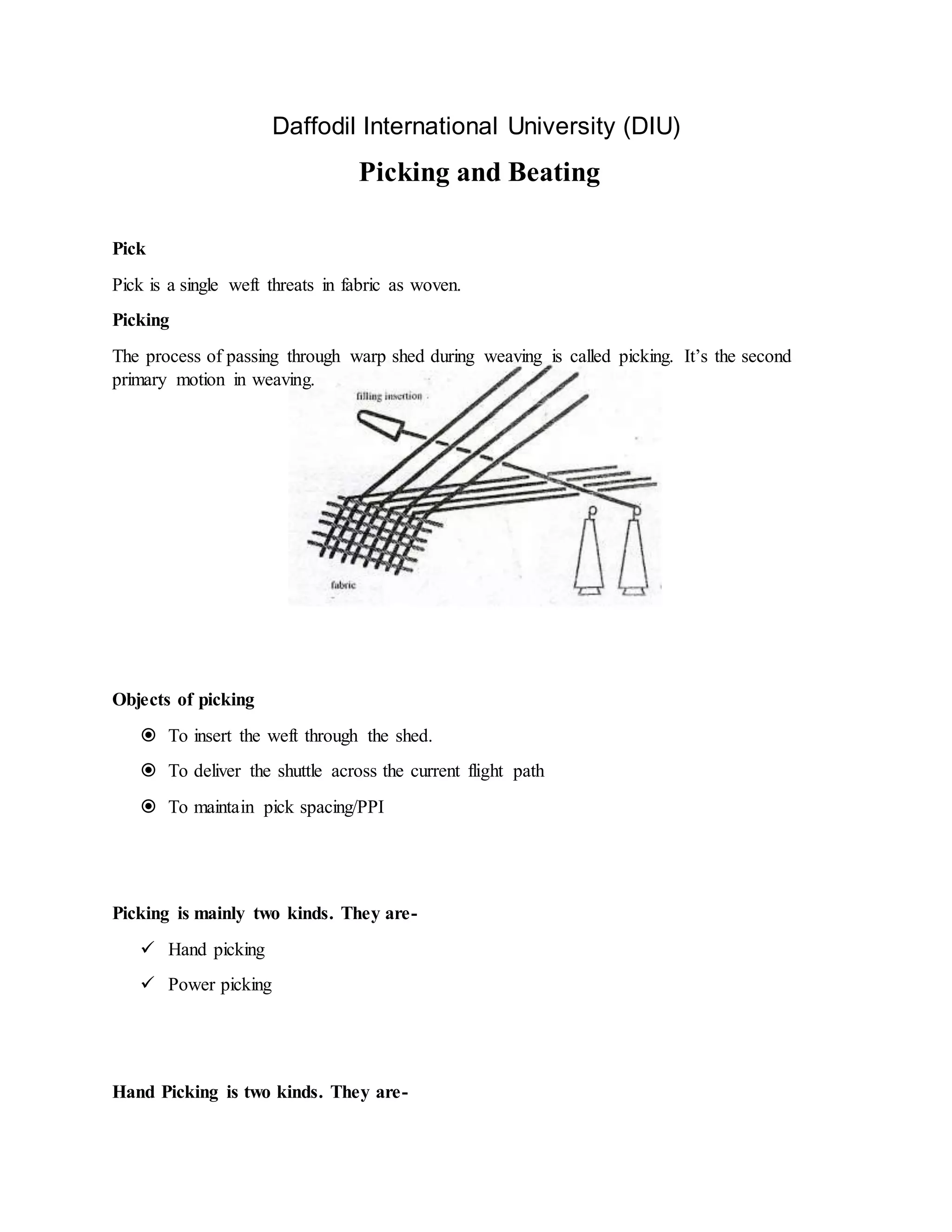
Picking
The process of passing through warp shed during weaving is called picking. It’s the second
primary motion in weaving.
Objects of picking
 To insert the weft through the shed.
 To deliver the shuttle across the current flight path
 To maintain pick spacing/PPI
Picking is mainly two kinds. They are-
 Hand picking
 Power picking
Hand Picking is two kinds. They are-
• Throw shuttle
• Fly shuttle
Power picking is two kinds. They are-
• Conventional
• Modern
Negative Picking:
In this mechanism, a carrier known as shuttle carries the weft yarn in a package called the “pirn”.
Positive Picking
In this mechanism, the weft yarn is inserted through the warp shed directly or positively by air,
water, a projectile, a rapier or a needle
Advantages of positive picking:
ž a small depth of shed
ž Low Warp thread breakage.
ž Pirns are not required.
ž saving in floor space and labor.
ž Produce high quality fabric
Tappet and cone over picking mechanism:
Construction:
 The cone over pick mechanism consists of vertical picking shaft which is placed either
inside or outside the loom framing
 The picking shaft consists of a stud, which is passed through a slot in picking shaft
 The picking tappet placed in contact with picking cone
 The picking tappet is mounted on the bottom shaft
 The picking lever/arm/stick is attached to a ring on the top of picking shaft
 From the forward end of the picking arm a lather picking strap passes down to a buffalo-
hide picker, which is freely mounted upon a spindle, placed over the centre of the shuttle
box
A-Picking Shaft
B-Picking Stick
C-Picking Strap
D-Picker
E-Spindle
F-Shuttle
G-Picking Tappet
H-Picking Cone
I- Bottom Shaft
S- Return Spring
Working principle:
With the rotation of loom/bottom shaft, picking tappet or cam rotates
↓
In revolving, picking tappet nose strikes the cone shaped antifriction roller on the stud and partly
rotates the picking shaft and the picking lever/stitch
↓
The picking arm/lever moves from right side to left side of the loom. It will give angular
movement which causes the picker to move inward with sufficient velocity to drive the shuttle
across the loom
↓
When the picker strikes the shuttle, the shuttle moves into the open shed through race board
↓
Picking is done
↓
The spring causes the picking arm and picker to move back after the delivery of a pick.
Cone under pick mechanism:
Construction:
 Picking tappet is connected with the bottom shaft. There is a cone joined with the side
shaft
 There are two bearings, which are joined with the side shaft
 Side shaft joined with the picking stick with the help of picking strap
 Picking stick is pivoted at eh below. At the upper position of the picking stick picker is
placed above the spindle
 Shuttle is placed at the centre of the picker
A-Tappet
B-Picking Cone
C-Side shaft
D&E-Strap
F- Picking Stick
O-Picker
Y-Shuttle
Figure: side shaft under pick mechanism
Working principle:
The tappet is driven by the bottom shaft
↓
When the picking tappet strikes the picking cone, it displaced and the side shaft is turned
↓
The turning action of side shaft pulls the picking stick which is connected to side shaft by
picking strap
↓
The lower end of picking stick is pivoted. So that is pulled with the pulling of side shaft
↓
Then the picker connected to picking arm strikes the shuttle and causes it to pass through the
warp shed
↓
Picking is done
Difference between over & under pick mechanism:
Over Pick Under Pick
Picking arm is above shuttle box Picking arm is under shuttle box
Works more smoothly Works less smoothly
Relatively higher loom speed Relatively lower loom speed
Used for narrow loom Used for medium & wider loom
It is easy to adjust & maintain It is difficult to adjust & maintain
Less direct action More direct action
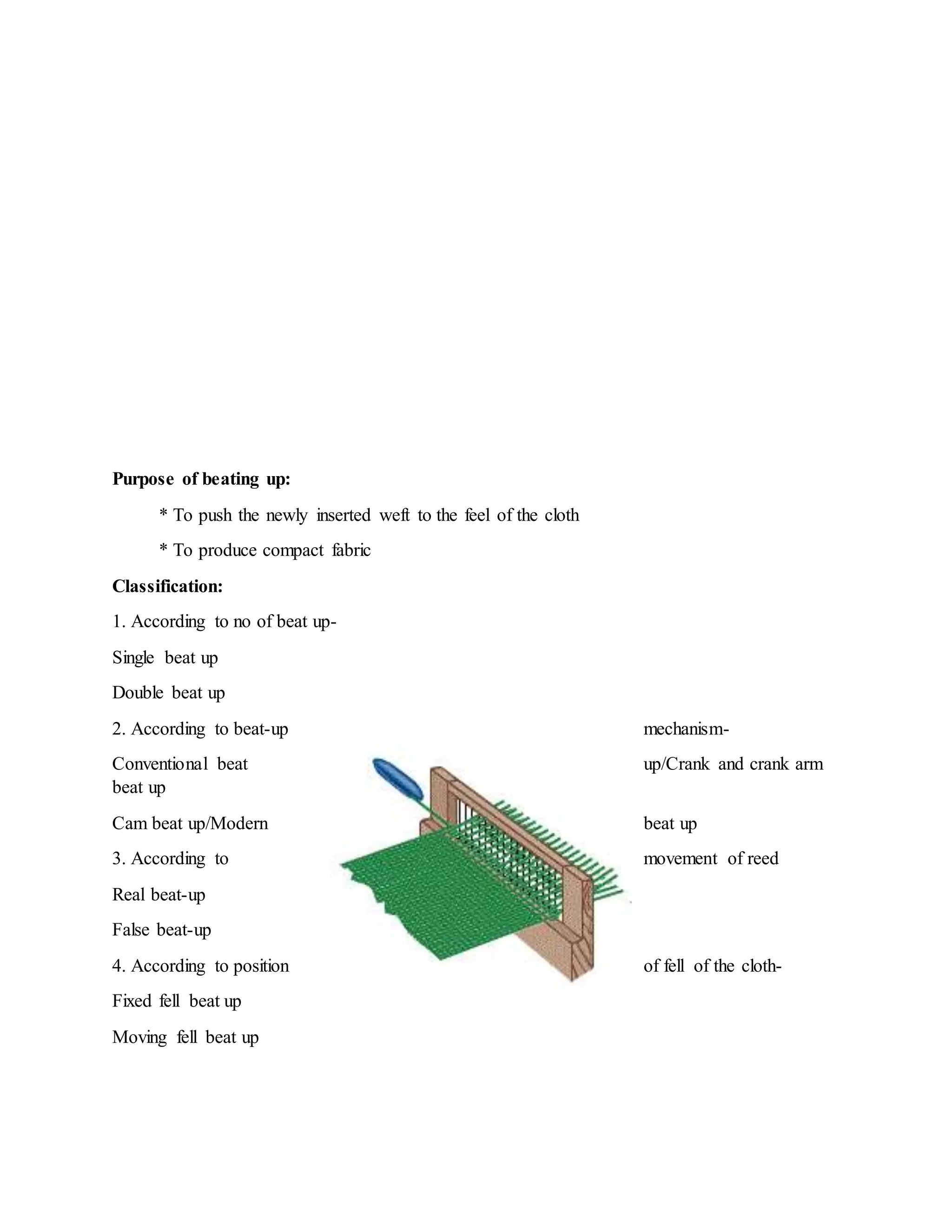
Beating Up
 Beating up is the third of the primary movement in weaving. It consists in driving the last
pick of weft to the fell of the cloth. This is accomplished by the going part with the help
of a reed fixed in the sley .
Purpose of beating up:
* To push the newly inserted weft to the feel of the cloth
* To produce compact fabric
Classification:
1. According to no of beat up-
Single beat up
Double beat up
2. According to beat-up mechanism-
Conventional beat up/Crank and crank arm
beat up
Cam beat up/Modern beat up
3. According to movement of reed
Real beat-up
False beat-up
4. According to position of fell of the cloth-
Fixed fell beat up
Moving fell beat up
Reed
A reed is part of a weaving loom, and resembles a comb. It is used to separate and space the
warp threads, to guide the shuttle's motion across the loom, and to push the weft threads into
place. The reed is securely held by the beater, and consists of a frame with many vertical slits.
Classification:
1. According to no of beat up-
Single beat up
Double beat up
2. According to beat-up mechanism-
Conventional beat up/Crank and crank arm beat up
Cam beat up/Modern beat up
3. According to movement of reed
Real beat-up
False beat-up
4. According to position of fell of
the cloth-
Fixed fell beat up
Moving fell beat up
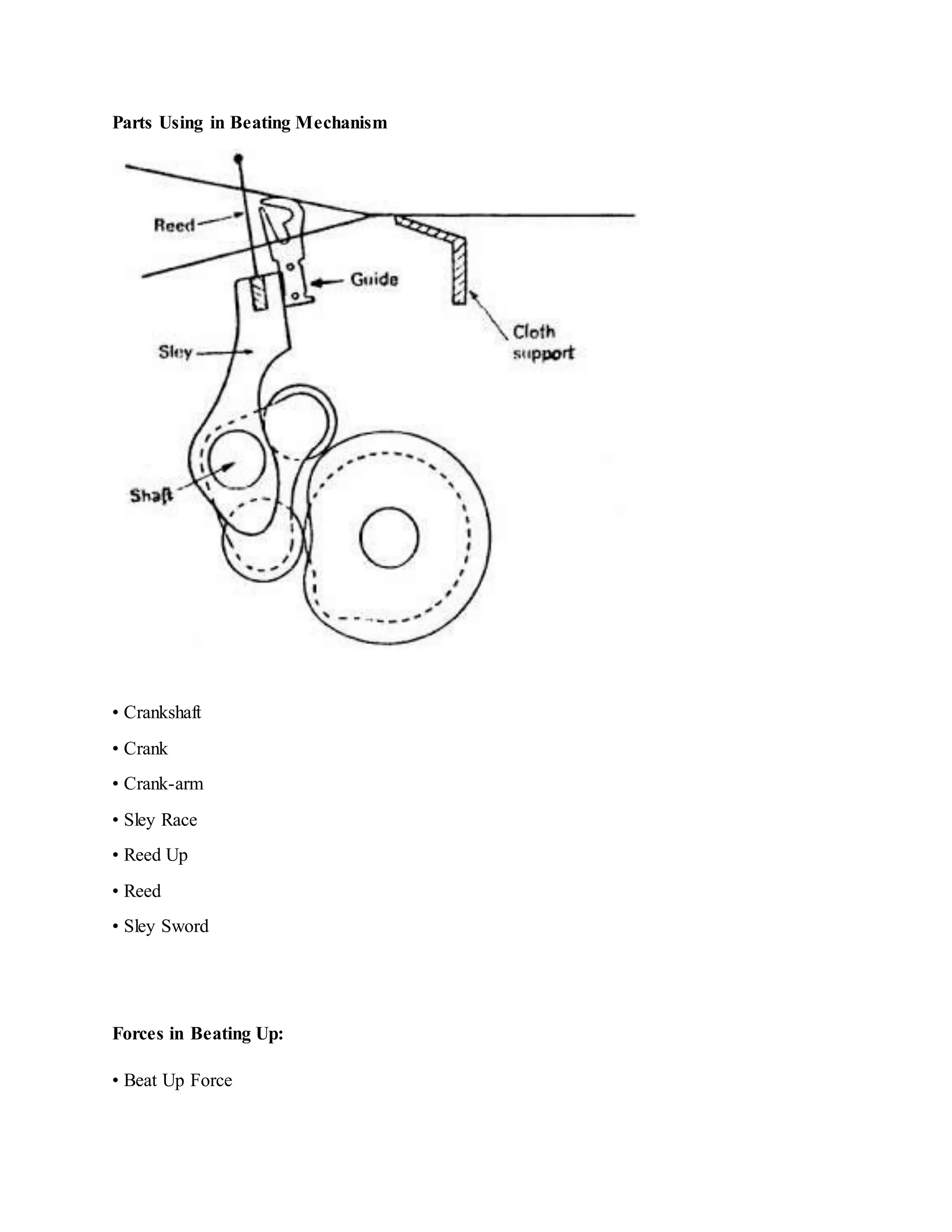
Parts Using in Beating Mechanism
• Crankshaft
• Crank
• Crank-arm
• Sley Race
• Reed Up
• Reed
• Sley Sword
Forces in Beating Up:
• Beat Up Force
• Warp & Fabric Tension
• Weaving Resistance
Factors influencing the Beating Force:
• Pick Spacing
• Weft Yarn Linear Density
• Timing of Shedding
• Warp Tension
Single Beat Up Mechanism
Construction:
1. The lower end of sley sword is pivoted to the rocking shaft and the sley race is connected to
the sley-sword and reed
2. The connecting rod or crank arm is connected to the back of sley-race by a pin called sword
pin and its other end fastens round the bend in the crank shaft, known as cranks
Working principle:
1. For beating up process, the sley sword must reciprocates, the sley sword is connected to the
rocking shaft for this purpose
2. When the crank of the crank shaft rotates and comes in forward position (at 90°), then it
pushes the crank arm forward. Thus crank arm gives to and form movement.
3. As the crank arm is connected to the sley race and reed is situated above the reed race, reed
also moves forward as the crank arm move forwards. The reed pushes the weft in the fell of the
cloth.
In this mechanism, one beat up is done for every picking.
Reed cap
Sword pin
Crank shaft
Sley sword
Rocking shaft
Sley race
Reed
Fig: Single beat up mechanism/Crank
Double Beat Up Mechanism
Construction:
Construction by a sley sword, a crank, a connecting arm, two arms one of them is hinged to the
framing & other is attached to sley by usual connecting pin.
The sley is wooden frame accommodating two shuttle boxes, a sleyrace, a reed, a reed cap and
two sley-swords. It swings forward and backward. At its forward motion, the last pick of weft is
beaten up to the fell of the cloth, and at its backward motion the shuttle is allowed to pass over
the sley-race through the open shed. So its forward centre position is known as beating up
position and the back centre position is called shedding and picking position.
Working principle:
 In one drawing the arms E & F are straight but when the crank moves to the top centre it
is pushed up & E,F are bent.
 When the crank moves & there comes a stage when the arm become straight & a beat-up
is done by the system.
 When the crank again moves up, the knuckle joint moves up & again the arms become
straight & cause beat-up.
 Hence the two beatup is done for a pick.
 The time, that elapses between the first & second straightening, can be increased either
by moving the crank centre up or by lengthening the crank arm
 Lowering the crank or shortening connecting arm can reduce time
 Lengthening the size of the crank the force of beat up may also be increased
The sley gets motion from the rotation of crank via a crank arm. When the crank shaft rotates it
pushes and pulls the sley with the help of it pushes and pulls the sley with the help of the crank
arm in forward and backward direction.
Connecting arm
G
Arm
Fixed point
Reed cap
Reed
Connecting pin
Sley sword
Rocking shaft
Arm
H
Fixed position/ Frame
Fig: Double Beat-up mechanism

Picking and beating

  • 1.
    ASSIGNMENT Course Tittle: FabricManufacturing-II Course Code: TE-313 Submitted to: Mr. Asit Ghosh Assistant Professor Department of Textile Engineering Faculty of Engineering Daffodil International University (DIU) Submitted by: Sifat Phychee Section: A Department of Textile Engineering Faculty of Engineering
  • 2.
    Daffodil International University(DIU) Picking and Beating Pick Pick is a single weft threats in fabric as woven. Picking The process of passing through warp shed during weaving is called picking. It’s the second primary motion in weaving. Objects of picking  To insert the weft through the shed.  To deliver the shuttle across the current flight path  To maintain pick spacing/PPI Picking is mainly two kinds. They are-  Hand picking  Power picking Hand Picking is two kinds. They are-
  • 3.
    • Throw shuttle •Fly shuttle Power picking is two kinds. They are- • Conventional • Modern Negative Picking: In this mechanism, a carrier known as shuttle carries the weft yarn in a package called the “pirn”. Positive Picking In this mechanism, the weft yarn is inserted through the warp shed directly or positively by air, water, a projectile, a rapier or a needle
  • 4.
    Advantages of positivepicking: ž a small depth of shed ž Low Warp thread breakage. ž Pirns are not required. ž saving in floor space and labor. ž Produce high quality fabric Tappet and cone over picking mechanism: Construction:  The cone over pick mechanism consists of vertical picking shaft which is placed either inside or outside the loom framing  The picking shaft consists of a stud, which is passed through a slot in picking shaft  The picking tappet placed in contact with picking cone  The picking tappet is mounted on the bottom shaft  The picking lever/arm/stick is attached to a ring on the top of picking shaft  From the forward end of the picking arm a lather picking strap passes down to a buffalo- hide picker, which is freely mounted upon a spindle, placed over the centre of the shuttle box
  • 5.
    A-Picking Shaft B-Picking Stick C-PickingStrap D-Picker E-Spindle F-Shuttle G-Picking Tappet H-Picking Cone I- Bottom Shaft S- Return Spring Working principle: With the rotation of loom/bottom shaft, picking tappet or cam rotates ↓ In revolving, picking tappet nose strikes the cone shaped antifriction roller on the stud and partly rotates the picking shaft and the picking lever/stitch ↓ The picking arm/lever moves from right side to left side of the loom. It will give angular movement which causes the picker to move inward with sufficient velocity to drive the shuttle across the loom ↓ When the picker strikes the shuttle, the shuttle moves into the open shed through race board ↓ Picking is done ↓ The spring causes the picking arm and picker to move back after the delivery of a pick. Cone under pick mechanism: Construction:  Picking tappet is connected with the bottom shaft. There is a cone joined with the side shaft
  • 6.
     There aretwo bearings, which are joined with the side shaft  Side shaft joined with the picking stick with the help of picking strap  Picking stick is pivoted at eh below. At the upper position of the picking stick picker is placed above the spindle  Shuttle is placed at the centre of the picker A-Tappet B-Picking Cone C-Side shaft D&E-Strap F- Picking Stick O-Picker Y-Shuttle Figure: side shaft under pick mechanism Working principle: The tappet is driven by the bottom shaft ↓ When the picking tappet strikes the picking cone, it displaced and the side shaft is turned ↓
  • 7.
    The turning actionof side shaft pulls the picking stick which is connected to side shaft by picking strap ↓ The lower end of picking stick is pivoted. So that is pulled with the pulling of side shaft ↓ Then the picker connected to picking arm strikes the shuttle and causes it to pass through the warp shed ↓ Picking is done Difference between over & under pick mechanism: Over Pick Under Pick Picking arm is above shuttle box Picking arm is under shuttle box Works more smoothly Works less smoothly Relatively higher loom speed Relatively lower loom speed Used for narrow loom Used for medium & wider loom It is easy to adjust & maintain It is difficult to adjust & maintain Less direct action More direct action Beating Up  Beating up is the third of the primary movement in weaving. It consists in driving the last pick of weft to the fell of the cloth. This is accomplished by the going part with the help of a reed fixed in the sley .
  • 8.
    Purpose of beatingup: * To push the newly inserted weft to the feel of the cloth * To produce compact fabric Classification: 1. According to no of beat up- Single beat up Double beat up 2. According to beat-up mechanism- Conventional beat up/Crank and crank arm beat up Cam beat up/Modern beat up 3. According to movement of reed Real beat-up False beat-up 4. According to position of fell of the cloth- Fixed fell beat up Moving fell beat up
  • 9.
    Reed A reed ispart of a weaving loom, and resembles a comb. It is used to separate and space the warp threads, to guide the shuttle's motion across the loom, and to push the weft threads into place. The reed is securely held by the beater, and consists of a frame with many vertical slits. Classification: 1. According to no of beat up- Single beat up Double beat up 2. According to beat-up mechanism- Conventional beat up/Crank and crank arm beat up Cam beat up/Modern beat up 3. According to movement of reed Real beat-up False beat-up 4. According to position of fell of the cloth- Fixed fell beat up Moving fell beat up
  • 10.
    Parts Using inBeating Mechanism • Crankshaft • Crank • Crank-arm • Sley Race • Reed Up • Reed • Sley Sword Forces in Beating Up: • Beat Up Force
  • 11.
    • Warp &Fabric Tension • Weaving Resistance Factors influencing the Beating Force: • Pick Spacing • Weft Yarn Linear Density • Timing of Shedding • Warp Tension Single Beat Up Mechanism Construction: 1. The lower end of sley sword is pivoted to the rocking shaft and the sley race is connected to the sley-sword and reed 2. The connecting rod or crank arm is connected to the back of sley-race by a pin called sword pin and its other end fastens round the bend in the crank shaft, known as cranks Working principle: 1. For beating up process, the sley sword must reciprocates, the sley sword is connected to the rocking shaft for this purpose 2. When the crank of the crank shaft rotates and comes in forward position (at 90°), then it pushes the crank arm forward. Thus crank arm gives to and form movement. 3. As the crank arm is connected to the sley race and reed is situated above the reed race, reed also moves forward as the crank arm move forwards. The reed pushes the weft in the fell of the cloth. In this mechanism, one beat up is done for every picking.
  • 12.
    Reed cap Sword pin Crankshaft Sley sword Rocking shaft Sley race Reed Fig: Single beat up mechanism/Crank Double Beat Up Mechanism Construction: Construction by a sley sword, a crank, a connecting arm, two arms one of them is hinged to the framing & other is attached to sley by usual connecting pin. The sley is wooden frame accommodating two shuttle boxes, a sleyrace, a reed, a reed cap and two sley-swords. It swings forward and backward. At its forward motion, the last pick of weft is beaten up to the fell of the cloth, and at its backward motion the shuttle is allowed to pass over the sley-race through the open shed. So its forward centre position is known as beating up position and the back centre position is called shedding and picking position. Working principle:  In one drawing the arms E & F are straight but when the crank moves to the top centre it is pushed up & E,F are bent.  When the crank moves & there comes a stage when the arm become straight & a beat-up is done by the system.
  • 13.
     When thecrank again moves up, the knuckle joint moves up & again the arms become straight & cause beat-up.  Hence the two beatup is done for a pick.  The time, that elapses between the first & second straightening, can be increased either by moving the crank centre up or by lengthening the crank arm  Lowering the crank or shortening connecting arm can reduce time  Lengthening the size of the crank the force of beat up may also be increased The sley gets motion from the rotation of crank via a crank arm. When the crank shaft rotates it pushes and pulls the sley with the help of it pushes and pulls the sley with the help of the crank arm in forward and backward direction. Connecting arm G Arm Fixed point Reed cap Reed Connecting pin Sley sword Rocking shaft Arm H Fixed position/ Frame Fig: Double Beat-up mechanism