Vygotsky’s Socio-
cultural
Perspective
Jammu University
2 Year B.Ed.
Paper 102
Sem: I
Unit: III
This work is licensed under a Creative Commons Attribution-ShareAlike 4.0 International
License.
Biography
 “The Mozart of Psychology”
Lev Vygotsky 1896-1934
A Russian psychologist and educator
Born 1896 (same year as Piaget)
Jewish middle class family
Privately tutored
Graduated Moscow State University 1917
Taught literature and psychology for seven years
Post-World War revolutionary Russia
Over 100 books and articles
Theory not known among English-speaking
educators until 1960s when works were translated
Few scholarly works published during his lifetime
Shortly after his death Vygotsky’s work was
banned in the Soviet Union for more than twenty
years
He died on June 10, 1934 at 37 after long battle
with TB
He is considered a influential thinker in
psychology, and much of his work is still
discovered and explored today
Vygotsky Theory is that social interaction plays a
very important in cognitive development
Did not focus on the individual child but on the
child as a product of social interaction, especially
with adults
Focus on dynamic interactions rather than child
by himself
People thinking differs dramatically between
cultures because different cultures stress different
things
Some terms
ontogenetic development
development of the individual over his or her lifetime.
microgenetic development
changes that occur over relatively brief periods of
time, in seconds, minutes, or days, as opposed to larger-
scale changes, as conventionally studied in ontogenetic
development.
phylogenetic development
development over evolutionary time.
sociohistorical development
changes that have occurred in one’s culture and the
values, norms, and technologies such a history has
generated.
cognitive growth occurs in a sociocultural
context that influences the form it takes,
and
many of a child’s most noteworthy
cognitive skills evolve from social
interactions with parents, teachers, and
other more competent associates.
Two main principles
The More Knowledgeable Other (MKO) -
anyone who has better understanding or higher
ability level than the learner
Normally thought of as being a teacher, trainer,
or older, adult, but MKO could also peers, a
younger person, even computers
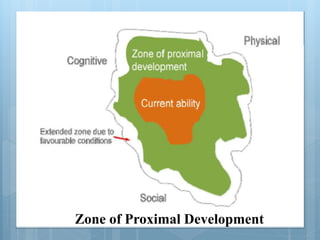
ZPD= Zone of Proximal Development
Zone of Proximal Development
 ZPD= Difference between what child can accomplish
alone and s/he can accomplish with the guidance of
another
 The range of tasks a child cannot yet do on their own,
but can do with the help of others is known as the Zone
of Proximal Development (ZPD)
 Children can perform more challenging tasks when
assisted
 Challenging tasks promote maximum cognitive growth
 Actual developmental level – Extent to which the child
can perform tasks independently
 Level of potential development – Extent to which the
child can perform tasks with assistance
 To help a child move through the ZPD, assistance is
provided by scaffolding
 Zone of Proximal Beyond reach Development is a
distance between at present the actual developmental
level determined by individual problem solving and the
level of development ZPD as determined through
problem solving under guidance or in collaboration
with more capable peers
 Child’s current achievement Within the ZPD are those
skills or tasks too difficult for a child to master on his
or her own; but that can be done with guidance and
encouragement from a knowledgeable person
Two features of ZPD
 I. Scaffolding
 Appropriate assistance given by the teacher to assist the
learner accomplish a task
 Requires that an instructor shows example how to solve
a problem, while controlling the learning environment
so that students can take things step by step expanding
their knowledge without excessive frustration
 II. Reciprocal Teaching
 A highly successful teaching method, it provides an
environment of open dialogue between student and
teacher which goes beyond a simple question and
answer session.
Scaffolding
Assistance provided by more competent peers
or adults to enable the task to be done
successfully
 Scaffolded instruction allows the learner to
move through the ZPD
Modelling; feedback; instruction; questioning;
encouragement; task structuring; chunking;
breaking the problem down
Scaffolding is gradually withdrawn
Four basic principles of Vygotsky
1) Children construct their knowledge
2) Development cannot be separated from its
social context
3) Learning is mediated
4) Language plays a central role in mental
development
Two types of mental functions
1. Lower Mental Function - Are those with
which we are born, are the natural functions
and are genetically determined.
2. Higher Mental Function - Are acquired and
developed through social interaction.
Teaching implications
Students need many opportunities to
learn with a teacher and with more-
skilled peers
Work within the zone of proximal
development – Establish a level of
difficulty
Challenging, but not too difficult
May mean differentiating learning
experiences – Evaluate independent
performance
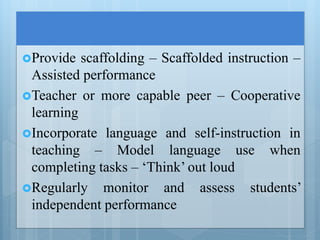
Provide scaffolding – Scaffolded instruction –
Assisted performance
Teacher or more capable peer – Cooperative
learning
Incorporate language and self-instruction in
teaching – Model language use when
completing tasks – ‘Think’ out loud
Regularly monitor and assess students’
independent performance
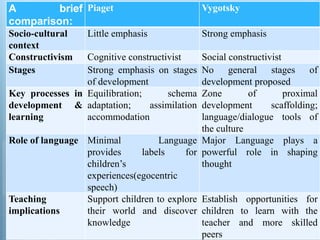
A brief
comparison:
Piaget Vygotsky
Socio-cultural
context
Little emphasis Strong emphasis
Constructivism Cognitive constructivist Social constructivist
Stages Strong emphasis on stages
of development
No general stages of
development proposed
Key processes in
development &
learning
Equilibration; schema
adaptation; assimilation
accommodation
Zone of proximal
development scaffolding;
language/dialogue tools of
the culture
Role of language Minimal Language
provides labels for
children’s
experiences(egocentric
speech)
Major Language plays a
powerful role in shaping
thought
Teaching
implications
Support children to explore
their world and discover
knowledge
Establish opportunities for
children to learn with the
teacher and more skilled
peers
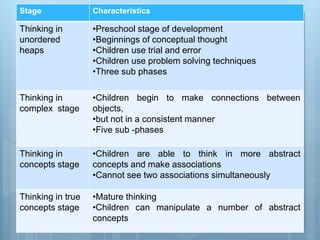
Stage Characteristics
Thinking in
unordered
heaps
•Preschool stage of development
•Beginnings of conceptual thought
•Children use trial and error
•Children use problem solving techniques
•Three sub phases
Thinking in
complex stage
•Children begin to make connections between
objects,
•but not in a consistent manner
•Five sub -phases
Thinking in
concepts stage
•Children are able to think in more abstract
concepts and make associations
•Cannot see two associations simultaneously
Thinking in true
concepts stage
•Mature thinking
•Children can manipulate a number of abstract
concepts
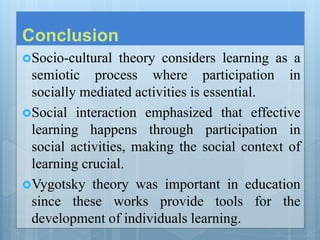
Conclusion
Socio-cultural theory considers learning as a
semiotic process where participation in
socially mediated activities is essential.
Social interaction emphasized that effective
learning happens through participation in
social activities, making the social context of
learning crucial.
Vygotsky theory was important in education
since these works provide tools for the
development of individuals learning.
Vygotsky’s Theory of Language and
Thought
Vygotsky agreed with Piaget that the child’s earliest thinking is
prelinguistic
early language often reflects what the child already knows
thought and language eventually merge and that many of the
nonsocial utterances that Piaget called “egocentric” actually
illustrate the transition from prelinguistic to verbal reasoning
preschool children’s self-directed monologues occur more often
in some contexts than in others, specifically as they attempt to
solve problems or achieve important goals
this nonsocial speech increased substantially whenever these
young problem solvers encountered obstacles in pursuing their
objectives.
nonsocial speech is not egocentric but
communicative; it is a “speech for self,” or
private speech, that helps young children to
plan strategies and regulate their behavior so
that they are more likely to accomplish their
goals
language play a critical role in cognitive
development by making children more
organized and efficient problem solvers
Primitive Stage
babies cry and babble
These are examples of the primitive stage of
language development.
The sounds produced serve no real purpose except
to produce the sound and experiment with our new
capability.
Just as a baby laid on his belly may make crawling
motions yet not crawl, the baby may also make
sounds without producing speech.
As the baby does not produce speech, there is also
not verbal thought, or internal monologue.
This does not mean the baby does not think, it
only means that the child has not yet internalized
his speech.
The verbalization performed at this stage serve
no purpose except to practice sound.
There is no reason for the child to internalize
during this stage.
Naive Stage
As the child begins to speak, he learns how to say words
far before he learns their meaning and function
An example of this manifestation is “ball”
To the child this one word can mean a variety of things
(“where is my ball”, “give me the ball”, etc.)
To an adult with an established knowledge of language,
this word refers to a child’s toy, to a child though it can
have various meanings
As the child develops and gains understanding of new
words, he begins to produce naïve sentences like “where
ball” and “where is the ball”
The child uses these structures without any
understanding of how to put a sentence together
or why the words must go in that order.
He only knows that when the words are said in
a certain way, others understand his meaning.
Understanding of word order comes about
before the child learns the logic of how the
words fit in that order.
External Stage
child begins to use external objects to represent
words
characterized by the child using flash cards,
objects, or fingers when counting
Rhyming is also used during this stage to improve
memory and sound recognition
Another interesting event is the beginning of
egocentric speech
The child will talk to himself when there is no one
else around and also during play with others
This is the child’s verbalization of thought
Ingrowth Stage
 As the child’s egocentric speech turns inward,
he enters the final stage
He uses the skills he has acquired to perform
logical tasks internally
Rather than counting aloud, he will count “in
his head” using part of his short term memory
This much faster than verbalizing each thought
and just as his initial speech developed with
practice, the more internalized thought and logic
is used, the better the child can perform.
Language Development
particularly interested in the role of language in
cognitive development
language is vital to human interactions,
believed that language was the most important
tool that human could utilize
Language, especially in the realm of
collaborative dialogue, is the way the more
knowledgeable other communications important
information to a child
believed that there are three forms of language
Social Speech –referred to as the external
communication that people use to talk with other people,
and he believed that this form of language was typical in
children from the age of two.
Private Speech –referred to as the internal
communication that a person directs to themselves. It
serves an intellectual function, and it is typical in children
from the age of three.
Silent Inner Speech –happens when private speech
diminishes in its audibility until it become a self-
regulating function. believed this was typical in children
from the age of seven.
focus on language as a part of cognitive development
was based on the idea that at the beginning of a child’s
life, language and thought begin as separate systems
within a child’s brain
Believed these two systems would merge in the child at
around the age of three, and the two systems would
become interdependent
As the two systems become interdependent, a child’s
communication can be internalized to become private
speech to the self, and this internalization of language is
an important component to a child’s cognitive
development.
private speech was an important mile marker
in a child’s cognitive development because it’s
the moment in a child’s development where
thoughts become connected with words, and a
child begins exhibiting verbal thinking.
Whereas social interaction is an important part
of cognitive development as a child learns
from a more knowledgeable other, private
speech allows a child to begin the
collaborative process of learning with
themselves.

Vygotsky: socio-cultural perspective

  • 1.
    Vygotsky’s Socio- cultural Perspective Jammu University 2Year B.Ed. Paper 102 Sem: I Unit: III This work is licensed under a Creative Commons Attribution-ShareAlike 4.0 International License.
  • 2.
    Biography  “The Mozartof Psychology” Lev Vygotsky 1896-1934 A Russian psychologist and educator Born 1896 (same year as Piaget) Jewish middle class family Privately tutored Graduated Moscow State University 1917 Taught literature and psychology for seven years Post-World War revolutionary Russia
  • 3.
    Over 100 booksand articles Theory not known among English-speaking educators until 1960s when works were translated Few scholarly works published during his lifetime Shortly after his death Vygotsky’s work was banned in the Soviet Union for more than twenty years He died on June 10, 1934 at 37 after long battle with TB He is considered a influential thinker in psychology, and much of his work is still discovered and explored today
  • 4.
    Vygotsky Theory isthat social interaction plays a very important in cognitive development Did not focus on the individual child but on the child as a product of social interaction, especially with adults Focus on dynamic interactions rather than child by himself People thinking differs dramatically between cultures because different cultures stress different things
  • 5.
    Some terms ontogenetic development developmentof the individual over his or her lifetime. microgenetic development changes that occur over relatively brief periods of time, in seconds, minutes, or days, as opposed to larger- scale changes, as conventionally studied in ontogenetic development. phylogenetic development development over evolutionary time. sociohistorical development changes that have occurred in one’s culture and the values, norms, and technologies such a history has generated.
  • 6.
    cognitive growth occursin a sociocultural context that influences the form it takes, and many of a child’s most noteworthy cognitive skills evolve from social interactions with parents, teachers, and other more competent associates.
  • 7.
    Two main principles TheMore Knowledgeable Other (MKO) - anyone who has better understanding or higher ability level than the learner Normally thought of as being a teacher, trainer, or older, adult, but MKO could also peers, a younger person, even computers ZPD= Zone of Proximal Development
  • 8.
    Zone of ProximalDevelopment
  • 9.
     ZPD= Differencebetween what child can accomplish alone and s/he can accomplish with the guidance of another  The range of tasks a child cannot yet do on their own, but can do with the help of others is known as the Zone of Proximal Development (ZPD)  Children can perform more challenging tasks when assisted  Challenging tasks promote maximum cognitive growth  Actual developmental level – Extent to which the child can perform tasks independently  Level of potential development – Extent to which the child can perform tasks with assistance
  • 10.
     To helpa child move through the ZPD, assistance is provided by scaffolding  Zone of Proximal Beyond reach Development is a distance between at present the actual developmental level determined by individual problem solving and the level of development ZPD as determined through problem solving under guidance or in collaboration with more capable peers  Child’s current achievement Within the ZPD are those skills or tasks too difficult for a child to master on his or her own; but that can be done with guidance and encouragement from a knowledgeable person
  • 11.
    Two features ofZPD  I. Scaffolding  Appropriate assistance given by the teacher to assist the learner accomplish a task  Requires that an instructor shows example how to solve a problem, while controlling the learning environment so that students can take things step by step expanding their knowledge without excessive frustration  II. Reciprocal Teaching  A highly successful teaching method, it provides an environment of open dialogue between student and teacher which goes beyond a simple question and answer session.
  • 12.
    Scaffolding Assistance provided bymore competent peers or adults to enable the task to be done successfully  Scaffolded instruction allows the learner to move through the ZPD Modelling; feedback; instruction; questioning; encouragement; task structuring; chunking; breaking the problem down Scaffolding is gradually withdrawn
  • 13.
    Four basic principlesof Vygotsky 1) Children construct their knowledge 2) Development cannot be separated from its social context 3) Learning is mediated 4) Language plays a central role in mental development
  • 14.
    Two types ofmental functions 1. Lower Mental Function - Are those with which we are born, are the natural functions and are genetically determined. 2. Higher Mental Function - Are acquired and developed through social interaction.
  • 15.
    Teaching implications Students needmany opportunities to learn with a teacher and with more- skilled peers Work within the zone of proximal development – Establish a level of difficulty Challenging, but not too difficult May mean differentiating learning experiences – Evaluate independent performance
  • 16.
    Provide scaffolding –Scaffolded instruction – Assisted performance Teacher or more capable peer – Cooperative learning Incorporate language and self-instruction in teaching – Model language use when completing tasks – ‘Think’ out loud Regularly monitor and assess students’ independent performance
  • 17.
    A brief comparison: Piaget Vygotsky Socio-cultural context Littleemphasis Strong emphasis Constructivism Cognitive constructivist Social constructivist Stages Strong emphasis on stages of development No general stages of development proposed Key processes in development & learning Equilibration; schema adaptation; assimilation accommodation Zone of proximal development scaffolding; language/dialogue tools of the culture Role of language Minimal Language provides labels for children’s experiences(egocentric speech) Major Language plays a powerful role in shaping thought Teaching implications Support children to explore their world and discover knowledge Establish opportunities for children to learn with the teacher and more skilled peers
  • 18.
    Stage Characteristics Thinking in unordered heaps •Preschoolstage of development •Beginnings of conceptual thought •Children use trial and error •Children use problem solving techniques •Three sub phases Thinking in complex stage •Children begin to make connections between objects, •but not in a consistent manner •Five sub -phases Thinking in concepts stage •Children are able to think in more abstract concepts and make associations •Cannot see two associations simultaneously Thinking in true concepts stage •Mature thinking •Children can manipulate a number of abstract concepts
  • 19.
    Conclusion Socio-cultural theory considerslearning as a semiotic process where participation in socially mediated activities is essential. Social interaction emphasized that effective learning happens through participation in social activities, making the social context of learning crucial. Vygotsky theory was important in education since these works provide tools for the development of individuals learning.
  • 20.
    Vygotsky’s Theory ofLanguage and Thought Vygotsky agreed with Piaget that the child’s earliest thinking is prelinguistic early language often reflects what the child already knows thought and language eventually merge and that many of the nonsocial utterances that Piaget called “egocentric” actually illustrate the transition from prelinguistic to verbal reasoning preschool children’s self-directed monologues occur more often in some contexts than in others, specifically as they attempt to solve problems or achieve important goals this nonsocial speech increased substantially whenever these young problem solvers encountered obstacles in pursuing their objectives.
  • 21.
    nonsocial speech isnot egocentric but communicative; it is a “speech for self,” or private speech, that helps young children to plan strategies and regulate their behavior so that they are more likely to accomplish their goals language play a critical role in cognitive development by making children more organized and efficient problem solvers
  • 22.
    Primitive Stage babies cryand babble These are examples of the primitive stage of language development. The sounds produced serve no real purpose except to produce the sound and experiment with our new capability. Just as a baby laid on his belly may make crawling motions yet not crawl, the baby may also make sounds without producing speech. As the baby does not produce speech, there is also not verbal thought, or internal monologue.
  • 23.
    This does notmean the baby does not think, it only means that the child has not yet internalized his speech. The verbalization performed at this stage serve no purpose except to practice sound. There is no reason for the child to internalize during this stage.
  • 24.
    Naive Stage As thechild begins to speak, he learns how to say words far before he learns their meaning and function An example of this manifestation is “ball” To the child this one word can mean a variety of things (“where is my ball”, “give me the ball”, etc.) To an adult with an established knowledge of language, this word refers to a child’s toy, to a child though it can have various meanings As the child develops and gains understanding of new words, he begins to produce naïve sentences like “where ball” and “where is the ball”
  • 25.
    The child usesthese structures without any understanding of how to put a sentence together or why the words must go in that order. He only knows that when the words are said in a certain way, others understand his meaning. Understanding of word order comes about before the child learns the logic of how the words fit in that order.
  • 26.
    External Stage child beginsto use external objects to represent words characterized by the child using flash cards, objects, or fingers when counting Rhyming is also used during this stage to improve memory and sound recognition Another interesting event is the beginning of egocentric speech The child will talk to himself when there is no one else around and also during play with others This is the child’s verbalization of thought
  • 27.
    Ingrowth Stage  Asthe child’s egocentric speech turns inward, he enters the final stage He uses the skills he has acquired to perform logical tasks internally Rather than counting aloud, he will count “in his head” using part of his short term memory This much faster than verbalizing each thought and just as his initial speech developed with practice, the more internalized thought and logic is used, the better the child can perform.
  • 28.
    Language Development particularly interestedin the role of language in cognitive development language is vital to human interactions, believed that language was the most important tool that human could utilize Language, especially in the realm of collaborative dialogue, is the way the more knowledgeable other communications important information to a child believed that there are three forms of language
  • 29.
    Social Speech –referredto as the external communication that people use to talk with other people, and he believed that this form of language was typical in children from the age of two. Private Speech –referred to as the internal communication that a person directs to themselves. It serves an intellectual function, and it is typical in children from the age of three. Silent Inner Speech –happens when private speech diminishes in its audibility until it become a self- regulating function. believed this was typical in children from the age of seven.
  • 30.
    focus on languageas a part of cognitive development was based on the idea that at the beginning of a child’s life, language and thought begin as separate systems within a child’s brain Believed these two systems would merge in the child at around the age of three, and the two systems would become interdependent As the two systems become interdependent, a child’s communication can be internalized to become private speech to the self, and this internalization of language is an important component to a child’s cognitive development.
  • 31.
    private speech wasan important mile marker in a child’s cognitive development because it’s the moment in a child’s development where thoughts become connected with words, and a child begins exhibiting verbal thinking. Whereas social interaction is an important part of cognitive development as a child learns from a more knowledgeable other, private speech allows a child to begin the collaborative process of learning with themselves.