Learning Theories and Integration Models UNLPam - Practica Educativa II  Students: Bessolo, Gabriela & Roldán, Soledad
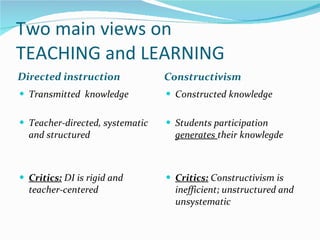
Two main views on  TEACHING and LEARNING Directed instruction Constructivism  Transmitted  knowledge Teacher-directed, systematic and structured Critics:  DI is rigid and teacher-centered Constructed knowledge  Students participation  generates  their knowlegde  Critics:  Constructivism is inefficient; unstructured and unsystematic
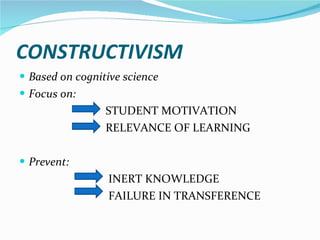
CONSTRUCTIVISM Based on cognitive science  Focus on:  STUDENT MOTIVATION RELEVANCE OF LEARNING Prevent: INERT KNOWLEDGE FAILURE IN TRANSFERENCE
Lev Semyonovich Vygotsky  (1896 - 1934) Born in Orsha, Russian Empire, now Belarus. PHILOSOPHER and EDUCATIONAL PSYCHOLOGIST Theory characterized by:  individual differences personal creativity influence of culture on learning
Main contributions  Cognitive development Key ideas: SOCIAL DEVELOPMENT Role of CULTURE and INTERPERSONAL COMMUNICATION Interaction with SIGNIFICANT PEOPLE INTERNALIZATION  -  APPROPIATION
Main contributions  Levels of  cognitive  functioning Key ideas: Adult / Expert – Child / Novice  ZONE OF PROXIMAL DEVELOPMENT (ZPD) MORE KNOWLEDGEABLE OTHER (MKO) SCAFFOLDING
ZONE OF PROXIMAL DEVELOPMENT (ZPD) Describes not the  actual  but the  potential   of human cognitive development. Range of tasks beyond a child’s mastery that can be learned only with guidance/assistance of a more-skilled partner.
MORE KNOWLEDGEABLE  OTHER (MKO)  Takes up on the notion of SIGNIFICANT PEOPLE Must have (or be programmed with) more knowledge about the topic being learned than the learner does
SCAFFOLDING scaf‧fold      countable] 1  a structure built next to a wall, for workers to stand on  while they build, repair, or paint a building 2  (AmE)  a structure that can be moved up and down to help people work on high buildings [=  cradle   (BrE) ]
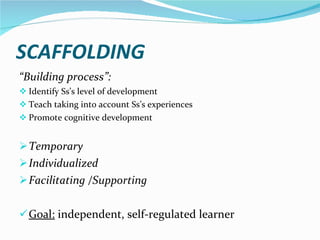
SCAFFOLDING “ Building process”: Identify Ss’s level of development Teach taking into account Ss’s experiences Promote cognitive development  Temporary Individualized Facilitating /Supporting Goal:  independent, self-regulated learner
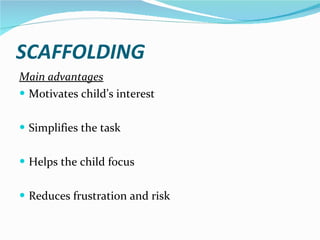
SCAFFOLDING Main advantages Motivates child’s interest Simplifies the task Helps the child focus Reduces frustration and risk
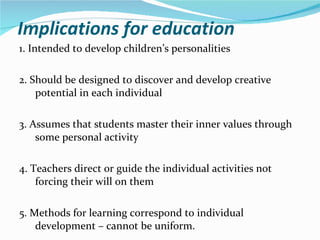
Implications for education 1. Intended to develop children’s personalities 2. Should be designed to discover and develop creative potential in each individual 3. Assumes that students master their inner values through some personal activity 4. Teachers direct or guide the individual activities not forcing their will on them 5. Methods for learning correspond to individual development – cannot be uniform.
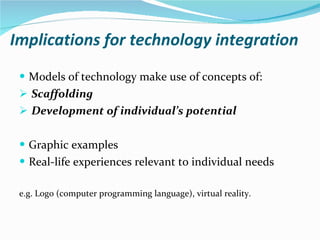
Implications for technology integration Models of technology make use of concepts of:  Scaffolding   Development of individual’s potential Graphic examples Real-life experiences relevant to individual needs e.g. Logo (computer programming language), virtual reality.

Vygotsky

  • 1.
    Learning Theories andIntegration Models UNLPam - Practica Educativa II Students: Bessolo, Gabriela & Roldán, Soledad
  • 2.
    Two main viewson TEACHING and LEARNING Directed instruction Constructivism Transmitted knowledge Teacher-directed, systematic and structured Critics: DI is rigid and teacher-centered Constructed knowledge Students participation generates their knowlegde Critics: Constructivism is inefficient; unstructured and unsystematic
  • 3.
    CONSTRUCTIVISM Based oncognitive science Focus on: STUDENT MOTIVATION RELEVANCE OF LEARNING Prevent: INERT KNOWLEDGE FAILURE IN TRANSFERENCE
  • 4.
    Lev Semyonovich Vygotsky (1896 - 1934) Born in Orsha, Russian Empire, now Belarus. PHILOSOPHER and EDUCATIONAL PSYCHOLOGIST Theory characterized by: individual differences personal creativity influence of culture on learning
  • 5.
    Main contributions Cognitive development Key ideas: SOCIAL DEVELOPMENT Role of CULTURE and INTERPERSONAL COMMUNICATION Interaction with SIGNIFICANT PEOPLE INTERNALIZATION - APPROPIATION
  • 6.
    Main contributions Levels of cognitive functioning Key ideas: Adult / Expert – Child / Novice ZONE OF PROXIMAL DEVELOPMENT (ZPD) MORE KNOWLEDGEABLE OTHER (MKO) SCAFFOLDING
  • 7.
    ZONE OF PROXIMALDEVELOPMENT (ZPD) Describes not the actual but the potential of human cognitive development. Range of tasks beyond a child’s mastery that can be learned only with guidance/assistance of a more-skilled partner.
  • 8.
    MORE KNOWLEDGEABLE OTHER (MKO) Takes up on the notion of SIGNIFICANT PEOPLE Must have (or be programmed with) more knowledge about the topic being learned than the learner does
  • 9.
    SCAFFOLDING scaf‧fold     countable] 1 a structure built next to a wall, for workers to stand on while they build, repair, or paint a building 2 (AmE) a structure that can be moved up and down to help people work on high buildings [=  cradle (BrE) ]
  • 10.
    SCAFFOLDING “ Buildingprocess”: Identify Ss’s level of development Teach taking into account Ss’s experiences Promote cognitive development Temporary Individualized Facilitating /Supporting Goal: independent, self-regulated learner
  • 11.
    SCAFFOLDING Main advantagesMotivates child’s interest Simplifies the task Helps the child focus Reduces frustration and risk
  • 12.
    Implications for education1. Intended to develop children’s personalities 2. Should be designed to discover and develop creative potential in each individual 3. Assumes that students master their inner values through some personal activity 4. Teachers direct or guide the individual activities not forcing their will on them 5. Methods for learning correspond to individual development – cannot be uniform.
  • 13.
    Implications for technologyintegration Models of technology make use of concepts of: Scaffolding Development of individual’s potential Graphic examples Real-life experiences relevant to individual needs e.g. Logo (computer programming language), virtual reality.