Vygotsky Socio Cultural Theory


Proffered By
Gurkirat Kaur
Asst. Prof. Chitkara University
What separates humans from animals?


What separates advanced societies from primitive
societies?


What separates advanced cognition from basic
cognition? That is, what makes us smart?
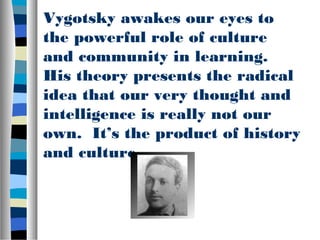
Vygotsky awakes our eyes to
the powerful role of culture
and community in learning.
His theory presents the radical
idea that our very thought and
intelligence is really not our
own. It’s the product of history
and culture.
Lev Semonovich Vygotsky Background

   Vygotsky was called "The Mozart of Psychology“.

   He was born in 1896- same year
    as Piaget - in the small Russian town of Orsha.

   Middle-class Jewish family.

   He entered into a private all boys secondary school
    known as a gymnasium—a secondary school that
    prepared students for the university.

   In 1913 entered Moscow University through lottery.

   In December of 1917, he graduated from Moscow
    University with a degree in law.
Lev Semonovich Vygotsky Background

   Vygotsky completed 270 scientific articles, numerous
    lectures, and ten books based on a wide range of
    Marxist-based psychological and teaching theories.

   He died on June 10, 1934, at the young age of thirty-
    seven after long battle with TB.

   Vygotsky’s work did not become known in the West
    until 1958, and was not published there until 1962.
Lev Semonovich Vygotsky Background

   Vygotsky completed 270 scientific articles, numerous
    lectures, and ten books based on a wide range of
    Marxist-based psychological and teaching theories.

   He died on June 10, 1934, at the young age of thirty-
    seven after long battle with TB.

   Vygotsky’s work did not become known in the West
    until 1958, and was not published there until 1962.
The sociocultural theory:

   Did NOT focus on the individual child but on the child as a
    product of social interaction, especially with adults (parents,
    teachers).

   Focus on DYADIC INTERACTIONS (e.g., child being taught by
    a parent how to perform some culturally specific action), rather
    than child by himself.

   Social world mediates children's cognitive development.
    Cognitive development occurs as child's thinking is molded by
    society in the form of parents, teachers, and peers. This leads to
    peer tutoring as a strategy in classrooms.

   People's thinking differs dramatically between cultures because
    different cultures stress different things.
Theory’s Principles and Concepts

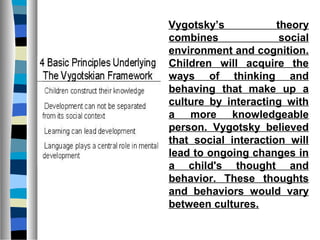
   Children construct their knowledge.
      Knowledge is not transferred passively, but is personally
    constructed.

   The learning is mediated.
      Cognitive development is not a direct result of activity, but it is
    indirect; other people must interact with the learner, use
    mediatory tools to facilitate the learning process, and then
    cognitive development may occur.

   Language plays a central role in mental development.
      The most significant sociocultural tool is language, as it is
    used to teach tool use and is vital in the process of developing
    higher psychological functions.
Theory’s Principles and Concepts

   Learning appears twice.
        First on the social level, and later, on the individual level; first
    between people (interpsychology), and then inside the child
    (intrapsychology).


   Development cannot be separated from its social
    context.
       The context needed for learning is that where the learners
    can interact with each other and use the new tools. This means
    that the learning environment must be authentic, that is, it must
    contain the type of people who would use these types of tools
    such as concepts, language, symbols in a natural way.
Theory’s Principles and Concepts
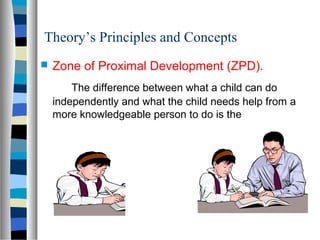
   Zone of Proximal Development (ZPD).
        The difference between what a child can do
    independently and what the child needs help from a
    more knowledgeable person to do is the
Theory’s Principles and Concepts
     Zone of Proximal Development (ZPD)

  Distance Between Actual and Potential
    Knowledge


      Two children with the same actual knowledge travel
      different distances to their potential knowledge; therefore
      different ZPDs
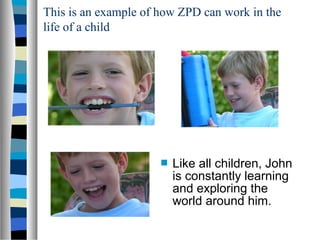
This is an example of how ZPD can work in the
life of a child


                         Like all children, John
                          is constantly learning
                          and exploring the
                          world around him.
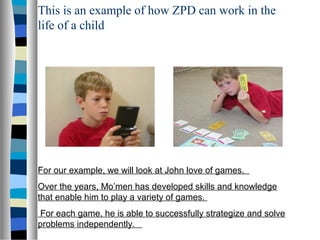
This is an example of how ZPD can work in the
life of a child


For our example, we will look at John love of games.
Over the years, Mo’men has developed skills and knowledge
that enable him to play a variety of games.
For each game, he is able to successfully strategize and solve
problems independently.
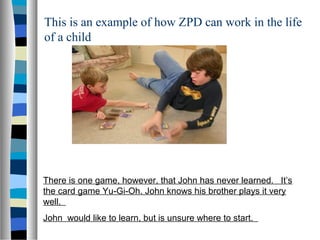
This is an example of how ZPD can work in the life
of a child


There is one game, however, that John has never learned. It’s
the card game Yu-Gi-Oh. John knows his brother plays it very
well.
John would like to learn, but is unsure where to start.
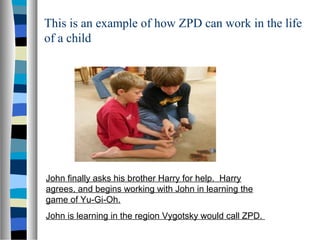
This is an example of how ZPD can work in the life
of a child


John finally asks his brother Harry for help. Harry
agrees, and begins working with John in learning the
game of Yu-Gi-Oh.
John is learning in the region Vygotsky would call ZPD.
This is an example of how ZPD can work in the life
of a child


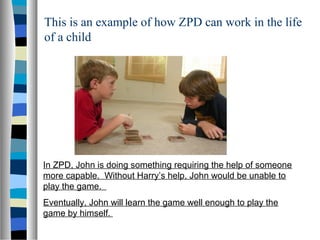
In ZPD, John is doing something requiring the help of someone
more capable. Without Harry’s help, John would be unable to
play the game.
Eventually, John will learn the game well enough to play the
game by himself.
This is an example of how ZPD can work in the life
of a child


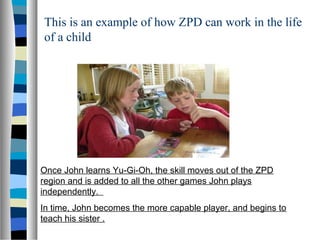
Once John learns Yu-Gi-Oh, the skill moves out of the ZPD
region and is added to all the other games John plays
independently.
In time, John becomes the more capable player, and begins to
teach his sister .
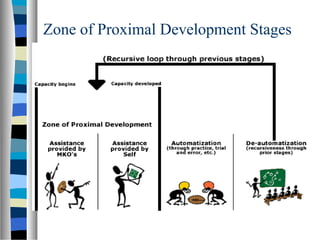
Zone of Proximal Development Stages
 Stage 1: Assistance from “more
   knowledgeable other” (capable peer
   or adult)
 Stage 2: Assistance from self (prior
   knowledge and research)
 Stage 3: Automatization (practice,
   trial-and-error)
 Stage 4: De-automatization (provide
   explanation to others)
Zone of Proximal Development Stages
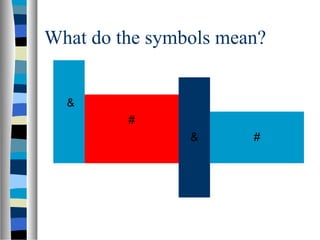
What do the symbols mean?


  &
         #
                &      #
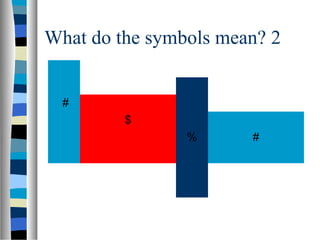
What do the symbols mean? 2


  #
         $
                %      #
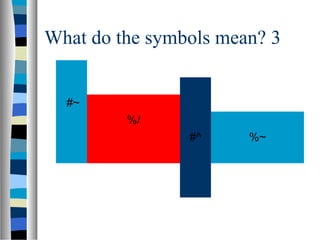
What do the symbols mean? 3


  #~
         %/
                #^     %~
Four Stages
 Four
     stages in the development of
 concepts

 Based on experiments with wooden
 blocks – nonsense labels put on blocks
 and their meaning has to be worked out

 Language   is a central concept
Four Stages (2)
   1. Vague Syncretic Stage – children failed to
    use any strategies and show little understanding
    of the concepts

   2. Complex Stage – some strategies used but
    not successful

   3. Potential Concept Stage – systematic but
    tendency to focus on only one quality at a time

   4. Mature Concept – systematic and successful;
    concepts formed
Theory’s Principles and Concepts
   Scaffolding
    “role of teachers and others in supporting the learner’s
    development and providing support structures to get to the
    next stage or level” Vygotsky.

       a knowledgeable participant can create by means of
    speech and supportive conditions in which the student
    (novice) can participate in and extend current skills and
    knowledge to a high level of competence.

        In an educational context, however, scaffolding is an
    instructional structure whereby the teacher models the
    desired learning strategy or task then gradually shifts
    responsibility to the students.
   Scaffolding:
     – Provides support
     – Extends the range of what a learner can do.
     – Allows the learner to accomplish tasks otherwise
       impossible
     – Used only when needed

   Example :
    An example of scaffolding in the classroom setting could
    include a teacher first instructing her children on how to
    write a sentence using commas and conjunctions. As the
    week goes on, she has her students practice writing these
    sentences with peers, gives students feedback and
    eventually has the kids to complete this skill without her
    guidance.
Principles of the Theory
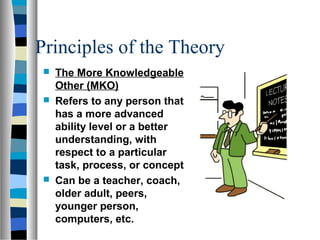
    The More Knowledgeable
     Other (MKO)
    Refers to any person that
     has a more advanced
     ability level or a better
     understanding, with
     respect to a particular
     task, process, or concept
    Can be a teacher, coach,
     older adult, peers,
     younger person,
     computers, etc.
Principles of the Theory
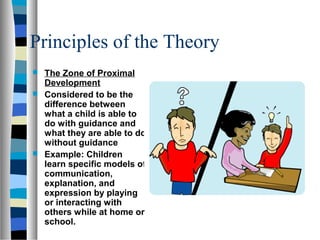
 The Zone of Proximal
  Development
 Considered to be the
  difference between
  what a child is able to
  do with guidance and
  what they are able to do
  without guidance
 Example: Children
  learn specific models of
  communication,
  explanation, and
  expression by playing
  or interacting with
  others while at home or
  school.
Vygotsky’s            theory
combines               social
environment and cognition.
Children will acquire the
ways of thinking and
behaving that make up a
culture by interacting with
a more knowledgeable
person. Vygotsky believed
that social interaction will
lead to ongoing changes in
a child's thought and
behavior. These thoughts
and behaviors would vary
between cultures.
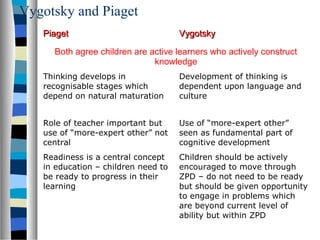
Vygotsky and Piaget
   Piaget                            Vygotsky

     Both agree children are active learners who actively construct
                              knowledge
   Thinking develops in              Development of thinking is
   recognisable stages which         dependent upon language and
   depend on natural maturation      culture


   Role of teacher important but     Use of “more-expert other”
   use of “more-expert other” not    seen as fundamental part of
   central                           cognitive development
   Readiness is a central concept    Children should be actively
   in education – children need to   encouraged to move through
   be ready to progress in their     ZPD – do not need to be ready
   learning                          but should be given opportunity
                                     to engage in problems which
                                     are beyond current level of
                                     ability but within ZPD
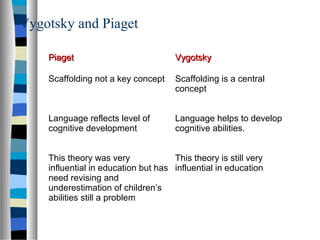
Vygotsky and Piaget

    Piaget                            Vygotsky

    Scaffolding not a key concept     Scaffolding is a central
                                      concept


    Language reflects level of        Language helps to develop
    cognitive development             cognitive abilities.


    This theory was very             This theory is still very
    influential in education but has influential in education
    need revising and
    underestimation of children’s
    abilities still a problem
Note:
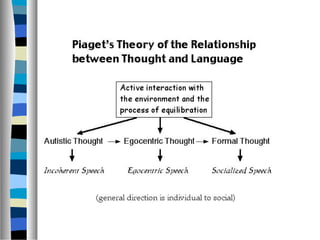
Formal thought is internalized language;
language comes from society; hence the
mind is a product of society.


        [Back to Vygotsky’s basic concepts.]
Implications for Students
 Instead of a teacher dictating her meaning to students
 for future recitation, the social development theory has
 the teacher working in partnership with her students in
 order for students to create their own meaning.

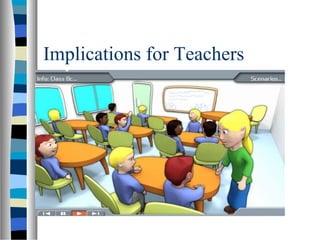
 The physical classroom, based on Vygotsky's theory,
 would provide clustered desks or tables and work
 space for peer instruction, collaboration, and small
 group instruction.

 In this environment, the material to be learned would be
 structured to advance and encourage student
 interaction and collaboration. With this, the classroom
 becomes a community of learning.
Implications for Teachers
Typically, schools have been organized around recitation &
memorization     teaching.      The  teacher   disseminates
knowledge to be memorized by the students, who in turn
recite the information back to the teacher. Vygotsky's social
development theory challenges this traditional teaching
method and studies have shown that strategies based on
the social development theory are far more effective than
other instructional strategies.
Scaffolding, reciprocal teaching, and guided instruction are
effective strategies that implement Vygotsky’s theory.
Scaffolding is a temporary supportive structure that the
teacher creates to assist a student to accomplish a task that
they could not complete alone.
Reciprocal teaching is an instructional strategy used to
teach reading where students take turns being the teacher
for a pair or small group. The teacher’s role may simply be
as a moderator.

Guided instruction involves the teacher and students
exploring problems and then sharing their different problem
solving strategies in an open dialogue.
Conclusion
   Sociocultural theory considers learning as a semiotic
    process where participation in socially-mediated
    activities is essential.

   The theory regards instruction as crucial to cognitive
    development in the classroom. Instruction should be
    geared to the ZPD that is beyond the learner’s actual
    development level.

   Social instruction actually produces new, elaborate,
    advanced psychological processes that are
    unavailable to the organism working in isolation

Vygotsky

  • 1.
    Vygotsky Socio CulturalTheory Proffered By Gurkirat Kaur Asst. Prof. Chitkara University
  • 2.
    What separates humansfrom animals? What separates advanced societies from primitive societies? What separates advanced cognition from basic cognition? That is, what makes us smart?
  • 3.
    Vygotsky awakes oureyes to the powerful role of culture and community in learning. His theory presents the radical idea that our very thought and intelligence is really not our own. It’s the product of history and culture.
  • 4.
    Lev Semonovich VygotskyBackground  Vygotsky was called "The Mozart of Psychology“.  He was born in 1896- same year as Piaget - in the small Russian town of Orsha.  Middle-class Jewish family.  He entered into a private all boys secondary school known as a gymnasium—a secondary school that prepared students for the university.  In 1913 entered Moscow University through lottery.  In December of 1917, he graduated from Moscow University with a degree in law.
  • 5.
    Lev Semonovich VygotskyBackground  Vygotsky completed 270 scientific articles, numerous lectures, and ten books based on a wide range of Marxist-based psychological and teaching theories.  He died on June 10, 1934, at the young age of thirty- seven after long battle with TB.  Vygotsky’s work did not become known in the West until 1958, and was not published there until 1962.
  • 6.
    Lev Semonovich VygotskyBackground  Vygotsky completed 270 scientific articles, numerous lectures, and ten books based on a wide range of Marxist-based psychological and teaching theories.  He died on June 10, 1934, at the young age of thirty- seven after long battle with TB.  Vygotsky’s work did not become known in the West until 1958, and was not published there until 1962.
  • 7.
    The sociocultural theory:  Did NOT focus on the individual child but on the child as a product of social interaction, especially with adults (parents, teachers).  Focus on DYADIC INTERACTIONS (e.g., child being taught by a parent how to perform some culturally specific action), rather than child by himself.  Social world mediates children's cognitive development. Cognitive development occurs as child's thinking is molded by society in the form of parents, teachers, and peers. This leads to peer tutoring as a strategy in classrooms.  People's thinking differs dramatically between cultures because different cultures stress different things.
  • 8.
    Theory’s Principles andConcepts  Children construct their knowledge. Knowledge is not transferred passively, but is personally constructed.  The learning is mediated. Cognitive development is not a direct result of activity, but it is indirect; other people must interact with the learner, use mediatory tools to facilitate the learning process, and then cognitive development may occur.  Language plays a central role in mental development. The most significant sociocultural tool is language, as it is used to teach tool use and is vital in the process of developing higher psychological functions.
  • 9.
    Theory’s Principles andConcepts  Learning appears twice. First on the social level, and later, on the individual level; first between people (interpsychology), and then inside the child (intrapsychology).  Development cannot be separated from its social context. The context needed for learning is that where the learners can interact with each other and use the new tools. This means that the learning environment must be authentic, that is, it must contain the type of people who would use these types of tools such as concepts, language, symbols in a natural way.
  • 10.
    Theory’s Principles andConcepts  Zone of Proximal Development (ZPD). The difference between what a child can do independently and what the child needs help from a more knowledgeable person to do is the
  • 11.
    Theory’s Principles andConcepts  Zone of Proximal Development (ZPD) Distance Between Actual and Potential Knowledge Two children with the same actual knowledge travel different distances to their potential knowledge; therefore different ZPDs
  • 12.
    This is anexample of how ZPD can work in the life of a child  Like all children, John is constantly learning and exploring the world around him.
  • 13.
    This is anexample of how ZPD can work in the life of a child For our example, we will look at John love of games. Over the years, Mo’men has developed skills and knowledge that enable him to play a variety of games. For each game, he is able to successfully strategize and solve problems independently.
  • 14.
    This is anexample of how ZPD can work in the life of a child There is one game, however, that John has never learned. It’s the card game Yu-Gi-Oh. John knows his brother plays it very well. John would like to learn, but is unsure where to start.
  • 15.
    This is anexample of how ZPD can work in the life of a child John finally asks his brother Harry for help. Harry agrees, and begins working with John in learning the game of Yu-Gi-Oh. John is learning in the region Vygotsky would call ZPD.
  • 16.
    This is anexample of how ZPD can work in the life of a child In ZPD, John is doing something requiring the help of someone more capable. Without Harry’s help, John would be unable to play the game. Eventually, John will learn the game well enough to play the game by himself.
  • 17.
    This is anexample of how ZPD can work in the life of a child Once John learns Yu-Gi-Oh, the skill moves out of the ZPD region and is added to all the other games John plays independently. In time, John becomes the more capable player, and begins to teach his sister .
  • 18.
    Zone of ProximalDevelopment Stages Stage 1: Assistance from “more knowledgeable other” (capable peer or adult) Stage 2: Assistance from self (prior knowledge and research) Stage 3: Automatization (practice, trial-and-error) Stage 4: De-automatization (provide explanation to others)
  • 19.
    Zone of ProximalDevelopment Stages
  • 20.
    What do thesymbols mean? & # & #
  • 21.
    What do thesymbols mean? 2 # $ % #
  • 22.
    What do thesymbols mean? 3 #~ %/ #^ %~
  • 23.
    Four Stages  Four stages in the development of concepts  Based on experiments with wooden blocks – nonsense labels put on blocks and their meaning has to be worked out  Language is a central concept
  • 24.
    Four Stages (2)  1. Vague Syncretic Stage – children failed to use any strategies and show little understanding of the concepts  2. Complex Stage – some strategies used but not successful  3. Potential Concept Stage – systematic but tendency to focus on only one quality at a time  4. Mature Concept – systematic and successful; concepts formed
  • 25.
    Theory’s Principles andConcepts  Scaffolding “role of teachers and others in supporting the learner’s development and providing support structures to get to the next stage or level” Vygotsky. a knowledgeable participant can create by means of speech and supportive conditions in which the student (novice) can participate in and extend current skills and knowledge to a high level of competence. In an educational context, however, scaffolding is an instructional structure whereby the teacher models the desired learning strategy or task then gradually shifts responsibility to the students.
  • 26.
    Scaffolding: – Provides support – Extends the range of what a learner can do. – Allows the learner to accomplish tasks otherwise impossible – Used only when needed  Example : An example of scaffolding in the classroom setting could include a teacher first instructing her children on how to write a sentence using commas and conjunctions. As the week goes on, she has her students practice writing these sentences with peers, gives students feedback and eventually has the kids to complete this skill without her guidance.
  • 27.
    Principles of theTheory  The More Knowledgeable Other (MKO)  Refers to any person that has a more advanced ability level or a better understanding, with respect to a particular task, process, or concept  Can be a teacher, coach, older adult, peers, younger person, computers, etc.
  • 28.
    Principles of theTheory  The Zone of Proximal Development  Considered to be the difference between what a child is able to do with guidance and what they are able to do without guidance  Example: Children learn specific models of communication, explanation, and expression by playing or interacting with others while at home or school.
  • 29.
    Vygotsky’s theory combines social environment and cognition. Children will acquire the ways of thinking and behaving that make up a culture by interacting with a more knowledgeable person. Vygotsky believed that social interaction will lead to ongoing changes in a child's thought and behavior. These thoughts and behaviors would vary between cultures.
  • 30.
    Vygotsky and Piaget Piaget Vygotsky Both agree children are active learners who actively construct knowledge Thinking develops in Development of thinking is recognisable stages which dependent upon language and depend on natural maturation culture Role of teacher important but Use of “more-expert other” use of “more-expert other” not seen as fundamental part of central cognitive development Readiness is a central concept Children should be actively in education – children need to encouraged to move through be ready to progress in their ZPD – do not need to be ready learning but should be given opportunity to engage in problems which are beyond current level of ability but within ZPD
  • 31.
    Vygotsky and Piaget Piaget Vygotsky Scaffolding not a key concept Scaffolding is a central concept Language reflects level of Language helps to develop cognitive development cognitive abilities. This theory was very This theory is still very influential in education but has influential in education need revising and underestimation of children’s abilities still a problem
  • 33.
    Note: Formal thought isinternalized language; language comes from society; hence the mind is a product of society. [Back to Vygotsky’s basic concepts.]
  • 34.
  • 35.
    Implications for Students Instead of a teacher dictating her meaning to students for future recitation, the social development theory has the teacher working in partnership with her students in order for students to create their own meaning. The physical classroom, based on Vygotsky's theory, would provide clustered desks or tables and work space for peer instruction, collaboration, and small group instruction. In this environment, the material to be learned would be structured to advance and encourage student interaction and collaboration. With this, the classroom becomes a community of learning.
  • 36.
  • 37.
    Implications for Teachers Typically,schools have been organized around recitation & memorization teaching. The teacher disseminates knowledge to be memorized by the students, who in turn recite the information back to the teacher. Vygotsky's social development theory challenges this traditional teaching method and studies have shown that strategies based on the social development theory are far more effective than other instructional strategies. Scaffolding, reciprocal teaching, and guided instruction are effective strategies that implement Vygotsky’s theory. Scaffolding is a temporary supportive structure that the teacher creates to assist a student to accomplish a task that they could not complete alone. Reciprocal teaching is an instructional strategy used to teach reading where students take turns being the teacher for a pair or small group. The teacher’s role may simply be as a moderator. Guided instruction involves the teacher and students exploring problems and then sharing their different problem solving strategies in an open dialogue.
  • 38.
    Conclusion  Sociocultural theory considers learning as a semiotic process where participation in socially-mediated activities is essential.  The theory regards instruction as crucial to cognitive development in the classroom. Instruction should be geared to the ZPD that is beyond the learner’s actual development level.  Social instruction actually produces new, elaborate, advanced psychological processes that are unavailable to the organism working in isolation