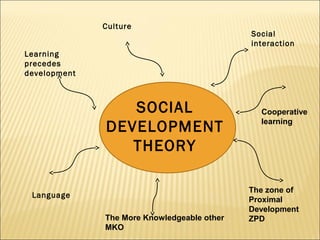
Culture
                                             Social
                                             interaction
Learning
precedes
development


                 SOCIAL                        Cooperative
                                               learning
              DEVELOPMENT
                 THEORY

                                             The zone of
 Language
                                             Proximal
                                             Development
              The More Knowledgeable other   ZPD
              MKO
According to Vygotsky, for the curriculum to be developmentally
appropriate, the teacher must plan activities that encompass not only what
children are capable of doing on their own but what they can learn with the
help of others (Karpov & Haywood, 1998).

 Vygotsky’s theory does not mean that anything can be taught to any
child. Only instruction and activities that fall within the zone promote
development.

 Instruction can be planned to provide practice in the zone of proximal
development for individual children or for groups of children. For example,
hints and prompts that helped children during the assessment could form
the basis of instructional activities.
Cooperative learning activities can be planned with groups of children at
different levels who can help each other learn.

Scaffolding (Wood, Bruner, & Ross, 1976) is a tactic for helping the child
in his or her zone of proximal development in which the adult provides hints
and prompts at different levels. In scaffolding, the adult does not simplify the
task, but the role of the learner is simplified “through the graduated
intervention of the teacher” (Greenfield, 1984, p. 119).

Role of the teacher
In Vygotsky's view, the teacher has the "task of guiding and directing the
child's activity." Children can then solve novel problems "on the basis of a
model they have been shown in class." In other words, children learn by
solving problems with the help of the teacher, who models processes for
them in a classroom environment that is directed by the teacher. In essence,
"the child imitates the teacher through a process of re-creating previous
classroom collaboration."
REFLECTION QUESTIONS

1. THINK OF THINGS YOU LEARNT BY YOURSELF AND THINGS IN
WHICH YOU REQUIRED SOME HELP.


2. THINK OF ACTIVITIES WHERE YOU APPLY THE PRINCIPLES OF
VYGOTSKY
CONCLUSIONS
The conclusions and implications of these theories for the teaching of children
and for language learning are as follows:

• Construction of knowledge is a very important notion to be taken into account
at all levels of teaching, for learning is a process of active discovery. This is
especially relevant when we work with children.

• There is an interaction between information that we have already processed
and internalized and information we select to 'take in'; tasks and materials
should always include the new mixed with the old.

• Thinking and knowledge can be developed in children through meaningful
material actions.

• Children use different approaches to knowledge, different strategies
according to individual differences.
• Interaction and communication help in the development of "intelligent,
adaptive thinking"; the more mature (teacher or more advanced pupil) should
interact with the less mature.

• Activities and experiences for children should be meaningful and purposeful
so as to stimulate curiosity and the desire to explore.

• Culture, presented in language, visuals (pictures, videos, TV.), books, etc.
contributes to the development of intelligence in children.

• Children understand better the things that are related to their social
environment and experiences. A new culture should be related to his own.

• Children should be exposed to the different "ways of thinking" that
characterize different areas of knowledge. Knowledge is, in some cases,
historically and culturally relative (cultural concepts age and change, within a
society and in different societies).

• Communication with children in their early stages of second language
learning may have the support of actions, mime and facial expressions, which,
together with the context, will help them to understand new meanings.
REFERENCES

Cárdenas, R., García, M., Restrepo, M.,”Young Learners”, London, Thames
Valley University, 1994

WEBLIOGRAPHY
http://www.simplypsychology.org/vygotsky.html

http://wps.ablongman.com/ab_slavin_edpsych_8/38/9951/2547689.cw/content/index.ht

Cognitive Development - Vygotsky's Sociocultural Theory - Child, Helps, Adult, and Cul


http://social.jrank.org/pages/142/Cognitive-Development-Vygotsky-s-
Sociocultural-Theory.html#ixzz2CjNetIF3

http://www.innovativelearning.com/educational_psychology/development/zone
-of-proximal-development.html

http://www.ncrel.org/sdrs/areas/issues/methods/instrctn/in5lk2-4.htm

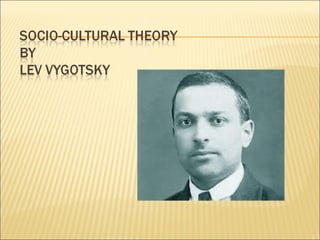
Socio cultural theory

  • 2.
    Culture Social interaction Learning precedes development SOCIAL Cooperative learning DEVELOPMENT THEORY The zone of Language Proximal Development The More Knowledgeable other ZPD MKO
  • 3.
    According to Vygotsky,for the curriculum to be developmentally appropriate, the teacher must plan activities that encompass not only what children are capable of doing on their own but what they can learn with the help of others (Karpov & Haywood, 1998).  Vygotsky’s theory does not mean that anything can be taught to any child. Only instruction and activities that fall within the zone promote development.  Instruction can be planned to provide practice in the zone of proximal development for individual children or for groups of children. For example, hints and prompts that helped children during the assessment could form the basis of instructional activities.
  • 4.
    Cooperative learning activitiescan be planned with groups of children at different levels who can help each other learn. Scaffolding (Wood, Bruner, & Ross, 1976) is a tactic for helping the child in his or her zone of proximal development in which the adult provides hints and prompts at different levels. In scaffolding, the adult does not simplify the task, but the role of the learner is simplified “through the graduated intervention of the teacher” (Greenfield, 1984, p. 119). Role of the teacher In Vygotsky's view, the teacher has the "task of guiding and directing the child's activity." Children can then solve novel problems "on the basis of a model they have been shown in class." In other words, children learn by solving problems with the help of the teacher, who models processes for them in a classroom environment that is directed by the teacher. In essence, "the child imitates the teacher through a process of re-creating previous classroom collaboration."
  • 5.
    REFLECTION QUESTIONS 1. THINKOF THINGS YOU LEARNT BY YOURSELF AND THINGS IN WHICH YOU REQUIRED SOME HELP. 2. THINK OF ACTIVITIES WHERE YOU APPLY THE PRINCIPLES OF VYGOTSKY
  • 6.
    CONCLUSIONS The conclusions andimplications of these theories for the teaching of children and for language learning are as follows: • Construction of knowledge is a very important notion to be taken into account at all levels of teaching, for learning is a process of active discovery. This is especially relevant when we work with children. • There is an interaction between information that we have already processed and internalized and information we select to 'take in'; tasks and materials should always include the new mixed with the old. • Thinking and knowledge can be developed in children through meaningful material actions. • Children use different approaches to knowledge, different strategies according to individual differences.
  • 7.
    • Interaction andcommunication help in the development of "intelligent, adaptive thinking"; the more mature (teacher or more advanced pupil) should interact with the less mature. • Activities and experiences for children should be meaningful and purposeful so as to stimulate curiosity and the desire to explore. • Culture, presented in language, visuals (pictures, videos, TV.), books, etc. contributes to the development of intelligence in children. • Children understand better the things that are related to their social environment and experiences. A new culture should be related to his own. • Children should be exposed to the different "ways of thinking" that characterize different areas of knowledge. Knowledge is, in some cases, historically and culturally relative (cultural concepts age and change, within a society and in different societies). • Communication with children in their early stages of second language learning may have the support of actions, mime and facial expressions, which, together with the context, will help them to understand new meanings.
  • 8.
    REFERENCES Cárdenas, R., García,M., Restrepo, M.,”Young Learners”, London, Thames Valley University, 1994 WEBLIOGRAPHY http://www.simplypsychology.org/vygotsky.html http://wps.ablongman.com/ab_slavin_edpsych_8/38/9951/2547689.cw/content/index.ht Cognitive Development - Vygotsky's Sociocultural Theory - Child, Helps, Adult, and Cul http://social.jrank.org/pages/142/Cognitive-Development-Vygotsky-s- Sociocultural-Theory.html#ixzz2CjNetIF3 http://www.innovativelearning.com/educational_psychology/development/zone -of-proximal-development.html http://www.ncrel.org/sdrs/areas/issues/methods/instrctn/in5lk2-4.htm