Lev Vygotsky’s
Cognitive Theory
Presented by: Karl S. Olimpo
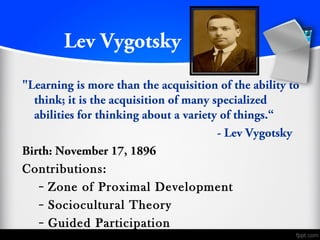
Lev Vygotsky
"Learning is more than the acquisition of the ability to
think; it is the acquisition of many specialized
abilities for thinking about a variety of things.“
- Lev Vygotsky
Birth: November 17, 1896
Contributions:
– Zone of Proximal Development
– Sociocultural Theory
– Guided Participation
Effects of Culture: Tools of
intellectual adaptation
 1. Elementary Mental Functions 
A. Attention
B. Sensation
C. Perception
D. Memory
2. Higher Mental Functions
Social Influences on Cognitive
Development
According to Vygotsky (1978) “much
important learning by the child occurs through
social interaction with a skillful tutor. The tutor
may model behaviors and/or provide verbal
instructions for the child”.
Cooperative/Collaborative Dialogue
Zone of Proximal
Development
•(ZPD) has been defined as "the distance
between the actual developmental level as
determined by independent problem
solving and the level of potential
development as determined through
problem solving under adult guidance, or
in collaboration with more capable peers" 
Vygotsky and Language
According to Vygotsky (1962) language
plays 2 critical roles in cognitive
development:
1: It is the main means by which adults transmit
information to children.
2: Language itself becomes a very powerful tool of
intellectual adaptation.
Forms of Language
1. Social speech which is external communication
used to talk to others (typical from the age of two);
2. Private speech (typical from the age of three)
which is directed to the self and serves an
intellectual function; private speech goes
underground, diminishing in audibility as it takes
on a self-regulating function and is transformed
into silent inner speech (typical from the age of
seven).
Classroom Applications
A contemporary educational application of
Vygotsky's theories is "reciprocal teaching", used
to improve students' ability to learn from text.
In this method, teacher and students
collaborate in learning and practicing four key
skills: summarizing, questioning, clarifying, and
predicting. The teacher's role in the process is
reduced over time.
Also, Vygotsky is relevant to instructional
concepts such as "scaffolding" and
"apprenticeship", in which a teacher or more
advanced peer helps to structure or arrange a
task so that a novice can work on it successfully.
Vygotsky's theories also feed into
current interest in collaborative learning,
suggesting that group members should
have different levels of ability so more
advanced peers can help less advanced
members operate within their ZPD.

Vygotsky's Socio-cultural Theory

  • 1.
  • 2.
    Lev Vygotsky "Learning ismore than the acquisition of the ability to think; it is the acquisition of many specialized abilities for thinking about a variety of things.“ - Lev Vygotsky Birth: November 17, 1896 Contributions: – Zone of Proximal Development – Sociocultural Theory – Guided Participation
  • 3.
    Effects of Culture:Tools of intellectual adaptation  1. Elementary Mental Functions  A. Attention B. Sensation C. Perception D. Memory 2. Higher Mental Functions
  • 4.
    Social Influences onCognitive Development According to Vygotsky (1978) “much important learning by the child occurs through social interaction with a skillful tutor. The tutor may model behaviors and/or provide verbal instructions for the child”. Cooperative/Collaborative Dialogue
  • 5.
    Zone of Proximal Development •(ZPD)has been defined as "the distance between the actual developmental level as determined by independent problem solving and the level of potential development as determined through problem solving under adult guidance, or in collaboration with more capable peers" 
  • 7.
    Vygotsky and Language Accordingto Vygotsky (1962) language plays 2 critical roles in cognitive development: 1: It is the main means by which adults transmit information to children. 2: Language itself becomes a very powerful tool of intellectual adaptation.
  • 8.
    Forms of Language 1.Social speech which is external communication used to talk to others (typical from the age of two); 2. Private speech (typical from the age of three) which is directed to the self and serves an intellectual function; private speech goes underground, diminishing in audibility as it takes on a self-regulating function and is transformed into silent inner speech (typical from the age of seven).
  • 9.
    Classroom Applications A contemporaryeducational application of Vygotsky's theories is "reciprocal teaching", used to improve students' ability to learn from text. In this method, teacher and students collaborate in learning and practicing four key skills: summarizing, questioning, clarifying, and predicting. The teacher's role in the process is reduced over time.
  • 10.
    Also, Vygotsky isrelevant to instructional concepts such as "scaffolding" and "apprenticeship", in which a teacher or more advanced peer helps to structure or arrange a task so that a novice can work on it successfully.
  • 11.
    Vygotsky's theories alsofeed into current interest in collaborative learning, suggesting that group members should have different levels of ability so more advanced peers can help less advanced members operate within their ZPD.