
Lev Vygotsky was a Russian psychologist who developed the theory of social constructivism, focusing on the important role of culture and social interaction in cognitive development. His theory proposes that intellectual development depends on cultural tools like language and counting systems. In contrast to Piaget, Vygotsky believed that cognitive development is strongly linked to input from others and occurs through social learning within a child's zone of proximal development with scaffolding from more knowledgeable individuals. His theory emphasizes using private speech and cooperative learning to internalize cultural knowledge and self-regulate independent thinking.
Vygotsky's theories contrast with Piaget's, focusing on the role of cultural context and social input in intellectual development.
Vygotsky contends learning comes before development, highlighting self-regulation's three steps: meaning, practice, and internalization.
Private speech aids children in transforming shared knowledge into personal knowledge, facilitating problem-solving and self-regulation.Learning occurs within the 'zone of proximal development' with guidance from more competent peers or adults, enhancing understanding.
Scaffolding, derived from Vygotsky's social learning concept, gradually reduces support as children gain confidence and responsibility.
Cooperative learning encourages children to share insights and reasoning, enhancing each other's understanding through collaboration and Vygotskian strategies.
Lev Semionovich Vygotskywas a Russian
psychologist who was also a contemporary of
Piaget.
Where Piaget’s theory focused on constructivism,
Vygotsky’s theory focused on Social constructivism.
Vygotsky’s theory was not widely read until 1970s.
His theory is now is a powerful source in the
development of psychology.
Vygotsky's work is based on two key ideas.
First, he proposed that intellectual development
can be understood only in terms of the historical
and cultural contexts children experience.
3.
Second, he believedthat development depends
on the sign systems that individuals grow up with:
the symbols that cultures create to help people
think, communicate, and solve problems.
For example, a culture's language, writing system, or
counting system.
In contrast to Piaget, Vygotsky proposed that
cognitive development is strongly linked to input
from others.
But like Piaget, Vygotsky also believed that the
acquisition of sign systems occurs in an invariant
sequence of steps that is the same for all children.
4.
How Development Occurs?
InPiaget’s theory, we get the idea that development
precedes learning. In Vygotsky’s theory the idea is just
the opposite which is learning precedes development.
According to Vygotsky, learning involves the acquisition
of signs by means of instruction and information from
others.
Child’s development requires the ability of internalizing
these signs so as to be able to think and solve problems
without the help of others. This ability is called self-
regulation which has three steps.
5.
The first stepin the development of self-regulation
and independent thinking is learning that actions and
sounds have a meaning.
For example, a baby learns that the process of reaching
towards an object is interpreted by others as a signal that the
infant wants the object. In the case of language acquisition,
children learn to associate certain sounds with meaning.
The second step in developing internal structures
and self-regulation involves practice. The infant
practices gestures that will get attention. The
preschooler will enter into conversations with others
to master language.
6.
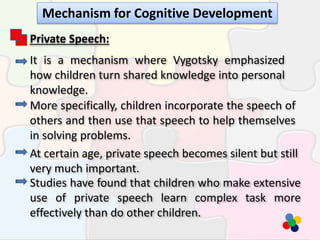
The third orfinal step involves
using signs to think and solve
problems without the help of
others. At this point, children
become self-regulating, and the
sign system has become
internalized.
7.
Mechanism for CognitiveDevelopment
Private Speech:
It is a mechanism where Vygotsky emphasized
how children turn shared knowledge into personal
knowledge.
More specifically, children incorporate the speech of
others and then use that speech to help themselves
in solving problems.
At certain age, private speech becomes silent but still
very much important.
Studies have found that children who make extensive
use of private speech learn complex task more
effectively than do other children.
8.
The Zone ofProximal Development:
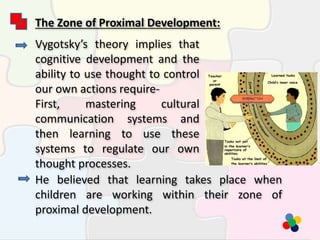
Vygotsky’s theory implies that
cognitive development and the
ability to use thought to control
our own actions require-
First, mastering cultural
communication systems and
then learning to use these
systems to regulate our own
thought processes.
He believed that learning takes place when
children are working within their zone of
proximal development.
9.
With the assistanceof more competent peers or
adults, Child can do tasks in the zone of
proximal development which is not possible
when alone.
Some educators refer to a "teachable moment"
when a child or group of children is exactly at the
point of readiness for a given concept.
10.
Scaffolding:
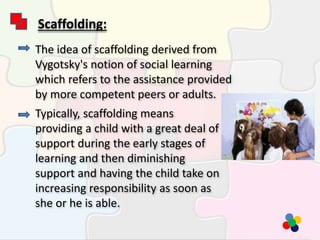
The idea ofscaffolding derived from
Vygotsky's notion of social learning
which refers to the assistance provided
by more competent peers or adults.
Typically, scaffolding means
providing a child with a great deal of
support during the early stages of
learning and then diminishing
support and having the child take on
increasing responsibility as soon as
she or he is able.
11.
For example, Parentsuse scaffolding when they
teach their children to play a new game or to tie
their shoes.
Cognitive apprenticeship, a related concept to
scaffolding describes the entire process of
modeling, coaching, scaffolding, and evaluation
that is typically seen whenever one-to-one
instruction takes place.
12.
Cooperative Learning:
Children worktogether to help one another learn.
Cooperative learning makes child’s inner speech
available to one another. In other words,
children share their inner speech in themselves
to facilitate one another.
While sharing inner speech, they can gain insight
of one another's reasoning process.
13.
Applications of VygotskianTheory in Teaching
Vygotsky's theories of education have two major
implications.
1. The desirability of setting up cooperative learning
arrangements among groups of students with
differing levels of ability.
2. Vygotskian approach to instruction emphasizes
scaffolding, with students taking more and more
responsibility for their own learning.