CONSTRUCTIVISM
CONSTRUCTIVISM
 Associated by many psychologists such as Jean
  Piaget (1896-1980), Jerome Bruner (1915-?), Lev
  Vygotsky (1896-1934), and John Dewey (1859-
  1952).
 These psychologists all believed through
  constructivism, a person builds his/her learning
  ability/process overtime through experience and
  surround knowledge.
CONSTRUCTIVISM
 By definition, constructivism is based on a type
  of learning in which the learner forms, or
  constructs, much of what he or she learns or
  comprehends.
 In other words, constructivism is how we change
  the way we think and learn as we grow older.
  For example, one might finds a school subject
  very difficult to learn when they were young
  but as they grow older they might change their
  way of thinking and through experience finds
  that subject easier and maybe as a career
  major.
CONSTRUCTIVISM
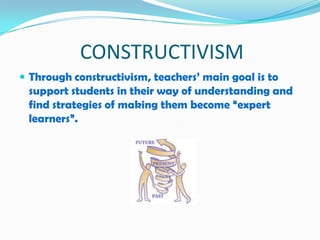
 Through constructivism, teachers’ main goal is to
 support students in their way of understanding and
 find strategies of making them become “expert
 learners”.
CONSTRUCTIVISM
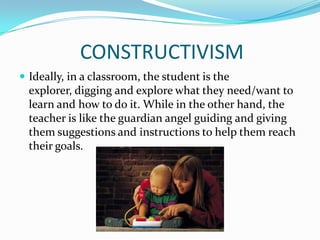
 Ideally, in a classroom, the student is the
  explorer, digging and explore what they need/want to
  learn and how to do it. While in the other hand, the
  teacher is like the guardian angel guiding and giving
  them suggestions and instructions to help them reach
  their goals.
CREDITS
 Presentation creators: Lam Vu, Anders Lanza, and Nicholas Leath.
 Gary Shelly, Glenda Gunter, and Randolph Gunter. “Teachers
  Discovering Computers Integrating Technology In A Connected World
  Seventh Edition”. Course Technology, Cengage Learning. (2012): 266-
  272. Print. 7 April. 2012.
 Picture credit (slide 4) -
  http://www.thirteen.org/edonline/concept2class/constructivism/index
  .html

Learning theory - Constructivism

  • 1.
  • 2.
    CONSTRUCTIVISM  Associated bymany psychologists such as Jean Piaget (1896-1980), Jerome Bruner (1915-?), Lev Vygotsky (1896-1934), and John Dewey (1859- 1952).  These psychologists all believed through constructivism, a person builds his/her learning ability/process overtime through experience and surround knowledge.
  • 3.
    CONSTRUCTIVISM  By definition,constructivism is based on a type of learning in which the learner forms, or constructs, much of what he or she learns or comprehends.  In other words, constructivism is how we change the way we think and learn as we grow older. For example, one might finds a school subject very difficult to learn when they were young but as they grow older they might change their way of thinking and through experience finds that subject easier and maybe as a career major.
  • 4.
    CONSTRUCTIVISM  Through constructivism,teachers’ main goal is to support students in their way of understanding and find strategies of making them become “expert learners”.
  • 5.
    CONSTRUCTIVISM  Ideally, ina classroom, the student is the explorer, digging and explore what they need/want to learn and how to do it. While in the other hand, the teacher is like the guardian angel guiding and giving them suggestions and instructions to help them reach their goals.
  • 6.
    CREDITS  Presentation creators:Lam Vu, Anders Lanza, and Nicholas Leath.  Gary Shelly, Glenda Gunter, and Randolph Gunter. “Teachers Discovering Computers Integrating Technology In A Connected World Seventh Edition”. Course Technology, Cengage Learning. (2012): 266- 272. Print. 7 April. 2012.  Picture credit (slide 4) - http://www.thirteen.org/edonline/concept2class/constructivism/index .html