Phonetics vowels
vowels free flow of air there is no blocking or constriction of air flow Vowels are extremely important as most of the time syllable is built around a vowel Languages vary as to the number of vowels in their systems Ubhyk a now extinct language has been analysed as having only one, but 80 consonants! Some languages have more vowels than consonants  Hawaiian has 8 consonants but 10 vowels, 5 long ones and five short ones
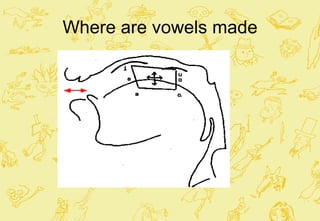
Where are vowels made
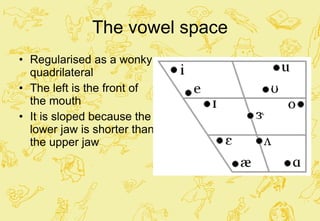
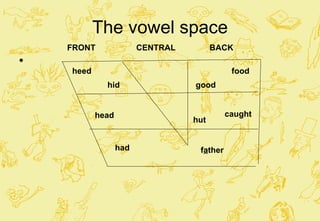
The vowel space Regularised as a wonky quadrilateral The left is the front of the mouth It is sloped because the lower jaw is shorter than the upper jaw
Dividing up vowels Unlike most consonants where we have to make discrete muscle movements to change from one consonant to another The vowel space is continuous … diphthongs shows us this So dividing up the vowels is a bit tricky But like consonants we can use three features to label them  Height, tongue position, lip position
Height differences in vowels different positions of tongue and jaw It is the lower jaw that moves up and down towards or away from the fixed upper jaw. Different vowels of English are along this pathway Iiiiiiiiiiiiiiiiiiiiiiiiiiiiiiiiiaaaaaaaaaaaaaaa Uuuuuuuuuuuuuuooooooooooooo BEAT >BID>BET>BAT>(BARD) BOOT>BIRD/SCHWA?CAUGHT>BARD/POT
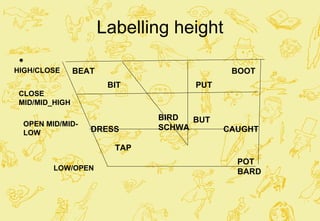
Labelling height HIGH/CLOSE CLOSE MID/MID_HIGH LOW/OPEN BEAT BIT DRESS TAP BOOT PUT CAUGHT BUT POT BARD  OPEN MID/MID-LOW BIRD SCHWA
Labelling tongue position Different vowels require raising and lowering of the tongue in different places in your mouth Say iiiiiiiiiii with your finger in your mouth Where do you feel pressure most from your tongue? What about with uuuuuuuuuu? Front versus back versus central
The vowel space FRONT  CENTRAL  BACK heed hid head had food good caught hut f a ther
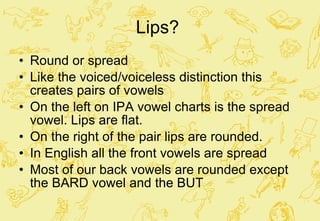
Lips?  Round or spread Like the voiced/voiceless distinction this creates pairs of vowels On the left on IPA vowel charts is the spread vowel. Lips are flat. On the right of the pair lips are rounded. In English all the front vowels are spread  Most of our back vowels are rounded except the BARD vowel and the BUT
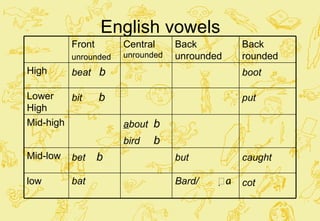
English vowels cot    Bard/     ɑ bat    low caught    but   bet   Mid-low a bout   bird   Mid-high put    bit   Lower High boot   beat   High Back rounded Back unrounded Central  unrounded Front unrounded
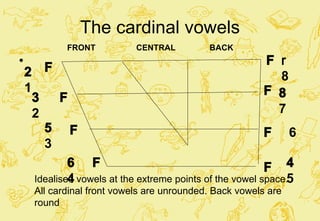
The cardinal vowels FRONT  CENTRAL  BACK         Idealised vowels at the extreme points of the vowel space. All cardinal front vowels are unrounded. Back vowels are round  8  7 6  4  5  3  2  1
Other common distinctions Long vowels  Some linguists add : to BEAT, i.e. i: as well as the BARD< BOOT AND CAUGHT vowels to show that they are longer than the DRESS CAT BUT PUT POT Vowels Not really necessary.  More important for languages which distinguish long vowels and short vowels where the mouth is exactly or almost exactly the same Māori  he ‘a/some’  he: ‘error’
Nasalised vowels nasal stops block the airflow in the oral cavity but allow air out the nose in a continuous stream Nasal vowels allow air through the nasal cavity as well as the oral cavity In English vowels are nasalised if they are near nasal consonants but some languages have which are inherently nasal  Warao, Amazon hiha ‘your hammock’ hĩhã ‘kind of bird’

Vowel Label

  • 1.
  • 2.
    vowels free flowof air there is no blocking or constriction of air flow Vowels are extremely important as most of the time syllable is built around a vowel Languages vary as to the number of vowels in their systems Ubhyk a now extinct language has been analysed as having only one, but 80 consonants! Some languages have more vowels than consonants Hawaiian has 8 consonants but 10 vowels, 5 long ones and five short ones
  • 3.
  • 4.
    The vowel spaceRegularised as a wonky quadrilateral The left is the front of the mouth It is sloped because the lower jaw is shorter than the upper jaw
  • 5.
    Dividing up vowelsUnlike most consonants where we have to make discrete muscle movements to change from one consonant to another The vowel space is continuous … diphthongs shows us this So dividing up the vowels is a bit tricky But like consonants we can use three features to label them Height, tongue position, lip position
  • 6.
    Height differences invowels different positions of tongue and jaw It is the lower jaw that moves up and down towards or away from the fixed upper jaw. Different vowels of English are along this pathway Iiiiiiiiiiiiiiiiiiiiiiiiiiiiiiiiiaaaaaaaaaaaaaaa Uuuuuuuuuuuuuuooooooooooooo BEAT >BID>BET>BAT>(BARD) BOOT>BIRD/SCHWA?CAUGHT>BARD/POT
  • 7.
    Labelling height HIGH/CLOSECLOSE MID/MID_HIGH LOW/OPEN BEAT BIT DRESS TAP BOOT PUT CAUGHT BUT POT BARD OPEN MID/MID-LOW BIRD SCHWA
  • 8.
    Labelling tongue positionDifferent vowels require raising and lowering of the tongue in different places in your mouth Say iiiiiiiiiii with your finger in your mouth Where do you feel pressure most from your tongue? What about with uuuuuuuuuu? Front versus back versus central
  • 9.
    The vowel spaceFRONT CENTRAL BACK heed hid head had food good caught hut f a ther
  • 10.
    Lips? Roundor spread Like the voiced/voiceless distinction this creates pairs of vowels On the left on IPA vowel charts is the spread vowel. Lips are flat. On the right of the pair lips are rounded. In English all the front vowels are spread Most of our back vowels are rounded except the BARD vowel and the BUT
  • 11.
    English vowels cot  Bard/  ɑ bat  low caught  but  bet  Mid-low a bout  bird  Mid-high put  bit  Lower High boot  beat  High Back rounded Back unrounded Central unrounded Front unrounded
  • 12.
    The cardinal vowelsFRONT CENTRAL BACK         Idealised vowels at the extreme points of the vowel space. All cardinal front vowels are unrounded. Back vowels are round  8  7 6  4  5  3  2  1
  • 13.
    Other common distinctionsLong vowels Some linguists add : to BEAT, i.e. i: as well as the BARD< BOOT AND CAUGHT vowels to show that they are longer than the DRESS CAT BUT PUT POT Vowels Not really necessary. More important for languages which distinguish long vowels and short vowels where the mouth is exactly or almost exactly the same Māori he ‘a/some’ he: ‘error’
  • 14.
    Nasalised vowels nasalstops block the airflow in the oral cavity but allow air out the nose in a continuous stream Nasal vowels allow air through the nasal cavity as well as the oral cavity In English vowels are nasalised if they are near nasal consonants but some languages have which are inherently nasal Warao, Amazon hiha ‘your hammock’ hĩhã ‘kind of bird’