CLASSIFICATION
OF
VOWELS
JERICK MENDOZA
- There are five vowels in the English alphabet.
- (a, e, i ,o ,u )
- This are categorized according to their vowel
qualities, articulation of the tongue, the
stability of articulation, lengthening and
thickness, and voicing.
Vowels can be defined as speech sounds
produced without obstruction or audible
friction of the lung air passing through
the
oral passage. The tongue and the lips can
produce various resonating chambers by
assuming different shapes.
Vowel sounds are classified into certain
sets basing on the following main
factors.
1.The Shape of the Lips
2. The Raising of the Tongue
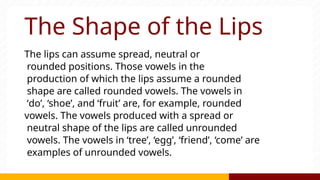
The Shape of the Lips
The lips can assume spread, neutral or
rounded positions. Those vowels in the
production of which the lips assume a rounded
shape are called rounded vowels. The vowels in
‘do’, ‘shoe’, and ‘fruit’ are, for example, rounded
vowels. The vowels produced with a spread or
neutral shape of the lips are called unrounded
vowels. The vowels in ‘tree’, ‘egg’, ‘friend’, ‘come’ are
examples of unrounded vowels.
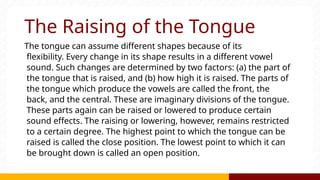
The Raising of the Tongue
The tongue can assume different shapes because of its
flexibility. Every change in its shape results in a different vowel
sound. Such changes are determined by two factors: (a) the part of
the tongue that is raised, and (b) how high it is raised. The parts of
the tongue which produce the vowels are called the front, the
back, and the central. These are imaginary divisions of the tongue.
These parts again can be raised or lowered to produce certain
sound effects. The raising or lowering, however, remains restricted
to a certain degree. The highest point to which the tongue can be
raised is called the close position. The lowest point to which it can
be brought down is called an open position.
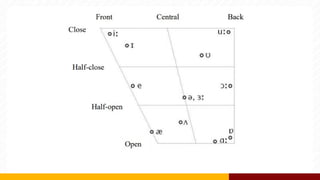
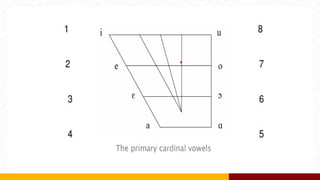
Two more intermediate imaginary
positions are also demarcated to
describe the raising of the tongue.
They are the half-close and the half-
open positions. These divisions and
heights can be shown with the help of
the following diagram
Primary Cardinal Vowels
The primary set [i e ɛ a ɑ ɔ o u],
are numbered 1 -8, (with 1 – 5
being unrounded and 6 - 8
rounded).
The cardinal vowels are auditorily agreed qualities
and must be learnt from a teacher who knows
how they sound, or from a recording. However,
vowels 1 and 5 can be given an articulatory
specification. No.1 is produced with the fronts
, closest position of the tongue which does not
produce audible friction, and No. 5 is produced
with the back, opens possible tongue
position, again without audible friction.
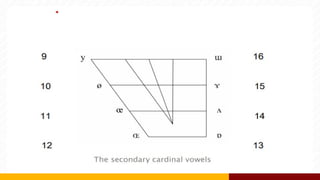
Secondary Cardinal Vowels
• The secondary cardinal vowels are [y Ø œ œ DA Y ш],
numbered 9-16. The secondary cardinal vowels are related
to the primary ones by reversing the lip- posture; so for
example vowel 1 (primary) is close, front, unrounded and so
vowel 9 (secondary) is close, front, rounded. To take another
example, vowel 8 is close, back, rounded -- so vowel 16 is
close, back, unrounded.
Articulation of the Tongue
The vowel articulation corresponds to the form of the mouth
and the position of the tongue when vowel sounds are
produced. Vowels are articulated based on tongue height
and tongue advancement.
Tongue Height
Vowels can be high, low, mid, mid-high and mid-low. These
classifications are based on the height of the tongue where
vowels are articulated. Notice the position of your tongue
when you say the words: "bead, peak, and mean". The
position of your tongue is closed to the roof of the mouth
when you utter these words. These are called high vowels.
High vowels are produced when the tongue is raised high
almost near the upper teeth.
Now try to say "no" and "bed". Notice that your tongue is in
the middle of the oral cavity when producing the phoneme
/o/ and /e/. These vowels are mid-vowels. Say these words:
"beet, bit, bait, bet, bat" and say them again without
sounding the /b/ and the /t/. Compare the positioning of
your tongue when producing the phoneme / er / such as in
the words "pay and grade."
• Let's practice:
• bead, bid,
• bade, bed, bad
• bod, bode, bush, booed, bud
• laud, loaf, took, lute, lump
Which word contain high, mid and low vowels?
Tongue Advancement
-When the vowels are produced, the tongue may be retracted
or advanced into three positions: (a) the back of the mouth,
(the center), and (c) the front. This is called tongue
advancement or back-ness.
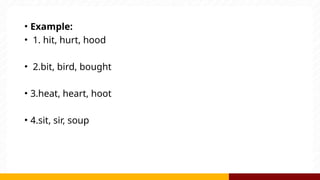
• Example:
• 1. hit, hurt, hood
• 2.bit, bird, bought
• 3.heat, heart, hoot
• 4.sit, sir, soup
Stability of Articulation
A monophthong is a single vowel sound in which the
positioning of the articulators at both beginning and end is
fairly fixed and does not glide up or down. Monophthongs
can be a lexeme or a syllable. Syllables are units of
pronunciation with one rhythmic character of the word. The
word "pit" is a monosyllabic word that contains a single
auditory quality, therefore, a monophthong. The vowel in
this word is produced with one sound /i/ using one mouth
position and one tone.
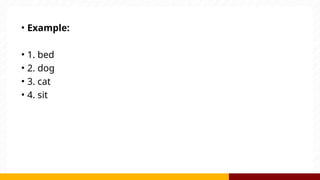
• Example:
• 1. bed
• 2. dog
• 3. cat
• 4. sit
Diphthongs
•has two vowel sound
• formed when two single vowels are combined in a syllable.
• It is a combination of vowel and a glide.
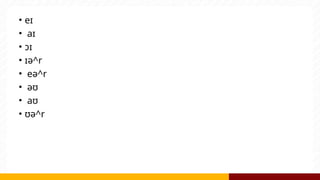
• 8 common used diphthongs in English:
• eɪ
• aɪ
• ɔɪ
• ɪə^r
• eə^r
• əʊ
• aʊ
• ʊə^r
Rising Diphthongs
• In rising diphthongs, the first vowel sound is shorter and
followed by a longer, higher vowel sound. This creates a
rising pitch pattern.
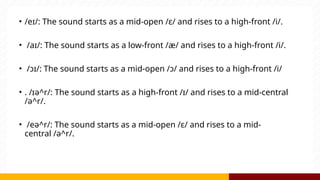
• /eɪ/: The sound starts as a mid-open /ɛ/ and rises to a high-front /i/.
• /aɪ/: The sound starts as a low-front /æ/ and rises to a high-front /i/.
• /ɔɪ/: The sound starts as a mid-open /ɔ/ and rises to a high-front /i/
• . /ɪə^r/: The sound starts as a high-front /ɪ/ and rises to a mid-central
/ə^r/.
• /eə^r/: The sound starts as a mid-open /ɛ/ and rises to a mid-
central /ə^r/.
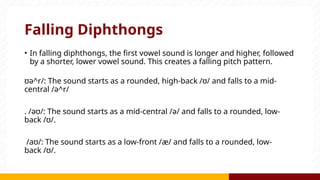
Falling Diphthongs
• In falling diphthongs, the first vowel sound is longer and higher, followed
by a shorter, lower vowel sound. This creates a falling pitch pattern.
ʊə^r/: The sound starts as a rounded, high-back /ʊ/ and falls to a mid-
central /ə^r/
. /əʊ/: The sound starts as a mid-central /ə/ and falls to a rounded, low-
back /ʊ/.
/aʊ/: The sound starts as a low-front /æ/ and falls to a rounded, low-
back /ʊ/.
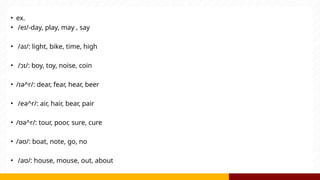
• ex.
• /eɪ/-day, play, may , say
• /aɪ/: light, bike, time, high
• /ɔɪ/: boy, toy, noise, coin
• /ɪə^r/: dear, fear, hear, beer
• /eə^r/: air, hair, bear, pair
• /ʊə^r/: tour, poor, sure, cure
• /əʊ/: boat, note, go, no
• /aʊ/: house, mouse, out, about
Triphthongs
•three vowel sound that glide together.
• it is monosyllabic, combination of diphthongs and
monophthongs that quickly and smoothly moves.
• There are three triphthongs that are generally agreed upon
in American English;
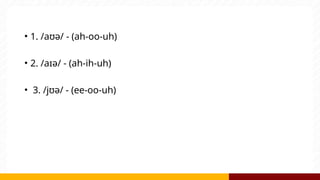
• 1. /aʊə/ - (ah-oo-uh)
• 2. /aɪə/ - (ah-ih-uh)
• 3. /jʊə/ - (ee-oo-uh)
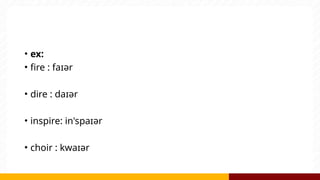
• ex:
• fire : faɪər
• dire : daɪər
• inspire: in'spaɪər
• choir : kwaɪər
Lip Rounding, Lengthening and
Tenseness
Roundedness
Vowels are classified in terms of roundedness.
Vowel roundedness in phonetics refers to the rounding of
the lips during the articulation of the vowel.
It is a vowel labialization, where the lips are involved in
producing the vowel sounds. When pronouncing a
rounded vowel, a circular or sphere opening of the lips is
formed. When vowels are unrounded the lips are relaxed.
Rounded Lips
1. [u] as in "food"
2. [o] as in "go“
3. [ʊ] as in "book"
Unrounded Lips
1. [i] as in "see"
2. [ɛ] as in "bed"
3. [æ] as in "cat"
Vowel Lengthening
• Say "can and can't" Notice any difference with how these
words are sounded. The difference between the vowel
production of these words is the lengthening of the vowel.
Generally, if a one-syllable word is followed with a voiced
consonant the vowel will be lengthened and longer than
when it is followed by an unvoiced consonant. Thus, in the
word "can't" the vowel length is affected by the final
consonant.
The lengthening of vowels produces long vowel sounds. Long
vowel
sounds are sounds of the five vowel letters ('a', 'e,' 'i,' 'o,' and 'u’),
the pronunciation of which is the as the same as how the letters
are pronounced: [er], [i], [ar], [ou], [yu]. Examples are the words
"rude, tube, rate, scene". In contrast, when they are not
pronounced like the letter itself, the vowels are short such as "tub,
cub." Long vowels often occur when a vowel is placed next to
another such as in the words "beam, deem rain, road, seen,
achieve, paid, beauty." The vowel is lengthened before a syllable
boundary.
Long Vowel Sounds
1. [ai] as in "rain"
2. 2. [ee] as in "see"
3. 3. [oa] as in "boat"
Short Vowel Sounds
1. [ɛ] as in "bed“
2. 2. [ʌ] as in "cup"
3. 3. [ɒ] as in "pot"
Tense and Lax Vowels
Notice how your mouth stretches when you say "too" and relaxes
when you say "to". "Too" is a long vowel, while "to" is a short vowel.
Most of the time, although not always, long vowels are tense, while
short vowels are lax. Tense vowels are articulated with more
tension of the muscles, the tongue position is somewhat higher and
the durations are longer compared to the lax vowels. Tense and lax
vowels refer to the degree of tension of the tongue and muscles of
the vocal tract. To feel the difference of the articulation, say "sheep
and ship." When you say "sheep and ship" your tongue is front and
high, your mouth is unrounded. However, when you say "sheep“
your muscles are tenser. This is similar when you say "late and let".
Tense Vowels
1. [i] as in "beat"
2. 2. [eɪ] as in "day"
3. 3. [u] as in "food"
Lax Vowels
1. [ɪ] as in "bit“
2. 2. [ɛ] as in "bed“
3. 3. [ʌ] as in "cup"
Rhotic vowels
In some words, "r" is pronounced, but dropped in others. When /r/ is
sounded the vowel is rhotic; if it is dropped, the vowel is non-rhotic. In
phonetics, rhoticity is the term that describes the sound of the /r/, based on
sound quality. Rhotic vowels (also called r-colored, retroflex, and vocalic r or
rhotacized vowel) are altered vowels resulting in the lowering of the
frequency of the third formant. Rhotic vowels are produced when the tip of
the tongue is curled upward. "The levels of rhoticity can vary between
speakers in a community and the process of a loss of rhoticity is a gradual one,
rather than the sharp binary distinction implied by the labels rhotic and non-
rhotic“(Barras, 2015).
Rhotic Vowels
1. [ɜːr] as in "bird" (in American English)
2. [ɔːr] as in "four"
3. [ɑr] as in "car"
Non-Rhotic Vowels
1. [ɪə] as in "beer"
2. 2. [ɛə] as in "hair"
3. 3. [ʊə] as in "tour“
In non-rhotic accents, the "r" in these examples is typically
not pronounced unless followed by a vowel.
ITL2 (2).pptxasdasdsadasdasdasdasdasdsadasd

ITL2 (2).pptxasdasdsadasdasdasdasdasdsadasd

  • 1.
  • 2.
    - There arefive vowels in the English alphabet. - (a, e, i ,o ,u ) - This are categorized according to their vowel qualities, articulation of the tongue, the stability of articulation, lengthening and thickness, and voicing.
  • 3.
    Vowels can bedefined as speech sounds produced without obstruction or audible friction of the lung air passing through the oral passage. The tongue and the lips can produce various resonating chambers by assuming different shapes.
  • 4.
    Vowel sounds areclassified into certain sets basing on the following main factors. 1.The Shape of the Lips 2. The Raising of the Tongue
  • 5.
    The Shape ofthe Lips The lips can assume spread, neutral or rounded positions. Those vowels in the production of which the lips assume a rounded shape are called rounded vowels. The vowels in ‘do’, ‘shoe’, and ‘fruit’ are, for example, rounded vowels. The vowels produced with a spread or neutral shape of the lips are called unrounded vowels. The vowels in ‘tree’, ‘egg’, ‘friend’, ‘come’ are examples of unrounded vowels.
  • 6.
    The Raising ofthe Tongue The tongue can assume different shapes because of its flexibility. Every change in its shape results in a different vowel sound. Such changes are determined by two factors: (a) the part of the tongue that is raised, and (b) how high it is raised. The parts of the tongue which produce the vowels are called the front, the back, and the central. These are imaginary divisions of the tongue. These parts again can be raised or lowered to produce certain sound effects. The raising or lowering, however, remains restricted to a certain degree. The highest point to which the tongue can be raised is called the close position. The lowest point to which it can be brought down is called an open position.
  • 7.
    Two more intermediateimaginary positions are also demarcated to describe the raising of the tongue. They are the half-close and the half- open positions. These divisions and heights can be shown with the help of the following diagram
  • 9.
    Primary Cardinal Vowels Theprimary set [i e ɛ a ɑ ɔ o u], are numbered 1 -8, (with 1 – 5 being unrounded and 6 - 8 rounded).
  • 11.
    The cardinal vowelsare auditorily agreed qualities and must be learnt from a teacher who knows how they sound, or from a recording. However, vowels 1 and 5 can be given an articulatory specification. No.1 is produced with the fronts , closest position of the tongue which does not produce audible friction, and No. 5 is produced with the back, opens possible tongue position, again without audible friction.
  • 12.
    Secondary Cardinal Vowels •The secondary cardinal vowels are [y Ø œ œ DA Y ш], numbered 9-16. The secondary cardinal vowels are related to the primary ones by reversing the lip- posture; so for example vowel 1 (primary) is close, front, unrounded and so vowel 9 (secondary) is close, front, rounded. To take another example, vowel 8 is close, back, rounded -- so vowel 16 is close, back, unrounded.
  • 15.
    Articulation of theTongue The vowel articulation corresponds to the form of the mouth and the position of the tongue when vowel sounds are produced. Vowels are articulated based on tongue height and tongue advancement.
  • 16.
    Tongue Height Vowels canbe high, low, mid, mid-high and mid-low. These classifications are based on the height of the tongue where vowels are articulated. Notice the position of your tongue when you say the words: "bead, peak, and mean". The position of your tongue is closed to the roof of the mouth when you utter these words. These are called high vowels. High vowels are produced when the tongue is raised high almost near the upper teeth.
  • 17.
    Now try tosay "no" and "bed". Notice that your tongue is in the middle of the oral cavity when producing the phoneme /o/ and /e/. These vowels are mid-vowels. Say these words: "beet, bit, bait, bet, bat" and say them again without sounding the /b/ and the /t/. Compare the positioning of your tongue when producing the phoneme / er / such as in the words "pay and grade."
  • 18.
    • Let's practice: •bead, bid, • bade, bed, bad • bod, bode, bush, booed, bud • laud, loaf, took, lute, lump Which word contain high, mid and low vowels?
  • 19.
    Tongue Advancement -When thevowels are produced, the tongue may be retracted or advanced into three positions: (a) the back of the mouth, (the center), and (c) the front. This is called tongue advancement or back-ness.
  • 20.
    • Example: • 1.hit, hurt, hood • 2.bit, bird, bought • 3.heat, heart, hoot • 4.sit, sir, soup
  • 21.
    Stability of Articulation Amonophthong is a single vowel sound in which the positioning of the articulators at both beginning and end is fairly fixed and does not glide up or down. Monophthongs can be a lexeme or a syllable. Syllables are units of pronunciation with one rhythmic character of the word. The word "pit" is a monosyllabic word that contains a single auditory quality, therefore, a monophthong. The vowel in this word is produced with one sound /i/ using one mouth position and one tone.
  • 22.
    • Example: • 1.bed • 2. dog • 3. cat • 4. sit
  • 23.
    Diphthongs •has two vowelsound • formed when two single vowels are combined in a syllable. • It is a combination of vowel and a glide. • 8 common used diphthongs in English:
  • 24.
    • eɪ • aɪ •ɔɪ • ɪə^r • eə^r • əʊ • aʊ • ʊə^r
  • 25.
    Rising Diphthongs • Inrising diphthongs, the first vowel sound is shorter and followed by a longer, higher vowel sound. This creates a rising pitch pattern.
  • 26.
    • /eɪ/: Thesound starts as a mid-open /ɛ/ and rises to a high-front /i/. • /aɪ/: The sound starts as a low-front /æ/ and rises to a high-front /i/. • /ɔɪ/: The sound starts as a mid-open /ɔ/ and rises to a high-front /i/ • . /ɪə^r/: The sound starts as a high-front /ɪ/ and rises to a mid-central /ə^r/. • /eə^r/: The sound starts as a mid-open /ɛ/ and rises to a mid- central /ə^r/.
  • 27.
    Falling Diphthongs • Infalling diphthongs, the first vowel sound is longer and higher, followed by a shorter, lower vowel sound. This creates a falling pitch pattern. ʊə^r/: The sound starts as a rounded, high-back /ʊ/ and falls to a mid- central /ə^r/ . /əʊ/: The sound starts as a mid-central /ə/ and falls to a rounded, low- back /ʊ/. /aʊ/: The sound starts as a low-front /æ/ and falls to a rounded, low- back /ʊ/.
  • 28.
    • ex. • /eɪ/-day,play, may , say • /aɪ/: light, bike, time, high • /ɔɪ/: boy, toy, noise, coin • /ɪə^r/: dear, fear, hear, beer • /eə^r/: air, hair, bear, pair • /ʊə^r/: tour, poor, sure, cure • /əʊ/: boat, note, go, no • /aʊ/: house, mouse, out, about
  • 29.
    Triphthongs •three vowel soundthat glide together. • it is monosyllabic, combination of diphthongs and monophthongs that quickly and smoothly moves. • There are three triphthongs that are generally agreed upon in American English;
  • 30.
    • 1. /aʊə/- (ah-oo-uh) • 2. /aɪə/ - (ah-ih-uh) • 3. /jʊə/ - (ee-oo-uh)
  • 31.
    • ex: • fire: faɪər • dire : daɪər • inspire: in'spaɪər • choir : kwaɪər
  • 32.
  • 33.
    Roundedness Vowels are classifiedin terms of roundedness. Vowel roundedness in phonetics refers to the rounding of the lips during the articulation of the vowel. It is a vowel labialization, where the lips are involved in producing the vowel sounds. When pronouncing a rounded vowel, a circular or sphere opening of the lips is formed. When vowels are unrounded the lips are relaxed.
  • 34.
    Rounded Lips 1. [u]as in "food" 2. [o] as in "go“ 3. [ʊ] as in "book"
  • 35.
    Unrounded Lips 1. [i]as in "see" 2. [ɛ] as in "bed" 3. [æ] as in "cat"
  • 36.
    Vowel Lengthening • Say"can and can't" Notice any difference with how these words are sounded. The difference between the vowel production of these words is the lengthening of the vowel. Generally, if a one-syllable word is followed with a voiced consonant the vowel will be lengthened and longer than when it is followed by an unvoiced consonant. Thus, in the word "can't" the vowel length is affected by the final consonant.
  • 37.
    The lengthening ofvowels produces long vowel sounds. Long vowel sounds are sounds of the five vowel letters ('a', 'e,' 'i,' 'o,' and 'u’), the pronunciation of which is the as the same as how the letters are pronounced: [er], [i], [ar], [ou], [yu]. Examples are the words "rude, tube, rate, scene". In contrast, when they are not pronounced like the letter itself, the vowels are short such as "tub, cub." Long vowels often occur when a vowel is placed next to another such as in the words "beam, deem rain, road, seen, achieve, paid, beauty." The vowel is lengthened before a syllable boundary.
  • 38.
    Long Vowel Sounds 1.[ai] as in "rain" 2. 2. [ee] as in "see" 3. 3. [oa] as in "boat"
  • 39.
    Short Vowel Sounds 1.[ɛ] as in "bed“ 2. 2. [ʌ] as in "cup" 3. 3. [ɒ] as in "pot"
  • 40.
    Tense and LaxVowels Notice how your mouth stretches when you say "too" and relaxes when you say "to". "Too" is a long vowel, while "to" is a short vowel. Most of the time, although not always, long vowels are tense, while short vowels are lax. Tense vowels are articulated with more tension of the muscles, the tongue position is somewhat higher and the durations are longer compared to the lax vowels. Tense and lax vowels refer to the degree of tension of the tongue and muscles of the vocal tract. To feel the difference of the articulation, say "sheep and ship." When you say "sheep and ship" your tongue is front and high, your mouth is unrounded. However, when you say "sheep“ your muscles are tenser. This is similar when you say "late and let".
  • 41.
    Tense Vowels 1. [i]as in "beat" 2. 2. [eɪ] as in "day" 3. 3. [u] as in "food"
  • 42.
    Lax Vowels 1. [ɪ]as in "bit“ 2. 2. [ɛ] as in "bed“ 3. 3. [ʌ] as in "cup"
  • 43.
    Rhotic vowels In somewords, "r" is pronounced, but dropped in others. When /r/ is sounded the vowel is rhotic; if it is dropped, the vowel is non-rhotic. In phonetics, rhoticity is the term that describes the sound of the /r/, based on sound quality. Rhotic vowels (also called r-colored, retroflex, and vocalic r or rhotacized vowel) are altered vowels resulting in the lowering of the frequency of the third formant. Rhotic vowels are produced when the tip of the tongue is curled upward. "The levels of rhoticity can vary between speakers in a community and the process of a loss of rhoticity is a gradual one, rather than the sharp binary distinction implied by the labels rhotic and non- rhotic“(Barras, 2015).
  • 44.
    Rhotic Vowels 1. [ɜːr]as in "bird" (in American English) 2. [ɔːr] as in "four" 3. [ɑr] as in "car"
  • 45.
    Non-Rhotic Vowels 1. [ɪə]as in "beer" 2. 2. [ɛə] as in "hair" 3. 3. [ʊə] as in "tour“ In non-rhotic accents, the "r" in these examples is typically not pronounced unless followed by a vowel.