Vowel
Made By:
Saveeda Hina
Contents
 Vowel
 Cardinal Vowel
 Monophthong
 Diphthong
 Triphthong
Vowel
 A vowel is a type of sound for which there is no closure
at any point of the vocal tract.
 A vowel is a sound in spoken language, such as ah! [a:]
or ee [i:]. pronounced with an open vocal tract so that
there is no build-up of air pressure at any point above
the glottis.
 Different from consonants
 Description of vowels is different from the description
of Consonants
Difference between Vowels and
consonants
 Vowels are different from consonant as consonants are produced with
obstruction or hindrance of air in the mouth such as “b” and “m”. Both are
stop –bilabial which are produced with obstruction of air in the mouth.
 All consonants are produced with obstruction of air in the mouth whereas all
the vowels are produced without ant obstruction of air in the mouth.
 Besides all vowels are voiced whereas some consonants are voiced and some
consonants are voiceless.
 Consonants have proper concepts to define their place and manner of
articulation whereas vowels are described by the position of tongue whether
high or low in the mouth and shape of the lips whether spread, rounded or
neutral and length of the vowel whether short vowel or long vowel.
Cardinal Vowels
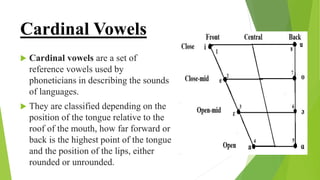
 Cardinal vowels are a set of
reference vowels used by
phoneticians in describing the sounds
of languages.
 They are classified depending on the
position of the tongue relative to the
roof of the mouth, how far forward or
back is the highest point of the tongue
and the position of the lips, either
rounded or unrounded.
Monophthongs
 A monophthong is simply a vowel.
 The word monophthong comes from the old Greek
language. Mono means one or single, and the -
phthong means sound or tone.
 The word monophthong shows that a vowel is spoken
with exactly one tone and one mouth position.
 For example, when you say "teeth", then while you are
creating the sound of the "ee", nothing changes for that
sound.
Description of Vowels
 Vowels are described based on the following criteria:
 (i) The part of the tongue that is raised or lowered
 1. Front 2. Central 3. Back
 (ii) The height of the tongue
 1. High 2. Mid 3. Low
 (iii) The position of the lips
 1. Spread(Unrounded) 2. Neutral 3. Rounded
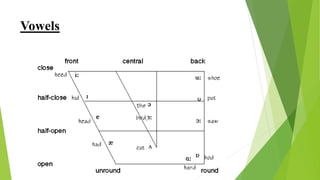
Vowels
Basic Concept To Remember
 In close vowels, the tongue is quite high in the mouth.
 In open vowels, the tongue in quite low in the mouth.
 For mid-vowels, the tongue is neither high nor low in the mouth.
 Front Vowels are those vowels in which the front of the tongue is
involved.
 Back Vowels are those vowels in which the back of the tongue is
involved.
 Central vowels are those vowels in which the centre of the
tongue is involved.
Front Vowels
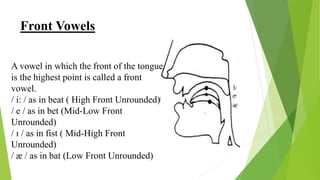
A vowel in which the front of the tongue
is the highest point is called a front
vowel.
/ i: / as in beat ( High Front Unrounded)
/ e / as in bet (Mid-Low Front
Unrounded)
/ ɪ / as in fist ( Mid-High Front
Unrounded)
/ æ / as in bat (Low Front Unrounded)
/ i: /
 When the body of the tongue is pushed forward and toward
the roof of the mouth we get this vowel sound.
 Long vowel
 Front vowel
 Close vowel
 Lips are slightly spread
 Examples
 Beat, feat, bead etc.
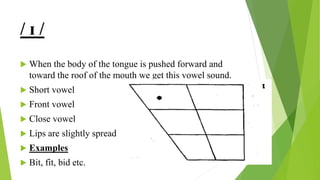
/ ɪ /
 When the body of the tongue is pushed forward and
toward the roof of the mouth we get this vowel sound.
 Short vowel
 Front vowel
 Close vowel
 Lips are slightly spread
 Examples
 Bit, fit, bid etc.
/ e /
 In [e], for example, the tongue body is pushed forward, as it is
during [i] and [æ], but it is further away from the roof of the
mouth in [e] than in [i], and closer to the roof of the mouth than
in [æ]. So we can place [e] on a vowel chart between [i] and [æ].
 Lie between half close and half-open Vowel
 Front vowel
 Short vowel
 Lips are spread
 Examples
 Red, bed, men, yes etc.
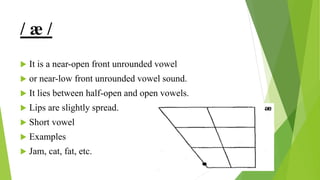
/ æ /
 It is a near-open front unrounded vowel
 or near-low front unrounded vowel sound.
 It lies between half-open and open vowels.
 Lips are slightly spread.
 Short vowel
 Examples
 Jam, cat, fat, etc.
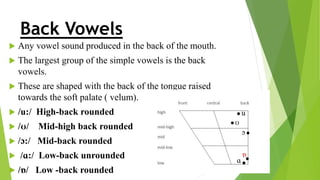
Back Vowels
 Any vowel sound produced in the back of the mouth.
 The largest group of the simple vowels is the back
vowels.
 These are shaped with the back of the tongue raised
towards the soft palate ( velum).
 /u:/ High-back rounded
 /ʊ/ Mid-high back rounded
 /ɔ:/ Mid-back rounded
 /ɑ:/ Low-back unrounded
 /ɒ/ Low -back rounded
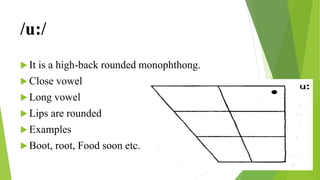
/u:/
 It is a high-back rounded monophthong.
 Close vowel
 Long vowel
 Lips are rounded
 Examples
 Boot, root, Food soon etc.
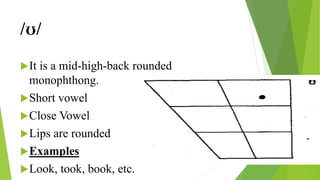
/ʊ/
It is a mid-high-back rounded
monophthong.
Short vowel
Close Vowel
Lips are rounded
Examples
Look, took, book, etc.
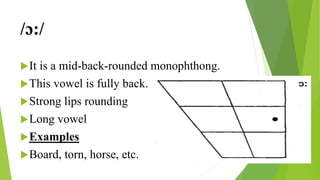
/ɔ:/
It is a mid-back-rounded monophthong.
This vowel is fully back.
Strong lips rounding
Long vowel
Examples
Board, torn, horse, etc.
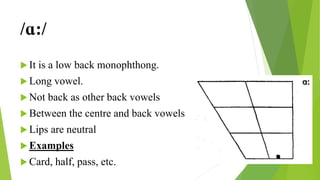
/ɑ:/
 It is a low back monophthong.
 Long vowel.
 Not back as other back vowels
 Between the centre and back vowels
 Lips are neutral
 Examples
 Card, half, pass, etc.
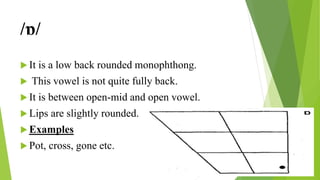
/ɒ/
 It is a low back rounded monophthong.
 This vowel is not quite fully back.
 It is between open-mid and open vowel.
 Lips are slightly rounded.
 Examples
 Pot, cross, gone etc.
Central Vowels
 A central vowel, formerly also known as a mixed vowel,
is any in a class of vowel sound used in some spoken
languages. The defining characteristic of a central vowel
is that the tongue is positioned halfway between a front
vowel and a back vowel.
 Central Vowels are produced with the middle of the
tongue.
 Central vowels are the following:
 /ʌ /,/ɜː /, and / ə /
/ə /
 The schwa [ə] is in the exact centre.
 It is a half-close vowel.
 Short vowel
 Schwa is often referred to as the neutral vowel, the vowel in which
the vocal tract is in its neutral state and most closely resembles a
perfect tube.
 All the other vowels require that the vocal tract be deformed by
moving the tongue body away from its neutral position, either up or
down, backward or forward.
 Examples
 About, above, etc.
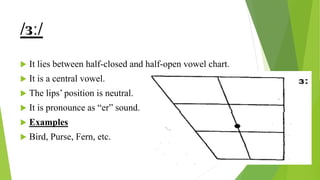
/ɜː/
 It lies between half-closed and half-open vowel chart.
 It is a central vowel.
 The lips’ position is neutral.
 It is pronounce as “er” sound.
 Examples
 Bird, Purse, Fern, etc.
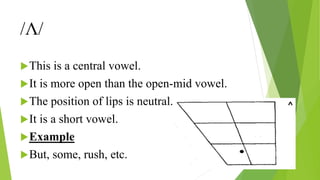
/Ʌ/
This is a central vowel.
It is more open than the open-mid vowel.
The position of lips is neutral.
It is a short vowel.
Example
But, some, rush, etc.
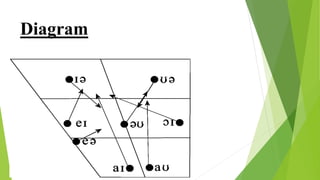
Diphthongs
 The word Diphthongs came from the Greek word Diphthongos,
Which means two sounds. Di- means double, thongos means
sounds. By combining these two words, we make Diphthongs.
 Diphthongs are the sounds that are produced by combining two
vowels.
 A vowel sound that starts near the articulatory position for one
vowel and moves toward the position for another.
 These are also called gliding sounds.
 Examples
 Hi [aɪ] and bye etc.
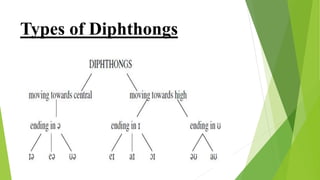
Types of Diphthongs
Diagram
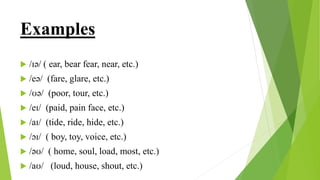
Examples
 /ɪə/ ( ear, bear fear, near, etc.)
 /eə/ (fare, glare, etc.)
 /ʊə/ (poor, tour, etc.)
 /eɪ/ (paid, pain face, etc.)
 /aɪ/ (tide, ride, hide, etc.)
 /ɔɪ/ ( boy, toy, voice, etc.)
 /əʊ/ ( home, soul, load, most, etc.)
 /aʊ/ (loud, house, shout, etc.)
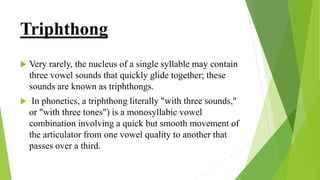
Triphthong
 Very rarely, the nucleus of a single syllable may contain
three vowel sounds that quickly glide together; these
sounds are known as triphthongs.
 In phonetics, a triphthong literally "with three sounds,"
or "with three tones") is a monosyllabic vowel
combination involving a quick but smooth movement of
the articulator from one vowel quality to another that
passes over a third.
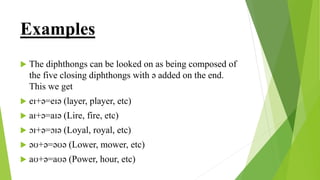
Examples
 The diphthongs can be looked on as being composed of
the five closing diphthongs with ə added on the end.
This we get
 eɪ+ə=eɪə (layer, player, etc)
 aɪ+ə=aɪə (Lire, fire, etc)
 ɔɪ+ə=ɔɪə (Loyal, royal, etc)
 əʊ+ə=əʊə (Lower, mower, etc)
 aʊ+ə=aʊə (Power, hour, etc)
Thank You

Vowels by saveeda hina

  • 1.
  • 2.
    Contents  Vowel  CardinalVowel  Monophthong  Diphthong  Triphthong
  • 3.
    Vowel  A vowelis a type of sound for which there is no closure at any point of the vocal tract.  A vowel is a sound in spoken language, such as ah! [a:] or ee [i:]. pronounced with an open vocal tract so that there is no build-up of air pressure at any point above the glottis.  Different from consonants  Description of vowels is different from the description of Consonants
  • 4.
    Difference between Vowelsand consonants  Vowels are different from consonant as consonants are produced with obstruction or hindrance of air in the mouth such as “b” and “m”. Both are stop –bilabial which are produced with obstruction of air in the mouth.  All consonants are produced with obstruction of air in the mouth whereas all the vowels are produced without ant obstruction of air in the mouth.  Besides all vowels are voiced whereas some consonants are voiced and some consonants are voiceless.  Consonants have proper concepts to define their place and manner of articulation whereas vowels are described by the position of tongue whether high or low in the mouth and shape of the lips whether spread, rounded or neutral and length of the vowel whether short vowel or long vowel.
  • 5.
    Cardinal Vowels  Cardinalvowels are a set of reference vowels used by phoneticians in describing the sounds of languages.  They are classified depending on the position of the tongue relative to the roof of the mouth, how far forward or back is the highest point of the tongue and the position of the lips, either rounded or unrounded.
  • 6.
    Monophthongs  A monophthongis simply a vowel.  The word monophthong comes from the old Greek language. Mono means one or single, and the - phthong means sound or tone.  The word monophthong shows that a vowel is spoken with exactly one tone and one mouth position.  For example, when you say "teeth", then while you are creating the sound of the "ee", nothing changes for that sound.
  • 7.
    Description of Vowels Vowels are described based on the following criteria:  (i) The part of the tongue that is raised or lowered  1. Front 2. Central 3. Back  (ii) The height of the tongue  1. High 2. Mid 3. Low  (iii) The position of the lips  1. Spread(Unrounded) 2. Neutral 3. Rounded
  • 8.
  • 9.
    Basic Concept ToRemember  In close vowels, the tongue is quite high in the mouth.  In open vowels, the tongue in quite low in the mouth.  For mid-vowels, the tongue is neither high nor low in the mouth.  Front Vowels are those vowels in which the front of the tongue is involved.  Back Vowels are those vowels in which the back of the tongue is involved.  Central vowels are those vowels in which the centre of the tongue is involved.
  • 10.
    Front Vowels A vowelin which the front of the tongue is the highest point is called a front vowel. / i: / as in beat ( High Front Unrounded) / e / as in bet (Mid-Low Front Unrounded) / ɪ / as in fist ( Mid-High Front Unrounded) / æ / as in bat (Low Front Unrounded)
  • 11.
    / i: / When the body of the tongue is pushed forward and toward the roof of the mouth we get this vowel sound.  Long vowel  Front vowel  Close vowel  Lips are slightly spread  Examples  Beat, feat, bead etc.
  • 12.
    / ɪ / When the body of the tongue is pushed forward and toward the roof of the mouth we get this vowel sound.  Short vowel  Front vowel  Close vowel  Lips are slightly spread  Examples  Bit, fit, bid etc.
  • 13.
    / e / In [e], for example, the tongue body is pushed forward, as it is during [i] and [æ], but it is further away from the roof of the mouth in [e] than in [i], and closer to the roof of the mouth than in [æ]. So we can place [e] on a vowel chart between [i] and [æ].  Lie between half close and half-open Vowel  Front vowel  Short vowel  Lips are spread  Examples  Red, bed, men, yes etc.
  • 14.
    / æ / It is a near-open front unrounded vowel  or near-low front unrounded vowel sound.  It lies between half-open and open vowels.  Lips are slightly spread.  Short vowel  Examples  Jam, cat, fat, etc.
  • 15.
    Back Vowels  Anyvowel sound produced in the back of the mouth.  The largest group of the simple vowels is the back vowels.  These are shaped with the back of the tongue raised towards the soft palate ( velum).  /u:/ High-back rounded  /ʊ/ Mid-high back rounded  /ɔ:/ Mid-back rounded  /ɑ:/ Low-back unrounded  /ɒ/ Low -back rounded
  • 16.
    /u:/  It isa high-back rounded monophthong.  Close vowel  Long vowel  Lips are rounded  Examples  Boot, root, Food soon etc.
  • 17.
    /ʊ/ It is amid-high-back rounded monophthong. Short vowel Close Vowel Lips are rounded Examples Look, took, book, etc.
  • 18.
    /ɔ:/ It is amid-back-rounded monophthong. This vowel is fully back. Strong lips rounding Long vowel Examples Board, torn, horse, etc.
  • 19.
    /ɑ:/  It isa low back monophthong.  Long vowel.  Not back as other back vowels  Between the centre and back vowels  Lips are neutral  Examples  Card, half, pass, etc.
  • 20.
    /ɒ/  It isa low back rounded monophthong.  This vowel is not quite fully back.  It is between open-mid and open vowel.  Lips are slightly rounded.  Examples  Pot, cross, gone etc.
  • 21.
    Central Vowels  Acentral vowel, formerly also known as a mixed vowel, is any in a class of vowel sound used in some spoken languages. The defining characteristic of a central vowel is that the tongue is positioned halfway between a front vowel and a back vowel.  Central Vowels are produced with the middle of the tongue.  Central vowels are the following:  /ʌ /,/ɜː /, and / ə /
  • 22.
    /ə /  Theschwa [ə] is in the exact centre.  It is a half-close vowel.  Short vowel  Schwa is often referred to as the neutral vowel, the vowel in which the vocal tract is in its neutral state and most closely resembles a perfect tube.  All the other vowels require that the vocal tract be deformed by moving the tongue body away from its neutral position, either up or down, backward or forward.  Examples  About, above, etc.
  • 23.
    /ɜː/  It liesbetween half-closed and half-open vowel chart.  It is a central vowel.  The lips’ position is neutral.  It is pronounce as “er” sound.  Examples  Bird, Purse, Fern, etc.
  • 24.
    /Ʌ/ This is acentral vowel. It is more open than the open-mid vowel. The position of lips is neutral. It is a short vowel. Example But, some, rush, etc.
  • 25.
    Diphthongs  The wordDiphthongs came from the Greek word Diphthongos, Which means two sounds. Di- means double, thongos means sounds. By combining these two words, we make Diphthongs.  Diphthongs are the sounds that are produced by combining two vowels.  A vowel sound that starts near the articulatory position for one vowel and moves toward the position for another.  These are also called gliding sounds.  Examples  Hi [aɪ] and bye etc.
  • 26.
  • 27.
  • 28.
    Examples  /ɪə/ (ear, bear fear, near, etc.)  /eə/ (fare, glare, etc.)  /ʊə/ (poor, tour, etc.)  /eɪ/ (paid, pain face, etc.)  /aɪ/ (tide, ride, hide, etc.)  /ɔɪ/ ( boy, toy, voice, etc.)  /əʊ/ ( home, soul, load, most, etc.)  /aʊ/ (loud, house, shout, etc.)
  • 29.
    Triphthong  Very rarely,the nucleus of a single syllable may contain three vowel sounds that quickly glide together; these sounds are known as triphthongs.  In phonetics, a triphthong literally "with three sounds," or "with three tones") is a monosyllabic vowel combination involving a quick but smooth movement of the articulator from one vowel quality to another that passes over a third.
  • 30.
    Examples  The diphthongscan be looked on as being composed of the five closing diphthongs with ə added on the end. This we get  eɪ+ə=eɪə (layer, player, etc)  aɪ+ə=aɪə (Lire, fire, etc)  ɔɪ+ə=ɔɪə (Loyal, royal, etc)  əʊ+ə=əʊə (Lower, mower, etc)  aʊ+ə=aʊə (Power, hour, etc)
  • 31.