
Universty of Duhok
Science & Education - Akre
English Department
Phonetic
The Consonants of English
Produced by:
Mosa H. Mosa
Teacher:
Saeed A. Attieh

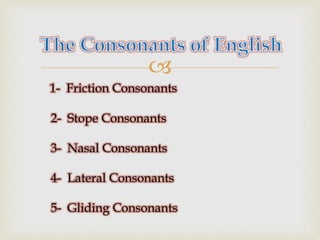
1- Friction Consonants
2- Stope Consonants
3- Nasal Consonants
4- Lateral Consonants
5- Gliding Consonants

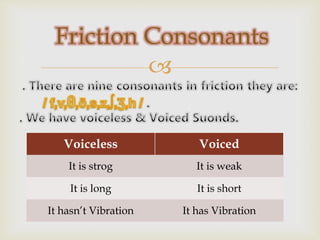
Friction Consonants
Voiceless Voiced
It is strog It is weak
It is long It is short
It hasn’t Vibration It has Vibration

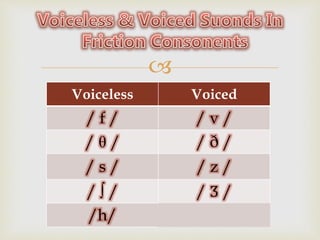
Voiceless Voiced
/ f / / v /
/ θ / / ð /
/ s / / z /
/ ∫ / / Ʒ /
/h/

* The soft plate is raised.
* The bottom lip is veryclose
to the upper front teeth.
* The tongue is not directly
concerned in making these
sounds.

* When /f/ and /v/ occur at the end of words,
after a vawel, they have an effect on the length of
the vowel. ( The strong consonant /f/ makes the
vowel shorter, the weak consonant /v/ makes the
vowel longer ). And for /θ,ð,s,z/
life /laIf/ live /laIv/
calf /kɑ:f/ carve /kɑ:v/

* The soft plate is raised so
that all the breath is forced
to go through the mouth.
* The tip of the tangue is close
to the upper front teeth.

* Between vowels /ð/ is voiced, but in initial it
will be fully voiced.
Between vowels: worthy /wз:ðI/ Voiced
In Initially: that /ðæt/ Fully Voiced
* The soft plate is raised so
that all the breath is forced
to go through the mouth.
* The tip and blade of the
tangue are very close to the
alveolar ridge.
* The friction for these sounds,
especially for /s/, is much greater than for
/f,v,θ/ and /ð/.

* /s/ and /z/ sounds is noisy, /θ/and /ð/ is
less noisy.
south /saʊθ/ this /ðIs/
these / ði:z/ those /ðǝʊz/


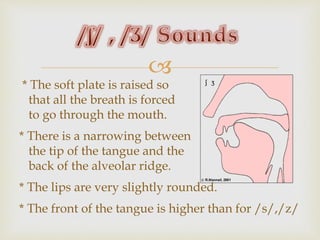
* The soft plate is raised so
that all the breath is forced
to go through the mouth.
* There is a narrowing between
the tip of the tangue and the
back of the alveolar ridge.
* The lips are very slightly rounded.
* The front of the tangue is higher than for /s/,/z/

* /Ʒ/ doesn’t occur at the beginning of English
words, But /ʃ / quite frequently does.
she /ʃi:/ show /ʃǝʊ/
short /ʃͻ:t/ shut /ʃʌt/

- In production, /h/ is like vowels.
Such as ( hot,hat,hit )
- In distribution, /h/is a consonants .
Such as ( sat,hat )
- we don’t use speech organs for /h/ sound.

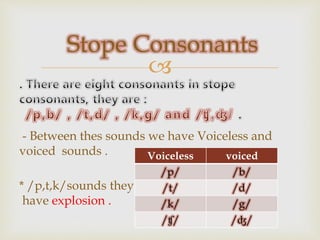
Stope Consonants
- Between thes sounds we have Voiceless and
voiced sounds .
* /p,t,k/sounds they
have explosion .
Voiceless voiced
/p/ /b/
/t/ /d/
/k/ /g/
/ʧ/ /ʤ/

* When /p/ occur in initially and if we have vowel
after /p/, It will be aspiration But if /p/ occurs
between vowels the aspiration may be less
noticeable or even absent, And for /t,k/ is same.
Aspiration: short period after the explosion of
/p,t,k/ when air leaves the mouth without voice.
- In initially: pool /ph
u:l/
- Between vowels: happy /hæpI/


* When /t/ occur in initially and if we have vowel
after /t/, It will be aspiration But if /t/ occurs
between vowels the aspiration may be weaker or
even absent.
- In initially: ton /th
ʌn/
- Between vowels: putting /pʊtIŋ/
* The back of the tangue is in firm contact with
the soft palate, and the soft palate is raised, so that
the breath is trapped for a short time.

* When /k/ occur in initially and if we have vowel
after /k/, It will be aspiration But if /k/ occurs
between vowels the aspiration may be weaker or
even absent.
- In initially: cool /kh
u:l/
- Between vowels: lacking /lækIŋ/


/p/ is aspirated and shortens the vowel before it, whilst /b/ is
particularly weak and only very little noise, but lenghens the vowel
before it. Example: cap /kæp/ cab /kæb/
/t/ is aspirated and shortens the vowel before it, whilst /d/ is
particularly weak and only very little noise, but lenghens the vowel
before it. Example: heart /hɑ:t/ hard /hɑ:d/
/k/ is aspirated and shortens the vowel before it, but /g/ is very
gentle weak lenghens the vowel before it.
Example: back /bæk/ bag /bæg/
/ʧ/ is strong and voiceless, and it shortens the vowel before it, but
/ʤ/ is very weak and short, and it lenghens the vowel before it.
Example: rich /rIʧ/ ridge /rIʤ/

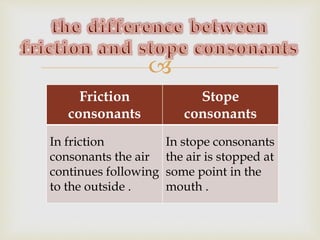
Friction
consonants
Stope
consonants
In friction
consonants the air
continues following
to the outside .
In stope consonants
the air is stopped at
some point in the
mouth .

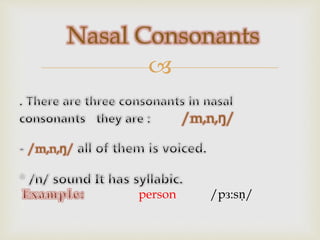
Nasal Consonants
/m,n,ŋ/
/m,n,ŋ/
person /pз:sṇ/


Lateral Consonants
* The air passes through
the sides of the tangue.
* The soft palate is raised.
* The sound is voiced.

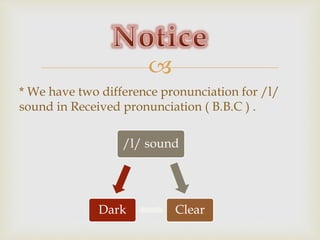
* We have two difference pronunciation for /l/
sound in Received pronunciation ( B.B.C ) .
/l/ sound
ClearDark

1- Dark:
* /l/ + Consonants = Dark e.g : milk /mIlk/
* /l/ in finally is dark e.g : full /fʊl/
2- Clear:
* /l/ + Vowel = Clear e.g : leaf /li:f/

Gliding Consonants
/j,w,r/
* In production /j,w,r/ is semi vowel.
Exampel: Yes /jes/
* /j/ doesn’t come finally
/jes/
/j/= short/I//j/= longe /i:/

* /r/ sound in Received pronunciation ( B.B.C ) ,
it is produced only befory vowels.
Exampel: marry /mærI/ , raw /rͻ:/
* In finally it is produced, if we have after /r/
word and the first letter of the word is vowel,
if we haven’t vowel isn’t produced.
Exampel: better of /betǝr ɒf/ letter /betǝ/
* /r/ after /p,t,k/ it will be voiceless.
Exampel: pray /preɪ/

The End
Produced by
Mosa Hussein Mosa
Sources: Internet & Better English Pronunciation
Facebook.com/mosakhurty
Twitter.com/mosakurdish
instagram.com/mosa_mzoory
Thanks

Consonants of English

  • 1.
     Universty of Duhok Science& Education - Akre English Department Phonetic The Consonants of English Produced by: Mosa H. Mosa Teacher: Saeed A. Attieh
  • 2.
     1- Friction Consonants 2-Stope Consonants 3- Nasal Consonants 4- Lateral Consonants 5- Gliding Consonants
  • 3.
     Friction Consonants Voiceless Voiced Itis strog It is weak It is long It is short It hasn’t Vibration It has Vibration
  • 4.
     Voiceless Voiced / f/ / v / / θ / / ð / / s / / z / / ∫ / / Ʒ / /h/
  • 5.
     * The softplate is raised. * The bottom lip is veryclose to the upper front teeth. * The tongue is not directly concerned in making these sounds.
  • 6.
     * When /f/and /v/ occur at the end of words, after a vawel, they have an effect on the length of the vowel. ( The strong consonant /f/ makes the vowel shorter, the weak consonant /v/ makes the vowel longer ). And for /θ,ð,s,z/ life /laIf/ live /laIv/ calf /kɑ:f/ carve /kɑ:v/
  • 7.
     * The softplate is raised so that all the breath is forced to go through the mouth. * The tip of the tangue is close to the upper front teeth.
  • 8.
     * Between vowels/ð/ is voiced, but in initial it will be fully voiced. Between vowels: worthy /wз:ðI/ Voiced In Initially: that /ðæt/ Fully Voiced
  • 9.
    * The softplate is raised so that all the breath is forced to go through the mouth. * The tip and blade of the tangue are very close to the alveolar ridge. * The friction for these sounds, especially for /s/, is much greater than for /f,v,θ/ and /ð/.
  • 10.
     * /s/ and/z/ sounds is noisy, /θ/and /ð/ is less noisy. south /saʊθ/ this /ðIs/ these / ði:z/ those /ðǝʊz/
  • 11.
  • 12.
     * The softplate is raised so that all the breath is forced to go through the mouth. * There is a narrowing between the tip of the tangue and the back of the alveolar ridge. * The lips are very slightly rounded. * The front of the tangue is higher than for /s/,/z/
  • 13.
     * /Ʒ/ doesn’toccur at the beginning of English words, But /ʃ / quite frequently does. she /ʃi:/ show /ʃǝʊ/ short /ʃͻ:t/ shut /ʃʌt/
  • 14.
     - In production,/h/ is like vowels. Such as ( hot,hat,hit ) - In distribution, /h/is a consonants . Such as ( sat,hat ) - we don’t use speech organs for /h/ sound.
  • 15.
     Stope Consonants - Betweenthes sounds we have Voiceless and voiced sounds . * /p,t,k/sounds they have explosion . Voiceless voiced /p/ /b/ /t/ /d/ /k/ /g/ /ʧ/ /ʤ/
  • 16.
  • 17.
    * When /p/occur in initially and if we have vowel after /p/, It will be aspiration But if /p/ occurs between vowels the aspiration may be less noticeable or even absent, And for /t,k/ is same. Aspiration: short period after the explosion of /p,t,k/ when air leaves the mouth without voice. - In initially: pool /ph u:l/ - Between vowels: happy /hæpI/
  • 18.
  • 19.
     * When /t/occur in initially and if we have vowel after /t/, It will be aspiration But if /t/ occurs between vowels the aspiration may be weaker or even absent. - In initially: ton /th ʌn/ - Between vowels: putting /pʊtIŋ/
  • 20.
    * The backof the tangue is in firm contact with the soft palate, and the soft palate is raised, so that the breath is trapped for a short time.
  • 21.
     * When /k/occur in initially and if we have vowel after /k/, It will be aspiration But if /k/ occurs between vowels the aspiration may be weaker or even absent. - In initially: cool /kh u:l/ - Between vowels: lacking /lækIŋ/
  • 22.
  • 23.
     /p/ is aspiratedand shortens the vowel before it, whilst /b/ is particularly weak and only very little noise, but lenghens the vowel before it. Example: cap /kæp/ cab /kæb/ /t/ is aspirated and shortens the vowel before it, whilst /d/ is particularly weak and only very little noise, but lenghens the vowel before it. Example: heart /hɑ:t/ hard /hɑ:d/ /k/ is aspirated and shortens the vowel before it, but /g/ is very gentle weak lenghens the vowel before it. Example: back /bæk/ bag /bæg/ /ʧ/ is strong and voiceless, and it shortens the vowel before it, but /ʤ/ is very weak and short, and it lenghens the vowel before it. Example: rich /rIʧ/ ridge /rIʤ/
  • 24.
     Friction consonants Stope consonants In friction consonants theair continues following to the outside . In stope consonants the air is stopped at some point in the mouth .
  • 25.
  • 26.
  • 27.
     Lateral Consonants * Theair passes through the sides of the tangue. * The soft palate is raised. * The sound is voiced.
  • 28.
     * We havetwo difference pronunciation for /l/ sound in Received pronunciation ( B.B.C ) . /l/ sound ClearDark
  • 29.
     1- Dark: * /l/+ Consonants = Dark e.g : milk /mIlk/ * /l/ in finally is dark e.g : full /fʊl/ 2- Clear: * /l/ + Vowel = Clear e.g : leaf /li:f/
  • 30.
     Gliding Consonants /j,w,r/ * Inproduction /j,w,r/ is semi vowel. Exampel: Yes /jes/ * /j/ doesn’t come finally /jes/ /j/= short/I//j/= longe /i:/
  • 31.
     * /r/ soundin Received pronunciation ( B.B.C ) , it is produced only befory vowels. Exampel: marry /mærI/ , raw /rͻ:/ * In finally it is produced, if we have after /r/ word and the first letter of the word is vowel, if we haven’t vowel isn’t produced. Exampel: better of /betǝr ɒf/ letter /betǝ/ * /r/ after /p,t,k/ it will be voiceless. Exampel: pray /preɪ/
  • 32.
     The End Produced by MosaHussein Mosa Sources: Internet & Better English Pronunciation Facebook.com/mosakhurty Twitter.com/mosakurdish instagram.com/mosa_mzoory Thanks

Editor's Notes