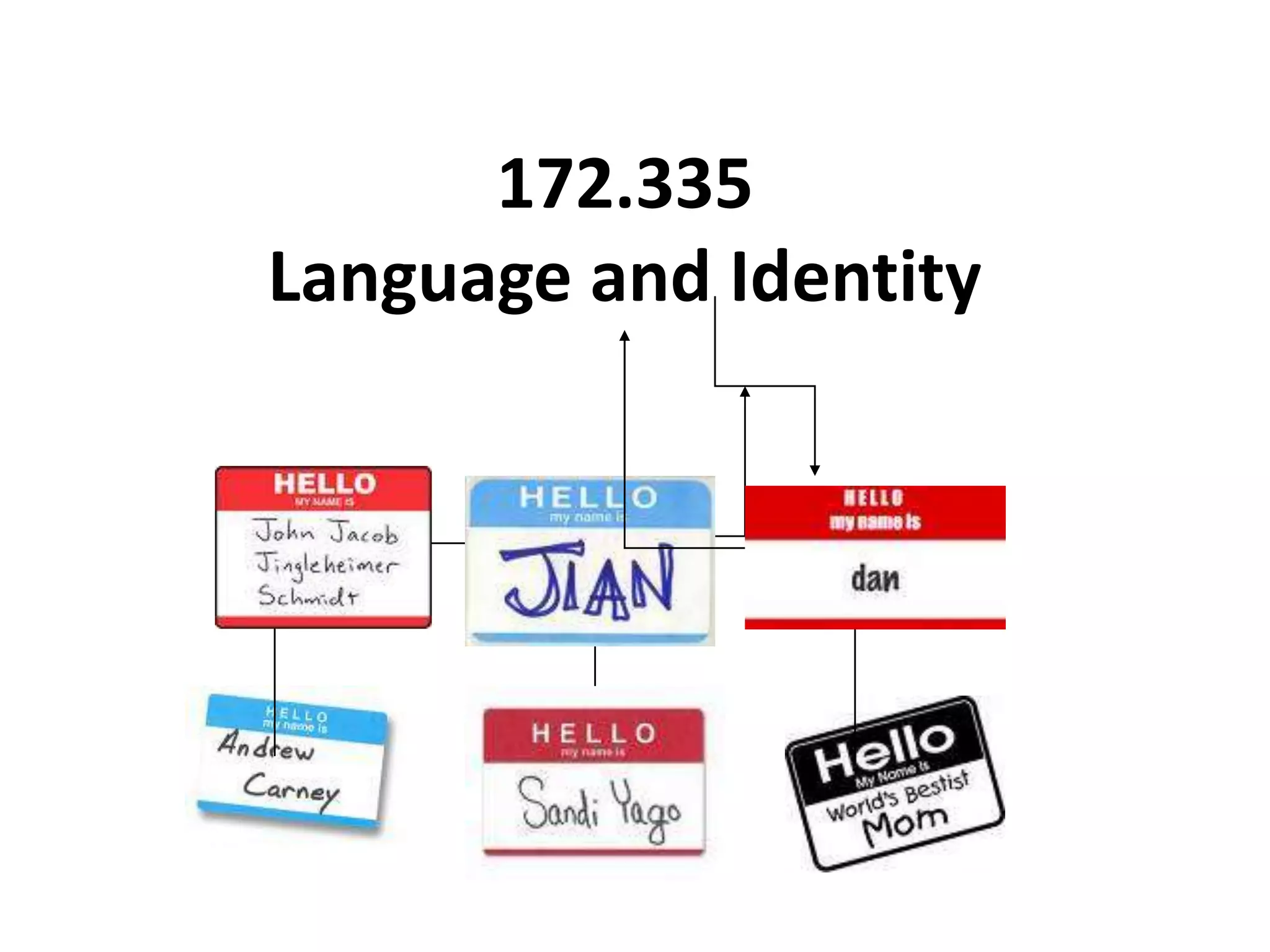
172.335 Language and Identity
What is discourseDiscourse has 2 meaningsLinguists’ original meaninga stretch of language greater than the sentenceThe top level of organisation of languageDiscourse		the organisation of utterances, textsSyntax 		the structure of sentencesMorphology	the study of the structure of wordsPhonology		the study of sounds within a languagePhonetics      	the study of human sound making
types and genres we will examineSpoken discourse – written discourseCo-constructed by speaker and listenerAuthor and readerDifferent genresDifferent functions of language
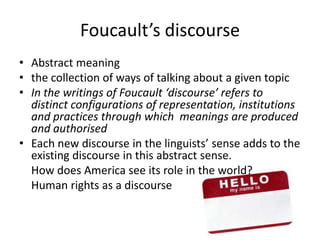
Foucault’s discourse Abstract meaningthe collection of ways of talking about a given topicIn the writings of Foucault ‘discourse’ refers to distinct configurations of representation, institutions and practices through which  meanings are produced and authorisedEach new discourse in the linguists’ sense adds to the existing discourse in this abstract sense.	How does America see its role in the world?	Human rights as a discourse
What we will be examiningWe will be looking at quite a few levels of languageDiscourse – both sensesPragmatics – the study of speaker intentionsSociophonetics – the social meaning of variants in pronunciation ......   BUT .....
Reinvigorating the sociology of sociolinguisticsWe will be linking these linguistic questions to newer ways of thinking about societyEarlier research into sociolinguistics was rather atheoretical in its approach to what was meant by society, class, gender etc
Social TheoryRecent Sociology and Social TheorySeeks to understand the relationship of the individual to the social world around themSeeks to explain the increasing importance of a having a sense of identity in modern timesSeeks to explore how identity is formed through the interaction of individuals and the social forces around us
What is identity?Identity is a set of verbal practices though which persons assemble and display who they are while in the presence of, and in interaction with, others. Hadden & Lester, 1978, p.331 use the term identity to refer to how people understand their relationship to the world, how that relationship is constructed across time and space, and how people understand the possibilities of their future. Norton 1997, p.410
What is identityWe recognise [identity] now as non-fixed, non-rigid, and always constructed by individuals of themselves or by peoples who share certain values or perceive another group as having such values ... Omoniyi & White 2006; coverSocial identities come and go but my identity goes on as something which unites all the social identities I ever had, or will have. My identity always overflows, adds to, transforms the social identities that are attached to me. Craib, 1998, p.4
Social constructionismSocial categories are not real but are constructed by people who belong to a community.William Labov wanted to know how middle class NY’ersspoke r, or lower middle class NY’ersThe social identity is the stimulus – the language variation is the response.What if we see this the other way round – people are choosing to act in certain ways to construct their social identity.Social construction sees people as having some choice in their self representation and different kinds of language as the building blocks to presenting an identity
The consequences of constructionismIf our identities are not permanent, we are are able to construct and reconstruct themThis means we are able to contextualise identity performancesWe are able to present different facets of our self through language (among other things) for specific audiences.If I am this everchanging parade of identities why do I always feel like me?Is there a real me under it all?

Hello my name is ...

  • 1.
  • 2.
    What is discourseDiscoursehas 2 meaningsLinguists’ original meaninga stretch of language greater than the sentenceThe top level of organisation of languageDiscourse the organisation of utterances, textsSyntax the structure of sentencesMorphology the study of the structure of wordsPhonology the study of sounds within a languagePhonetics the study of human sound making
  • 3.
    types and genreswe will examineSpoken discourse – written discourseCo-constructed by speaker and listenerAuthor and readerDifferent genresDifferent functions of language
  • 4.
    Foucault’s discourse Abstractmeaningthe collection of ways of talking about a given topicIn the writings of Foucault ‘discourse’ refers to distinct configurations of representation, institutions and practices through which meanings are produced and authorisedEach new discourse in the linguists’ sense adds to the existing discourse in this abstract sense. How does America see its role in the world? Human rights as a discourse
  • 5.
    What we willbe examiningWe will be looking at quite a few levels of languageDiscourse – both sensesPragmatics – the study of speaker intentionsSociophonetics – the social meaning of variants in pronunciation ...... BUT .....
  • 6.
    Reinvigorating the sociologyof sociolinguisticsWe will be linking these linguistic questions to newer ways of thinking about societyEarlier research into sociolinguistics was rather atheoretical in its approach to what was meant by society, class, gender etc
  • 7.
    Social TheoryRecent Sociologyand Social TheorySeeks to understand the relationship of the individual to the social world around themSeeks to explain the increasing importance of a having a sense of identity in modern timesSeeks to explore how identity is formed through the interaction of individuals and the social forces around us
  • 8.
    What is identity?Identityis a set of verbal practices though which persons assemble and display who they are while in the presence of, and in interaction with, others. Hadden & Lester, 1978, p.331 use the term identity to refer to how people understand their relationship to the world, how that relationship is constructed across time and space, and how people understand the possibilities of their future. Norton 1997, p.410
  • 9.
    What is identityWerecognise [identity] now as non-fixed, non-rigid, and always constructed by individuals of themselves or by peoples who share certain values or perceive another group as having such values ... Omoniyi & White 2006; coverSocial identities come and go but my identity goes on as something which unites all the social identities I ever had, or will have. My identity always overflows, adds to, transforms the social identities that are attached to me. Craib, 1998, p.4
  • 10.
    Social constructionismSocial categoriesare not real but are constructed by people who belong to a community.William Labov wanted to know how middle class NY’ersspoke r, or lower middle class NY’ersThe social identity is the stimulus – the language variation is the response.What if we see this the other way round – people are choosing to act in certain ways to construct their social identity.Social construction sees people as having some choice in their self representation and different kinds of language as the building blocks to presenting an identity
  • 11.
    The consequences ofconstructionismIf our identities are not permanent, we are are able to construct and reconstruct themThis means we are able to contextualise identity performancesWe are able to present different facets of our self through language (among other things) for specific audiences.If I am this everchanging parade of identities why do I always feel like me?Is there a real me under it all?