ESCUELA: CIENCIAS DE LA EDUCACIÓN
NOMBRES:
ENGLISH PHONOLOGY
FIRST BIMESTER
FECHA:
Dra: Carmen Benítez C.
ABRIL / AGOSTO 2009
1
INTRODUCTION
 Purpose
 Definition
 Importance
 Phoneme (example)
 Conventions (examples)
 Accent
 Dialect
2
 Received Pronunciation
 BBC Pronunciation
 Estuary English
3
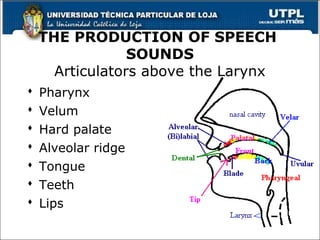
THE PRODUCTION OF SPEECH
SOUNDS
Articulators above the Larynx
 Pharynx
 Velum
 Hard palate
 Alveolar ridge
 Tongue
 Teeth
 Lips
4
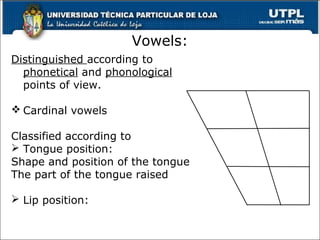
Vowels:
Distinguished according to
phonetical and phonological
points of view.
 Cardinal vowels
Classified according to
 Tongue position:
Shape and position of the tongue
The part of the tongue raised
 Lip position:
5
THE PRODUCTION OF SPEECH
SOUNDS
Classification according to length
 Short: relativeley short in length
 Long: relatively long in length
 Length: physical duration of the sound
6
LONG VOWELS, DIPHTHONGS
AND TRIPHTHONGS
LONG VOWELS:
Tend to be longer than short in similar
contexts
Different in:
 Length
 Quality
Different according to:
 Context
 Presence or absence of stress
7
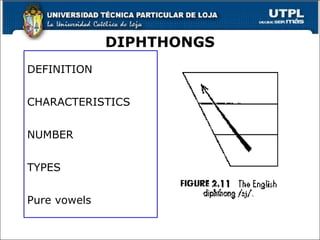
DIPHTHONGS
DEFINITION
CHARACTERISTICS
NUMBER
TYPES
Pure vowels
8
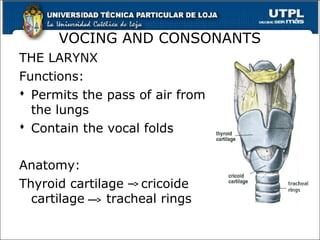
VOCING AND CONSONANTS
THE LARYNX
Functions:
 Permits the pass of air from
the lungs
 Contain the vocal folds
Anatomy:
Thyroid cartilage cricoide
cartilage tracheal rings
9
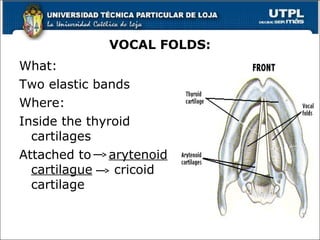
VOCAL FOLDS:
What:
Two elastic bands
Where:
Inside the thyroid
cartilages
Attached to arytenoid
cartilague cricoid
cartilage
10
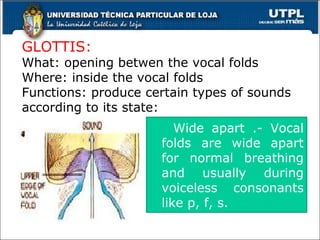
GLOTTIS:
What: opening betwen the vocal folds
Where: inside the vocal folds
Functions: produce certain types of sounds
according to its state:
11
Wide apart .- Vocal
folds are wide apart
for normal breathing
and usually during
voiceless consonants
like p, f, s.
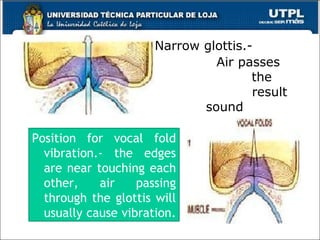
Narrow glottis.-
Air passes
through the
glottis and the result
is a fricative sound
12
Position for vocal fold
vibration.- the edges
are near touching each
other, air passing
through the glottis will
usually cause vibration.
13
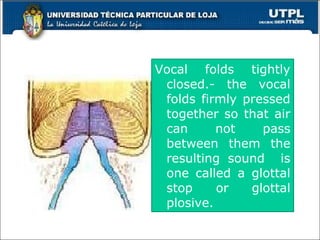
Vocal folds tightly
closed.- the vocal
folds firmly pressed
together so that air
can not pass
between them the
resulting sound is
one called a glottal
stop or glottal
plosive.
RESPIRATION AND VOICING
Air in the lungs is forced out, as a result:
eggresisve pulmoic airstream
important to produce sounds
Process for producing airstream :
 ribcage is lifted upwaurd and outwards
so lungs are expanded
 lungs take air as ribcage returns to its
position, the air expeled is used to
produce sounds.
14
Air is retained as it scapes from the
lungs formimg strictures
A stricture: obstruction of air,
happens in the larynx if:
vocal folds are in a correct position
air is under enough pressure to be
forced out the glottis.
15
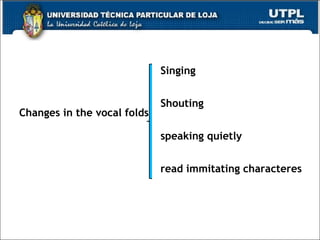
Changes in the vocal folds
Singing
Shouting
speaking quietly
read immitating characteres
16
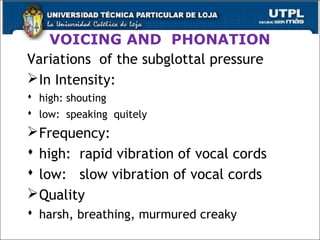
VOICING AND PHONATION
Variations of the subglottal pressure
In Intensity:
 high: shouting
 low: speaking quitely
Frequency:
 high: rapid vibration of vocal cords
 low: slow vibration of vocal cords
Quality
 harsh, breathing, murmured creaky
17
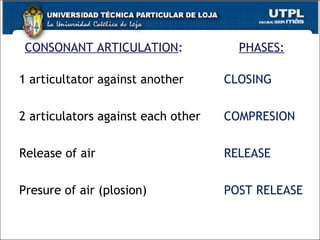
CONSONANT ARTICULATION: PHASES:
1 articultator against another
2 articulators against each other
Release of air
Presure of air (plosion)
CLOSING
COMPRESION
RELEASE
POST RELEASE
18
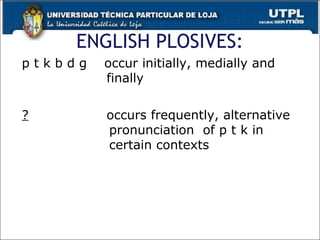
ENGLISH PLOSIVES:
p t k b d g occur initially, medially and
finally
? occurs frequently, alternative
pronunciation of p t k in
certain contexts
19
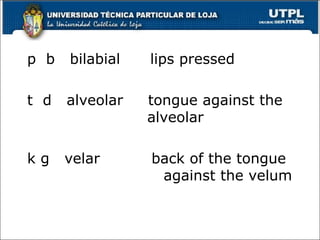
p b bilabial lips pressed
t d alveolar tongue against the
alveolar
k g velar back of the tongue
against the velum
20
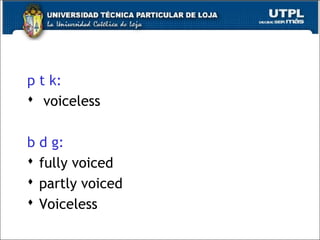
p t k:
 voiceless
b d g:
 fully voiced
 partly voiced
 Voiceless
21
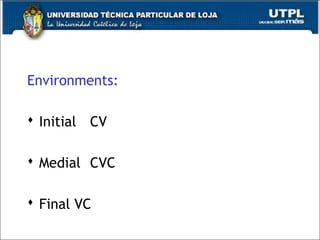
Environments:
 Initial CV
 Medial CVC
 Final VC
22
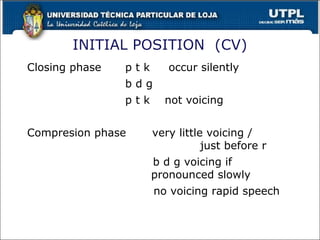
INITIAL POSITION (CV)
Closing phase p t k occur silently
b d g
p t k not voicing
Compresion phase very little voicing /
just before r
b d g voicing if
pronounced slowly
no voicing rapid speech
23
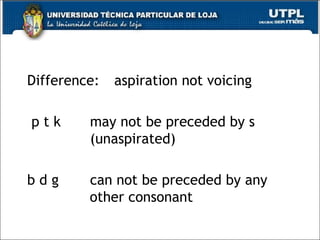
Difference: aspiration not voicing
p t k may not be preceded by s
(unaspirated)
b d g can not be preceded by any
other consonant
24
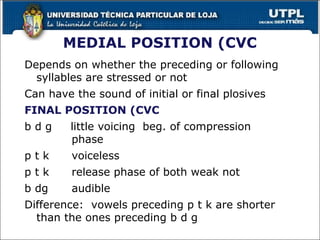
MEDIAL POSITION (CVC
Depends on whether the preceding or following
syllables are stressed or not
Can have the sound of initial or final plosives
FINAL POSITION (CVC)
b d g little voicing beg. of compression
phase
p t k voiceless
p t k release phase of both weak not
b dg audible
Difference: vowels preceding p t k are shorter
than the ones preceding b d g
25
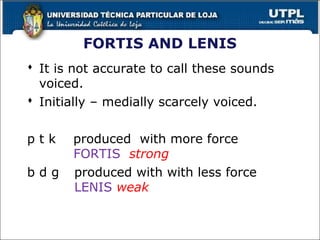
FORTIS AND LENIS
 It is not accurate to call these sounds
voiced.
 Initially – medially scarcely voiced.
p t k produced with more force
FORTIS strong
b d g produced with with less force
LENIS weak
26
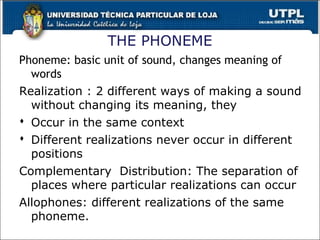
THE PHONEME
Phoneme: basic unit of sound, changes meaning of
words
Realization : 2 different ways of making a sound
without changing its meaning, they
 Occur in the same context
 Different realizations never occur in different
positions
Complementary Distribution: The separation of
places where particular realizations can occur
Allophones: different realizations of the same
phoneme.
27
SYMBOLS AND TRANSCRIPTIONS
 PHONEMIC SYMBOLS
Do not indicate precise phonetic value
There are many phonetic symbols according to
different authors
 PHONETIC SYMBOLS
Indicate precise phonetic value
TRANSCRIPTION:
PHONEMIC
PHONETIC 28
TRANSCRIPTION
PHONEMIC: using phonemes / written with
the appropriate symbol.
From dictation: Ss listen to a person or
recording and write down what they hear
From a written text: Ss are given a passage
and use phonemic symbols to represent how
they think it should be pronounced by any
speaker
29
PHONEMIC: Much more accurate in phonetic
detail
Narrow: shows exact quality of sounds
Broad: a little more information than a
phonemic one
30
 Symbols differ according to writers
 We are not looking at all of them
 We are using the BBC pronunciation and
symbols (cambridge dictionary)
 Reasons :
 Some have established a minimum set of
nonstandard symbols.
 Others have thought on quantity
 Others in quality
 Others in both
31
PHONOLOGY
 PHONETICS:
The comparative straightforward businesss of
describing the sounds used in the language
 PHONOLOGY:
How phonemes function in the language, the
relationship among them (abstarct side of the
language)
 IMPORTANCE:
To acquire a full understanding of the use of
sounds in the English language 32
FRICATIVES AND AFFRICATES
 FRICATIVES:
Definition: sounds in which air escapes through a
small passage making a hissing sound, also
called continuants because you can make
them without any interruption (sssssss)
 AFFRICATES:
Definition: sounds that begin as plosives and end
as fricatives; ʧ begins in t and ends in ʃ.
The sequence kf is not considered a single sound
because they need to be homorganic.
33
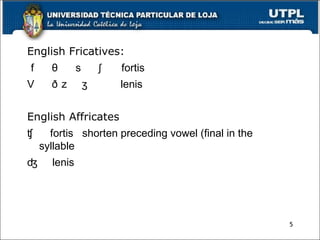
English Fricatives:
f θ s ʃ fortis
V ð z ʒ lenis
English Affricates
ʧ fortis shorten preceding vowel (final in the
syllable
ʤ lenis
5
NASAL AND OTHER CONSONANTS
Definition: sounds in which the airflow leaves
through the nose
m n occur frequently in initial position
ŋ never in initial position, but in
middle position, quite frequent
ŋk sequence pronounced as ŋ
ng sequence pronounced sometimes as ŋ,
sometimes as ŋg
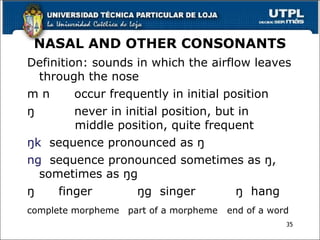
ŋ finger ŋg singer ŋ hang
complete morpheme part of a morpheme end of a word
35
The consonant l
l is a lateral consonat, the airflow leaves
through the sides of the tongue.
Occurs in initial, medial and final positions
Clear l before a vowel (back of the tongue
raised)
Dark l after a vowel (realized different, front of
the tongue raised)
Devoiced l after p or t
36
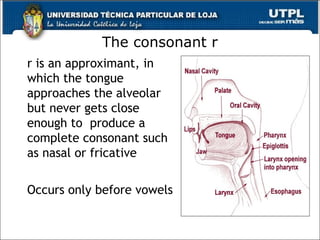
The consonant r
r is an approximant, in
which the tongue
approaches the alveolar
but never gets close
enough to produce a
complete consonant such
as nasal or fricative
Occurs only before vowels
37
The consonants j and w
Approximant sounds (semivowels)
Phonetically (way of pronouncing) are like
vowels.
Phonologicaly (distribution) are like
consonats.
After p, t, k they are devoiced
j palatal
w bilabial
38
THE SYLLABLE
Two points of view
Phonetically: way of producing them, way they sound:
consist of a center with little or no obstruction and
which sounds comparatively loud (vowel). Before
and after the center a great deal of obstruction
(consonant)
Minimum: single vowel I aɪ:
Onset: consonat before vowel pear pe:
Coda: vowel before consonant are a:
Onset and coda consonat vowel consonant put pʊt
39
Phonolgically: possible combinations of
English phonemes
Syllables start with:
 A vowel
 1, 2 or 3 consonants
 More than 3 is impossible
Syllables end with
 A vowel
 1,2,3 or 4 consonats
 More than 4 is impossible
THANKS
42

English Phonology, I Bim

  • 1.
    ESCUELA: CIENCIAS DELA EDUCACIÓN NOMBRES: ENGLISH PHONOLOGY FIRST BIMESTER FECHA: Dra: Carmen Benítez C. ABRIL / AGOSTO 2009 1
  • 2.
    INTRODUCTION  Purpose  Definition Importance  Phoneme (example)  Conventions (examples)  Accent  Dialect 2
  • 3.
     Received Pronunciation BBC Pronunciation  Estuary English 3
  • 4.
    THE PRODUCTION OFSPEECH SOUNDS Articulators above the Larynx  Pharynx  Velum  Hard palate  Alveolar ridge  Tongue  Teeth  Lips 4
  • 5.
    Vowels: Distinguished according to phoneticaland phonological points of view.  Cardinal vowels Classified according to  Tongue position: Shape and position of the tongue The part of the tongue raised  Lip position: 5
  • 6.
    THE PRODUCTION OFSPEECH SOUNDS Classification according to length  Short: relativeley short in length  Long: relatively long in length  Length: physical duration of the sound 6
  • 7.
    LONG VOWELS, DIPHTHONGS ANDTRIPHTHONGS LONG VOWELS: Tend to be longer than short in similar contexts Different in:  Length  Quality Different according to:  Context  Presence or absence of stress 7
  • 8.
  • 9.
    VOCING AND CONSONANTS THELARYNX Functions:  Permits the pass of air from the lungs  Contain the vocal folds Anatomy: Thyroid cartilage cricoide cartilage tracheal rings 9
  • 10.
    VOCAL FOLDS: What: Two elasticbands Where: Inside the thyroid cartilages Attached to arytenoid cartilague cricoid cartilage 10
  • 11.
    GLOTTIS: What: opening betwenthe vocal folds Where: inside the vocal folds Functions: produce certain types of sounds according to its state: 11 Wide apart .- Vocal folds are wide apart for normal breathing and usually during voiceless consonants like p, f, s.
  • 12.
    Narrow glottis.- Air passes throughthe glottis and the result is a fricative sound 12 Position for vocal fold vibration.- the edges are near touching each other, air passing through the glottis will usually cause vibration.
  • 13.
    13 Vocal folds tightly closed.-the vocal folds firmly pressed together so that air can not pass between them the resulting sound is one called a glottal stop or glottal plosive.
  • 14.
    RESPIRATION AND VOICING Airin the lungs is forced out, as a result: eggresisve pulmoic airstream important to produce sounds Process for producing airstream :  ribcage is lifted upwaurd and outwards so lungs are expanded  lungs take air as ribcage returns to its position, the air expeled is used to produce sounds. 14
  • 15.
    Air is retainedas it scapes from the lungs formimg strictures A stricture: obstruction of air, happens in the larynx if: vocal folds are in a correct position air is under enough pressure to be forced out the glottis. 15
  • 16.
    Changes in thevocal folds Singing Shouting speaking quietly read immitating characteres 16
  • 17.
    VOICING AND PHONATION Variationsof the subglottal pressure In Intensity:  high: shouting  low: speaking quitely Frequency:  high: rapid vibration of vocal cords  low: slow vibration of vocal cords Quality  harsh, breathing, murmured creaky 17
  • 18.
    CONSONANT ARTICULATION: PHASES: 1articultator against another 2 articulators against each other Release of air Presure of air (plosion) CLOSING COMPRESION RELEASE POST RELEASE 18
  • 19.
    ENGLISH PLOSIVES: p tk b d g occur initially, medially and finally ? occurs frequently, alternative pronunciation of p t k in certain contexts 19
  • 20.
    p b bilabiallips pressed t d alveolar tongue against the alveolar k g velar back of the tongue against the velum 20
  • 21.
    p t k: voiceless b d g:  fully voiced  partly voiced  Voiceless 21
  • 22.
    Environments:  Initial CV Medial CVC  Final VC 22
  • 23.
    INITIAL POSITION (CV) Closingphase p t k occur silently b d g p t k not voicing Compresion phase very little voicing / just before r b d g voicing if pronounced slowly no voicing rapid speech 23
  • 24.
    Difference: aspiration notvoicing p t k may not be preceded by s (unaspirated) b d g can not be preceded by any other consonant 24
  • 25.
    MEDIAL POSITION (CVC Dependson whether the preceding or following syllables are stressed or not Can have the sound of initial or final plosives FINAL POSITION (CVC) b d g little voicing beg. of compression phase p t k voiceless p t k release phase of both weak not b dg audible Difference: vowels preceding p t k are shorter than the ones preceding b d g 25
  • 26.
    FORTIS AND LENIS It is not accurate to call these sounds voiced.  Initially – medially scarcely voiced. p t k produced with more force FORTIS strong b d g produced with with less force LENIS weak 26
  • 27.
    THE PHONEME Phoneme: basicunit of sound, changes meaning of words Realization : 2 different ways of making a sound without changing its meaning, they  Occur in the same context  Different realizations never occur in different positions Complementary Distribution: The separation of places where particular realizations can occur Allophones: different realizations of the same phoneme. 27
  • 28.
    SYMBOLS AND TRANSCRIPTIONS PHONEMIC SYMBOLS Do not indicate precise phonetic value There are many phonetic symbols according to different authors  PHONETIC SYMBOLS Indicate precise phonetic value TRANSCRIPTION: PHONEMIC PHONETIC 28
  • 29.
    TRANSCRIPTION PHONEMIC: using phonemes/ written with the appropriate symbol. From dictation: Ss listen to a person or recording and write down what they hear From a written text: Ss are given a passage and use phonemic symbols to represent how they think it should be pronounced by any speaker 29
  • 30.
    PHONEMIC: Much moreaccurate in phonetic detail Narrow: shows exact quality of sounds Broad: a little more information than a phonemic one 30
  • 31.
     Symbols differaccording to writers  We are not looking at all of them  We are using the BBC pronunciation and symbols (cambridge dictionary)  Reasons :  Some have established a minimum set of nonstandard symbols.  Others have thought on quantity  Others in quality  Others in both 31
  • 32.
    PHONOLOGY  PHONETICS: The comparativestraightforward businesss of describing the sounds used in the language  PHONOLOGY: How phonemes function in the language, the relationship among them (abstarct side of the language)  IMPORTANCE: To acquire a full understanding of the use of sounds in the English language 32
  • 33.
    FRICATIVES AND AFFRICATES FRICATIVES: Definition: sounds in which air escapes through a small passage making a hissing sound, also called continuants because you can make them without any interruption (sssssss)  AFFRICATES: Definition: sounds that begin as plosives and end as fricatives; ʧ begins in t and ends in ʃ. The sequence kf is not considered a single sound because they need to be homorganic. 33
  • 34.
    English Fricatives: f θs ʃ fortis V ð z ʒ lenis English Affricates ʧ fortis shorten preceding vowel (final in the syllable ʤ lenis 5
  • 35.
    NASAL AND OTHERCONSONANTS Definition: sounds in which the airflow leaves through the nose m n occur frequently in initial position ŋ never in initial position, but in middle position, quite frequent ŋk sequence pronounced as ŋ ng sequence pronounced sometimes as ŋ, sometimes as ŋg ŋ finger ŋg singer ŋ hang complete morpheme part of a morpheme end of a word 35
  • 36.
    The consonant l lis a lateral consonat, the airflow leaves through the sides of the tongue. Occurs in initial, medial and final positions Clear l before a vowel (back of the tongue raised) Dark l after a vowel (realized different, front of the tongue raised) Devoiced l after p or t 36
  • 37.
    The consonant r ris an approximant, in which the tongue approaches the alveolar but never gets close enough to produce a complete consonant such as nasal or fricative Occurs only before vowels 37
  • 38.
    The consonants jand w Approximant sounds (semivowels) Phonetically (way of pronouncing) are like vowels. Phonologicaly (distribution) are like consonats. After p, t, k they are devoiced j palatal w bilabial 38
  • 39.
    THE SYLLABLE Two pointsof view Phonetically: way of producing them, way they sound: consist of a center with little or no obstruction and which sounds comparatively loud (vowel). Before and after the center a great deal of obstruction (consonant) Minimum: single vowel I aɪ: Onset: consonat before vowel pear pe: Coda: vowel before consonant are a: Onset and coda consonat vowel consonant put pʊt 39
  • 40.
    Phonolgically: possible combinationsof English phonemes Syllables start with:  A vowel  1, 2 or 3 consonants  More than 3 is impossible Syllables end with  A vowel  1,2,3 or 4 consonats  More than 4 is impossible
  • 41.
  • 42.