Maun Sadhu
Head & Assistant Professor
Department of English
C.U. Shah Institute of Computer Application
C.U. Shah Institute of Science
Speaking
Strategies
Speaking Strategies
Vowels and Consonants
01
Braking words into syllabus and
making accent/stress
02
Interview
03
Presentation
04
"When we produce some
sounds, air escapes
through mouth with
friction and these sounds
are called 'consonants’.”
Letters of the English alphabet
that represent vowels:
B, C, D, F, G, J, K, L, M, N,
P, Q, S, T, V, X, Z and often
H, R, W, Y.
Consonants
Vowels and Consonants
A vowel is a speech sound
made by allowing breath
to flow out of the mouth,
without closing any part of
the mouth or throat
(although the lips may over to
create the correct sound, as in
creating the sound “o”).
Letters of the English alphabet
that represent vowels:
a, e, i, o, u, and sometimes y.
Vowels
Vowels
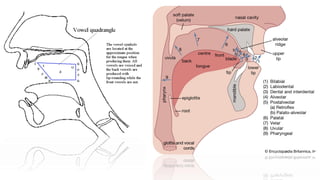
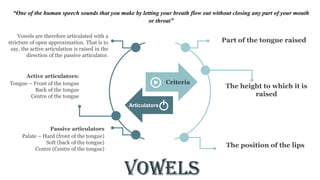
Part of the tongue raised
The height to which it is
raised
The position of the lips
Vowels are therefore articulated with a
stricture of open approximation. That is to
say, the active articulation is raised in the
direction of the passive articulator.
Tongue – Front of the tongue
Back of the tongue
Centre of the tongue
Active articulators:
Palate – Hard (front of the tongue)
Soft (back of the tongue)
Centre (Centre of the tongue)
Passive articulators
Criteria
Articulators
“One of the human speech sounds that you make by letting your breath flow out without closing any part of your mouth
or throat”
Front Vowels
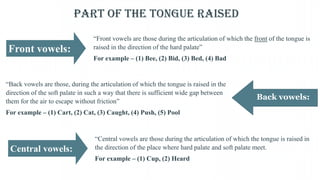
Part of the tongue raised
“Front vowels are those during the articulation of which the front of the tongue is
raised in the direction of the hard palate”
For example – (1) Bee, (2) Bid, (3) Bed, (4) Bad
Front vowels:
Back vowels:
“Back vowels are those, during the articulation of which the tongue is raised in the
direction of the soft palate in such a way that there is sufficient wide gap between
them for the air to escape without friction”
For example – (1) Cart, (2) Cat, (3) Caught, (4) Push, (5) Pool
Central vowels:
“Central vowels are those during the articulation of which the tongue is raised in
the direction of the place where hard palate and soft palate meet.
For example – (1) Cup, (2) Heard
Open vowels
Close vowels:
The height to which it is raised
1. The part of the tongue is raised 2. The height to which it is raised
Tongue is positioned as close as possible
to the roof of the mouth and produce a
sound.
Example : U
Tongue is far away from the roof of the
mouth during the articulation.
Example : A
The position of the lips
01
02
Rounded vowels are those during the
articulation of which the lips are rounded.
For example - cot, caught, put, fool.
Rounded
Unrounded vowels are those during the
articulation of which the lips are spread or neutral
For example – Seat, Sit, Set, sat
.
Unrounded
Cardinal vowels
1
Front close unrounded - [i]
2
Front half-close unrounded - [e]
4
Front half-open unrounded - [Ʃ]
5
Back open unrounded - [ɑ]
There is a vowel area in the oral cavity. According to the position of tongue and lips it can be classified.
3
Front open unrounded - [a]
6
Back half-open rounded - [ɔ]
7
Back half-close rounded - [O]
8
Back close rounded - [u]
Monophthongs:
Diphthongs
Vowels which do not change their quality
are called Monophthongs or pure vowels.
“The vowel at the end does not sound the same as the
vowel at the beginning”
By this we can define diphthongs as,
“Vowels of changing quality are called ‘diphthongs’”
This can be described as ‘Vowel glide’ the tongue first
takes the position required for the articulation of certain
vowel and then moves (or glide) towards the position
required for the articulation of another vowel.
For example: Buy – Boy – Cow – Poor
.
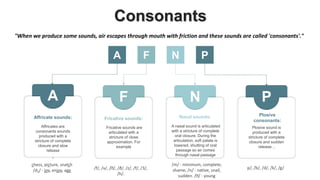
Consonants
A F N P
A
Affricates are
consonants sounds
produced with a
stricture of complete
closure and slow
release
.
Affricate sounds:
F
Fricative sounds are
articulated with a
stricture of close
approximation. For
example
Fricative sounds:
N
A nasal sound is articulated
with a stricture of complete
oral closure. During the
articulation, soft palate is
lowered, shutting of oral
passage so air comes
through nasal passage
Nasal sounds:
P
Plosive sound is
produced with a
stricture of complete
closure and sudden
release. ,
Plosive
consonants:
"When we produce some sounds, air escapes through mouth with friction and these sounds are called 'consonants'."
chess, picture, snatch
/d3/ - joy, enjoy, age
p/, /b/, /d/, /k/, /g/
/m/ - minimum, complete,
shame, /n/ - native, snail,
sudden. / / - young
/f/, /v/, / /, /ð/, /z/, /f/, /3/,
/h/.
Dental suggests teeth. Labiodental suggests that lips and teeth
are involved in the production of some sound. For example, /v/ -
vine, /f/ - fine.
Labiodentals:
Dental suggests teeth. The tip of tongue touches to the front
upper teeth. For example - thin - then..
Dental:
The tip of blade touches the teeth ridge. The tip of the tongue is
n active articulator. For example - tin, din, sin, and love.
Alveolar:
The front tongue is the active
articulator and the hard palate is
passive. For example - yes.
Palatal:
The back tongue moves to soft palate.
For example - back, bag, bang
Velar:
Glottal sounds are produced at the
glottis and the two vocal cords are the
articulators. For example- hat.
Glottal:
Labial is regarding lips. In the production of sound lips becomes
the important part.
For example - mile - /m/, pile - /p/.
Bilabial:
The front of the tongue is raised
towards the hard palate.
shin [ʃ], chin [tʃ], gin [dʒ]
Palato Alveolar:
Articulation involved
Back side of teeth ridge is hard palate; the tip of tongue goes
towards that part but doesn't touch the hard palate. This part is
post Alveolar. For example - try, dry.
Post Alveolar:
Thank You

Speaking stratagies

  • 1.
    Maun Sadhu Head &Assistant Professor Department of English C.U. Shah Institute of Computer Application C.U. Shah Institute of Science Speaking Strategies
  • 2.
    Speaking Strategies Vowels andConsonants 01 Braking words into syllabus and making accent/stress 02 Interview 03 Presentation 04
  • 3.
    "When we producesome sounds, air escapes through mouth with friction and these sounds are called 'consonants’.” Letters of the English alphabet that represent vowels: B, C, D, F, G, J, K, L, M, N, P, Q, S, T, V, X, Z and often H, R, W, Y. Consonants Vowels and Consonants A vowel is a speech sound made by allowing breath to flow out of the mouth, without closing any part of the mouth or throat (although the lips may over to create the correct sound, as in creating the sound “o”). Letters of the English alphabet that represent vowels: a, e, i, o, u, and sometimes y. Vowels
  • 5.
    Vowels Part of thetongue raised The height to which it is raised The position of the lips Vowels are therefore articulated with a stricture of open approximation. That is to say, the active articulation is raised in the direction of the passive articulator. Tongue – Front of the tongue Back of the tongue Centre of the tongue Active articulators: Palate – Hard (front of the tongue) Soft (back of the tongue) Centre (Centre of the tongue) Passive articulators Criteria Articulators “One of the human speech sounds that you make by letting your breath flow out without closing any part of your mouth or throat”
  • 6.
    Front Vowels Part ofthe tongue raised “Front vowels are those during the articulation of which the front of the tongue is raised in the direction of the hard palate” For example – (1) Bee, (2) Bid, (3) Bed, (4) Bad Front vowels: Back vowels: “Back vowels are those, during the articulation of which the tongue is raised in the direction of the soft palate in such a way that there is sufficient wide gap between them for the air to escape without friction” For example – (1) Cart, (2) Cat, (3) Caught, (4) Push, (5) Pool Central vowels: “Central vowels are those during the articulation of which the tongue is raised in the direction of the place where hard palate and soft palate meet. For example – (1) Cup, (2) Heard
  • 7.
    Open vowels Close vowels: Theheight to which it is raised 1. The part of the tongue is raised 2. The height to which it is raised Tongue is positioned as close as possible to the roof of the mouth and produce a sound. Example : U Tongue is far away from the roof of the mouth during the articulation. Example : A
  • 8.
    The position ofthe lips 01 02 Rounded vowels are those during the articulation of which the lips are rounded. For example - cot, caught, put, fool. Rounded Unrounded vowels are those during the articulation of which the lips are spread or neutral For example – Seat, Sit, Set, sat . Unrounded
  • 9.
    Cardinal vowels 1 Front closeunrounded - [i] 2 Front half-close unrounded - [e] 4 Front half-open unrounded - [Ʃ] 5 Back open unrounded - [ɑ] There is a vowel area in the oral cavity. According to the position of tongue and lips it can be classified. 3 Front open unrounded - [a] 6 Back half-open rounded - [ɔ] 7 Back half-close rounded - [O] 8 Back close rounded - [u]
  • 10.
    Monophthongs: Diphthongs Vowels which donot change their quality are called Monophthongs or pure vowels. “The vowel at the end does not sound the same as the vowel at the beginning” By this we can define diphthongs as, “Vowels of changing quality are called ‘diphthongs’” This can be described as ‘Vowel glide’ the tongue first takes the position required for the articulation of certain vowel and then moves (or glide) towards the position required for the articulation of another vowel. For example: Buy – Boy – Cow – Poor .
  • 11.
    Consonants A F NP A Affricates are consonants sounds produced with a stricture of complete closure and slow release . Affricate sounds: F Fricative sounds are articulated with a stricture of close approximation. For example Fricative sounds: N A nasal sound is articulated with a stricture of complete oral closure. During the articulation, soft palate is lowered, shutting of oral passage so air comes through nasal passage Nasal sounds: P Plosive sound is produced with a stricture of complete closure and sudden release. , Plosive consonants: "When we produce some sounds, air escapes through mouth with friction and these sounds are called 'consonants'." chess, picture, snatch /d3/ - joy, enjoy, age p/, /b/, /d/, /k/, /g/ /m/ - minimum, complete, shame, /n/ - native, snail, sudden. / / - young /f/, /v/, / /, /ð/, /z/, /f/, /3/, /h/.
  • 12.
    Dental suggests teeth.Labiodental suggests that lips and teeth are involved in the production of some sound. For example, /v/ - vine, /f/ - fine. Labiodentals: Dental suggests teeth. The tip of tongue touches to the front upper teeth. For example - thin - then.. Dental: The tip of blade touches the teeth ridge. The tip of the tongue is n active articulator. For example - tin, din, sin, and love. Alveolar: The front tongue is the active articulator and the hard palate is passive. For example - yes. Palatal: The back tongue moves to soft palate. For example - back, bag, bang Velar: Glottal sounds are produced at the glottis and the two vocal cords are the articulators. For example- hat. Glottal: Labial is regarding lips. In the production of sound lips becomes the important part. For example - mile - /m/, pile - /p/. Bilabial: The front of the tongue is raised towards the hard palate. shin [ʃ], chin [tʃ], gin [dʒ] Palato Alveolar: Articulation involved Back side of teeth ridge is hard palate; the tip of tongue goes towards that part but doesn't touch the hard palate. This part is post Alveolar. For example - try, dry. Post Alveolar:
  • 13.