An Introduction to
English Phonetics
    Richard Ogden
An Introduction to English Phonetics
Edinburgh Textbooks on the English Language

General Editor
Heinz Giegerich, Professor of English Linguistics (University of Edinburgh)

Editorial Board
Laurie Bauer (University of Wellington)
Derek Britton (University of Edinburgh)
Olga Fischer (University of Amsterdam)
Rochelle Lieber (University of New Hampshire)
Norman Macleod (University of Edinburgh)
Donka Minkova (UCLA)
Edward W. Schneider (University of Regensburg)
Katie Wales (University of Leeds)
Anthony Warner (University of York)


titles in the series include
An Introduction to English Syntax
Jim Miller
An Introduction to English Phonology
April McMahon
An Introduction to English Morphology: Words and Their Structure
Andrew Carstairs-McCarthy
An Introduction to International Varieties of English
Laurie Bauer
An Introduction to Middle English
Jeremy Smith and Simon Horobin
An Introduction to Old English
Richard Hogg
An Introduction to Early Modern English
Terttu Nevalainen
An Introduction to English Semantics and Pragmatics
Patrick Griffiths
An Introduction to English Sociolinguistics
Graeme Trousdale
An Introduction to Late Modern English
Ingrid Tieken-Boon van Ostade
An Introduction to Regional Englishes: Dialect Variation in England
Joan Beal
An Introduction to English Phonetics
Richard Ogden
An Introduction to
English Phonetics


Richard Ogden


Edinburgh University Press
© Richard Ogden, 2009

Edinburgh University Press Ltd
22 George Square, Edinburgh

www.euppublishing.com

Typeset in Janson
by Norman Tilley Graphics Ltd, and
printed and bound in Great Britain
by CPI Antony Rowe, Chippenham and Eastbourne

A CIP record for this book is available from
the British Library

ISBN 978 0 7486 2540 6 (hardback)
ISBN 978 0 7486 2541 3 (paperback)

The right of Richard Ogden
to be identified as author of this work
has been asserted in accordance with
the Copyright, Designs and Patents Act 1988.
Contents


List of figures and tables                      viii
To readers                                      xi
Acknowledgements                               xiii

 1 Introduction to phonetics                     1
   1.1 What is phonetics?                        1
   1.2 What this book covers                     3
   1.3 Ways to talk about sounds                 3
   1.4 An overview of the book                   5
   Further reading                               6

 2 Overview of the human speech mechanism        7
   2.1 The complexity of speech sounds           7
   2.2 Breathing                                 7
   2.3 The larynx and voicing                    9
   2.4 Airflow                                   10
   2.5 Place of articulation                    12
   2.6 Manner of articulation                   16
   Summary                                      18
   Exercises                                    18
   Further reading                              19

 3 Representing the sounds of speech            20
   3.1 Introduction                             20
   3.2 Phonetic transcription                   20
   3.3 Acoustic representations                 29
   3.4 Acoustic representations and segments    35
   3.5 Representation and units in phonetics    36
   Summary                                      37
   Exercises                                    37
   Further reading                              38
vi            AN INTRODUCTION TO ENGLISH PHONETICS

 4 The larynx, voicing and voice quality              40
   4.1 Introduction: the production of voicing        40
   4.2 How the vocal folds vibrate                    42
   4.3 Fundamental frequency, pitch and intonation    43
   4.4 Phrasing and intonation                        46
   4.5 Voice quality                                  50
   Summary                                            53
   Exercises                                          54
   Further reading                                    54

 5 Vowels                                             56
   5.1 Introduction                                   56
   5.2 Reference points for vowels: cardinal vowels   56
   5.3 The acoustics of vowels                        62
   5.4 Other vocalic features                         63
   5.5 Vowels in English ‘keywords’                   64
   5.6 Reduced vowels                                 74
   5.7 Voiceless vowels                               75
   Summary                                            75
   Exercises                                          76
   Further reading                                    76

 6 Approximants                                       78
   6.1 Introduction                                   78
   6.2 The palatal approximant [j]                    79
   6.3 A doubly articulated sound: the labiovelar
        approximant [w]                               81
   6.4 Laterals                                       83
   6.5 ‘Rhotics’                                      89
   Summary                                            94
   Exercises                                          94
   Further reading                                    94

 7 Plosives                                            96
   7.1 Introduction                                    96
   7.2 Overview of the production of plosives          96
   7.3 Voicing and plosives in English                 99
   7.4 Glottalisation                                 104
   7.5 Long closure                                   106
   7.6 Place of articulation                          106
   7.7 Release features of plosives                   109
   7.8 Taps                                           114
CONTENTS       vii

     Summary                                116
     Exercises                              116
     Further reading                        117

 8 Fricatives                               118
   8.1 Introduction to fricatives           118
   8.2 The production of fricatives         118
   8.3 Details of English fricatives        120
   8.4 Non-lexical fricatives               131
   Summary                                  136
   Exercises                                136
   Further reading                          136

 9 Nasals                                   138
   9.1 The production of nasals             138
   9.2 Details of English nasals            140
   9.3 Nasalised vowels                     146
   9.4 Syllabic nasals                      148
   Summary                                  152
   Exercises                                152
   Further reading                          153

10 Glottalic and velaric airstreams         154
   10.1 Airstream mechanisms                154
   10.2 The velaric airstream mechanism     154
   10.3 The glottalic airstream mechanism   162
   Summary                                  168
   Exercises                                169
   Further reading                          169

11 Conclusion                               170

Glossary                                    173
Discussion of the exercises                 181
Further reading                             187
Index                                       191
Figures and tables


Figures
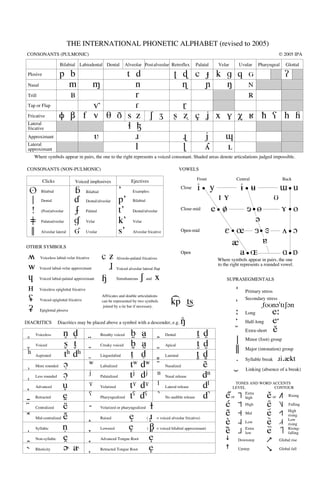
       The International Phonetic Alphabet (revised to 2005)         xiv
2.1    Cross-section of the vocal tract                               10
3.1    Waveform of a vowel                                            30
3.2    Three types of sound                                           31
3.3    Spectrogram of the word ‘spend’, with periodic, aperiodic
       and transient sounds marked                                    32
3.4    Expanded version of part of Figure 3.3                         32
3.5    Waveform of part of a voiceless fricative                      34
3.6    Transient portion (T) for the initial plosive of ‘spend’       35
3.7    Spectrogram of a production of ‘took off his cloak’ (RP) (IPA) 38
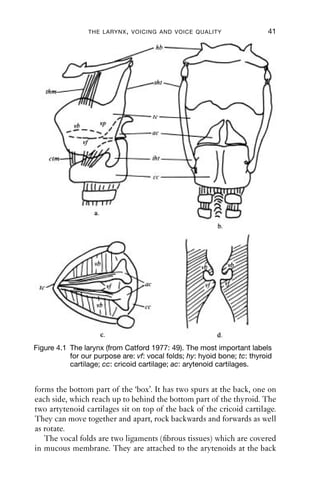
4.1    The larynx (from Catford 1977: 49)                             41
4.2    f0 on a linear scale                                           45
4.3    f0 on a logarithmic scale                                      45
4.4    1. ‘hello’ [hεləυ], 2. ‘hello’ [hε/ləυ], 3. ‘hello there’
       [hε/ləυ ðε ]                                                   47
4.5    Creaky voice                                                   51
5.1    The vowel quadrilateral                                        59
5.2    Spectrogram of cardinal vowels 1–8                             63
5.3    RP monophthongs                                                69
5.4    Australian monophthongs                                        70
5.5    American English monophthongs                                  70
5.6    RP closing diphthongs                                          70
5.7    RP centring diphthongs                                         71
5.8    Australian diphthongs                                          71
5.9    American English diphthongs                                    71
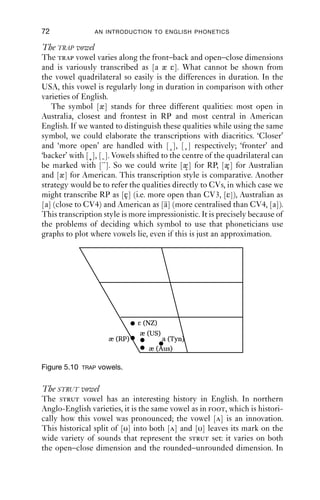
5.10   trap vowels                                                    72
5.11   strut vowels                                                   73
5.12   face vowels                                                    73
5.13   goose vowels                                                   74
6.1    ‘A yacht’                                                      80
                                   viii
FIGURES AND TABLES                            ix

6.2    ‘A win’                                                           82
6.3    An alveolar lateral with varying secondary articulation,
       from palatalised to velarised                                    87
6.4    ‘Leaf ’                                                          88
6.5    ‘Feel’                                                           88
6.6    ‘To lead’ and ‘to read’                                          93
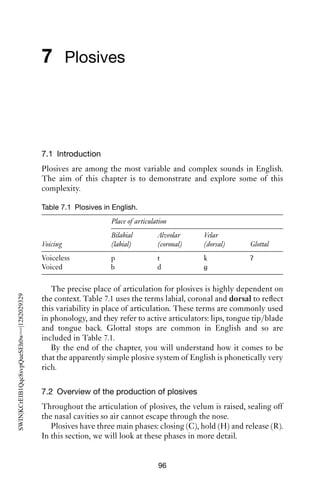
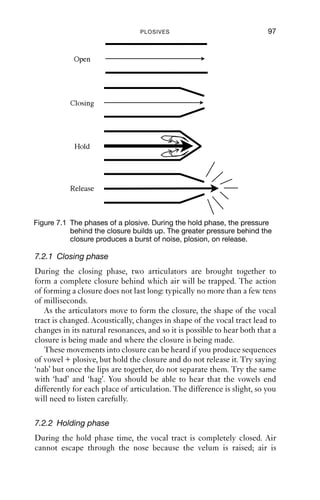
7.1    The phases of a plosive                                          97
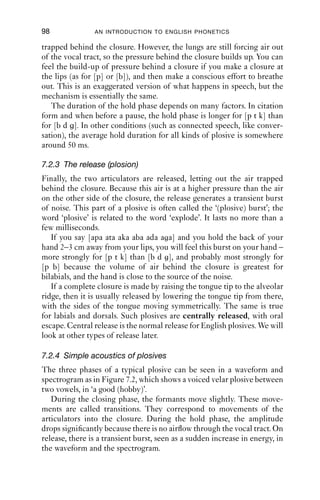
7.2    Waveform and spectrogram of the underlined portion
       of ‘a good (hobby)’ [ə υd hɒbi]                                   99
7.3    Voicing for plosives                                             100
7.4    Fully voiced [ ], in ‘gig’, [ i ]                                101
7.5    Vocalic portion, closure, plosive release, vocalic portion
       from ‘a bit’, [ə bit]                                            101
7.6    Vocalic portion, closure, plosive release, aspiration, vocalic
       portion from ‘a pit’, [ə phit]                                   102
7.7    Friction, closure, release and vocalic portion from ‘a spit’,
       [ə spit]                                                         103
7.8    Preaspiration                                                    105
7.9    Glottalisation in ‘kit’, [kh ʔt h], as spoken by a New Zealand
       speaker (IPA)                                                    105
7.10   A sequence of [kt], with two audible releases                    113
7.11   A sequence of [k t], with [k] release inaudible.                 113
7.12   ‘City’, [ siɾi], as produced by a speaker from southern
       Michigan (IPA)                                                   115
7.13   Material for exercise 2                                          117
8.1    Annotated waveforms for the first 300 ms of ‘sip’ as
       produced by an RP speaker (IPA)                                  121
8.2    Annotated waveforms for the first 300 ms of ‘zip’ as
       produced by an RP speaker (IPA)                                  121
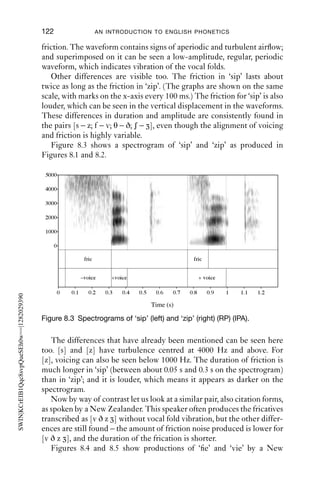
8.3    Spectrograms of ‘sip’ (left) and ‘zip’ (right) (RP) (IPA)        122
8.4    ‘Fie’ (New Zealand) (IPA)                                        123
8.5    ‘Vie’ (New Zealand) (IPA)                                        123
8.6    ‘Fie’ (left) and ‘vie’ (right) as spoken by a New Zealander
       (IPA)                                                            124
8.7    Spectrogram of ‘looser’, with friction (FRIC) and the offset
       and onset of voicing (V off, V on) marked                        126
8.8    Spectrogram of ‘loser’, with friction (FRIC) and the offset
       and onset of voicing (V off, V on) marked                        126
8.9    ‘Sigh’ and ‘shy’ as spoken by a male Australian speaker.
       Note the lower frequency energy for [ʃ] than for [s] (IPA)       129
8.10   ‘Kids do i[θ]’. Speaker: 18-year-old male, Dublin (IViE file
       f1mdo)                                                           133
x              AN INTRODUCTION TO ENGLISH PHONETICS

8.11 ‘I don’t smo[x]e’. Speaker: 18-year-old male, Liverpool
     (IViE file f1sgw)                                              134
9.1 Co-ordination of articulations in nasal + vowel sequences      140
9.2 Initial part of ‘map’, [mæ-] (RP) (IPA)                        141
9.3 Co-ordination of articulations in vowel + nasal sequences      142
9.4 Vowel + nasal portion from the word ‘hang’ [(h)æŋ].
                                                      ˜
     Speaker: Australian male (IPA)                                142
9.5 ‘The more (he blew)’. Speaker: RP female (IPA)                 143
9.6 ‘Bottom’ [bɑɾəm] and ‘button’ [b ʔt nn]. Speaker: Australian
     male (IPA)                                                    149
10.1 Spectrogram of a click (from extract (5))                     157
10.2 ‘Week’. Pulmonic (1); ejective (2). Female speaker            166
10.3 The word ‘good’, [ u d], in Jamaican Creole (IPA)             168

Tables
3.1   Systematic transcription of English consonants                26
4.1   Average f0 values (Baken and Orlikoff 2000)                   46
5.1   Anglo-English vs. American homophones                         66
5.2   Vowels in English keywords                                    67
6.1   Approximants in English at the systematic level               78
7.1   Plosives in English                                           96
7.2   Differences between [t + r] and [t ɹ ]                       111
7.3   Phonetic characteristics of voicing with English plosives    116
8.1   Fricatives in English                                        118
8.2   Voiced and voiceless fricatives                              125
8.3   Fricatives from undershoot                                   135
9.1   English nasals                                               138
To readers


Immediately I had agreed to write a book with the title ‘Introduction
to the Phonetics of English’, I realised that describing the phonetics of
‘English’ is problematic because English is so phonetically hetero-
geneous. So the result is a book that is more about phonetics, with illus-
trations from around the English-speaking world. It is not a complete
description of any one variety; rather, my intention has been to try to
provide enough of a descriptive phonetic framework so that readers can
describe their own variety in reasonable detail.
    I have tried in this book to concentrate on how to go about about
doing phonetics, and to show how phonetics can inform our under-
standing of categories like ‘voicing’, and explain sound changes like the
vocalisation of laterals, and how phonetic details relate to meaning and
linguistic structure on many levels. I have tried to take a broad view of
what ‘meaning’ is, so the book is not limited to phonemes and allophones.
Following J. R. Firth, I use the word ‘sound’ as a neutral term. Con-
sequently, this book contains many things that many introductory text-
books don’t. Glottal stops are included among the plosives; clicks and
ejectives find a place; and where possible the data comes from naturally
occurring talk, without giving too much weight to citation forms. This
is, I admit, a controversial decision; but my own experience has been
that students want to be able to engage with the stuff of language that
surrounds them, and with appropriate help, they can do that.
    In common with many introductory books on phonetics, this one
leaves out much explicit discussion of rhythm, intonation and other
‘prosodic’ features. This isn’t because I think they are unimportant;
but teaching them often involves working with hunches and intuitions,
and any framework for description moves quickly into phonological
representations that can be complex. So only the bare bones are covered
in this book.
    Likewise, assimilation, a common topic of introductory textbooks, is
not covered much in this book. When considered as a phonetic phenom-
                                    xi
xii             AN INTRODUCTION TO ENGLISH PHONETICS

                                           enon, recent work shows that it’s much more complex than traditional
                                           descriptions imply. The chapters here, I hope, will give students enough
                                           grounding in observing and understanding the phonetic organisation of
                                           talk so that understanding phenomena such as assimilation will be easier.
SWIN|KCrEIB1Qqc8svpQueSEh0w==|1282029103
Acknowledgements


I owe a great debt of thanks to many people who have helped me with
data for this book. These include the secretary of the IPA, Katerina
Nicolaidis; Dom Watt; Esther Grabe; and many of my own students, who
over the years have collected a lot of material full of wonderful detail.
   Thanks also to Alex, Hazel, Jennifer, Julianne, Lis, Malcolm, Nan and
Roger, my panel of non-phonetician readers who took the time to read
parts of this and helped to make it understandable; to my colleagues
who let me have the time to bring this to completion; and to fellow
phoneticians who have kept me enthused about working with speech.
The acoustic representations in the book were made using PRAAT
(www.praat.org), developed by Paul Boersma and David Weenink. Ester
Grabe kindly gave permission to use files from the IViE Project (www.
phon.ox.ac.uk). Where recordings from this have been used, they are
referred to with the preface IViE, followed by the identifier.
   The IPA chart is reprinted with permission of the International
Phonetic Association. Copyright 2005 International Phonetic Asso-
ciation. I am grateful to the IPA for permission to use material from the
Journal of the IPA, the Handbook of the IPA and the accompanying record-
ings, which are available to members via the IPA website. Where images
are based on IPA recordings from the website above, they are marked
(IPA) in the accompanying captions. Information about IPA membership
can be obtained from the IPA website: http://www.langsci.ucl.ac.uk/
ipa/index.html.


                                   xiii
THE INTERNATIONAL PHONETIC ALPHABET (revised to 2005)
CONSONANTS (PULMONIC)                                                                                                                                                              © 2005 IPA

                                      Bilabial Labiodental Dental                     Alveolar Post alveolar Retroflex     Palatal       Velar          Uvular      Pharyngeal            Glottal
 Plosive                              p b         t d                                                         Ê   c Ô k g q G     /
 Nasal                                  m   μ       n                                                           =       N   –
 Trill                                  ı           r                                                                       R
 Tap or Flap                                v       |                                                           «
 Fricative                            F B f v T D s z S Z                                                     ß   ç J x V X Â © ? h H
 Lateral
 fricative                                        Ò L
 Approximant                                        ®                                                              ’            j            ˜
 Lateral
 approximant                                        l                                                                           ¥            K
                       Where symbols appear in pairs, the one to the right represents a voiced consonant. Shaded areas denote articulations judged impossible.

CONSONANTS (NON-PULMONIC)                                                                                         VOWELS
                                                                                                                             Front
                                                                                                                           Front                      Central
                                                                                                                                                    Central                          Back Back
                           Clicks               Voiced implosives                        Ejectives

           >              Bilabial                        Bilabial             ’         Examples:
                                                                                                                  Close    i         y                      È Ë                     ¨ u
           ˘              Dental                Î         Dental/alveolar      p’        Bilabial
                                                                                                                                      IY                                       U
           !              (Post)alveolar        ˙         Palatal              t’        Dental/alveolar          Close-mid          e P                     e                       Ø o
           ¯              Palatoalveolar        ƒ         Velar                k’        Velar                                                                      ´
                                                Ï                              s’                                                           E {                     ‰                 ø O


                                                                                                                                                                        ò
                          Alveolar lateral                Uvular                         Alveolar fricative       Open-mid


OTHER SYMBOLS
                                                                                                                                             œ     å
                          Voiceless labial-velar fricative           ÇÛ
                                                                                                                  Open                         a ”                                    A Å
                                                                              Alveolo-palatal fricatives                                 Where symbols appear in pairs, the one
                                                                                                                                         to the right represents a rounded vowel.
    w                    Voiced labial-velar approximant               »      Voiced alveolar lateral flap

    Á                    Voiced labial-palatal approximant           Í        Simultaneous   S and x                                         SUPRASEGMENTALS

    Ì                    Voiceless epiglottal fricative
                                                                                                                                                    "       Primary stress
    ¿                                                                Affricates and double articulations
                                                                                                                                                    Æ
                                                                                                              (


                                                                                                                                                            Secondary stress
                         Voiced epiglottal fricative                 can be represented by two symbols        kp ts                                                     ÆfoUn´"tIS´n
                                                                                                                       (


                                                                      joined by a tie bar if necessary.
    ÷                    Epiglottal plosive
                                                                                                                                                    …       Long               e…
DIACRITICS                           Diacritics may be placed above a symbol with a descender, e.g.               N(                                Ú       Half-long          eÚ
                  9    Voiceless       n9 d9 ª                       Breathy voiced    bª aª 1 Dental                   t1 d1                           *   Extra-short        e*
     3                 Voiced          s3 t3   0                     Creaky voiced     b0 a0 ¡ Apical                   t¡ d¡                       ˘       Minor (foot) group
                                                                                                                                                            Major (intonation) group
 Ó                     Aspirated       tÓ dÓ £                       Linguolabial      t£ d£ 4 Laminal                  t4 d4                       .       Syllable break      ®i.œkt
       7               More rounded O7       W                       Labialized        tW dW ) Nasalized                   e)                                Linking (absence of a break)
         ¶             Less rounded    O¶                            Palatalized       t d ˆ Nasal release                 dˆ
           ™           Advanced        u™                            Velarized         t d ¬ Lateral release d¬                                      TONES AND WORD ACCENTS
                                                                                                                                                   LEVEL
                                                                                                                                                                          ˆ
                                                                                                                                                                     CONTOUR

             2         Retracted       e2                            Pharyngealized t        d } No audible release d}                       e_   or    âExtra
                                                                                                                                                         high       or    e
                                                                                                                                                                          Rising    ä
   ·                   Centralized     e·    ù                       Velarized or pharyngealized :
                                                                                                                                             e!         ê   High          e$        ë      Falling


               +       Mid-centralized e+        6                   Raised           e6 ( ®6 = voiced alveolar fricative)                   e@         î   Mid           e%        ü      High
                                                                                                                                                                                           rising
                                                                                                                                             e~         ô   Low           efi        ï      Low

                 `     Syllabic        n`          §                 Lowered          e§ ( B§ = voiced bilabial approximant)                 e—         û   Extra
                                                                                                                                                                          e&         ñ$
                                                                                                                                                                                           rising
                                                                                                                                                                                           Rising-

                   8                                 5
                                                                                                                                                            low                            falling
                       Non-syllabic    e8                            Advanced Tongue Root        e5                                          Õ          Downstep          ã         Global rise

 ±                     Rhoticity       ´± a±                         Retracted Tongue Root       e                                           õ          Upstep            Ã         Global fall
1 Introduction to phonetics


                                           1.1 What is phonetics?
                                           Language is one of the distinctive characteristics of human beings. With-
                                           out formal instruction, we learn from infanthood the skills that we need
                                           to be successful users of a language. For most of us, this will be spoken
                                           language, though for some it will be a signed language. In acquiring
                                           language, we learn words, and how to put them together; we learn to link
                                           words and sentences to meaning; we learn how to use these structures
                                           to get what we want, to say how we feel, and to form social bonds with
                                           others; and we also learn how to sound like members of the community
                                           around us – or perhaps choose to sound different from them.
                                              Linguistics is the formal study of language. Its main sub-disciplines
                                           are: syntax, the study of sentence structure; semantics, the study of
                                           meaning; pragmatics, the study of meaning in context; morphology, the
                                           study of word structure; sociolinguistics, the study of language in its
                                           social context; phonology, the study of sound systems; and phonetics,
SWIN|KCrEIB1Qqc8svpQueSEh0w==|1282029110


                                           the study of the sounds of speech. In this book, we will be mindful that
                                           linguistically significant aspects of the sounds of a language have to do
                                           with meaning on some level, whether it is to distinguish words from each
                                           other, to join together words of particular kinds, to mark (or do) some-
                                           thing social, such as where the speaker comes from, or to handle the flow
                                           of talk in a conversation.
                                              Language and speech are often distinguished in linguistics. For many,
                                           linguistics constitutes a set of claims about human beings’ universal
                                           cognitive or biological capacities. Most of the constructs of linguistics
                                           are attempts at explaining commonalities between members of com-
                                           munities which use language, and they are abstract.
                                              Phonetics on the other hand is the systematic study of the sounds of
                                           speech, which is physical and directly observable. Phonetics is some-
                                           times seen as not properly linguistic, because it is the outward, physical
                                           manifestation of the main object of linguistic research, which is language
                                           (not speech): and language is abstract.
                                                                               1
2               AN INTRODUCTION TO ENGLISH PHONETICS

   On the other hand, setting aside Deaf signing communities, speech is
the commonest and primary form of language. Most of our interactions,
with family members, colleagues, people we buy things from or whom
we ask for help, are done through the medium of speech. There is a
primacy about the spoken form of language which means that for us to
understand questions like “what is the possible form of a word?”, “how
do you ask questions in this language?”, “why does this speaker use that
particular pronunciation, and not some other?”, we need to have an
understanding of phonetics.
   Speech is produced by the controlled movement of air through the
throat, mouth and nose (more technically known as the vocal tract). It
can be studied in a number of different ways:

• articulatory phonetics (how speech sounds are made in the body)
• acoustic phonetics (the physical properties of the sounds that are
  made)
• perception (what happens to the speech signal once the sound wave
  reaches the listener’s ear).

The linguistic phonetic study of a language involves working out how
the sounds of language (the ‘phonetic’ part) are used to make meaning
(which is what makes it ‘linguistic’, and not just the study of the sounds
we can make with our bodies): how words are shaped, how they are put
together, how similar (but different) strings of sounds can be dis-
tinguished (such as ‘I scream’ and ‘ice cream’), how particular shades
of meaning are conveyed, and how the details of speech relate system-
atically to its inherently social context.
   One of the central paradoxes of phonetics is that we make obser-
vations of individuals in order to understand something about the
way groups of people behave. This is good in the sense that we can use
ourselves and the people around us as representatives of groups; it is
bad in that we cannot always be sure how representative someone is,
and there is always the possibility that what we observe is just an idio-
syncratic habit. In this book, we will mostly skirt round this issue: there
are (surprisingly) still many things that are not known about English
phonetics, so in this book, we will make observations of English-
speaking communities and individuals in order to show how the
phonetic potential of the vocal tract is used by speakers of English, in
various settings.
INTRODUCTION TO PHONETICS                           3

1.2 What this book covers
Because the English-speaking world contains so many diverse com-
munities, scattered over a wide geographical area with different histori-
cal and cultural backgrounds, our basic stance is that it is not really
possible to describe the phonetics of ‘English’ as such. Even in the British
Isles, there is huge variability in the way that English sounds. Tradition-
ally, British textbooks on English phonetics concentrate on Received
Pronunciation (RP), a variety of English which traditionally has had
high social status, but is spoken nowadays by few people. So in this book
we explore the phonetic potential of the vocal tract, and illustrate it
from English; but also you, the reader, are encouraged to reflect on what
is true for you and your community. Despite its being one of the most
written-about languages, there are still many discoveries to make about
English, and perhaps you will make one of them.
    In making our observations, we will look at the way that sounds are
articulated, and think about how the articulations are co-ordinated with
one another in time. We will look at how the sounds of English can be
represented using the Phonetic Alphabet of the International Phonetic
Association. We will look a little at acoustic representations so that we
can see speech in a different way; and we will look at speech in a number
of different settings, including carefully produced tokens of words and
conversational speech.

1.3 Ways to talk about sounds
Talking about sounds is something that most native English-speaking
children do from a very young age. One reason for this is our writing
system, which is based, however loosely, on a system where a set of
twenty-six symbols is used to represent the forty-five or so sounds of
English. So we learn, for example, that the letter <m> stands for the
sound [m], and the letter <c> can usually stand for either a [k] or a
[s] sound. Learning this way gives priority to letters over sounds. For
example, if we want to describe how to say a word like ‘knight’, we have
to say something like ‘the “k” is silent’. The problems do not end there:
<igh> stands for what is often called ‘a long “i”-sound’, which in
phonetic transcription is often represented as [ai]. These ways of talking
also cause us problems. What does it mean to say that the word ‘knight’
‘has a “k”’, when we never pronounce it? It is temptingly easy to talk
about words in terms of the letters we write them with rather than their
linguistic structure.
   We will discuss ways of representing sounds in Chapter 3. For now, we
4               AN INTRODUCTION TO ENGLISH PHONETICS

just observe that for English, there is no one-to-one mapping of letter to
sound, or of sound to letter (which is what is meant when people say
English is not ‘spelt phonetically’).
   In this book, we will use the word ‘sounds’ as a semi-technical term.
Phonetics and phonology have a well-developed vocabulary for talking
about sounds in technical ways, and many of the terms used are very
specific to particular theories.

1.3.1 The phoneme
Many theories of phonology use the concept of the phoneme. The
phoneme is the smallest unit of sound which can differentiate one word
from another: in other words, phonemes make lexical distinctions. So if
we take a word like ‘cat’, [kat], and swap the [k] sound for a [p] sound, we
get ‘pat’ instead of ‘cat’. This is enough to establish that [k] and [p] are
linguistically meaningful units of sound, i.e. phonemes. Phonemes are
written between slashes, so the phonemes corresponding to the sounds
[p] and [k] are represented as /p/ and /k/ respectively. Phonemes are
phonological (not phonetic) units, because they relate to linguistic struc-
ture and organisation; so they are abstract units. On the other hand,
[p] and [k] are sounds of speech, which have a physical dimension and
can be described in acoustic, auditory or articulatory terms; what is
more, there are many different ways to pronounce /p/ and /k/, and
transcribing them as [p] and [k] captures only some of the phonetic
details we can observe about these sounds.
   Phoneme theory originated in the early twentieth century, and was
influential in many theories of phonology; however, in recent decades,
many phonologists and phoneticians have seen phonemes as little more
than a convenient fiction. One reason for this is that phonemic represen-
tations imply that speech consists of units strung together like beads on
a string. This is a very unsatisfactory model of speech, because at any one
point in time, we can usually hear cues for two or more speech sounds.
For example, if you say the words ‘cat’, ‘kit’, ‘coot’ and isolate the [k]
sounds, you will notice that they are different from one another. The
tongue makes contact with the roof of the mouth at slightly different
places (further forward for ‘kit’, further back for ‘coot’ and somewhere in
between for ‘cat’), and the lips also have different shapes. These things
make the [k] sounds sound different from one another. Now, we have the
feeling, as native speakers of English, that these sounds are at some level
‘the same’; and this is what phoneme theory attempts to explain. These
different sounds are allophones of the phoneme /k/: they have some
things in common, and the differences between them arise from the
INTRODUCTION TO PHONETICS                           5

context they are in. The differences are not seen as linguistically im-
portant, because they are predictable.
   Another way to look at this is to think of the consonant as telling us
something about the vowel that is coming: if you hear the kind of [k]
which goes in the word ‘kit’, then before you even hear the vowel sound
for real, you can tell what kind of vowel sound is coming. So in a way, the
consonant and the vowel are being produced at the same time.
   The question for us as phoneticians is what we make of this, and how
we explain it. In this book, we will use the word ‘sound’ as an essentially
neutral word which does not take one stance or another towards what we
hear. It is a term chosen so as to allow us to be as descriptively rich as we
would like, without committing us one way or another to whether the
best account is a phonemic one or something else.
   Sounds will be written enclosed in square brackets, such as [k], [a], [t]
or [kat]. Phonemes, where we refer to them, will be enclosed in slash
brackets such as /k/, /a/, /t/. And letters will from now on be enclosed
between angled brackets like this: <c> <a> <t>; but when referring to
words, the convention will be: ‘cat’. We will use English spelling quite a
lot, and this might seem counterintuitive in a book on English phonetics.
But remember that speakers of English do not all pronounce the same
words with the same phonemes, let alone the same sounds; and the only
neutral way to write English is in fact its orthography: this is one reason
why English spelling has been so resistant to change over the years.


1.4 An overview of the book
The book begins by taking an overview of the mouth, nose and throat,
where we cover the main details of the production of speech. We intro-
duce a lot of essential terminology there, and get a broad picture of the
sounds of English. Next, we take a look at ways of representing sound on
paper: a difficult problem, since the material for our study is grounded
in time, ephemeral and short-lived, whereas the printed word is static
and long-lasting. We cover aspects of phonetic transcription and take
a simplified look at acoustic representations. After this, we look at the
larynx and matters of breathing, pitch and voice quality.
   Next comes a series of chapters on the main kinds of sound in
English, beginning with vowels. We start with vowels because they are a
fundamental building block of speech, and in English many consonants
take on properties of their adjacent vowels. After vowels, we move
through the main consonant types in English: approximants, plosives,
fricatives and nasals. Finally, we look at some less common sounds where
6               AN INTRODUCTION TO ENGLISH PHONETICS

the air is moved into or out of the vocal tract by some other mechanism
than the lungs.
   Each chapter ends with some exercises and suggestions for further
reading. Discussion of the exercises can be found at the end of the book,
though for many of the exercises there are no clear-cut answers. When
terms appear in bold, this is a first mention, and a glossary containing
these terms is provided at the end of the book.
   By the end of this book, you should have some understanding of ways
to represent spoken English. You should understand something about
the way sounds are made in the vocal tract, and something of the
complexity and detail of spoken English. Most importantly of all, by the
end of the book you should have some skills for making some phonetic
observations of your own.

Further reading
Many books on linguistics provide an overview of the place of phonetics
and phonology within linguistics, and the relations between them, e.g.
Fromkin et al. (2007), which also discusses the phoneme.
   English phonetics is discussed from a phonemic point of view in e.g.
Jones (1975) and Cruttenden (2001).
2 Overview of the human
  speech mechanism


2.1 The complexity of speech sounds
Human speech is complex, and lay people are not used to describing it
in technical ways. On the other hand, many people have some inkling of
how to describe music. We could describe the rhythm (where are the
beats? what is the tempo?), the melodic structure (what key is it in? what
scale does it use? are there recurrent themes?), instrumentation, and
so forth. All of these are different aspects of music, and all of them
contribute to the totality of what we hear.
   Describing speech is a similarly complex task. Speech involves the
careful co-ordination of the lips, tongue, vocal folds, breathing and so on.
The signal that we perceive as successive sounds arises from skills that
we learn over years of our lives, even as our bodies grow and age. In
producing even the simplest of speech sounds, we are co-ordinating
a large number things. Phonetics involves something like unpicking the
sounds of speech and working out how all the components work
together, what they do, and when. It is a bit like hearing a piece of music
and working out how the score is constructed.
   One problem we face is exactly the interconnectivity of the parts: in
a way, we need to know something about everything all of the time.
The purpose of this chapter is to give you an overview of the speech
mechanism. The terms and concepts that are introduced here will be
developed in more detail in later chapters, but understanding even the
simplest things about speech is easiest if we have an overview of the
whole system: so this chapter introduces a lot of basic terminology of
phonetics.

2.2 Breathing
Speech sounds are made by manipulating the way air moves out of (or
sometimes into) the vocal tract. There are a number of ways of doing
this, as we will see in Chapter 10, but universally across languages sounds
                                     7
8                AN INTRODUCTION TO ENGLISH PHONETICS

of speech are produced on an out-breath. This kind of airflow is called
pulmonic (because the movement of air is initiated by the lungs; the
Latin word for lung is ‘pulmo’) and egressive (because the air comes out
of the vocal tract; ‘e-’, ‘out’, ‘-gress-’, ‘move forwards’): all spoken
languages have pulmonic egressive sounds.
   Try an experiment. Take a lung full of air and then hum or say ‘aaah’
until you have to stop. Time yourself; it should take you quite a long time
before you run out of air. Now repeat this, but breathe out first. This
time, you will see that you cannot sustain the same sound for anything
like as long. This is enough to show you that a simple sound like ‘aaah’
([ɑ ]) or ‘mmm’ ([m ] – [ ] is the diacritic for long) requires an out-
breath with a reasonable amount of air in the lungs.
   Now try breathing in while you say ‘aah’ or ‘mmm’. You probably will
find that this is quite hard, and you will probably get a more ‘croaky’
voice quality. If you try saying your name while breathing in, you will
notice that it feels both unpleasant and difficult; and it doesn’t sound
very good either. This is because the vocal tract works best for speech
when breathing out, i.e. on an egressive airflow.
   The lungs are large spongy organs in the thoracic cavity (chest). They
are connected to the outside world via the trachea, or windpipe. The
lungs are surrounded at the front by ribs, and at the bottom by the
diaphragm. The ribs are attached to one another by intercostal muscles.
In breathing in, the diaphragm lowers and the intercostal muscles make
the rib cage move upwards and outwards. This increases the size of the
thoracic cavity, and so it lowers the air pressure. As a result, air flows into
the lungs, and they expand and fill up with air. Once inhalation stops, the
diaphragm and the intercostal muscles relax, and exert a gentle pressure
on the lungs. Air is forced out of the lungs, generating a pulmonic
egressive airflow.

2.2.1 In-breaths to project talk
In beginning to speak, people often make audible in-breaths. In-breaths
are one way to communicate: “I am about to say something.”
   Fragment (1) shows a question–answer pair, where the answer is given
in overlap with the question. (Where two speakers speak at once, this
is marked with ‘[’ and ‘]’, with the respective talk lined up. The codes
before data fragments are an index to the original sources.)
(1) (Voc9/02.01.04;0342 acid)
1      P              Marguerite you need a little bit of acid
2                     in there to get a s[et as
OVERVIEW OF THE HUMAN SPEECH MECHANISM                       9

3      M      →                          [h ↓
4      P              [well is that right]
5      M              [you wouldn’t] with redcurrants
P and M are talking about making jam. In line 1, P asks M whether some
acid is needed to make it set. In line 3, M marks that she is about to speak,
by producing an audible in-breath (transcribed [h ] with [↓] to indicate
that the air is coming into the body, not out) and then gives her answer
while P1 in line 2 produces the end of his question. Audible in-breaths
like this are one way for a speaker to display “I have something (more) to
say.” Here, the “something to say” is an answer, and M produces her
in-breath at a point relative to P’s talk where it is clear what kind of
answer is relevant in the context. Producing audible in-breaths is a
common device that allows speakers to co-ordinate turn-taking in
conversation.


2.3 The larynx and voicing
The larynx (Figure 2.1) is a structure built of cartilage. Its main purpose
is as a kind of valve to stop things going down into the lungs. We will look
at the larynx in more detail in Chapter 4.
    You should be able to locate your larynx quite easily. You probably
know it as your ‘Adam’s apple’ or voice box. It is often visible as a notch
at the front of the neck.
    The larynx contains the vocal folds (also known as the vocal cords,
but this suggests that they are like strings on a stringed instrument, which
they are not). When we breathe, they are kept wide apart, which allows
air to pass freely across the glottis, the space between the folds; but
during speaking, the vocal folds play an important role because they can
be made to vibrate. This vibration is called voicing. Sounds which are
accompanied by voicing are called voiced sounds, while those which are
not are called voiceless sounds.
    You can sense voicing by a simple experiment. Say the sound [m] but
put your hands over your ears. You will hear quite a loud buzzing which
is conducted through your bones to your ears. Now repeat this saying
a [s] sound, and you will notice that the buzzing stops. Instead, you will
hear a (much quieter) hissing sound, which is due to the turbulent
airflow near the back of the teeth. If you now say a [z] sound, you will
notice that everything is the same as for [s], except that there is the
buzzing sound because [z] is voiced. Voicing is caused by the very rapid
vibration of the vocal folds. Voicing is one of the most important features
of speech sounds, and we will look at it in more detail in Chapter 4.
10              AN INTRODUCTION TO ENGLISH PHONETICS


                                nasal cavities
                                  s
                                nasal
alveolar
 ridge


 upper                    hard p
                               palate
  lip

                                                                    velum
                                                                 (soft palate)
                                bla
                                  ade
                                blade       front
 teeth                    tip
                                                                    uvula
                                                     back
                                                        k
                                           tongue
                                            body
 lower                                                             pharynx
   lip                                              tonguue
                                                    tongue
                                                      root
                                                      root
                                                                  epiglottis


                                                                 hyoid bone

                                                               thyroid cartilage


                                                    larynx
                                                    larynx
                                                        n


                                                               cricoid cartilage


Figure 2.1 Cross-section of the vocal tract.


2.4 Airflow
Air passes out of the vocal tract through the mouth or the nose. The way
that it comes out affects the sound generated, so we need a framework to
describe this aspect of speech.

2.4.1 Central and lateral airflow
Central airflow is when the air flows down the middle of the vocal tract.
If you say the sound [s], hold the articulation and then suck air in, you
should feel that it goes cold and dry down the middle of your tongue and
OVERVIEW OF THE HUMAN SPEECH MECHANISM                     11

the middle of the roof of your mouth. The cold and dry patches will be
more or less symmetrical on each side of your mouth. All languages have
sounds with central airflow.
   Lateral airflow is when the air flows down one or both sides of the
vocal tract. If you say the sound [l], hold the articulation and then suck
air in, you should feel this time that it goes cold and dry down one or
both sides of the mouth, but not down the middle. The sides of the
tongue are lowered, and the air passes out between the back teeth.
   In theory, lateral airflow can be produced at the lips too: to do this,
keep the sides of the lips together and try saying something like ‘Pepé
bought a pencil’. It will both sound and look strange. It is probably not a
surprise that no language has lateral airflow caused by constricting the
lips at one side, and this combination is blocked out in the chart of the
International Phonetic Association.


2.4.2 Oral and nasal airflow
Air can exit the vocal tract through the nose or the mouth. This is
controlled by the position of the velum. The velum is a sort of valve that
controls airflow through the nose. If the velum is raised, then the nasal
cavities are blocked off. Consequently, air cannot pass through them, and
it must exit the vocal tract through the mouth. Sounds with airflow exit-
ing through the mouth only are said to have oral airflow. If the velum is
lowered, air flows through the nasal cavities, and out through the nostrils.
If the air flows through the nose, the airflow is nasal.
    If you say a [s] sound and pinch your nose, you will notice that you
can easily continue the [s] sound. This is because [s] is oral: the velum is
raised and makes a tight seal, preventing escape of air through the nose.
On the other hand, if you say a [m] sound and pinch your nose, you will
notice that you can only continue the [m] sound for a very short time.
This is because the lips are closed, making oral escape impossible, but
the velum is lowered, so that the airflow is nasal. By pinching your nose,
you effectively seal off the only remaining means of escape for the air.
    A third possibility exists, where air escapes through the nose and the
mouth. For these sounds, the velum is lowered, but there is no complete
closure in the oral tract, as we had for [m] (where the complete closure
is at the lips). A good example would be a nasalised vowel, as in the
French word ‘pain’, [pã], ‘bread’. You might try making a nasalised [s]
sound, [s ], but you will notice that it is much quieter and less hissy than
         ˜
it should be, with as much noise caused by air coming through the
nostrils as through the mouth.
12               AN INTRODUCTION TO ENGLISH PHONETICS

2.5 Place of articulation
The vocal tract contains some discrete physical landmarks which are
used primarily in producing and describing consonants. In describing
the place of articulation, we are describing where in the vocal tract a
sound is made.
   Articulators are the parts of the oral tract that are used in producing
speech sounds. They are often grouped into two kinds, active and
passive. Active articulators are ones that move: the tongue tip is an active
articulator in sounds like [s t n], since it moves up to behind the teeth.
Passive articulators are articulators that cannot move, but are the target
for active articulators. In the case of sounds like [s t n], the passive
articulator is the bony ridge behind the upper teeth, known as the
alveolar ridge.
   Most places of articulation are described by reference to the passive
articulator. We start our description of them with the lips, working our
way down the vocal tract.


2.5.1 Bilabial
Bilabial sounds are sounds made at the lips. ‘Bi-’ means ‘two’, and ‘labial’
is an adjective based on the Latin word for ‘lips’. In English, the sounds
[p b m] are bilabial. If you say [apa aba ama] and look in the mirror, you
will see that they look identical. If you say the sounds silently to your-
self and concentrate on your lips, you will feel that the two lips touch one
another for a short period, and the action is basically the same for all
three sounds.


2.5.2 Labiodental
Labiodental sounds are made with the upper teeth (‘dental’) against the
lower lip (‘labio’). In English the labiodental sounds [f v] occur. Logically
speaking, labiodental sounds could involve the lower teeth and the upper
lip, but this is difficult for most people to do: it involves protruding the
jaw, and most people have upper teeth that sit in front of the lower teeth.
   Labiodental sounds can be made with the teeth against either the
inside surface of the lip (endolabial) or the outside edge of the lip
(exolabial).


2.5.3 Dental
Dental sounds involve an articulation made against the back of the upper
OVERVIEW OF THE HUMAN SPEECH MECHANISM                        13

                                           teeth. [θ ð] in English (as in the initial sounds of ‘think’ and ‘then’) are
                                           often dental; they can also be interdental, that is, produced with the
                                           tongue between (‘inter’ in Latin) the teeth, especially in North America.
                                           Dental forms of [l] and [n] are used in words like ‘health’ and ‘tenth’,
                                           where they are followed by a dental; and dental forms of [t] and [d] are
                                           regularly used in many varieties of English (e.g. some forms of Irish or
                                           New York English, and in Nigeria) as forms of [θ ð].

                                           2.5.4 Alveolar
                                           Alveolar sounds are made at the alveolar ridge. This is a bony ridge
                                           behind the upper teeth. If you rest your tongue on the upper teeth then
                                           gradually move it backwards, you will feel a change in texture from the
                                           smooth enamel to the bumpier gum. Just behind the teeth you should be
                                           able to feel the alveolar ridge. This sticks out a bit just behind the teeth.
                                           People’s alveolar ridges are very variable: some are very prominent,
                                           others hardly noticeable. Alternatively, try isolating the consonant
                                           sounds in the word ‘dent’, and you should feel that the tongue tip is
                                           making contact with the alveolar ridge. Sounds with an alveolar place of
                                           articulation in most varieties of English are [t d n l r s z].

                                           2.5.5 Postalveolar
                                           Postalveolar sounds are made just behind (‘post’) the alveolar ridge.
                                           There are four of these in English, [ʃ] and [ ], the sounds spelt <sh> in
                                           ‘ship’, [ʃip], and <si> in ‘invasion’, [i vei ən], and the sounds [tʃ d ] as
SWIN|KCrEIB1Qqc8svpQueSEh0w==|1282029137


                                           in ‘church’ and ‘judge’. It can be hard to feel the difference in place
                                           of articulation between alveolar and postalveolar sounds, but if you
                                           produce a [s] sound, then a [ʃ] sound, and suck air in immediately after
                                           each sound, you should feel that part of the roof of the mouth which goes
                                           cold and dry is further back for [ʃ] than for [s].
                                               Special symbols for dentals and postalveolars only exist for the frica-
                                           tives. If dental or postalveolar articulations need to be distinguished, this
                                           can be done using diacritics – characters which modify the basic value
                                           of letters, and are placed over or under simple letters. For [t], we use
                                           [t t t ] respectively, where [ ] marks ‘dental’, and [ ] marks ‘retracted’ (i.e.
                                           further back), i.e. postalveolar.
                                               Postalveolars are reported occasionally in dialects which are on their
                                           way to losing distinct [r] sounds. Hedevind (1967) reports a contrast
                                           between dentals/alveolars and postalveolars (transcribed [n, z , t ] in
                                           pairs such as those below in a dialect from Dent (Cumbria, Northern
                                           England).
14              AN INTRODUCTION TO ENGLISH PHONETICS

(2) own         [a n]                   brain (‘harn’)     [a n]
    mows        [ma z]                  mars               [ma z]
    shot        [ʃɔt ]                  short              [ʃɔt ]
If you slowly move your tongue away from the alveolar ridge and slide it
back along the roof of your mouth, you will feel a change in texture (it
will get smooth and hard) as well as a distinct change in shape (it will feel
domed). This domed part is known as the hard palate. (You may be able
to curl your tongue even further back, when you will feel a change in
texture again – it will feel soft – and it might feel a bit uncomfortable;
this is the velum, or soft palate.)


2.5.6 Retroflex
Retroflex sounds are made with the tongue curled (‘flex’) back (‘retro’)
to the hard palate. (This is one case where the ‘place of articulation’
refers to the active articulator.) The symbols for retroflex sounds are
easy to remember: they all have a rightward-facing hook on the bottom:
[             ].
   Retroflex [         ] are frequently used in Indian varieties of English
instead of alveolars for the sounds [t d n]. (Many Indian languages have
dental and retroflex or postalveolar sounds, but not alveolar.) The
retroflex fricative sound [ ] also occurs in some varieties of English,
notably some Scottish and North American varieties, as a combination
of [r] + [s], as in ‘of course’, [əv kɔ ]. And many varieties of American
English use [ ] for the r-sound; this is also known as ‘curled-r’.


2.5.7 ‘Coronal’
On the IPA chart, sounds are described according to where in the mouth
they are made; but it is equally important to think about which part
of the tongue is used to make them. Dental, alveolar, postalveolar and
retroflex sounds are all made with the front part of the tongue, the tip
(the very frontmost part of the tongue) or the blade (the part just behind
the tip). There is a lot of variability among English speakers as to which
part of the tongue they use to articulate dental, alveolar and postalveo-
lar sounds, so usually this factor is ignored, since it seems to play no
linguistic role for English. In the phonology literature, sounds made with
the front part of the tongue are often called coronal, a term which does
not appear on the IPA chart. (The Latin word ‘corona’ means ‘crown’;
this is the term used to refer to the front part of the tongue.)
OVERVIEW OF THE HUMAN SPEECH MECHANISM                        15

2.5.8 Palatal
Palatal sounds are made with the tongue body, the massive part of the
middle of the tongue, raised up to the hard palate, or the roof of the
mouth. Palatal sounds aren’t common in English, except for the sound
[j], which is usually spelt <y>, as in ‘yes’, ‘yacht’, ‘yawn’; or as part of the
sequence [ju] represented by the letter <u> in words like ‘usual’,
‘computer’.

2.5.9 Velar
Velar sounds are made with the tongue back (or dorsum) raised towards
the soft palate. The soft palate is at the back of the roof of the mouth, and
is also known as the velum. The sounds [k ] are velars, as is the sound
[ŋ], represented by <ng> in words like ‘king’, ‘wrong’, ‘hang’; but as we
will see in Chapter 7, there are in fact many variations in the precise
place of articulation in English.
   The velum also acts as a kind of valve, because it can be raised and
lowered. When it is lowered, air can pass into the nasal cavities and
escape through the nose. When it is raised, the nasal cavities are sealed
off, and air can only escape through the mouth.

2.5.10 Uvular
Uvular sounds are made with the uvula (which is Latin for ‘little egg’, the
shape of the uvula). The uvula is the little fleshy appendage that hangs
down in the middle of your mouth at the back. If you gargle, the uvula
vibrates. French, German, Dutch and Danish all use uvular articulations
for orthographic <r>; and in fact, one variety of English (around the
north east of England) has, in its more archaic forms, a uvular sound too
in this position.

2.5.11 Pharyngeal
The pharynx is the cavity behind the tongue root and just above the
larynx. Pharyngeal sounds are made by constricting the muscles of the
neck and contracting the pharynx; this kind of articulation occurs rarely
in English.


2.5.12 Glottal
Glottal sounds are made at the glottis, the space between the vocal folds,
16              AN INTRODUCTION TO ENGLISH PHONETICS

which are located at the larynx. English uses a number of such sounds:
[h] as in ‘head’ and its voiced equivalent between two vowels, [ ], as in
‘ahead’; and the glottal stop [ʔ], which is often used alongside or in place
of [t] (as in many Anglo-English – that is, the English of England –
pronunciations of words like ‘water’, [wɔ tə, wɔ ʔə]), and in words that
begin with vowels (as in many American and Australian pronunciations
of phrases like ‘the [ʔ]apple’).

2.6 Manner of articulation
As well as knowing where a sound is made, we need to know how it is
made. Consonants involve at least two articulators. When the articu-
lators are brought closer together, the flow of air between them changes:
for instance, it can be stopped or made turbulent. The channels between
any two articulators govern the pressure and flow of air through the
vocal tract, and in turn this affects the kinds of sound that come out. The
way a sound is made (rather than where it is made) is called manner of
articulation. Most manners of articulation are combinable with most
places of articulation.

2.6.1 Stop articulations
Stop articulations are those sounds where a complete closure is made
in the oral tract between two articulators; this stops the air moving out
of the oral tract. Stop articulations include a whole range of sound types,
which vary according to the kind of airflow (oral vs. nasal) and whether
the closure can be maintained for a long time or not.
   Plosives are made with a complete closure in the oral tract, and with
the velum raised, which prevents air escaping through the nose. English
plosives include the sounds [p t k b d ]. Plosives are ‘maintainable’ stops
because they can be held for a long time, and the closure portion arises
from a deliberate articulation. The term ‘plosive’ relates to the way the
stop is released – with what is sometimes called an ‘explosion’. We look
at the release of plosives in more detail in Chapter 7. It is worth pointing
out that many phoneticians use the word ‘stop’ to mean ‘plosive’. We are
using the word ‘stop’ in Catford’s (2001) sense.
   Nasals are made with a complete closure in the oral tract, but with
the velum lowered so that air escapes through the nose. For English there
are three main nasal sounds, [m n ŋ], bilabial, alveolar and velar respec-
tively. Nasals are usually voiced in English.
   The other kinds of stopped articulations are trills and taps. In these
sounds, a closure is made only for a very short time, and the closure
OVERVIEW OF THE HUMAN SPEECH MECHANISM                     17

arises because of aerodynamics or the movement of articulators from
one position to another.
   Trills are rare in English, but they are one form of ‘rolled r’: they
involve the tongue tip striking the alveolar ridge repeatedly (usually
three to four times). They have a very restricted occurrence in English,
primarily among a very particular kind of theatrical performer, though
they are often thought of as typically Scottish.
   Taps on the other hand are quite common in English. These consist
of just one short percussive movement of the tongue tip against the
alveolar ridge. They occur in many varieties of English, but are
especially well known as kinds of [t] or [d] sound in many North
American varieties in words like ‘bu[ɾ]er’, ‘wri[ɾ]er’, ‘a[ɾ]om’.

2.6.2 Fricative articulations
Fricative articulations are the result of two articulators being in close
approximation with each other. This is a degree of stricture whereby
the articulators are held close enough together for air to pass between
them, but because the gap between them is small, the airflow becomes
turbulent and creates friction noise. (In lay terms, we might talk about a
‘hissing’ sound.) Fricatives in English include [f v θ ð s z ʃ ], the sounds
represented orthographically by the underlined portion: fish, vow, think,
then, loose, lose, wish, vision. Notice that there are not very consistent
representations particularly for the sounds [ʃ ] in English spelling.
   Fricative articulations can be held for as long as there is sufficient air
to expel. The amount of friction generated depends on the amount of air
being forced through the stricture and on the degree of stricture. If you
produce a [s] sound and then push more air out, you will notice an
increase in the loudness (intensity) of the friction. If you do this and at
the same time make the tongue tenser, the intensity of the friction will
increase and the friction will sound ‘sharper’. On the other hand, if you
relax the articulators in producing a [s] sound, you will notice that the
friction gets quieter and that it changes quality, becoming ‘flatter’.
   Affricates are plosives which are released into fricatives. English has
two of these: [tʃ d ], both postalveolar, as in ‘church’ and ‘judge’.
   The sounds [h ] as in ‘heart’ and ‘ahead’ are voiceless and voiced
glottal fricatives respectively. These sounds are produced with friction at
the glottis.
   Tongue shape plays a determining role in the overall sound of frica-
tives. We will return to this in Chapter 8.
18              AN INTRODUCTION TO ENGLISH PHONETICS

2.6.3 Resonant articulations
If articulators are held so as not to generate friction, but to allow air
to pass between them smoothly, then we get articulations known as
resonant. The degree of stricture is known as open approximation, and
consonant sounds generated this way are called approximants. Vowels
are another kind of resonant articulation.
   Approximants in English include the sounds [j w l r]. (Note: [j] stands
for the sound usually written <y> in English, as in ‘yes’. The phonetic
symbol [y] stands for a vowel.) [j w] are often called glides, because they
are closely related in phonetic terms to the vowels [i] and [u], and can be
thought of as non-syllabic versions of these vowels. [l r] are often called
liquids, and they have certain similarities in the places where they occur
in consonant clusters. We will use the symbol [r] for now to represent
any kind of [r]-sound, though for the majority of English varieties, a
more accurate symbol would be [ɹ].
   The English approximants [w j r] are central and [l] is lateral.
Approximants are among the phonetically most complex of sounds in
English because they typically involve more than one articulation; so we
shall leave further discussion of English approximants to a later chapter.

Summary
There are three main aspects of the production of speech sounds in
English: voicing, place of articulation and manner of articulation. We
have introduced much terminology for describing speech sounds. In
later chapters, we will look at place, manner and voicing in much more
detail. We will focus on those aspects of the sound of English which
relate to meaning in its broadest sense: word meaning, utterance mean-
ing and social meaning. To do this, we will make extensive use of the
categories of the International Phonetic Alphabet.

Exercises
1. What is the place and manner of articulation of the consonants in the
following words? Remember to refer to the sounds you make in pronun-
ciation, which do not always straightforwardly correspond with the
letters in the spelling!
a.   club             f.   Dutch                k.    psychology
b.   heavy            g.   contact              l.    hearing
c.   deaf             h.   community            m.    perform
d.   kiss             i.   industry             n.    translate
e.   raised           j.   night
OVERVIEW OF THE HUMAN SPEECH MECHANISM                   19

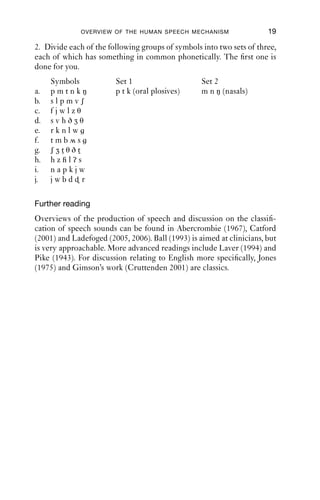
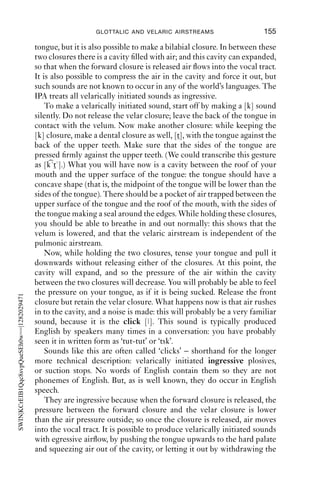
2. Divide each of the following groups of symbols into two sets of three,
each of which has something in common phonetically. The first one is
done for you.
     Symbols            Set 1                      Set 2
a.   pmtnkŋ             p t k (oral plosives)      m n ŋ (nasals)
b.   slpmvʃ
c.   fjwlzθ
d.   svhð θ
e.   rknlw
f.   tmb s
g.   ʃ tθðt
h.   hz lʔs
i.   napkjw
j.   jwbd r

Further reading
Overviews of the production of speech and discussion on the classifi-
cation of speech sounds can be found in Abercrombie (1967), Catford
(2001) and Ladefoged (2005, 2006). Ball (1993) is aimed at clinicians, but
is very approachable. More advanced readings include Laver (1994) and
Pike (1943). For discussion relating to English more specifically, Jones
(1975) and Gimson’s work (Cruttenden 2001) are classics.
3 Representing the sounds
       of speech


3.1 Introduction
One of the problems that phonetics needs to solve is how to represent
speech, an ephemeral and time-bound phenomenon, so that it is avail-
able in a more permanent form.
   In this book we will look at two ways to represent speech. The first is
phonetic transcription: the use of alphabetic symbols to represent the
sounds of speech. This is the kind of representation found in dictionary
entries, for instance, to represent the pronunciation of words with incon-
sistent spellings, like ‘plough’, ‘tough’, ‘trough’, ‘cough’ and ‘although’.
   English, like all languages, has a set of conventions to relate letters to
sounds; but it has fewer one-to-one mappings between letter and sound
than many other languages that use the Roman alphabet. Phonetic tran-
scriptions are built on the apparently simple alphabetic principle of
one symbol for each sound.
   The second kind of representation we will look at gives us quite
different information. These are representations that have a basis in
acoustic analysis, such as waveforms and spectrograms. They provide a
different perspective on the organisation of speech. Acoustic represen-
tations help us to see that despite our impressions, reinforced by an
alphabetic writing system, the sounds of speech are constantly changing,
are interwoven with one another, and are not discrete in the way that
letters are. Acoustic representations are commonly used in phonetics,
and they make it possible to see individual aspects of sounds separately.

3.2 Phonetic transcription
The practice of using written letters to represent the sounds of speech
is called phonetic transcription. Transcriptions represent an analysis of
the sounds we can hear, so transcriptions often have a linguistic status.
(‘Often’ and not ‘always’ because some transcriptions are more impress-
                                     20
REPRESENTING THE SOUNDS OF SPEECH                      21

ionistic and try to capture what we hear rather than make claims about
the significance of what we hear for making meaning.) It is useful for
phoneticians to write down what we can hear, and we need to do this in
a way that is systematic, easy to use, easily understood by others, and
portable – a notepad and a pencil predate modern recording equipment
by many years, and remain the cheapest tools of the phonetician’s trade.
   How we transcribe is not a simple matter. Using just the letters of the
Roman alphabet is problematic for a number of reasons.
   First, the phonetic values of letters are variable. For instance, the
letter <g> is regularly used in most European languages with the value
of a voiced velar plosive, [ ]. In Dutch <g> is pronounced like the <ch>
in Scottish ‘loch’; in French and Portuguese before an <e> or <i> it has
the same value as <si> in ‘invasion’, [ ]; in Swedish in the same context
<g> is pronounced like English <y> in ‘yes’; in English (sporadically)
and Italian (regularly) [d ], as in ‘gem’.
   Within English, letters can have very different values, as in <g> in
‘get’ and ‘gem’, or <a> in ‘sofa’, ‘hat’ and ‘hate’. These differences are
due to different spelling conventions being used at different times in the
history of the language, or spelling conventions reflecting the etymology
of words, and through the conservative approach to spelling reform
adopted in the English-speaking world.
   Secondly, the Roman alphabet has no symbol for some sounds of
English, so that we use digraphs (combinations of two letters) like <th>
for the different sounds of ‘thick’ ([θ]) and ‘this’ ([ð]) or <sh> for the
[ʃ] sound in ‘ship’; but ‘facial’, ‘admission’, ‘station’ and ‘louche’ also
contain this sound, where it is represented differently. So the alphabetic
principle in English writing is weak.
   A number of writing systems built on phonetic principles have been
invented over the centuries, but the one that is most widely used is the
alphabet of the International Phonetic Association.

3.2.1 The main tool of transcription: the IPA alphabet
The commonest tool for phonetic transcription is the alphabet of the
International Phonetic Association. A little confusingly, both the Asso-
ciation and the Alphabet are commonly known as ‘the IPA’, a practice
maintained here. The Alphabet is approved by the Association; amend-
ments are made to it regularly on the basis of practical experience and
scientific advice. For this reason, phonetics textbooks from different
years contain slightly different versions of the Alphabet. (In particular,
over the years there have been substantial changes to the number of
vowels the IPA represents.)
22              AN INTRODUCTION TO ENGLISH PHONETICS

   ‘Alphabet’ is perhaps also not the best way to refer to the IPA. The
letters of the alphabet, {A, B, C …}, occur in a random order, with
vowels scattered among consonants, and the consonants not grouped
according to any linguistic principle. The IPA, however, is a set of tables
containing symbols organised into rows and columns which are labelled
with terms that have agreed meanings.
   The rows of the Consonant chart groups sounds according to manner
of articulation. The first row contains plosives: [p b t d    c k q g ʔ].
The rows below have sounds with progressively more open stricture.
The columns organise symbols by place of articulation, with the leftmost
column containing symbols that stand for bilabial sounds, and sub-
sequent columns containing symbols for sounds made progressively
further down the vocal tract, so that the rightmost column contains
symbols for glottal sounds.
   The symbols of the IPA are presented in a number of tables, the main
ones being pulmonic egressive consonants and vowels. The other tables
contain non-pulmonic consonants, diacritics (small marks that combine
with letter symbols to represent sounds not on the chart, as we have
already seen) and suprasegmentals, aspects of sound which relate to
things like length, phrasing, intonation and so on. There is also a collec-
tion of ‘other symbols’, which stand for sounds that do not easily fit in the
main scheme.

3.2.2 The principles of the IPA
The IPA, like any system that is used for analysis, makes some assump-
tions about the nature of speech. Not all of these assumptions are shared
by all phoneticians, but it is important none the less to understand them.
They are set out in the IPA Handbook (IPA 1999: 3–4).
   According to the IPA, ‘Some aspects of speech are linguistically
relevant whilst others … are not.’ Phonetic transcriptions should only
contain information that is linguistically meaningful.
   If two speakers from the same speech community say the same thing
in the same accent (for instance, ‘Come in!’), then they will none the less
sound different, although we recognise them as saying the same thing.
Physical differences, caused by things such as gender, age or physical
state (like being out of breath), mean that people sound different; but
these are physical, not linguistic, differences, so a phonetic transcription
does not capture them. Except in clinical situations, phonetic transcrip-
tions generally ignore speakers’ individual quirks, preferring to work on
the language of a community, and not just of an individual.
   On the other hand, think about ways of saying ‘Shut up!’: in particu-
REPRESENTING THE SOUNDS OF SPEECH                       23

lar, how are the two words joined? In the north west of England, you
might hear a [ɹ] sound (as if it were written ‘shurrup’); in many parts of
the English-speaking world, you will hear a glottal stop, [ʔ], or a tap, [ɾ]
(as in ‘shuddup’, defined in the online Urban Dictionary as ‘what Donald
Duck says to Goofy Dog’). In most places, you could hear an alveolar
plosive with a puff of air (aspiration), [th]. Most speakers will have a
choice about how to join these words, with [th] probably being the sound
that has the highest social status. These differences are certainly socio-
linguistically meaningful, and for that reason, phoneticians want to be
able to represent them.
    Secondly: ‘Speech can be represented partly as a sequence of discrete
sounds or segments.’ ‘Segment’ means a piece of something that has
been chopped up: in the case of speech, ‘segments’ means a piece of the
speech signal, which is actually continuous. This is the principle that
makes the use of the IPA alphabetic: the claim is not that speech is
made of segments, but that we can represent it as segments. It is a useful
working assumption in many ways, and it is familiar to people who use
an alphabetic writing system.
    Thirdly: the IPA establishes two major types of segment, consonant
and vowel. Consonants are those sounds which are produced with
some kind of constriction in the vocal tract. We can feel, see and hear
where these constrictions are made, and what kind of constriction they
are.
    Vowels, by contrast, are produced without a constriction in the
vocal tract, and it is harder to sense how they are articulated. The IPA’s
terminological framework for describing consonants and vowels is
different.
    Suprasegmentals are aspects of speech which persist over several
segments, such as duration, loudness, tempo (speed), pitch character-
istics and voice quality; they are often thought of as the ‘musical’ aspects
of speech, but may include other properties like lip-rounding. They are
called suprasegmentals because they function over (‘supra’ in Latin)
consonants and vowels.
    The effect of suprasegmentals is easy to illustrate. In talking to a cat,
a dog or a baby, you may adopt a particular set of suprasegmentals.
Often, when doing this, people adopt a different voice quality, with high
pitch register, and protrude their lips and adopt a tongue posture where
the tongue body is high and front in the mouth, making the speech sound
‘softer’.
    Suprasegmentals are important for marking all kinds of meanings, in
particular speakers’ attitudes or stances to what they are saying (or the
person they are saying it to), and in marking out how one utterance
24               AN INTRODUCTION TO ENGLISH PHONETICS

relates to another (e.g. a continuation or a disjunction). Both the forms
and functions of suprasegmentals are less tangible than those of con-
sonants and vowels, and they often do not form discrete categories.

3.2.3 Types and levels of transcription
Perhaps surprisingly, for any utterance there is more one appropriate
phonetic transcription. Different situations make different demands of a
transcription, so we need to understand how transcriptions can vary.
   For example, if we encounter a new language or a new variety for the
first time, there is no way of knowing initially what might turn out to be
important, and what might not. In this case it is common to transcribe as
many details as possible so that we have rich working notes to refer to.
These transcriptions might be personal memoranda to remind ourselves
of what we heard. (Most phoneticians have a good auditory memory:
reading detailed transcriptions is one way to recall what was heard.)
   We might be working on data for a specific linguistic reason, for
instance to work out something about the details of place of articulation
for [t] sounds within a given variety. In doing this it is best to concentrate
on things that are relevant to the problem in hand, so some parts of the
transcription might be detailed, while others will be sketchier.
   One important dimension is the amount of detail that a transcription
contains. At one end of the spectrum, transcriptions can contain rep-
resentations of as many details as we can observe. This kind of tran-
scription is often called narrow. At the other end of the spectrum are
transcriptions that use a restricted set of symbols, and which therefore
gloss over many phonetic details on the grounds that they are pre-
dictable from the context, and not important in distinguishing word
meanings. Such transcriptions are often called broad. Transcriptions in
dictionaries are typically broad.
   A simple transcription is one which uses familiar Roman letter shapes
in preference to non-Roman letters shapes. E.g. the [r] sound in English
is often pronounced as [ɹ]; but it can be represented with [r] in a simple
transcription unambiguously because although [r] stands for a voiced
alveolar trill on the IPA chart, alveolar trills do not usually occur in
English.
   Transcriptions are sometimes used to compare sounds. For instance,
we might want to compare the pronunciation of <r> in Scottish English
and Irish English, so we could use use symbols such as [ɾ] (tap), [r] (trill),
[ɹ] (approximant), etc., so as to make comparison easier. Transcribing
different varieties of a single sound when we hear them produces a
comparative (also narrower) transcription.
REPRESENTING THE SOUNDS OF SPEECH                        25

   Systematic transcriptions limit the number of symbols used to a
given set. In some circumstances, there are choices about how to rep-
resent sounds. Phonemic transcriptions are by definition systematic. For
example, the word ‘hue’ starts with palatal approximation, voicelessness
and friction. In a systematic transcription, the set of available symbols is
restricted. Since [h] and [j] are needed independently (for e.g. ‘who’ and
‘you’), the combination [hj] represents the sound at the start of ‘hue’
unambiguously, without introducing a new symbol, although the symbol
[ç] represents a voiceless palatal fricative and is equally accurate in this
case. We return to this problem in Section 6.2.3.
   Phonemic transcriptions embrace the concept that one linguistically
meaningful sound should map on to one symbol. (‘Linguistically mean-
ingful’ in this context usually means ‘capable of distinguishing words’.)
So the velar plosives in the words ‘kick, cat, cool, skim, school, look, sick’
(which are all slightly different) are all transcribed as [k]. Phonemic
transcriptions are necessarily broad. Allophonic transcriptions capture
such details, even though they are predictable. Allophonic transcriptions
are narrower than phonemic ones. Phonemic and allophonic transcrip-
tions constitute the basis for a phonemic analysis of speech.
   A transcription which uses the full potential of the IPA to record
much observable detail is called impressionistic. Impressionistic tran-
scriptions (or ‘impressionistic records’) are necessarily narrow.

3.2.4 Systematic transcription of English consonants
Table 3.1 contains the set of symbols used in this book for representing
the consonants of English at a systematic level. The transcription is
broad and general, and does not attempt to represent differences
between varieties. Illustrations of the sounds that the symbols stand for
are underlined. The sound [ ] is put in brackets because some speakers
do not use this sound, but use [w] in its place. Where letters of English
spelling appear between parentheses, this shows that not all speakers will
have appropriate examples of the relevant sound; for example, not
everyone pronounces the final <r> of ‘error’.
   For vowels, it is much more difficult to provide a systematic
transcription system. The reason for this is that vowels are extremely
variable across varieties of English. We look at vowels of English in more
detail in Chapter 5, including some of the issues of transcribing and
representing vowels.
26              AN INTRODUCTION TO ENGLISH PHONETICS

                                           Table 3.1 Systematic transcription of English consonants.
                                                p    pip, happy, spot, lamp
                                                t    take, hot, matting, stop, rant
                                                k    cake, sticky, scan, rank
                                                b    baby, hobby, rub, bulb
                                                d    dad, rudder, hand
                                                     gig, ghost, ragged, rag
                                             tʃ      church, inch, itchy
                                             d       judge, edgy, gem
                                             m       mat, hammer, ram, lamp, lamb
                                             n       not, gnat, honour, phone
                                                ŋ    sing, finger, rank
                                                f    fall, offer, if, philosophy, laughter, rough
                                                v    velvet, delve, love, over
                                                θ    think, ether, truth, tenth
                                                ð    though, rather, breathe
                                                ʃ    ship, fish, Russia, station, facial
                                                     invasion, pleasure, beige
                                             l       look, hilly, all, play, help
                                             r       red, erro(r), sorry, write
                                             w       wall, away, (wh)ite, witch
                                            ( )      white, while, which
                                             j       young, computer, beauty


                                           3.2.5 Examples of transcription
                                           Now we will look at how one piece of speech can be transcribed in a
SWIN|KCrEIB1Qqc8svpQueSEh0w==|1282029167


                                           variety of ways, and comment on the transcription.
                                              We will look at a series of transcriptions of the utterance ‘I think I
                                           need some shoes for that.’ (The context is two young women chatting
                                           about a night out at a graduation ball that they are planning to go to. One
                                           of them is discussing the clothes she wants to buy.)
                                              The citation form is the form of the word when spoken slowly and in
                                           isolation; this is the form found in dictionaries. Using a standard English
                                           dictionary, we could transcribe this sentence as in (1):
                                           (1) Citation form transcription:
                                               [ai θiŋk ai ni d s m nju ʃu z fɔ ðat].
                                           This transcription simply concatenates the citation forms for each word
                                           in the sentence. However, in real life, many function words (such as
                                           prepositions, auxiliary verbs, conjunctions, pronouns, etc.) in English
                                           have other forms called ‘weak’ forms, which occur when the word is
                                           unstressed. The word ‘for’ is one such word. Here it is transcribed as [fɔ ],
REPRESENTING THE SOUNDS OF SPEECH                        27

so that it is homophonous with ‘four’. But in this context, a more natural
pronunciation would be [fə], like a fast version of the word ‘fur’. (This is
true whether you pronounce the <r> in ‘fur’ and ‘for’ or not!) Likewise,
the word ‘I’ is often pronounced in British English as something like [a]
when it is not stressed, and ‘some’ as [səm]. So a more realistic tran-
scription of the sentence as it might be pronounced naturally is:
(2) Citation form + weak forms:
    [a θiŋk a ni d səm nju ʃu z fə ðat].
This is a broad transcription; it is also phonemic because all the symbols
used represent sounds that are used to distinguish word meanings. It
is systematic because it uses a small and limited set of transcription
symbols.
    We could add some allophonic details to the transcription and make
it ‘narrower’. Vowels before nasals in the same syllable – as in ‘think’ – are
often nasalised. This means that the velum is lowered at the same time
as a vowel is produced, allowing air to escape through both the nose
and mouth. Nasalisation is marked by placing the diacritic [˜] over the
relevant symbol.
    Voiced final plosives and fricatives (as in ‘need’, ‘shoes’) are often
produced without vocal fold vibration all through the consonant articu-
lation when they occur finally and before voiceless consonants; this is
marked by placing the diacritic [ ] below the relevant symbol.
(3) Citation form + weak forms + some allophones:
    [a θiŋk a ni d səm nju ʃu z fə ðat].
        ˜           ˜
If we know the sounds and the contexts, these phonetic details are
predictable for this variety of English. Not including them in the tran-
scription saves some effort, but the details are still recoverable so long
as we know how to predict some of the systematic phonetic variation of
this variety of English. This transcription is not only narrower, it is also
allophonic: the details we have added are predictable from what we know
of English phonetics and phonology.
   This sentence was spoken by a real person and without prompting,
and there is a recording of her doing so. This means that the details are
available for further inspection, and therefore can be transcribed. Now
we will look at some of the details and illustrate what it means to
produce an impressionistic transcription.
   The transcriptions so far imply that sounds follow one to another in
discrete steps. In reality, things are more subtle. The end of the word
‘shoes’ and the start of ‘for’, [—z f—], requires voicing to be stopped and
the location of the friction to switch from the alveolar ridge (for the end
28               AN INTRODUCTION TO ENGLISH PHONETICS

of ‘shoe[z]’) to the lips and teeth (for ‘[f ]or’). These things do not happen
simultaneously (as the transcription [z f ] implies), so that first we get
[alveolarity +friction +voicing], [z], but then the voicing stops, so we
have [alveolarity +friction –voicing], [z]. Since labiodental articulations
do not involve the same articulators as alveolar ones, the two articu-
lations can overlap, so we get a short portion of [alveolarity +labioden-
tality +friction –voicing]. We can represent this as [z f ]: the symbol
[ ]means that two articulations occur simultaneously. The alveolar
constriction is then removed, leaving just labiodental friction. So in all,
the fricative portion between these two words can be narrowly tran-
scribed as [z z z f f]. This could imply four different ‘sounds’, and at some
level, there are: there are four portions that are phonetically different
from each other, but really there are only two parameters here: voicing
goes from ‘on’ to ‘off ’, and place of articulation changes from ‘alveolar’
to ‘labiodental’.
    The end of this utterance is produced with creaky voice. This is where
the vocal folds vibrate slowly and randomly (Chapter 4). As well as
this, the final plosive is not in fact alveolar; like many speakers, this
one uses a glottal stop instead. So the last two syllables can be partially
transcribed as [fəðaʔ]. The dental sound in ‘that’ is produced without
friction: it is a ‘more open’ articulation (i.e. the tongue is not as close to
the teeth as it might be, and not close enough to produce friction): this is
transcribed with the diacritic [ ] (‘more open’); and there is at least a
percept of nasality throughout the final syllable. This might be because
the velum is lowered (the usual cause of nasality), but sometimes glottal
constrictions produce the same percept. We can’t be sure which is the
correct account, but the percept is clear enough, and in an impression-
istic transcription, it is best not to dismiss any detail out of hand. (For all
we know, the percept of nasality might be a feature regularly used by this
speaker to mark utterance finality.)
(4) Impressionistic transcription:
        ˜           ˜               ˜˜
    [a θiŋk a ni d səm nju ʃu zzzffəðaʔ].
This probably looks a bit frightening, but it is worth remembering
that (a) this is a transcription of one utterance on one occasion by
one speaker, and (b) the transcription is based on a set of rather simple
observations of what we can hear: it’s more important to understand that
relationship than to worry about the details of the transcription. It is
important not to fetishise transcriptions, but to see the linguistic patterns
that lie beyond them.
   These impressionistic transcriptions, as can be seen, use the full range
of IPA symbols and diacritics in an attempt to capture details of pronun-
REPRESENTING THE SOUNDS OF SPEECH                          29

ciation whose linguistic status is not clear. There is no point including
details of voice quality in an English dictionary because voice quality
does not systematically distinguish words one from another. On the
other hand, if it turns out that the speaker whose speech we have
transcribed regularly uses creak to mark utterance finality (one possible
explanation for what we have found), then transcribing it will have
served a useful purpose. Impressionistic transcriptions are there-
fore often preliminary to further analysis, because they raise a lot of
questions.

3.2.6 ‘Correct’ transcriptions
Students learning phonetics frequently worry whether they have the
‘correct’ transcription. Common mistakes include: transcribing the same
sounds differently (or different sounds the same); importing letters from
spelling (like [c] for [k], or ‘silent’ letters like <k> in <kn->); using strong
vowels where weak ones are more usual (e.g. [fɔ , fɔr] for [fə, fər] in ‘for’).
   Aside from accuracy, the appropriateness of a transcription depends
on what the transcription is to be used for and the style of transcription
that is adopted. As we have seen, the same thing can be transcribed in a
number of different ways; and each transcription is useful for noting
different kinds of thing. The main problem that arises with transcrip-
tions as a working tool is when they are inconsistent; which means
that the transcription style needs to be decided at the outset. It is also
good practice to state briefly what conventions have been used for
transcription: e.g. ‘[r] stands for [ɹ]’; ‘the transcription is phonemic’; ‘the
transcription is impressionistic and focuses on nasalisation’.

3.3 Acoustic representations
The sounds of speech are made by changes to air pressure that are
caused by airflow through the vocal tract. As the air moves, it causes
perturbations, which the ear picks up. The ear converts physical move-
ments in the air into electrical signals that are sent to the brain, which is
where processing of other kinds (such as detecting meaningful units like
sounds, words, sentences and so on) occurs.
   Technology makes it possible to convert these changes of air pressure
into pictures; and being static and unchanging, these pictures allow us
to examine more of the detail of talk as it happened. This kind of
phonetics is known as acoustic phonetics, and in this book we use some
acoustic representations to show some of the details of talk. The aim of
this section is to enable you to understand that there is a connection
30               AN INTRODUCTION TO ENGLISH PHONETICS

between articulation and acoustics. There are two main kinds of acoustic
representations we will use in this book: waveforms and spectrograms.
We will approach these representations as pictures which can show
us particular aspects of speech and as a useful complementary tool to
transcriptions.

3.3.1 Waveforms
Waveforms are a kind of graph. Graphs have an x-axis, which runs
horizontally, and a y-axis, which runs vertically. In waveforms of speech,
the x-axis represents time and is usually scaled in seconds or milli-
seconds, while the y-axis shows (to simplify a great deal) amplitude, a
representation of loudness.

 0.3593


      0


–0.4704
          0         0.1           0.2              0.3         0.4           0.5
                                        Time (s)
Figure 3.1 Waveform of a vowel.


   Figure 3.1 shows a waveform of a vowel. On the x-axis, time is marked
at 0.1 second (or 100 ms) intervals. On the y-axis, there is a line marked
0 (the zero crossing) which goes through the waveform. The bigger the
displacement from this line, the louder the sound is. The beginning and
end of this waveform have no displacement from the zero crossing line,
so the recording begins and ends with a period of silence. The sound
starts just before 0.1 s into the recording, and is loudest around 0.2 s.
From a little after 0.2 s to around 0.45 s, the sound gets quieter: or, a little
more technically, the amplitude decreases. By about 0.45 s, the signal has
died away.
   With a little experience and practice, various other kinds of sound are
also evident in waveforms. We will look at these after we have considered
spectrograms.
REPRESENTING THE SOUNDS OF SPEECH                      31

3.3.2 Spectrograms
Spectrograms are pictures of speech: in spy movies they are often called
‘voiceprints’, which although inaccurate conveys the idea that it shows a
picture of someone speaking.
   Spectrograms provide more complex information than waveforms.
Time, as in waveforms, is marked on the x-axis. The y-axis shows
frequency. Amplitude is reflected in darkness: the louder a given
component in the speech signal is, the darker it appears on the spectro-
gram.

3.3.3 Three types of sound and their appearance
There are three main kinds of sound that are easily distinguishable on a
spectrogram, corresponding to three acoustic categories. Sounds can be
periodic (that is, regularly repeating), or aperiodic (that is, random).
Aperiodic sounds in speech can be either continuous (like fricatives such
as [s f θ]) or transient (that is, short and momentary), like [p t k]. Each
has a different appearance on a spectrogram and in waveforms.

                                Sound


                     Periodic               Aperi
                                            Aperiodic
                                                iodic


                                Transient
                                Transient         Continuous
Figure 3.2 Three types of sound.

   Figure 3.3 is a spectrogram of the word ‘spend’. This word illustrates
the three main kinds of sound.

3.3.4 Periodic sounds
Waveforms which repeat themselves are called periodic. (In reality they
are not perfectly periodic, but for simplicity we will think of them as
such.) In speech, periodicity is associated with the vibration of the vocal
folds, so periodic waveforms are associated with voicing. Each one of the
major peaks in a periodic waveform corresponds to one opening of the
vocal folds. Figure 3.4 shows the waveform of the section between
0.3 and 0.4 s of Figure 3.3, in the middle of the vocalic portion.
   One complete repetition is called a cycle or period. There are about
32                             AN INTRODUCTION TO ENGLISH PHONETICS

                                                       Periodic noise.
                                                                no
                                                                 oise.
                                  Each vertical striation correspo
                                                                 onds
                                                          corresponds to to an opening of
                                    the vocal folds: note alignment with peaks in the
                                                           alignm
                                                                ment
                                         waveform. Distinct formant structure.
                                                               for
                                                                 rmant
                  Aperiodic friction noise
                            frictio
                                  on                                                         Transient
                                                                                             Transient burst spike.

     5000


     4000


     3000                                                                      F3

     2000
                                                                               F2

     1000
                                                                               F1

        0

    0.2688


        0


-0.2919
–
             0           0.1           0.2           0.3         0.4                0.5           0
                                                                                                  0.6           0.7   0.7633
                                                             Tim
                                                             Time (s)
                                                               me

Figure 3.3 Spectrogram of the word ‘spend’, with periodic, aperiodic and
           transient sounds marked.


0


0.3              0.31     0.32        0.33       0.34       0.35        0.36          0.37        0.38        0.39      0.4

Figure 3.4 Expanded version of part of Figure 3.3.


10.5 cycles in Figure 3.4. This reflects the number of times the vocal folds
open in the time represented. The number of complete cycles the vocal
folds make in one second is called the fundamental frequency (f0); it is
measured in Hertz (Hz). A frequency of 1 Hz means that there is one
complete cycle per second. A frequency of 100 Hz means that there are
one hundred complete cycles per second, or alternatively one complete
cycle every 0.01 s (every one hundredth of a second). In the waveform in
Figure 3.4, there are approximately 10.5 cycles in 0.1 s, which means the
fundamental frequency in this stretch of speech is about 105 Hz.
REPRESENTING THE SOUNDS OF SPEECH                       33

    In spectrograms, periodic signals have two important visual proper-
ties. First, there are vertical striations which correspond to the opening
of the vocal folds: each time the vocal folds open and air escapes, there is
a sudden increase in amplitude. This shows up in the striations in the
spectrogram which line up with the peaks in the waveform. Voicing
is seen in regular spikes in a waveform, and corresponding regular
striations in a spectrogram.
    Secondly, there are darker horizontal bands running across the
spectrogram known as formants. There are three clearly visible
formants in the periodic part of Figure 3.3, one centred at around 700 Hz
(labelled F1), another around 1800 Hz (labelled F2), and a third one
around 2800 Hz (labelled F3). There are in fact more formants, but
usually only the first three are of interest.
    Formants are named counting upwards. The first one is called the first
formant, or F1. The next one up is called the second formant, or F2; and
so on.
    Formants are natural resonances. Each configuration of the vocal
tract has its own natural resonance. Most of us are familiar with the idea
of resonances. Imagine a home-made xylophone made of glass bottles. If
the bottles are different sizes and shapes, or if there are varying amounts
of water in the bottles, then when they are tapped, they will produce
different notes. The big bottles will have a deeper ‘ring’ to them than the
little ones, or the ones with more water in them. The vocal tract exhibits
similar (though more complex) properties: when the sound wave from
the vocal folds passes through the vocal tract, some parts of the acoustic
signal are made louder, and some quieter. The frequencies which get
amplified (made louder) are the natural resonances of the vocal tract,
and are determined by its size and shape. In turn, the size and shape of
the vocal tract depends on the position of the tongue, velum, lips and all
the other articulators, so that different sounds of speech have different
natural resonances; and in turn, they look different on a spectrogram.
    To illustrate this, produce any vowel sound (say, [i ] as in ‘bee’), and
then round and unround your lips. As you do this, you change the length
of the vocal tract and the shape of its frontmost cavity. Acoustically,
the effect of this is to change the sound that comes out, by changing the
location of the formants relative to one another. When the lips are
rounded, the vocal tract is a little longer; so the formants will all be a
little lower.
    Say the vowel [i ]; now make a glottal stop by holding your breath. If
you flick your larynx gently, you will excite the first formant. You will
hear a low pitched knocking sound each time you flick. If you now try
this with a vowel like [a], you will hear an altogether different, higher
34              AN INTRODUCTION TO ENGLISH PHONETICS

note. This is because the shape of the vocal tract has been changed by
moving the tongue and opening the jaw. If you make a vowel like [u] you
will hear a lower note again.
  In summary: periodic sounds in the vocal tract are caused by voicing.
Periodicity is seen in a regular waveform, striations in the spectrogram,
and visible formants in the spectrogram. Vowels and the sounds [w j l r
m n ŋ] all illustrate these properties well.

3.3.5 Aperiodic, continuous sounds
For aperiodic sounds there is no repetition, but rather random noise.
This kind of sound is called aperiodic. Figure 3.5 shows 0.1 s of the
voiceless fricative [s] sound. If you compare this with Figure 3.4, you will
see that it looks very different: [s] has no repeating waveform, and the
amplitude varies apparently randomly.


0


0.05   0.06   0.07   0.08   0.09    0.1    0.11   0.12   0.13   0.14   0.15

Figure 3.5 Waveform of part of a voiceless fricative.

    Friction noise is generated when the airflow between two articulators
is turbulent. The correlate of this in a waveform is a very much more
irregular, random pattern than we find for periodic sounds; it lacks the
regular ups and downs of a periodic waveform.
    In Figure 3.3, the aperiodic portion lacks the clear formant structure
and the vertical striations we saw for periodic portions. However, the
pattern of the frequencies does change. As the lips close to form the [p]
sound, the [s] sound changes, and sounds as though it gets lower in pitch:
this can be seen in the end of the segment marked ‘aperiodic’.
    A combination of voicing (periodic) and friction (aperiodic) is also
possible; we will see this in Chapter 8.

3.3.6 Transient sounds
Transient sounds are aperiodic sounds which come and go quickly.
Examples from everyday life are a knock on a door, the sound of one
piece of cutlery rattling against another, or a firework exploding. In
REPRESENTING THE SOUNDS OF SPEECH                                         35

speech, the main source of transient sounds is the explosive release of a
closure, such as releasing a closure for [p] or [k]. Other common tran-
sient sounds in speech are the tongue or lips coming apart as someone
starts to speak, bubbles of saliva bursting in the mouth, the velum being
raised, or the sides of the tongue making contact with the teeth or
cheeks.
   In a waveform, transients show up as a spike. On spectrograms, they
appear as dark vertical lines which last only a short time.
   In Figure 3.3, there are two transients. One, at about 0.25 s, corre-
sponds to the lips opening for the sound [p], the other, marked with
the box just after 0.6 s, corresponds to the tongue coming away from the
alveolar ridge, for [d].
   Figure 3.6 shows the waveform of a transient (the start of [d] in
‘spend’) in more detail. The transient portion T lasts less than 30 ms. It
has an abrupt start and then fades away.


                               periodic                                 T

         0.55   0.56    0.57   0.58       0.59     0.6    0.61   0.62       0.63   0.64   0.65
                                                 Time (s)

Figure 3.6 Transient portion (T) for the initial plosive of ‘spend’.

3.4 Acoustic representations and segments
Acoustic representations are rarely static in the way that transcriptions
are. In the waveform and spectrogram of ‘spend’ (Figure 3.3), many
things change simultaneously: the amplitude of the signal and the
formants in particular are not static. In speech, many articulations do not
start and stop quite synchronously. Looking at the spectrogram we can
identify six or seven more or less stable portions. On the other hand, this
utterance is transcribed broadly as [spεnd], which implies five discrete
units.
   Transcriptions and acoustic representations capture different kinds of
truth about speech. [spεnd] captures the fact that English speakers
conceive of this word as having five distinct sounds. English speakers’
intuitions about how many segments there are do not match up with
what our eyes might tell us. The acoustic representation captures the fact
36              AN INTRODUCTION TO ENGLISH PHONETICS

that in speaking, the articulators are rarely static. When articulators
move, these movements have acoustic consequences, and this very
fluidity helps to make everyday speech easier to perceive. Both the
acoustic and written representations convey important but different
information about speech.
   Transcriptions may have a generality to them which acoustic rep-
resentations do not. A broad transcription represents many of the
important details of the speech of a whole community of speakers, which
is why such transcriptions are used in dictionaries. On the other hand,
acoustic representations capture details and facts about one utterance on
one occasion by one speaker (as may an impressionistic transcription); if
the speaker changed, or if the same speaker produced the same word e.g.
more slowly, then many of the details of the acoustic representation
would also change. So acoustic representations may be less useful from
the point of view of representing facts about language.

3.5 Representation and units in phonetics
From both written transcriptions and acoustic representations, it should
be clear that all forms of representation of speech are partial, and none
gives a complete picture of speech. In the same way, an architect or an
estate agent will describe a house in different ways, reflecting different
purposes and different levels of detail.
   Both transcriptions and (perhaps more surprisingly) acoustic rep-
resentations have an element of subjectivity in them. As phoneticians, we
train ourselves to listen more objectively. Ways to make transcription
more of a ‘science’ and less of an ‘art’ include regular practice, collabor-
ating with others whose judgements are trustworthy, or combining the
activity of transcription with acoustic observation, which allows for a
slower, more piecemeal approach to work and can make it possible to
check impressions against acoustics. If our records open the way to other
work, then they have served a useful purpose.
   Acoustic representations seem more objective: after all, any two
people can put the same acoustic signal in and get the same represen-
tation out. However, such representations are less objective than they
appear. For instance, it is possible to manipulate the way the acoustic
signal is processed and the way that spectrograms are drawn so that they
appear sharper; or to emphasise the temporal organisation of the signal
over the frequency aspect (or vice versa); or to draw spectrograms in
colour rather than black and white; and the Hertz scale does not by any
means represent the way the ear and brain analyse the signal. So there
are also many unknowns with this kind of representation.
REPRESENTING THE SOUNDS OF SPEECH                      37

   For all these reasons, it is wise be wary of ascribing to any one form of
representation some kind of primacy. Made and used carefully, they are
all informative in some way.


Summary
In this chapter we have looked at two forms of representation of speech:
transcription and acoustic representations. We have seen that each has a
place, and each type of representation has both advantages and draw-
backs.
    In later chapters, we will use verbal descriptions, transcriptions and
acoustic representations to try to give some impression of the way the
sounds of English are produced, and to try to show some of the details
of those sounds where using words is not straightforward. Phonetics
is special in linguistics for the way it combines the production and per-
ception of sounds, the auditory, visual and kinaesthetic aspects of the
subject: this means that learning phonetics can be a multi-sensory
experience. It is worth persisting, if frustration sets in, to try to put
the various forms of phonetic description and representation together,
because it results in a richer understanding of the embodied nature of
human speech.


Exercises
1. Consider the functions of phonetic transcriptions in the following
circumstances: a speech therapist with a client; a fieldworker working
out a writing system for an unwritten language; a dictionary aimed at
learners of English as a foreign language. What demands and needs
might each situation make?

2. Below is a text and various phonetic transcriptions of it (represen-
tative of a variety of Anglo-English where <r> is pronounced only
before vowels). For each transcription, comment on its properties: how
broad is it, how simple, how systematic?
‘He was really tired, because he didn’t get any sleep the night before
either.’
a.   [hi wɒz riəli taiəd bikɒz hi didənt εt εni sli p ðə nait bifɔ r aiðə]
b.   [i wəz ɹi li thaiəd bikəz i didənʔ εʔ εni sli p ðə nait bifɔ r aiðə]
c.   [i wəz ri li thaiəd bikəz i didənʔ εʔ εni sli p ðə nait bifɔ r aiðə]
d.   [ʔi wəzw ɹ wi li ta iəb pəxəz i diŋʔ εʔ εni sli p dðə nɑip bi f wɔ ɹ    w
                                           ˜ ˜                ˜˜
     ɑiðə]
         ˜
38                   AN INTRODUCTION TO ENGLISH PHONETICS

3. The spectrogram and waveform in Figure 3.7 represent a production
of ‘took off his cloak’, [tυk ɒf iz kləυk], spoken by a speaker of RP.
Identify the following things:
a.       four periods of voicing
b.       four transients
c.       the first three formants
d.       two portions with low F2, one with high F2
e.       portions where there is aperiodic (friction) noise

5000


4000


3000


2000


1000


     0


             took          off         his                    cloak


         0    0.1    0.2         0.3   0.4      0.5     0.6   0.7     0.8   0.9 0.96718
                                             Time (s)

Figure 3.7 Spectrogram of a production of ‘took off his cloak’ (RP) (IPA).


Further reading
Bell (2004) discusses English spelling in an approachable but critical way.
The Handbook of the IPA (1999) provides a short overview of the prin-
ciples of the IPA and transcription styles. Abercrombie (1967), Kelly and
Local (1989), Laver (1994) and Jones (1975) contain more thorough
discussion of transcription styles, and Pullum and Ladusaw (1996) is a
useful guide to IPA and other phonetic symbols. For more practice at
transcription, Lecumberri and Maidment (2000) has lots of exercises and
discussion.
REPRESENTING THE SOUNDS OF SPEECH                 39

   For a more technical introduction to acoustic phonetics, Ladefoged
(1995) is very approachable; Denes and Pinson (1993) and Johnson
(2002) are also recommended.
4 The larynx, voicing and
       voice quality


4.1 Introduction: the production of voicing
In this chapter, we look at the production of voicing, the construction
of the larynx, and the mechanism which gets the vocal folds vibrating.
We will then move on to look at ways this vibration can be controlled to
produce different pitches and voice qualities.
   Good examples of pairs of sounds distinguished by voicing in English
are [s f ] (voiceless) and [z v] (voiced). Produce a [s] or [f ] sound; close
your eyes and concentrate on how it feels to produce this sound; and
then make a [z] or [v] sound instead. Now produce chains of sounds like
[s z s z s …] or [f v f v …] without inserting a pause between them. If
you put your fingers in your ears, you will notice a humming or buzzing
for [z v] which is not there for [s f ]. With the fingers resting very lightly
on your larynx, you will notice that [z v] involve a vibration that you do
not feel for [s f ].
   Voicing is produced when the vocal folds vibrate. The vocal folds are
located in the larynx (Figure 4.1), which sits just below where your jaw
meets your neck. For males, there is a rather prominent notch at the front
of the larynx, and it is a couple of centimetres below the jawbone; for
females, the larynx is less prominent and may be a bit higher up the neck.
If you watch yourself in a mirror, you will probably be able to see your
larynx bob down and then up again as you swallow.
   The larynx is constructed from three main cartilages: the thyroid,
cricoid and arytenoid cartilages. Of these three, the thyroid is the most
obvious. It is the largest and is at the front of the larynx, and forms the
‘box’ of the larynx. It consists of two plates which are joined at an angle
at the front. Female thyroids are at a wider angle than male thyroids, so
the notch where the plates meet is more obvious in males than in
females. The thyroid cartilage is attached by muscles to the hyoid bone
higher up in the neck.
   The cricoid cartilage is a sort of ring shape underneath the thyroid. It
                                     40
THE LARYNX , VOICING AND VOICE QUALITY                   41


Figure 4.1 The larynx (from Catford 1977: 49). The most important labels
           for our purpose are: vf: vocal folds; hy: hyoid bone; tc: thyroid
           cartilage; cc: cricoid cartilage; ac: arytenoid cartilages.


forms the bottom part of the ‘box’. It has two spurs at the back, one on
each side, which reach up to behind the bottom part of the thyroid. The
two artytenoid cartilages sit on top of the back of the cricoid cartilage.
They can move together and apart, rock backwards and forwards as well
as rotate.
   The vocal folds are two ligaments (fibrous tissues) which are covered
in mucous membrane. They are attached to the arytenoids at the back
42              AN INTRODUCTION TO ENGLISH PHONETICS

and the thyroid at the front. At the side, they are attached to muscle in
the larynx. In the middle they are free, so that there is a gap or a space
between them, known as the glottis. The arytenoids can move, but the
thyroid is static; by manipulating the arytenoids, the tension across the
vocal folds can be changed, as can their thickness and the way they
vibrate.

4.2 How the vocal folds vibrate
The vocal folds form a kind of valve. Their primary function is to
prevent anything entering the lungs, such as food or water, by forming a
stoppage in the windpipe. For example, if when you swallow something
‘goes down the wrong way’ (a description which is actually rather
accurate), the reflex reaction is to close the vocal folds tightly together,
and then cough. Coughing involves an increase of air pressure below the
closure at the glottis, and then releasing the closure forcefully in an
attempt to expel anything that has fallen down too far. You can make
a cough and then release it more gently: this release of the cough is a
glottal stop, transcribed [ʔ]. We return to glottal stops in Chapter 7.
   For breathing, the vocal folds are open and held wide apart so that air
can pass in and out of the lungs unimpeded. If you breathe with your
mouth open, you will hear only a gentle noise as the air moves in and out
of your body. However, you can make a little more tension across the
vocal folds, and you will get a [h] sound.
   Sounds that are made with the vocal folds open, allowing the free
passage of air across the glottis, are voiceless. In English, voiceless
sounds include [p t k f θ s ʃ]. Voiceless sounds often have a more open
glottis than the state of the vocal folds for breathing.
   Voiced sounds are made with a more or less regular vibration of vocal
folds. They include: [b d v ð z m n ŋ l r w j] and all the vowels. As
we will see in later chapters, the way the contrast between voiced and
voiceless sounds is accomplished phonetically involves more than the
presence or absence of vocal fold vibration.
   We will now take a look at the mechanism by which voicing is
produced. The vibration of the folds is not caused directly by commands
from the brain telling the folds to open and close: it is caused by having
the right amount of tension across the folds. When the folds are shut, the
air below them cannot escape, yet the pressure from the intercostal
muscles has the effect of forcing the air out. So the pressure builds up
below the glottis. Once this pressure is great enough, it forces the folds
to open from below, until eventually they come open. Once they are
open, and air can pass through the glottis, the air pressure above the
THE LARYNX , VOICING AND VOICE QUALITY                   43

glottis and below the glottis equalises. Now the tension across the vocal
folds forces them back together again, making a closure again. The
process now repeats itself: the folds are closed, air cannot escape through
the glottis, so the pressure builds up, the folds are forced open, the
pressure equalises, the folds close again.
   This cycle of opening and closing is an aerodynamic effect called the
Bernoulli effect.
   When the vocal folds vibrate making complete closure along their full
length (that is, with no gaps in contact between the vocal folds), with
regular vibration, and with no particular tension in the folds to make
them especially thick (and short) or thin (and long), this is called modal
voicing. Few speakers really achieve modal voicing, but since most
people have a ‘normal’ setting (that is, one that has no particular dis-
tinguishing features for them), we often speak of modal voicing to mean
a person’s default voice quality.

4.3 Fundamental frequency, pitch and intonation
The rate of vocal fold vibration affects the perceived pitch of speech.
The faster the rate of vibration of the vocal folds, the higher in pitch
the speech signal will sound. Correspondingly, the lower the rate of
vibration of the vocal folds, the lower in pitch the speech signal will
sound.

4.3.1 Changing the rate of vibration of the vocal folds
The rate of vibration of the vocal folds is affected by several things.
First, more tension across the folds creates a faster rate of vibration. If
the folds are tightened (adducted) by the arytenoid cartilages, then they
will start to vibrate more quickly, and the pitch will rise. If on the other
hand they are relaxed, and the tension is lowered, then they will vibrate
more slowly. You can get a sense of this by singing a very high note. If
you hold that note silently, you will feel quite a lot of tension in your
larynx. You may also be raising your larynx: this facilitates the tension
across the folds. Now drop from a high note to a low note quickly, and
you will feel a change in tension and possibly also in larynx height.
    Secondly, the more air pressure there is below the folds, the more
quickly they will vibrate, other things being equal. Under certain con-
ditions (stress being one of them), we typically breathe more quickly. As
a result, the average air pressure below the folds increases, and with it
both the loudness of our speech and its average pitch. On the other hand,
if there is rather little air in the lungs, the air pressure below the folds
44              AN INTRODUCTION TO ENGLISH PHONETICS

will be low. Speech produced like this is more likely to sound ‘tired’
because it requires less energy to produce. But this can also be used as a
more linguistic device: when coming to the end of a topic, one iconic
device we can use to mark this in our speech is to talk quietly and with a
low pitch.

4.3.2 Pitch and fundamental frequency
The pitch of speech is related to the rate of vibration of the vocal folds:
grossly speaking, the higher the rate of vocal fold vibration, the higher
the pitch. This is not a straightforward relationship because of the way
our hearing mechanism works, and as we have seen, the relationship
between air pressure, airflow and vocal fold vibration is not quite simple.
We use the term ‘pitch’ to refer to a percept rather than a physical event.
The rate of vibration of the vocal folds is often called the fundamental
frequency, because it is the lowest component frequency of speech.
Fundamental frequency is often abbreviated as f0.
   The relation between pitch and fundamental frequency is not a linear
one, but is more logarithmic in nature. Linear relationships are where an
absolute difference of a certain number of units always has the same
effect: for example, if the f0 : pitch relation were linear, then the differ-
ence between 100 Hz and 200 Hz would sound like the same difference
as that between 200 Hz and 300 Hz: a difference of +100 Hz in each case.
   For logarithmic relations, the important factor is the proportionality.
For example, the difference between 100 Hz and 200 Hz sounds the same
as the difference between 200 Hz and 400 Hz, because in each case the
second figure is twice the first one: a proportion of 1 : 2. The difference
between 200 Hz and 300 Hz is not in the proportion 1 : 2, but 1 : 1.5.
   Figures 4.2 and 4.3 show a pitch trace for a production of ‘oh thank
you for calling’ by a female speaker. The figures are scaled according to
this speaker’s range: her lowest pitch is 80 Hz, and her highest pitch is
585 Hz. Her average pitch is 220, marked on the right. Figure 4.2 shows
a linear pitch trace: the steps 200–300–400–500 Hz are equal on the
y-axis. The speaker’s average pitch seems rather low in her range on this
graph, and certainly lower than half way through her range.
   Figure 4.3 shows the same thing on a logarithmic scale. Here, the
distance between 100 Hz and 200 Hz is the same as that between 200 Hz
and 400 Hz, because the proportion 100 : 200 is the same as 200 : 400,
that is 1 : 2 – the second number is twice the value of the first. On this
representation, the higher frequencies appear squashed together; and
the speaker’s average pitch is more in the centre of the graph. This is
closer to what we perceive.
THE LARYNX , VOICING AND VOICE QUALITY                    45
                                                                               585
 500
 400
 300
 200                                                                           220

 100                                                                           80

           oh             thank      you         for        calling

       0        0.2        0.4       0.6         0.8    1             1.2   1.323
                                      Time (s)
Figure 4.2 f0 on a linear scale.


                                                                               585
 500
 400
 300
 200                                                                           220


 100
                                                                               80

           oh             thank      you         for        calling

       0        0.2        0.4       0.6         0.8    1             1.2   1.323
                                      Time (s)

Figure 4.3 f0 on a logarithmic scale.


4.3.3 Parameters for describing f0
Speakers cannot produce f0 above or below a certain level, for physical
reasons; or to put it another way, f0 is produced within a certain range.
The bottom of the range refers to a speaker’s lowest f0 value, while the
top of the range refers to their highest f0 value. This range varies from
individual to individual, but it also varies according to extralinguistic
factors such as state of health, the loudness of the speech and the time of
day.
    Average values for male speakers are around 120 Hz, while female
speakers’ averages are around 220 Hz. A typical f0 range in conversation
is something like 120–300 Hz for females and 70–250 Hz for males.
    The reason for so much individual variation in f0 is that it is a prod-
uct of individuals’ vocal tract shapes, their larynx and their habitual way
of speaking. However, we can draw some generalisations about relations
between f0 and speaker age and gender. Female speakers have a higher
46                AN INTRODUCTION TO ENGLISH PHONETICS

average f0 than male speakers. This represents anatomical differences in
the construction of the larynx. The thyroid cartilages are at a wider
angle in female larynxes than in male ones, which means that the aver-
age tension across the folds is higher for female speakers than for males.
There are cultural effects too: in English-speaking cultures, it is common
for males to enhance their intrinsically lower f0 by lowering their larynx,
and for females to enhance their intrinsically higher f0. The other differ-
ence is to do with age. Children of both sexes have roughly the same f0
and are anatomically alike until the onset of puberty, when boys’ voices
start to become lower in pitch. As people age, the cartilages harden and
the mucous membranes which coat the vocal folds become dryer, making
it harder for speakers to produce such a wide range of f0 as in their
younger years. The data in Table 4.1 is taken from Baken and Orlikoff
(2000); it shows how gender and age impact on mean f0.

Table 4.1 Average f0 values (Baken and Orlikoff 2000).
Gender             Mean age        Age range        No. subjects   Mean f0 (Hz)
Male               20.3            17.9–25.8        25             120
Male               85              80–92            12             141
Female             24.6            20–29            21             224
Female             85              80–94            10             200


4.4 Phrasing and intonation
All languages use changes in pitch to handle some aspect of meaning.
In English, changes in pitch are associated with sentence- or utterance-
level meanings and not e.g. word meanings. Intonation is the linguistic
use of particular f0 contours in the production of speech. These contours
can be described using labels that refer to their shapes such as ‘fall’
([]), ‘rise’ ([/]), ‘fall–rise’ ([/]), ‘rise–fall’ ([/]), ‘level’ [`], sometimes
accompanied by a reference to where in the speaker’s overall range the
contour is: ‘a high fall’, ‘a fall to low’, ‘a low rise’.
   In English utterances, the main stressed item of an utterance carries
an intonation contour. This means that pitch movement starts on the
stressed item and carries on over any subsequent syllables. Other stress-
bearing syllables may, but need not, carry an intonation contour. The
placement of contours in English depends on the context.
   Figure 4.4 shows f0 traces for three utterances: ‘hello’ [hεləυ], ‘hello’
[hεləυ] and ‘hello there’ [hεləυ ðε ]. The difference between the
falling and rising contours should be visible enough. (It is safe to ignore
the smaller movements of f0 on the unstressed syllables: they are not
THE LARYNX , VOICING AND VOICE QUALITY                            47
5000
4000
3000
2000
1000
    0

 600

 300
 200

 100
  80
                hello (1)                  hello (2)        hello (3)     there
        0                                                                         1.3424
                                          Time (s)

Figure 4.4 1. ‘hello’ [hεləυ], 2. ‘hello’ [hε/ləυ], 3. ‘hello there’ [hε/ləυ ðε ].


auditorily prominent in the way that movements on stressed syllables
are.) In ‘hello (3)’, the f0 contour is the same as in ‘hello (2)’, but it is
distributed over more material.
   Here are two speakers assessing a third person:
(1) nrb/reluctant lover
1           K               she’s really nice | isn’t she
2           J    →          she is nice
Our focus of interest is line 2, ‘she is nice’. In the first line, K assesses
another person as ‘really nice’, and invites J to agree with her (‘isn’t she’).
J responds by repeating K’s words: ‘she is nice’. In English, when words
are repeated, it is normal for the stress to shift to a different word from
the first time round: the ‘nice’ in line 2 is ‘deaccented’. The main stresses
in the utterances are marked with underlining.
   Now let us imagine different intonation contours here. With a falling
intonation contour (‘she is nice’), the pitch would be high on ‘is’, and fall
to low at the end of ‘nice’. Most English speakers would say that line 2
produced this way expresses straightforward agreement. If the contour is
different, then the meaning is different. If line 2 had a fall followed by a
rise (‘she /is nice’), where the pitch is high on ‘is’, but then falls and is
low at the start of ‘nice’, rising up again at the end of ‘nice’, then most
English speakers would say that the next word is likely to be ‘but’. A
fall–rise intonation contour in this context usually says: there is an
upcoming disagreement.
   In fact, this is how the conversation actually went:
48              AN INTRODUCTION TO ENGLISH PHONETICS

(2) nrb/reluctant lover (ctd).
1      K             she’s `really nice | isn’t she
2      J             she /is nice
3                    I do find though that she says stuff
4                    for the sake of saying stuff
In lines 3–4, J qualifies her agreement that the other person is ‘nice’. This
illustrates that in English intonation handles utterance-level meanings:
the fall vs. fall–rise contours here mark different types of agreement.
    Here are two examples of the word ‘yes’, both located after an assess-
ment. They differ in intonation, loudness, pitch range, and in their
location relative to the previous turn at talk; and they also differ in the
meanings they convey.

(3) njc.nice feet.10;15
1      W             Vic had slip-ons on
2      M             yes I saw Vicky
3      W             [I quite liked those]
4      M             [I though she had quite nice] feet
5      W      →      ↑YES
6      M             I thought she had really nice feet
7      W             yeah I did

(4) gw/00.washing machine
1      H             but it’s better than tokens though
2                    (0.4)
3      E      →      yes it is better than token[s
4      H                                        [cos like you always
5                    went to the porter and he said “oh we’ve got none”
6                    like went back two days later and he still had none
7      E             .mt we-uhm (1.0) my card always says bad card all
8                    the time
In (3), Marion and Wendy are discussing a character from a soap opera.
Marion says she thought she had ‘quite nice feet’, and Wendy agrees with
her. She does her agreement in line 5 almost immediately after Marion
has assessed Vicky’s feet. She does her agreement loud (represented with
capital letters here) and with quite high pitch (represented by [↑]).
   The second case, ‘washing machine’, also has a ‘yes’, in line 3. In this
fragment, Elizabeth and Helen are discussing the system used to pay for
the launderette at college, which has changed from tokens to a smart
card. Helen says the new system is ‘better than tokens though’. Elizabeth
THE LARYNX , VOICING AND VOICE QUALITY                   49

agrees with this, but her agreement comes late (almost half a second
later). Agreeing late weakens the sense of agreement; notice that Helen
comes in and explains her assessment of the new system as ‘better’, and
the next thing Elizabeth does is to find a reason why the new system
is not very good (lines 7–8). So the ‘yes’ here is not whole-hearted,
especially in comparison with the ‘yes’ of the first example. Perhaps
unsurprisingly, the strength of agreement is audible too: the ‘yes’ in
line 3 of the ‘washing machine’ extract is quiet, low pitched, and slow –
a direct contrast with the ‘yes’ in line 5 of the ‘nice feet’ extract.
   Here, then, we have two instances where ‘yes’ is produced, but the
intonation, along with other things, affects the ‘meaning’ of the ‘yes’,
making it stronger and more affirmative, or weaker and prefacing a
disagreement.
   Phrasing and intonation give speakers clues about the syntax that
organises words into structures. This is one of the main interfaces
between phonetics and syntax and semantics. Talk is chunked up into
phrases, whose boundaries reflect major syntactic boundaries. The
symbols [| | mark minor and major intonational phrase boundaries.
             |]
Phrases have some or all of the following characteristics (roughly):
• at the start: speeding up, re-setting of pitch
• at the end: slowing down, quieter, near the bottom or top of the
  speaker’s pitch range
• a pause before or after
• congruence with syntactic or pragmatic boundaries
Take the following sentence:
(5) We didn’t go to the museum because it was raining.
Did we go or not? If the sentence is spoken on a monotone, it is not
possible to tell. But if an intonation contour is placed on the sentence,
then two different meanings are possible:
(5a) | We `didn’t go to the mu`seum be`cause it was /raining |
     |                                                        |
(5b) | We didn’t go to the museum | because it was raining |
     |                                                       |
In the first one, there is one phrase and the last word has a falling + rising
intonation contour on it. It means: we did go to the museum, but for some
other reason than the fact that it was raining. In the second one, there are
two phrases, with a slowing down at the end of ‘museum’, and two falling
contours, one on ‘didn’t’, the other on ‘raining’. This means: we did not
go to the museum and the reason is that it was raining.
50              AN INTRODUCTION TO ENGLISH PHONETICS

4.5 Voice quality
Speakers can control not just the rate of vibration of the vocal folds, but
also the way in which they vibrate. This is known as voice quality. Aside
from modal voice quality, we will look at four voice qualities which are
regularly used in certain situations, to convey e.g. a particular stance
towards the thing being talked about. There is also some evidence that
varieties of English have habitual settings for voice quality: that is,
speakers belonging to certain sociolinguistic groups share a common
voice quality. None the less, there remains much work to be done on the
function and use of voice quality in English.


4.5.1 Breathy voice
Breathy voice is produced by incomplete closure along the length of the
vocal folds as they vibrate. There is an opening which allows air to flow
out during voicing, generating both voicing and some friction noise.
Breathy voice impressionistically is ‘soft’, and tends to be quieter than
modal (‘normal’) voicing. In English-speaking cultures it is often asso-
ciated with female speakers, and is often exploited in e.g. adverts for
chocolate or cosmetics. Many people (of either gender) regularly use a
slightly breathy setting in their ordinary speech.
   Breathy voice is transcribed with the diacritic [ ], which sits below the
symbol, e.g. [mmm], ‘mhm’.
   English [h] is often produced as a stretch of breathy voicing: for
example, in the phrase ‘a happy holiday’, the words ‘happy’ and ‘holiday’
have voicing at their start, accompanied with breathiness. We could
transcribe this as [ə api ɒlidei], or alternatively – and equivalently –
as [ə aapi ɒɒlidei].


4.5.2 Creak
Creaky voice can be produced in a number of ways. It involves closure
along the vocal folds leaving an opening at the front end; the folds are
loosely pressed together and are thicker than in other settings. The
subglottal pressure is often low. Creak often leads to a more irregular
pattern of vibration, and always to a slower one than is normal for the
speaker. This means that the f0 of creaky voice is low, and in fact it is
sometimes possible to hear individual pulses as the folds open. When
speakers reach the low part of a falling f0 contour, they may switch into
creaky voice: there is a close relationship between low f0 and creak.
The symbol for transcribing creak is the diacritic [ ], which sits
THE LARYNX , VOICING AND VOICE QUALITY                     51
    5000

    4000

    3000

    2000

    1000

       0

                  disgusting                      yeuagh


                                                           creak

      6.673                                                         8.208
                                    Time (s)

Figure 4.5 Creaky voice.


under another symbol. A creaky production of the word ‘yeah’ could
be transcribed [jεa].
   Figure 4.5 shows a spectrogram of a stretch of speech where creak is
used. The speaker is describing a fizzy drink as ‘disgusting yeuagh’ (a
‘nonce’ word, invented for the occasion), [dis υstiŋ jøa ]. The latter
part of this is produced with very marked creaky voice, which can be
seen in the way that vertical striations change from being rather regu-
larly spaced to being irregularly spaced, and further apart from one
another.

4.5.3 Whisper
Whisper is produced by narrowing the vocal vocal folds so that the
glottis is not closed, and the folds do not vibrate; none the less the glottis
is narrow enough so that when air passes through it, the airflow becomes
turbulent. Whisper is used by speakers as a way to speak ‘quietly’, or
‘secretively’: this seems to be a very widespread practice among linguis-
tic communities. It is sometimes also used to mark stance, as in (6) below.
The IPA has no symbol for marking whisper.
(6) tlj-sum04-damsongin
1                     if you like /damson /jam
2                     if you like stewed /damsons
3                     if you like {whdawh}mson {wh giwh }n,
4                     which is gorgeous …
52               AN INTRODUCTION TO ENGLISH PHONETICS

4.5.4 Falsetto
Falsetto involves the raising of a speaker’s average f0 to way beyond their
normal range. To produce falsetto, the vocal folds are stretched and
lengthened and the glottis is not completely closed. Falsetto can be used
in singing, but also occurs in conversational speech. The IPA has no
symbol for marking falsetto.
   Here are two cases of falsetto from everyday talk. The first one is part
of a complaint from Lesley to her friend Joyce about an acquaintance of
theirs, who has offended Lesley. At line 8, she goes into falsetto, probably
marking some kind of stance such as ‘outrage’ at the way she has been
treated. (We will return to this story in Chapter 10.)
(7) Field C85.4
1      L      and he came up to me and he said
2             “oh hello Lesley, still trying to buy something for
3             nothing?”
4      J      [| ɑ↓ ] ((a click followed by a sharp in-breath))
5             [ooh
6      L      [ooh
7      J      isn’t [he
8      L            [{Falsetto what do you say Falsetto}
9      J      oh isn’t he dreadful
The second example is a woman describing to a friend her feelings
towards a man. She compares her earlier stance towards him with her
current view of him: she is now much more favourably disposed towards
him than she was. She uses the same words to express her stance towards
him, but the second time round, she speaks in falsetto, as well as speaking
much more slowly and loudly.
(8) smc/sweet guy
1      B      much more attractive in every way
2      A      hahahaha
3      B      not even just physically just like in every way than
4             he was before
5             it’s like before when he did something that was
6             really sweet it was just like
7             “oh that’s really sweet=that’s Tim”
              {fast———————————–}
8             .hh and now it’s like “o:h that’s ↑really sweet”
                                       {falsetto ——————}
                                       {loud, slow—————}
THE LARYNX , VOICING AND VOICE QUALITY                   53

In both of these examples, by moving into falsetto, the speaker is able to
use a higher pitch range than her normal one, which means that the
difference between the highest and lowest values of the f0 range is
expanded. The high pitches the speakers can reach (as high as 673 Hz in
the first example and 572 Hz in the second one) may be used to mark out
their current talk as conveying something ‘noteworthy’, or something
that the other person is expected to comment on. In both these cases, the
speakers are involved in presenting a strong stance towards the person
they are talking about: in the first case as part of a complaint, and in
the second case as part of a positive, upgraded stance as compared to
an earlier one. Perhaps falsetto is used to mark an attitude towards
the subject matter which is at one extreme or the other – but not
neutral.

4.5.5 Voice quality as a sociolinguistic marker: Glasgow
Glasgow is one of the major cities of Scotland, with a strong Scottish
and distinctively Glaswegian identity. Glasgow English is one of the few
varieties of English whose voice quality has been systematically studied
(Stuart-Smith, in Foulkes and Docherty 1999). This study showed
that voice quality in Glasgow varies with age, gender and class. Male
speakers overall are more creaky than female speakers.
   There are also differences in ‘articulatory settings’ – that is, in the
habitual postures that speakers use throughout their speech. Here we list
some of the main ones. Male speakers have overall a more nasalised
setting than female speakers: they keep the velum slightly lowered,
allowing nasal escape of air. Working-class speakers tend to speak with a
more open jaw, with a more raised and backed tongue body, perhaps also
with their tongue roots more retracted: this gives the auditory effect of a
constriction in the throat and makes speech sound lower in pitch and
harsher in tone. Middle-class speakers have no particular traits, just an
absence of working-class ones.
   ‘Voice quality’, then, can be used as a sociolinguistic marker, but it is
worth noting that the description of voice quality for Glasgow does not
just involve laryngeal settings: it involves a cluster of features involving
the whole vocal tract.

Summary
In this chapter, we have seen how speakers control the vibration of the
vocal folds to bring about changes in pitch and changes in voice quality.
Voicing is also implicated in distinguishing certain pairs of sounds in
54              AN INTRODUCTION TO ENGLISH PHONETICS

English. Both pitch and voice quality are used linguistically in English,
but with a complex range of meanings, none of them lexical.
   There is comparatively little work on voice quality in English, either
in terms of its functions in small stretches of conversation or in terms
of its more generic function in marking speakers as belonging to a par-
ticular community: this is another area of English phonetics which is
ripe for research.


Exercises
1. Using the IPA chart, identify which of the sounds of English we
looked at in Chapter 3 are voiced, and which voiceless. For each sound,
find a pair of words or phrases which highlights the contrast. The pairs
should be as alike as possible. For example: [f – v]: ‘proof ’, ‘prove’. For
some sounds, you will not be able to find pairs; try to produce the sound
with/without voicing.

2. The texts below (based on spoken material) have no punctuation.
Punctuate them with <. , ( ) ? !> etc., and read them out loud. What
differences to pronunciation does the punctuation indicate? Are there
places where some kind of punctuation is impossible? Or obligatory? Are
there any cases where the meaning is ambiguous depending on how you
phrase the words?
a. now politics is competitive so obviously when people are trying to
   score points off each other you will find imaginative use of language
b. you’re a caterer with a big firm small firm your own firm
c. I was so off my face on a wonderful collection of drugs it was a great
   experience
d. you know looking back at the photos now she was like a sort of you
   know like one of those film stars for the time she was just a normal you
   know regular person in the nineteen forties in the war time
e. as I understand it Marguerite is that right it’s a pound of sugar to a
   pint of juice
f. now you grow your own fruit which is fantastic but not too happy
   about your jam mate are you


Further reading
Baken and Orlikoff (2000), primarily aimed at clinicians, is an extensive
survey of the voice and its measurement. Laver (1994: ch. 7) provides
a classificatory overview of voicing and voice quality. For more
THE LARYNX , VOICING AND VOICE QUALITY               55

detailed descriptions of English intonation, see Couper-Kuhlen (1986),
Cruttenden (1997) or Wells (2006) (who all take a traditional ‘British’
approach); Ladd (1996) presents a more contemporary theoretical
overview.
5 Vowels


5.1 Introduction
In the remaining chapters we turn our attention to the vowels and
consonants of English, beginning with vowels. Vowels play a central
role in the phonetics of English. While words can consist of vowels
alone (e.g. ‘eye’, ‘awe’), they cannot consist of consonants alone.
Typically, consonants adapt to an adjacent vowel, but not vice versa.
When an English speaker starts talking, we can often tell within a few
syllables where they are from because of the vowels they use.
   Vowels are syllabic sounds made with free passage of air down the
mid-line of the vocal tract, usually with a convex tongue shape, and
without friction. They are normally voiced; and they are normally oral.
As we will see, there are exceptions to this generalisation.
   There is considerable discussion about the definition of vowels which
is beyond the scope of this chapter; suggestions for further reading are
given at its end.
   The vowels of English vary enormously by variety. In this chapter we
introduce the concept of keywords, a way of referring to whole sets of
vowels by using the spelling of English. Keywords are written here in
small capitals. When we say ‘The vowel of goose’, we mean the vowel of
‘goose’ and words like it, such as ‘loose’, ‘boot’, and ‘rude’. More details
are set out in Section 5.5.

5.2 Reference points for vowels: cardinal vowels
The IPA describes vowels using a set of reference vowels called
cardinal vowels (CVs). The idea for this is found in 1844 in the work of
A. J. Ellis; but it was around the time of the First World War that Daniel
Jones, a phonetician at University College, London, first worked out the
system of cardinal vowels which is still in use today. Jones trained many
phoneticians in Britain, for many years, and the oral tradition of learn-

                                    56
VOWELS                                  57

ing and perfecting one’s cardinal vowels is still strong among pho-
neticians in Britain, the USA, Germany, Australia and elsewhere who are
trained in the ‘British’ tradition.
    Cardinal vowels are a set of reference vowels that have pre-
determined phonetic values. Other vowels are described with reference
to the cardinal vowels. A phonetician can say: this vowel sounds like
cardinal vowel 2, but is a little more open; or, this vowel is half way
between cardinals 6 and 7. One phonetician can replicate the sound
described by another following the instructions given alongside the
transcription.
    The cardinal vowels represent possibilities of the human vocal tract
rather than actual vowels of a language because they are established on
theoretical grounds. They are independent of any particular language.
    Cardinal vowels are best learnt from a trained phonetician. It takes
much practice to get them right, and to learn them well, good feedback
is needed. First we take a practical look at three of them; move on to look
at the full system; then see how it has been applied to a few varieties of
English.

5.2.1 Cardinal vowel 1, [i]
Produce a word beginning with a [j] sound: that is, something that begins
with the letter <y> in the spelling, such as ‘yes’. Hold the [j] sound. The
sides of the tongue are pressed against the sides of the upper teeth, and
the upper surface of the tongue is quite close to the hard palate. If you
vigorously suck air in or out of the vocal tract, you should feel a cold, dry
patch near the front part of the tongue and on the front part of the hard
palate. Your lips should be spread, a little as though you are smiling. This
articulatory posture is close to the posture of cardinal vowel 1, [i]. Now
make your tongue a little tenser, and raise it a bit: you should generate
friction by doing this, which sounds a bit like a [ ]-sound. The cardinal
vowel is as extreme as a vocalic articulation can be while not producing
friction, which is a consonant. So release some of the tension, and return
to the frictionless sound.
   This vowel is cardinal vowel 1 (CV1), [i]. It has a close (or high) and
front tongue position; and it is made with spread lips. It is close to (but
more extreme than) the sound spelt ‘ee’ in many varieties of English: for
example, the word ‘bee’ in RP is close to this.

5.2.2 Cardinal vowel 8, [u]
Now start to say a word that begins with a [w] sound, such as ‘wet’. Hold
58              AN INTRODUCTION TO ENGLISH PHONETICS

the [w] sound silently, and reflect on your tongue. The back of the
tongue is raised up towards the velum (or soft palate). Suck air in
vigorously, and you should feel that the back of the tongue and the rear
part of the roof of the mouth go cold and dry. The lips are pursed: you
may need to purse them a bit more, as if you were about to blow out a
candle, or as if holding a pen in your mouth. This is close to cardinal
vowel 8 (CV8), [u].
   Another way to approach this vowel is to whistle the lowest note
possible, hold that posture, and then try to produce a vowel.
   This vowel is cardinal vowel 8 (CV8), [u]. It has a close (or high) and
back tongue position; and it is made with rounded lips. English does not
really use this vowel sound, although very conservative varieties of both
RP and General American come close to it. If you use it in words like
‘soon’, ‘cool’ or ‘rude’, you will probably sound very ‘posh’, ‘conservative’
or ‘old fashioned’. In any case, do not be tempted to think of the sound
of words like these as ‘CV8’: the English versions of this vowel are much
too front for CV8.
   Now move silently back and forth between [i] and [u]. The backward
and forward movement of the tongue should give you a sense of the
back–front dimension.

5.2.3 Cardinal vowel 5, [ɑ ]
Cardinal vowel 5 (CV5) is a back, open vowel. Imagine a doctor asking
you to ‘say aahhh’; you open the jaw wide, and keep the tongue low in the
mouth. This is close to CV5. If you take the tongue any further back, you
will feel some friction, and a slight tickle caused by the back of the
tongue making contact with the walls of the pharynx. CV5 is written [ɑ]:
this is not the regular printed letter <a>, but more like the hand-written
<a>. CV5 is an open, or low, back vowel. It is produced with open lips,
which are neither rounded nor spread.
    English has vowels like this, but not as far back. The vowel in the word
‘father’ in many varieties (including English in the south of England
and much of the north) is like this; the vowel in ‘hot’ is like this in most
American varieties.
    Now move silently between [i] and [ɑ], and [u] and [ɑ]. The vertical
movement of the tongue should give you a sense of the height dimen-
sion, with [i] and [u] as close vowels, and [ɑ] as an open vowel.
VOWELS                                     59

5.2.4 Dimensions of vowel description
                        Front                    Central                 Back

          Close     i           y                                              u
                                                                   
        Close-mid          e        ø
o
                                                         
        Open-mid                             œ       
           
                                                             
          Open                           a

                                     Where symbols appear in pairs, the one
                                                            r
                                     on the right represents a rounded vowel.

Figure 5.1 The vowel quadrilateral.


The three vowels we have just described form three corners of the IPA’s
vowel quadrilateral. This represents, schematically, the vowel space:
sounds articulated at the edge of or inside the box are vowels. The vowel
space uses three dimensions for describing vowels: vowel height, front-
ness and backness, and lip posture (or rounding). If the tongue is raised
any higher than the sounds along the [i]–[u] axis, then friction is gener-
ated, and so a fricative (i.e. a consonant sound) is produced. If the tongue
is lowered or backed beyond the vowel [ɑ], then friction is also produced.
The cardinal vowels take pre-determined positions in the quadrilateral;
other vowels are fitted in the spaces in between.
    Vowel height is represented on the vertical dimension: from close
through close-mid, and open-mid to open, along a continuum. The
horizontal dimension of the chart (front – central – back) represents
the second aspect of vowel description: vowel frontness/backness.
The points between the extremes are chosen because they are useful
reference points. In theory there is an infinite number of points between
the extremes on each dimension.
    The third aspect of vowel description is lip posture. The lips can
be held in a large number of postures. Here are a few: spread and
close (as if smiling), spread and protruded (as if to make a rectangular
box between the lips and teeth), compressed and protruded (as if to
make a polite kiss on someone’s cheek), and open and rounded (as if
to make a big O-shape). The IPA represents lip posture implicitly in
60              AN INTRODUCTION TO ENGLISH PHONETICS

symbols, with diacritics for deviations from what is implied.
   There are two sets of cardinal vowels: the eight primary cardinal
vowels [i e ε a ɑ ɔ o u] and the secondary cardinal vowels [y ø œ ɒ
ɯ]. The primary cardinal vowels are, as the name suggests, the more
important ones, because they represent the commonest types of vowel
across the world’s languages. The secondary cardinal vowels are less
common. They are the same as the primary cardinal vowels with respect
to tongue posture, but they have reversed lip postures: for example, [y]
has the same tongue position as [i], but the same lip posture as [u]; [ɯ]
has the same tongue position as [u], but the same lip posture as [i].

5.2.5 Cardinal vowels 2–4 and 6–7
[i ɑ u] are the easiest vowels to define in articulatory terms. The other
CVs fit in between the cardinal vowels in auditorily equidistant steps.
Articulatory descriptions of the cardinal vowels are impressionistic
rather than factually correct: their definition is primarily an auditory and
impressionistic one.
    Between [i] and [ɑ], there are CVs 2–4, [e – ε – a]. They are all made
with the tongue front in the mouth, and CV4, [a], is made with the
tongue low in the mouth (and/or with an open jaw). They are ‘auditorily
equidistant’ from each other, which means that the step from [i] to [e]
sounds like the same sort of step as from [e] to [ε], and from [ε] to [a],
etc. These vowels have lip postures that change from ‘close, spread’ for
[i] to ‘neutral’ for [a].
    Between [ɑ] and [u], there are two more cardinal vowels, [ɔ] and [o].
These vowels have accompanying lip rounding. [ɔ] has the most open
rounding, and the amount of rounding and protrusion changes through
[ɔ – o – u] to become more puckered and closer. As with the front series,
the vowels [ɑ – ɔ – o – u] are auditorily equidistant from one another.
    If there is more lip-rounding than to be expected according to the
IPA, system, we can use the diacritic [ ]; if there is less, then we can use
the diacritic [ ]. For example [o] with the rounding of [u] can be tran-
scribed [o]. The diacritic [w] is used for consonants that are accompanied
by lip-rounding (as in e.g. RP [swɔ ], ‘saw’), but is also occasionally used
to mark rounding at the end of a vowel, as a [w]-like off-glide into
another sound, as in RP ‘go away’, [ əυw ə wei].

5.2.6 Secondary cardinal vowels
Secondary cardinal vowels have the same tongue postures as primary
cardinal vowels, but they reverse the lip posture. So secondary CV1, [y],
VOWELS                                   61

has the tongue height and frontness of CV1, [i], but it has the rounding
of its opposite number, [u]. This is close to vowel in the French word ‘tu’,
[ty], ‘you’; or the sound written ü in German. Vowels like [y] occur in
English, especially in [ju] sequences in words like ‘use’, ‘computer’, ‘you’,
which we could more narrowly transcribe with [jy].
   Secondary CV2, [ø], has the tongue height and frontness of CV2, [e],
but the rounding of [o], which is the same height, but is back not front
and rounded. It is close to the French vowel in the word ‘feu’, [fø],
‘fire’; or the German sound written ö. Vowels like [ø] occur in some
varieties of English: for example, in broad Australian English and in
some northern Anglo-English varieties, the vowel in words like ‘bird’ is
often close to [ø]. In New Zealand, the vowel in this set of words is tran-
scribed as [ɵ] and described as a front or central close-mid rounded
vowel.
   Conversely, secondary CV8, [ɯ], has the tongue height and backness
of [u], but the spread lips of [i], and secondary CV7, [ ], has the tongue
height and backness of [o], but the spread lip posture of [e].
   There are two other vowels between CV1 and CV8, [ ] and [ ]. These
represent close central unrounded and rounded vowels respectively.
Vowels like these are not ones we expect to find in stressed syllables in
English, but they are rather common in conversational productions of
the word ‘because’. It is often pronounced ‘bec[ɒ]se’, ‘bec[ə]se’, ‘bec[ ]se’
or ‘bec[ ]se’.
   Many varieties have a rather front vowel in words like goose: even in
varieties where this vowel is by convention transcribed [u], the sound
is often closer to [y] than to [u]. The symbol [ ] represents a rounded
vowel half way between the two: a close central rounded vowel. This
symbol is commonly used in representing the goose vowel of Australian
and New Zealand English. Many varieties of English (including Scottish
and North American) use a similar, but unrounded, vowel for the close
unstressed vowel in words like ‘fitt[ ]d’, ‘clos[ ]s’: other varieties, such as
RP, use a fronter vowel, [i], in this position.
   Many varieties of English (including RP, some Canadian varieties,
Australia and New Zealand) have a back open rounded vowel, [ɒ], for
the vowel of ‘hot’; and the vowel of ‘strut’ is frequently transcribed as [ ],
the unrounded sister of CV6, [ɔ].

5.2.7 ‘Float’ symbols
The vowels represented by the symbols [i y υ ə æ ɐ] are not cardinal, but
vowels that are none the less useful in the description of languages. Their
values are stated relative to CVs, hence the name ‘float’ symbols. Tran-
62               AN INTRODUCTION TO ENGLISH PHONETICS

                                           scriptions of English commonly use some of these symbols, so we will
                                           consider them in this section.
                                              The symbol [i] is commonly used for a short close spread vowel: the
                                           sound of RP or General American ‘bid’.
                                              The symbol [υ], in the opposite corner of the chart, stands in the same
                                           relation to [u] as [i] stands in to [i]: somewhat more central and open. It
                                           is often used to represent the vowel of the word ‘good’.
                                              Both [i] and [υ] are used to represent short vowels in opposition to the
                                           long vowels [i( )] and [u( )], as in pairs like ‘beat’ – ‘bit’, ‘book’ – ‘booed’
                                           in e.g. RP and General American. Because the short vowels are also
                                           different in quality, the opposition is sometimes know as ‘tense’ [i] and
                                           [u] vs ‘lax’ [i] and [υ].
                                              The symbol [æ] stands for a sound somewhere between CV3 and
                                           CV4. This is traditionally used to represent the short open vowel of the
                                           word ‘bad’ in many varieties. (The symbol was used traditionally to
                                           remind learners of English – especially French or German speakers –
                                           that the RP vowel is closer to [ε] than the [a]-like vowel found in many
                                           other languages.)
                                              In between close-mid and open-mid is the vowel [ə], sometimes
                                           called ‘schwa’. This stands for a mid central vowel, sometimes called a
                                           ‘neutral’ vowel, and it is used to transcribe unstressed vowels in words
                                           such as ‘sofa’, ‘banana’, ‘assume’, ‘today’. In varieties such as RP and
                                           Australian English, where r is only pronounced before vowels,
                                           unstressed syllables in words like ‘butter’, ‘letter’, ‘perhaps’ also have
                                           this vowel or the more open [ɐ]. Its precise quality is highly variable,
                                           partly because it is very short and strongly coloured by neighbouring
SWIN|KCrEIB1Qqc8svpQueSEh0w==|1282029252


                                           consonants; this is one reason why a ‘float’ symbol, with no precise
                                           definition, can be a useful tool for transcription: it can cover a wide range
                                           of qualities in one symbol.

                                           5.3 The acoustics of vowels
                                           There is a relatively simple correspondence between tongue height,
                                           frontness and backness, and the relative positions of F1 and F2.
                                              Figure 5.2 shows spectrograms of the eight primary cardinal vowels.
                                           The formants are shown with white lines.
                                              The first formant relates to vowel height. Close vowels have a low F1,
                                           and open vowels have a high F1. This means that CV1 [i] and CV8 [u]
                                           both have a low F1 of approximately the same value, while CV4 [a] and
                                           CV5 [ɑ] have an F1 which is comparatively high, because these vowels
                                           are both open. The scale used on spectrograms is normally linear, which
                                           means that e.g. an interval of 100 Hz is represented as an equal interval
VOWELS                                  63

at all points in the graph. Our hearing, however, is not like this: the
human ear is more sensitive to changes in frequency in the lower ranges
than in upper ranges; so the difference between e.g. 400 Hz and 600 Hz
sounds much bigger than the difference between e.g. 2100 Hz and
2300 Hz. So although the differences between the F1 values for CV1 and
CV4 do not look great, they are quite significant from the point of view
of hearing.
   The second formant relates to frontness and backness. Front vowels
have a high F2, but back vowels have a low F2. Rounding the lips also
lowers F2, so as we move through cardinals 1–8, F2 gets progressively
lower.

5000


4000


3000


2000


1000


  0

Figure 5.2 Spectrogram of cardinal vowels 1–8.


5.4 Other vocalic features
Before we can tackle the vowels of English, the cardinal vowel scheme
needs a little more expansion.

5.4.1 Retroflexion
Retroflexion means curling the tongue back. It is not represented
directly on the IPA chart, but it is an important feature of [vowel] +r
sequences in rhotic varieties, such as General American, Irish and
Scottish English, where r is always pronounced after vowels. Any
vowel sound can in principle be produced with retroflexion. The
diacritic is [ ], added to the right of the vowel symbol. It is added mostly
to the mid central vowels [ə] and [ ]: [ə ]. These stand for the vowels
found in American English words like the second syllable of letter,
[lεɾə ], and in the word nurse, [n s].
64              AN INTRODUCTION TO ENGLISH PHONETICS

5.4.2 Diphthongs
The vowels so far are monophthongs: they are ‘pure’ and do not change.
Diphthongs are monosyllabic vowels which have two discernibly differ-
ent points, one at the start and one at the end. Most varieties of English
have several diphthongs. The most obvious diphthongs are the vowels of
choice, mouth and price in most standard varieties of English. These
diphthongs start with open vowels and then raise to close vowels, gener-
ally in the area of [i] or [u]. These are called closing diphthongs for this
reason. Diphthongs are transcribed by the start and end points. E.g. the
vowel of choice is transcribed in RP as [ɔi]: it starts with [ɔ] and ends
with [i].

5.4.3 Triphthongs
Diphthongs are vowels that have a start point different from their end
point. Triphthongs get from the start point to the end point via some
other, third, vowel in the middle. Or, alternatively, they are diphthongs
with a vowel that forms an extension.
   Triphthongs have been described for RP in words such as ‘fire’ and
‘power’, i.e. diphthongs which are followed by an r in the spelling.
These words are pronounced monosyllabically with triphthongs such as
[ɑiə] and [aυə]; but they are also susceptible to ‘smoothing’, giving
pronunciations such as [fa ] and [pɑ ] respectively.
   Triphthongs also occur in southern US varieties. For example, in
Alabama, the vowel of mouth is produced as [æεɑ], that of choice as
[ɒo ] and that of square as [aiæ].
   Triphthongs are a more controversial unit than diphthongs, because
they are not considered to have a phonological status. In RP, triphthongs
can be analysed as diphthongs + phonemic /r/. The Alabaman triph-
thongs can be thought of as complex realisations of simpler underlying
phonological units. Tripthongs can, at least in some varieties, distinguish
words. For example, in RP, ‘hire’ (one morpheme) has a single syllable,
[ɑiə], and never two; but the word ‘higher’ (two morphemes, ‘high+er’)
can be disyllabic, [ɑi.ə], which ‘hire’ cannot be.

5.5 Vowels in English ‘keywords’
Vowels are perhaps the most important variable between varieties of
English. If you think of a word in your own variety, and compare it with
the pronunciation of that word in some other variety, you will easily be
able to appreciate this.
   First, there are systemic differences: i.e. differences in the structure
VOWELS                                    65

of the vowel system. For example, most northern varieties of Anglo-
English, and southern Irish, have five short vowels, [i ε a ɒ υ], which in
stressed syllables must be followed by a consonant (in words like ‘hid’,
‘head’, ‘had’), but most other varieties have six: the five ‘northern’ ones
plus [ ]. So in words like ‘love’, ‘run’, ‘up’, some varieties have [υ], while
most have [ ].
    Vowel length can be a systemic difference. In Anglo-English (and
many other) varieties, there is a contrast between ‘long’ and ‘short’
vowels, in pairs like ‘bit’ – ‘beat’, ‘bud’ – ‘bird’, ‘cot’ – ‘caught’. Speakers
have to learn which words have long vowels, and which have short; it is
a lexical property. In Scottish and northern Irish varieties, vowels are
long or short depending on where they are in a word, the consonant that
comes after them, and even the morphological shape of the word: in
these varieties, ‘brood’, [br d], is a morphologically simple word with a
short vowel, but ‘brewed’ is ‘brew’+‘ed’, [br d], which conditions a long
vowel.
    Vowel duration also depends on a following syllable-final consonant.
Before voiced consonants, vowels are regularly longer; before voiceless
consonants, they are regularly shorter: in the words ‘heed, heat, hid, hit’,
the vowels are progressively shorter in duration.
    Another systemic variable is rhotics (r-sounds). Some varieties (such
as most of Anglo-English, Australia, New Zealand, South Africa and
parts of the USA) only permit [r] sounds before vowels – they are non-
rhotic – while others (such as most of north America, parts of England,
Ireland and Scotland) permit [r] after vowels and before consonants and
are called rhotic.
    Non-rhotic varieties typically have a larger number of diphthongs
(vowel + vowel combinations) than do rhotic varieties. For example, in
RP, the word ‘care’ in isolation is pronounced [kεə]. When a consonant
comes after it, as in ‘I don’t care for that’, the word is also pronounced
[kεə]. But if a vowel follows, then [r] is inserted, as in ‘care [kεər] in the
community’. In rhotic varieties, the word ‘care’ is always pronounced
with [r], e.g. [ke r].
    Distinctions made in one variety are not always made elsewhere:
for instance, for many Anglo-English speakers, ‘paw’, ‘poor’, ‘pore’ have
identical vowels (such as [ɔ ]), while other English speakers do dis-
tinguish these (e.g. as [ɑ, ur, ɔr]) (Table 5.1); some American speakers do
not distinguish ‘merry’, ‘Mary’ and ‘marry’, [meri], which are all distinct
in e.g. RP, [mεri, mεəri, mæri]. While northern and southern varieties of
Anglo-English both have a short [a] vowel and a long [ɑ ] or [a ] vowel,
there are distributional differences, so that words like ‘grass’, ‘bath’,
‘after’ have the short vowel [a] in the north, but the long one, [ɑ ] or [a ],
66              AN INTRODUCTION TO ENGLISH PHONETICS

                                           in the south.
                                              Finally, varieties vary in realisation; that is, in the way phonologically
                                           equivalent vowels are produced. Australian English has virtually the
                                           same vowel system as southern Anglo-English; but as we will see in
                                           Section 5.5.3, their realisations in these varieties are different.
                                              So we cannot state what ‘the vowels of English’ are, because they vary
                                           so much, and along many dimensions.
                                              In this book, we will adopt the system of so-called ‘keywords’. The
                                           concept comes from John Wells’s work (1982), and it makes use of
                                           English spelling, which is independent of dialect.
                                              Keywords exploit the fact that the spelling often captures potential
                                           (or English-wide) differences which are not exploited in all varieties
                                           of English. Referring to vowels by keyword makes it easier to compare
                                           across dialects. If we referred to ‘the phonemes of American English’ and
                                           ‘the phonemes of RP’, there would be different sets, and the phonemes
                                           would not be distributed in the same way through the lexicon. Keywords
                                           make it easier to see what the distribution is and provide a way to refer
                                           to classes of vowels without using phonemes.

                                           Table 5.1 Anglo-English vs. American homophones.
                                                                       Anglo-English          General American
                                                paw                                           pɑ
                                                pore                   pɔ                     por
                                                poor                                          pur
SWIN|KCrEIB1Qqc8svpQueSEh0w==|1282029261


                                               Table 5.2 shows keywords in English orthography, and then gives
                                           phonetic values for the vowels of those words, as can be found in
                                           ‘Illustrations of the IPA’ (see Further Reading, p. 76). The transcriptions
                                           reflect roughly where the vowels lie in the cardinal vowel system.
                                           The qualities of vowels are more precisely specified for some of these
                                           varieties by plotting them on the vowel quadrilateral as in Section 5.5.3.

                                           5.5.1 Transcribing vowels
                                           We shall now discuss a few of the main issues in transcribing English
                                           vowels. In the examples here, we use the same conventions as the original
                                           researchers.
                                              First, it must be decided whether to transcribe vowel quality, vowel
                                           quantity (length) or both. RP, for example, has short [i] (as in kit)
                                           and long [i] (as in fleece). We could transcribe them as [i – i ], which
VOWELS                                        67
                                           Table 5.2 Vowels in English keywords.
                                                                                       General
                                                                         Tyneside      American      Australian
                                                             RP          (Tyn)         (US)          (Aus)       New Zealand
                                                             (Roach      (Watt and     (Laderfoged   (Cox et al. (NZ) (Bauer
                                           Keyword           2004)       Allen 2003)   1999)         2007)       et al. 2007)
                                           kit               i           i             i             i             ə
                                           dress             e           ε             ε             e             e
                                           trap              æ           a             æ             æ             ε
                                           lot               ɒ           ɒ             ɑ             ɔ             ɒ
                                           strut                         υ                           ɐ             ɐ
                                           foot              υ           υ             υ             υ             υ
                                           bath              ɑ           a             æ             ɐ             ɐ
                                           cloth             ɒ           ɒ             ɑ             ɔ             ɒ
                                           nurse                         ø             ə                           ɵ
                                           fleece            i           i             i             i             i
                                           face              ei          e             e             æi            æe
                                           palm              ɑ           ɒ             ɑ             ɐ             ɐ
                                           thought           ɔ           ɔ             ɑ             o             o
                                           goat              əυ          o             o             ə             ɐ
                                           goose             u           u             u
                                           price             ai          ai            ai            ɑe            ɑe
                                           choice            ɔi          oe            ɔi            oi            oe
                                           mouth             aυ          æυ            aυ            æɔ            æo
                                           near              iə          iɐ            ir            iə            iə
                                           square            eə          ε             er            e             eə
                                           start             ɑ           ɒ             ɑr            ɐ             ɐ
                                           north
SWIN|KCrEIB1Qqc8svpQueSEh0w==|1282029264


                                                             ɔ           ɔ             or            o             o
                                           force             ɔ           ɔ             or            o             o
                                           cure              υə          uɐ            ur                .ə or o       ə
                                           happy             i           i             i             i             i
                                           letter            ə           ə             ə             ə              e
                                           comma             ə           ə             ə             ə              e


                                           captures the contrasting length ([ ] is the diacritic for long) but not
                                           quality; or as [i – i], which captures quality but not quantity; or as [i – i ],
                                           which captures both quality and quantity. Representing either quality or
                                           quantity (but not both) makes the transcription simpler.
                                              Secondly, we have to decide whether to use simple, Roman-shaped
                                           vowel symbols, or to use other shapes. For example, most varieties of
                                           English have in words like goose a vowel that is much fronter than CV8;
                                           [ ] is a more accurate representation of it than [u]. But it could also be
68              AN INTRODUCTION TO ENGLISH PHONETICS

argued that [u] should be preferred because it is a simpler shape, and is
more familiar to English speakers. The symbol [ ] highlights the fact
that the sound it stands for is not the same as for instance in German
‘Kuh’, ‘cow’, which is closer to CV8; but [ ] is a less familiar symbol. In
making any transcription, the conventions should be stated: if [u] is used,
the accompanying conventions should say that [u] stands for a vowel
with a quality like [ ].
   A third issue in transcription is how to handle the final parts of diph-
thongs, and (in rhotic varieties) r-coloured vowels. There is a tradition of
using vowel symbols like [ai] and [aυ] for price and mouth, but there is
also a strong (mostly American) tradition of representing these vowels as
[aj aw], so that [j w] are parallel with [r] – that is, start is transcribed
with [ar], parallel with [aw] and [aj].

5.5.2 More on the keyword transcriptions
The varieties represented in Table 5.2 and subsequent vowel charts are
all taken from ‘Illustrations of the IPA’ (see Further Reading, p. 76),
showing how the principles of the IPA can be adopted to transcribe
and describe languages. The ‘Illustrations’ are short and easy to read, and
they contain a variety of transcription choices.
   The RP transcription uses symbols which reflect the preferences
of teachers of English as a Foreign Language; simple symbols are used
(such as [e] rather than [ε]) but the symbol [æ] is used (rather than
simpler [a]) because it reminds students that the front open vowel in
RP is closer than [a] in e.g. many European languages. The Tyneside
transcription makes for an interesting contrast with RP: note the differ-
ent distribution of vowels shown up by the keyword system, such as the
vowels of strut and bath, of face and goat, and of words like near and
cure.
   The system used for American English here is one of four presented
in the Handbook of the IPA (IPA, 1999). This system marks both vowel
quality and vowel length, so it is more detailed and less simple than it
need be. For instance, the pair ‘bead’ – ‘bid’ is transcribed [i i], rather
than e.g. [i i] or [i i], which also capture the distinction.
   Transcriptions of Australian English were traditionally based on tran-
scriptions of RP. The one presented here attempts to capture the quality
of Australian vowels rather than using RP as a model. New Zealand
English is subtly different from Australian English, and this can be seen
in the choice of transcription symbols for New Zealand, which are rather
faithful to the phonetic detail.
VOWELS                              69

5.5.3 Comparison of vowels across dialects
In order to see some of the differences and similarities between varieties
of English, we will plot some of the vowels represented in Table 5.2 on
the vowel quadrilateral, and then look more closely at a few keywords.
This will let us see two things:

1. The symbols used to transcribe vowels represent an abstraction over
   the data: for example, sometimes vowels with roughly the same vowel
   qualities in two different varieties are transcribed with different
   symbols. Likewise, identical symbols are sometimes used to represent
   different vowel qualities.
2. The IPA cardinal vowel system can be applied to real data, although
   the vowels of spoken language are not the same as cardinal vowels.

   The monophthongs of RP, Australian and American are shown in
Figures 5.3–5.5. Figures 5.6–5.9 show the diphthongs from the same
varieties. The vowels plotted on these graphs should be cross-referred to
the keywords in Table 5.2. These plots show where the vowels lie in the
CV space, so we can interpret the symbols used more accurately.


                i                                        u


                                            ,
                       e


                               æ


Figure 5.3 RP monophthongs.
70             AN INTRODUCTION TO ENGLISH PHONETICS


                i
                                                        o


                                e


                                    æ

Figure 5.4 Australian monophthongs.


                    i                               u


                        e
                                                            o


                                        æ

Figure 5.5 American English monophthongs.


                            e


                                            a   a

Figure 5.6 RP closing diphthongs.
VOWELS           71


                           e


Figure 5.7 RP centring diphthongs.


                                                o


                       e


                               æ
                                                e
                                   æ

Figure 5.8 Australian diphthongs.


                   a                        a


Figure 5.9 American English diphthongs.
72               AN INTRODUCTION TO ENGLISH PHONETICS

The TRAP vowel
The trap vowel varies along the front–back and open–close dimensions
and is variously transcribed as [a æ ε]. What cannot be shown from
the vowel quadrilateral so easily is the differences in duration. In the
USA, this vowel is regularly long in duration in comparison with other
varieties of English.
   The symbol [æ] stands for three different qualities: most open in
Australia, closest and frontest in RP and most central in American
English. If we wanted to distinguish these qualities while using the same
symbol, we could elaborate the transcriptions with diacritics. ‘Closer’
and ‘more open’ are handled with [ ], [ ] respectively; ‘fronter’ and
‘backer’ with [ ], [ ]. Vowels shifted to the centre of the quadrilateral can
be marked with [ ]. So we could write [æ ] for RP, [æ ] for Australian
and [æ] for American. This transcription style is comparative. Another
strategy would be to refer the qualities directly to CVs, in which case we
might transcribe RP as [ε] (i.e. more open than CV3, [ε]), Australian as
[a] (close to CV4) and American as [ä] (more centralised than CV4, [a]).
This transcription style is more impressionistic. It is precisely because of
the problems of deciding which symbol to use that phoneticians use
graphs to plot where vowels lie, even if this is just an approximation.


                                  (NZ)
                                 æ (US)
                        æ (RP)         a (Tyn)
                                             )
                                   æ (A
                                     (Aus)
                                      Aus)

Figure 5.10   TRAP   vowels.


The STRUT vowel
The strut vowel has an interesting history in English. In northern
Anglo-English varieties, it is the same vowel as in foot, which is histori-
cally how this vowel was pronounced; the vowel [ ] is an innovation.
This historical split of [υ] into both [ ] and [υ] leaves its mark on the
wide variety of sounds that represent the strut set: it varies on both
the open–close dimension and the rounded–unrounded dimension. In
VOWELS                             73

Australia and New Zealand, the strut vowel is even more open, and is
transcribed with [ɐ], an open central vowel.


                                                 (Tyn)
                                                 (Tyn)


                                             (US, RP)

                                              (Aus, NZ)


Figure 5.11   STRUT    vowels.

The FACE vowel
The face vowel is very variable in English, ranging through diphthongs
(mostly rising towards [i] or [e] from open vowels like [æ] or [a]) to
monophthongs in the [e] region. Again, this diversity partly reflects
the history of the vowel. In Figure 5.12, diphthongs are marked with an
arrow; the dot marks the start of a diphthong and the arrow-head marks
the end.


              e (US)
                   )
              e (Tyn)

                 e (RP)


                                   æe (NZ)

                                 æi (Aus)
                                  i

Figure 5.12   FACE   vowels.

The GOOSE vowel
The goose vowel is often very front in modern English, especially
following alveolar consonants like [s t]; some transcription systems
represent this through use of the symbol [ ]. However, in older, more
74               AN INTRODUCTION TO ENGLISH PHONETICS

conservative varieties of both RP and General American, the goose
vowel was much backer, which partly explains the use of [u] to represent
it. This vowel can also be unrounded, in which case a more accurate tran-
scription might be [ ]; it is often produced this way in the south east of
England in phrases like ‘it’s really good’ [g d]. This pronunciation is
not, as one might think, new: it is found in phonetic descriptions of
English at least from the 1920s.

                                                   u (RP, Tyn)


                            (Aus)               u (US)

                                (NZ)


Figure 5.13   GOOSE   vowels.


5.6 Reduced vowels
In unstressed syllables, English permits a narrower range of vowels
than in stressed syllables; and there are a number of vowels which are
particular to unstressed syllables, often known as reduced vowels. The
main ones are the unstressed vowels of happy, comma and wanted.
   The happy vowel is usually a close front vowel such as [i] or [i]. In
some varieties it may be much more open, as in north west England or
some parts of the Southern USA, where it can be close to [e] or [ε].
   The comma vowel is canonically a mid central vowel in the region of
[ə] (though see notes on individual varieties above), but it is particularly
susceptible to its surrounding context. For example, in the phrases ‘to the
[tə ðə] park’ vs ‘to the [tə ðə] hill’, there are backer vs. fronter qualities
respectively, reflecting the vowels of the words ‘park’ and ‘hill’. This is a
form of ‘vowel harmony’, where the vowels in a stretch of speech share
some phonetic property (here, frontness or backness).
   The vowel of wanted varies along the front–back dimension, with
some varieties having [i], others having backer vowels such as [ ], or
indeed the same vowel as comma.
VOWELS                                 75

    Many function words (prepositions, auxiliary verbs, pronouns and
determiners) in English have ‘strong’ and ‘weak’ forms, where the
‘strong’ form contains a ‘full’ vowel and the ‘weak’ form (which is always
unstressed) contains a ‘reduced’ vowel. Weak forms are generally
pronounced without [h]. Compare the vowels in the underlined words
in the following sentences (stress is marked [ ]):
(1) I didn’t want to [tə] walk there, but [bət] I had to [tu ].
(2) Chris had [əd] never seen the [ðə] film but Pat had [had],
(3) Chris told her [ə/ə ] she’d seen him [im]; Pat said he’d [id] seen
     her [h /hə ] but not him [him].
(4) We thought it was [wəz] raining, but it wasn’t [wɒzənt].

5.7 Voiceless vowels
A common feature of conversational speech is the devoicing of vowels
in unstressed syllables, especially adjacent to voiceless consonants. The
IPA marks voiceless vowels with the diacritic [ ].
   The commonest environment for devoicing is where there is an
unstressed vowel with voiceless consonants on either side. Words like
‘potato’ and ‘suppose’, which have unstressed first syllables and voiceless
consonants on either side of the vowel, frequently have voiceless vowels
in the first syllable: [pəth-], [səph-].
(5) get t[ə] p[ə]sitions of power
    yeah, this [i ]s Marcia
    I am going t[ə] cook t[ə]day …
    what I’m having to do f[ə] people I know …
    s[ə] sh[i ]s came in asking me if I’d seen Gary
In a few cases, devoicing can give rise to pairs of words which are only
slightly different such as: ‘sport/support’, [sp-, səph-]; ‘please/police’,
[pl-, pəl-]. The main differences in these pairs are in the co-ordination
of voicing with other articulatory events and the duration of the sur-
rounding sounds. For example, in ‘sport’ vs. ‘support’, the main differ-
ence is in the immediate start of voicing on release of the plosive in
‘sport’, and the rounding starting earlier in ‘sport’ than in ‘support’. In
the ‘please/police’ example, the main difference is in whether there is
voicing co-ordinated with lateral airflow or not (Chapter 7, Section 7.3).

Summary
In this chapter we have looked at the theory of cardinal vowels as a
framework for describing vowels, and then seen it applied to a small
76              AN INTRODUCTION TO ENGLISH PHONETICS

number of varieties of English. Vowels are an important starting point in
the phonetic analysis of any variety of English, since they are highly
variable sociolinguistically.

Exercises
1. Try to complete the chart of keywords with vowels appropriate for
your own variety of English. (You could use one of the dialects as a
model, and adjust as necessary.) For diphthongs, remember to locate the
start and end points of the vowel.

2. Plot your vowels on a series of vowel quadrilaterals. It might be easier
to separate e.g. short from long vowels; monophthongs from diphthongs;
closing vs. centring diphthongs. Use the table of keywords as a reference
point.

3. In English, vowel quality depends somewhat on stress. Some ortho-
graphically identical words have different stress patterns depending on
whether they are a noun, verb or adjective. Transcribe your productions
of the following words (the first is done for you as an illustration):

record                   rεkɔ d                        r i kɔ d
alternate
object
minute
permit
present
produce
frequent
invalid


4. Find an English text and (a) identify those words which have strong
and weak forms, then (b) transcribe the strong and weak forms using
symbols appropriate for your own variety.

Further reading
The history and theory of cardinal vowels is discussed in Abercrombie
(1967), Catford (2001), Jones (1975), Ladefoged (2006), Laver (1994)
and IPA (1999). Laver (1994) also discusses problems in the definition
of vowels. Overviews of the acoustics of vowels can be found in e.g.
Johnson (2002), Ladefoged and Maddieson (1996) and Ladefoged (2005).
VOWELS                                 77

   Most of the material in this chapter is taken from ‘Illustrations of the
IPA’, applications of the cardinal vowel scheme regularly published in
the Journal of the IPA (Bauer et al. 2007; Cox and Palethorpe 2007; Hillen-
brand 2003; Ladefoged 1999; Roach 2004; Watson 2007; Watt and Allen
2003). Other varieties are discussed in e.g. Wells (1982), Foulkes and
Docherty (1999), Giegerich (1992) and Rogers (2000). More on the
duration of American English vowels can be found in Jacewicz et al.
(2007); more on American English triphthongs can be found in Thomas
(2003).
   An interesting historical discussion of rhoticity in Australian English
can be found in Trudgill and Gordon (2006).
6 Approximants


6.1 Introduction
As we have seen, the IPA distinguishes between consonants and vowels
as two different kinds of segment. The distinction seems real enough
if we consider obvious vowels like [ɑ u i], or obvious consonants like
[p f m]. In fact, the distinction between vowel and consonant is not
so straightforward, and this point is most clearly seen with the approxi-
mants.

Table 6.1 Approximants in English at the systematic level.
                     Alveolar      Alveolar lateral   Palatal    Labiovelar
Approximants         r             l                  j          w

   Approximants are formed when two articulators are brought together
(‘approximated’: ‘ad-’, ‘to’, ‘prox-’, ‘near’, in Latin) so that air passes
through the vocal tract without generating any friction noise, and the
velum is raised, sealing off the nasal cavities. In this respect, approxi-
mants are like vowels: in fact, the definition just given fits vowels as well
as approximants. The theoretical distinction between consonants and
vowels is difficult to make. In common with the IPA, we will treat vowels
as sounds which form a syllable, and approximants as vocalic sounds
which function as consonants.
   Approximants can have airflow down the mid-line of the oral tract, or
down one (or both) sides. In English, the approximants at the systematic
level are [j w r l]. We will start by looking at [j] and [w], because these
closely resemble cardinal vowels [i] and [u], and are the most straight-
forward to describe. We will then move on to look at [l] and [r],
which are phonetically complex and highly variable across varieties of
English.


                                       78
APPROXIMANTS                                 79

6.2 The palatal approximant [j]
6.2.1 Phonetic description of [ j]
The palatal approximant [j] is closely related to the cardinal vowel [i].
Many phoneticians and phonologists treat [j] as the consonantal equiv-
alent of [i]. In English spelling it is usually represented by the letter
y, as in ‘you’, ‘yet’, ‘York’, and is often part of the value of the letter
u in words like ‘use’, ‘computer’ and ‘cue’.
   The palatal approximant [j] is made by raising the tongue body up
to the hard palate. At the same time, the lips are spread. The velum is
raised, so air does not escape through the nose. The vocal folds are
vibrating, so there is voicing.
   The palatal approximant shares its articulatory features with cardinal
vowel 1, [i]. Produce CV1 and hold it: [i ]. Now make another vowel
sound such as [ɑ ], and alternate the two sounds. Gradually make the
[i] sound shorter, until it is extremely short, and you will end up with
something like [jɑ jɑ ]. The palatal approximant can be thought of as
a very short, non-syllabic version of [i]. The difference is that the vocalic
version is syllabic, and the consonantal version is not. As a consequence,
the approximant [j] does not really have a steady state where it is held,
but consists mostly of a movement into palatal approximation and, once
that has been achieved, a movement out of it.

6.2.2 The distribution of palatal approximation
[j] in English only occurs before vowels. Many speakers will be able
to form pairs with ‘beauty’ – ‘pewter’, [bj-, pj-], and ‘duty’ – ‘tutor’, [dj-,
tj-], because the words that have alveolar sounds initially are followed
by the sequence [ju]. For speakers of many other varieties of English
(including most of the USA, but also some British varieties), the words
‘duty’, ‘tutor’ and others which start with alveolars do not have the
sequence [ju], but just the vowel [u]. So the transcription would be [bj-,
pj-, d-, t-] (rather than [dj-, tj-]). This feature is sometimes known as
yod-dropping.

6.2.3 Voicelessness and palatality
Palatal approximation in English is generally accompanied by vocal fold
vibration: [j] is normally voiced. However, it can also be accompanied
by voicelessness in clusters with voiceless consonants. For instance, in
‘beauty’ it is voiced, but in ‘pewter’ it is voiceless. When voiceless, there
is greater airflow across the glottis because it is open. A greater quantity
80                 AN INTRODUCTION TO ENGLISH PHONETICS

of air means that the pressure behind a constriction can build up more
quickly; and in turn, this means that it is easier to generate noisy turbu-
lent airflow with voiceless sounds than with voiced sounds. So strictly
speaking, most of the sounds that result from the combination of voice-
lessness + palatality + open approximation are in fact not approximants
but fricatives.
    There are several possible ways to transcribe the combination voice-
lessness + palatality + friction. An allophonic transcription could
modify [j] by marking voicelessness using the diacritic [ ] or [ ]. Words
like ‘pewter’, ‘few’, ‘cue’ and so on can be transcribed with [ ]. This
captures the structural similarity between the voiced and the voiceless
pairs, so for instance for ‘beauty’ we would have [bju-] and for ‘pewter’
we would have [p u-], and it makes it obvious in a visual way that there
is a relationship between the sequences in both cases.
    More narrowly and impressionistically, we could use the symbol for
a voiceless palatal fricative, [ç]. This makes it more obvious that as well
as palatality there is voicelessness and friction; in the transcription [ ],
friction is more implicit than explicit.

6.2.4 The acoustics of the palatal approximant
Figure 6.1 shows a spectrogram of the phrase ‘a yacht’, [ə jɒt].

5000

4000

3000

2000

1000

     0

                   PAL approx


                      1

         0   0.1     0.2        0.3   0.4      0.5   0.6   0.7     0.8 0.8503
                                      Time (s)
Figure 6.1 ‘A yacht’.

    For [j], as for [i], there is a low F1, because the tongue body is close
(i.e. raised), and a high F2, because the tongue body is front in the mouth.
APPROXIMANTS                               81

The portion labelled ‘PAL approx’ is part of the spectrogram where the
palatal approximation is clearly visible on the spectrogram. Notice the
voicing throughout, seen in the vertical striations that continue through-
out the marked segment.

6.3 A doubly articulated sound: the labiovelar approximant [w]
The labiovelar approximant [w] is closely related to the cardinal
vowel [u]. Just as many phoneticians and phonologists treat [j] as the
consonantal equivalent of [i], so they also treat [w] as the consonantal
equivalent of [u].
    For [w], there were two articulations with the same degree of stric-
ture, and we say that [w] is a double articulation: open approximation
at (1) the lips, (2) the tongue back at the velum. The tongue back is raised
up to the soft palate (i.e. the velum) in a stricture of open approximation.
At the same time, the lips are closely rounded, but not so close as to
produce friction noise: in other words, there is a second stricture of open
approximation, at the lips. The velum is raised, so air does not escape
through the nose. The vocal folds are vibrating, so there is voicing.
    The labiovelar approximant shares its articulatory features with
cardinal vowel 8, [u]. Produce CV8 and hold it: [u ]. Now make
another vowel sound such as [ɑ ], and alternate the two sounds.
Gradually make the [u] sound shorter, until it is extremely short, and
you will end up with something like [wɑ wɑ ]. The labiovelar
approximant can be thought of as a very short, non-syllabic version
of [u].
    If you look at the ‘approximants’ row on the IPA chart, you will see
that there is no place for [w], unlike [j]. This is because [j] has only one
constriction, which is the tongue body at the soft palate, so [j] appears in
the column headed ‘palatal’. [w], as a doubly articulated sound, has two
places of articulation, a circumstance that does not fit neatly on the IPA
chart.

6.3.1 Labiovelarity and voicelessness
Just as [j] has a voiceless counterpart, so does [w]. This sound can be
transcribed as [w] or [ ]. As for [j], there is friction for this sound, but
the audible friction is generated at the lips.
   The combination of tongue-back raising + lip-rounding + voiceless-
ness occurs in two main places in English. The first is parallel to
the places where voicelessness + palatality + approximation occur, in
clusters with voiceless consonants. So for instance, words like ‘twin’ or
82                 AN INTRODUCTION TO ENGLISH PHONETICS

‘twenty’ have a period of labiovelar approximation + voicelessness once
the plosive has been released, [tw].
   The other place where it occurs depends on the speaker’s dialect. For
many speakers of English, words like ‘witch’ – ‘which’, ‘wail’ – ‘whale’ are
homophones, i.e. they sound identical. But for some speakers, including
many Scots and North Americans, there is a distinction maintained
between [w] and [ ], with [ ] being used in words spelt wh.

6.3.2 The acoustics of labiovelar approximants
Figure 6.2 shows a spectrogram of the phrase ‘a win’.

 5000

 4000

 3000

 2000

 1000

     0

                      LV approx


                         1

         0   0.1         0.2      0.3        0.4   0.5    0.6      0.7 0.75
                                        Time (s)
Figure 6.2 ‘A win’.

   The portion labelled ‘LV approx’ is the portion where there are clear
signs of labiovelar approximation. As the lips are rounded and the
tongue back is raised towards the velum, the first formant moves down-
wards ([u], like [i], has a low F1), while F2 gets much lower, because of
both tongue backing and lip-rounding. As the approximations are made,
the vocal tract narrows, and the amplitude diminishes: it can be seen
from the spectrogram that there is almost no visible information much
above 1000 Hz.
   Notice that for both [j] and [w] the formants are moving throughout
the labelled portions. The point labelled ‘1’ for [j] is where F2 is highest
and F1 is lowest: this is the most ‘[j]-like’ part of the portion. The point
labelled ‘1’ for [w] is where F1 and F2 are lowest: the most ‘[w]-like’ part
of the portion.
APPROXIMANTS                                  83

   Auditorily, as visually, the phonetics associated with [j] and [w] is
distributed over a long stretch of time: this is a recurrent property of
approximants, and it is most clearly visible when we look at spectro-
grams, or listen to very short stretches of speech where the ‘blending’
of sounds into one another is very obvious. Notice that the formants
are constantly moving: there is no ‘steady state’, because in making
an approximant, the articulators are gliding into and out of a kind of
articulatory target.

6.4 Laterals
Lateral approximants, more frequently called just ‘laterals’, occur in
English. Laterals are represented in English orthography with the letter
l. Phonetically they are very variable sounds both for individual
speakers and across varieties of English.
   Laterals are made with a complete closure of the tongue front (either
the tip or the blade) against the alveolar ridge, which makes this part of
the tongue gesture the same as that for [t d n]. But for laterals, one or
both sides of the tongue is kept down, allowing air to escape. If you say
the word ‘leaf ’, and isolate the first consonantal sound, then suck air in,
you should feel that one or both sides of the mouth go cold and dry. Just
as some people are left-handed and some are right-handed (and some
are ambidextrous), so some predominantly produce laterals with one or
the other side of their tongue.
   Lateral approximants are a little different from the other approxi-
mants in terms of their overall gesture: they do not have a stricture
of open approximation. On the other hand, the acoustic effect of open
approximation is that it produces frictionless airflow, and laterals in
English do not have friction, so they are classified as approximants.
   Laterals vary in several ways: voicing, place of articulation, secondary
articulation and syllabicity. In the next sections, we will look these
features one by one.

6.4.1 Voicing
Laterals are generally voiced throughout, i.e. they are accompanied by
vocal fold vibration: the laterals in ‘loose’ (a simple syllable initial),
‘hollow’ (between vowels after a stressed syllable), ‘allow’ (between
vowels before a stressed syllable) and ‘fall’ (syllable final) are all fully
voiced.
   Laterals may be produced with voicelessness. This happens after
voiceless plosives in a cluster syllable-initially, as in ‘play’, ‘plum’, ‘clay’,
84                AN INTRODUCTION TO ENGLISH PHONETICS

‘clunk’. The combination of voicelessness + laterality without friction
has no IPA symbol of its own, so a composite one has to be made from a
lateral approximant symbol together with a diacritic for voicelessness:
[l ]. This is how clusters such as those we have just mentioned are usually
transcribed: ‘[pl ]ay’, ‘[kl ]ay’, etc. As with [j] and [w], it is hard to produce
frictionless sounds in combination with voicelessness, so these sounds
typically have some degree of friction. (See Chapter 8, Section 8.2, for
more on lateral fricatives.)


6.4.2 Place of articulation
For English laterals the active articulator is the tongue tip or the tongue
blade, which makes a closure at the alveolar ridge.
    Laterals are produced with a dental place of articulation when the
next sound is also dental. Laterals combined with [θ] regularly have a
dental articulation: ‘hea[l]th’, ‘wea[l]th’, ‘stea[l]’. Across word bound-
aries, too, laterals can be produced with a dental place of articulation as
in ‘all the people’, [-l ð-, -l -].
    There is another variant of [l] which it is a bit counterintuitive to call
‘lateral’, because it has no lateral airflow; but it turns up as a variant of
[l], so it makes sense to think of it as belonging in the same family of
sounds, i.e. as an allophone of /l/. Many varieties of English, includ-
ing many southern Anglo-English, African American, Scottish and
Australian ones, use a vocalic articulation for laterals which involves no
constriction of the front part of the tongue at all. For example, a word
like ‘hill’ can be produced as something like [hiw, hi , hiö]. Phonetically,
these sounds are not laterals, but vowels; but they function just like [l] in
the same position. They are said to be ‘vocalised’. As linguists, one of our
jobs is to explain how it comes to be that ‘laterals’ can turn out not to be
laterals at all; we will do this in the next section.


6.4.3 Laterals: primary and secondary articulations
In considering how lateral approximants are made, we have looked only
at the front of the tongue. This is not, however, the whole story. Making
a closure with the tip or blade of the tongue leaves the tongue body and
tongue back free, as well as the lips, to be placed into a range of con-
figurations. You can try this for yourself. Make a [l]-sound, and concen-
trate on your tongue tip. As you make this sound, move your tongue body
backwards and forwards, and round and spread your lips as if trying to
make a range of vowel sounds at the same time as making a [l] sound.
APPROXIMANTS                                  85

What you should hear is that the ‘tone’ of the sound changes constantly
with the changes in the shape and size of the vocal tract caused by the
movement of the tongue body. All of these different sounds are voiced
alveolar lateral approximants.
    In making [l], there are actually two (or three) different articulations.
The primary articulation is the closure of the tongue tip against the
alveolar ridge. The other articulations are called secondary articu-
lations – so called because they are more open articulations than the
primary one.
    Secondary articulations are very similar to vocalic articulations. To
make a secondary [i] articulation, spread the lips and push the tongue
body forward and high in the mouth; to make a secondary [ɯ] articu-
lation (like [u] without the rounding), raise the tongue back up towards
the velum while keeping the tongue tip fixed to the alveolar ridge. These
two secondary articulations are called palatalisation and velarisation
respectively, and are transcribed as [j] and [γ] respectively. Velarisation is
often accompanied by labialisation (i.e. lip-rounding; symbolised with
the diacritic [w]), giving labiovelarisation, which can be transcribed
as [γw]. Phoneticians often refer to the auditory impression of these
qualities: palatalised laterals are often called ‘clear’ (often also ‘light’, by
American linguists) and velarised laterals are often called ‘dark’.
    Palatalisation and velarisation are at opposite ends of a scale. Palatal-
isation involves tongue-body fronting and raising, while velarisation
involves tongue-body backing and raising. In between, as you will have
observed, there are many shades of difference.
    Now say a few pairs of words: ‘leaf, feel; loaf, foal; lot, toll’. If you
compare the laterals at the start and the end of these words, you will
notice that they sound different. If you hold the articulation, you will
feel a different tongue shape and posture. Syllable-final laterals are
backer, more velarised, or ‘darker’ than syllable-initial ones. They are
also longer in duration. Conversely, syllable-initial laterals are usually
more palatalised, or ‘clearer’, than syllable-final ones. It is important to
note that these are terms are relative. In some varieties of English, all
laterals are dark, even when syllable initial. This is the case for e.g. many
varieties of North American English (but perhaps especially New York),
Manchester and Leeds (both in northern England). However, there are
still relativities within these varieties, so while the initial laterals are
dark, the final ones are even darker. Conversely, some varieties have
clear laterals in all positions, such as many varieties of Irish English
and Newcastle (England). Likewise, although these varieties have clear
laterals finally, the final laterals are still darker than the initial laterals,
without actually being dark.
86               AN INTRODUCTION TO ENGLISH PHONETICS

    For many varieties of English, syllable-final laterals are regularly
heavily velarised, or labiovelarised.
    In many cases, there is a vocalic on-glide. As the articulators move
out of the vowel into the lateral, they produce what sounds like a distinct
sound. Compare, for instance, the words ‘feed’ and ‘feel’; you may well
notice that the [i] vowels end differently. Speakers who have a strong
on-glide into the lateral will be tempted to transcribe ‘feel’ as something
like [fiəlγ], but ‘feed’ as [fi d]. This on-glide is very distinctive for com-
binations of vowel + dark lateral in many varieties, and it highlights the
auditory significance of the secondary articulation. It may also explain
how it comes to be that in so many varieties of English, syllable-
final laterals can be vocalised. Vocalisation means that the consonantal
articulation from [lγw] (i.e. the tongue tip at the alveolar ridge) is lost, but
the ‘secondary’ articulations are retained – we use the scare quotes
because now, of course, this is not a secondary articulation but the
primary articulation. Remember the earlier transcriptions of ‘hill’ as
[hiw hi hiö]. These all capture some kind of (labio)velar approximation
at the end of the word. In these varieties, it seems that the most salient
feature of syllable-final ‘laterals’ is not laterality but velarisation, or
labiovelarisation.
    Another phenomenon associated with dark syllable-final laterals is
that in some British English and Australian varieties, the vowel of goat
has a backer and more rounded beginning when before a dark lateral: in
these varieties, we get something like [əυ] for ‘goat’, but something more
like [ɔυ] for ‘goal’. In Melbourne (Australia), for some speakers ‘gulf ’ and
‘golf ’ are homophones, [ ɔυf]: there is rounding syllable finally (result-
ing in [ɔυ] instead of [ lγ]) and the lateral is vocalised, resulting in [υ].
What is achieved by these kinds of articulations is that labiovelarisation
is audible (and probably also visible in a face-to-face setting) quite a long
time before laterality starts; in turn, this may enhance the percept of the
dark lateral.

6.4.4 Syllabic laterals
Laterals can form syllables by themselves, usually as an alternative to the
sequence [əl]. Syllabic consonants are transcribed with the diacritic [ ]
placed below the relevant symbol. The clearest cases are those where the
consonant at the start of the same syllable is one which can be released
laterally (i.e. [t d]; see Chapter 7), which involves releasing not the front
of the tongue, but the side of the tongue.
   Compare, for instance, ‘bottle’ with and without a syllabic lateral:
[-təlγ, -tlγ]. To make the version with [-təlγ], make sure the tongue
APPROXIMANTS                              87

releases from the alveolar ridge, allowing a short period of vocalicity
before it is raised again to make [l]. To make the syllabic version, [-tlγ],
keep the tongue on the alveolar ridge and lower the tongue on one side,
allowing air to pass out laterally.
   Syllabic laterals are generally found word finally: ‘bottle’, ‘little’,
‘handle’, ‘facial’, etc. For many verbs, the syllabic is possible even when a
suffix is attached, as in ‘pickle’, ‘pickling’, which can be [pik.l.iŋ] rather
than [pik.liŋ] or [pi.kliŋ]. But they can also, in some varieties, occur word
medially, as in ‘Italy’ [it.l.i].
   The distribution of syllabic laterals is similar to that of syllabic nasals,
which are discussed in Chapter 9, Section 9.4.

6.4.5 Acoustics
The articulatory variability is reflected acoustically. Figure 6.3 shows the
effect of secondary articulations on the acoustics of laterals. This is a
spectrogram of a production of [l] whose secondary articulation is
shifted from palatalised to velarised. Notice that F2 – associated with
frontness and backness – changes, moving from rather high, at around
2100 Hz, to low, at under 1000 Hz.

                 5000


                 4000
Frequency (Hz)


                 3000


                 2000


                 1000


                   0
                        0   0.2     0.4              0.6       0.8       0.9533
                                          Time (s)

Figure 6.3 An alveolar lateral with varying secondary articulation, from
           palatalised to velarised.

   Figure 6.4 shows a spectrogram of an utterance of the word ‘leaf ’.
   The lateral portion is marked LAT. At the very end of it, at the point
marked 1, there is a spike; this corresponds to the release of the tongue
tip from the alveolar ridge and the switch from central to lateral airflow.
This change in airflow has an acoustic effect too: notice that the lateral
portion is lighter in colour (which means that it is lower in amplitude)
88                         AN INTRODUCTION TO ENGLISH PHONETICS

     5000

     4000

     3000

     2000

     1000

             0

                     LAT


                                 1

                 0         0.1             0.2         0.3        0.4           0.5           0.6 0.6527
                                                       Time (s)

Figure 6.4 ‘Leaf’.


than the following vocalic portion. F2 during the lateral portion is just
about visible at around 1600 Hz; this value is consistent with a relatively
clear lateral.

 5000

 4000

 3000

 2000

 1000

     0

                                                                          O-G               LAT

         0           0.1             0.2         0.3        0.4         0.5           0.6         0.7
                                                       Time (s)
Figure 6.5 ‘Feel’.


   Figure 6.5 is a spectrogram of an utterance of the word ‘feel’. The
portion marked O-G (on-glide) shows the formants moving from the
values for the vocalic portion – note in particular the high F2 associated
with a close front spread vowel – to the values for a velarised lateral. This
implies a low F2; and in the portion marked LAT, it can be seen that
APPROXIMANTS                                89

F2 is at around 1000 Hz. This utterance is by the same speaker as the
previous example, so the lateral here is darker than the lateral in ‘leaf ’.
The on-glide, it can be noticed, is almost as long as the period of only
lateral airflow. Notice that as with ‘leaf ’, lateral airflow induces lower
amplitude, seen in the overall lighter spectrogram for the LAT portion.
   It should be clear from Figures 6.4 and 6.5 that syllable-initial and
syllable-final laterals are far from mirror images of one another. There
are two main differences. First, the syllable-initial lateral is clearer, and
has a higher F2 than the syllable-final lateral. Secondly, the syllable-
initial lateral has a more abrupt ending than the beginning of the
syllable-final one: while the transition out of the lateral portion is rapid,
in the syllable-final case, the transition into the lateral portion is slow.

6.5 ‘Rhotics’
The last set of approximants we will look at is not one that appears on
the IPA chart. The term ‘rhotics’ comes from the name for the Greek
letter rho, ρ, and has been the topic of quite considerable discussion.
There are many symbols on the IPA chart which are based on the letter
r: [r ɹ r ʁ ɾ ɺ ]. Many of these represent the phonetic values of the
letter r in many European languages. For instance, English has [ɹ],
French has [r ʁ], Finnish and Spanish have [ɾ r], and so on. If you look
these symbols up on the IPA charts, however, you will see that they do
not fit under a single heading for either place or manner of articulation.
The term ‘rhotic’ has been coined to cover this set of sounds, and when
it comes to English, we need to consider some extra sounds which are not
part of the set just given.
    The second thing to say is that not all rhotics are in fact approximants.
For example, the trill [r] involves several short periods of closure of the
tongue tip against the alveolar ridge, while the tap [ɾ] has just one. In
English, most rhotics are approximants and they have a similar distri-
bution in words to laterals: for example, they occur in similar environ-
ments in consonant clusters, and behave similarly with respect to voicing
in such clusters. So in this chapter, we will group rhotics together on
functional grounds.
    At the systematic level, we transcribe rhotics broadly with [r], since
there is rarely any ambiguity about its value; narrower transcriptions are
used below so that different types of [r] can be compared across varieties
and to convey more of the phonetic detail.
90              AN INTRODUCTION TO ENGLISH PHONETICS

6.5.1 Linking- and intrusive-r
As we saw in Chapter 5, English dialects are classed as either rhotic
or non-rhotic. Rhotic dialects are those where [r] is pronounced after
vowels: so words like ‘car’, ‘weird’, ‘born’ are pronounced with [r]. In
these dialects, word pairs like ‘sauce’ – ‘source’ and ‘law’ – ‘lore’ are
not homophones; the second item of the pair is pronounced with [r],
while the first one is not; and the two words might have different vowel
qualities too.
    Non-rhotic dialects are ones where [r] is pronounced only before a
vowel. After a vowel, [r] is not pronounced; but usually the vowel has a
centring off-glide, producing diphthongs like [iə uə εə], or is long, as
in [i: ε: ɔ: ɑ:]. Non-rhotic varieties include much of England, Wales,
Australia, New Zealand and South Africa, and some parts of North
America. In these varieties, pairs like ‘sauce’ – ‘source’ and ‘law’ – ‘lore’
are frequently homophones (check the north and thought vowels
in Table 5.2). But these varieties usually have [r] as a linking sound.
When r-final words join with vowel-initial words, [r] is inserted. So while
‘I fear nothing’ has no [r], ‘I fear evil’ usually does. This is often called
linking-r.
    This principle is often overgeneralised by non-rhotic speakers. If we
take two verbs, ‘saw’ and ‘soar’, both pronounced [sɔ ] by non-rhotic
Anglo-English speakers, and add the suffix -ing, we get ‘sawing’ and
‘soaring’. While ‘sawing’ can be pronounced [sɔ iŋ], it can also be
pronounced [sɔ ɹiŋ], homophonous with ‘soaring’. This is often called
intrusive-r, because in these cases [r] is pronounced where historically
there is no warrant for it. It happens between words too, as in ‘law[r] and
order’, ‘Pizza[r] Express’, ‘vodka[r] and lime’. On the other hand, African
American Vernacular English, which is reported by Labov (1972) as
being mostly non-rhotic, sometimes drops [r] where rhotic speakers
have it, e.g. story [stɔi], Paris [pæs], Carol [kal].
    From the point of view of modern speakers, linking- and intrusive-r
are the same phenomenon: a way to join two vowels together by using an
alveolar approximant. The term intrusive-r has its basis in the spelling
system of English: the only difference between linking-r and intrusive-
r is that intrusive-r refers to a linking-r when there is no r in the
spelling.


6.5.2 Rhotics in English
The starting point for our discussion of rhotics is the voiced alveolar
approximant [ɹ]. This is the commonest variety of rhotic in English,
APPROXIMANTS                                 91

and is used in Britain, Ireland, North America and most parts of the
Southern Hemisphere. To produce this sound, the tongue tip or blade is
raised up towards the alveolar ridge in a stricture of open approximation,
the velum is raised and the vocal folds vibrate.
   However, this is a simplified description. [ɹ] is frequently accom-
panied by other articulations. If you compare ‘red’ and ‘led’ and watch
your lips, you may well see that for ‘red’ there is lip movement, whereas
for ‘led’ there is not. This could be more accurately transcribed as [ɹw].
The movement is often protrusion or rounding, and the rounding can, in
more extreme cases, involve puckering of the lips or contact between the
upper teeth and lower lip. These more extreme cases could be tran-
scribed as [ɹ , ɹ ]. [ ] is the IPA symbol for a labiodental approximant, i.e.
a sound made between the lips and the teeth which is made with open
approximation and no friction noise generated. (Some speakers actually
do produce friction: this could be transcribed as [ɹv]. The symbol [ ]
represents the fact that the two articulations are produced at the same
time, rather than one after the other in sequence, as implied by [ɹ ].
   Alveolar approximants often have another secondary articulation.
Recall that for laterals, the main place of constriction is at the tongue tip,
leaving the body and back of the tongue free to form other articulations.
The same is equally true for [ɹ]. [ɹ] is frequently dark, or velarised. This
is marked in trancription as [ɹγ]. As with laterals, the degree of velaris-
ation is variable. Typically, speakers with clear initial laterals have darker
initial rhotics; and speakers with darker initial laterals have clearer initial
rhotics.
   Commonly, [ɹ] is both labialised and velarised: [ɹγw]. Just as [l] often
loses its primary articulation at the tongue tip and instead the
‘secondary’ articulations are retained (so-called vocalisation), so also [ɹ]
sometimes loses its primary articulation at the tongue tip, but the
secondary articulation of labialisation is retained. Many speakers
produce [r] as a labiodental approximant, [ ]; or as a velarised labio-
dental approximant, [ γ].
   One way to understand non-rhotic accents is as varieties which have
lost the tongue-tip articulation of [ɹ] syllable finally, leaving just vowel
colouring. This is parallel with loss of tongue-tip articulation in the case
of vocalised [l].

6.5.3 Non-approximant articulations
Although approximation is the most common articulation type, rhotics
can be produced in a variety of other ways.
   In South African English, alveolar approximants occur, and are
92              AN INTRODUCTION TO ENGLISH PHONETICS

usually clear; but other articulations are found too, such as alveolar
fricatives. These are not like [z], because the tongue shape is not right to
produce the narrow channel needed for this. The friction is generated
with the tongue tip at the alveolar ridge, and the articulation is the same
as that for [ɹ] except that there is close instead of open approximation.
There is no specific symbol for this sound, but one can be composed
from the symbol [ɹ] with the diacritic [ ], which stands for a closer
articulation, giving [ɹ ].
   Another common variant of [r] in South Africa is a tap, [ɾ]. Taps are
produced with a short movement of the tongue tip towards the alveolar
ridge which makes a closure of short duration. Taps are therefore not
approximants, but stops. Taps occur in very conservative varieties of RP
especially between vowels, and can be commonly heard in old British
films. Nowadays, taps for rhotics most commonly occur in Anglo-
English only after [θ], where they tend also to be voiceless, as in ‘three’,
[θɾi]. Taps are also common realisations of [r] in Liverpool (England)
and Scotland. They may be voiced or voiceless, and when voiceless they
often have a lot of friction accompanying them. The voiceless taps seem
to come utterance finally or next to a voiceless consonant, as in ‘winter
time’ and ‘shirt’, which can both have the cluster [ɾt]. Taps are also
variants of [t] and [d] and are discussed in more detail in Chapter 7.

6.5.4 Non-alveolar articulations
Rhotics need not be alveolar, as we have seen. They may also be labio-
dental (usually with some kind of velarisation), though this is most often
a feature of an individual’s speech rather than of a whole community.
   Rhotics can also be produced at places of articulation further back
than alveolar. One such type of rhotic is produced by combining
retroflexion (i.e. backward curling of the tongue) and approximation,
giving the sound [ ], often known as ‘curled-r’ in the USA. This kind of
articulation is also generally accompanied by labiovelarisation, and is
found in many parts of the Western USA and in some parts of England.
   A similar sound to this is known as ‘bunched-r’ or ‘molar-r’ and has no
IPA symbol. It is descibed by Laver (1994: 302) as made not with the
tongue tip (which is retracted), but with the tongue body, which is raised
up to the back of the hard palate and the front of the soft palate (velum),
roughly the same location as the first molar teeth (hence the name
‘molar-r’). For retroflex sounds, the surface of the tongue behind the
tip is concave; but for molar-r the tongue shape is domed, or convex.
These two sounds are very alike auditorily, and they are both found in
the Western USA.
APPROXIMANTS                                  93

   Other kinds of rhotics that are frequently mentioned involve some
kind of constriction further back than the velum, such as at the uvula or
in the pharynx. These are common articulations in related European
languages, such as German, Dutch or Danish, but they are very unusual
in English. Uvular approximants did occur in Northumberland (north
east England), and can be heard in some of the recordings of the older
speakers of the Survey of English Dialects, e.g. ‘tree’, [tʁəi], ‘straight’,
[stʁeit]. (These recordings are accessible online from the British
Library.) This feature, if it persists among modern speakers, is rare.

6.5.5 Acoustics
A common property of rhotics is that they have a low F3 (around
1800 Hz). Because most versions of rhotics involve movement of the
tongue body, which is relatively massive and slow to move, their acoustic
properties tend to be very extensive in the time domain.
   We illustrate this with the approximants [ɹ] and [l]. Figure 6.6 shows
two utterances: ‘to lead’, [tə li:d], and ‘to read’, [tə ɹi:d]. The portion of
laterality is marked LAT. Notice that it has more or less clear boundaries
on the spectrogram, corresponding to the fairly abrupt onset and offset
of lateral airflow. [ɹ], like [j] and [w], has no clear beginning or end. The
portion marked RHO surrounds obvious formant transitions where F3
moves downwards, and the point marked ‘1’ is the place where F3 is
lowest on the spectrogram.
   Without either labialisation or velarisation, [ɹ] has a low F3. With
these secondary articulations, F3 is lowered still further. So one explan-

5000

4000

3000

2000

1000

   0

           LAT                                      RHO


                                                    1

       0   0.2    0.4     0.6     0.8           1         1.2   1.4   1.6   1.8
                                                                            1.825
                                        Time (s)
Figure 6.6 ‘To lead’ and ‘to read’.
94                   AN INTRODUCTION TO ENGLISH PHONETICS

ation for the secondary articulations is that they enhance the low F3 of
[ɹ] and so make it more perceptually salient.


Summary
In this chapter, we have looked at approximants, which have similarities
with vowels but which function as consonants in English. We have seen
that two approximants, [j] and [w], are close to cardinal vowels. The
other two approximants, [r] and [l], are very complex in their articu-
lations, and in the range of possible articulations across varieties of
English.
   We have also discussed primary, secondary and double articulations.
We have seen that approximants combine consonantal and vocalic
elements in their articulation, and the vocalic elements are a property
of the sounds in English: [j] always has palatalisation; [w] always has
labiovelarisation; [l] is darker or more velarised syllable finally than
syllable initially; [r] typically has labialisation and/or velarisation as part
of its phonetic make-up. In later chapters, we will see that secondary
articulations are an important factor in the make-up of English sounds;
but while approximants have inherent secondary aritculations, most (but
by no means all) other consonants share their secondary articulations
with adjacent vowels.


Exercises
1. Give a phonetic description of the laterals in the following words
and phrases as you produce them. Pay particular attention to voicing,
duration, and the degree of velarisation.
     I like it; I’ll hike it; I’ll wipe it; he’d fill them; he’d fill it; he’d fill ink pens; all
     those; all of them; it’s all a memory; it’s all the memory

2. Make a list of words which have r (a) initially (like ‘read’), (b) after
a plosive (like ‘creak’), (c) after a fricative (like ‘three’), (d) after a vowel
(like ‘star’). Describe in as much detail as you can how you produce these
words, paying attention to secondary articulations. Can you extend any
words in (d) (e.g. ‘star/starry’)? What happens to rhoticity in that case?


Further reading
For more on primary, secondary and double articulations, see Ladefoged
and Maddieson (1996), and Laver (1994). Jones (1975) and Cruttenden
APPROXIMANTS                             95

(2001) give classic descriptions of English approximants. Kelly and Local
(1989) and Wells (1982) make observations on yod-dropping in a range
of English varieties.
   Laterals and rhotics have been the source of much phonetic research.
One of the original papers on this topic is Lindau (1985). For an
interesting study of the sociolinguistic significance of laterals, read
Slomanson and Newman (2004), a study of laterals in New York Latino
speech; Stuart-Smith (2007) discusses rhotics in Glasgow.
7 Plosives


                                           7.1 Introduction
                                           Plosives are among the most variable and complex sounds in English.
                                           The aim of this chapter is to demonstrate and explore some of this
                                           complexity.

                                           Table 7.1 Plosives in English.
                                                                Place of articulation
                                                                Bilabial         Alveolar    Velar
                                           Voicing              (labial)         (coronal)   (dorsal)      Glottal
                                           Voiceless            p                t           k             ʔ
                                           Voiced               b                d

                                              The precise place of articulation for plosives is highly dependent on
SWIN|KCrEIB1Qqc8svpQueSEh0w==|1282029329


                                           the context. Table 7.1 uses the terms labial, coronal and dorsal to reflect
                                           this variability in place of articulation. These terms are commonly used
                                           in phonology, and they refer to active articulators: lips, tongue tip/blade
                                           and tongue back. Glottal stops are common in English and so are
                                           included in Table 7.1.
                                              By the end of the chapter, you will understand how it comes to be
                                           that the apparently simple plosive system of English is phonetically very
                                           rich.

                                           7.2 Overview of the production of plosives
                                           Throughout the articulation of plosives, the velum is raised, sealing off
                                           the nasal cavities so air cannot escape through the nose.
                                              Plosives have three main phases: closing (C), hold (H) and release (R).
                                           In this section, we will look at these phases in more detail.


                                                                                 96
PLOSIVES                                97


            Open


           Closing


            Hold


           Release


Figure 7.1 The phases of a plosive. During the hold phase, the pressure
           behind the closure builds up. The greater pressure behind the
           closure produces a burst of noise, plosion, on release.

7.2.1 Closing phase
During the closing phase, two articulators are brought together to
form a complete closure behind which air will be trapped. The action
of forming a closure does not last long: typically no more than a few tens
of milliseconds.
   As the articulators move to form the closure, the shape of the vocal
tract is changed. Acoustically, changes in shape of the vocal tract lead to
changes in its natural resonances, and so it is possible to hear both that a
closure is being made and where the closure is being made.
   These movements into closure can be heard if you produce sequences
of vowel + plosive, but hold the closure and do not release it. Try saying
‘nab’ but once the lips are together, do not separate them. Try the same
with ‘had’ and ‘hag’. You should be able to hear that the vowels end
differently for each place of articulation. The difference is slight, so you
will need to listen carefully.

7.2.2 Holding phase
During the hold phase time, the vocal tract is completely closed. Air
cannot escape through the nose because the velum is raised; air is
98              AN INTRODUCTION TO ENGLISH PHONETICS

trapped behind the closure. However, the lungs are still forcing air out
of the vocal tract, so the pressure behind the closure builds up. You can
feel the build-up of pressure behind a closure if you make a closure at
the lips (as for [p] or [b]), and then make a conscious effort to breathe
out. This is an exaggerated version of what happens in speech, but the
mechanism is essentially the same.
   The duration of the hold phase depends on many factors. In citation
form and when before a pause, the hold phase is longer for [p t k] than
for [b d ]. In other conditions (such as connected speech, like conver-
sation), the average hold duration for all kinds of plosive is somewhere
around 50 ms.

7.2.3 The release (plosion)
Finally, the two articulators are released, letting out the air trapped
behind the closure. Because this air is at a higher pressure than the air
on the other side of the closure, the release generates a transient burst
of noise. This part of a plosive is often called the ‘(plosive) burst’; the
word ‘plosive’ is related to the word ‘explode’. It lasts no more than a
few milliseconds.
   If you say [apa ata aka aba ada a a] and you hold the back of your
hand 2–3 cm away from your lips, you will feel this burst on your hand –
more strongly for [p t k] than [b d ], and probably most strongly for
[p b] because the volume of air behind the closure is greatest for
bilabials, and the hand is close to the source of the noise.
   If a complete closure is made by raising the tongue tip to the alveolar
ridge, then it is usually released by lowering the tongue tip from there,
with the sides of the tongue moving symmetrically. The same is true
for labials and dorsals. Such plosives are centrally released, with oral
escape. Central release is the normal release for English plosives. We will
look at other types of release later.

7.2.4 Simple acoustics of plosives
The three phases of a typical plosive can be seen in a waveform and
spectrogram as in Figure 7.2, which shows a voiced velar plosive between
two vowels, in ‘a good (hobby)’.
   During the closing phase, the formants move slightly. These move-
ments are called transitions. They correspond to movements of the
articulators into the closure. During the hold phase, the amplitude
drops significantly because there is no airflow through the vocal tract. On
release, there is a transient burst, seen as a sudden increase in energy, in
the waveform and the spectrogram.
PLOSIVES                                     99
           5000

           4000

           3000

           2000

           1000

              0


                                C            H          R
                                +vo
                                +voice
                                  oice              –voice   +v
                                                             +voice
                                                              voice
                   0.1                     0.2                 0.3
                                         Time (s)

Figure 7.2 Waveform and spectrogram of the underlined portion of
           ‘a good (hobby)’ [ə υd hɒbi].

   Although there is some voicing during the closure (notice the regular
peaks in the waveform), it is quiet and its amplitude diminishes until
eventually it stops. Voicing starts again very soon after the release of the
closure.

7.3 Voicing and plosives in English
English phonology recognises two sets of plosives, ‘voiced’ /b d / and
‘voiceless’ /p t k/, as in pairs such as ‘pit’ – ‘bit’, ‘rapid’ – ‘rabid’, ‘locking’
– ‘logging’, ‘hat’ – ‘had’. These labels are not so helpful from a phonetic
perspective, because they hide the complexity of the relationship
between voicing, closure and release.
   Vowels before [p t k] are regularly shorter than vowels before [b d ]:
compare the vowels of ‘lock’ and ‘log’ (e.g. [lɒk, lɒ ]) or ‘heat’ and ‘heed’
([hi t, hi d]).
   There are many permutations of voicing and closure. There can be
voicing throughout the hold phase, within constraints. Voicing can stop
before, at or after the closure is achieved; and start again at or after
release. Some possible arrangements are illustrated in Figure 7.3.
   The time between the release and the onset of voicing is called voice
onset time (VOT). It is measured in milliseconds (ms). If the voicing
100                       AN INTRODUCTION TO ENGLISH PHONETICS

                                            C      H       R


                                                    Time
                                                    Time

                 Fully voiced
                       v
 Partially voiced, e.g. [b d ]
                         b
       Voiceless, unaspirated
       Voiceless, unaspirated
        o
         Voiceless, aspirated
         Voiceless, aspirated
          o
      Voiceless, preaspirated
      Voiceless, preaspir
       o                rated

Figure 7.3 Voicing for plosives. Dotted line = voicing. The upper lines
           represent two articulators moving together and apart again.

starts after release, VOT is said to be positive, while if it starts before
release, it is said to be negative.

7.3.1 Fully voiced plosives
In fully voiced plosives, modal vocal fold vibration continues through all
phases of the plosive.
   Make a fully voiced plosive by producing a vowel, e.g. [ɑ], and then
make a closure at the lips while continuing to say the vowel. This results
in a closure with a low-pitched (and quiet) buzzing sound. For the vocal
folds to vibrate, there needs to be a difference in pressure above and
below the glottis. With a complete oral closure, eventually the pressure
above and below the glottis equalises, because the air above the glottis
has no means of escape. Therefore the duration of a fully voiced closure
is constrained by how long a pressure difference across the glottis can
be maintained. If the closure is released as soon as the voicing stops, a
fully voiced plosive is produced. Fully voiced plosives commonly occur
between two voiced sounds, as in ‘hobby’, ‘under’, ‘hunger’, and in some
(but by no means all) varieties they are normal productions of [b d ].

7.3.2 Partially voiced plosives
If preceded by a voiced sound, the sounds [b d ] in English are gener-
ally partially voiced: voicing continues during the early part of the
closure but then ceases part way through the hold phase. On release,
voicing starts again almost immediately.
   An example of this is shown in Figure 7.5, which contains [b] between
two vowels. Voicing stops half way through the hold phase, and starts
again immediately after the release of the closure.
   Utterance-final [b d ] are often partially voiced, and have no voicing,
or whispery voice, on release; this can be transcribed as [b d ].
PLOSIVES                                      101
                  5000

                  4000

                  3000

                  2000

                  1000

                    0


                                    H                 R
                                             +voice
                         0   0.05   0.1      0.15     0.2       0.25      0.3
                                           Time (s)
Figure 7.4 Fully voiced [ ], in ‘gig’, [ i ]. (After a pause; no visible C phase.)


       5000

       4000

       3000

       2000

       1000

          0


                               +voice              –voice             +voice
                                             H              R
              0              0.1            0.2                 0.3             0.4
                                          Time (s)
Figure 7.5 Vocalic portion, closure, plosive release, vocalic portion from ‘a
           bit’, [ə bit].
102               AN INTRODUCTION TO ENGLISH PHONETICS

7.3.3 Voiceless aspirated plosives
Voiceless aspirated plosives are the commonest productions of the
sounds [p t k] in English. In this arrangement, voicing stops at about the
same time as the closure is made. Throughout the closure, the vocal folds
are held open, so that the hold phase is voiceless. Vocal fold vibration
starts after a delay of approximately 20–50 ms after the release of the
closure. For voiceless aspirated plosives, VOT is typically 20–50 ms.
       5000

       4000

       3000

       2000

       1000

          0


                  +voice             –voice              +voice
                                 H            R
              0            0.1             0.2         0.3            0.4
                                         Time (s)

Figure 7.6 Vocalic portion, closure, plosive release, aspiration, vocalic
           portion from ‘a pit’, [ə phit].


   Figure 7.6 shows the lag between release and onset of voicing. After
the release, there is a period of noise before voicing begins. This is called
aspiration and it is generated by air passing through the glottis and then
the vocal tract. Aspiration is a product of turbulent airflow, and some-
times it persists even after the voicing has started.
   If you say the phrases ‘a pick, a tick, a kick’ with the back of the hand
just in front of the mouth, you will probably feel aspiration as a puff of
air. Aspiration is transcribed with a superscript [h]: [ə phik, ə thik, ə khik].
The quality of this aspiration depends on the accompanying vocalic
articulation: with front, close vowels (in words like ‘peat’, ‘tick’, ‘king’,
‘cute’ in most varieties), the aspiration has qualities of palatalisation;
with back, close vowels, the aspiration has qualities of labiovelarisation
PLOSIVES                                   103

(in words like ‘port’, ‘took’, ‘queen’ in most varieties); with [r]-sounds,
there is accompanying retroflexion, and possibly also labiovelarisation,
as in ‘prey’, ‘treat’, ‘creep’.
   The degree and duration of aspiration depend on word and sentence
stress. The more prominent a word is, the more aspiration with any
voiceless plosive in it it is likely to have.

7.3.4 Voiceless unaspirated plosives
For voiceless unsapirated plosives, there is no voicing during the closure.
Vocal fold vibration starts very soon (about 5–20 ms) after the release of
the closure.

      5000

      4000

      3000

      2000

      1000

          0


                  +voice                  –voice                    +voice
                                                      H         R
              0            0.1          0.2           0.3              0.4
                                     Time (s)Wo

Figure 7.7 Friction, closure, release and vocalic portion from ‘a spit’, [ə
           spit].


   Unaspirated plosives are regularly found in English in the syllable-
initial clusters [sp st sk]. If you say ‘a pie’ and ‘a spy’ with your hand just
in front of your mouth, you will feel a noticeable difference: for ‘a pie’,
you will feel a stronger puff of air than for ‘a spy’. This corresponds to
the difference in aspiration, and a shorter VOT for these plosives. If you
can produce ‘a spy’, but remove the [s] and keep an unaspirated plosive,
the resulting sound will probably be closer to the English sound [b] than
104              AN INTRODUCTION TO ENGLISH PHONETICS

the [p] sound. This is because when preceded by a voiceless sound or
when utterance initial, the closure for [b d ] is usually voiceless. On
release into a following vowel, voicing starts almost immediately.

7.3.5 Voiceless preaspirated plosives
If voicing stops before a complete closure is achieved, i.e. the vocal folds
allow air to pass through while the closure is still being made, this results
in a short period of voicelessness and friction as the closure is being
made, and is commonly known as preaspiration, though there are two
types.
   Voiceless friction can be generated as the articulators approximate
one another. This can be transcribed using the appropriate fricative
symbol, e.g. [φp, st, xk]. Shortness is indicated by a superscript.
   The other source of noise is turbulence at the glottis. This source of
noise is transcribed as e.g. [hp ht hk] and is known as preaspiration.
   Preaspiration is not common in English, but has been reported for
word- and utterance-final plosives in Tyneside, North east England
(Watt and Allen 2003), and Hull (Williams and Kerswill, in Foulkes and
Docherty 1999: 147).
   Figure 7.8 shows a spectrogram and waveform of part of the word
‘loop’, [lu φph], as spoken by a young female speaker from Tyneside. In
this production, voicing stops before the closure is made, resulting in a
short period of voiceless friction. The friction is similar to that in the
release part of the plosive. It could also transcribed as [u] or [h], since the
friction is at the lips and there is audible lip-rounding.

7.4 Glottalisation
Closures of voiceless plosives [p t k] and the affricate [tʃ] are often
accompanied by glottalisation. This involves the adduction of the vocal
folds usually before the oral closure is made. If complete, the adduction
results in a glottal stop; if incomplete, there is a portion of creaky voice.
Both of these give an auditory impression of the vowel being cut short.
This is often called ‘glottal reinforcement’.
   Glottalisation is limited to syllable-final voiceless plosives.
   Figure 7.9 shows a New Zealand speaker’s production of the vowel +
plosive portion the word ‘kit’, [kh ʔth] with glottal reinforcement. There
is a short portion between the segments labelled [+voice] and [–voice]
where there is a glottal stop (labelled [?]): in the spectrogram, it shows up
as an irregular and distinct vertical striation. On the waveform, notice
the similarly abrupt pulse during that segment; the amplitude drops
PLOSIVES                               105
                                           5000

                                           4000

                                           3000

                                           2000

                                           1000

                                              0


                                                                 +voice                                     –voice
                                                                                          C            H             R
                                                  0        0.1            0.2                0.3           0.4       0.5
                                                                                          Time (s)
                                           Figure 7.8 Preaspiration. The hold phase (H) starts after the offset of
                                                      voicing, producing a short portion of voiceless friction while
                                                      the closure is made.

                                           5000

                                           4000

                                           3000
SWIN|KCrEIB1Qqc8svpQueSEh0w==|1282029349


                                           2000

                                           1000

                                              0


                                                      -voice       +voice       ?                          –voice
                                                                                C     H       R
                                              0.3        0.4       0.5              0.6              0.7     0.8     0.9     1
                                                                                          Time (s)
                                           Figure 7.9 Glottalisation in ‘kit’, [kh ʔt h], as spoken by a New Zealand
                                                      speaker (IPA).
106             AN INTRODUCTION TO ENGLISH PHONETICS

away more abruptly than in other vowel-to-plosive transitions that we
have seen. This abrupt ending to the vowel gives the impression of
it having been cut short: voiceless plosives in English are regularly
preceded by shorter vowels than voiced plosives, so glottalisation
enhances the percept of ‘shortness’.
   Glottalisation is especially common with alveolar closure, and some-
times even replaces alveolar closure, when it is known as ‘glottal replace-
ment’. It is less common in conjunction with bilabial or dorsal closure,
though there are varieties of English where bilabial and dorsal closure
can be replaced by just glottal closure, as in Cockney [ə khaʔ ə thi] for
‘a cup of tea’.

7.5 Long closure
Plosives are sometimes called maintainable stops because they can be
held for varying periods of time. For instance, in a sequence of two
plosives of the same kind, it is possible to produce a long closure, as if
for two plosives: ‘coo[k] + [k]arrots’, ‘if I ha[d] + [d]one it’. The closure
is made as for the end of the first word, but then held approximately
twice as long before being released. There is only one release in such
sequences, although of course it is possible to produce a sequence of two
plosives. Long closures can be transcribed with the symbol [ ] to mark
length: [kυk arəts], [had n]; or as two plosives, but with the first marked
as unreleased: [-k k-]. This is useful to make it easier to mark stress and
word breaks: ‘cook carrots’, [kυk karəts].

7.6 Place of articulation
As well as labial, coronal and dorsal plosives, English has a plosive at a
fourth place of articulation: the glottal stop. Because glottal stops are
frequent in English, we include a discussion of them in this section.
   Place of articulation for plosives in English varies in part because of
a process called assimilation, where the place of articulation for the
plosive adapts to the place of articulation for a following sound.

7.6.1 Labial
Most labial plosives in English are bilabial, [p b]. Occasionally they may
be labiodental. This might not be a straightforward labiodental closure,
but rather a bilabial closure during which time the upper teeth are
resting on the inside of the lower lip. This kind of production can come
in sequences such as [b] + [v], e.g. ‘obvious’. These plosives take longer
PLOSIVES                                 107

to release, since there is more contact between the upper and lower
articulators than if the closure were purely bilabial. There is no separate
IPA symbol for labiodental plosives, but the symbols [p b] can be
modified with the ‘dental’ diacritic [ ], giving [b p], or perhaps [bb, pp].

7.6.2 Coronal
Coronal plosives can be made with either the tongue tip or the tongue
blade. This seems to be a matter of individual habit. In using the word
coronal, we are recognising that the tip or the blade of the tongue can be
used to make closures at a number of different places. The main ones are
dental, alveolar and postalveolar.
    Dental plosives occur in a number of places in English: before the
sounds [θ] and [ð], as in ‘width’, ‘breadth’; and often as an alternative
production of [ð] in utterance-initial position. The IPA does not provide
special symbols for dental plosives, so the diacritic [ ] is added below the
symbol to mark a dental place of articulation, as in [d θ] for ‘breadth’ or
[t θ] for ‘eighth’.
    The voiceless alveolar plosive and the voiced alveolar plosive ([t d]
respectively) have slightly different tongue shapes in many varieties. For
[t], the tongue tip tends to have a little slit in it, so that on release, there
is often a short period of friction (affrication), which we could transcribe
as [ts]. [d] on the other hand usually does not have this tongue shape, so
its release is less affricated and sounds ‘flatter’.
    Postalveolar plosives occur as part of affricates [tʃ d ] (which we will
discuss in Chapter 8), and in clusters before [ɹ], as in ‘train’, ‘drain’. If you
compare the tongue postures for the initial plosives of ‘tie’ and ‘try’, you
will notice that for ‘try’ the tongue tip or blade is making contact a bit
behind the alveolar ridge; you may also notice that the sides of the
tongue are curled up a little and the part of the tongue that makes
contact with the roof of the mouth might be different from the part for
‘tie’: in my own production, the frontmost underside of the tongue makes
contact for the postalveolar plosive. Postalveolar plosive can be tran-
scribed [t d]; the diacritic [ ] means ‘retracted’ (i.e. further back).

7.6.3 Dorsal
The back of the tongue (dorsum) and the roof of the mouth both have
large surface areas compared to e.g. the lips. In English, dorso-velar
plosives can be made at a number of places along the roof of the mouth,
and this is especially so for combinations of [k] + vowel.
   If you say the words ‘key’, ‘cat’ and ‘court’ (or words with vowels close
108              AN INTRODUCTION TO ENGLISH PHONETICS

to CV1, CV4 and CV7 or CV8), and isolate the initial consonant articu-
lation, you should be able to feel that the back of the tongue makes
contact with the roof of the mouth in different places. For ‘key’, the artic-
ulation is quite far forward (advanced), which can be transcribed with
the diacritic [ ]: [k]. For ‘court’, the articulation is much further back
(retracted), and if you compare this [k] sound with that of ‘key’, you will
hear that it has a lower-pitched ring to it. This is partly because the lips
are rounded (the vocalic articulation includes a high tongue back and
lip-rounding); but even if you unround your lips, the sound is still differ-
ent. The diacritic for this is [ ]: [k]. The sound in ‘cat’ is ‘neutral’: neither
particularly front nor back when compared to the others.
   This variability arises because the plosive consonant is co-
articulated with vocalic articulations which differ in tongue frontness
and backness and in lip posture. Already in hearing the [k] sound in
‘key’, some secondary articulations associated with the vowel are
audible. Because they anticipate the next sound, this is often called
‘anticipatory co-articulation’. At a narrower, more detailed phonetic
level, then, we have as many ‘kinds of [k]’ as we have kinds of vocalic
articulation.
   We have talked about ‘vocalic articulation’ and not ‘vowel’. This is
because velars do not depend on vowels for their place of articulation:
they depend on the subsequent approximant or vowel, whichever is
closer. In the word ‘screen’, there is a retracted [k], not the advanced
[k] of ‘keen’ or ‘ski’. In this case, [k] is co-articulated with [ɹ], which for
many speakers of English has a secondary articulation of velarisation
and/or lip-rounding. Likewise, in ‘queen’, the velar articulation is co-
ordinated with the labiovelarity of [w] and not the frontness and spread
lips of [i].
   Note that this relationship between vocalic and dorsal articulations is
not reciprocal: in sequences of vowel + [k ], the place of articulation of
the dorsal is less adapted to the vocalic articulation than in [k ] + vowel:
compare ‘keep’ and ‘peak’ and ‘caught’ and ‘talk’; you will probably find
that when the velar comes after a vowel, its place of articulation is neither
particularly front nor back as compared to when it precedes a vowel.

7.6.4 Glottal
Glottal stops occur in English, although they are not used to distinguish
one word from another. For this reason, they find no place in a phonemic
analysis of English except as free variants of other sounds, or as pre-
dictable sounds. For instance, if we compare e.g. [il] and [ʔil], these are
just different productions of the word ‘ill’.
PLOSIVES                               109

   Phonetically, glottal stops are very common in spoken English. They
occur in a number of locations. These are all illustrated in the transcript
in (1) below, which is taken from a conservative RP speaker:
1. simultaneously with, or instead of, voiceless alveolar plosives, (‘salt’,
   line 4; ‘important’, line 5) – glottal reinforcement and glottal replace-
   ment respectively;
2. word initially, as markers of phrase beginnings or to mark vowel-
   initial words which carry stress (‘all’, line 9);
3. as a way to mark repair (‘that is the- …’, line 3);
4. occasionally instead of [ð] word initially (‘that’s’, line 5).
(1)    VT 020104
 1     M      now brining is salting them
 2     P      yeap
 3     M      and that is theʔ ʔap not just to give
 4            a salʔ flavour
 5            ʔat’s not the impor[tanʔ thing
 6     P                           [it’s to draw
 7            the moisture ou[t
 8     M                        [and
 9            to get [ʔall the [moisture [out
10     P             [yeap [yeap            [yeap


7.7 Release features of plosives
There are four main ways to release plosives in English: centrally (along
the middle of the vocal tract), centrally into friction (as is the case with
affricates [tʃ d ]), nasally (through the nose) and laterally (down one or
both sides of the tongue). Another possibility is inaudible release.
   The type of release is often predictable from context. The direction
and type of airflow on release usually match those of the subsequent
sound: so in sequences of plosive + vowel, plosives are released centrally,
because vowels require airflow down the mid-line of the vocal tract. In a
sequence of plosive + nasal, however, the plosive may be released nasally,
because nasals require nasal airflow.

7.7.1 Central release
We have already discussed central release. Central release of plosives
always occurs when plosives are released into fricatives, approximants
(except lateral approximants), vowels and other plosives. It may also
110               AN INTRODUCTION TO ENGLISH PHONETICS

occur before nasals and laterals, though other kinds of release into these
consonants are possible.

7.7.2 Fricative release
Plosives can be released into friction which is generated immediately on
release. In this case, the two articulators are separated only so far as to
generate a stricture of close approximation, causing friction on release.
This friction is homorganic with the plosive, i.e. it is made at the same
place of articulation. The friction can be long or short in duration.
    Combinations of plosive + long fricative release are commonly
known as ‘affricates’. English has two clear instances of affricates, [tʃ]
and [d ]. These are clear cases because they both pattern phonologically
as one unit. They occur both syllable initially and syllable finally. For
both, the coronal closure is postalveolar, and the tongue shape is the one
required for [ʃ] and [ ]. (See Chapter 8 for more details on the produc-
tion of fricatives.) More narrowly, then, they can be transcribed as [tʃ d ].
    The release of the plosive portion is immediately into friction. The
best way to realise the difference is to take a pair where there is a
sequence of [t] + [ʃ] vs. an affricate [tʃ], such as ‘why choose/white
shoes’, ‘to buy chews/to bite shoes’. In the cases with affricate [tʃ], the
first word ends with an open articulation, and the second begins with an
affricate; in cases with [t+ʃ], the first word ends with an alveolar closure
and the second starts with a fricative. The closure is longer in the [t + ʃ]
sequences than in the [-tʃ-] cases. The tongue shape on release is flatter
in the [t + ʃ] sequences, whereas in the [-tʃ-] cases it has the appro-
priate shape for generating postalveolar friction. The closure is also a
little further back for the affricate [tʃ]. These many small details reveal
some of the subtle phonetic distinctions that can be made to differentiate
what on paper at least look like potentially homophonous sequences.
    Other common affricate sequences in English are [t ɹ d ɹ]. [t ɹ ] occurs
syllable initially, e.g. in ‘tree, tram, true’. The plosive part, [t ], involves a
postalveolar closure with a tongue shape appropriate for a [ɹ] sound: the
tongue is somewhat curled back, the sides make a tight contact with the
teeth, and the tongue back is raised. It can be classed as an affricate
because the release part, [ɹ ], involves friction caused by the curling back
of the tongue. There may also be a narrow channel down the tongue,
causing some degree of whistling on release.
    [d ɹ] is the voiced equivalent of [t ɹ ]. As a voiced sound, it has weaker
friction than [[t ɹ ].
    [t ɹ ] and [d ɹ] are distinguishable from sequences of [t+r] and [d+r]
because they only occur syllable initially. If you compare pairs such as
PLOSIVES                                111

‘a tree’, [ə t ɹ i ] vs. ‘at Reeth’, [ət ɹi θ], then you should notice several
differences between them (Table 7.2).

Table 7.2 Differences between [t + r] and [tɹ].
[t + r]                                     [tɹ]
Possibility of glottalisation               Impossibility of glottalisation
in preceding vowel                          in preceding vowel
Voicing combined with rhoticity             Voicelessness combined with rhoticity
Lip-rounding starts late                    Lip-rounding during closure

   We turn now to plosives with short periods of friction on release. We
will transcribe these with a small superscript symbol for the frication
portion.
   Initial [ð] can often be pronounced as [dð], especially when utterance
initial. Many function words (which are commonly phrase initial), such
as ‘the, this, that, those, they’, start with this sound.
   Below are three examples of [dð]. G speaks a dialect from the West
Midlands of England (around Birmingham); W’s variety is from the
north west of England.
(2) jdc 123.04
1         G        →            dðat’s (.) [totally perfect
2         W                                [ʔs genius

(3) jdc 174 bar crawl
1         W        →            we’re- dðey’re starting in (.) ((Placename))
2                               (0.3)
3         G        →            who’s (.)dðey
   Plosives released with short periods of friction are common in
English. Most speakers have some degree of frication in their release of
the closure for [t], giving a sound which is sometimes transcribed as [ts].
In Edinburgh (Chirrey, in Foulkes and Docherty 1999: 227), fricated
releases for word-final plosives are reported, as in [the ʔkxh, f dzh], ‘take,
food’, respectively.

7.7.3 Nasal release
In order for the pressure to build up for a plosive release, air is trapped
in the oral tract, and for this the velum must be raised. It is possible for
112              AN INTRODUCTION TO ENGLISH PHONETICS

the air to be released through the nose, i.e. nasal release. This is produced
by lowering the velum while keeping the oral closure. The IPA tran-
scription for nasal release is a superscript [n]: [tn].
    Nasal release is used in English as a way to join a sequence of plosive
+ nasal consonant, as in the word ‘button’. One way that the plosive [t]
can be released in this word is with an oral, central release, as in [b tən].
The second is a nasal release, as in [b tnn]. You might be able to isolate
the [tn] sequence and produce a chain of alveolar plosives with voiceless
nasal release, [tnn]. When you do this the tongue is kept in place against
the alveolar ridge. If you pinch your nose, you will not be able to produce
it because the air will remain trapped in the nasal cavities.
    Note that the place of articulation for the nasal and the plosive are the
same, and this is the regular pattern: ‘happen’, [hapnm], ‘bacon’, [beiknŋ]
exhibit the same pattern. One ‘weak’ form of the word ‘can’ (whose
‘strong’ form is [kan]) is with a syllabic nasal: ‘I [knŋ] buy them’. The
place of articulation is the same across the plosive+nasal sequence, but
the nasal could also have the same place of articulation as the bilabial
plosive in ‘buy’, giving e.g. [kəm bai]; this is the pattern we regularly find
when the nasal is not syllabic.

7.7.4 Lateral release
Lateral release involves letting air out down the sides of the vocal tract
rather than down the mid-line. This occurs in English only in sequences
of [t+l] and [d+l], with the sides of the tongue being lowered while the
tip or blade of the tongue makes a complete closure against the alveolar
ridge, as in ‘immediately’, ‘rapidly’, ‘little’ and ‘handle’. Lateral release is
transcribed with a superscript [l]: [tll dll].
    Lateral release is just one possibility for joining the elements of
plosive + lateral sequences, because it is also possible to release the
plosives centrally, into a vowel articulation.
    Lateral release is generally optional in English, and its distribution a
little complex. It is common in unstressed syllables at the ends of words
where the final vowel is (or would be) [ə], like ‘handle’, ‘little’, ‘bottle’,
‘puddle’ (which end in [-dəl -təl] or [-tll, -dll]), but can sometimes also
be heard in the middle of words, as in ‘Italy’, [ itəli itll i].
    Some dialects (notably in northern England) also have laterally
released [t d] sounds in some initial clusters, in words such as ‘clothes’,
‘clean’, ‘gloves’: i.e. in clusters which in other varieties have velar +
lateral articulations, pronounced with [tll - dll-] in those dialects.
PLOSIVES                                 113

                                           7.7.5 Inaudible release
                                           Sometimes plosives have no audible plosion. Inaudible release is
                                           marked with the diacritic [ ].
                                              This can arise when one stop closure is made, then another: the
                                           second one masks the release of the first, while the hold of the first masks
                                           the transition into the closure of the second.
                                              This is well illustrated in words with plosive + plosive clusters, such
                                           as ‘tact’ and ‘apt’. There are two possibilities for the first of the plosives
                                           in the [kt] and [pt] clusters. The first is that the plosive is released, so that
                                           two distinct plosive portions are heard: [takt apt] (Figure 7.10).


                                               [k]          C          H           R

                                               [t]                                         C          H           R

                                           Figure 7.10 A sequence of [kt], with two audible releases.


                                               The second possibility is that the first plosive of the cluster is
                                           inaudibly released; in this case, closure into velarity or labiality is heard
                                           in the vowel. Once the dorsal or labial closure is achieved, the alveolar
                                           one is made; and when the alveolar closure is achieved, the first closure
                                           is released (Figure 7.11). In the case of a velar + alveolar sequence, the
                                           velar closure is behind the alveolar one, so nothing will be heard. In the
                                           case of a labial + coronal sequence, the amount of air between the two
                                           closures is very small, and release of the labial closure may generate a
SWIN|KCrEIB1Qqc8svpQueSEh0w==|1282029370


                                           percussive sound (i.e. just the sound of the articulators coming apart),
                                           but there will be insufficient air pressure in the cavity between the lips
                                           and coronal closure to produce a plosive release. The release is then
                                           made into alveolar plosion. The whole sequence can be transcribed as
                                           [tak t ap t].
                                                                                       Inaudible


                                                      [k]          C           H          R

                                                      [t]                      C           H          R


                                                                           In
                                                                           Inaudible
                                                                            naudible
                                           Figure 7.11 A sequence of [k t], with [k] release inaudible.
114              AN INTRODUCTION TO ENGLISH PHONETICS

    The third possibility is a common way to end utterances where the
speaker has no more to say: most notably, word forms like ‘yep’, [jεp ],
and ‘nope’, [nəυp ], for ‘yes’ and ‘no’ are not produced with audible
release. One likely explanation for these kinds of forms is that they end
with labial closure, which is visible: a mouth that is closed is a mouth that
is not talking. By making a bilabial closure, the ‘completed’ nature of the
utterances that end this way is highly visible.

7.8 Taps
Taps are stop articulations, but unlike plosives, the closure for a tap
is non-maintainable. For taps, the closure is made by two articulators
when one articulator – usually the front of the tongue – strikes another
in passing. The closure lasts for about 30–40 ms. Because the active
articulator is in motion, the closure cannot be maintained.
    Taps occur very commonly all over the English-speaking world as
forms of [t] and [d] between vowels. The cluster [nt] is sometimes
produced with a nasalised tap [ɾ ], so that e.g. ‘winter’ can be pronounced
[wi ɾə ]. Taps are especially common in many varieties of American
English, but are by no means limited to those varieties.
    Figure 7.12 shows a production of the word ‘city’, [ siɾi], by a speaker
from southern Michigan. The portion labelled C corresponds to the short
closure period characteristic of taps. Notice how short it is (about 25 ms).
It is voiced all the way through. Immediately after the labelled portion
there is a transient which corresponds to the release of the tongue.
    There are many pairs of words distinguished by [t] and [d] which
sound very alike or even identical when pronounced with taps: ‘writer’
and ‘rider’ ([raiɾə ]) are well-known cases. Sometimes, however, the
distinction is still made through e.g. vowel duration (longer duration in
[t/ɾ] words) and vowel quality (for example, Canadian speakers use [ai]
in ‘rider’, but [ i] in ‘writer’). This loss of distinction between originally
different words has given rise to some interesting ‘eggcorns’ – words
which are misheard and then given peculiar spellings. (‘Eggcorn’ is
an eggcorn from ‘acorn’.) Examples arising from confusion over [t/d]
include: ‘Catillac’, ‘radify’, ‘color-coated’, and ‘don’t know X from atom’.
(See eggcorns.lascribe.net for more.)
    Here are some taps as produced by Anglo-English speakers in
unscripted conversation in places where [t] might also be expected:
(4) VT 020104
      a little bi[ɾ] of acid
      I’ve go[ɾ]a go by my husband’s opinion
PLOSIVES                                  115
      5000

      4000

      3000

      2000

      1000

         0


                                          C
             0                                                   0.733
                                    Time (s)
Figure 7.12 ‘City’, [ siɾi], as produced by a speaker from southern
            Michigan. C marks the closure portion for the tap [ɾ] (IPA).

    le[ɾ] it cool
    I think I know wha[ɾ] i[ɾ] is
    i[ɾ] is del:icious
   Taps occur in conservative varieties of Anglo-English as one form of
rhotic. They are commonly heard in old British black-and-white films
where the actors speak RP. Taps also occur dialectally in England as
tokens of rhotics, e.g. in many parts of Yorkshire and Liverpool. Many
speakers who do not normally produce r as a tap use a voiceless tap
in the cluster [ɾ], as in ‘three’.
   Here are some narrow transcriptions of words with taps in Liverpool
English (Scouse) (Watson 2007). Scouse is known for its open articu-
lations, of which there are many here, including aspiration for [d] in
‘around’.
(5) Liverpool English
    free                         fɾii
    around                         ɾɑnγdh
                                     ˜
    stronger                      s tɾɒŋ ə
                                      ˜
    agreed                       ə ɾi dh
    probably on aggregate         pɾɒβəβli ɒn a ɾiγəh
    stronger of the two           stɹ ɒŋ əɾəvði tsi
116              AN INTRODUCTION TO ENGLISH PHONETICS

Summary
We have seen in this chapter that the phonetic details of plosives depend
very much on the context and variety of English. One of the most
complex aspects of plosives is the way that the voicing contrast is
produced. These differences are summarised (for Standard Southern
British English) in Table 7.3.

Table 7.3 Phonetic characteristics of voicing with English plosives.
                       Voiceless                    Voiced
Vocal fold vibration   None during closure          In the early part of the
                       Except after [s], voicing    closure; occasionally
                       starts late after release;   throughout closure
                       aspiration                   Voicing starts early after
                                                    release
Voice quality          Glottalisation possible      Possible whispery voice
                       in preceding vowel, nasal    quality
                       or lateral

Durational aspects     Short preceding vowel,       Long preceding vowel,
                       nasal or lateral             nasal or lateral
                       Long hold phase              Short hold phase


Exercises
1. Give a phonetic description of the plosives in your production of the
words below, paying particular attention to how you get into and out of
them:
   lock – log – locking – logging
   ramp – ramping – rant – ranting – rank – ranking
   hump – Humber – hunt – hunter – under – hunk – hunger
Are there any pairs where the voice quality is different?

2. The spectrograms and waveforms at 1–5 in Figure 7. 13 correspond
to the underlined portions of five of the phrases at (a)–(g) below. By look-
ing at the friction, voicing and transients in the acoustic data, try to match
1–5 with the appropriate data. Can you use the acoustic data to provide
a narrower transcription?
a. churches
b. cocktail
c. jukebox
PLOSIVES                                        117

d.           robin
e.           pecking
f.           tapestries
g.           and trust

5000

4000

3000

2000

1000

     0


                   1           2               3                  4              5

         0       0.1   0.2   0.3   0.4   0.5       0.6     0.7   0.8   0.9   1       1.1   1.2
                                                    Time (s)


Figure 7.13 Material for exercise 2.


Further reading
For more on the general phonetics of plosives, see especially Jones
(1975), Cruttenden (2001) and Laver (1994). For an acoustic description
of plosives, see Johnson (2002). Crystal and House (1988) give a good
overview of instrumental findings on plosives. For a comprehensive
description of the phonetics of glottal stops in English, see Dilley et al.
(1996).
   The voicing of English plosives is highly variable by dialect, so
general references such as Wells (1982), Foulkes and Docherty (1999)
and Wolfram and Fasold (1974) are very useful.
8 Fricatives


8.1 Introduction to fricatives
At the systematic level, English has nine fricatives (Table 8.1). This
makes them the largest class of consonants in English by manner of
articulation. One determining factor in the auditory quality of fricatives
is the shape of the tongue; the shape of the surface where friction is
generated (such as the teeth or the roof of the mouth) is also important.
Although they are not explicitly represented on the IPA chart, these
factors explain why it contains so many fricatives.

Table 8.1 Fricatives in English.
                 Labiodental Dental         Alveolar   Postalveolar Glottal
Voiceless        f            θ             s          ʃ            h
Voiced           v            ð             z


8.2 The production of fricatives
Friction can be generated in two ways in the vocal tract. One way is to
produce a constriction of close approximation. To achieve this, two
articulators are far enough apart so that air can pass between them, but
close enough together so that when it does, it becomes turbulent and
produces friction noise just forward of the maximal constriction. This is
how friction is produced for labiodental fricatives [f v] and dental frica-
tives [θ ð] (as in ‘think’ and ‘then’). The other way is to direct a channel
of air at another surface, such as the back of the teeth or the alveolar
ridge, and when the moving air hits this surface, it becomes turbulent.
This is how friction is produced for alveolar fricatives [s z] and postalve-
olar fricatives [ʃ ] (as in ‘ship’ and ‘pleasure’).
   How much friction is generated depends on a number of variables.
First, the width of the channel between articulators affects the pressure
of air through the constriction. With a narrower channel (e.g. for [s] and
                                      118
FRICATIVES                               119

[ʃ]), the pressure increases, and so the turbulence increases too. With a
wider channel (e.g. for [f ] and [θ]), there is less pressure and therefore
also less friction.
   Secondly, the volume of air affects the volume of friction generated.
The more air forced through the constriction, the greater the pressure,
and therefore the greater the turbulence and the amount of friction
noise. This will depend on the amount of air being expelled from the
lungs.
   If this seems a bit abstract, imagine watering a garden with a hosepipe.
If the pipe is not blocked and the water pressure is not too high, water
flows through the hose and comes out in a steady stream. If you narrow
the end of the pipe by putting your finger over it, the pressure within
the pipe increases, generating turbulence in the flow of water, and pro-
ducing a spray. You can also increase pressure in the hose by opening the
tap, which increases the flow of water through the pipe and therefore
also the pressure behind the stoppage. To get a really good spray (in
other words, a lot of turbulent water), you can increase the pressure by
both opening up the tap and making the constriction narrower. Air
moving through the vocal tract is a little similar: the constriction in the
vocal tract corresponds to your finger at the end of the hosepipe, and the
water moving through the pipe corresponds to the air being pushed out
of the vocal tract.
   Fricatives are often classed as strident or non-strident. Strident
fricatives, [s z ʃ ], have a lot of friction noise, especially at higher
frequencies, caused by a comparatively narrow constriction. Non-
strident fricatives are [f v θ ð]. If you compare the sounds [θ] and [s] in
particular, you will hear that one of the main differences between them
auditorily is that [θ] has a much ‘flatter’, quieter sound than [s], which
sounds ‘sharper’ or ‘brighter’ and louder.
   Fricatives in English all have airflow down the mid-line of the vocal
tract. You can tell this by producing a fricative, holding the articulators
in place and then sucking air in. The part of the mouth that goes cold and
dry as you do this should be symmetrical around the middle of the vocal
tract.
   Some speakers use fricatives with lateral airflow: the voiceless lateral
fricative [ ] is a Welsh sound (spelt ll) that occurs in many place-
names, such as ‘Llandudno’, ‘Llangollen’ and ‘Llanfair’. Many English
speakers replace this sound with a sequence like [tl kl θl]; but it is not
difficult to produce [ ]. First, make a [l] sound, and hold it; secondly,
remove the voicing (as in the [l ] of ‘p[l ]ay’); thirdly, raise and tense the
sides of the tongue a little. This should produce a good [ ].
   English fricatives all have oral airflow: the velum is raised and forms a
120               AN INTRODUCTION TO ENGLISH PHONETICS

tight seal preventing air from flowing through the nose. This can be
demonstrated by pinching the nose while producing a sustained fricative
such as [s:::]. It makes no difference to the sound that comes out because
[s] requires a good seal, preventing leakage of air through the nasal
cavities and therefore weakening the friction.
   Affricates have no place on the IPA chart, because they are sounds
composed of two elements, plosive+fricative. In English, there are two
such sounds at the systematic level, [tʃ d ], usually represented by ch
-tch and j ge- gi- -dg- respectively in the spelling. Affricates are also
discussed in Chapter 7, but their fricative components [ʃ ] are described
in this chapter.
   There are fricatives at five places of articulation in most standard
varieties of English: labiodental, dental, alveolar, postalveolar and
glottal; and two degrees of voicing: voiced and voiceless.
   Other fricatives also occur in English, for a range of reasons. These are
discussed towards the end of this chapter.

8.3 Details of English fricatives
We start with a consideration of generic properties of fricatives, before
looking at the specific details of individuals.

8.3.1 Voicing
English has four pairs of fricatives which are traditionally said to be
distinguished by voicing: [f – v; θ – ð; s – z; ʃ – ]. Say the sounds con-
tinuously, alternating between the voiced and voiceless sound: e.g.
[s::z::s::z::]. If you do this while covering your ears, you will hear the vocal
fold vibration for the voiced sound conducted through your bones, but
otherwise, the articulators remain in the same configuration.
    The phonetic detail of voicing is more complex for many speakers.
We will see that the contrast actually involves a cluster of phonetic
features, only one of which is vocal fold vibration.
    If you compare a voiced and a voiceless pair of fricatives, such as
[s z] or [f v], you will notice that there is less friction noise for a voiced
fricative than for a voiceless one. The best way to hear this is to compare
pairs, or near-pairs like ‘loser’, ‘looser’; ‘ever’, ‘heifer’. The reason for this
difference is that when there is vocal fold vibration, the vocal folds are
closed for about half of the time, and so there is less air flowing through
the vocal tract. With voicing, the flow of air is reduced, and consequently
the amount of friction noise is reduced.
    Figures 8.1 and 8.2 show waveforms of a stretch of about 300 ms from
FRICATIVES                              121


                                 fric


                               –voice                              +voice

0.04                                                                    0.35
                                     Time (s)
Figure 8.1 Annotated waveforms for the first 300 ms of ‘sip’ as produced
           by an RP speaker (IPA).


                fric


                           + voice

0.76                                                                     1.07
                                     Time (s)
Figure 8.2 Annotated waveforms for the first 300 ms of ‘zip’ as produced
           by an RP speaker (IPA).


the words ‘sip’ and ‘zip’ as produced by a speaker of RP in isolation. In
these figures, friction and voicing are marked. As can be seen, for ‘sip’, the
initial friction and voicing do not overlap at all: the waveform has no
periodicity until after the aperiodic friction has ended. By contrast, in
the case of ‘zip’, friction and voicing overlap throughout the period of
122                         AN INTRODUCTION TO ENGLISH PHONETICS

                                           friction. The waveform contains signs of aperiodic and turbulent airflow;
                                           and superimposed on it can be seen a low-amplitude, regular, periodic
                                           waveform, which indicates vibration of the vocal folds.
                                              Other differences are visible too. The friction in ‘sip’ lasts about
                                           twice as long as the friction in ‘zip’. (The graphs are shown on the same
                                           scale, with marks on the x-axis every 100 ms.) The friction for ‘sip’ is also
                                           louder, which can be seen in the vertical displacement in the waveforms.
                                           These differences in duration and amplitude are consistently found in
                                           the pairs [s – z; f – v; θ – ð; ʃ – ], even though the alignment of voicing
                                           and friction is highly variable.
                                              Figure 8.3 shows a spectrogram of ‘sip’ and ‘zip’ as produced in
                                           Figures 8.1 and 8.2.

                                            5000

                                            4000

                                            3000

                                            2000

                                            1000

                                                 0

                                                                fric                                     fric


                                                               –voice      +voice                             + voice

                                                     0   0.1      0.2    0.3   0.4   0.5    0.6   0.7   0.8      0.9    1   1.1   1.2
SWIN|KCrEIB1Qqc8svpQueSEh0w==|1282029390


                                                                                           Time (s)

                                           Figure 8.3 Spectrograms of ‘sip’ (left) and ‘zip’ (right) (RP) (IPA).


                                              The differences that have already been mentioned can be seen here
                                           too. [s] and [z] have turbulence centred at 4000 Hz and above. For
                                           [z], voicing can also be seen below 1000 Hz. The duration of friction is
                                           much longer in ‘sip’ (between about 0.05 s and 0.3 s on the spectrogram)
                                           than in ‘zip’; and it is louder, which means it appears as darker on the
                                           spectrogram.
                                              Now by way of contrast let us look at a similar pair, also citation forms,
                                           as spoken by a New Zealander. This speaker often produces the fricatives
                                           transcribed as [v ð z ] without vocal fold vibration, but the other differ-
                                           ences are still found – the amount of friction noise produced is lower for
                                           [v ð z ], and the duration of the frication is shorter.
                                              Figures 8.4 and 8.5 show productions of ‘fie’ and ‘vie’ by a New
FRICATIVES                             123


                     fric


                     –voice                         +voice

                                  Time (s)
Figure 8.4 ‘Fie’ (New Zealand) (IPA).


              fric


              –voice                            +voice


                                  Time (s)
Figure 8.5 ‘Vie’ (New Zealand) (IPA).


Zealander. For ‘fie’, as expected, friction is produced without voicing.
But the same is true for ‘vie’, where voicing and friction do not coincide.
This is unexpected, and we might assume that ‘fie’ and ‘vie’ are homo-
phones for this speaker. But they are not: as can be seen from the vertical
displacement in the waveforms, [f ] is produced louder – with more
turbulent friction – than [v]; and at about 145 ms the friction for [f ] is
124                AN INTRODUCTION TO ENGLISH PHONETICS

5000

4000

3000

2000

1000

  0

           fric                                fric


          –voice       +voice                 –voice      +voice

                                   Time (s)

Figure 8.6 ‘Fie’ (left) and ‘vie’ (right) as spoken by a New Zealander (IPA).


longer in duration than that for [v], which is about 110 ms. These
productions of voiced fricatives, where there is little or no voicing along
with friction, are very common in English, so we will look at them in a
bit more detail.
   Figure 8.6 shows a spectrogram of the utterances in Figures 8.4 and
8.5: note the lower-amplitude friction for [v] than for [f ]: between about
0.1 and 0.2 s the fricative portion corresponding to [f ] on the spectro-
gram is darker than the corresponding portion between about 0.8 and
0.9 s, which corresponds to [v].
   These patterns of partial voicing are recurrent in English. On first
noticing them, it is common to worry about how to name and transcribe
these differences. There are a number of solutions to this problem. First,
the difference has often been referred to as ‘tense’ [f θ s ʃ] and ‘lax’
[v ð z ] (rather than ‘voiced’ and ‘voiceless’), to avoid the implication
that [v ð z ] are necessarily accompanied by regular vocal fold vibration.
This is not a solution that has been universally accepted, because it can
be seen as just a difference in the way names are used, and is not much
more descriptive or factually accurate than the term ‘voiced’. Secondly,
conventions should be stated for transcription symbols so that they can
be interpreted accurately. The details are set out in Table 8.2.
   We may want to represent the overlap of friction and voicing more
accurately in our transcriptions: for instance, there may be variability
within a speaker’s productions so that some instances of [v ð z ] are fully
voiced while others are not. In this case, we might transcribe [v ð z ], but
use the diacritic for ‘voiceless’, [ ], along with the symbol for ‘voiced’
fricatives: [v ð z ]. These symbols might seem to be equivalent to
FRICATIVES                                 125
Table 8.2 Voiced and voiceless fricatives.
Symbols       Conventions
[f θ s ʃ]     Voicing and friction do not overlap
              Friction is loud and turbulent as compared to [v ð z ]
              Friction is long in duration as compared to [v ð z ]
[v ð z ]      Voicing and friction may (but do not necessarily) overlap
              Friction is quiet (low amplitude) as compared to [f θ s ʃ]
              Friction is short in duration as compared to [f θ s ʃ]


[f θ s ʃ], but conventionally they are thought of as implying lower-
amplitude friction and shorter duration of friction, so that they do not
refer to the same sounds as [f θ s ʃ].
    By using this diacritic, we can transcribe three kinds of fricative, such
as [s z z]. This does not represent the phonological facts of English,
because there is no evidence that three kinds of fricatives contrast in
any variety of English, but it may be that the distribution of [z] and [z]
is regular and patterned (e.g. related to location in syllable structure),
and therefore the differences between them could be linguistically
informative details.
    These differences are not true of medial fricatives. Typically, in a
vowel + voiced fricative + vowel sequence, there is a short period of
voicing and friction at the beginning and the end of the fricative portion,
and the middle part of the fricative is often either voiceless or has only
low-amplitude (quiet) voicing. Usually, there is a little more overlap of
friction and voicing going into a fricative from a vowel than there is
coming out of a fricative portion into a vowel. In either case, the period
of overlapping friction and voicelessness is usually just a few cycles of
voicing as the vocal folds stop (or start) vibrating. This can be seen in
Figures 8.7 and 8.8: compare the duration of friction for the voiced and
voiceless fricatives; the amplitude; and the point at which the voicing
goes off (V off ) and on (V on).
    If you compare words with voiceless and voiced fricatives finally, such
as ‘race’ and ‘raise’, or ‘leaf ’ and ‘leave’, you will hear that although there
is little or no voicing towards the end of the words with [z] and [v], the
friction is quieter than in the words with [s] or [f ]: [reis , re iz, li f, li v].
For many speakers of English, this reduction of friction noise as
compared to their voiceless counterparts is one of the properties of the
sounds [v ð z ]. This reduction in friction noise happens even when the
sounds are produced without voicing throughout, as when they are word
final.
126             AN INTRODUCTION TO ENGLISH PHONETICS

5000

4000

3000

2000

1000

   0


                                     FRIC
                          V off                    V on
       0       0.1         0.2        0.3            0.4     0.5         0.6
                                    Time (s)
Figure 8.7 Spectrogram of ‘looser’, with friction (FRIC) and the offset and
           onset of voicing (V off, V on) marked.


5000

4000

3000

2000

1000

   0


                                            FRIC
                                    V off          V on
       0       0.1         0.2        0.3            0.4     0.5         0.6
                                    Time (s)

Figure 8.8 Spectrogram of ‘loser’, with friction (FRIC) and the offset and
           onset of voicing (V off, V on) marked.
FRICATIVES                              127

8.3.2 Place of articulation
We will now look at the main English fricatives by place of articulation:
labiodental, dental, alveolar, postalveolar and glottal. Having done that,
we will look at a few other fricatives in English which occur but which
are not treated as lexically important in most standard varieties.

Labiodental
For labiodental fricatives [f v], air passes between the upper teeth and
lower lip. Labiodental articulations are made with the upper teeth on
either the outside or the inside of the lower lip. The two do not sound
very different from each other and, as far as is known, no variety of
English exploits the difference.
   Because they are made without involvement of the tongue, labio-
dental fricatives are highly susceptible to secondary articulations made
by different tongue postures: for example, compare the sounds at the
beginning of ‘feast’ and ‘fool’, and you will probably hear an [i]-like
secondary articulation in ‘feast’ – with the tongue close and front in the
mouth, [f j] – but an [u]-like one in ‘fool’, with the tongue body raised
towards the velum, and perhaps with some lip-rounding [f γw]. Retroflex-
ion can also co-occur with labiodental articulation, and is common in
productions of the word ‘from’, where there is often a period of friction
and rhoticity simultaneously: [f ɹəm, fɹəm].

Dental
The fricatives [θ ð] can be made at a couple of places of articulation. For
many speakers, the articulation is interdental, i.e. made with the tongue
blade between (‘inter-’) the upper and lower teeth. In this case, it may
protrude, or be barely visible between the teeth. Such articulations are
frequently reported for varieties of American English.
   In other varieties, the friction is generated against the back of the
teeth and the tongue is held relatively flat so that the air escapes through
quite a wide channel. This wide channel is what makes the fricatives
[θ ð] so quiet in comparison with [s z]. If you make a [θ] sound and
then suck air in, you should be able to feel the place where friction is
generated: it is the part of the mouth which goes cold and dry. In the case
of dental fricatives, this is a wide area at the front of the tongue.
   Some speakers do not use dental fricatives, replacing them with labio-
dental ones instead, giving [fiŋ] for ‘thing’, [faŋks] for ‘thanks’, [və]
for ‘the’, and [fɑ və] for ‘father’. This phenomenon has gained a lot
of attention in sociolinguistic literature and is commonly known as
th-fronting.
128              AN INTRODUCTION TO ENGLISH PHONETICS

   The sounds [θ ð] are not always produced as fricatives. In some
varieties of English, notably some Irish varieties and the East Coast of
the USA, they are produced as dental plosives instead, [t d], in all situ-
ations. Another possible pronunciation is as an affricate, i.e. a plosive
with a fricative release: [tθ dð]. See Chapter 7.
   For many speakers, [ð] in particular is highly variable in its manner of
articulation, ranging through plosive, nasal, fricative, lateral approxi-
mant, and approximant articulations:
(1) Variability in voiced dentals:
      plosive (utterance initial)    that’s good            dðats gυd
      nasal                          in the (park)          inγ ə pɑ k
      lateral                        all those (people)     ɔ lγəυz pi pəl
      approximant (intervocalic)     weather                wεðə

Alveolar
The alveolar fricatives [s z] are made with a groove in the centre of the
tongue. This groove directs air towards the alveolar ridge, and the main
source of turbulence for these fricatives is the air striking the alveolar
ridge, which is an obstacle in its path. (It is hard for people without front
teeth to produce good [s z] sounds.) The jaw is fairly close, so that the
upper and lower teeth are close together: to hear the effect of jaw height,
say a [s] sound and slowly open the jaw, and you will notice that the
friction decreases in loudness. The second feature of these fricatives with
respect to tongue shape is that there is a hollow behind the groove, so the
tongue has a concave shape, with the tongue sides raised and pressed
against the upper teeth to produce a good seal. Without this, air would
leak out, and the sibilance of the fricatives would be much diminished.
   [s] and [z] can be made with the tongue tip either up or down; in
fact, the precise articulation of these sounds is very variable between
individuals. The huge variety in individuals’ dentition and the shape of
the inside of the mouth leads to a great variety in articulation, but the
resulting acoustics are similar.
   [s] and [z] are made with the front part of the tongue, leaving the lips
and tongue back free. These sounds can take on a range of secondary
articulations, especially before a vowel: compare the [s] sounds of ‘see’,
‘saga’ and ‘soar’, and you will hear something like [s j, s, sγw].

Postalveolar
The fricatives [ʃ ] are made with a constriction that is further back than
[s z]. Their place of articulation is variously described as palatoalveolar
or postalveolar. The tongue has a wider channel than for [s z], and it
FRICATIVES                                        129

is convex behind the groove, rather than concave as for [s z]. Like [s z],
[ʃ ] can be produced with the tongue tip either up or down.
   [ʃ] is usually accompanied in English by a secondary articulation
of labialisation (lip-rounding). If you compare the words ‘lease’ – ‘leash’,
and ‘said’ – ‘shed’, you will probably notice quite different lip postures.
For the alveolar sounds, the lips have the same shape as for the vowel; but
for the postalveolars, the lips are rounded, even though the vowels are
not. So a narrower transcription would be [li:ʃw]. One possible reason for
this secondary articulation is that the postalveolars have friction at a
lower frequency than the alveolars. If the lips are rounded, then the
friction sounds as though it has a lower pitch. Try this for yourself: isolate
the [ʃw] sound of ‘shed’ and then unround and round the lips so you can
hear the acoustic effect.
   Figure 8.9 shows a spectrogram of an Australian male speaker saying
the words ‘sigh’ and ‘shy’. Note that the centre of the energy in the
fricative portion is lower for [ʃ] than for [s], having significant energy at
2000 Hz and above. Lip-rounding for [ʃ] can be thought of as enhancing
one of the acoustic differences between [s] and [ʃ].

5000

4000

3000

2000

1000

   0

                             sigh                                     shy

       0   0.1   0.2   0.3     0.4   0.5   0.6    0.7 0.8   0.9   1   1.1   1.2   1.3   1.4   1.5
                                                 Time (s)

Figure 8.9 ‘Sigh’ and ‘shy’ as spoken by a male Australian speaker. Note
           the lower frequency energy for [ʃ] than for [s] (IPA).

    Not all [ʃ] sounds in English are rounded. This reflects one source of
the sound [ʃ] historically, which is a combination of [s]+[i] or [j]. Many
words across varieties of English can vary between the alveolar+palatal
sequence and the postalveolar sound: ‘tissue’, [tisju: tiʃu:], illustrates this.
In some words one or the other possibility has become lexicalised, that
is, it has become the normative pronunciation of the word: examples
include ‘sugar’, where modern English has [ʃ], but the spelling indicates
130              AN INTRODUCTION TO ENGLISH PHONETICS

that it was originally [sj-], and ‘suit’, which is usually [su:t], can be [sju:t]
but cannot be [ʃu:t].
    In the words with the alveolar+palatal sequence, the rounding does
not start till the frication ends. In words like ‘tissue’, the rounding can
start later during the fricative, so that the last syllable of ‘tissue’ is not
homophonous with the word ‘shoe’. For some speakers, there are the odd
pairs like ‘fisher’ [fiʃ wɵ] and ‘fissure’ [fiʃ jə], where in the first case there
is rounding throughout the friction and in the second syllable ([ɵ] stands
for a rounded version of [ə]), while in ‘fissure’ the friction is slightly
longer than in ‘fisher’ and has a palatal off-glide and lip-rounding with
a later onset. These are small, subtle details which not all speakers of
English have in their speech.
    Another place where there is some subtlety about the lip-rounding
is across words, in phrases where in between [s] and [j] there is a word
boundary, as in ‘I miss you’. Here, a wide range of possibilities occurs,
from [s j] through to articulations that are more like [ʃ] throughout.
    The fricative [ ] in many instances derives historically from [z]+[i],
which makes it somewhat parallel to [ʃ] (which has other sources as
well). It has a much more restricted distribution than [ʃ], however: the
main difference is that [ ] cannot be word initial or word final in native
English words. [ ] often alternates with [ʃ] and/or [zi]: ‘Parisian’
[pə riziən, pə ri: ən], ‘nausea’, ‘anaesthesia’, [-ziə - ə -ʃə]; also with [d ]
in some loanwords like ‘garage’, whose last syllable can be [-ɑ -id ]).
The other main source of [ ] is indeed loanwords, such as ‘negligée’,
‘beige’, ‘rouge’. It does not occur, however, at the boundary of
morphemes where the rightmost morpheme is -er: words like ‘rosy’,
‘cosy’, ‘cheesy’ have comparative forms with [-zi-], and not [- -] (so, e.g.,
[ rəυziə], not [ rəυ ə]).

Glottal
Finally, we come to the glottal fricative, [h], which does not occur at
all in some varieties of English. This is usually classed as a fricative on
the grounds that its friction noise is generated at the glottis. Because
of this, its quality is very different depending on what follows. If you say
the words ‘heat, heart, hoot’, and isolate the initial fricative, you will
hear very different qualities, which are determined by the quality of
the vowel that follows. This is because although there is friction being
generated at the glottis, the rest of the vocal tract above the glottis (the
supralaryngeal tract) excites and amplifies some parts of the friction
more than others. One commonly suggested analysis of [h] is that it is
a period of voicelessness superimposed on a vowel, so that it might also
be transcribed as e.g. [i ɑ u]. Between vowels, voiced glottal friction is
FRICATIVES                               131

common. Examples of this are to be found in the words ‘ahead, ahoy,
behold’. One analysis of this sound is to treat it as a period of voicing
with glottal friction, or breathy voice. So we might transcribe ‘ahead’ as
[ə εd] (with a voiced glottal fricative) or [ə εεd (with breathy voicing
and a vowel).
   [h] is usually counted as a fricative of English, though phonologically
it patterns more closely with /w/ and /j/, which are also limited in
distribution to syllable-initial position. /h/ also has phonological simi-
larities with /w/ and /ð/: for instance, it occurs at the start of many
function words (including some related ones: ‘where’, ‘there’, ‘here’), and
can be dropped from the start of words (e.g. will/’ll, them/’em, her/’er).
Connected to this, the distribution of [h] is related to stress: it appears
in stressed syllables, but not in unstressed ones – compare ‘he likes it’
[hi laiks it] with ‘does he like it?’ [d z i /laik it]. ‘Dropping one’s h’s’ in
unstressed syllables is normal for even conservative speakers.

8.4 Non-lexical fricatives
Having discussed the nine fricatives of English that are likely to be
represented in a dictionary, we will now discuss other fricatives which
are found more sporadically. They fall into three main sets: those frica-
tives which arise from sequences of other sounds and which have a set of
alternatives which can be analysed as a sequence (Section 8.4.1); those
which are regularly used in certain varieties of English in place of other
sounds (8.4.2); and those which are the result of incomplete closure for
plosives (8.4.3).

8.4.1 Fricatives which arise out of a sequence of sounds
Postalveolar fricatives
A common combination of sounds across morphemes in English is
[-s + j-], as in phrases like ‘this year’, ‘I miss you’.
   These sequences can be produced as [-s j-]. The two sounds can also
merge to produce a postalveolar fricative with a palatal off-glide [-ʃj-].
A phrase like ‘this year’ can be produced as [ðis jiə(r)] or [ðiʃjiə(r)],
where the last syllable is not homophonous with ‘shear’, [ʃiə(r)]. These
two possibilities are extremes of a spectrum of possibilities, including
portions during which the friction changes from [s] to [ʃ].

Palatoalveolar fricatives
The sequence [t + j] sometimes gives rise to palatoalveolar fricatives, as
in words like ‘Tuesday’ and ‘question’, which can be pronounced with
132              AN INTRODUCTION TO ENGLISH PHONETICS

                                           [t ] or with the sequence [tj]. For some speakers, the first syllable of
                                           ‘Tuesday’ may be homophonous with ‘chews’; but for others, there is a
                                           distinction between the two kinds of word. ‘Chews’ has lip-rounding
                                           throughout and an overall dark resonance; on the other hand ‘Tues-’ has
                                           increasing lip-rounding throughout the consonantal portion until the
                                           [u] vowel is reached, when lip-rounding is at a maximum. The friction is
                                           also not in the same place as for [ʃ]: it is further forward and is made with
                                           the blade of the tongue. It is alveolopalatal and transcribed as [ ].
                                              Similar observations could be made for ‘question’. Phonemicising
                                           this word as /kwεstʃən/ predicts that the consonant cluster /stʃ/ in the
                                           middle of the word should sound the same as in the sequence ‘nice
                                           church’. However, this does not seem quite accurate for all speakers,
                                           because the lip-rounding and tongue body posture in the two are differ-
                                           ent. In ‘question’, the friction is front and clear, and close to palato-
                                           alveolar, [ ].

                                           Palatal fricatives
                                           In discussing the approximant [j], we noted that there is the possibility
                                           of voicelessness + palatality, as in words like ‘pew’. Voiceless palatal
                                           fricatives are also common in English as realisations of the sequence
                                           /hj/, as in ‘hue’, ‘huge’, ‘human’, etc. This is not surprising: as we have
                                           seen, [h] has no associated tongue shape and represents voicelessness. It
                                           must be accompanied by some supralaryngeal articulation, and in the
                                           case of the sequence [ju] (represented in English orthography as ‘long
                                           u’), this means that the accompanying supralaryngeal articulation
                                           will be that for a palatal approximant. If this is produced without voicing,
SWIN|KCrEIB1Qqc8svpQueSEh0w==|1282029416


                                           there will be greater airflow through the vocal tract, and in turn this will
                                           generate friction, resulting in voicelessness, palatality and friction, which
                                           is represented as [ç]. Notice that (as with [pj-], etc.) other transcriptions
                                           suggest themselves on phonological grounds, such as [hj] or [ ]. It may
                                           not be a coincidence that there are varieties of English where these
                                           words have initial voicing, not voicelessness: [ju d , ju mən].


                                           8.4.2 Fricatives in place of other sounds
                                           Some varieties of English, notably Liverpool and Irish English, regularly
                                           use fricatives for sounds that are produced as plosives in other varieties.
                                           These fricatives correspond to the places of articulation of plosives, so
                                           there are bilabial fricatives, alveolars and velars corresponding to the
                                           plosives [p b; t d; k ]. How these fricative sounds should be transcribed
                                           is a matter of debate. In some varieties of English, especially Liverpool
FRICATIVES                                       133

                                           and Irish, such sounds are normal productions, not just common pro-
                                           ductions, of the sound [p t k b d ], but especially [t], in many contexts.
                                           In all varieties of English, fricatives like these arise in speech that is often
                                           described as ‘fast’ or ‘casual’, though perhaps a more accurate description
                                           would be ‘ordinary’. What is special about Irish and Liverpool English is
                                           that these are normal productions of ‘plosives’.

                                           Alveolar: ‘slit-t’
                                           Irish English has a form of [t] which is sometimes described as ‘slit-t’.
                                           It is made with an incomplete closure. The tongue shape is flatter than
                                           for [s], and the onset of the friction is rather sudden: this gives a very
                                           different impression from a ‘real’ [s], which has a more gradual build-up
                                           of friction. The period of friction is shorter in duration than for [s].
                                           There is no agreed way to transcribe this sound. Possibilities include
                                           modifications of [s], but [s] implies a grooved tongue shape, which is not
                                           accurate; variations of [t], which captures the fact that the sound does the
                                           work of [t] in other varieties; and [θ], which implies a sound with the
                                           tongue shape of [θ], but an alveolar place of articulation, marked with
                                                               -
                                           the diacritic [-], taken from the Extensions to the IPA (for the tran-
                                           scription of clinical and disordered speech). This sound occurs between
                                           vowels and word finally, but not if another consonant occurs either
                                           before or after. A similar sound can also be heard in some varieties of
                                           Australian English.
SWIN|KCrEIB1Qqc8svpQueSEh0w==|1282029418


                                           5000

                                           4000

                                           3000

                                           2000

                                           1000

                                              0

                                                                kids                   do                  it


                                                                                                                FRIC

                                                  0       0.1          0.2     0.3          0.4      0.5               0.6   0.6537
                                                                                Time (s)

                                           Figure 8.10 ‘Kids do i[θ]’. Speaker: 18-year-old male, Dublin (IViE file
                                                       f1mdo).
134             AN INTRODUCTION TO ENGLISH PHONETICS

Velar
Velar fricatives are regularly found in at least two varieties of British
English: Scottish English and Liverpool English. In Scottish English, the
velar fricative occurs in a few peculiarly Scottish lexical items such as
‘driech’, [drix], a term to describe dark, grey, cloudy weather, and ‘loch’,
[lɔx], a kind of lake or inlet from the sea.
   Liverpool also has fricatives where other varieties have [k] after
vowels. The friction is made with the tongue body or back, from palatal
through to uvular articulations, depending on the preceding vowel: a
more forward place of articulation with front vowels, a backer place of
articulation with back vowels, as in ‘week’, [wi:ç], ‘back’, [bax], ‘dock’,
[dɒχ]. Figure 8.11 shows a spectrogram of a Liverpool speaker saying
‘I don’t smoke’ [smə x]. Notice the last portion, labelled FRIC, which
has no voicing, but has prolonged friction all the way through.

5000

4000

3000

2000

1000

   0

           I         don’t                     smoke


                                                          FRIC

       0                                                               0.9877
                                    Time (s)

Figure 8.11 ‘I don’t smo[x]e’. Speaker: 18-year-old male, Liverpool (IViE
            file f1sgw).


8.4.3 Fricatives from undershoot
The third group of fricatives we will consider in this section can be thought
of as plosives that do not have the complete closure needed to create
plosion. These are fricatives that arise from undershoot: that is, where
articulators fail to make the complete closure needed to produce a
plosive. These are rather common in ordinary speech in all varieties of
English.
    In normal speech, these sounds are barely audible as fricatives; often,
it is only through close inspection of a recording that they are clearly
FRICATIVES                                135
Table 8.3 Fricatives from undershoot.
                              Labial             Coronal            Dorsal
Complete closure              pb                 td                 k
Incomplete closure            φβ                 stzd               xγ


hearable as fricative rather than plosive articulations. The entry into
these fricatives is rather tight and fast; and they are short in duration
in comparison with the fricatives we looked at in the early part of this
chapter.
   Here is an example of two such fricatives. The speaker speaks a
variety of London English.
(2) London:
    what are you going to cook for us today?
    [ wɒsjəγəɾə kυk fəɹəs tə dei]
              ˜
The utterance is produced with a pitch high in the speaker’s range. It
is quiet and fast, until it gets to the word ‘cook’. On the word ‘cook’,
there is a fall in pitch, and then the pitch remains low to the end of the
question. In the fast talk that precedes the stressed word ‘cook’, there are
a number of unusual sounds. The first one is [s ]. The diacritic [ ] marks
that the articulation is closer than close approximation: that is to say, the
tongue tip is raised quickly, so that friction starts abruptly. This articu-
lation is similar to that of the Irish ‘slit-t’ we looked at earlier, but has a
sharper, more [s]-like quality; you could think of it as a ‘fast [t]’, which
in some sense it is.
    The sound transcribed [γ] at the start of the word ‘gonna’ is made with
voicing + friction + velarity. It is achieved in the same way that [s ] is: that
is, the tongue body is raised towards the velum, as if to make a velar
closure, [ ], but it fails to make a complete closure and instead generates
a short period of friction, [γ]. As with [s ], the speed with which the
articulation is made and its short duration both contribute to the per-
ception of these sounds as [t] and [ ] respectively.
    Here is another example from English spoken in the north west of
England (around Manchester), although this pattern is common in other
varieties of English too (Kelly 1967). In clusters of the shape [-sPs],
where P stands for a voiceless plosive [p t k], complete closure is not
made; what happens is that two articulators approximate each other,
producing a short period of friction. In the case of labials and dorsals, the
friction is concurrent with alveolar friction. In the case of coronals, there
is a slight change in the quality of the friction as the tongue is raised:
136               AN INTRODUCTION TO ENGLISH PHONETICS

(3) Northern English
      the wasp’s here    [-s φs s-]
      the mast’s here    [-s s s-]
      the desk’s here    [-s xs s-]

Summary
As with plosives and approximants, we have seen that fricatives form a
phonetically rich set of sounds in English. This richness stems in part
from the fact that tongue shape, the volume of air flowing through the
vocal tract and place of articulation all affect the quality of friction. The
way that fricatives are entered and exited is also a linguistically signifi-
cant feature, distinguishing ‘real’ fricatives from those which arise from
the failure to achieve a complete closure to form a plosive. Although the
number of fricatives in the words of English (nine) is larger than that of
plosives (six), we have also seen that some of these fricatives cannot
occur everywhere in words, and sometimes alternate with other frica-
tives. Fricatives, then, are also a phonologically complex set of sounds.

Exercises
1. Transcribe, broadly and then more narrowly, your productions of
the words and phrases below. Pay particular attention to the secondary
articulations. The first one is done for you.

future                           fju tjə                  f jj ʔt ə
shop
this shop
disgusting
sneezing
all the horses
from the summer
a thin veil
for his father
to hush up
thank you


Further reading
For a more complete description of Liverpool English see Watson (2007)
and references therein. Pandeli et al. (1997) discuss the production of
Irish English ‘slit-t’.
FRICATIVES                            137

   Zsiga (1994) and Nolan et al. (1996) are instrumental studies of
variations in word-final /s/. Overviews of plosives changing to fricatives
in speech can be found in Brown (1977) and Shockey (2003).
9 Nasals


9.1 The production of nasals
At the systematic level, English has three nasal sounds, which are all
voiced (Table 9.1). In conversational speech, we can observe nasals at
other places of articulation as well, in ways that are contextually deter-
mined. It is also reasonably easy to find stretches of talk which have oro-
nasal airflow, i.e. airflow through both the nose and the mouth.

Table 9.1 English nasals.
Bilabial                     Alveolar                     Velar
m                            n                            ŋ


    The nasals have different distributions: [m n] occur both syllable
initially and syllable finally, but [ŋ] occurs only syllable finally.
    Nasal sounds are so called because when they are produced, air flows
through the nasal cavity. The nasal cavity is a space above the palate and
behind the nostrils. It has a large surface area because it is filled with
‘conchae’, long, curled bone structures that resemble seashells (the name
is related to the word ‘conch’). The primary function of the large surface
area is to warm and humidify air as it passes from the outside into the
body. The complex structures of the nasal cavity mean that they absorb
sounds at some frequencies (much as soft furnishings do) so that the
acoustic structure of nasals is also complex. The effect of airflow through
the nasal cavity in speech is to dampen the sound that comes out: nasal
sounds are relatively quiet and low in volume as compared to non-
nasal sounds. Compared to oral sounds, they sound ‘dull’. It is harder to
distinguish fine details of nasals auditorily than it is for e.g. plosives or
fricatives
    Nasal consonants require three main articulations in English. First,

                                    138
NASALS                                139

they require the velum to be lowered. This lowering of the velum is what
allows air to flow out of the vocal tract via the nasal cavity. Learning to
control the raising and lowering of the velum is not very easy, since most
people are not aware of the velum. One way to become more aware is to
open the jaw (as if to make an [ɑ] sound), and then breathe in through
the nose, but breathe out through the mouth, and then repeat this. At the
transition between breathing in through the nose and out through the
mouth, you might hear a quiet popping sound as the velum is lowered.
This can make you more aware of the velum’s position.
   Secondly, nasal consonants require a complete closure to be made
somewhere in the vocal tract: the oral gestures for [m n ŋ] are the same
as those for [b d ] except that the velum is raised for [b d ] and lowered
for [m n ŋ]. For this reason, nasals are often classed as ‘stops’, alongside
plosives: in this case, the term ‘stop’ refers to a sound with a complete
constriction in the oral tract, rather than a complete constriction in the
vocal tract as a whole.
   Thirdly, nasals in English are voiced.
   Most of these the properties of nasals can be tested simply. Make a
long nasal sound such as [m ] or [n ], and then pinch your nose. You
should find that the sound cannot be sustained for very much longer
once the nose is pinched: this is because the closure in the vocal tract
seals off airflow through the mouth, so there is no oral airflow; and by
pinching the nose, airflow through the nose is also blocked.
   Next, make a [s ] sound. You may be able to make a nasalised [s]
sound, [s ], by lowering the velum. If you achieve this, the amount of fric-
         ˜
tion will diminish rapidly as you move from [s] to [s ], and the fricative
                                                       ˜
will sound weak and ‘thin’ compared to [s]. However, you can restore
some of the volume to [s ] by pinching the nose again, blocking nasal
                           ˜
airflow.
   Finally, try a simple experiment with a friend. Make nasals at a few
places of articulation, including labial, labiodental, dental, alveolar and
postalveolar; but do this out of sight, e.g. with your back turned or with
your hands in front of your mouth, so that they cannot see the articu-
lation. Ask them to guess the place of articulation. Most likely, they will
not be very successful. The reason is that that nasals are not, by them-
selves, very distinctive, because the nasal cavity absorbs a lot of acoustic
energy. Most information about place of articulation for nasals is located
in the transitions into and out of the nasal occlusion which correspond
to the closing phase of plosives.
140                 AN INTRODUCTION TO ENGLISH PHONETICS

9.2 Details of English nasals
In looking at the details of nasals in English, we will first consider how
speakers come out of a nasal sound, normally into a vowel. Secondly, we
will consider how speakers get into a nasal sound – the process of going
into a nasal is not a mirror image of the process of coming out of a nasal.
This is because two articulations have to be co-ordinated in time: the
velum has to be lowered (to produce nasal airflow) or raised (to stop
nasal airflow); and remember also that there must be an oral closure as
well. The timing of these two events relative to one another can be
varied.

9.2.1 Releasing nasals into vowels
In coming out of a nasal into a vowel, the oral closure must be released,
and the velum must be raised to block airflow through the nasal cavity.
These two articulations are generally simultaneous, so that when the
oral closure is released, the airflow becomes oral. This produces a
discontinuity in volume, which can be seen in waveforms and spectro-
grams as a rapid change in amplitude. Sometimes, movements of the
velum can be seen in a spectrogram.


         Raised
 Velum
 Velum
         Lowered

         Together
          o
         Together
  Lips
          Apart


                                 [m]                        [a]

Figure 9.1 Co-ordination of articulations in nasal + vowel sequences.


   Figure 9.1 gives a schematic representation of a nasal followed by a
vowel. The upper line represents the action of the velum, and the lower
line represents the action of the lips; the two articulations are temporally
aligned so that they co-occur. The transition in time from [m] to [a] is
quite fast (a few tens of milliseconds).
   Figure 9.2 gives a spectrogram and a waveform of the start of the word
‘map’, as produced by a male speaker of RP. The nasal and vowel
portions are marked [m] and [a] respectively: notice the rather abrupt
change in amplitude as the nasality ends. What can also be seen is
NASALS                               141

              5000
              4000
              3000
              2000
              1000
                  0


                             m                        a


                 0.186                                    0.34
                                                          0.34
                                                            3
                                     Time (s)

Figure 9.2 Initial part of ‘map’, [mæ-] (RP) (IPA).


that during the spectrogram of the portion labelled [m], there are some
areas of low amplitude, such as around 1600 Hz. This is because the nasal
cavities absorb some of the acoustic energy, and gaps like this (called
zeroes) are often evident on spectrograms. Although there are formants
visible during the nasal portion, they are less distinct than in the vocalic
portion; this is because the formant peaks are wider, which makes them
also quieter and less visually prominent. This is particularly noticeable
for F1.

9.2.2 Vowel + nasal sequences
In vowel + nasal sequences, nasality starts early and is slow compared to
the onset of the closure in the vocal tract, meaning that there is a period
of oro-nasal airflow. A common sequence is: oral airflow only (i.e. velum
raised, allowing air to flow out of the mouth only); oro-nasal airflow (i.e.
velum lowered, vocal tract open, allowing air to flow out of the mouth
and nose); nasal. This description slightly misleadingly suggests that
there are three discrete segments. In the middle part, the nasal airflow
gradually increases, so that the transition from oral to nasal is generally
quite smooth. Individuals’ (and dialectal) co-ordination of the velum
lowering and the formation of the oral closure is variable: some speakers
142                       AN INTRODUCTION TO ENGLISH PHONETICS

lower the velum rather quickly and the vowel + nasal sequence is more
like a reflection of the nasal + vowel sequence.
   Figure 9.3 represents vowel + nasal sequences schematically. The
lowering of the velum is represented as starting early, and happening
slowly.

               Raised
  Ve
   elum
  Velum
               Lowered

               Together
               Together
Articulators
                Apart


                                  [a]              [ã
                                                   [ã]
                                                    ã]            [m, n, ]
                                                                    ,

Figure 9.3 Co-ordination of articulations in vowel + nasal sequences.

  Figure 9.4 shows the vowel + nasal portion for a male Australian
English speaker saying the word ‘hang’.
               5000
               4000
               3000
               2000
               1000
                   0


                                  a                      ng


                          0.7         0.8          0.9        1     1.1
                                            Times (s)

Figure 9.4 Vowel + nasal portion from the word ‘hang’ [(h)æŋ]. Speaker:
                                                          ˜
           Australian male (IPA).

  The vowel + nasal portions are much less distinct than in the case of
nasal + vowel sequences. F1, around 1000 Hz, gently falls, but its ampli-
NASALS                                 143

tude fades away too (that is, it gets lighter in colour on the spectrogram).
The waveform has a smooth diminuendo, and the amplitude falls off
gradually. F2 and F3 come together into a pattern distinctive for velars
at around 0.87 s, where the boundary between [a] and [ŋ] is marked, and
then they fade away in amplitude and are no longer visible.
   The nasalisation of vowels before nasal consonants is an example of
anticipatory co-articulation (cf. Section 7.6.3): a vowel anticipates a later
sound (in this case a nasal) by adopting some aspect of the production of
the later sound.

9.2.3 Nasals between vowels
As we saw, the transition into syllable-final nasals is not a mirror image
of the transition out of nasals into vowels. When between vowels, the
entry into the nasal portion tends to be quicker than syllable final, which
means that there is shorter (and less) nasalisation than we saw in the
earlier section.
   Figure 9.5 is a spectrogram of a female RP speaker saying ‘the more
(he blew)’ [dðə mɔ hi blu ].

     5000

     4000

     3000

     2000

     1000

        0


                   the                 m                 ore


       21.66                                                     21.86
                                   Time (s)
Figure 9.5 ‘The more (he blew)’. Speaker: RP female (IPA).
144             AN INTRODUCTION TO ENGLISH PHONETICS

   As can be seen from the diminution in amplitude in the latter portion
of ‘the’, nasality increases slowly, but then the amplitude drops abruptly
once the bilabial closure is made, and the transition out of the vocal
portion into the nasal one is more abrupt and obvious than in the case
of ‘hang’ earlier. As the nasal is released, there is a spike corresponding
to the opening of the lips, which can be seen at the boundary between
the segments labelled [m] and [ore].


9.2.4 Places of articulation with nasals
There are three main places of articulation for English nasals: bilabial,
alveolar and velar, as illustrated by e.g. ‘simmer’, ‘sinner’ and ‘singer’.
However, other places of articulation also occur, and are in many ways
parallel with plosives.

Bilabial
Bilabial nasals occur both syllable finally and syllable initially.

Labiodental
Labiodental nasals are sometimes found before labiodental fricatives, in
words like ‘emphasis’, [ε fəsis], and ‘invariant’, [i vεəriənt].

Dental
Dental nasals are rather common in English but are limited to word-final
clusters within words and morpheme boundaries between words.
   Within words, they occur before the dental fricative [θ] in words like
‘plinth’, [pl˜n θ], ‘tenth’, [t˜nθ] – which contains two morphemes, ‘ten’
             i                 ε
and ‘-th’.
   The fricative [ð] occurs initially only in function words, such as ‘this,
that, the, those, they’. When nasals occur in this context, there may or
may not be friction. So in phrases like ‘in the –’, a range of pronunciations
is possible, including [-n dð-], [-n ð-] and [-n -]. In addition to this,
dental nasals in English typically have a ‘dark’ secondary resonance, with
some degree of velarisation. The entry and exit into dental nasals is also
slower and less crisp than for alveolar consonants. These details make
quite a strong contrast between the definite form ‘in the –’ and the
indefinite form ‘in a –’.

Alveolar
Alveolar consonants occur syllable initially and syllable finally in
English.
NASALS                                 145

Postalveolar
Postalveolar nasals (transcribed [n]) occur before the postalveolar sounds
[ʃ t ʃ d ], in words such as ‘French’, ‘lunch’, ‘grunge’ (narrowly: [frεn tʃ,
l ntʃ, gr nd ]).
   They are also reported as variants of alveolar nasals in Indian English;
and as variants of [r] + nasal in some rhotic dialects.

Velar
Velar nasals in English, like velar plosives, have a range of places
of articulation, from rather front ([ŋ]) through to rather retracted or
back ([ŋ]). Velar nasals, however, must follow a vowel (i.e. they are not
syllable initial or word initial), and the range of vowels that can precede
then is limited: they must be short, and are the vowels of kit, trap, lot
and strut. Compare the place of articulation for ‘sing, sang, song, sung’,
and they should feel different: probably frontest for ‘sing’, backest for
‘song’, and roughly the same for ‘sang, sung’, depending on the quality
you have for these vowels.
    The place of articulation of velar plosives is more dependent on the
vowel that comes after than before them; and when they occur between
vowels, the place of articulation is somewhere between the places of
articulation expected for the vowel sounds. The same is roughly true for
velar nasals. Compare the place of articulation for ‘singer’ and ‘singing’:
you should notice that it is slightly advanced for ‘singing’ as compared to
‘singer’. However well these differences can be felt in production, in
perception they are less easy to notice, especially as compared to the
various [k] sounds.

9.2.5 Clusters with nasals
The case where things do not quite work this way is where a nasal comes
before a plosive consonant which shares the same place of articulation,
in the clusters [mp nt nd ŋk ŋ ], as in ‘lamp’, ‘rant’, ‘land’, ‘lank’ and
‘finger’. In these clusters, the oral closure is held and the velum is raised
in order to produce oral airflow.
   The three clusters with voiceless plosives deserve some comment.
Recall that vowels are longer before voiced plosives, and before voiceless
plosives, many speakers produce creaky voice during the vowel. The
same is also true for nasal + plosive clusters: compare ‘lend’ and ‘lent’.
For ‘lend’, you will probably produce something like [l˜n d], but for
                                                              ε
‘lent’, it will probably be something more like [l˜nt]. (The diacritic [˘]
                                                     ε˘
here is used to mark: shorter than expected.)
   When it comes to nasal + voiced plosive clusters, the situation is more
146              AN INTRODUCTION TO ENGLISH PHONETICS

complex. There is a gap in English, in that there is no word-final [-mb]
cluster. [-nd], on the other hand, is very common. The velar cluster [-ŋ ]
is more problematic. There are varieties of English where there is
no final [ŋ], since it is always pronounced as [ŋ ]. This means there are
varieties of English where ‘singer’ and ‘finger’ rhyme, and have the same
rhythm: [s˜ŋ ə, f˜ŋ ə]; and others where they do not: [s˜ŋ ə(r), f˜ŋ ə(r)].
            i     i                                          i        i
The difference is occasioned by the different morphological structure of
the words: ‘finger’ has one morpheme; but ‘singer’ has two: ‘sing’
([s˜ŋ( )])+ -er ([-ə(r)]).
   i
   There is also a phonetic explanation for the origin of the [ŋ/ŋ ]
variation. To exit a nasal, the velum must be lowered, but the oral closure
must also be released. This velar can be seen in Figure 9.4 above at
around time 0.98. In this case, the velar release is produced simply as a
percussive, that is, it is a transient noise that arises from the separation of
the two articulators. We will transcribe this as [ ], using superscript to
represent its shortness and low amplitude. But if it is preceded by more
airflow, and there is more pressure behind the closure, it is a short step
from [-ŋ ] to [-ŋ ].

9.3 Nasalised vowels
9.3.1 The production and transcription of nasalised vowels
As we have seen, in cases where a nasal is syllable final, nasality starts
before oral closure, giving rise to a period of oro-nasal airflow. The result
of this is typically a nasalised vowel, which can be transcribed as a vowel
symbol + the diacritic [˜], resulting in transcriptions like [haŋ], ‘hang’,
                                                                 ˜
[su n], ‘soon’, and [m˜n], ‘men’.
  ˜                     ε
   The same kinds of symbols are used for vowels in languages which
use the distinction between oral and nasalised vowels lexically, such as
French and Portuguese. It is often said in fact that English does not ‘have’
nasalised vowels, because the vowels that we can find with oro-nasal
airflow are different from languages which ‘do have’ nasalised vowels in
two respects. The first is that in English, the occurrence of nasalisation
in vowels is predictable from context and therefore is not seen, especially
in phonemic accounts of English, as being significant for meaning. The
second difference is that in French and Portuguese (and indeed other
languages) nasalised vowels are more heavily nasalised than in English:
that is to say, the velum is lower than in English, allowing more airflow
through the nasal cavity.
NASALS                                 147

9.3.2 Nasalised vowels in conversational speech
Vowels are commonly nasalised in conversational speech. This happens
in the context of a nasal consonant, and may be quite extensive. Here are
some examples of naturally occurring talk which illustrate nasalisation.
   In this first example, from a Liverpool speaker, nasality is found both
before and after a nasal consonant: in ‘don’t’ and in ‘anything’, nasality
extends from the vowel portions to the subsequent consonant, and in the
case of ‘anything’, the vowel after the alveolar nasal [n] is also nasalised.
(1) Liverpool nasalisation:
    ‘We don’t grow anything after that’
    [wi dɔυŋ ɹɔυ ˜n˜θi ŋk ʔaftə ðat]
         ˜˜       ε i ˜
   The next example comes from the United States. This speaker pro-
duces, in the word ‘one’, a nasal consonant where the nasal airflow starts
at the same time as the closure is achieved, meaning that she does not
have nasality in the vowel before nasal consonants. On the other hand,
vowels in the words ‘only’, ‘on’, ‘and’, ‘means’ and ‘committee’ are
nasalised. The reason for this difference may lie in the fact that ‘one’
carries the main accent in this utterance, and it bears a falling intonation
contour which starts high in her range.
(2) USA (Santa Barbara) nasalisation:
    ‘There’s only one on the ways and means committee’
    [ðə z õnli ↑w n ʔɑn ə we z ən mı nz kəmiɾi]
                       ˜        ˜    ˜    ˜


9.3.3 Nasalised vowels in the place of nasal consonants
In some varieties of English, syllable-final nasal consonants do not
always occur, but are manifest only through the nasalisation of vowels.
This phenomenon is reported for English in the Southern USA (Wells
1982: 541), where a sequence of vowel + nasal + voiceless plosive can be
produced as a nasalised vowel + voiceless plosive. All the same ‘ingredi-
ents’ are present, but they are reordered in time so that nasal airflow
occurs concurrently with the open resonant articulation needed for the
vowel, and there is no discrete portion which has nasality + closure.
(This variety, in common with many others in the USA, has vocalic
on-glides into some consonants.)
(3) Southern USA (Wells 1982):
    lump          [l˜əp]
                     ˜
    pint          [pa˜t]
                    ˜i
148               AN INTRODUCTION TO ENGLISH PHONETICS

      drink        [dr˜k]
                       i
      tint/tent    [t˜ət]
                     i˜
      glance       [ læ˜s]
                       ˜i
      can’t        [kæət, k˜˜t]
                      ˜ ˜ εi
   This can be seen as a ‘natural’ process, in that it has a simple phonetic
explanation: the velum lowers early, producing nasality + vocalicity
followed by nasality + a stop articulation.
   Here are some examples taken from Cockney English (the traditional
dialect of London, especially the eastern part of the city), recorded in
the early 1950s from the speech of people born in the 1890s (Sivertsen
1960). What is recorded here, then, is ‘conservative’ or ‘traditional’, from
a modern perspective. The distribution of nasalisation in Cockney is
under-researched: it occurs in the context of nasal consonants, and is
commonly found on open vowels; it is also a property of the voice
quality used by Cockney speakers. The transcriptions have been
simplified a little.
(4) Cockney (Sivertsen 1960):
      ə peərəʔləi
              ˜            apparently
      ɑ we ʔ
           ˜               I went
       n θi k
           ˜               nothing
      ə pɑ ʔ n ə ɑ f
           ˜               a pint and a half
      its nɑ s
            ˜              it’s nice
       f ˜n˜ ˜n˜ʔ
           i i i           funny isn’t it
      ði ɔod ˜əsε          the old house
      əz ðεi lɑiʔ
                ˜          as they like
    It can be seen from these transcriptions that some vowels are nasalised
in words which in the spelling contain nasals: ‘apparently’, ‘went’, ‘pint’
are all examples of this. Then there are words where there is nasalisation
also after a nasal consonant, as in ‘funny’, ‘isn’t it’ and ‘nice’. But there are
also words with nasalised vowels where there is no nasal in the spelling:
‘house’ and ‘like’ are examples of this. These details are very character-
istic of this dialect, and they show that sometimes phonetic parameters
do not behave in the same way in all varieties.

9.4 Syllabic nasals
Nasals can be syllabic in English. This means that they occur in syllables
without vowels in unstressed syllables. The patterns of distribution for
syllabic nasals are not well understood, and there is some disagreement
in the literature and among dictionaries over which words have syllabic
NASALS                                              149

nasals (which could be a matter of personal or social preference), and
over what the definition of a syllabic nasal is.
    The most straightforward cases of syllabic nasals are ones where there
is a homorganic plosive + nasal sequence. Some examples of words like
this are:
(5) Syllabic nasals:
                   open, happen [-pnm]
                   button, sudden [-tnn, -dnn ]
                   bacon, wagon [-knŋ, - nŋ]
   Syllabic nasals can be thought of as a product of the join between
the plosive and the nasal portions of the words. We will start with the
simplest case, ‘button’. This word has an alveolar plosive [t] with nasal
release into an alveolar nasal [n]. (See Chapter 7 on nasal plosive
release.)
   Between the [t] and the [n], then, there is no intervening vocalic
portion. This is because by definition vowels have unimpeded airflow
through the vocal tract, but all through the sequence [tnn], the tongue
makes a complete closure against the alveolar ridge. For this reason, the
nasal in a sequence like [tnn] in words like ‘button’ is considered to be
syllabic. This is more precisely transcribed as [tnn].
   Similar sequences can be made at other places of articulation: so
words like ‘happen’ can be pronounced as [hapnm], and words like
‘bacon’ can be pronounced as [beiknŋ], with syllabic bilabial and velar
nasal portions respectively.
   Figure 9.6 shows spectrograms for the words ‘bottom’ [bɑɾəm] and
‘button’ [b ʔtnn] as spoken by an Australian male speaker.
                   5000                                                 5000


                   4000                                                 4000
  Frequency (Hz)


                                                       Frequency (Hz)


                   3000                                                 3000


                   2000                                                 2000


                   1000                                                 1000


                      0                                                   0
                      0.55 0.6   0.7     0.8   0.9
                                                0.92                      0.72   0.8    0.9       1   1.1
                                 Time (s)                                              Time (s)

Figure 9.6 ‘Bottom’ [bɒɾəm] and ‘button’ [b ʔt nn]. Speaker: Australian
           male (IPA).
150             AN INTRODUCTION TO ENGLISH PHONETICS

   The spectrograms show very clear differences between the non-
syllabic and syllabic nasals. The non-syllabic nasal is on the left: at about
time 0.74 s, there is a short vocalic portion followed by a portion starting
around 0.8 s which has the low amplitude associated with nasals. In the
case of ‘button’, there is a glottal stop at around 0.85 s, followed by a
silent portion, during which airflow through the vocal tract ceases and an
alveolar closure is made; and then at about 0.95 s, voicing starts again.
Notice the low amplitude of this portion of the spectrogram: this is
consistent with a nasal release.
   These cases are straightforwardly syllabic nasals, because the plosive
and nasal portions are homorganic: they share the same place of articu-
lation. Slightly more difficult is the case of e.g. fricative + nasal, as in
‘prison’, ‘reason’, ‘often’, ‘rhythm’, ‘oven’. In these cases, the two con-
sonants do not necessarily share a place of articulation. For them to be
syllabic, the join between the fricative portion and the nasal portion
requires the oral closure for the nasal consonant to be made without a
more open gesture intervening between the gesture of close approxi-
mation for the fricative and the oral closure needed for the nasal. This is
easy to achieve in words like ‘prison’, where the tongue needs merely to
be raised so as to make a complete closure against the alveolar ridge,
giving [-zn]. But such words can easily be produced with a lowering of
the tongue tip first, so that the transition between [z] and [n] does allow
for a vocalic portion, [-zən]. This is likely also to be nasalised, [-zən].
                                                                          ˜
Auditorily, there might not be much difference between the syllabic and
non-syllabic versions, especially if the vocalic portion is short.
   The word ‘and’ is regularly pronounced as a syllabic nasal (with
varying places of articulation), even when it comes at the start of an
utterance.
   Syllabic nasals can also be found in nasal + plosive + nasal sequences,
which are more common than one might expect. The distribution
here is more difficult to explain: e.g. the name ‘Clinton’ (the former US
president) is [klintən], [klintnn] or [klinʔn].
   Here is an example of a syllabic nasal by an American speaker, where
the word ‘something’ has two different forms in the same turn. The
second one has a nasal + plosive + nasal cluster:

(6) NB II 4R 7-9 ESRC-O34
      N    I mean can I get you [s mθiŋ]? or [s mpnm]? or [s mpnm]?
   Syllabic nasals are often used as response tokens in conversation.
Both mono- and di-syllabic versions are found. Monosyllabic tokens
are mostly bilabial in English. In the disyllabic tokens, there is usually a
NASALS                                 151

glottal stop or a portion of voicelessness or breathiness in the middle.
The place of articulation is usually bilabial, but alveolar tokens are also
found. These are one of the few places in English where voiceless nasals
are found.
   The transcriptions in (7) below are all taken from conversational data.
For the sake of completeness, intonation is marked on the syllabic nasal
portions: / means the intonation falls then rises; ↑– means the syllable
has a relatively high, level pitch; / means the intonation rises. Neither
the forms nor the functions of tokens like these are very well understood.
(7)   NJC 02:20
      1       Wen:           I’m looking forward to going to the library
      2                      (.)
      3       Mar: →         [/m ]
      4                      (.)
      5       Mar:           [you sad individual ((laugh)) .hhh ]hh
      6       Wen:           [((laugh—————————–)) ]
(8)   JDC 1077
      1       W              `cos we did like communal food
      2       G         →    m[
      3       W                 [there was like eleven of us
(9)   SBL:2:1:6R:4-7 ESRC-O40
      52      Bea:           Ah-ha:h .hh because part of them were going
                             to drink coffee you see
      53      Tess: →        [↑-m/mm]
(10) SBL:3:1R:1-3,8-9 ESRC-O42
      187     Claire:        that’s one reason I didn’t take the thin[g
      188     Mary:                                                  [ye:ah
      189               →    [m/mm]
   So far the syllabic nasals we have looked at have all been word final,
but they can also occur word medially too, especially when there is a
morpheme after the nasal. For example, the word ‘instances’, which has
a plural morpheme [-iz], can have a syllabic nasal: [istnnsiz].
   One good place to observe this is in verbs formed from adjectives
with the suffix ‘-en’. For instance, the adjective ‘bright’ has a related verb
‘brighten’, which can be produced as [braitnn]. This verb can be inflected,
producing the form ‘brightening’ (as in: ‘the weather’s brightening up
now’), which can be pronounced as [braitnniŋ]. The past tense form is
152              AN INTRODUCTION TO ENGLISH PHONETICS

correspondingly [braitnnd]. Words like this can also be produced with-
out the syllabic nasal, in which case the release of the alveolar closure is
different: compare [braitnnd and [braitənd].
   Syllabic consonants are not obligatory in these contexts, and in cases
where the morphological form is less transparent, syllabic nasals are less
likely. A well-known pair is ‘lightening’ (‘light’ + ‘-en’ + ‘ing’), [laitnniŋ]
(with three syllables), and ‘lightning’, [laitnniŋ] (with two syllables).
Another example is ‘frightening’ – although this is derived from ‘fright’
+ ‘-en’ + ‘-ing’, it behaves more like a monomorphemic word, and is
more likely to be [fraitnniŋ] (parallel with ‘lightning’) than [fraitnniŋ]
(parallel with ‘lightening’).


Summary
Although there are only three nasal phonemes in English, we have seen
that nasal airflow is common in a range of sounds in English, and syllabic
nasals are an important feature of everyday speech.


Exercises
1. Transcribe the words below, paying particular attention to the place
of articulation for the nasal consonants.
   emphasis; hangar; unreal; unbalanced; in bad shape; in good shape; in dubious
   taste; ungrateful; hymn; mind; anthropology; in that manner; I’m going to (or:
   gonna) mime it

2. Do you produce syllabic nasals in the following words? Try to put
them in different but comparable contexts; e.g. bacon – bacon and eggs –
I like bacon; I like baking.
   bacon; baking; ribbon; ribbing; London; fatten; redden; darken; organ; even

3. In some varieties of English, sequences of fricative+nasal in words
like ‘seven’, ‘isn’t’, ‘eleven’ are produced as plosive+nasal, as in [sεbnm].
Do you do this? How might this phenomenon be explained?

4. There are modern loanwords in English from French which (in
French) contain nasalised vowels. How do you produce them? They are
underlined in the examples below:
   restaurant, croissant, bon vivant, bon mot, entrepreneur, rapprochement,
   liaison, gratin, timbre, seance, crouton
NASALS                              153

Is there variability in your pronunciation? How do you explain their
treatment in English?

Further reading
As ever, Cruttenden (2001) and Jones (1975) cover the main details
and discuss assimilation in some detail. Sivertsen (1960) is a study of
Cockney English. For discussion of response particles like ‘mhm’, see
Jefferson (1985). For a phonological account of assimilation, see e.g.
Giegerich (1992).
10 Glottalic and velaric
          airstreams


10.1 Airstream mechanisms
Airstream mechanism is the term we use to describe the means by
which air is moved out of or into the vocal tract. So far, in almost all the
sounds we have looked at, the airstream is pulmonic and egressive. Every
spoken language uses this mechanism. There are two other important
airstream mechanisms in the world’s languages, and it is possible to
illustrate them from spoken English. They are:
• velaric airstream, where there is a complete closure of the back of
  the tongue against the velum (sometimes uvula), with another closure
  somewhere forward of that, making a cavity between the two closures
• glottalic airstream, where the glottis is closed and the larynx is raised
  to compress, or lowered to rarefy, air trapped between the glottal
  closure and a constriction higher up in the vocal tract
   In this chapter, we explore and illustrate these two airstreams with
material from English.
   While sounds that are made with the velaric and glottalic airstream
mechanisms can be observed in English, very little is known about the
uses to which these sounds are put, what their distribution in speech is,
and who is likely to use them. This is an area for much further work. It is
a challenging area, because velarically and glottalically initiated sounds
are not easy to elicit from speakers (e.g. in eliciting word lists), but in
many varieties of spoken English they are common in spontaneous,
conversational speech.

10.2 The velaric airstream mechanism
Velarically initiated sounds have two closures in the vocal tract. One
of these is the back of the tongue against the velum (hence the name
‘velaric’) and the other closure is further forward: usually the front of the

                                    154
GLOTTALIC AND VELARIC AIRSTREAMS                     155

                                           tongue, but it is also possible to make a bilabial closure. In between these
                                           two closures there is a cavity filled with air; and this cavity can expanded,
                                           so that when the forward closure is released air flows into the vocal tract.
                                           It is also possible to compress the air in the cavity and force it out, but
                                           such sounds are not known to occur in any of the world’s languages. The
                                           IPA treats all velarically initiated sounds as ingressive.
                                               To make a velarically initiated sound, start off by making a [k] sound
                                           silently. Do not release the velar closure; leave the back of the tongue in
                                           contact with the velum. Now make another closure: while keeping the
                                           [k] closure, make a dental closure as well, [t], with the tongue against the
                                           back of the upper teeth. Make sure that the sides of the tongue are
                                           pressed firmly against the upper teeth. (We could transcribe this gesture
                                           as [k t ].) What you will have now is a cavity between the roof of your
                                           mouth and the upper surface of the tongue: the tongue should have a
                                           concave shape (that is, the midpoint of the tongue will be lower than the
                                           sides of the tongue). There should be a pocket of air trapped between the
                                           upper surface of the tongue and the roof of the mouth, with the sides of
                                           the tongue making a seal around the edges. While holding these closures,
                                           you should be able to breathe in and out normally: this shows that the
                                           velum is lowered, and that the velaric airstream is independent of the
                                           pulmonic airstream.
                                               Now, while holding the two closures, tense your tongue and pull it
                                           downwards without releasing either of the closures. At this point, the
                                           cavity will expand, and so the pressure of the air within the cavity
                                           between the two closures will decrease. You will probably be able to feel
                                           the pressure on your tongue, as if it is being sucked. Release the front
SWIN|KCrEIB1Qqc8svpQueSEh0w==|1282029471


                                           closure but retain the velar closure. What happens now is that air rushes
                                           in to the cavity, and a noise is made: this will probably be a very familiar
                                           sound, because it is the click [ ]. This sound is typically produced
                                           English by speakers many times in a conversation: you have probably
                                           seen it in written form as ‘tut-tut’ or ‘tsk’.
                                               Sounds like this are often called ‘clicks’ – shorthand for the longer
                                           more technical description: velarically initiated ingressive plosives,
                                           or suction stops. No words of English contain them so they are not
                                           phonemes of English. But, as is well known, they do occur in English
                                           speech.
                                               They are ingressive because when the forward closure is released, the
                                           pressure between the forward closure and the velar closure is lower
                                           than the air pressure outside; so once the closure is released, air moves
                                           into the vocal tract. It is possible to produce velarically initiated sounds
                                           with egressive airflow, by pushing the tongue upwards to the hard palate
                                           and squeezing air out of the cavity, or letting it out by withdrawing the
156             AN INTRODUCTION TO ENGLISH PHONETICS

tongue’s contact from the upper surfaces of the mouth. These sounds
are not known to occur in the world’s languages, although a velarically
initiated, bilabial egressive plosive or trill can be used in English to mean
something like ‘nothing’, or ‘I have no idea’ (‘and I don’t care’).
   In learning to produce clicks in phonetics classes, students commonly
allow the tongue to plop down on to the floor of the mouth. This
produces a secondary sound known as a percussive. Percussives are
sounds made when two articulators strike each other, but there is no
airstream necessarily involved in producing the noise. When English-
speaking children mimic the sound of a horse walking on a road, they
often make a sequence of click + percussive, which mimics the ‘clip clop’
of the horse’s feet. In producing clicks, it is important to try to eliminate
any percussive element.
   Clicks can be produced at a range of places of articulation. In English,
the commonest ones are probably dental [ ], bilabial [◎] and alveolar
lateral [ ]; other possibilities include palatoalveolar [ ] and alveolar [!].
We will look at dental clicks in Section 10.2.1 below.
   Clicks are complex articulations, but in their simplest form, we
can think of them as a velar plosive accompanied by another complete
closure which is released before the velar closure. It is quite possible to
produce more complex click articulations by changing the ‘accompani-
ments’ that go with them. For instance, it is possible to produce a click
with voicing, by combining velar closure and voicing: so instead of
voicelessness at the same time as velar closure, [k], as the accompani-
ment, we have voicing and velar closure, [ ]. Voicing and nasality are
also combinable with clicks. These are easier to produce than might be
thought. Start off by making a protracted [ŋ] sound, and simultaneously
start to make a clicking sound: this should be easy to do, because the
airstream needed for clicks is located forward of the velum, so air can
flow through the nasal cavities while a click is being made. The resulting
sound can be transcribed [ŋ ].
   It has become usual to think of clicks as ‘click + accompaniment’
(a point of view that originated in the work of Ladefoged and Traill
1994), and it is common to transcribe clicks in two parts: the first part
describing the velar (or uvular) articulation (as e.g. [k ŋ], the second
part describing the click type. The two parts are joined with a ‘tie bar’,
[ ]. So a fuller transcription of the click [ ] (the ‘tut’ of English) would
be [k ].
   Figure 10.1 shows a spectrogram of a click (from extract (5) below).
Point 1 marks the release of the forward closure, in this case a dental
closure. This closely resembles the burst of the release of [t]: it has most
energy higher up in the frequency range. Notice that there is a transient
GLOTTALIC AND VELARIC AIRSTREAMS                         157
 5000


 4000


 3000


 2000


 1000


    0


           1    2


          9.6       9.7   9.8   9.9   10    10.1   10.2   10.3   10.4   10.5
                                      Time (s)

Figure 10.1 Spectrogram of a click (from extract (5)).


burst followed by a longer period of noise. Very soon after that comes the
second release, that of the velar closure. This is marked 2. Notice the
centre of energy is very different: around 1500 Hz. This is consistent
with the kind of burst we find for velars. After the release of the velar
closure there is a lot of ingressive aspiration noise, which is the sound of
air entering the vocal tract; and then the particle ‘ah’. This spectrogram,
then, shows clearly the two releases associated with the velaric airstream
mechanism.

10.2.1 Clicks in English
Clicks can be produced at a range of places of articulation. In English,
the commonest ones are probably bilabial, alveolar lateral and dental.
   Bilabial clicks, when produced with pursed lips, resemble a peck on
the cheek. These clicks are used to mimic kissing (or even done instead
158               AN INTRODUCTION TO ENGLISH PHONETICS

of kissing, as in the stereotyped ‘mwah!’ of insincerely warm greetings).
Lateral clicks are sometimes used to ‘gee up’ horses (and usually come
in pairs).
   The dental click is so ubiquitous in English that we even have a verb
to describe making it: ‘tutting’. Stereotypically, we associate this with an
expression of disapproval (accompanied in our mind’s eye by rolling
one’s eyes heavenwards). In the next few paragraphs, we look at some
instances of [ ] taken from naturally occurring English conversation.
   We start with an example of a click used as part of a response to a
story. Lesley has been telling Joyce about a visit to a church fair. At this
fair, an acquaintance of theirs said something Lesley finds offensive, and
which she has taken delight in telling Joyce about. At lines 2–3, Lesley
directly quotes this acquaintance and brings his objectionable behaviour
to the fore in the punchline of the story.

(1)   Holt C38 4
      1       L              and he came up to me and he said
      2                      “oh hello Lesley, still trying to buy some-
      3                      thing for nothing?”
      4       J       →      [ ɑ↓ ]
      5                      [ooh
      6       L              [ooh
      7       J              isn’t [he
      8       L                    [what do you say
      9       J              oh isn’t he dreadful

   Joyce’s immediate reaction to the punchline at line 4 is a dental click
followed by an open vocalic gesture accompanied by ingressive airflow.
This is a display of understanding of Lesley’s story: a complaint about
the behaviour of their acquaintance. The click is only the beginning
of the sequence of talk in which Joyce and Lesley complain about him,
and Joyce’s turn continues with an assessment of this acquaintance as
‘dreadful’.
   Perhaps it is significant that both the click and the vowel sound that
come after it are ingressive: having air in the lungs is a prerequisite for
talking, and in-breaths are often used to mark: ‘I have more to say’. Sharp
in-breaths are also a reflex reaction to unexpected physical events:
perhaps the in-breath here is an iconic device to express ‘shock’ –
although it is unlikely to be a spontaneous shock, since the story has been
constructed to achieve precisely this response.
   Clicks can also be used to initiate turns at talk in less emotionally
charged contexts, as in the following cases:
GLOTTALIC AND VELARIC AIRSTREAMS                      159

(2)   ell sum04 cheese
      1        P              what’s on offer at the market then today
      2        I      →       [ h↓] well we’ve got lots of different cheeses
(3)   klm sum04 housing
      1        I              ((complains about new houses to be built in
                              M—))
      2        M              and you’re unhappy about that
      3        I              yes and so’s a lot of people in M——
      4        M              thank you
      5                       Councillor P——?
      6        P      →       [ h↓] oh hello Imogen
      7                       the issue is, as you know, is the Government...
   In (2), the click in line 2 prefaces the answer to a question; in (3), the
click in line 6 starts Councillor P’s response to I’s point, having been
selected as the next speaker in line 5 by M.
   Again the clicks are followed by ingressive airflow, this time an
in-breath (marked in the transcripts as [h↓]). In these cases, the clicks do
not seem to ‘express disapproval’. Rather, they seem to be used to project
more talk by the speaker, i.e. to mark ‘I have more to say’.
   Clicks can be used as part of turns that display other kinds of stance.
For example, they can occur at the start of turns that mark some display
of sympathy. In the example below, Agnes complains about the weekend
she has had. In response to this telling, Billie produces a click followed
by a long and creaky [ɑ ]. The click is produced on beat with a rhythm
established by Agnes: the stars above lines 2 and 3 mark the beats, which
are evenly spaced in time.
(4)   CK/SW #63
      1        A      it’s just kinda dull
                                  *         *                 *      *
      2        A      God what a miserable miserable              [weekend
      3        B                                              [ ] [[ɑ:::::: ]
      4        B      that’s a shame
   Billie comes in at line 3 before the completion of Agnes’s turn ‘what
a miserable miserable weekend’ with a click. Agnes and Billie both
continue their talk on beat (i.e. they talk in overlap), Agnes producing the
completion of her turn, ‘weekend’, Billie producing a long, creaky open
vowel. Since the rhythm was established by Agnes, we could interpret
Billie’s use of it to time her talk as a display of attention to the details of
160               AN INTRODUCTION TO ENGLISH PHONETICS

Agnes’s talk, and in doing that, going along with the complaint made by
Agnes. This is consistent with her display of sympathy in her next turn:
‘that’s a shame’. So here we have a click which seems to be produced as
the first part of a display of sympathy with another’s situation, and which
seems to be temporally placed to display attentiveness to that other
person’s telling of the situation.
   Clicks can also be used to mark receipt of positive news. In the next
fragment, Jade tells Kate how two people they know became a couple.
Once she has completed her story, Kate offers an appreciation of the
story (line 6), which starts with a click followed by a long, breathy open
vowel with falling pitch. If clicks marked ‘disapproval’, then Kate would
be treating this story as bad news; but in fact she makes a positive assess-
ment of the story: ‘that’s lovely’. Indeed, we might even say that the
stretch [ʔɑ ] marks a positive receipt of the news.
(5)   nrb reluctant lover
      1       J              he wouldn’t stop asking her out
      2                      he used to ring her like three times a day
      3                      and she’d go “no no”
      4                      or she’d say yes and not turn up
      5                      and then she just completely fell for him
      6       K       →      [ h (.) ʔɑ ] that’s lovely
    So, here we have a few instances where clicks initiate turns that
provide assessments or appreciations of a telling; in these turns, the
recipient of a story demonstrates their understanding of the kind of
story it was, which can include ‘disapproval’, but also ‘a story deserving
of sympathy’ and ‘good news’.
   Another common use for clicks is to signal the transition from one
activity to another (Wright 2007). A good place to observe this is at the
end of phone calls, where there is a sequence that English speakers
commonly use to manage how they will both get to the point of putting
the phone down. (This may seem trivial, but putting the phone
down before it is due is a big faux pas in English-speaking societies.)
The fragment in (6) below displays this well. The current topic is
closed down in lines 8–9 (‘oh splendid’/‘yahp’); then there follows a click
in line 9; then there is a short sequence in lines 9–10 where a proposal
is made to close the call (‘Okay then’), which is accepted (‘right’), and
then greetings are exchanged, and the speakers hang up the phone.
Clicks are common in this sequence in between the closing down of the
topic and the ‘OK’:
GLOTTALIC AND VELARIC AIRSTREAMS                   161

(6)   Holt.C.1985.6/splendid (Wright 2007)
      1     Bod:      It might be mo:re I don’t[know.]
      2     Les:                               [Yes: ]I was going
      3               to bring Missiz La:mp (0.2) from North
                      Cadbury
      4               (.)
      5      Les:     but she can’t come because her husband’s
      6               unexpectedly .hhh had to go away so she’s
                      coming
      7               to the first one after Christmas.
      8      Bod:     Oh: splendid
      9      Les: → Yahp. [ ] Okay the[n
      10     Bod:                        [Righ[t, well I shall ]see you
      11     Les:                             [See you later]
      12                 (.)
      13     Les:     B[ye bye:
      14     Bod:       [Bye
      – end of call –
   The click occurs in a single turn which has two parts. The first part,
‘yahp’, closes down the earlier sequence about Mrs Lamp’s attendance at
a meeting. The second part of the sequence, ‘Okay then’, marks the
beginning of the closing of the call (‘Okay then/right’, after which the
speakers start to exchange greetings). The click marks the transition
between two activities.
   While we commonly find velarically initiated clicks in turns like this,
we also find other kinds of ingressive sounds and percussives: the most
usual are audible lip smacks or releases of other closures, where the
articulators are separated from one another, which may produce a sound
loud enough to be heard. If the speaker breathes in loudly enough to be
heard, this can sound like e.g. an ingressive voiceless bilabial plosive,
[p↓]. It is perhaps an important feature of clicks in these particular
sequences that they stand in free variation with other (related) sounds;
whereas the clicks that express some kind of stance are not, and cannot
be, produced in this way, but must be velarically initiated.
   The clicks we have looked at so far are all accompanied by [k]
and then sometimes followed by a vocalic articulation which is either
ingressive or egressive. The next, and final, example of a click is accom-
panied by voicing and nasality, [ŋ ]. In this example, the click occurs at
the start of the receipt of a compliment.
162               AN INTRODUCTION TO ENGLISH PHONETICS

(7)   nrb/01.red hair.aiff
      1       J              ’s very red but it’s very ni[ce
      2       K                                          [it is very red
      3                      [isn’t it
      4       J              [looks in really good conditi[on ]
      5       K       →                                      [[ŋ ɑ ]]
                             [thank      you]
      6       J              [(*) lovely and] shiny
   (In line 6, (*) marks an indistinct syllable.) Kate has dyed her hair red,
and Jade has been complimenting her on it. In line 5, Kate produces a
nasalised click with a breathy-voiced and long open vowel, with a pitch
contour that falls from high to low in her range. It is immediately
followed by ‘thank you’. The commonest lay interpretation of clicks,
‘disapproval’, is once again unlikely to be what Kate does in line 5.
   In summary then, we can find a range of clicks in naturally occurring
spoken English. Their distribution and functions are not well researched;
but they seem to occur at the start of turns, or to mark the transition from
one kind of activity to another within a turn. They commonly seem to
be involved in assessing stories or situations, but (contrary to English
speakers’ general intuitions) they do not necessarily imply ‘disapproval’,
or even anything negative at all.

10.3 The glottalic airstream mechanism
The glottalic airstream mechanism relies on air being moved into or out
of the vocal tract by raising the larynx while the glottis is closed (in
the case of egressive sounds) or by lowering the larynx while there is a
glottal constriction (in the case of ingressive sounds). Some varieties of
English use an egressive glottalic airstream, so we will concentrate on
that.
   To make an ejective, start off by making a glottal stop, [ʔ]. You should
be able to feel that you can breathe neither in nor out while the glottal
stop is held. If you flick your index finger against the larynx while the
glottis is closed and the mouth is open there will be a hollow ringing
sound, rather like tapping a wooden tube. (If the glottis is open, the
sound will be altogether more dull and less resonant.)
   Now try to get a sense of raising and lowering the larynx. One way to
do this is to sing a very high note, and then a very low note. On reaching
the high note, it is likely that you will raise your larynx; and conversely,
on reaching the low note, the larynx is likely to be low. If you do this
silently, you should be able to feel the larynx raised for the ‘high’ note,
GLOTTALIC AND VELARIC AIRSTREAMS                       163

                                           and lowered for the ‘low’ note. If you can do these two things in quick
                                           succession, you will feel the larynx bobbing up and down. To make good
                                           ejectives, you need to be able to control the upward movement of the
                                           larynx.
                                              Now make a glottal stop again, and this time combine it with another
                                           complete closure, for instance at the velum, as for [k]. (We could tran-
                                           scribe this as [ʔ k ].) Having two complete closures – the glottis at the
                                           lower end and the velum at the upper end – means that the air between
                                           them is trapped. If the larynx is now raised, the air pressure between the
                                           closures will increase, because there is the same amount of air, but in a
                                           smaller space. In the case of a pulmonically initiated plosive, the increase
                                           in air pressure behind a closure comes from the lungs; but in the case of
                                           a glottalically initiated egressive plosive, the increase in air pressure
                                           comes from the raising of the larynx. If the velar closure is now released,
                                           there will be a sound rather like a [k] sound, but it has a much harsher,
                                           louder character than a pulmonically initiated plosive.
                                              Egressive, glottalically initiated plosives like this are called ‘ejectives’.
                                           (The Latin origin of this term is quite descriptive: ‘e-’, ‘out’; ‘-ject-’,
                                           ‘thrown’.) The IPA uses the convention of an apostrophe after the symbol
                                           for the corresponding pulmonic sound: in the case of a velar ejective,
                                           then, the symbol is [k’].
                                              Since ejectives require a closure at the glottis, they are necessarily
                                           voiceless sounds.

                                           10.3.1 Ejectives in English
SWIN|KCrEIB1Qqc8svpQueSEh0w==|1282029497


                                           Ejectives occur in a good number of British English varieties, though
                                           remarkably little is known about which ones. Nor is anything much
                                           known about the distribution of ejectives. The material on which the
                                           observations in this section are based is collected from a range of sources
                                           in Britain, and the following observations seem to be true, but are only
                                           indicative. Ejectives occur:
                                           • word finally (and not e.g. before vowels)
                                           • in stressed syllables
                                           • after vowels, nasals and laterals (which are all voiced), but not after
                                             voiceless sounds such as [s]
                                           • within utterances (before pauses), as well as at the end of utterances
                                               Ejectives may be a development of glottal reinforcement (Chapter 7).
                                           In glottal reinforcement, a glottal constriction is made before an oral
                                           one; once the oral constriction is made, the glottis is opened, and air
                                           is forced from the lungs across the open glottis. In the case of ejectives,
164               AN INTRODUCTION TO ENGLISH PHONETICS

a glottal constriction is also made simultaneously with an oral con-
striction; but is released after the release of the oral constriction. So ejec-
tives involve a rearrangement in time of the constrictions needed to
produce glottally reinforced voiceless plosives.
   Another explanation for ejectives in English lies in the fact that the
plosive release of ejectives is typically loud (or at least louder than
the release of the corresponding pulmonic sound): this enhances the
audibility of the burst, and makes it easier to perceive the place of
articulation of the plosive.
   Here are some examples of ejectives taken from a narrative by a
woman from Aberdeen in her early twenties. She is telling about apply-
ing for a job. (Timings between brackets within transcriptions mark
pauses in the speaker’s talk; e.g. (0.5 s) means the speaker is not talking
for 0.5 seconds.)
(8) Ab KU23F CS
      (a) so that was quite lengthy to fill all that ou[t’] (0.7 s) [th↓] and I
          was really nervous
      (b) so they told me about th[a ʔt’ a n dh] (0.8 s) they didn’t
          really …
      (c) they didn’t ask for specific examples which was gr[e t’ h↓ a n dh]
          (0.5 s) [p t↓] after that I had to …
    The ejectives here all come in the context of a pause in her talk, either
immediately or shortly after the ejective. In (a), the ejective comes before
a pause, which is exited with an audible percussive alveolar release,
followed immediately by an in-breath (marked here with [th↓]). In (c)
too, there is an in-breath just after the ejective. In (b) and (c), the ejective
is followed by a long production of ‘and’ which starts with creaky voice:
we might expect creak after a glottal closure, as the vocal folds start to
vibrate modally again. In all these cases, the speaker continues speaking
after the stretch which contains the ejective.
    In the extract in (9) below, a conversation between two students from
the north of England, there are two ejectives: one turn-finally, the other
in the middle of a turn.
    The turn-final ejective is in line 2, a reformulation of a question
(line 1) which makes it more specific what kind of answer is required
(a reference to which week in term, rather than, e.g. a calendar date like
‘15 June’). This one is at a place in the conversation where the other
person can be expected to talk next.
    The turn-medial one comes in line 15 between the words ‘week’ and
‘three’, which is part of a list (week one, week two, week three). Although
GLOTTALIC AND VELARIC AIRSTREAMS                      165

the word ‘three’ is highly predictable from the context, there is a hitch in
the speaker’s production, and the ejective occurs before a 0.2-s pause.
(9)   gw lab 0701 weeks
1     H               when are your finals then
2              →      what wee[k’]
3     E               (0.6 s)
4     H               [ʔ]uhm (.) wee[kh] (0.5 s) [b] one (1.2 s)
5                     I’ve got my exams from this term
6     E               [p t↓] yeah
7     H               wee[kh ʔ ] (1.1 s) two [ʔ]and three is then[ʔ]
8                     write my open paper
9                     (0.3 s)
10    E               yeah
11    H               ooh I wonder when that’s gotta be in
12                    cos that might be quite good
13                    (0.5 s)
14                    [h↓] cos David’s brother’s: (0.3 s) wedding’s
15             →      at– [[ʔ ]on the week]end of wee[k’ (0.3 s) ʔ ]three
16    E                    [ohh yeah         ]
17    H               (0.3 s) [h ↓] (.) [ʔ ]and the:n (0.8 s)
18                    is that right weekend
    In line 15, in between the release of the plosive of ‘week’ and the start
of the friction of ‘three’ is a pause of about 0.3 s. The fricative [f ] at the
start of ‘three’ starts with a glottal stop. So the glottal closure made
earlier at the same time as the velar closure in ‘week’ is held until the
speaker starts to speak again with ‘three’. Articulations which are held
across gaps in speaking within a speaker’s turn like this have been shown
for English to mark: ‘I may not be speaking now but I have more to say
and I am keeping the turn’. So perhaps the ejective in this environment
is a side-effect of some other work that is being done by a glottal stop.
    We can compare Helen’s production of ‘week’ here with her other
productions of ‘week’ in lines 4 and 7. In line 4, the plosive is produced
with aspiration, followed by a long pause. There is evidently labial
closure too: the word ‘one’ is preceded by a bilabial plosive with
approximately 0.07 s of voicing during the closure. In line 7, the plosive
at the end of ‘week’ is produced with lengthy aspiration (0.45 s), which is
abruptly cut off by a glottal stop before a pause of 1.1 s. The pause is
released into an alveolar plosive.
    For comparison, spectrograms of the tokens of ‘week’ from lines 4
([k]) and 15 ([k’]) are shown in Figure 10.2.
166                   AN INTRODUCTION TO ENGLISH PHONETICS

 5000

 4000

 3000

 2000

 1000

      0


                                      1                                                  2


          0   0.1   0.2   0.3   0.4       0.5   0.6   0.7    0.8   0.9   1   1.1   1.2   1.3
                                                  Time (s)

Figure 10.2 ‘Week’. Pulmonic (1); ejective (2). Female speaker.


   The first production (on the left) shows voicelessness and closure co-
occurring: notice the high-frequency friction around 3000–4000 Hz
between 0.3 and 0.4 s on the spectrogram. The plosive is released with a
considerable amount of aspiration: the release is marked at 1 on the spec-
trogram. The second production is an ejective production, marked at
2 on the spectrogram. Notice the glottal closure at around 1.15 s, and the
very abrupt way that the energy for the vowel dies away. The plosive
release marked at 2 is sharp and loud (darker than at 1), and although
there is some friction noise, it is much shorter in duration than in the
pulmonic production. This is because the amount of air available
between the glottal and velar closures is rather small, which makes it
difficult for friction to be sustained for very long; whereas for pulmoni-
cally initiated productions, there is far more air in the lungs which can
be forced out to produce aspiration noise.
   So while not all the tokens of ‘week’ contain ejectives in this fragment,
they do all have some kind of closure which is held in the pause after the
word ‘week’, and two of these, in lines 7 and 15, involve also glottal
GLOTTALIC AND VELARIC AIRSTREAMS                      167

closure. In making sense of the distribution of ejectives, then, we
probably need to look at the wider context. This way, we can see the ejec-
tives as part of a longer stretch of phonetic events, which includes a
plosive, a pause, and an exit from the pause.

10.3.2 Implosives
Ingressive glottalically initiated plosives (implosives) can also be made.
These sounds are made by lowering the larynx while there is a forward
closure. As the larynx is lowered, the air pressure between the glottal
constriction and supralaryngeal closure drops, and when the supra-
laryngeal closure is released, air flows into the vocal tract. It is possible
to produce voiceless glottalically initiated ingressive plosives, but these
are thought not to occur in the world’s languages. Much more commonly
for these sounds, the vocal folds vibrate as the larynx is lowered. This is
also the case for Jamaican Creole (see below).
    Auditorily, these sounds are rather distinctive. As the larynx is
lowered and the vocal folds vibrate, a peculiar ‘swallowing’ sound can be
heard. As might be guessed, voiced implosives are fully voiced. The IPA
represents implosives with modified plosive symbols which contain a
rightward hook on the upper part of the letter: [          ].
    In many languages, implosives seem to have derived historically from
fully voiced plosives. Remember that the vocal folds can only vibrate
when there is a pressure difference above and below the glottis; and
when there is a complete closure in the vocal tract, the pressure above
and below the glottis will eventually equalise. One way to enable the
vocal folds to continue vibrating while there is a supralaryngeal closure
is to expand the size of the vocal tract. If this is done, then there is more
volume, which means that the pressure in the supralaryngeal tract will
fall. Expanding the vocal tract can be achieved by puffing out the cheeks,
or expanding the pharynx by lowering the larynx: this may account
for how some languages develop fully voiced glottalically initiated
ingressive plosives.
    Implosives have not been formally reported for any varieties of
English. One reason for this absence is probably that most varieties of
English do not have fully voiced plosives. One prediction that we might
make is that implosives – perhaps even weak ones, with a short hold
period and a short portion of voicing along with larynx lowering – might
be found as an innovation or a development in varieties which do have
fully voiced plosives.
    Implosives do, however, occur in at least one English-derived creole,
Jamaican Creole (Harry 2006), where they occur as realisations of
168              AN INTRODUCTION TO ENGLISH PHONETICS

voiced plosives when they are initial in syllables that are auditorily
prominent, especially word initially.
   A spectrogram of an implosive [ ] in the word ‘good’ in Jamaican
Creole is shown in Figure 10.3. At the point marked 1, a short transient
noise burst can be seen. This corresponds to the tongue back making a
complete closure against the velum. In between points 1 and 2, there is a
rather lengthy voiced portion, about 135 ms in duration, during which
there is complete closure. Notice how the amplitude of the voicing dies
away shortly before the release of the closure at point 2. This is what we
would expect as the pressure difference above and below the vocal folds
becomes smaller, and the pressure equalises. Point 2 is where the velar
closure is released. The [d] at the end of the word is also fully voiced, but
not implosive.

5000

4000

3000

2000

1000

   0


                 1               2


       0   0.1       0.2   0.3       0.4        0.5   0.6   0.7   0.8   0.8888
                                       Time (s)

Figure 10.3 The word ‘good’, [ u d], in Jamaican Creole (IPA).


Summary
In this chapter, we have looked at a group of sounds produced using the
velaric and glottalic airstream mechanisms that are not typically thought
of as ‘sounds of English’. However, it is relatively easy to find examples
of both clicks and ejectives in English. These sounds are not part of the
phonemic inventory of English. Nevertheless, both kinds of sound do
GLOTTALIC AND VELARIC AIRSTREAMS                    169

seem to pattern in an orderly way, but currently we have only a poor
grasp of this orderliness.
   The study of ‘non-lexical sounds’ in English may prove to be a rich
and rewarding aspect of study.

Exercises
1. Make a collection of stretches of talk with clicks. Good places to start
might be radio phone-in shows, or panel discussions, where the activities
of the show move on rapidly. Word searches are another place where
clicks seem common. Compare what you find with the descriptions in
this chapter.

2. Ejectives are very understudied in English. One place to search for
them might be where speakers need to give a quick answer, as in a game
show or a quiz; and in the examples in this chapter, they were often found
before pauses in word searches. See whether you can find ejectives in a
variety familiar to you; try to reproduce them.

Further reading
There is currently rather little literature on ejectives and clicks in
English. See Ladefoged and Maddieson (1996) for an overview of clicks,
ejectives and implosives in languages other than English; and Wright
(2007) and Ward (2006) on clicks in spoken English.
11 Conclusion


This book has, I hope, shown some of the richness and complexity of
the sounds of English. We have seen a great deal of phonetic diversity for
sounds which intuitively we think of as ‘the same’. In many cases, what
started off looking like a simple system turned out to be more complex.
For example, /l/ is not always produced as a lateral in English, a fact that
we explained with secondary articulations. Syllable-initial and syllable-
final /l/ have different secondary articulations, with the syllable-final
lateral being (labio)velarised, [lγ], and we saw that in some cases, the
alveolar closure is lost, leaving only the secondary articulation, giving
fairly close, back, vocalic articulations like [ ö] or [υ]. We also noted
that the kind and degree of secondary articulation vary according to
the variety of English. The linguistic interpretation of this kind of
complexity is a problem for phonology, which is largely beyond the
scope of this book.
   If we consider critically what we have learnt, we can draw a number
of conclusions.
   First, we have seen that sometimes the phonetic details are more
complex than we might first imagine. This is especially obvious for
voiced and voiceless fricatives and plosives (as in ‘race’ vs. ‘raise’ or
‘hit’ vs. ‘hid’). For these sounds, we have seen that the phonetics of the
voicing contrast in English is more complex than just vocal fold
vibration. The timing of the start and end of voicing with, for example,
the onset and offset of friction, or closure and release, is complex in
English. There are also differences in the volume of air passing through
the vocal tract, possible differences in voice quality, and differences in
the duration of resonant articulations that precede such sounds. We have
seen also that in many cases, the location of a sound in a syllable or a
word is an important determinant of how it is pronounced: for example,
syllable-initial nasality and syllable-final nasality are co-ordinated with
oral gestures (such as complete closure) in different ways. Likewise,
syllable-initial [k] matches closely the articulation of an adjacent

                                    170
CONCLUSION                                 171

resonant (as in ‘keep’, ‘car’, ‘corn’, ‘creep’), while syllable-final [k] is a lot
less variable in its place of articulation. Phonetic details like these
provide listeners with a lot of information about linguistic structure: and
this is information that they can use to make sense out of the sounds of
speech.
    Secondly, we have seen that there are many things we can observe
phonetically that relate to ‘meaning’, but not to word meaning. For
example, the use of voice quality to convey a stance towards the thing
being talked about; the use of in-breaths and clicks to project ‘I have
more to say’; the clustering of ejective sounds with other phonetic details
around pauses of particular types: all these things seem to be used by
speakers to mark something that goes beyond word meaning. Another
kind of non-lexical meaning involves the use of one sound in place of
another that is found in more standard varieties. Examples of this
include the use of glottal stops in the place of [t] or [d], or the more open
articulations found in Liverpool, or the particular voice quality found in
Glasgow. These details index another kind of meaning: ‘I am from
(where I am from)’, or ‘I belong to such-and-such a social group’.
    Phonetic details at all levels are not ‘extras’, but are often an
indispensable part of speakers’ phonetic repertoires. Some of the most
exciting work in phonetics at the moment comes from the systematic
exploration of how such details work in everyday talk, taking into
account speakers’ sociolinguistic background, marking ‘stance’, ‘attitude’
and ‘affect’, and looking at how talk is organised in conversation. There
is still a great deal that we do not know, for example, about the way
speakers use intonation, voice quality, sounds made with non-pulmonic
airstreams, and other phonetic parameters to generate meaning.
    In our studies, we have used our eyes (through the use of symbols,
spectrograms, waveforms and other diagrams), our ears (listening and
reflecting on our own productions), and our awareness of our own vocal
tracts (reflecting how it feels to make a sound), as well as data from care-
fully controlled recordings and everyday conversation. Phonetics is, by
its very nature, a multisensory discipline. Human communication is also
a multisensory phenomenon: whether our language is spoken or signed,
language is ultimately produced, sensed and mediated through our
bodies. One growing area for research in phonetics is how our speech is
co-ordinated with other physical activities like body posture, pointing
gestures, eye gaze and eyebrow movements; another is how the brain
handles speech and language.
    What comes next for you, the reader? This will depend on your own
interests, but a better understanding of acoustics will make it easier for
you to appreciate how speech perception works. There is much more to
172             AN INTRODUCTION TO ENGLISH PHONETICS

say about the way that phonetics and phonology relate to one another.
We have not even scratched the surface of the phonetics of the inton-
ational and rhythmical systems of English. The small details of today’s
English sometimes become the lexically contrastive of ones tomorrow,
just as the details of today’s English have developed from earlier pronun-
ciations. Historical change and sociolinguistic variability are closely
related, and often have phonetic explanations. There are many varieties
of English (let alone other languages) whose phonetic details have not
been recorded: it’s a healthy stance to approach each variety as a foreign
language, noticing as many details as possible, because in many cases we
still do not know what details are important to speakers and hearers. To
develop as a phonetician, constant practice and observation are needed.
We are lucky that the stuff of our trade surrounds us.
Glossary


acoustic phonetics – The aspect of phonetics which looks at the physical
   properties of sounds, such as their frequency, amplitude, duration, etc.
active articulator – When two articulators are involved in making a sound, the
   active articulator is the one that moves. E.g. in [t] the active articulator is the
   tongue tip. Cf. passive articulator.
advanced – Advanced articulations are further forward than might be expected.
   Diacritic [ ], e.g. ‘key’, [k]. (Cf. ‘cart’ or ‘court’.) Cf. retracted.
airstream mechanism – The way in which air is made to flow into or out of the
   vocal tract in order to make a speech sound. There are three major airstream
   mechanisms: pulmonic, velaric, glottalic.
allophone – A contextually determined variant of a phoneme. For example,
   /p/ is realised as a voiceless aspirated plosive [ph] when initial in a stressed
   syllable, as in ‘pit’, unless there is a /s/ before it in the same syllable, when it
   is realised as voiceless but unaspirated, [p], as in ‘spit’.
alphabetic principle – The principle of writing one symbol per sound.
aperiodic – Aperiodic signals have no regularly repeating part, as in e.g. voice-
   less friction.
approximant – A frictionless consonantal sound with a stricture of open
   approximation; in English the sounds [j w l r] are approximants.
articulatory phonetics – The aspect of phonetics which looks at how the
   sounds of speech are made with the organs of the vocal tract such as the vocal
   folds, tongue, lips, velum, etc.
arytenoid cartilage – The vocal folds are attached at their rear to the arytenoid
   cartilages, which are at the back of the larynx. The arytenoids can swivel and
   rotate, changing the tension and thickness of the vocal folds, which affects
   pitch and voice quality.
aspiration – A period of glottal friction after the release of a plosive. Diacritic
   [h], e.g. [ph].
assimilation – The process of one sound becoming more like another in some
   respect, e.g. place of articulation.
Bernoulli effect – An aerodynamic effect which causes two articulators to come
   together and move apart, as in the production of voicing and trills.
breathy voice – A voice quality generated by incomplete closure of the vocal
   folds during vibration because the vocal folds are slack, not tense. Diacritic
   [ ], e.g. [a].


                                         173
174               AN INTRODUCTION TO ENGLISH PHONETICS

cardinal vowels (CVs) – A set of reference vowels used in the description of the
   vowels of languages. There are eight primary cardinal vowels, [i e ε a ɑ ɔ o u].
central airflow – Airflow along the centre of the vocal tract. Cf. lateral airflow;
   nasal airflow.
citation form – The phonetic form of a word when spoken carefully; the usual
   form found in a dictionary.
click – A type of ingressive plosive made on a velaric airstream. In English
   speech, clicks do not form parts of words but are common in everyday talk;
   often represented as ‘tut’ or ‘tsk’.
close approximation – An articulation which generates turbulent airflow
   between two articulators, resulting in friction.
co-articulation – The articulation of aspects of two or more sounds at the
   same time. E.g. the velar closure in [k] in ‘keep’ is front (advanced); it is co-
   articulated with the following front [i] sound.
complete closure – An articulation which blocks the passage of air through the
   vocal tract because a seal is made between two articulators.
consonant – One of two kinds of segment recognised by the IPA, the other
   being vowels. Consonants are produced with a stricture of at least open
   approximation in the vocal tract. Consonants are described in terms of
   voicing, place and manner of articulation.
coronal (adj.) – A term used widely in phonology, referring to sounds made
   with the tongue tip and blade, i.e. the active articulator, without specifying
   what the passive articulator is. Alveolar consonants, e.g. [t z n l], as well as
   dental consonants, [θ ð d l]are coronal.
creaky voice – A voice quality generated by slow, tense, sometimes random
   vibration of the vocal folds. Diacritic [ ], e.g. [a ].
cricoid cartilage – A ring of cartilage at the base of the larynx.
diacritic – A character which modifies the basic value of a phonetic symbol and
   is placed around simple letter shapes. E.g. [ ] is the diacritic for voicelessness.
   Since there is no special symbol for a voiceless alveolar nasal, this diacritic
   can be combined with the symbol for the voiced sound [n], giving [n].
diphthong – A sequence of two vowels within the same syllable. The vowels of
   choice, mouth and price in most varieties of English are diphthongs, as in
   RP [ɔi, aυ, ɑi].
distribution – A statement of where something occurs in a language, e.g.
   syllable initially, word medially, utterance finally.
dorsal (adj.), dorsum (n.) – A term referring to sounds made with the tongue
   back, i.e. the active articulator, without specifying what the passive articu-
   lator is. Velar consonants, [k ŋ], are dorsal.
double articulation (doubly articulated) – A sound with two articulations
   with the same degree of stricture. [w] has open approximation at the lips and
   the velum, and is a double articulation.
egressive – A sound made with air flowing out of the vocal tract.
ejective – A type of egressive plosive made on a glottalic airstream. Ejectives
   occur in some varieties of British English. Diacritic [’], e.g. [k’].
GLOSSARY                                  175

Extensions to the IPA (ExtIPA) – Extensions to the IPA system for the descrip-
   tion of disordered speech, but often useful in the notation of details from
   everyday talk.
falsetto – A voice quality generated by making the vocal folds long, thin and
   tense, causing them to vibrate at a much faster rate than usual. May be
   marked using ExtIPA conventions, e.g. {falsetto [wɑt də jə sei] falsetto}.
formant – A broad, dark band on a spectrogram. It indicates an area of the
   acoustic signal which is boosted by the natural resonances of the vocal tract.
   Formants are counted upwards, from the first formant, F1 (the lowest). In
   speech, F1–F3 are the most important formants.
frequency – Frequency is a measure of the rate of how many cycles occur per
   second. It is measured in Hertz.
fricative – When there is turbulent airflow through the vocal tract, generally as
   the result of close approximation, fricatives are generated. English fricatives
   include [f v θ ð s z ʃ h].
fundamental frequency (f0) – In speech, the lowest component frequency of
   the speech signal, generated by the vibration of the vocal folds.
glottalic (airstream) – Airflow caused by the raising or lowering of the larynx.
   When egressive, the glottis is closed. When ingressive, there is usually vocal
   fold vibration.
glottalisation – The accompaniment of creaky voice and/or glottal stop while
   a sound is made. Common for syllable-final voiceless plosives, e.g. ‘hat’,
   [haʔ t], when it is often known as glottal reinforcement.
glottis – The space between the vocal folds.
Hertz (Hz) – A measure of frequency. 1 Hz = one complete cycle per second.
   If there is voicing at a frequency of 150 Hz, it means the vocal folds open and
   close 150 times in a second.
homophone – Two words which are different but sound alike are homophones,
   e.g. ‘whole’ (adj.) and ‘hole’ (n.).
homorganic – Two sounds are homorganic when they share the same place of
   articulation, as in the clusters [mp lt ŋk].
implosive – A type of voiced ingressive plosive made on a glottalic airstream.
   They are said to occur in parts of the Southern states of the USA, and
   occur in some English-derived creoles. The IPA represents implosives with
   modified plosive symbols which contain a rightward hook on the upper part
   of the letter: [      ].
ingressive – A sound made with air flowing into the vocal tract. Symbol
   (ExtIPA) [↓].
intonation – A linguistic use of pitch, spread out over whole utterances.
intrusive-r – In non-rhotic varieties: a [r] sound (produced as e.g. [ɹ ɾ])
   used to join two words where the second starts with a vowel but there is no
   historical warrant for the presence of [r]. E.g. ‘China [-r-] and Japan’.
IPA – International Phonetic Association; International Phonetic Alphabet.
labialisation – A secondary articulation where the lips are rounded in a gesture
   of open approximation. Diacritic [w], e.g. [ʃ w].
176               AN INTRODUCTION TO ENGLISH PHONETICS

labiovelarisation – A secondary articulation which combines velarisation and
   labialisation. Diacritic [γw], e.g. [ɹγw].
larynx – Voice box; Adam’s apple. A structure made of cartilage, located in the
   neck. Houses the vocal folds.
lateral airflow – Air passes down one side of the vocal tract; in English only for
   the sound [l].
linking-r – In non-rhotic varieties: a [r] sound (produced as e.g. [ɹ ɾ]) used
   to join two words where the second starts with a vowel. E.g. ‘far and wide’,
   [fɑ r ən wɑid] (but cf. ‘far sighted’, [fɑ sɑitid], without [r]).
modal voicing – Vibration of the vocal folds along their full length with regular
   vibration.
morpheme – The smallest meaningful unit in words. For example, ‘misunder-
   standing’ has the morphemes ‘mis+under+stand+ing’.
nasal – A consonant sound made with a complete closure in the oral tract and
   the velum lowered. English nasals include [m n ŋ].
nasal airflow – Air passes through the nose, but not the mouth.
nasalised – Sounds made with oro-nasal airflow are said to be nasalised.
   Diacritic [˜], e.g. [a], a nasalised, front open vowel.
                        ˜
non-rhotic – Varieties of English which do not allow [r] sounds before con-
   sonants are known as non-rhotic. E.g. in non-rhotic varieties, the word ‘start’
   is pronounced as [sta t] or [stɑ t]. Cf. rhotic.
off-glide – Off-glide describes the way speakers get out of a sound; aspiration is
   a kind of voiceless off-glide out of a plosive.
on-glide – On-glide describes the way speakers get into a sound; preaspiration
   is a kind of voiceless on-glide into a plosive.
open approximation – An articulation where two articulators are brought
   towards each other, but not close enough to generate turbulent airflow. Used
   in the production of approximants [j w ɹ].
oral airflow – Air passes through the mouth.
oro-nasal airflow – Air passes through the nose and the mouth, resulting in
   nasalisation.
palatalisation – A secondary, [i]-like articulation where the tongue body is
   raised towards the hard palate in a gesture of open approximation. Diacritic
   [j], e.g. [lj].
passive articulator – When two articulators are involved in making a sound,
   the passive articulator is the one that does not move. E.g. in [t] the passive
   articulator is the alveolar ridge. Cf. active articulator.
perception – That part of phonetics, speech sciences and psychology more
   generally that investigates how the sounds of speech are recognised,
   organised and classified.
percussive – A sound made when two articulators strike each other, but there is
   no airstream necessarily involved in producing the noise; e.g. the sound of the
   lips coming apart in preparation for speaking.
periodic – Periodic sounds are those which repeat themselves. In speech,
   periodicity is normally the result of the vibration of the vocal folds. Other
GLOSSARY                                      177

   sources of sounds are aperiodic. Voiced fricatives contain both periodic and
   aperiodic components (voicing and friction respectively).
phoneme – A unit of phonology: sounds which can differentiate one word from
   another, e.g. the sounds [t] and [d] in ‘hit’ and ‘hid’. Transcribed between slash
   brackets, e.g. /t d/.
pitch – A percept generated by f0. High pitch is caused by high f0, low pitch by
   low f0.
plosive – An oral consonant made with complete closure in the vocal tract.
   Plosives have three possible stages: closing, holding and release.
preaspiration – A period of voiceless friction as a closure into a plosive is made.
   Transcribed with [h] e.g. ‘loop’, [lu hp], or with a homorganic fricative symbol,
   e.g. [lu φp].
primary articulation – In complex articulations, the primary articulation is the
   closest of two or more articulations. In English, syllable-final laterals are
   velarised: compare ‘leaf ’, [l-], and ‘feel’, [-lγ]. The primary articulation is [l],
   the secondary articulation is velarisation.
pulmonic (airstream) – Airflow originating from the lungs; pulmonic airstream;
   cf. glottalic; velaric.
Received Pronunciation (RP) – The traditionally prestigious variety of British
   English. This is the variety of British English which has most commonly been
   described, and is taught to learners of English.
reduced vowel – The use of one of a limited set of vowels (such as [ə i]) in
   unstressed syllables.
release, central – The most usual way to release plosives, by letting air flow
   down the middle of the vocal tract.
release, fricative – The release of a plosive into a period of friction. Affricates,
   such as [tʃ, d ], are plosives with fricative release.
release, inaudible – A form of release without audible plosion. Diacritic [ ], e.g.
   [-k t-].
release, lateral – A way to release alveolar plosives, by lowering one side of the
   tongue and allowing air to flow down the side(s) of the vocal tract. Diacritic
   [l], e.g. [dl].
release, nasal – A way to release plosives, by lowering the velum while retain-
   ing the oral closure and allowing air to escape through the nose. Diacritic [n],
   e.g. [bn].
resonance – As a physical space, the vocal tract boosts the amplitude (loudness)
   of some parts of the speech signal (frequencies) more than others. These
   amplified parts are known as resonances. The values of the resonances of the
   vocal tract depend on the shape of the vocal tract, which is why different
   sounds sound different from one another.
resonant articulation – Sounds made without friction.
retracted – Retracted articulations are further back than might be expected.
   Diacritic [ ], e.g. ‘court’, [k]. (Cf. ‘cart’ or ‘key’.) Cf. advanced.
retroflexion – Curling back of the tongue tip. Diacritic for vowels [ ], e.g.
   ‘mother’, [m ðə ], in rhotic varieties. Symbols for retroflex consonants all
   have a right-facing downward hook, e.g. [                ].
178               AN INTRODUCTION TO ENGLISH PHONETICS

rhotic (adj.) – Varieties of English which allow [r] sounds before consonants are
   known as rhotic. E.g. in rhotic varieties, the word ‘start’ is pronounced as
   [start] or [stɑrt]. Cf. non-rhotic.
rhotic (n.) – A cover term used to refer to an r-sound; one of a family of sounds,
   such as [ɹ ɾ ], which is a realisation of r.
secondary articulation – The more open of two or more articulations in the
   same sound. In English, syllable-final laterals have a secondary articulation
   of velarisation: compare ‘leaf ’, [l-], and ‘feel’, [-lγ].
segment – Speech is conventionally thought of as being composed of segments:
   consonants and vowels. In acoustic phonetics, ‘segment’ may refer to any
   stretch of the sound wave which can be identified consistently, such as the
   hold portion of plosives.
spectrogram – A graphical representation with time on the horizontal axis
   and frequency on the vertical axis. Amplitude (loudness) is represented by
   darkness.
stop articulation – An articulation made with complete closure in the oral tract.
   Plosives and taps are stop articulations.
striation – A vertical line on a spectrogram corresponding to one opening of the
   vocal folds: a good indication of voicing.
strident – Strident fricatives are those which have a lot of friction noise, caused
   by a narrow constriction. Strident fricatives in English are [s z ʃ ].
suprasegmental – Properties of speech which extend over segments. Supra-
   segmental features of speech include intonation, loudness, rhythm, voice
   quality and tempo.
syllabic lateral/nasal – A nasal or lateral which forms a syllable by itself,
   usually after a lateral or nasal release. Diacritic [ ], as in ‘bottle’, [bɑtll],
   ‘button’, [b tnn].
tap – A sound made by a short complete closure in the vocal tract as one artic-
   ulator strikes another.
thyroid cartilage – One of three cartilages that make up the larynx. The thyroid
   has two prominent plates which form a notch at the front of the larynx.
transcription – The practice of representing speech in writing.
transcription, allophonic – A transcription which uses the phoneme symbols
   of a language and includes some allophonic detail. Allophonic transcriptions
   are narrower than phonemic transcriptions.
transcription, broad – A transcription which contains a limited amount of
   phonetic detail. Cf. transcription, narrow.
transcription, comparative – A transcription whose purpose is to compare
   sounds within or between varieties.
transcription, impressionistic – A transcription which uses the full potential of
   the IPA to record much observable detail. Impressionistic transcriptions (or
   ‘impressionistic records’) are necessarily narrow.
transcription, narrow – A transcription which contains some phonetic detail.
   There is a gradual scale from broad to narrow transcription. Cf. transcription,
   broad.
GLOSSARY                                   179

transcription, phonemic – A transcription which uses only the phoneme
    symbols of a language. Phonemic transcriptions are necessarily systematic
    and broad.
transcription, simple – A transcription which uses familiar Roman letter shapes
    in preference to non-Roman letters shapes. E.g. the sound [r] in English can
    be transcribed [r] in a simple transcription unambiguously; in a non-simple
    transcription, the symbol [ɹ] (or variants with diacritics) might be used.
transcription, systematic – A transcription which uses a limited set of symbols.
    Phonemic transcriptions are necessarily systematic.
transient – Short-lived sounds which appear as spikes in waveforms and
    spectrograms. The release portions of plosives are transients.
trill – A sound made by the repeated striking of one articulator against another
    using aerodynamics. Sounds called ‘rolled r’ are often trills.
triphthong – A series of three vowels within the same syllable. The vowel of
    hire can be a triphthong in RP, [ɑiə]. Triphthongs are also found in Southern
    varieties in the USA.
undershoot – When articulators do not reach their target, they are often said to
    ‘undershoot’. This is common in ordinary speech. For example, in making a
    [b] sound, the lips might not make a complete closure, producing a fricative-
    like sound instead, [β ].
velaric (airstream) – Airflow originating from an enclosed space between a
    closure at the velum and another closure further forward. Cf. click.
velarisation – A secondary articulation where the dorsum is raised towards the
    velum in a gesture of open approximation. Diacritic [γ], as in ‘feel’, [lγ].
velum – Also known as the soft palate; tissue at the back of the roof of the mouth.
    The velum can be lowered to allow airflow through the nose, or raised to seal
    off the nasal cavities.
vocal folds (cords) – Two fleshy folds which are stretched across the larynx.
    They can be held wide open, as in breathing; completely closed, as in a glottal
    stop or cough; or made to vibrate to produce voicing. Different kinds of
    vibration produce different voice qualities.
voice onset time (VOT) – The time between the release of a plosive and the
    start of voicing, measured in milliseconds. Positive VOT means the voicing
    starts after the release of the plosive; negative VOT means the voicing starts
    before the release of the plosive.
voice quality – Different modes of vibration of the vocal folds generate differ-
    ent voice qualities. Cf. breathy voice; creaky voice; falsetto; whisper.
voiced – Sounds made with vibration of the vocal folds. Voiced sounds are made
    with vibrating vocal folds. Voiced sounds in English include [b d v ð z m
    n ŋ l r w j] and all vowels.
voiceless – Sounds made without vibration of the vocal folds. Voiceless
    phonemes in English include [p t k f θ s ʃ]. Other sounds can be voiceless in
    English in the appropriate context. Diacritic [ ], e.g. [m].
voicing – Use of vocal fold vibration in speech.
vowel – One of two kinds of segment recognised by the IPA, the other being
180               AN INTRODUCTION TO ENGLISH PHONETICS

  consonants. Vowels are voiced oral resonant sounds made with central
  airflow. Vowels may occasionally be voiceless or nasalised. Vowels are
  described in terms of height, frontness/backness and lip posture.
vowel frontness/backness – One of three dimensions for describing vowels.
  The IPA recognises three arbitrary points along a continuum: front, central
  and back.
vowel height – One of three dimensions for describing vowels. The IPA recog-
  nises four arbitrary points along a continuum: close, close-mid, open-mid
  and open. ‘High’ and ‘low’ are sometimes used instead of ‘close’ and ‘open’
  respectively.
vowel – lip posture – One of three dimensions for describing vowels. The lips
  can be held in a number of postures, such as spread and close (as for CV1 [i]),
  compressed and protruded (as for CV8, [u]) or open and rounded (as for [ɒ]).
  The IPA represents lip postures implicitly in symbols.
vowel quadrilateral – The four-cornered chart which is used to represent the
  vowel space.
vowel space – An abstract space which represents the possible configurations of
  the vocal tract that produce vowels. Articulations outside the vowel space
  generate friction and are consonantal.
waveform – A graphical representation with time on the horizontal axis and
  sound pressure level on the vertical axis.
whisper – A type of voice quality where the vocal folds are narrowed, so as to
  produce turbulent airflow across the glottis. The vocal folds do not vibrate in
  whisper.
yod-dropping – A term applied to some varieties of English which have no [j]
  sound after alveolars before [u] in words such as ‘dew’, ‘new’, [d(j)u , n(j)u ].
Discussion of the exercises


Chapter 2
1a. velar plosive; alveolar lateral; bilabial plosive
b. glottal fricative; labiodental fricative
c. alveolar plosive, labiodental fricative
d. velar plosive; alveolar fricative
e. alveolar approximant; alveolar fricative; alveolar plosive
f. alveolar plosive; postalveolar affricate
g. velar plosive; alveolar nasal; alveolar plosive; velar plosive; alveolar
   plosive
h. velar plosive; bilabial nasal; alveolar nasal; alveolar plosive (or tap)
i. alveolar nasal; alveolar plosive; alveolar fricative; alveolar plosive
j. alveolar nasal; alveolar plosive. (NB g and h are not pro-
   nounced.)
k. alveolar fricative; velar plosive; alveolar lateral approximant; post-
   alveolar affricate
l. glottal fricative; alveolar approximant; velar nasal
m. bilabial plosive; (alveolar approximant); labiodental fricative;
   (alveolar approximant); bilabial nasal. Not all speakers will pro-
   nounce this word with [r] sounds.
n. alveolar plosive; alveolar approximant; alveolar nasal; alveolar frica-
   tive; alveolar lateral approximant; alveolar plosive


                                       181
182                               AN INTRODUCTION TO ENGLISH PHONETICS

2.
              Symbols                          Set 1                                             Set 2
a.            pmtnk                            p t k (oral plosives)                             m n ŋ (nasals)
b.            slpmvʃ                           p m v (labial)                                    s l ʃ (made with tongue tip)
c.            fjwlzθ                           f z θ (fricatives)                                j w l (approximants)
d.            svhð θ                           v ð (voiced fricatives)                           s h θ (voiceless fricatives)
e.            rknlw                            k w (velar)                                       r n l (alveolar)
f.            tmb s                            t s (voiceless)                                   m b g (voiced)
g.            ʃ tθðt                           ʃ t (postalveolar)                                t θ ð dental)
h.            hz lʔs                           h ʔ (glottal)                                     z l s (alveolar)
i.            napkjw                           a j w (made with open                             n p k (made with complete
                                               approximation)                                    closure; stops)
j.            jwbd               r             j w r (approximants)                              b d (plosives)

Chapter 3
2. (a) is a phonemic transcription, based on citation forms. It is a broad,
systematic transcription. (b) is a more allophonic, narrower transcription
which contains some predictable details such as aspiration and the
unstressed vowels in ‘was’ and ‘because’. (c) is much the same, but it is
simpler; it uses the familiar letter shapes [e] and [r]. (d) is a narrow tran-
scription, and is more impressionistic. It uses a full range of diacritics to
mark e.g. voicelessness and lip-rounding; it also shows many details of
the consonants that are not evident in (a)–(c).
3.                          Transi
                            Transients
                                 ients                                            Transients
                                                                                  Transients

                                                            High F2

                5000


                4000


                3000


                2000                                                                                                   First
                                                                                                                         r
                                                                                                                       First three formants

                1000
                  00
     Low F2
                  0


                                too
                                took
                                  ok            off             his                      cloak


                       0         0.1
                                 0.1     0.2          0.3       0.4      0.5     0.6     0.7      0.8    0.9 0.96718
                                                                      Time (s)

                                                              L
                                                              Lower panel
                                                                     r
                           Periods of voicing in ellipses; aperiodic noise in rectangles. Both have
                                                           aperio
                                                                odic                      Bot
                                                                                            th
                                  onding
                           correspo                   spectrogrram
                           corresponding portions of spectrogram immediately above.
DISCUSSION OF THE EXERCISES                           183

Chapter 4
1. Finding contrasting pairs for [s – z], [f – v] and [θ – ð] should be
straightforward where these are word final. Word initially, it is harder,
because the distributions of [z ð ] are limited in this position. This kind
of test is useful for working out the distribution of sounds.

2. You should find that some kind of phrase boundary must be marked
with punctuation at major syntactic breaks, but not generally between
words that are closely related syntactically. In the sentence below, |
marks a possible phrase boundary, * where a boundary could not
occur.
   you’re * a * caterer | with * a * big * firm | small * firm | your * own * firm |
   e.g. You’re a caterer. With a big firm? Small firm? Your own firm?
In spoken language, names used to identify the next speaker are gener-
ally phrases: ‘As I understand it, Marguerite, is that right …’. Certain
displays of hesitation also have phrase boundaries: ‘ she was like a, sort
of, you know, like one of those film stars’. Certain relative clauses also
require phrase boundaries: ‘You grow your own fruit which is fantastic’
(= your fruit is fantastic); ‘You grow your own fruit, which is fantastic’
(= it’s fantastic that you grow your fruit (which may or may not be
fantastic)).

Chapter 5
1. and 2. The answers you come up with will depend on your own
dialect.

3. Here are the sorts of transcriptions many Anglo-English speakers
would produce:

record                     rεkɔ d (n)                      ri kɔ d (v)
alternate                  ɒltəneit (v)                    ɒl t :nət (adj)
object                     ɒbd ikt (n)                     əb d ekt (v)
minute                     minit (n)                       mai nju t (a)
permit                     p mit (n)                       pə mit (v)
present                    prεzənt (adj, n)                prə zεnt (v)
produce                    prɒdju s (n)                    prə dju s (v)
frequent                   fri kwənt (adj)                 fri kwεnt (v)
invalid                    invəlid (n)                     in valid (adj)
184               AN INTRODUCTION TO ENGLISH PHONETICS

4. Your transcriptions are most likely to contain function words, includ-
ing auxiliary verbs (e.g. ‘have’, ‘is’, ‘will’, ‘can’), pronouns (e.g. ‘he’, ‘her’,
you’), prepositions (e.g. ‘for’, ‘to’, ‘from’) and conjunctions (e.g. ‘and’, ‘or’).
If you look at the weak forms overall, you will see fewer vowels than in
the set of strong forms (and probably many of them will be [ə] or [i]),
and they are unlikely to contain [h].

Chapter 6
1. Most speakers will find that they have more heavily velarised laterals
when a consonant follows; and that when a vowel follows, the lateral
will be more velarised when syllable final than when syllable initial.
Many speakers will also find that pronouns behave differently from other
words in e.g. ‘fill it’ vs. ‘fill ink …’, with less velarisation before pronouns.
Place of articulation will most probably be dental if there is a following
dental; and these will generally be more velarised than in other positions.

2. Check whether your production of words in (d) is like that in (a)–(c).
For (b), the plosive probably shares many features with [r]; compare e.g.
the [k] sounds of ‘creep’ and ‘keep’. It may be useful to check the lips in
a mirror.

Chapter 7
1. Pay particular attention to the duration of the various articulations.
When considering plosives in verbs, the plosive is in different positions
in each form of the verb. When followed by -ing, there is a central
release, with the possibility of aspiration. When word final, or when
followed by -ed, the release may not be evident. [t] between vowels
may be produced as a tap. The degree of aspiration will probably be
greatest when the plosive is word final.

2. The waveforms and spectrograms match up as follows: 1: (f ). The
voicing stops at the same time as closure is made. After release, there is
a short period of aspiration before voicing starts again. [-ph-]. 2: (d).
There is voicing throughout the closure, though it dies away in the later
portion. Full voicing starts again soon after release. [-b-]. 3: (e). Voicing
dies away gradually, and there is a little friction before complete closure
is made. There is a lot of aspiration on release, and voicing starts late. We
could transcribe [-hkh-]. 4: (g). This has a short period of closure which
looks incomplete. On release there is a lot of noisy friction, reminiscent
of [ʃ]. F3 is low, which indicates [r]. [-nt r -]. 5: (b). This has a long closure
DISCUSSION OF THE EXERCISES                            185

compared to the simple plosives at 1 and 2. There is a transient just
before 1.1 s which may correspond to velar release. The alveolar release
has a lot of aspiration and voicing starts late. [-k( )th-].

Chapter 8
1. The transcriptions below capture some of the details of most Anglo-
English speakers. The last one represents a common pronunciation in
conversational speech.
future                 fju tjə                  fj     ʔt ə
shop                  ʃɒp                       ʃwɒ wp
                                                   ˜
this shop             ðis ʃɒp                   ðiʃ ʃwɒpw, dðiʃ ʃwɒpw
disgusting            dis stiŋ, diz stiŋ        diz stiŋ
sneezing              sni ziŋ                   sni ziŋ, snni ziŋ
all the horses        ɔ l ðe hɔsiz              ɔ l ə ɔsi z, ɔ l ə ɔɔsi z
from the summer       frəm ðə s mə              f γwɹγwəm nə s mə
a thin veil           ə θin veil                ə θi beil, ə θin b eil
for his father        fər iz fɑ ðə              fɹ γwiz fɑ ðə
to hush up            tə h ʃ p                  tə ʃ w p
thank you             θaŋk ju                     aŋkj , ããŋkj


Chapter 9
1. In the following words, the nasal and following consonant share their
place of articulation:
  emphasis [ f ], hangar [ŋ ], unreal [nr], anthropology [nθ], in that (manner)
  [nð]
In other words and phrases, productions may vary between e.g. alveolar
+ another place of articulation; one (non-alveolar) place of articulation;
possibly a double articulation:
  unbalanced [nb, mb], ungrateful [n , ŋ ], in good (shape) [n , ŋ , nŋ ].
In the phrase ‘I’m going to’/‘gonna’, the nasal is often velar. Usually it is
nasals which are basically alveolar which exhibit this change in place of
articulation.

3. In these cases, the complete closure needed for the final nasal is
produced early, and instead of close approximation (which would result
in friction). The result is a cluster of two consonants with a shared place
of articulation. The first part of the cluster has oral airflow, the second
has nasal airflow, and the transition from the oral to nasal airflow is
achieved through lowering of the velum.
186             AN INTRODUCTION TO ENGLISH PHONETICS

                                           4. English does not use nasalised vowels; but some speakers mimic them
                                           in their pronunciation of French words: [grata, kwasɑ]. Another strategy
                                                                                          ˜       ˜
                                           is to use a vowel similar to the French one and put a nasal consonant after
                                           it, e.g. [bɒn məυ, kru tɒn]. Words can also become completely nativised,
                                           such as [lieizən].
SWIN|KCrEIB1Qqc8svpQueSEh0w==|1282029551
Further reading


Abbreviations
EWW English World-Wide
JIPA Journal of the International Phonetic Association

Abercrombie, David (1967), Elements of general phonetics, Edinburgh: Edinburgh
   University Press.
Baken, R. J. and Robert F. Orlikoff (2000), Clinical measurement of speech and voice
   (2nd edn), San Diego: Singular Press.
Ball, Martin (1993), Phonetics for speech pathology, London: Whurr.
Bauer, Laurie, Paul Warren, Dianne Bardsley, Marianna Kennedy and George
   Major (2007), New Zealand English, JIPA 37: 97–102.
Bell, Masha (2004), Understanding English spelling, Cambridge: Pegasus.
Boersma, Paul and David Weenink (2009), Praat: doing phonetics by computer.
   Version 5.1. http://www.praat.org
Brown, Gillian (1977), Listening to spoken English, London: Longman.
Catford, J. C. (1977), Fundamental problems in phonetics, Edinburgh: Edinburgh
   University Press.
Catford, J. C. (2001), A practical introduction to phonetics, Oxford: Oxford Univer-
   sity Press.
Couper-Kuhlen, Elizabeth (1986), An introduction to English prosody, London:
   Arnold.
Cox, Felicity and Sallyanne Palethorpe (2007), Australian English, JIPA 37:
   341–50.
Cruttenden, Alan (1997), Intonation (2nd edn), Cambridge: Cambridge Univer-
   sity Press.
Cruttenden, Alan (2001), Gimson’s pronunciation of English, London: Arnold.
Crystal, T. and A. House (1988), The duration of American-English stop con-
   sonants: an overview, Journal of Phonetics 16: 285–94.
Denes, Peter B. and Elliot N. Pinson (1993), The speech chain: physics and biology of
   spoken language, New York: W. H. Freeman.
Dilley, L., S. Shattuck-Hufnagel and M. Ostendorf (1996), Glottalization of
   vowel-initial syllables as a function of prosodic structure, Journal of Phonetics
   24: 423–44.

                                        187
188               AN INTRODUCTION TO ENGLISH PHONETICS

Foulkes, Paul and Gerard Docherty (1999), Urban voices: accent studies in the British
    Isles, London: Arnold.
Fromkin, Victoria, Robert Rodman and Nina Hyams (2007), An introduction to
    language, Boston, MA and London: Thomson/Wadsworth.
Giegerich, Heinz (1992), English phonology, Cambridge: Cambridge University
    Press.
Harry, O. G. (2006), Jamaican Creole, JIPA 36, 125–31.
Hedevind, Bertil (1967), The dialect of Dentdale in the West Riding of Yorkshire,
    Uppsala: Äppelbergs tryckeri, Acta Universitatis Upsaliensis 5, Studia
    Anglicistica Upsaliensia.
Hillenbrand, James M. (2003), American English: Southern Michigan, JIPA 33:
    121–6.
IPA (International Phonetic Association) (1999), Handbook of the International
    Phonetic Association, Cambridge: Cambridge University Press.
Jacewicz, Ewa, Joseph Salmons and Robert A. Fox (2007), Vowel duration in
    three American English dialects, American Speech 82: 367–85.
Jefferson, Gail (1985), Notes on a systematic deployment of the acknowledge-
    ment tokens ‘Yeah’ and ‘Mmhm’, Papers in Linguistics 17(2): 197–216.
Johnson, Keith (2002), Acoustic and auditory phonetics (2nd edn), Oxford: Blackwell.
Jones, Daniel (1975), An outline of English phonetics (9th edn), Cambridge and New
    York: Cambridge University Press.
Kelly, John (1967), On the phonology of an English urban accent, Le Maître
    Phonétique 127: 2–5.
Kelly, John and John Local (1989), Doing phonology, Manchester: Manchester
    University Press.
Labov, William (1972), Language in the inner city: studies in the Black English
    Vernacular, Philadelphia: University of Pennsylvania Press.
Ladd, D. Robert (1996), Intonational phonology, Cambridge: Cambridge University
    Press.
Ladefoged, Peter (1995), Elements of acoustic phonetics (2nd edn), Chicago: Univer-
    sity of Chicago Press.
Ladefoged, Peter (1999), American English, in IPA 1999: 41–4.
Ladefoged, Peter (2005), Vowels and consonants: An introduction to the sounds of
    languages (2nd edn), Oxford: Blackwell.
Ladefoged, Peter (2006), A course in phonetics (5th edn), Boston, MA: Thom-
    son/Wadsworth.
Ladefoged, Peter and Ian Maddieson (1996), Sounds of the world’s languages,
    Oxford: Blackwell.
Ladefoged, Peter and Anthony Traill (1994), Clicks and their accompaniments,
    Journal of Phonetics 22: 33–64.
Laver, John (1994), Principles of phonetics, Cambridge: Cambridge University
    Press.
Lecumberri, Maria Luisa Garcia and J. A. Maidement (2000), English tran-
    scription course, London: Arnold.
Lindau, Mona (1985), The story of /r/. In V. A. Fromkin (ed.), Phonetic linguis-
    tics, London: Academic Press, 157–68.
FURTHER READING                                   189

Nolan, Francis, Tara Holst and Barbara Kühnert (1996), Modelling [s] to [ʃ]
   accommodation in English, Journal of Phonetics 24: 113–37.
Pandeli, H., J. Eska, M. J. Ball and J. Rahilly (1997), Problems of phonetic
   transcription: the case of the Hiberno-English flat alveolar fricative, JIPA 27:
   65–75.
Pike, Kenneth L. (1943), Phonetics: a critical analysis of phonetic theory and a technic
   for the practical description of sounds, Ann Arbor: University of Michigan Press.
Pullum, Geoffrey K. and William A. Ladusaw (1996), Phonetic symbol guide
   (2nd edn), Chicago: University of Chicago Press.
Roach, Peter (2004), British English: Received Pronunciation, JIPA 34: 239–45.
Rogers, Henry (2000), The sounds of language: an introduction to phonetics, New York:
   Longman.
Shockey, Linda (2003), Sound patterns of spoken English, Oxford: Blackwell.
Sivertsen, Eva (1960), Cockney phonology, Oslo: University Press and New York:
   Humanities Press.
Slomanson, Peter and Michael Newman (2004), Peer group identification and
   variation in New York Latino English laterals, EWW 25: 199–216.
Stuart-Smith, Jane (2007), A sociophonetic investigation of postvocalic /r/ in
   Glaswegian adolescents, Proceedings of the 16th International Congress of Phonetic
   Sciences, Saarbrücken, 1307–10.
Thomas, Erik (2003), Secrets revealed by Southern vowel shifting, American
   Speech 78: 150–16.
Trudgill, Peter and Elizabeth Gordon (2006), Predicting the past: dialect
   archaeology and Australian English rhoticity, EWW 27: 235–46.
Ward, Nigel (2006), Non-lexical conversational sounds in American English,
   Pragmatics and Cognition 14(1), 113–84.
Watson, Kevin (2007), Liverpool English, JIPA 37: 351–60.
Watt, Dominic and William Allen (2003), Tyneside English, JIPA 33: 267–71.
Wells, J. C. (1982), Accents of English, vols 1–3, Cambridge: Cambridge University
   Press.
Wells, J. C. (2006), English intonation: an introduction, Cambridge: Cambridge
   University Press.
Wolfram, Walt and Ralph W. Fasold (1974), The study of social dialects in American
   English, Englewood Cliffs, NJ: Prentice Hall.
Wright, Melissa (2007), Clicks as markers of new sequences in English
   conversation, Proceedings of the 16th International Congress of Phonetic Sciences,
   Saarbrücken, 1069–72.
Zsiga, Elizabeth C. (1994), Acoustic evidence for gestural overlap in consonant
   sequences, Journal of Phonetics 22: 121–40.
Index


Note: this index covers the main chapters of the book, not the Glossary, where many of the terms listed
in the Index can also be found.

acoustic phonetics, 2, 29, 39                         cartilage, thyroid, 10, 40–1, 41–2, 46
affricate, 17, 104, 107, 109, 110, 120, 128           citation form, 26, 98, 122
airflow, central, 10–11, 18, 87                        click, 52, 154–62, 169, 171
airflow, lateral, 11, 75, 83, 87, 89, 93; see          close approximation, 17, 110, 118, 135
      also plosive, lateral release                   co-articulation, 108, 143
airflow, nasal, 11; see also plosive, nasal            consonant, 5, 12, 16, 22, 23, 25–6, 56;
      release                                               see also individual consonant types
airflow, oral, 11                                      consonant cluster, 18, 79–80, 81–2, 83–4,
airflow, oro-nasal, 138, 141, 146–8; see also                89, 92, 112, 132, 144, 145–6, 150
      nasalisation                                    conversation, 1, 9, 45, 52, 61, 75, 114, 138,
allophone, 4–5, 27, 84,                                     147, 150–1, 154, 155;
alphabet, 20–3                                           examples of conversational speech,
alveolar ridge (alveolar), 12, 13, 17, 27–8,                8–9, 28, 47–8, 51, 52, 75, 77, 109, 114,
      35, 83, 84, 85, 86, 87, 89, 91, 92, 112,              147, 151, 158–62, 164, 165
      128, 149, 150                                   coronal, 14, 96, 107, 110, 113, 135
aperiodic, 31–2, 34, 121–2, 182                       creaky voice, 28, 50–1, 104–6, 145, 164
approximant, 24, 78–94, 107, 109–10, 128,             Creole, Jamaican, 167–8
      132
articulator, active, 12, 14, 84, 96, 114              dental, 12–13
articulator, passive, 12                                 click, 158–62
aspiration, 23, 102–3, 115, 116, 157,                    diacritic, 107
      165–6                                              fricative, 28, 118–19, 127–8,
assimilation, 106, 112, 153; see also 107,               lateral, 84
      128, 130, 131, 144                                 nasal, 145
                                                         plosive, 107, 128
Bernoulli effect, 43                                  devoicing, 75
bilabial, 12                                          diacritic, 13, 22, 28–9, 50, 60, 72
   click, 156, 157–8                                     advanced, 108
   fricative, 132                                        dental, 107
   nasal, 16, 138, 144, 149, 150–1                       inaudible release, 113
   plosive, 96, 98, 106, 114, 132, 161                   labialisation, 85
breathing, 7–8, 42, 43, 139                              long, 8, 68
breathy voice, 50, 131, 151                              nasalisation, 27, 146
                                                         palatalisation, 85
cardinal vowel, 56–61, 66, 69, 77, 79, 81                postalveolar, 107
cartilage, arytenoid, 40–2, 43                           raised, 92, 135
cartilage, cricoid, 10, 40–1                             retracted, 108

                                                 191
192                                          INDEX

  retroflexion, 63–4                               formant, 32, 33–4, 62–3, 82–3, 88–9, 93,
  slit-t, 133                                           98, 141
  syllabic consonant, 86                          formant, first (F1), 32, 33, 62–3, 80, 82,
  velarisation, 85                                      141, 142
  voicelessness, 27, 75, 80, 84, 124–5            formant, second (F2), 32, 33, 62, 63, 80,
  vowels, 72                                            82, 87, 88, 89, 143
digraph, 21                                       frequency, 31, 32, 36, 43–5, 63, 129, 156,
diphthong, 64, 65, 70–1, 73, 90                         166
dorsum (dorsal), 15, 96, 98, 106, 107–8,          fricative, 14, 17, 25, 80, 84, 104, 107,
     113, 135                                           118–37, 144, 150
double articulation, 81                              acoustics, 31, 34
duration, 23                                         dental, 144
  aspiration, 103                                    rhotic, 92
  fricatives, 122, 123–4, 125–6, 135                 voicing, 27–8, 170
  laterals, 85                                       with nasality, 139
  plosives, 98, 100, 110, 116, 133, 166              with plosion, 110–11
  taps, 92                                           with syllabic consonants, 150
  vowels, 65, 72, 114                             friction, see fricative
                                                  function word, 26, 75, 84, 111, 131, 144
ejective, 163–7                                   fundamental frequency (f0), 32, 44–7, 50,
English                                                 52, 53, 135
   American (USA), 13, 14, 16, 17, 62–74,
      77, 79, 82, 84, 85, 90, 91, 92, 114, 127,   glide, 18
      128, 147, 150                               glottal reinforcement, 104, 109, 163
   Australian, 16, 61, 62, 65, 66, 67–74, 77,     glottal stop, 16, 23, 28, 42, 104–6, 150–1,
      84, 86, 90, 129, 133, 142, 149                    162, 165
   Canadian, 61, 114                              glottalisation, 104–6, 111, 116
   Cockney, see English, London                   glottis (glottal), 9, 15–16, 17, 42–3, 51, 52,
   Dent (Cumbria), 14                                   79–80, 100, 102, 104, 130, 154, 162,
   Glasgow, 53, 95,                                     163, 167
   Irish, 13, 63, 65, 85, 128, 132–3, 136
   Liverpool, 92, 115, 132–3, 134, 136, 147       Hertz, 32, 36
   London, 106, 135, 148, 135, 153                homophone, 66, 82, 86, 90
   Manchester (UK), 85, 135
   New York, 13, 85, 95                           implosive, 167–8
   New Zealand, 61, 65, 67, 68, 73, 90,           in-breath, 8–9, 158, 159, 164
      104–5, 122–3,                               inhalation, see in-breath
   Nigeria, 13                                    International Phonetic Alphabet, xvi, 18,
   northern England, 61, 65, 72, 112,                  21–2
      135–6                                       International Phonetic Association, 21
   Northumberland, 93                             intonation, 22, 46–9, 147, 151, 171
   Received Pronunciation (RP), 3, 58, 60,        intrusive-r, 90
      61, 62, 65, 66–74, 92, 109, 115, 120–1,
      122, 140–1, 143–4                           Jones, Daniel, 56
   Scottish, 14, 17, 21, 61, 63, 65, 84, 92,
      111, 134; see also English, Glasgow         keyword, 64–6, 67, 68
   Tyneside, 67–8, 85, 104
                                                  labial, 12, 96, 106, 113, 135
falsetto, 52–3                                    labiodental, 12, 28
float symbol, 62                                      approximant, 91
INDEX                                        193
   fricative, 112, 118                         phoneme, 4–5, 64, 66, 108, 146, 155, 132
   nasal, 144                                  phrasing, 22, 46–9
   plosive, 106–7                              pitch, 23, 34, 44, 47, 48, 49, 53, 54, 151,
labiovelarisation, 85, 86, 92, 94, 102, 103          160, 162
larynx, 9, 15–16, 33, 40–1, 42, 43, 46, 154,   place of articulation, 12, 14, 18, 22, 110,
      162–3, 167                                     150
lateral                                        plosive, 16, 21, 23, 27, 82, 83–4, 96–117,
   airflow, 10–11                                     128, 132–5, 139, 147–8, 149, 150,
   approximant, 83–9, 91, 95, 116, 128               163, 165–6, 167–8
   click, 157                                  postalveolar, 13–14
   fricative, 119                                 affricate, 17
   release, 112–13                                fricative, 128–30
length, 22                                        nasal, 145
   consonants, 106                                plosive, 107, 110–11
   vowels, 65, 67, 68                          preaspiration, 100, 104
linear scale, 44–5, 63                         primary articulation, 86, 91
linking-r, 90                                  pulmonic airflow (airstream), 7–8, 22, 154
liquid, 18
loan words, 130                                reduced vowel, 74–5
logarithmic scale, 44–5                        resonance, 33, 97
                                                  secondary, 132, 144
manner of articulation, 16–18, 89              retroflexion, 14, 63–4, 92, 103, 127
meaning, 2, 29                                 rhotic (sound), 89–94, 95, 111, 115, 127
  sentence, 46–9                               rhotic (variety), see rhoticity
  word, 4–5, 24, 25, 27                        rhoticity, 63, 65, 68, 77, 90, 145
morpheme, 64, 65, 130, 131, 144, 146,          rhythm, 146, 159
    151–2                                      rounding, 23, 60, 61, 63, 75, 81, 82, 85, 86,
                                                    91, 104, 108, 111, 127, 129, 130, 132
nasal, 163
  airflow, 11                                   schwa, 62
  cavities, 10, 11, 15, 78, 96, 120, 156       secondary articulation, 84–6, 87, 91, 108,
  click, 156, 162                                    127, 128, 129, 144, 170
  consonant, 16, 128                           segment, 23, 35–6, 78, 141–2
  release, 109, 111–12                         sociolinguistics, 23, 53, 76, 95, 127, 172
nasalisation, 11, 53, 139                      spectrogram, 31–3, 35–6, 36–7, 63; see also
  tap, 114                                           individual figures listed on pages viii–x
  vowel, 27, 146–8, 150                        spelling, 3, 5, 17, 20–1, 25–6, 29, 57, 64,
nasalised, see nasal, nasalisation                   66, 79, 83, 90, 114, 120, 129–30, 132,
nasality, 28, 53                                     148
                                               stance, 52–3
off-glide, 60, 90, 130, 131                    stop, 106, 114, 133, 139, 155
on-glide, 86, 88–9, 147–8                      stricture, 17, 18, 22
open approximation, 18, 80, 81, 83, 91,        strident fricative, 119
     92                                        suprasegmental, 22, 23–4
orthography, see spelling                      syllabic, 56, 79, 81
                                                  lateral, 86–7
palatalisation, 85, 94, 102                       nasal, 148–52
percussive, 113, 146, 156, 162, 164            syllable
periodic, 31–2, 33, 34                            final (position), 85, 86, 91, 104, 110,
pharynx (pharyngeal), 15, 58, 93, 167                138, 143–4, 147–8

Introduction to phonetics

  • 1.
    An Introduction to EnglishPhonetics Richard Ogden
  • 2.
    An Introduction toEnglish Phonetics
  • 3.
    Edinburgh Textbooks onthe English Language General Editor Heinz Giegerich, Professor of English Linguistics (University of Edinburgh) Editorial Board Laurie Bauer (University of Wellington) Derek Britton (University of Edinburgh) Olga Fischer (University of Amsterdam) Rochelle Lieber (University of New Hampshire) Norman Macleod (University of Edinburgh) Donka Minkova (UCLA) Edward W. Schneider (University of Regensburg) Katie Wales (University of Leeds) Anthony Warner (University of York) titles in the series include An Introduction to English Syntax Jim Miller An Introduction to English Phonology April McMahon An Introduction to English Morphology: Words and Their Structure Andrew Carstairs-McCarthy An Introduction to International Varieties of English Laurie Bauer An Introduction to Middle English Jeremy Smith and Simon Horobin An Introduction to Old English Richard Hogg An Introduction to Early Modern English Terttu Nevalainen An Introduction to English Semantics and Pragmatics Patrick Griffiths An Introduction to English Sociolinguistics Graeme Trousdale An Introduction to Late Modern English Ingrid Tieken-Boon van Ostade An Introduction to Regional Englishes: Dialect Variation in England Joan Beal An Introduction to English Phonetics Richard Ogden
  • 4.
    An Introduction to EnglishPhonetics Richard Ogden Edinburgh University Press
  • 5.
    © Richard Ogden,2009 Edinburgh University Press Ltd 22 George Square, Edinburgh www.euppublishing.com Typeset in Janson by Norman Tilley Graphics Ltd, and printed and bound in Great Britain by CPI Antony Rowe, Chippenham and Eastbourne A CIP record for this book is available from the British Library ISBN 978 0 7486 2540 6 (hardback) ISBN 978 0 7486 2541 3 (paperback) The right of Richard Ogden to be identified as author of this work has been asserted in accordance with the Copyright, Designs and Patents Act 1988.
  • 6.
    Contents List of figuresand tables viii To readers xi Acknowledgements xiii 1 Introduction to phonetics 1 1.1 What is phonetics? 1 1.2 What this book covers 3 1.3 Ways to talk about sounds 3 1.4 An overview of the book 5 Further reading 6 2 Overview of the human speech mechanism 7 2.1 The complexity of speech sounds 7 2.2 Breathing 7 2.3 The larynx and voicing 9 2.4 Airflow 10 2.5 Place of articulation 12 2.6 Manner of articulation 16 Summary 18 Exercises 18 Further reading 19 3 Representing the sounds of speech 20 3.1 Introduction 20 3.2 Phonetic transcription 20 3.3 Acoustic representations 29 3.4 Acoustic representations and segments 35 3.5 Representation and units in phonetics 36 Summary 37 Exercises 37 Further reading 38
  • 7.
    vi AN INTRODUCTION TO ENGLISH PHONETICS 4 The larynx, voicing and voice quality 40 4.1 Introduction: the production of voicing 40 4.2 How the vocal folds vibrate 42 4.3 Fundamental frequency, pitch and intonation 43 4.4 Phrasing and intonation 46 4.5 Voice quality 50 Summary 53 Exercises 54 Further reading 54 5 Vowels 56 5.1 Introduction 56 5.2 Reference points for vowels: cardinal vowels 56 5.3 The acoustics of vowels 62 5.4 Other vocalic features 63 5.5 Vowels in English ‘keywords’ 64 5.6 Reduced vowels 74 5.7 Voiceless vowels 75 Summary 75 Exercises 76 Further reading 76 6 Approximants 78 6.1 Introduction 78 6.2 The palatal approximant [j] 79 6.3 A doubly articulated sound: the labiovelar approximant [w] 81 6.4 Laterals 83 6.5 ‘Rhotics’ 89 Summary 94 Exercises 94 Further reading 94 7 Plosives 96 7.1 Introduction 96 7.2 Overview of the production of plosives 96 7.3 Voicing and plosives in English 99 7.4 Glottalisation 104 7.5 Long closure 106 7.6 Place of articulation 106 7.7 Release features of plosives 109 7.8 Taps 114
  • 8.
    CONTENTS vii Summary 116 Exercises 116 Further reading 117 8 Fricatives 118 8.1 Introduction to fricatives 118 8.2 The production of fricatives 118 8.3 Details of English fricatives 120 8.4 Non-lexical fricatives 131 Summary 136 Exercises 136 Further reading 136 9 Nasals 138 9.1 The production of nasals 138 9.2 Details of English nasals 140 9.3 Nasalised vowels 146 9.4 Syllabic nasals 148 Summary 152 Exercises 152 Further reading 153 10 Glottalic and velaric airstreams 154 10.1 Airstream mechanisms 154 10.2 The velaric airstream mechanism 154 10.3 The glottalic airstream mechanism 162 Summary 168 Exercises 169 Further reading 169 11 Conclusion 170 Glossary 173 Discussion of the exercises 181 Further reading 187 Index 191
  • 9.
    Figures and tables Figures The International Phonetic Alphabet (revised to 2005) xiv 2.1 Cross-section of the vocal tract 10 3.1 Waveform of a vowel 30 3.2 Three types of sound 31 3.3 Spectrogram of the word ‘spend’, with periodic, aperiodic and transient sounds marked 32 3.4 Expanded version of part of Figure 3.3 32 3.5 Waveform of part of a voiceless fricative 34 3.6 Transient portion (T) for the initial plosive of ‘spend’ 35 3.7 Spectrogram of a production of ‘took off his cloak’ (RP) (IPA) 38 4.1 The larynx (from Catford 1977: 49) 41 4.2 f0 on a linear scale 45 4.3 f0 on a logarithmic scale 45 4.4 1. ‘hello’ [hεləυ], 2. ‘hello’ [hε/ləυ], 3. ‘hello there’ [hε/ləυ ðε ] 47 4.5 Creaky voice 51 5.1 The vowel quadrilateral 59 5.2 Spectrogram of cardinal vowels 1–8 63 5.3 RP monophthongs 69 5.4 Australian monophthongs 70 5.5 American English monophthongs 70 5.6 RP closing diphthongs 70 5.7 RP centring diphthongs 71 5.8 Australian diphthongs 71 5.9 American English diphthongs 71 5.10 trap vowels 72 5.11 strut vowels 73 5.12 face vowels 73 5.13 goose vowels 74 6.1 ‘A yacht’ 80 viii
  • 10.
    FIGURES AND TABLES ix 6.2 ‘A win’ 82 6.3 An alveolar lateral with varying secondary articulation, from palatalised to velarised 87 6.4 ‘Leaf ’ 88 6.5 ‘Feel’ 88 6.6 ‘To lead’ and ‘to read’ 93 7.1 The phases of a plosive 97 7.2 Waveform and spectrogram of the underlined portion of ‘a good (hobby)’ [ə υd hɒbi] 99 7.3 Voicing for plosives 100 7.4 Fully voiced [ ], in ‘gig’, [ i ] 101 7.5 Vocalic portion, closure, plosive release, vocalic portion from ‘a bit’, [ə bit] 101 7.6 Vocalic portion, closure, plosive release, aspiration, vocalic portion from ‘a pit’, [ə phit] 102 7.7 Friction, closure, release and vocalic portion from ‘a spit’, [ə spit] 103 7.8 Preaspiration 105 7.9 Glottalisation in ‘kit’, [kh ʔt h], as spoken by a New Zealand speaker (IPA) 105 7.10 A sequence of [kt], with two audible releases 113 7.11 A sequence of [k t], with [k] release inaudible. 113 7.12 ‘City’, [ siɾi], as produced by a speaker from southern Michigan (IPA) 115 7.13 Material for exercise 2 117 8.1 Annotated waveforms for the first 300 ms of ‘sip’ as produced by an RP speaker (IPA) 121 8.2 Annotated waveforms for the first 300 ms of ‘zip’ as produced by an RP speaker (IPA) 121 8.3 Spectrograms of ‘sip’ (left) and ‘zip’ (right) (RP) (IPA) 122 8.4 ‘Fie’ (New Zealand) (IPA) 123 8.5 ‘Vie’ (New Zealand) (IPA) 123 8.6 ‘Fie’ (left) and ‘vie’ (right) as spoken by a New Zealander (IPA) 124 8.7 Spectrogram of ‘looser’, with friction (FRIC) and the offset and onset of voicing (V off, V on) marked 126 8.8 Spectrogram of ‘loser’, with friction (FRIC) and the offset and onset of voicing (V off, V on) marked 126 8.9 ‘Sigh’ and ‘shy’ as spoken by a male Australian speaker. Note the lower frequency energy for [ʃ] than for [s] (IPA) 129 8.10 ‘Kids do i[θ]’. Speaker: 18-year-old male, Dublin (IViE file f1mdo) 133
  • 11.
    x AN INTRODUCTION TO ENGLISH PHONETICS 8.11 ‘I don’t smo[x]e’. Speaker: 18-year-old male, Liverpool (IViE file f1sgw) 134 9.1 Co-ordination of articulations in nasal + vowel sequences 140 9.2 Initial part of ‘map’, [mæ-] (RP) (IPA) 141 9.3 Co-ordination of articulations in vowel + nasal sequences 142 9.4 Vowel + nasal portion from the word ‘hang’ [(h)æŋ]. ˜ Speaker: Australian male (IPA) 142 9.5 ‘The more (he blew)’. Speaker: RP female (IPA) 143 9.6 ‘Bottom’ [bɑɾəm] and ‘button’ [b ʔt nn]. Speaker: Australian male (IPA) 149 10.1 Spectrogram of a click (from extract (5)) 157 10.2 ‘Week’. Pulmonic (1); ejective (2). Female speaker 166 10.3 The word ‘good’, [ u d], in Jamaican Creole (IPA) 168 Tables 3.1 Systematic transcription of English consonants 26 4.1 Average f0 values (Baken and Orlikoff 2000) 46 5.1 Anglo-English vs. American homophones 66 5.2 Vowels in English keywords 67 6.1 Approximants in English at the systematic level 78 7.1 Plosives in English 96 7.2 Differences between [t + r] and [t ɹ ] 111 7.3 Phonetic characteristics of voicing with English plosives 116 8.1 Fricatives in English 118 8.2 Voiced and voiceless fricatives 125 8.3 Fricatives from undershoot 135 9.1 English nasals 138
  • 12.
    To readers Immediately Ihad agreed to write a book with the title ‘Introduction to the Phonetics of English’, I realised that describing the phonetics of ‘English’ is problematic because English is so phonetically hetero- geneous. So the result is a book that is more about phonetics, with illus- trations from around the English-speaking world. It is not a complete description of any one variety; rather, my intention has been to try to provide enough of a descriptive phonetic framework so that readers can describe their own variety in reasonable detail. I have tried in this book to concentrate on how to go about about doing phonetics, and to show how phonetics can inform our under- standing of categories like ‘voicing’, and explain sound changes like the vocalisation of laterals, and how phonetic details relate to meaning and linguistic structure on many levels. I have tried to take a broad view of what ‘meaning’ is, so the book is not limited to phonemes and allophones. Following J. R. Firth, I use the word ‘sound’ as a neutral term. Con- sequently, this book contains many things that many introductory text- books don’t. Glottal stops are included among the plosives; clicks and ejectives find a place; and where possible the data comes from naturally occurring talk, without giving too much weight to citation forms. This is, I admit, a controversial decision; but my own experience has been that students want to be able to engage with the stuff of language that surrounds them, and with appropriate help, they can do that. In common with many introductory books on phonetics, this one leaves out much explicit discussion of rhythm, intonation and other ‘prosodic’ features. This isn’t because I think they are unimportant; but teaching them often involves working with hunches and intuitions, and any framework for description moves quickly into phonological representations that can be complex. So only the bare bones are covered in this book. Likewise, assimilation, a common topic of introductory textbooks, is not covered much in this book. When considered as a phonetic phenom- xi
  • 13.
    xii AN INTRODUCTION TO ENGLISH PHONETICS enon, recent work shows that it’s much more complex than traditional descriptions imply. The chapters here, I hope, will give students enough grounding in observing and understanding the phonetic organisation of talk so that understanding phenomena such as assimilation will be easier. SWIN|KCrEIB1Qqc8svpQueSEh0w==|1282029103
  • 14.
    Acknowledgements I owe agreat debt of thanks to many people who have helped me with data for this book. These include the secretary of the IPA, Katerina Nicolaidis; Dom Watt; Esther Grabe; and many of my own students, who over the years have collected a lot of material full of wonderful detail. Thanks also to Alex, Hazel, Jennifer, Julianne, Lis, Malcolm, Nan and Roger, my panel of non-phonetician readers who took the time to read parts of this and helped to make it understandable; to my colleagues who let me have the time to bring this to completion; and to fellow phoneticians who have kept me enthused about working with speech. The acoustic representations in the book were made using PRAAT (www.praat.org), developed by Paul Boersma and David Weenink. Ester Grabe kindly gave permission to use files from the IViE Project (www. phon.ox.ac.uk). Where recordings from this have been used, they are referred to with the preface IViE, followed by the identifier. The IPA chart is reprinted with permission of the International Phonetic Association. Copyright 2005 International Phonetic Asso- ciation. I am grateful to the IPA for permission to use material from the Journal of the IPA, the Handbook of the IPA and the accompanying record- ings, which are available to members via the IPA website. Where images are based on IPA recordings from the website above, they are marked (IPA) in the accompanying captions. Information about IPA membership can be obtained from the IPA website: http://www.langsci.ucl.ac.uk/ ipa/index.html. xiii
  • 15.
    THE INTERNATIONAL PHONETICALPHABET (revised to 2005) CONSONANTS (PULMONIC) © 2005 IPA Bilabial Labiodental Dental Alveolar Post alveolar Retroflex Palatal Velar Uvular Pharyngeal Glottal Plosive p b t d Ê c Ô k g q G / Nasal m μ n = N – Trill ı r R Tap or Flap v | « Fricative F B f v T D s z S Z ß ç J x V X  © ? h H Lateral fricative Ò L Approximant ® ’ j ˜ Lateral approximant l ¥ K Where symbols appear in pairs, the one to the right represents a voiced consonant. Shaded areas denote articulations judged impossible. CONSONANTS (NON-PULMONIC) VOWELS Front Front Central Central Back Back Clicks Voiced implosives Ejectives > Bilabial Bilabial ’ Examples: Close i y È Ë ¨ u ˘ Dental Î Dental/alveolar p’ Bilabial IY U ! (Post)alveolar ˙ Palatal t’ Dental/alveolar Close-mid e P e Ø o ¯ Palatoalveolar ƒ Velar k’ Velar ´ Ï s’ E { ‰ ø O ò Alveolar lateral Uvular Alveolar fricative Open-mid OTHER SYMBOLS œ å Voiceless labial-velar fricative ÇÛ Open a ” A Å Alveolo-palatal fricatives Where symbols appear in pairs, the one to the right represents a rounded vowel. w Voiced labial-velar approximant » Voiced alveolar lateral flap Á Voiced labial-palatal approximant Í Simultaneous S and x SUPRASEGMENTALS Ì Voiceless epiglottal fricative " Primary stress ¿ Affricates and double articulations Æ ( Secondary stress Voiced epiglottal fricative can be represented by two symbols kp ts ÆfoUn´"tIS´n ( joined by a tie bar if necessary. ÷ Epiglottal plosive … Long e… DIACRITICS Diacritics may be placed above a symbol with a descender, e.g. N( Ú Half-long eÚ 9 Voiceless n9 d9 ª Breathy voiced bª aª 1 Dental t1 d1 * Extra-short e* 3 Voiced s3 t3 0 Creaky voiced b0 a0 ¡ Apical t¡ d¡ ˘ Minor (foot) group Major (intonation) group Ó Aspirated tÓ dÓ £ Linguolabial t£ d£ 4 Laminal t4 d4 . Syllable break ®i.œkt 7 More rounded O7 W Labialized tW dW ) Nasalized e) Linking (absence of a break) ¶ Less rounded O¶ Palatalized t d ˆ Nasal release dˆ ™ Advanced u™ Velarized t d ¬ Lateral release d¬ TONES AND WORD ACCENTS LEVEL ˆ CONTOUR 2 Retracted e2 Pharyngealized t d } No audible release d} e_ or âExtra high  or e Rising ä · Centralized e· ù Velarized or pharyngealized : e! ê High e$ ë Falling + Mid-centralized e+ 6 Raised e6 ( ®6 = voiced alveolar fricative) e@ î Mid e% ü High rising e~ ô Low efi ï Low ` Syllabic n` § Lowered e§ ( B§ = voiced bilabial approximant) e— û Extra e& ñ$ rising Rising- 8 5 low falling Non-syllabic e8 Advanced Tongue Root e5 Õ Downstep ã Global rise ± Rhoticity ´± a± Retracted Tongue Root e õ Upstep à Global fall
  • 16.
    1 Introduction tophonetics 1.1 What is phonetics? Language is one of the distinctive characteristics of human beings. With- out formal instruction, we learn from infanthood the skills that we need to be successful users of a language. For most of us, this will be spoken language, though for some it will be a signed language. In acquiring language, we learn words, and how to put them together; we learn to link words and sentences to meaning; we learn how to use these structures to get what we want, to say how we feel, and to form social bonds with others; and we also learn how to sound like members of the community around us – or perhaps choose to sound different from them. Linguistics is the formal study of language. Its main sub-disciplines are: syntax, the study of sentence structure; semantics, the study of meaning; pragmatics, the study of meaning in context; morphology, the study of word structure; sociolinguistics, the study of language in its social context; phonology, the study of sound systems; and phonetics, SWIN|KCrEIB1Qqc8svpQueSEh0w==|1282029110 the study of the sounds of speech. In this book, we will be mindful that linguistically significant aspects of the sounds of a language have to do with meaning on some level, whether it is to distinguish words from each other, to join together words of particular kinds, to mark (or do) some- thing social, such as where the speaker comes from, or to handle the flow of talk in a conversation. Language and speech are often distinguished in linguistics. For many, linguistics constitutes a set of claims about human beings’ universal cognitive or biological capacities. Most of the constructs of linguistics are attempts at explaining commonalities between members of com- munities which use language, and they are abstract. Phonetics on the other hand is the systematic study of the sounds of speech, which is physical and directly observable. Phonetics is some- times seen as not properly linguistic, because it is the outward, physical manifestation of the main object of linguistic research, which is language (not speech): and language is abstract. 1
  • 17.
    2 AN INTRODUCTION TO ENGLISH PHONETICS On the other hand, setting aside Deaf signing communities, speech is the commonest and primary form of language. Most of our interactions, with family members, colleagues, people we buy things from or whom we ask for help, are done through the medium of speech. There is a primacy about the spoken form of language which means that for us to understand questions like “what is the possible form of a word?”, “how do you ask questions in this language?”, “why does this speaker use that particular pronunciation, and not some other?”, we need to have an understanding of phonetics. Speech is produced by the controlled movement of air through the throat, mouth and nose (more technically known as the vocal tract). It can be studied in a number of different ways: • articulatory phonetics (how speech sounds are made in the body) • acoustic phonetics (the physical properties of the sounds that are made) • perception (what happens to the speech signal once the sound wave reaches the listener’s ear). The linguistic phonetic study of a language involves working out how the sounds of language (the ‘phonetic’ part) are used to make meaning (which is what makes it ‘linguistic’, and not just the study of the sounds we can make with our bodies): how words are shaped, how they are put together, how similar (but different) strings of sounds can be dis- tinguished (such as ‘I scream’ and ‘ice cream’), how particular shades of meaning are conveyed, and how the details of speech relate system- atically to its inherently social context. One of the central paradoxes of phonetics is that we make obser- vations of individuals in order to understand something about the way groups of people behave. This is good in the sense that we can use ourselves and the people around us as representatives of groups; it is bad in that we cannot always be sure how representative someone is, and there is always the possibility that what we observe is just an idio- syncratic habit. In this book, we will mostly skirt round this issue: there are (surprisingly) still many things that are not known about English phonetics, so in this book, we will make observations of English- speaking communities and individuals in order to show how the phonetic potential of the vocal tract is used by speakers of English, in various settings.
  • 18.
    INTRODUCTION TO PHONETICS 3 1.2 What this book covers Because the English-speaking world contains so many diverse com- munities, scattered over a wide geographical area with different histori- cal and cultural backgrounds, our basic stance is that it is not really possible to describe the phonetics of ‘English’ as such. Even in the British Isles, there is huge variability in the way that English sounds. Tradition- ally, British textbooks on English phonetics concentrate on Received Pronunciation (RP), a variety of English which traditionally has had high social status, but is spoken nowadays by few people. So in this book we explore the phonetic potential of the vocal tract, and illustrate it from English; but also you, the reader, are encouraged to reflect on what is true for you and your community. Despite its being one of the most written-about languages, there are still many discoveries to make about English, and perhaps you will make one of them. In making our observations, we will look at the way that sounds are articulated, and think about how the articulations are co-ordinated with one another in time. We will look at how the sounds of English can be represented using the Phonetic Alphabet of the International Phonetic Association. We will look a little at acoustic representations so that we can see speech in a different way; and we will look at speech in a number of different settings, including carefully produced tokens of words and conversational speech. 1.3 Ways to talk about sounds Talking about sounds is something that most native English-speaking children do from a very young age. One reason for this is our writing system, which is based, however loosely, on a system where a set of twenty-six symbols is used to represent the forty-five or so sounds of English. So we learn, for example, that the letter <m> stands for the sound [m], and the letter <c> can usually stand for either a [k] or a [s] sound. Learning this way gives priority to letters over sounds. For example, if we want to describe how to say a word like ‘knight’, we have to say something like ‘the “k” is silent’. The problems do not end there: <igh> stands for what is often called ‘a long “i”-sound’, which in phonetic transcription is often represented as [ai]. These ways of talking also cause us problems. What does it mean to say that the word ‘knight’ ‘has a “k”’, when we never pronounce it? It is temptingly easy to talk about words in terms of the letters we write them with rather than their linguistic structure. We will discuss ways of representing sounds in Chapter 3. For now, we
  • 19.
    4 AN INTRODUCTION TO ENGLISH PHONETICS just observe that for English, there is no one-to-one mapping of letter to sound, or of sound to letter (which is what is meant when people say English is not ‘spelt phonetically’). In this book, we will use the word ‘sounds’ as a semi-technical term. Phonetics and phonology have a well-developed vocabulary for talking about sounds in technical ways, and many of the terms used are very specific to particular theories. 1.3.1 The phoneme Many theories of phonology use the concept of the phoneme. The phoneme is the smallest unit of sound which can differentiate one word from another: in other words, phonemes make lexical distinctions. So if we take a word like ‘cat’, [kat], and swap the [k] sound for a [p] sound, we get ‘pat’ instead of ‘cat’. This is enough to establish that [k] and [p] are linguistically meaningful units of sound, i.e. phonemes. Phonemes are written between slashes, so the phonemes corresponding to the sounds [p] and [k] are represented as /p/ and /k/ respectively. Phonemes are phonological (not phonetic) units, because they relate to linguistic struc- ture and organisation; so they are abstract units. On the other hand, [p] and [k] are sounds of speech, which have a physical dimension and can be described in acoustic, auditory or articulatory terms; what is more, there are many different ways to pronounce /p/ and /k/, and transcribing them as [p] and [k] captures only some of the phonetic details we can observe about these sounds. Phoneme theory originated in the early twentieth century, and was influential in many theories of phonology; however, in recent decades, many phonologists and phoneticians have seen phonemes as little more than a convenient fiction. One reason for this is that phonemic represen- tations imply that speech consists of units strung together like beads on a string. This is a very unsatisfactory model of speech, because at any one point in time, we can usually hear cues for two or more speech sounds. For example, if you say the words ‘cat’, ‘kit’, ‘coot’ and isolate the [k] sounds, you will notice that they are different from one another. The tongue makes contact with the roof of the mouth at slightly different places (further forward for ‘kit’, further back for ‘coot’ and somewhere in between for ‘cat’), and the lips also have different shapes. These things make the [k] sounds sound different from one another. Now, we have the feeling, as native speakers of English, that these sounds are at some level ‘the same’; and this is what phoneme theory attempts to explain. These different sounds are allophones of the phoneme /k/: they have some things in common, and the differences between them arise from the
  • 20.
    INTRODUCTION TO PHONETICS 5 context they are in. The differences are not seen as linguistically im- portant, because they are predictable. Another way to look at this is to think of the consonant as telling us something about the vowel that is coming: if you hear the kind of [k] which goes in the word ‘kit’, then before you even hear the vowel sound for real, you can tell what kind of vowel sound is coming. So in a way, the consonant and the vowel are being produced at the same time. The question for us as phoneticians is what we make of this, and how we explain it. In this book, we will use the word ‘sound’ as an essentially neutral word which does not take one stance or another towards what we hear. It is a term chosen so as to allow us to be as descriptively rich as we would like, without committing us one way or another to whether the best account is a phonemic one or something else. Sounds will be written enclosed in square brackets, such as [k], [a], [t] or [kat]. Phonemes, where we refer to them, will be enclosed in slash brackets such as /k/, /a/, /t/. And letters will from now on be enclosed between angled brackets like this: <c> <a> <t>; but when referring to words, the convention will be: ‘cat’. We will use English spelling quite a lot, and this might seem counterintuitive in a book on English phonetics. But remember that speakers of English do not all pronounce the same words with the same phonemes, let alone the same sounds; and the only neutral way to write English is in fact its orthography: this is one reason why English spelling has been so resistant to change over the years. 1.4 An overview of the book The book begins by taking an overview of the mouth, nose and throat, where we cover the main details of the production of speech. We intro- duce a lot of essential terminology there, and get a broad picture of the sounds of English. Next, we take a look at ways of representing sound on paper: a difficult problem, since the material for our study is grounded in time, ephemeral and short-lived, whereas the printed word is static and long-lasting. We cover aspects of phonetic transcription and take a simplified look at acoustic representations. After this, we look at the larynx and matters of breathing, pitch and voice quality. Next comes a series of chapters on the main kinds of sound in English, beginning with vowels. We start with vowels because they are a fundamental building block of speech, and in English many consonants take on properties of their adjacent vowels. After vowels, we move through the main consonant types in English: approximants, plosives, fricatives and nasals. Finally, we look at some less common sounds where
  • 21.
    6 AN INTRODUCTION TO ENGLISH PHONETICS the air is moved into or out of the vocal tract by some other mechanism than the lungs. Each chapter ends with some exercises and suggestions for further reading. Discussion of the exercises can be found at the end of the book, though for many of the exercises there are no clear-cut answers. When terms appear in bold, this is a first mention, and a glossary containing these terms is provided at the end of the book. By the end of this book, you should have some understanding of ways to represent spoken English. You should understand something about the way sounds are made in the vocal tract, and something of the complexity and detail of spoken English. Most importantly of all, by the end of the book you should have some skills for making some phonetic observations of your own. Further reading Many books on linguistics provide an overview of the place of phonetics and phonology within linguistics, and the relations between them, e.g. Fromkin et al. (2007), which also discusses the phoneme. English phonetics is discussed from a phonemic point of view in e.g. Jones (1975) and Cruttenden (2001).
  • 22.
    2 Overview ofthe human speech mechanism 2.1 The complexity of speech sounds Human speech is complex, and lay people are not used to describing it in technical ways. On the other hand, many people have some inkling of how to describe music. We could describe the rhythm (where are the beats? what is the tempo?), the melodic structure (what key is it in? what scale does it use? are there recurrent themes?), instrumentation, and so forth. All of these are different aspects of music, and all of them contribute to the totality of what we hear. Describing speech is a similarly complex task. Speech involves the careful co-ordination of the lips, tongue, vocal folds, breathing and so on. The signal that we perceive as successive sounds arises from skills that we learn over years of our lives, even as our bodies grow and age. In producing even the simplest of speech sounds, we are co-ordinating a large number things. Phonetics involves something like unpicking the sounds of speech and working out how all the components work together, what they do, and when. It is a bit like hearing a piece of music and working out how the score is constructed. One problem we face is exactly the interconnectivity of the parts: in a way, we need to know something about everything all of the time. The purpose of this chapter is to give you an overview of the speech mechanism. The terms and concepts that are introduced here will be developed in more detail in later chapters, but understanding even the simplest things about speech is easiest if we have an overview of the whole system: so this chapter introduces a lot of basic terminology of phonetics. 2.2 Breathing Speech sounds are made by manipulating the way air moves out of (or sometimes into) the vocal tract. There are a number of ways of doing this, as we will see in Chapter 10, but universally across languages sounds 7
  • 23.
    8 AN INTRODUCTION TO ENGLISH PHONETICS of speech are produced on an out-breath. This kind of airflow is called pulmonic (because the movement of air is initiated by the lungs; the Latin word for lung is ‘pulmo’) and egressive (because the air comes out of the vocal tract; ‘e-’, ‘out’, ‘-gress-’, ‘move forwards’): all spoken languages have pulmonic egressive sounds. Try an experiment. Take a lung full of air and then hum or say ‘aaah’ until you have to stop. Time yourself; it should take you quite a long time before you run out of air. Now repeat this, but breathe out first. This time, you will see that you cannot sustain the same sound for anything like as long. This is enough to show you that a simple sound like ‘aaah’ ([ɑ ]) or ‘mmm’ ([m ] – [ ] is the diacritic for long) requires an out- breath with a reasonable amount of air in the lungs. Now try breathing in while you say ‘aah’ or ‘mmm’. You probably will find that this is quite hard, and you will probably get a more ‘croaky’ voice quality. If you try saying your name while breathing in, you will notice that it feels both unpleasant and difficult; and it doesn’t sound very good either. This is because the vocal tract works best for speech when breathing out, i.e. on an egressive airflow. The lungs are large spongy organs in the thoracic cavity (chest). They are connected to the outside world via the trachea, or windpipe. The lungs are surrounded at the front by ribs, and at the bottom by the diaphragm. The ribs are attached to one another by intercostal muscles. In breathing in, the diaphragm lowers and the intercostal muscles make the rib cage move upwards and outwards. This increases the size of the thoracic cavity, and so it lowers the air pressure. As a result, air flows into the lungs, and they expand and fill up with air. Once inhalation stops, the diaphragm and the intercostal muscles relax, and exert a gentle pressure on the lungs. Air is forced out of the lungs, generating a pulmonic egressive airflow. 2.2.1 In-breaths to project talk In beginning to speak, people often make audible in-breaths. In-breaths are one way to communicate: “I am about to say something.” Fragment (1) shows a question–answer pair, where the answer is given in overlap with the question. (Where two speakers speak at once, this is marked with ‘[’ and ‘]’, with the respective talk lined up. The codes before data fragments are an index to the original sources.) (1) (Voc9/02.01.04;0342 acid) 1 P Marguerite you need a little bit of acid 2 in there to get a s[et as
  • 24.
    OVERVIEW OF THEHUMAN SPEECH MECHANISM 9 3 M → [h ↓ 4 P [well is that right] 5 M [you wouldn’t] with redcurrants P and M are talking about making jam. In line 1, P asks M whether some acid is needed to make it set. In line 3, M marks that she is about to speak, by producing an audible in-breath (transcribed [h ] with [↓] to indicate that the air is coming into the body, not out) and then gives her answer while P1 in line 2 produces the end of his question. Audible in-breaths like this are one way for a speaker to display “I have something (more) to say.” Here, the “something to say” is an answer, and M produces her in-breath at a point relative to P’s talk where it is clear what kind of answer is relevant in the context. Producing audible in-breaths is a common device that allows speakers to co-ordinate turn-taking in conversation. 2.3 The larynx and voicing The larynx (Figure 2.1) is a structure built of cartilage. Its main purpose is as a kind of valve to stop things going down into the lungs. We will look at the larynx in more detail in Chapter 4. You should be able to locate your larynx quite easily. You probably know it as your ‘Adam’s apple’ or voice box. It is often visible as a notch at the front of the neck. The larynx contains the vocal folds (also known as the vocal cords, but this suggests that they are like strings on a stringed instrument, which they are not). When we breathe, they are kept wide apart, which allows air to pass freely across the glottis, the space between the folds; but during speaking, the vocal folds play an important role because they can be made to vibrate. This vibration is called voicing. Sounds which are accompanied by voicing are called voiced sounds, while those which are not are called voiceless sounds. You can sense voicing by a simple experiment. Say the sound [m] but put your hands over your ears. You will hear quite a loud buzzing which is conducted through your bones to your ears. Now repeat this saying a [s] sound, and you will notice that the buzzing stops. Instead, you will hear a (much quieter) hissing sound, which is due to the turbulent airflow near the back of the teeth. If you now say a [z] sound, you will notice that everything is the same as for [s], except that there is the buzzing sound because [z] is voiced. Voicing is caused by the very rapid vibration of the vocal folds. Voicing is one of the most important features of speech sounds, and we will look at it in more detail in Chapter 4.
  • 25.
    10 AN INTRODUCTION TO ENGLISH PHONETICS nasal cavities s nasal alveolar ridge upper hard p palate lip velum (soft palate) bla ade blade front teeth tip uvula back k tongue body lower pharynx lip tonguue tongue root root epiglottis hyoid bone thyroid cartilage larynx larynx n cricoid cartilage Figure 2.1 Cross-section of the vocal tract. 2.4 Airflow Air passes out of the vocal tract through the mouth or the nose. The way that it comes out affects the sound generated, so we need a framework to describe this aspect of speech. 2.4.1 Central and lateral airflow Central airflow is when the air flows down the middle of the vocal tract. If you say the sound [s], hold the articulation and then suck air in, you should feel that it goes cold and dry down the middle of your tongue and
  • 26.
    OVERVIEW OF THEHUMAN SPEECH MECHANISM 11 the middle of the roof of your mouth. The cold and dry patches will be more or less symmetrical on each side of your mouth. All languages have sounds with central airflow. Lateral airflow is when the air flows down one or both sides of the vocal tract. If you say the sound [l], hold the articulation and then suck air in, you should feel this time that it goes cold and dry down one or both sides of the mouth, but not down the middle. The sides of the tongue are lowered, and the air passes out between the back teeth. In theory, lateral airflow can be produced at the lips too: to do this, keep the sides of the lips together and try saying something like ‘Pepé bought a pencil’. It will both sound and look strange. It is probably not a surprise that no language has lateral airflow caused by constricting the lips at one side, and this combination is blocked out in the chart of the International Phonetic Association. 2.4.2 Oral and nasal airflow Air can exit the vocal tract through the nose or the mouth. This is controlled by the position of the velum. The velum is a sort of valve that controls airflow through the nose. If the velum is raised, then the nasal cavities are blocked off. Consequently, air cannot pass through them, and it must exit the vocal tract through the mouth. Sounds with airflow exit- ing through the mouth only are said to have oral airflow. If the velum is lowered, air flows through the nasal cavities, and out through the nostrils. If the air flows through the nose, the airflow is nasal. If you say a [s] sound and pinch your nose, you will notice that you can easily continue the [s] sound. This is because [s] is oral: the velum is raised and makes a tight seal, preventing escape of air through the nose. On the other hand, if you say a [m] sound and pinch your nose, you will notice that you can only continue the [m] sound for a very short time. This is because the lips are closed, making oral escape impossible, but the velum is lowered, so that the airflow is nasal. By pinching your nose, you effectively seal off the only remaining means of escape for the air. A third possibility exists, where air escapes through the nose and the mouth. For these sounds, the velum is lowered, but there is no complete closure in the oral tract, as we had for [m] (where the complete closure is at the lips). A good example would be a nasalised vowel, as in the French word ‘pain’, [pã], ‘bread’. You might try making a nasalised [s] sound, [s ], but you will notice that it is much quieter and less hissy than ˜ it should be, with as much noise caused by air coming through the nostrils as through the mouth.
  • 27.
    12 AN INTRODUCTION TO ENGLISH PHONETICS 2.5 Place of articulation The vocal tract contains some discrete physical landmarks which are used primarily in producing and describing consonants. In describing the place of articulation, we are describing where in the vocal tract a sound is made. Articulators are the parts of the oral tract that are used in producing speech sounds. They are often grouped into two kinds, active and passive. Active articulators are ones that move: the tongue tip is an active articulator in sounds like [s t n], since it moves up to behind the teeth. Passive articulators are articulators that cannot move, but are the target for active articulators. In the case of sounds like [s t n], the passive articulator is the bony ridge behind the upper teeth, known as the alveolar ridge. Most places of articulation are described by reference to the passive articulator. We start our description of them with the lips, working our way down the vocal tract. 2.5.1 Bilabial Bilabial sounds are sounds made at the lips. ‘Bi-’ means ‘two’, and ‘labial’ is an adjective based on the Latin word for ‘lips’. In English, the sounds [p b m] are bilabial. If you say [apa aba ama] and look in the mirror, you will see that they look identical. If you say the sounds silently to your- self and concentrate on your lips, you will feel that the two lips touch one another for a short period, and the action is basically the same for all three sounds. 2.5.2 Labiodental Labiodental sounds are made with the upper teeth (‘dental’) against the lower lip (‘labio’). In English the labiodental sounds [f v] occur. Logically speaking, labiodental sounds could involve the lower teeth and the upper lip, but this is difficult for most people to do: it involves protruding the jaw, and most people have upper teeth that sit in front of the lower teeth. Labiodental sounds can be made with the teeth against either the inside surface of the lip (endolabial) or the outside edge of the lip (exolabial). 2.5.3 Dental Dental sounds involve an articulation made against the back of the upper
  • 28.
    OVERVIEW OF THEHUMAN SPEECH MECHANISM 13 teeth. [θ ð] in English (as in the initial sounds of ‘think’ and ‘then’) are often dental; they can also be interdental, that is, produced with the tongue between (‘inter’ in Latin) the teeth, especially in North America. Dental forms of [l] and [n] are used in words like ‘health’ and ‘tenth’, where they are followed by a dental; and dental forms of [t] and [d] are regularly used in many varieties of English (e.g. some forms of Irish or New York English, and in Nigeria) as forms of [θ ð]. 2.5.4 Alveolar Alveolar sounds are made at the alveolar ridge. This is a bony ridge behind the upper teeth. If you rest your tongue on the upper teeth then gradually move it backwards, you will feel a change in texture from the smooth enamel to the bumpier gum. Just behind the teeth you should be able to feel the alveolar ridge. This sticks out a bit just behind the teeth. People’s alveolar ridges are very variable: some are very prominent, others hardly noticeable. Alternatively, try isolating the consonant sounds in the word ‘dent’, and you should feel that the tongue tip is making contact with the alveolar ridge. Sounds with an alveolar place of articulation in most varieties of English are [t d n l r s z]. 2.5.5 Postalveolar Postalveolar sounds are made just behind (‘post’) the alveolar ridge. There are four of these in English, [ʃ] and [ ], the sounds spelt <sh> in ‘ship’, [ʃip], and <si> in ‘invasion’, [i vei ən], and the sounds [tʃ d ] as SWIN|KCrEIB1Qqc8svpQueSEh0w==|1282029137 in ‘church’ and ‘judge’. It can be hard to feel the difference in place of articulation between alveolar and postalveolar sounds, but if you produce a [s] sound, then a [ʃ] sound, and suck air in immediately after each sound, you should feel that part of the roof of the mouth which goes cold and dry is further back for [ʃ] than for [s]. Special symbols for dentals and postalveolars only exist for the frica- tives. If dental or postalveolar articulations need to be distinguished, this can be done using diacritics – characters which modify the basic value of letters, and are placed over or under simple letters. For [t], we use [t t t ] respectively, where [ ] marks ‘dental’, and [ ] marks ‘retracted’ (i.e. further back), i.e. postalveolar. Postalveolars are reported occasionally in dialects which are on their way to losing distinct [r] sounds. Hedevind (1967) reports a contrast between dentals/alveolars and postalveolars (transcribed [n, z , t ] in pairs such as those below in a dialect from Dent (Cumbria, Northern England).
  • 29.
    14 AN INTRODUCTION TO ENGLISH PHONETICS (2) own [a n] brain (‘harn’) [a n] mows [ma z] mars [ma z] shot [ʃɔt ] short [ʃɔt ] If you slowly move your tongue away from the alveolar ridge and slide it back along the roof of your mouth, you will feel a change in texture (it will get smooth and hard) as well as a distinct change in shape (it will feel domed). This domed part is known as the hard palate. (You may be able to curl your tongue even further back, when you will feel a change in texture again – it will feel soft – and it might feel a bit uncomfortable; this is the velum, or soft palate.) 2.5.6 Retroflex Retroflex sounds are made with the tongue curled (‘flex’) back (‘retro’) to the hard palate. (This is one case where the ‘place of articulation’ refers to the active articulator.) The symbols for retroflex sounds are easy to remember: they all have a rightward-facing hook on the bottom: [ ]. Retroflex [ ] are frequently used in Indian varieties of English instead of alveolars for the sounds [t d n]. (Many Indian languages have dental and retroflex or postalveolar sounds, but not alveolar.) The retroflex fricative sound [ ] also occurs in some varieties of English, notably some Scottish and North American varieties, as a combination of [r] + [s], as in ‘of course’, [əv kɔ ]. And many varieties of American English use [ ] for the r-sound; this is also known as ‘curled-r’. 2.5.7 ‘Coronal’ On the IPA chart, sounds are described according to where in the mouth they are made; but it is equally important to think about which part of the tongue is used to make them. Dental, alveolar, postalveolar and retroflex sounds are all made with the front part of the tongue, the tip (the very frontmost part of the tongue) or the blade (the part just behind the tip). There is a lot of variability among English speakers as to which part of the tongue they use to articulate dental, alveolar and postalveo- lar sounds, so usually this factor is ignored, since it seems to play no linguistic role for English. In the phonology literature, sounds made with the front part of the tongue are often called coronal, a term which does not appear on the IPA chart. (The Latin word ‘corona’ means ‘crown’; this is the term used to refer to the front part of the tongue.)
  • 30.
    OVERVIEW OF THEHUMAN SPEECH MECHANISM 15 2.5.8 Palatal Palatal sounds are made with the tongue body, the massive part of the middle of the tongue, raised up to the hard palate, or the roof of the mouth. Palatal sounds aren’t common in English, except for the sound [j], which is usually spelt <y>, as in ‘yes’, ‘yacht’, ‘yawn’; or as part of the sequence [ju] represented by the letter <u> in words like ‘usual’, ‘computer’. 2.5.9 Velar Velar sounds are made with the tongue back (or dorsum) raised towards the soft palate. The soft palate is at the back of the roof of the mouth, and is also known as the velum. The sounds [k ] are velars, as is the sound [ŋ], represented by <ng> in words like ‘king’, ‘wrong’, ‘hang’; but as we will see in Chapter 7, there are in fact many variations in the precise place of articulation in English. The velum also acts as a kind of valve, because it can be raised and lowered. When it is lowered, air can pass into the nasal cavities and escape through the nose. When it is raised, the nasal cavities are sealed off, and air can only escape through the mouth. 2.5.10 Uvular Uvular sounds are made with the uvula (which is Latin for ‘little egg’, the shape of the uvula). The uvula is the little fleshy appendage that hangs down in the middle of your mouth at the back. If you gargle, the uvula vibrates. French, German, Dutch and Danish all use uvular articulations for orthographic <r>; and in fact, one variety of English (around the north east of England) has, in its more archaic forms, a uvular sound too in this position. 2.5.11 Pharyngeal The pharynx is the cavity behind the tongue root and just above the larynx. Pharyngeal sounds are made by constricting the muscles of the neck and contracting the pharynx; this kind of articulation occurs rarely in English. 2.5.12 Glottal Glottal sounds are made at the glottis, the space between the vocal folds,
  • 31.
    16 AN INTRODUCTION TO ENGLISH PHONETICS which are located at the larynx. English uses a number of such sounds: [h] as in ‘head’ and its voiced equivalent between two vowels, [ ], as in ‘ahead’; and the glottal stop [ʔ], which is often used alongside or in place of [t] (as in many Anglo-English – that is, the English of England – pronunciations of words like ‘water’, [wɔ tə, wɔ ʔə]), and in words that begin with vowels (as in many American and Australian pronunciations of phrases like ‘the [ʔ]apple’). 2.6 Manner of articulation As well as knowing where a sound is made, we need to know how it is made. Consonants involve at least two articulators. When the articu- lators are brought closer together, the flow of air between them changes: for instance, it can be stopped or made turbulent. The channels between any two articulators govern the pressure and flow of air through the vocal tract, and in turn this affects the kinds of sound that come out. The way a sound is made (rather than where it is made) is called manner of articulation. Most manners of articulation are combinable with most places of articulation. 2.6.1 Stop articulations Stop articulations are those sounds where a complete closure is made in the oral tract between two articulators; this stops the air moving out of the oral tract. Stop articulations include a whole range of sound types, which vary according to the kind of airflow (oral vs. nasal) and whether the closure can be maintained for a long time or not. Plosives are made with a complete closure in the oral tract, and with the velum raised, which prevents air escaping through the nose. English plosives include the sounds [p t k b d ]. Plosives are ‘maintainable’ stops because they can be held for a long time, and the closure portion arises from a deliberate articulation. The term ‘plosive’ relates to the way the stop is released – with what is sometimes called an ‘explosion’. We look at the release of plosives in more detail in Chapter 7. It is worth pointing out that many phoneticians use the word ‘stop’ to mean ‘plosive’. We are using the word ‘stop’ in Catford’s (2001) sense. Nasals are made with a complete closure in the oral tract, but with the velum lowered so that air escapes through the nose. For English there are three main nasal sounds, [m n ŋ], bilabial, alveolar and velar respec- tively. Nasals are usually voiced in English. The other kinds of stopped articulations are trills and taps. In these sounds, a closure is made only for a very short time, and the closure
  • 32.
    OVERVIEW OF THEHUMAN SPEECH MECHANISM 17 arises because of aerodynamics or the movement of articulators from one position to another. Trills are rare in English, but they are one form of ‘rolled r’: they involve the tongue tip striking the alveolar ridge repeatedly (usually three to four times). They have a very restricted occurrence in English, primarily among a very particular kind of theatrical performer, though they are often thought of as typically Scottish. Taps on the other hand are quite common in English. These consist of just one short percussive movement of the tongue tip against the alveolar ridge. They occur in many varieties of English, but are especially well known as kinds of [t] or [d] sound in many North American varieties in words like ‘bu[ɾ]er’, ‘wri[ɾ]er’, ‘a[ɾ]om’. 2.6.2 Fricative articulations Fricative articulations are the result of two articulators being in close approximation with each other. This is a degree of stricture whereby the articulators are held close enough together for air to pass between them, but because the gap between them is small, the airflow becomes turbulent and creates friction noise. (In lay terms, we might talk about a ‘hissing’ sound.) Fricatives in English include [f v θ ð s z ʃ ], the sounds represented orthographically by the underlined portion: fish, vow, think, then, loose, lose, wish, vision. Notice that there are not very consistent representations particularly for the sounds [ʃ ] in English spelling. Fricative articulations can be held for as long as there is sufficient air to expel. The amount of friction generated depends on the amount of air being forced through the stricture and on the degree of stricture. If you produce a [s] sound and then push more air out, you will notice an increase in the loudness (intensity) of the friction. If you do this and at the same time make the tongue tenser, the intensity of the friction will increase and the friction will sound ‘sharper’. On the other hand, if you relax the articulators in producing a [s] sound, you will notice that the friction gets quieter and that it changes quality, becoming ‘flatter’. Affricates are plosives which are released into fricatives. English has two of these: [tʃ d ], both postalveolar, as in ‘church’ and ‘judge’. The sounds [h ] as in ‘heart’ and ‘ahead’ are voiceless and voiced glottal fricatives respectively. These sounds are produced with friction at the glottis. Tongue shape plays a determining role in the overall sound of frica- tives. We will return to this in Chapter 8.
  • 33.
    18 AN INTRODUCTION TO ENGLISH PHONETICS 2.6.3 Resonant articulations If articulators are held so as not to generate friction, but to allow air to pass between them smoothly, then we get articulations known as resonant. The degree of stricture is known as open approximation, and consonant sounds generated this way are called approximants. Vowels are another kind of resonant articulation. Approximants in English include the sounds [j w l r]. (Note: [j] stands for the sound usually written <y> in English, as in ‘yes’. The phonetic symbol [y] stands for a vowel.) [j w] are often called glides, because they are closely related in phonetic terms to the vowels [i] and [u], and can be thought of as non-syllabic versions of these vowels. [l r] are often called liquids, and they have certain similarities in the places where they occur in consonant clusters. We will use the symbol [r] for now to represent any kind of [r]-sound, though for the majority of English varieties, a more accurate symbol would be [ɹ]. The English approximants [w j r] are central and [l] is lateral. Approximants are among the phonetically most complex of sounds in English because they typically involve more than one articulation; so we shall leave further discussion of English approximants to a later chapter. Summary There are three main aspects of the production of speech sounds in English: voicing, place of articulation and manner of articulation. We have introduced much terminology for describing speech sounds. In later chapters, we will look at place, manner and voicing in much more detail. We will focus on those aspects of the sound of English which relate to meaning in its broadest sense: word meaning, utterance mean- ing and social meaning. To do this, we will make extensive use of the categories of the International Phonetic Alphabet. Exercises 1. What is the place and manner of articulation of the consonants in the following words? Remember to refer to the sounds you make in pronun- ciation, which do not always straightforwardly correspond with the letters in the spelling! a. club f. Dutch k. psychology b. heavy g. contact l. hearing c. deaf h. community m. perform d. kiss i. industry n. translate e. raised j. night
  • 34.
    OVERVIEW OF THEHUMAN SPEECH MECHANISM 19 2. Divide each of the following groups of symbols into two sets of three, each of which has something in common phonetically. The first one is done for you. Symbols Set 1 Set 2 a. pmtnkŋ p t k (oral plosives) m n ŋ (nasals) b. slpmvʃ c. fjwlzθ d. svhð θ e. rknlw f. tmb s g. ʃ tθðt h. hz lʔs i. napkjw j. jwbd r Further reading Overviews of the production of speech and discussion on the classifi- cation of speech sounds can be found in Abercrombie (1967), Catford (2001) and Ladefoged (2005, 2006). Ball (1993) is aimed at clinicians, but is very approachable. More advanced readings include Laver (1994) and Pike (1943). For discussion relating to English more specifically, Jones (1975) and Gimson’s work (Cruttenden 2001) are classics.
  • 35.
    3 Representing thesounds of speech 3.1 Introduction One of the problems that phonetics needs to solve is how to represent speech, an ephemeral and time-bound phenomenon, so that it is avail- able in a more permanent form. In this book we will look at two ways to represent speech. The first is phonetic transcription: the use of alphabetic symbols to represent the sounds of speech. This is the kind of representation found in dictionary entries, for instance, to represent the pronunciation of words with incon- sistent spellings, like ‘plough’, ‘tough’, ‘trough’, ‘cough’ and ‘although’. English, like all languages, has a set of conventions to relate letters to sounds; but it has fewer one-to-one mappings between letter and sound than many other languages that use the Roman alphabet. Phonetic tran- scriptions are built on the apparently simple alphabetic principle of one symbol for each sound. The second kind of representation we will look at gives us quite different information. These are representations that have a basis in acoustic analysis, such as waveforms and spectrograms. They provide a different perspective on the organisation of speech. Acoustic represen- tations help us to see that despite our impressions, reinforced by an alphabetic writing system, the sounds of speech are constantly changing, are interwoven with one another, and are not discrete in the way that letters are. Acoustic representations are commonly used in phonetics, and they make it possible to see individual aspects of sounds separately. 3.2 Phonetic transcription The practice of using written letters to represent the sounds of speech is called phonetic transcription. Transcriptions represent an analysis of the sounds we can hear, so transcriptions often have a linguistic status. (‘Often’ and not ‘always’ because some transcriptions are more impress- 20
  • 36.
    REPRESENTING THE SOUNDSOF SPEECH 21 ionistic and try to capture what we hear rather than make claims about the significance of what we hear for making meaning.) It is useful for phoneticians to write down what we can hear, and we need to do this in a way that is systematic, easy to use, easily understood by others, and portable – a notepad and a pencil predate modern recording equipment by many years, and remain the cheapest tools of the phonetician’s trade. How we transcribe is not a simple matter. Using just the letters of the Roman alphabet is problematic for a number of reasons. First, the phonetic values of letters are variable. For instance, the letter <g> is regularly used in most European languages with the value of a voiced velar plosive, [ ]. In Dutch <g> is pronounced like the <ch> in Scottish ‘loch’; in French and Portuguese before an <e> or <i> it has the same value as <si> in ‘invasion’, [ ]; in Swedish in the same context <g> is pronounced like English <y> in ‘yes’; in English (sporadically) and Italian (regularly) [d ], as in ‘gem’. Within English, letters can have very different values, as in <g> in ‘get’ and ‘gem’, or <a> in ‘sofa’, ‘hat’ and ‘hate’. These differences are due to different spelling conventions being used at different times in the history of the language, or spelling conventions reflecting the etymology of words, and through the conservative approach to spelling reform adopted in the English-speaking world. Secondly, the Roman alphabet has no symbol for some sounds of English, so that we use digraphs (combinations of two letters) like <th> for the different sounds of ‘thick’ ([θ]) and ‘this’ ([ð]) or <sh> for the [ʃ] sound in ‘ship’; but ‘facial’, ‘admission’, ‘station’ and ‘louche’ also contain this sound, where it is represented differently. So the alphabetic principle in English writing is weak. A number of writing systems built on phonetic principles have been invented over the centuries, but the one that is most widely used is the alphabet of the International Phonetic Association. 3.2.1 The main tool of transcription: the IPA alphabet The commonest tool for phonetic transcription is the alphabet of the International Phonetic Association. A little confusingly, both the Asso- ciation and the Alphabet are commonly known as ‘the IPA’, a practice maintained here. The Alphabet is approved by the Association; amend- ments are made to it regularly on the basis of practical experience and scientific advice. For this reason, phonetics textbooks from different years contain slightly different versions of the Alphabet. (In particular, over the years there have been substantial changes to the number of vowels the IPA represents.)
  • 37.
    22 AN INTRODUCTION TO ENGLISH PHONETICS ‘Alphabet’ is perhaps also not the best way to refer to the IPA. The letters of the alphabet, {A, B, C …}, occur in a random order, with vowels scattered among consonants, and the consonants not grouped according to any linguistic principle. The IPA, however, is a set of tables containing symbols organised into rows and columns which are labelled with terms that have agreed meanings. The rows of the Consonant chart groups sounds according to manner of articulation. The first row contains plosives: [p b t d c k q g ʔ]. The rows below have sounds with progressively more open stricture. The columns organise symbols by place of articulation, with the leftmost column containing symbols that stand for bilabial sounds, and sub- sequent columns containing symbols for sounds made progressively further down the vocal tract, so that the rightmost column contains symbols for glottal sounds. The symbols of the IPA are presented in a number of tables, the main ones being pulmonic egressive consonants and vowels. The other tables contain non-pulmonic consonants, diacritics (small marks that combine with letter symbols to represent sounds not on the chart, as we have already seen) and suprasegmentals, aspects of sound which relate to things like length, phrasing, intonation and so on. There is also a collec- tion of ‘other symbols’, which stand for sounds that do not easily fit in the main scheme. 3.2.2 The principles of the IPA The IPA, like any system that is used for analysis, makes some assump- tions about the nature of speech. Not all of these assumptions are shared by all phoneticians, but it is important none the less to understand them. They are set out in the IPA Handbook (IPA 1999: 3–4). According to the IPA, ‘Some aspects of speech are linguistically relevant whilst others … are not.’ Phonetic transcriptions should only contain information that is linguistically meaningful. If two speakers from the same speech community say the same thing in the same accent (for instance, ‘Come in!’), then they will none the less sound different, although we recognise them as saying the same thing. Physical differences, caused by things such as gender, age or physical state (like being out of breath), mean that people sound different; but these are physical, not linguistic, differences, so a phonetic transcription does not capture them. Except in clinical situations, phonetic transcrip- tions generally ignore speakers’ individual quirks, preferring to work on the language of a community, and not just of an individual. On the other hand, think about ways of saying ‘Shut up!’: in particu-
  • 38.
    REPRESENTING THE SOUNDSOF SPEECH 23 lar, how are the two words joined? In the north west of England, you might hear a [ɹ] sound (as if it were written ‘shurrup’); in many parts of the English-speaking world, you will hear a glottal stop, [ʔ], or a tap, [ɾ] (as in ‘shuddup’, defined in the online Urban Dictionary as ‘what Donald Duck says to Goofy Dog’). In most places, you could hear an alveolar plosive with a puff of air (aspiration), [th]. Most speakers will have a choice about how to join these words, with [th] probably being the sound that has the highest social status. These differences are certainly socio- linguistically meaningful, and for that reason, phoneticians want to be able to represent them. Secondly: ‘Speech can be represented partly as a sequence of discrete sounds or segments.’ ‘Segment’ means a piece of something that has been chopped up: in the case of speech, ‘segments’ means a piece of the speech signal, which is actually continuous. This is the principle that makes the use of the IPA alphabetic: the claim is not that speech is made of segments, but that we can represent it as segments. It is a useful working assumption in many ways, and it is familiar to people who use an alphabetic writing system. Thirdly: the IPA establishes two major types of segment, consonant and vowel. Consonants are those sounds which are produced with some kind of constriction in the vocal tract. We can feel, see and hear where these constrictions are made, and what kind of constriction they are. Vowels, by contrast, are produced without a constriction in the vocal tract, and it is harder to sense how they are articulated. The IPA’s terminological framework for describing consonants and vowels is different. Suprasegmentals are aspects of speech which persist over several segments, such as duration, loudness, tempo (speed), pitch character- istics and voice quality; they are often thought of as the ‘musical’ aspects of speech, but may include other properties like lip-rounding. They are called suprasegmentals because they function over (‘supra’ in Latin) consonants and vowels. The effect of suprasegmentals is easy to illustrate. In talking to a cat, a dog or a baby, you may adopt a particular set of suprasegmentals. Often, when doing this, people adopt a different voice quality, with high pitch register, and protrude their lips and adopt a tongue posture where the tongue body is high and front in the mouth, making the speech sound ‘softer’. Suprasegmentals are important for marking all kinds of meanings, in particular speakers’ attitudes or stances to what they are saying (or the person they are saying it to), and in marking out how one utterance
  • 39.
    24 AN INTRODUCTION TO ENGLISH PHONETICS relates to another (e.g. a continuation or a disjunction). Both the forms and functions of suprasegmentals are less tangible than those of con- sonants and vowels, and they often do not form discrete categories. 3.2.3 Types and levels of transcription Perhaps surprisingly, for any utterance there is more one appropriate phonetic transcription. Different situations make different demands of a transcription, so we need to understand how transcriptions can vary. For example, if we encounter a new language or a new variety for the first time, there is no way of knowing initially what might turn out to be important, and what might not. In this case it is common to transcribe as many details as possible so that we have rich working notes to refer to. These transcriptions might be personal memoranda to remind ourselves of what we heard. (Most phoneticians have a good auditory memory: reading detailed transcriptions is one way to recall what was heard.) We might be working on data for a specific linguistic reason, for instance to work out something about the details of place of articulation for [t] sounds within a given variety. In doing this it is best to concentrate on things that are relevant to the problem in hand, so some parts of the transcription might be detailed, while others will be sketchier. One important dimension is the amount of detail that a transcription contains. At one end of the spectrum, transcriptions can contain rep- resentations of as many details as we can observe. This kind of tran- scription is often called narrow. At the other end of the spectrum are transcriptions that use a restricted set of symbols, and which therefore gloss over many phonetic details on the grounds that they are pre- dictable from the context, and not important in distinguishing word meanings. Such transcriptions are often called broad. Transcriptions in dictionaries are typically broad. A simple transcription is one which uses familiar Roman letter shapes in preference to non-Roman letters shapes. E.g. the [r] sound in English is often pronounced as [ɹ]; but it can be represented with [r] in a simple transcription unambiguously because although [r] stands for a voiced alveolar trill on the IPA chart, alveolar trills do not usually occur in English. Transcriptions are sometimes used to compare sounds. For instance, we might want to compare the pronunciation of <r> in Scottish English and Irish English, so we could use use symbols such as [ɾ] (tap), [r] (trill), [ɹ] (approximant), etc., so as to make comparison easier. Transcribing different varieties of a single sound when we hear them produces a comparative (also narrower) transcription.
  • 40.
    REPRESENTING THE SOUNDSOF SPEECH 25 Systematic transcriptions limit the number of symbols used to a given set. In some circumstances, there are choices about how to rep- resent sounds. Phonemic transcriptions are by definition systematic. For example, the word ‘hue’ starts with palatal approximation, voicelessness and friction. In a systematic transcription, the set of available symbols is restricted. Since [h] and [j] are needed independently (for e.g. ‘who’ and ‘you’), the combination [hj] represents the sound at the start of ‘hue’ unambiguously, without introducing a new symbol, although the symbol [ç] represents a voiceless palatal fricative and is equally accurate in this case. We return to this problem in Section 6.2.3. Phonemic transcriptions embrace the concept that one linguistically meaningful sound should map on to one symbol. (‘Linguistically mean- ingful’ in this context usually means ‘capable of distinguishing words’.) So the velar plosives in the words ‘kick, cat, cool, skim, school, look, sick’ (which are all slightly different) are all transcribed as [k]. Phonemic transcriptions are necessarily broad. Allophonic transcriptions capture such details, even though they are predictable. Allophonic transcriptions are narrower than phonemic ones. Phonemic and allophonic transcrip- tions constitute the basis for a phonemic analysis of speech. A transcription which uses the full potential of the IPA to record much observable detail is called impressionistic. Impressionistic tran- scriptions (or ‘impressionistic records’) are necessarily narrow. 3.2.4 Systematic transcription of English consonants Table 3.1 contains the set of symbols used in this book for representing the consonants of English at a systematic level. The transcription is broad and general, and does not attempt to represent differences between varieties. Illustrations of the sounds that the symbols stand for are underlined. The sound [ ] is put in brackets because some speakers do not use this sound, but use [w] in its place. Where letters of English spelling appear between parentheses, this shows that not all speakers will have appropriate examples of the relevant sound; for example, not everyone pronounces the final <r> of ‘error’. For vowels, it is much more difficult to provide a systematic transcription system. The reason for this is that vowels are extremely variable across varieties of English. We look at vowels of English in more detail in Chapter 5, including some of the issues of transcribing and representing vowels.
  • 41.
    26 AN INTRODUCTION TO ENGLISH PHONETICS Table 3.1 Systematic transcription of English consonants. p pip, happy, spot, lamp t take, hot, matting, stop, rant k cake, sticky, scan, rank b baby, hobby, rub, bulb d dad, rudder, hand gig, ghost, ragged, rag tʃ church, inch, itchy d judge, edgy, gem m mat, hammer, ram, lamp, lamb n not, gnat, honour, phone ŋ sing, finger, rank f fall, offer, if, philosophy, laughter, rough v velvet, delve, love, over θ think, ether, truth, tenth ð though, rather, breathe ʃ ship, fish, Russia, station, facial invasion, pleasure, beige l look, hilly, all, play, help r red, erro(r), sorry, write w wall, away, (wh)ite, witch ( ) white, while, which j young, computer, beauty 3.2.5 Examples of transcription Now we will look at how one piece of speech can be transcribed in a SWIN|KCrEIB1Qqc8svpQueSEh0w==|1282029167 variety of ways, and comment on the transcription. We will look at a series of transcriptions of the utterance ‘I think I need some shoes for that.’ (The context is two young women chatting about a night out at a graduation ball that they are planning to go to. One of them is discussing the clothes she wants to buy.) The citation form is the form of the word when spoken slowly and in isolation; this is the form found in dictionaries. Using a standard English dictionary, we could transcribe this sentence as in (1): (1) Citation form transcription: [ai θiŋk ai ni d s m nju ʃu z fɔ ðat]. This transcription simply concatenates the citation forms for each word in the sentence. However, in real life, many function words (such as prepositions, auxiliary verbs, conjunctions, pronouns, etc.) in English have other forms called ‘weak’ forms, which occur when the word is unstressed. The word ‘for’ is one such word. Here it is transcribed as [fɔ ],
  • 42.
    REPRESENTING THE SOUNDSOF SPEECH 27 so that it is homophonous with ‘four’. But in this context, a more natural pronunciation would be [fə], like a fast version of the word ‘fur’. (This is true whether you pronounce the <r> in ‘fur’ and ‘for’ or not!) Likewise, the word ‘I’ is often pronounced in British English as something like [a] when it is not stressed, and ‘some’ as [səm]. So a more realistic tran- scription of the sentence as it might be pronounced naturally is: (2) Citation form + weak forms: [a θiŋk a ni d səm nju ʃu z fə ðat]. This is a broad transcription; it is also phonemic because all the symbols used represent sounds that are used to distinguish word meanings. It is systematic because it uses a small and limited set of transcription symbols. We could add some allophonic details to the transcription and make it ‘narrower’. Vowels before nasals in the same syllable – as in ‘think’ – are often nasalised. This means that the velum is lowered at the same time as a vowel is produced, allowing air to escape through both the nose and mouth. Nasalisation is marked by placing the diacritic [˜] over the relevant symbol. Voiced final plosives and fricatives (as in ‘need’, ‘shoes’) are often produced without vocal fold vibration all through the consonant articu- lation when they occur finally and before voiceless consonants; this is marked by placing the diacritic [ ] below the relevant symbol. (3) Citation form + weak forms + some allophones: [a θiŋk a ni d səm nju ʃu z fə ðat]. ˜ ˜ If we know the sounds and the contexts, these phonetic details are predictable for this variety of English. Not including them in the tran- scription saves some effort, but the details are still recoverable so long as we know how to predict some of the systematic phonetic variation of this variety of English. This transcription is not only narrower, it is also allophonic: the details we have added are predictable from what we know of English phonetics and phonology. This sentence was spoken by a real person and without prompting, and there is a recording of her doing so. This means that the details are available for further inspection, and therefore can be transcribed. Now we will look at some of the details and illustrate what it means to produce an impressionistic transcription. The transcriptions so far imply that sounds follow one to another in discrete steps. In reality, things are more subtle. The end of the word ‘shoes’ and the start of ‘for’, [—z f—], requires voicing to be stopped and the location of the friction to switch from the alveolar ridge (for the end
  • 43.
    28 AN INTRODUCTION TO ENGLISH PHONETICS of ‘shoe[z]’) to the lips and teeth (for ‘[f ]or’). These things do not happen simultaneously (as the transcription [z f ] implies), so that first we get [alveolarity +friction +voicing], [z], but then the voicing stops, so we have [alveolarity +friction –voicing], [z]. Since labiodental articulations do not involve the same articulators as alveolar ones, the two articu- lations can overlap, so we get a short portion of [alveolarity +labioden- tality +friction –voicing]. We can represent this as [z f ]: the symbol [ ]means that two articulations occur simultaneously. The alveolar constriction is then removed, leaving just labiodental friction. So in all, the fricative portion between these two words can be narrowly tran- scribed as [z z z f f]. This could imply four different ‘sounds’, and at some level, there are: there are four portions that are phonetically different from each other, but really there are only two parameters here: voicing goes from ‘on’ to ‘off ’, and place of articulation changes from ‘alveolar’ to ‘labiodental’. The end of this utterance is produced with creaky voice. This is where the vocal folds vibrate slowly and randomly (Chapter 4). As well as this, the final plosive is not in fact alveolar; like many speakers, this one uses a glottal stop instead. So the last two syllables can be partially transcribed as [fəðaʔ]. The dental sound in ‘that’ is produced without friction: it is a ‘more open’ articulation (i.e. the tongue is not as close to the teeth as it might be, and not close enough to produce friction): this is transcribed with the diacritic [ ] (‘more open’); and there is at least a percept of nasality throughout the final syllable. This might be because the velum is lowered (the usual cause of nasality), but sometimes glottal constrictions produce the same percept. We can’t be sure which is the correct account, but the percept is clear enough, and in an impression- istic transcription, it is best not to dismiss any detail out of hand. (For all we know, the percept of nasality might be a feature regularly used by this speaker to mark utterance finality.) (4) Impressionistic transcription: ˜ ˜ ˜˜ [a θiŋk a ni d səm nju ʃu zzzffəðaʔ]. This probably looks a bit frightening, but it is worth remembering that (a) this is a transcription of one utterance on one occasion by one speaker, and (b) the transcription is based on a set of rather simple observations of what we can hear: it’s more important to understand that relationship than to worry about the details of the transcription. It is important not to fetishise transcriptions, but to see the linguistic patterns that lie beyond them. These impressionistic transcriptions, as can be seen, use the full range of IPA symbols and diacritics in an attempt to capture details of pronun-
  • 44.
    REPRESENTING THE SOUNDSOF SPEECH 29 ciation whose linguistic status is not clear. There is no point including details of voice quality in an English dictionary because voice quality does not systematically distinguish words one from another. On the other hand, if it turns out that the speaker whose speech we have transcribed regularly uses creak to mark utterance finality (one possible explanation for what we have found), then transcribing it will have served a useful purpose. Impressionistic transcriptions are there- fore often preliminary to further analysis, because they raise a lot of questions. 3.2.6 ‘Correct’ transcriptions Students learning phonetics frequently worry whether they have the ‘correct’ transcription. Common mistakes include: transcribing the same sounds differently (or different sounds the same); importing letters from spelling (like [c] for [k], or ‘silent’ letters like <k> in <kn->); using strong vowels where weak ones are more usual (e.g. [fɔ , fɔr] for [fə, fər] in ‘for’). Aside from accuracy, the appropriateness of a transcription depends on what the transcription is to be used for and the style of transcription that is adopted. As we have seen, the same thing can be transcribed in a number of different ways; and each transcription is useful for noting different kinds of thing. The main problem that arises with transcrip- tions as a working tool is when they are inconsistent; which means that the transcription style needs to be decided at the outset. It is also good practice to state briefly what conventions have been used for transcription: e.g. ‘[r] stands for [ɹ]’; ‘the transcription is phonemic’; ‘the transcription is impressionistic and focuses on nasalisation’. 3.3 Acoustic representations The sounds of speech are made by changes to air pressure that are caused by airflow through the vocal tract. As the air moves, it causes perturbations, which the ear picks up. The ear converts physical move- ments in the air into electrical signals that are sent to the brain, which is where processing of other kinds (such as detecting meaningful units like sounds, words, sentences and so on) occurs. Technology makes it possible to convert these changes of air pressure into pictures; and being static and unchanging, these pictures allow us to examine more of the detail of talk as it happened. This kind of phonetics is known as acoustic phonetics, and in this book we use some acoustic representations to show some of the details of talk. The aim of this section is to enable you to understand that there is a connection
  • 45.
    30 AN INTRODUCTION TO ENGLISH PHONETICS between articulation and acoustics. There are two main kinds of acoustic representations we will use in this book: waveforms and spectrograms. We will approach these representations as pictures which can show us particular aspects of speech and as a useful complementary tool to transcriptions. 3.3.1 Waveforms Waveforms are a kind of graph. Graphs have an x-axis, which runs horizontally, and a y-axis, which runs vertically. In waveforms of speech, the x-axis represents time and is usually scaled in seconds or milli- seconds, while the y-axis shows (to simplify a great deal) amplitude, a representation of loudness. 0.3593 0 –0.4704 0 0.1 0.2 0.3 0.4 0.5 Time (s) Figure 3.1 Waveform of a vowel. Figure 3.1 shows a waveform of a vowel. On the x-axis, time is marked at 0.1 second (or 100 ms) intervals. On the y-axis, there is a line marked 0 (the zero crossing) which goes through the waveform. The bigger the displacement from this line, the louder the sound is. The beginning and end of this waveform have no displacement from the zero crossing line, so the recording begins and ends with a period of silence. The sound starts just before 0.1 s into the recording, and is loudest around 0.2 s. From a little after 0.2 s to around 0.45 s, the sound gets quieter: or, a little more technically, the amplitude decreases. By about 0.45 s, the signal has died away. With a little experience and practice, various other kinds of sound are also evident in waveforms. We will look at these after we have considered spectrograms.
  • 46.
    REPRESENTING THE SOUNDSOF SPEECH 31 3.3.2 Spectrograms Spectrograms are pictures of speech: in spy movies they are often called ‘voiceprints’, which although inaccurate conveys the idea that it shows a picture of someone speaking. Spectrograms provide more complex information than waveforms. Time, as in waveforms, is marked on the x-axis. The y-axis shows frequency. Amplitude is reflected in darkness: the louder a given component in the speech signal is, the darker it appears on the spectro- gram. 3.3.3 Three types of sound and their appearance There are three main kinds of sound that are easily distinguishable on a spectrogram, corresponding to three acoustic categories. Sounds can be periodic (that is, regularly repeating), or aperiodic (that is, random). Aperiodic sounds in speech can be either continuous (like fricatives such as [s f θ]) or transient (that is, short and momentary), like [p t k]. Each has a different appearance on a spectrogram and in waveforms. Sound Periodic Aperi Aperiodic iodic Transient Transient Continuous Figure 3.2 Three types of sound. Figure 3.3 is a spectrogram of the word ‘spend’. This word illustrates the three main kinds of sound. 3.3.4 Periodic sounds Waveforms which repeat themselves are called periodic. (In reality they are not perfectly periodic, but for simplicity we will think of them as such.) In speech, periodicity is associated with the vibration of the vocal folds, so periodic waveforms are associated with voicing. Each one of the major peaks in a periodic waveform corresponds to one opening of the vocal folds. Figure 3.4 shows the waveform of the section between 0.3 and 0.4 s of Figure 3.3, in the middle of the vocalic portion. One complete repetition is called a cycle or period. There are about
  • 47.
    32 AN INTRODUCTION TO ENGLISH PHONETICS Periodic noise. no oise. Each vertical striation correspo onds corresponds to to an opening of the vocal folds: note alignment with peaks in the alignm ment waveform. Distinct formant structure. for rmant Aperiodic friction noise frictio on Transient Transient burst spike. 5000 4000 3000 F3 2000 F2 1000 F1 0 0.2688 0 -0.2919 – 0 0.1 0.2 0.3 0.4 0.5 0 0.6 0.7 0.7633 Tim Time (s) me Figure 3.3 Spectrogram of the word ‘spend’, with periodic, aperiodic and transient sounds marked. 0 0.3 0.31 0.32 0.33 0.34 0.35 0.36 0.37 0.38 0.39 0.4 Figure 3.4 Expanded version of part of Figure 3.3. 10.5 cycles in Figure 3.4. This reflects the number of times the vocal folds open in the time represented. The number of complete cycles the vocal folds make in one second is called the fundamental frequency (f0); it is measured in Hertz (Hz). A frequency of 1 Hz means that there is one complete cycle per second. A frequency of 100 Hz means that there are one hundred complete cycles per second, or alternatively one complete cycle every 0.01 s (every one hundredth of a second). In the waveform in Figure 3.4, there are approximately 10.5 cycles in 0.1 s, which means the fundamental frequency in this stretch of speech is about 105 Hz.
  • 48.
    REPRESENTING THE SOUNDSOF SPEECH 33 In spectrograms, periodic signals have two important visual proper- ties. First, there are vertical striations which correspond to the opening of the vocal folds: each time the vocal folds open and air escapes, there is a sudden increase in amplitude. This shows up in the striations in the spectrogram which line up with the peaks in the waveform. Voicing is seen in regular spikes in a waveform, and corresponding regular striations in a spectrogram. Secondly, there are darker horizontal bands running across the spectrogram known as formants. There are three clearly visible formants in the periodic part of Figure 3.3, one centred at around 700 Hz (labelled F1), another around 1800 Hz (labelled F2), and a third one around 2800 Hz (labelled F3). There are in fact more formants, but usually only the first three are of interest. Formants are named counting upwards. The first one is called the first formant, or F1. The next one up is called the second formant, or F2; and so on. Formants are natural resonances. Each configuration of the vocal tract has its own natural resonance. Most of us are familiar with the idea of resonances. Imagine a home-made xylophone made of glass bottles. If the bottles are different sizes and shapes, or if there are varying amounts of water in the bottles, then when they are tapped, they will produce different notes. The big bottles will have a deeper ‘ring’ to them than the little ones, or the ones with more water in them. The vocal tract exhibits similar (though more complex) properties: when the sound wave from the vocal folds passes through the vocal tract, some parts of the acoustic signal are made louder, and some quieter. The frequencies which get amplified (made louder) are the natural resonances of the vocal tract, and are determined by its size and shape. In turn, the size and shape of the vocal tract depends on the position of the tongue, velum, lips and all the other articulators, so that different sounds of speech have different natural resonances; and in turn, they look different on a spectrogram. To illustrate this, produce any vowel sound (say, [i ] as in ‘bee’), and then round and unround your lips. As you do this, you change the length of the vocal tract and the shape of its frontmost cavity. Acoustically, the effect of this is to change the sound that comes out, by changing the location of the formants relative to one another. When the lips are rounded, the vocal tract is a little longer; so the formants will all be a little lower. Say the vowel [i ]; now make a glottal stop by holding your breath. If you flick your larynx gently, you will excite the first formant. You will hear a low pitched knocking sound each time you flick. If you now try this with a vowel like [a], you will hear an altogether different, higher
  • 49.
    34 AN INTRODUCTION TO ENGLISH PHONETICS note. This is because the shape of the vocal tract has been changed by moving the tongue and opening the jaw. If you make a vowel like [u] you will hear a lower note again. In summary: periodic sounds in the vocal tract are caused by voicing. Periodicity is seen in a regular waveform, striations in the spectrogram, and visible formants in the spectrogram. Vowels and the sounds [w j l r m n ŋ] all illustrate these properties well. 3.3.5 Aperiodic, continuous sounds For aperiodic sounds there is no repetition, but rather random noise. This kind of sound is called aperiodic. Figure 3.5 shows 0.1 s of the voiceless fricative [s] sound. If you compare this with Figure 3.4, you will see that it looks very different: [s] has no repeating waveform, and the amplitude varies apparently randomly. 0 0.05 0.06 0.07 0.08 0.09 0.1 0.11 0.12 0.13 0.14 0.15 Figure 3.5 Waveform of part of a voiceless fricative. Friction noise is generated when the airflow between two articulators is turbulent. The correlate of this in a waveform is a very much more irregular, random pattern than we find for periodic sounds; it lacks the regular ups and downs of a periodic waveform. In Figure 3.3, the aperiodic portion lacks the clear formant structure and the vertical striations we saw for periodic portions. However, the pattern of the frequencies does change. As the lips close to form the [p] sound, the [s] sound changes, and sounds as though it gets lower in pitch: this can be seen in the end of the segment marked ‘aperiodic’. A combination of voicing (periodic) and friction (aperiodic) is also possible; we will see this in Chapter 8. 3.3.6 Transient sounds Transient sounds are aperiodic sounds which come and go quickly. Examples from everyday life are a knock on a door, the sound of one piece of cutlery rattling against another, or a firework exploding. In
  • 50.
    REPRESENTING THE SOUNDSOF SPEECH 35 speech, the main source of transient sounds is the explosive release of a closure, such as releasing a closure for [p] or [k]. Other common tran- sient sounds in speech are the tongue or lips coming apart as someone starts to speak, bubbles of saliva bursting in the mouth, the velum being raised, or the sides of the tongue making contact with the teeth or cheeks. In a waveform, transients show up as a spike. On spectrograms, they appear as dark vertical lines which last only a short time. In Figure 3.3, there are two transients. One, at about 0.25 s, corre- sponds to the lips opening for the sound [p], the other, marked with the box just after 0.6 s, corresponds to the tongue coming away from the alveolar ridge, for [d]. Figure 3.6 shows the waveform of a transient (the start of [d] in ‘spend’) in more detail. The transient portion T lasts less than 30 ms. It has an abrupt start and then fades away. periodic T 0.55 0.56 0.57 0.58 0.59 0.6 0.61 0.62 0.63 0.64 0.65 Time (s) Figure 3.6 Transient portion (T) for the initial plosive of ‘spend’. 3.4 Acoustic representations and segments Acoustic representations are rarely static in the way that transcriptions are. In the waveform and spectrogram of ‘spend’ (Figure 3.3), many things change simultaneously: the amplitude of the signal and the formants in particular are not static. In speech, many articulations do not start and stop quite synchronously. Looking at the spectrogram we can identify six or seven more or less stable portions. On the other hand, this utterance is transcribed broadly as [spεnd], which implies five discrete units. Transcriptions and acoustic representations capture different kinds of truth about speech. [spεnd] captures the fact that English speakers conceive of this word as having five distinct sounds. English speakers’ intuitions about how many segments there are do not match up with what our eyes might tell us. The acoustic representation captures the fact
  • 51.
    36 AN INTRODUCTION TO ENGLISH PHONETICS that in speaking, the articulators are rarely static. When articulators move, these movements have acoustic consequences, and this very fluidity helps to make everyday speech easier to perceive. Both the acoustic and written representations convey important but different information about speech. Transcriptions may have a generality to them which acoustic rep- resentations do not. A broad transcription represents many of the important details of the speech of a whole community of speakers, which is why such transcriptions are used in dictionaries. On the other hand, acoustic representations capture details and facts about one utterance on one occasion by one speaker (as may an impressionistic transcription); if the speaker changed, or if the same speaker produced the same word e.g. more slowly, then many of the details of the acoustic representation would also change. So acoustic representations may be less useful from the point of view of representing facts about language. 3.5 Representation and units in phonetics From both written transcriptions and acoustic representations, it should be clear that all forms of representation of speech are partial, and none gives a complete picture of speech. In the same way, an architect or an estate agent will describe a house in different ways, reflecting different purposes and different levels of detail. Both transcriptions and (perhaps more surprisingly) acoustic rep- resentations have an element of subjectivity in them. As phoneticians, we train ourselves to listen more objectively. Ways to make transcription more of a ‘science’ and less of an ‘art’ include regular practice, collabor- ating with others whose judgements are trustworthy, or combining the activity of transcription with acoustic observation, which allows for a slower, more piecemeal approach to work and can make it possible to check impressions against acoustics. If our records open the way to other work, then they have served a useful purpose. Acoustic representations seem more objective: after all, any two people can put the same acoustic signal in and get the same represen- tation out. However, such representations are less objective than they appear. For instance, it is possible to manipulate the way the acoustic signal is processed and the way that spectrograms are drawn so that they appear sharper; or to emphasise the temporal organisation of the signal over the frequency aspect (or vice versa); or to draw spectrograms in colour rather than black and white; and the Hertz scale does not by any means represent the way the ear and brain analyse the signal. So there are also many unknowns with this kind of representation.
  • 52.
    REPRESENTING THE SOUNDSOF SPEECH 37 For all these reasons, it is wise be wary of ascribing to any one form of representation some kind of primacy. Made and used carefully, they are all informative in some way. Summary In this chapter we have looked at two forms of representation of speech: transcription and acoustic representations. We have seen that each has a place, and each type of representation has both advantages and draw- backs. In later chapters, we will use verbal descriptions, transcriptions and acoustic representations to try to give some impression of the way the sounds of English are produced, and to try to show some of the details of those sounds where using words is not straightforward. Phonetics is special in linguistics for the way it combines the production and per- ception of sounds, the auditory, visual and kinaesthetic aspects of the subject: this means that learning phonetics can be a multi-sensory experience. It is worth persisting, if frustration sets in, to try to put the various forms of phonetic description and representation together, because it results in a richer understanding of the embodied nature of human speech. Exercises 1. Consider the functions of phonetic transcriptions in the following circumstances: a speech therapist with a client; a fieldworker working out a writing system for an unwritten language; a dictionary aimed at learners of English as a foreign language. What demands and needs might each situation make? 2. Below is a text and various phonetic transcriptions of it (represen- tative of a variety of Anglo-English where <r> is pronounced only before vowels). For each transcription, comment on its properties: how broad is it, how simple, how systematic? ‘He was really tired, because he didn’t get any sleep the night before either.’ a. [hi wɒz riəli taiəd bikɒz hi didənt εt εni sli p ðə nait bifɔ r aiðə] b. [i wəz ɹi li thaiəd bikəz i didənʔ εʔ εni sli p ðə nait bifɔ r aiðə] c. [i wəz ri li thaiəd bikəz i didənʔ εʔ εni sli p ðə nait bifɔ r aiðə] d. [ʔi wəzw ɹ wi li ta iəb pəxəz i diŋʔ εʔ εni sli p dðə nɑip bi f wɔ ɹ w ˜ ˜ ˜˜ ɑiðə] ˜
  • 53.
    38 AN INTRODUCTION TO ENGLISH PHONETICS 3. The spectrogram and waveform in Figure 3.7 represent a production of ‘took off his cloak’, [tυk ɒf iz kləυk], spoken by a speaker of RP. Identify the following things: a. four periods of voicing b. four transients c. the first three formants d. two portions with low F2, one with high F2 e. portions where there is aperiodic (friction) noise 5000 4000 3000 2000 1000 0 took off his cloak 0 0.1 0.2 0.3 0.4 0.5 0.6 0.7 0.8 0.9 0.96718 Time (s) Figure 3.7 Spectrogram of a production of ‘took off his cloak’ (RP) (IPA). Further reading Bell (2004) discusses English spelling in an approachable but critical way. The Handbook of the IPA (1999) provides a short overview of the prin- ciples of the IPA and transcription styles. Abercrombie (1967), Kelly and Local (1989), Laver (1994) and Jones (1975) contain more thorough discussion of transcription styles, and Pullum and Ladusaw (1996) is a useful guide to IPA and other phonetic symbols. For more practice at transcription, Lecumberri and Maidment (2000) has lots of exercises and discussion.
  • 54.
    REPRESENTING THE SOUNDSOF SPEECH 39 For a more technical introduction to acoustic phonetics, Ladefoged (1995) is very approachable; Denes and Pinson (1993) and Johnson (2002) are also recommended.
  • 55.
    4 The larynx,voicing and voice quality 4.1 Introduction: the production of voicing In this chapter, we look at the production of voicing, the construction of the larynx, and the mechanism which gets the vocal folds vibrating. We will then move on to look at ways this vibration can be controlled to produce different pitches and voice qualities. Good examples of pairs of sounds distinguished by voicing in English are [s f ] (voiceless) and [z v] (voiced). Produce a [s] or [f ] sound; close your eyes and concentrate on how it feels to produce this sound; and then make a [z] or [v] sound instead. Now produce chains of sounds like [s z s z s …] or [f v f v …] without inserting a pause between them. If you put your fingers in your ears, you will notice a humming or buzzing for [z v] which is not there for [s f ]. With the fingers resting very lightly on your larynx, you will notice that [z v] involve a vibration that you do not feel for [s f ]. Voicing is produced when the vocal folds vibrate. The vocal folds are located in the larynx (Figure 4.1), which sits just below where your jaw meets your neck. For males, there is a rather prominent notch at the front of the larynx, and it is a couple of centimetres below the jawbone; for females, the larynx is less prominent and may be a bit higher up the neck. If you watch yourself in a mirror, you will probably be able to see your larynx bob down and then up again as you swallow. The larynx is constructed from three main cartilages: the thyroid, cricoid and arytenoid cartilages. Of these three, the thyroid is the most obvious. It is the largest and is at the front of the larynx, and forms the ‘box’ of the larynx. It consists of two plates which are joined at an angle at the front. Female thyroids are at a wider angle than male thyroids, so the notch where the plates meet is more obvious in males than in females. The thyroid cartilage is attached by muscles to the hyoid bone higher up in the neck. The cricoid cartilage is a sort of ring shape underneath the thyroid. It 40
  • 56.
    THE LARYNX ,VOICING AND VOICE QUALITY 41 Figure 4.1 The larynx (from Catford 1977: 49). The most important labels for our purpose are: vf: vocal folds; hy: hyoid bone; tc: thyroid cartilage; cc: cricoid cartilage; ac: arytenoid cartilages. forms the bottom part of the ‘box’. It has two spurs at the back, one on each side, which reach up to behind the bottom part of the thyroid. The two artytenoid cartilages sit on top of the back of the cricoid cartilage. They can move together and apart, rock backwards and forwards as well as rotate. The vocal folds are two ligaments (fibrous tissues) which are covered in mucous membrane. They are attached to the arytenoids at the back
  • 57.
    42 AN INTRODUCTION TO ENGLISH PHONETICS and the thyroid at the front. At the side, they are attached to muscle in the larynx. In the middle they are free, so that there is a gap or a space between them, known as the glottis. The arytenoids can move, but the thyroid is static; by manipulating the arytenoids, the tension across the vocal folds can be changed, as can their thickness and the way they vibrate. 4.2 How the vocal folds vibrate The vocal folds form a kind of valve. Their primary function is to prevent anything entering the lungs, such as food or water, by forming a stoppage in the windpipe. For example, if when you swallow something ‘goes down the wrong way’ (a description which is actually rather accurate), the reflex reaction is to close the vocal folds tightly together, and then cough. Coughing involves an increase of air pressure below the closure at the glottis, and then releasing the closure forcefully in an attempt to expel anything that has fallen down too far. You can make a cough and then release it more gently: this release of the cough is a glottal stop, transcribed [ʔ]. We return to glottal stops in Chapter 7. For breathing, the vocal folds are open and held wide apart so that air can pass in and out of the lungs unimpeded. If you breathe with your mouth open, you will hear only a gentle noise as the air moves in and out of your body. However, you can make a little more tension across the vocal folds, and you will get a [h] sound. Sounds that are made with the vocal folds open, allowing the free passage of air across the glottis, are voiceless. In English, voiceless sounds include [p t k f θ s ʃ]. Voiceless sounds often have a more open glottis than the state of the vocal folds for breathing. Voiced sounds are made with a more or less regular vibration of vocal folds. They include: [b d v ð z m n ŋ l r w j] and all the vowels. As we will see in later chapters, the way the contrast between voiced and voiceless sounds is accomplished phonetically involves more than the presence or absence of vocal fold vibration. We will now take a look at the mechanism by which voicing is produced. The vibration of the folds is not caused directly by commands from the brain telling the folds to open and close: it is caused by having the right amount of tension across the folds. When the folds are shut, the air below them cannot escape, yet the pressure from the intercostal muscles has the effect of forcing the air out. So the pressure builds up below the glottis. Once this pressure is great enough, it forces the folds to open from below, until eventually they come open. Once they are open, and air can pass through the glottis, the air pressure above the
  • 58.
    THE LARYNX ,VOICING AND VOICE QUALITY 43 glottis and below the glottis equalises. Now the tension across the vocal folds forces them back together again, making a closure again. The process now repeats itself: the folds are closed, air cannot escape through the glottis, so the pressure builds up, the folds are forced open, the pressure equalises, the folds close again. This cycle of opening and closing is an aerodynamic effect called the Bernoulli effect. When the vocal folds vibrate making complete closure along their full length (that is, with no gaps in contact between the vocal folds), with regular vibration, and with no particular tension in the folds to make them especially thick (and short) or thin (and long), this is called modal voicing. Few speakers really achieve modal voicing, but since most people have a ‘normal’ setting (that is, one that has no particular dis- tinguishing features for them), we often speak of modal voicing to mean a person’s default voice quality. 4.3 Fundamental frequency, pitch and intonation The rate of vocal fold vibration affects the perceived pitch of speech. The faster the rate of vibration of the vocal folds, the higher in pitch the speech signal will sound. Correspondingly, the lower the rate of vibration of the vocal folds, the lower in pitch the speech signal will sound. 4.3.1 Changing the rate of vibration of the vocal folds The rate of vibration of the vocal folds is affected by several things. First, more tension across the folds creates a faster rate of vibration. If the folds are tightened (adducted) by the arytenoid cartilages, then they will start to vibrate more quickly, and the pitch will rise. If on the other hand they are relaxed, and the tension is lowered, then they will vibrate more slowly. You can get a sense of this by singing a very high note. If you hold that note silently, you will feel quite a lot of tension in your larynx. You may also be raising your larynx: this facilitates the tension across the folds. Now drop from a high note to a low note quickly, and you will feel a change in tension and possibly also in larynx height. Secondly, the more air pressure there is below the folds, the more quickly they will vibrate, other things being equal. Under certain con- ditions (stress being one of them), we typically breathe more quickly. As a result, the average air pressure below the folds increases, and with it both the loudness of our speech and its average pitch. On the other hand, if there is rather little air in the lungs, the air pressure below the folds
  • 59.
    44 AN INTRODUCTION TO ENGLISH PHONETICS will be low. Speech produced like this is more likely to sound ‘tired’ because it requires less energy to produce. But this can also be used as a more linguistic device: when coming to the end of a topic, one iconic device we can use to mark this in our speech is to talk quietly and with a low pitch. 4.3.2 Pitch and fundamental frequency The pitch of speech is related to the rate of vibration of the vocal folds: grossly speaking, the higher the rate of vocal fold vibration, the higher the pitch. This is not a straightforward relationship because of the way our hearing mechanism works, and as we have seen, the relationship between air pressure, airflow and vocal fold vibration is not quite simple. We use the term ‘pitch’ to refer to a percept rather than a physical event. The rate of vibration of the vocal folds is often called the fundamental frequency, because it is the lowest component frequency of speech. Fundamental frequency is often abbreviated as f0. The relation between pitch and fundamental frequency is not a linear one, but is more logarithmic in nature. Linear relationships are where an absolute difference of a certain number of units always has the same effect: for example, if the f0 : pitch relation were linear, then the differ- ence between 100 Hz and 200 Hz would sound like the same difference as that between 200 Hz and 300 Hz: a difference of +100 Hz in each case. For logarithmic relations, the important factor is the proportionality. For example, the difference between 100 Hz and 200 Hz sounds the same as the difference between 200 Hz and 400 Hz, because in each case the second figure is twice the first one: a proportion of 1 : 2. The difference between 200 Hz and 300 Hz is not in the proportion 1 : 2, but 1 : 1.5. Figures 4.2 and 4.3 show a pitch trace for a production of ‘oh thank you for calling’ by a female speaker. The figures are scaled according to this speaker’s range: her lowest pitch is 80 Hz, and her highest pitch is 585 Hz. Her average pitch is 220, marked on the right. Figure 4.2 shows a linear pitch trace: the steps 200–300–400–500 Hz are equal on the y-axis. The speaker’s average pitch seems rather low in her range on this graph, and certainly lower than half way through her range. Figure 4.3 shows the same thing on a logarithmic scale. Here, the distance between 100 Hz and 200 Hz is the same as that between 200 Hz and 400 Hz, because the proportion 100 : 200 is the same as 200 : 400, that is 1 : 2 – the second number is twice the value of the first. On this representation, the higher frequencies appear squashed together; and the speaker’s average pitch is more in the centre of the graph. This is closer to what we perceive.
  • 60.
    THE LARYNX ,VOICING AND VOICE QUALITY 45 585 500 400 300 200 220 100 80 oh thank you for calling 0 0.2 0.4 0.6 0.8 1 1.2 1.323 Time (s) Figure 4.2 f0 on a linear scale. 585 500 400 300 200 220 100 80 oh thank you for calling 0 0.2 0.4 0.6 0.8 1 1.2 1.323 Time (s) Figure 4.3 f0 on a logarithmic scale. 4.3.3 Parameters for describing f0 Speakers cannot produce f0 above or below a certain level, for physical reasons; or to put it another way, f0 is produced within a certain range. The bottom of the range refers to a speaker’s lowest f0 value, while the top of the range refers to their highest f0 value. This range varies from individual to individual, but it also varies according to extralinguistic factors such as state of health, the loudness of the speech and the time of day. Average values for male speakers are around 120 Hz, while female speakers’ averages are around 220 Hz. A typical f0 range in conversation is something like 120–300 Hz for females and 70–250 Hz for males. The reason for so much individual variation in f0 is that it is a prod- uct of individuals’ vocal tract shapes, their larynx and their habitual way of speaking. However, we can draw some generalisations about relations between f0 and speaker age and gender. Female speakers have a higher
  • 61.
    46 AN INTRODUCTION TO ENGLISH PHONETICS average f0 than male speakers. This represents anatomical differences in the construction of the larynx. The thyroid cartilages are at a wider angle in female larynxes than in male ones, which means that the aver- age tension across the folds is higher for female speakers than for males. There are cultural effects too: in English-speaking cultures, it is common for males to enhance their intrinsically lower f0 by lowering their larynx, and for females to enhance their intrinsically higher f0. The other differ- ence is to do with age. Children of both sexes have roughly the same f0 and are anatomically alike until the onset of puberty, when boys’ voices start to become lower in pitch. As people age, the cartilages harden and the mucous membranes which coat the vocal folds become dryer, making it harder for speakers to produce such a wide range of f0 as in their younger years. The data in Table 4.1 is taken from Baken and Orlikoff (2000); it shows how gender and age impact on mean f0. Table 4.1 Average f0 values (Baken and Orlikoff 2000). Gender Mean age Age range No. subjects Mean f0 (Hz) Male 20.3 17.9–25.8 25 120 Male 85 80–92 12 141 Female 24.6 20–29 21 224 Female 85 80–94 10 200 4.4 Phrasing and intonation All languages use changes in pitch to handle some aspect of meaning. In English, changes in pitch are associated with sentence- or utterance- level meanings and not e.g. word meanings. Intonation is the linguistic use of particular f0 contours in the production of speech. These contours can be described using labels that refer to their shapes such as ‘fall’ ([]), ‘rise’ ([/]), ‘fall–rise’ ([/]), ‘rise–fall’ ([/]), ‘level’ [`], sometimes accompanied by a reference to where in the speaker’s overall range the contour is: ‘a high fall’, ‘a fall to low’, ‘a low rise’. In English utterances, the main stressed item of an utterance carries an intonation contour. This means that pitch movement starts on the stressed item and carries on over any subsequent syllables. Other stress- bearing syllables may, but need not, carry an intonation contour. The placement of contours in English depends on the context. Figure 4.4 shows f0 traces for three utterances: ‘hello’ [hεləυ], ‘hello’ [hεləυ] and ‘hello there’ [hεləυ ðε ]. The difference between the falling and rising contours should be visible enough. (It is safe to ignore the smaller movements of f0 on the unstressed syllables: they are not
  • 62.
    THE LARYNX ,VOICING AND VOICE QUALITY 47 5000 4000 3000 2000 1000 0 600 300 200 100 80 hello (1) hello (2) hello (3) there 0 1.3424 Time (s) Figure 4.4 1. ‘hello’ [hεləυ], 2. ‘hello’ [hε/ləυ], 3. ‘hello there’ [hε/ləυ ðε ]. auditorily prominent in the way that movements on stressed syllables are.) In ‘hello (3)’, the f0 contour is the same as in ‘hello (2)’, but it is distributed over more material. Here are two speakers assessing a third person: (1) nrb/reluctant lover 1 K she’s really nice | isn’t she 2 J → she is nice Our focus of interest is line 2, ‘she is nice’. In the first line, K assesses another person as ‘really nice’, and invites J to agree with her (‘isn’t she’). J responds by repeating K’s words: ‘she is nice’. In English, when words are repeated, it is normal for the stress to shift to a different word from the first time round: the ‘nice’ in line 2 is ‘deaccented’. The main stresses in the utterances are marked with underlining. Now let us imagine different intonation contours here. With a falling intonation contour (‘she is nice’), the pitch would be high on ‘is’, and fall to low at the end of ‘nice’. Most English speakers would say that line 2 produced this way expresses straightforward agreement. If the contour is different, then the meaning is different. If line 2 had a fall followed by a rise (‘she /is nice’), where the pitch is high on ‘is’, but then falls and is low at the start of ‘nice’, rising up again at the end of ‘nice’, then most English speakers would say that the next word is likely to be ‘but’. A fall–rise intonation contour in this context usually says: there is an upcoming disagreement. In fact, this is how the conversation actually went:
  • 63.
    48 AN INTRODUCTION TO ENGLISH PHONETICS (2) nrb/reluctant lover (ctd). 1 K she’s `really nice | isn’t she 2 J she /is nice 3 I do find though that she says stuff 4 for the sake of saying stuff In lines 3–4, J qualifies her agreement that the other person is ‘nice’. This illustrates that in English intonation handles utterance-level meanings: the fall vs. fall–rise contours here mark different types of agreement. Here are two examples of the word ‘yes’, both located after an assess- ment. They differ in intonation, loudness, pitch range, and in their location relative to the previous turn at talk; and they also differ in the meanings they convey. (3) njc.nice feet.10;15 1 W Vic had slip-ons on 2 M yes I saw Vicky 3 W [I quite liked those] 4 M [I though she had quite nice] feet 5 W → ↑YES 6 M I thought she had really nice feet 7 W yeah I did (4) gw/00.washing machine 1 H but it’s better than tokens though 2 (0.4) 3 E → yes it is better than token[s 4 H [cos like you always 5 went to the porter and he said “oh we’ve got none” 6 like went back two days later and he still had none 7 E .mt we-uhm (1.0) my card always says bad card all 8 the time In (3), Marion and Wendy are discussing a character from a soap opera. Marion says she thought she had ‘quite nice feet’, and Wendy agrees with her. She does her agreement in line 5 almost immediately after Marion has assessed Vicky’s feet. She does her agreement loud (represented with capital letters here) and with quite high pitch (represented by [↑]). The second case, ‘washing machine’, also has a ‘yes’, in line 3. In this fragment, Elizabeth and Helen are discussing the system used to pay for the launderette at college, which has changed from tokens to a smart card. Helen says the new system is ‘better than tokens though’. Elizabeth
  • 64.
    THE LARYNX ,VOICING AND VOICE QUALITY 49 agrees with this, but her agreement comes late (almost half a second later). Agreeing late weakens the sense of agreement; notice that Helen comes in and explains her assessment of the new system as ‘better’, and the next thing Elizabeth does is to find a reason why the new system is not very good (lines 7–8). So the ‘yes’ here is not whole-hearted, especially in comparison with the ‘yes’ of the first example. Perhaps unsurprisingly, the strength of agreement is audible too: the ‘yes’ in line 3 of the ‘washing machine’ extract is quiet, low pitched, and slow – a direct contrast with the ‘yes’ in line 5 of the ‘nice feet’ extract. Here, then, we have two instances where ‘yes’ is produced, but the intonation, along with other things, affects the ‘meaning’ of the ‘yes’, making it stronger and more affirmative, or weaker and prefacing a disagreement. Phrasing and intonation give speakers clues about the syntax that organises words into structures. This is one of the main interfaces between phonetics and syntax and semantics. Talk is chunked up into phrases, whose boundaries reflect major syntactic boundaries. The symbols [| | mark minor and major intonational phrase boundaries. |] Phrases have some or all of the following characteristics (roughly): • at the start: speeding up, re-setting of pitch • at the end: slowing down, quieter, near the bottom or top of the speaker’s pitch range • a pause before or after • congruence with syntactic or pragmatic boundaries Take the following sentence: (5) We didn’t go to the museum because it was raining. Did we go or not? If the sentence is spoken on a monotone, it is not possible to tell. But if an intonation contour is placed on the sentence, then two different meanings are possible: (5a) | We `didn’t go to the mu`seum be`cause it was /raining | | | (5b) | We didn’t go to the museum | because it was raining | | | In the first one, there is one phrase and the last word has a falling + rising intonation contour on it. It means: we did go to the museum, but for some other reason than the fact that it was raining. In the second one, there are two phrases, with a slowing down at the end of ‘museum’, and two falling contours, one on ‘didn’t’, the other on ‘raining’. This means: we did not go to the museum and the reason is that it was raining.
  • 65.
    50 AN INTRODUCTION TO ENGLISH PHONETICS 4.5 Voice quality Speakers can control not just the rate of vibration of the vocal folds, but also the way in which they vibrate. This is known as voice quality. Aside from modal voice quality, we will look at four voice qualities which are regularly used in certain situations, to convey e.g. a particular stance towards the thing being talked about. There is also some evidence that varieties of English have habitual settings for voice quality: that is, speakers belonging to certain sociolinguistic groups share a common voice quality. None the less, there remains much work to be done on the function and use of voice quality in English. 4.5.1 Breathy voice Breathy voice is produced by incomplete closure along the length of the vocal folds as they vibrate. There is an opening which allows air to flow out during voicing, generating both voicing and some friction noise. Breathy voice impressionistically is ‘soft’, and tends to be quieter than modal (‘normal’) voicing. In English-speaking cultures it is often asso- ciated with female speakers, and is often exploited in e.g. adverts for chocolate or cosmetics. Many people (of either gender) regularly use a slightly breathy setting in their ordinary speech. Breathy voice is transcribed with the diacritic [ ], which sits below the symbol, e.g. [mmm], ‘mhm’. English [h] is often produced as a stretch of breathy voicing: for example, in the phrase ‘a happy holiday’, the words ‘happy’ and ‘holiday’ have voicing at their start, accompanied with breathiness. We could transcribe this as [ə api ɒlidei], or alternatively – and equivalently – as [ə aapi ɒɒlidei]. 4.5.2 Creak Creaky voice can be produced in a number of ways. It involves closure along the vocal folds leaving an opening at the front end; the folds are loosely pressed together and are thicker than in other settings. The subglottal pressure is often low. Creak often leads to a more irregular pattern of vibration, and always to a slower one than is normal for the speaker. This means that the f0 of creaky voice is low, and in fact it is sometimes possible to hear individual pulses as the folds open. When speakers reach the low part of a falling f0 contour, they may switch into creaky voice: there is a close relationship between low f0 and creak. The symbol for transcribing creak is the diacritic [ ], which sits
  • 66.
    THE LARYNX ,VOICING AND VOICE QUALITY 51 5000 4000 3000 2000 1000 0 disgusting yeuagh creak 6.673 8.208 Time (s) Figure 4.5 Creaky voice. under another symbol. A creaky production of the word ‘yeah’ could be transcribed [jεa]. Figure 4.5 shows a spectrogram of a stretch of speech where creak is used. The speaker is describing a fizzy drink as ‘disgusting yeuagh’ (a ‘nonce’ word, invented for the occasion), [dis υstiŋ jøa ]. The latter part of this is produced with very marked creaky voice, which can be seen in the way that vertical striations change from being rather regu- larly spaced to being irregularly spaced, and further apart from one another. 4.5.3 Whisper Whisper is produced by narrowing the vocal vocal folds so that the glottis is not closed, and the folds do not vibrate; none the less the glottis is narrow enough so that when air passes through it, the airflow becomes turbulent. Whisper is used by speakers as a way to speak ‘quietly’, or ‘secretively’: this seems to be a very widespread practice among linguis- tic communities. It is sometimes also used to mark stance, as in (6) below. The IPA has no symbol for marking whisper. (6) tlj-sum04-damsongin 1 if you like /damson /jam 2 if you like stewed /damsons 3 if you like {whdawh}mson {wh giwh }n, 4 which is gorgeous …
  • 67.
    52 AN INTRODUCTION TO ENGLISH PHONETICS 4.5.4 Falsetto Falsetto involves the raising of a speaker’s average f0 to way beyond their normal range. To produce falsetto, the vocal folds are stretched and lengthened and the glottis is not completely closed. Falsetto can be used in singing, but also occurs in conversational speech. The IPA has no symbol for marking falsetto. Here are two cases of falsetto from everyday talk. The first one is part of a complaint from Lesley to her friend Joyce about an acquaintance of theirs, who has offended Lesley. At line 8, she goes into falsetto, probably marking some kind of stance such as ‘outrage’ at the way she has been treated. (We will return to this story in Chapter 10.) (7) Field C85.4 1 L and he came up to me and he said 2 “oh hello Lesley, still trying to buy something for 3 nothing?” 4 J [| ɑ↓ ] ((a click followed by a sharp in-breath)) 5 [ooh 6 L [ooh 7 J isn’t [he 8 L [{Falsetto what do you say Falsetto} 9 J oh isn’t he dreadful The second example is a woman describing to a friend her feelings towards a man. She compares her earlier stance towards him with her current view of him: she is now much more favourably disposed towards him than she was. She uses the same words to express her stance towards him, but the second time round, she speaks in falsetto, as well as speaking much more slowly and loudly. (8) smc/sweet guy 1 B much more attractive in every way 2 A hahahaha 3 B not even just physically just like in every way than 4 he was before 5 it’s like before when he did something that was 6 really sweet it was just like 7 “oh that’s really sweet=that’s Tim” {fast———————————–} 8 .hh and now it’s like “o:h that’s ↑really sweet” {falsetto ——————} {loud, slow—————}
  • 68.
    THE LARYNX ,VOICING AND VOICE QUALITY 53 In both of these examples, by moving into falsetto, the speaker is able to use a higher pitch range than her normal one, which means that the difference between the highest and lowest values of the f0 range is expanded. The high pitches the speakers can reach (as high as 673 Hz in the first example and 572 Hz in the second one) may be used to mark out their current talk as conveying something ‘noteworthy’, or something that the other person is expected to comment on. In both these cases, the speakers are involved in presenting a strong stance towards the person they are talking about: in the first case as part of a complaint, and in the second case as part of a positive, upgraded stance as compared to an earlier one. Perhaps falsetto is used to mark an attitude towards the subject matter which is at one extreme or the other – but not neutral. 4.5.5 Voice quality as a sociolinguistic marker: Glasgow Glasgow is one of the major cities of Scotland, with a strong Scottish and distinctively Glaswegian identity. Glasgow English is one of the few varieties of English whose voice quality has been systematically studied (Stuart-Smith, in Foulkes and Docherty 1999). This study showed that voice quality in Glasgow varies with age, gender and class. Male speakers overall are more creaky than female speakers. There are also differences in ‘articulatory settings’ – that is, in the habitual postures that speakers use throughout their speech. Here we list some of the main ones. Male speakers have overall a more nasalised setting than female speakers: they keep the velum slightly lowered, allowing nasal escape of air. Working-class speakers tend to speak with a more open jaw, with a more raised and backed tongue body, perhaps also with their tongue roots more retracted: this gives the auditory effect of a constriction in the throat and makes speech sound lower in pitch and harsher in tone. Middle-class speakers have no particular traits, just an absence of working-class ones. ‘Voice quality’, then, can be used as a sociolinguistic marker, but it is worth noting that the description of voice quality for Glasgow does not just involve laryngeal settings: it involves a cluster of features involving the whole vocal tract. Summary In this chapter, we have seen how speakers control the vibration of the vocal folds to bring about changes in pitch and changes in voice quality. Voicing is also implicated in distinguishing certain pairs of sounds in
  • 69.
    54 AN INTRODUCTION TO ENGLISH PHONETICS English. Both pitch and voice quality are used linguistically in English, but with a complex range of meanings, none of them lexical. There is comparatively little work on voice quality in English, either in terms of its functions in small stretches of conversation or in terms of its more generic function in marking speakers as belonging to a par- ticular community: this is another area of English phonetics which is ripe for research. Exercises 1. Using the IPA chart, identify which of the sounds of English we looked at in Chapter 3 are voiced, and which voiceless. For each sound, find a pair of words or phrases which highlights the contrast. The pairs should be as alike as possible. For example: [f – v]: ‘proof ’, ‘prove’. For some sounds, you will not be able to find pairs; try to produce the sound with/without voicing. 2. The texts below (based on spoken material) have no punctuation. Punctuate them with <. , ( ) ? !> etc., and read them out loud. What differences to pronunciation does the punctuation indicate? Are there places where some kind of punctuation is impossible? Or obligatory? Are there any cases where the meaning is ambiguous depending on how you phrase the words? a. now politics is competitive so obviously when people are trying to score points off each other you will find imaginative use of language b. you’re a caterer with a big firm small firm your own firm c. I was so off my face on a wonderful collection of drugs it was a great experience d. you know looking back at the photos now she was like a sort of you know like one of those film stars for the time she was just a normal you know regular person in the nineteen forties in the war time e. as I understand it Marguerite is that right it’s a pound of sugar to a pint of juice f. now you grow your own fruit which is fantastic but not too happy about your jam mate are you Further reading Baken and Orlikoff (2000), primarily aimed at clinicians, is an extensive survey of the voice and its measurement. Laver (1994: ch. 7) provides a classificatory overview of voicing and voice quality. For more
  • 70.
    THE LARYNX ,VOICING AND VOICE QUALITY 55 detailed descriptions of English intonation, see Couper-Kuhlen (1986), Cruttenden (1997) or Wells (2006) (who all take a traditional ‘British’ approach); Ladd (1996) presents a more contemporary theoretical overview.
  • 71.
    5 Vowels 5.1 Introduction Inthe remaining chapters we turn our attention to the vowels and consonants of English, beginning with vowels. Vowels play a central role in the phonetics of English. While words can consist of vowels alone (e.g. ‘eye’, ‘awe’), they cannot consist of consonants alone. Typically, consonants adapt to an adjacent vowel, but not vice versa. When an English speaker starts talking, we can often tell within a few syllables where they are from because of the vowels they use. Vowels are syllabic sounds made with free passage of air down the mid-line of the vocal tract, usually with a convex tongue shape, and without friction. They are normally voiced; and they are normally oral. As we will see, there are exceptions to this generalisation. There is considerable discussion about the definition of vowels which is beyond the scope of this chapter; suggestions for further reading are given at its end. The vowels of English vary enormously by variety. In this chapter we introduce the concept of keywords, a way of referring to whole sets of vowels by using the spelling of English. Keywords are written here in small capitals. When we say ‘The vowel of goose’, we mean the vowel of ‘goose’ and words like it, such as ‘loose’, ‘boot’, and ‘rude’. More details are set out in Section 5.5. 5.2 Reference points for vowels: cardinal vowels The IPA describes vowels using a set of reference vowels called cardinal vowels (CVs). The idea for this is found in 1844 in the work of A. J. Ellis; but it was around the time of the First World War that Daniel Jones, a phonetician at University College, London, first worked out the system of cardinal vowels which is still in use today. Jones trained many phoneticians in Britain, for many years, and the oral tradition of learn- 56
  • 72.
    VOWELS 57 ing and perfecting one’s cardinal vowels is still strong among pho- neticians in Britain, the USA, Germany, Australia and elsewhere who are trained in the ‘British’ tradition. Cardinal vowels are a set of reference vowels that have pre- determined phonetic values. Other vowels are described with reference to the cardinal vowels. A phonetician can say: this vowel sounds like cardinal vowel 2, but is a little more open; or, this vowel is half way between cardinals 6 and 7. One phonetician can replicate the sound described by another following the instructions given alongside the transcription. The cardinal vowels represent possibilities of the human vocal tract rather than actual vowels of a language because they are established on theoretical grounds. They are independent of any particular language. Cardinal vowels are best learnt from a trained phonetician. It takes much practice to get them right, and to learn them well, good feedback is needed. First we take a practical look at three of them; move on to look at the full system; then see how it has been applied to a few varieties of English. 5.2.1 Cardinal vowel 1, [i] Produce a word beginning with a [j] sound: that is, something that begins with the letter <y> in the spelling, such as ‘yes’. Hold the [j] sound. The sides of the tongue are pressed against the sides of the upper teeth, and the upper surface of the tongue is quite close to the hard palate. If you vigorously suck air in or out of the vocal tract, you should feel a cold, dry patch near the front part of the tongue and on the front part of the hard palate. Your lips should be spread, a little as though you are smiling. This articulatory posture is close to the posture of cardinal vowel 1, [i]. Now make your tongue a little tenser, and raise it a bit: you should generate friction by doing this, which sounds a bit like a [ ]-sound. The cardinal vowel is as extreme as a vocalic articulation can be while not producing friction, which is a consonant. So release some of the tension, and return to the frictionless sound. This vowel is cardinal vowel 1 (CV1), [i]. It has a close (or high) and front tongue position; and it is made with spread lips. It is close to (but more extreme than) the sound spelt ‘ee’ in many varieties of English: for example, the word ‘bee’ in RP is close to this. 5.2.2 Cardinal vowel 8, [u] Now start to say a word that begins with a [w] sound, such as ‘wet’. Hold
  • 73.
    58 AN INTRODUCTION TO ENGLISH PHONETICS the [w] sound silently, and reflect on your tongue. The back of the tongue is raised up towards the velum (or soft palate). Suck air in vigorously, and you should feel that the back of the tongue and the rear part of the roof of the mouth go cold and dry. The lips are pursed: you may need to purse them a bit more, as if you were about to blow out a candle, or as if holding a pen in your mouth. This is close to cardinal vowel 8 (CV8), [u]. Another way to approach this vowel is to whistle the lowest note possible, hold that posture, and then try to produce a vowel. This vowel is cardinal vowel 8 (CV8), [u]. It has a close (or high) and back tongue position; and it is made with rounded lips. English does not really use this vowel sound, although very conservative varieties of both RP and General American come close to it. If you use it in words like ‘soon’, ‘cool’ or ‘rude’, you will probably sound very ‘posh’, ‘conservative’ or ‘old fashioned’. In any case, do not be tempted to think of the sound of words like these as ‘CV8’: the English versions of this vowel are much too front for CV8. Now move silently back and forth between [i] and [u]. The backward and forward movement of the tongue should give you a sense of the back–front dimension. 5.2.3 Cardinal vowel 5, [ɑ ] Cardinal vowel 5 (CV5) is a back, open vowel. Imagine a doctor asking you to ‘say aahhh’; you open the jaw wide, and keep the tongue low in the mouth. This is close to CV5. If you take the tongue any further back, you will feel some friction, and a slight tickle caused by the back of the tongue making contact with the walls of the pharynx. CV5 is written [ɑ]: this is not the regular printed letter <a>, but more like the hand-written <a>. CV5 is an open, or low, back vowel. It is produced with open lips, which are neither rounded nor spread. English has vowels like this, but not as far back. The vowel in the word ‘father’ in many varieties (including English in the south of England and much of the north) is like this; the vowel in ‘hot’ is like this in most American varieties. Now move silently between [i] and [ɑ], and [u] and [ɑ]. The vertical movement of the tongue should give you a sense of the height dimen- sion, with [i] and [u] as close vowels, and [ɑ] as an open vowel.
  • 74.
    VOWELS 59 5.2.4 Dimensions of vowel description Front Central Back Close i y u Close-mid e ø
  • 75.
    o Open-mid œ Open a Where symbols appear in pairs, the one r on the right represents a rounded vowel. Figure 5.1 The vowel quadrilateral. The three vowels we have just described form three corners of the IPA’s vowel quadrilateral. This represents, schematically, the vowel space: sounds articulated at the edge of or inside the box are vowels. The vowel space uses three dimensions for describing vowels: vowel height, front- ness and backness, and lip posture (or rounding). If the tongue is raised any higher than the sounds along the [i]–[u] axis, then friction is gener- ated, and so a fricative (i.e. a consonant sound) is produced. If the tongue is lowered or backed beyond the vowel [ɑ], then friction is also produced. The cardinal vowels take pre-determined positions in the quadrilateral; other vowels are fitted in the spaces in between. Vowel height is represented on the vertical dimension: from close through close-mid, and open-mid to open, along a continuum. The horizontal dimension of the chart (front – central – back) represents the second aspect of vowel description: vowel frontness/backness. The points between the extremes are chosen because they are useful reference points. In theory there is an infinite number of points between the extremes on each dimension. The third aspect of vowel description is lip posture. The lips can be held in a large number of postures. Here are a few: spread and close (as if smiling), spread and protruded (as if to make a rectangular box between the lips and teeth), compressed and protruded (as if to make a polite kiss on someone’s cheek), and open and rounded (as if to make a big O-shape). The IPA represents lip posture implicitly in
  • 76.
    60 AN INTRODUCTION TO ENGLISH PHONETICS symbols, with diacritics for deviations from what is implied. There are two sets of cardinal vowels: the eight primary cardinal vowels [i e ε a ɑ ɔ o u] and the secondary cardinal vowels [y ø œ ɒ ɯ]. The primary cardinal vowels are, as the name suggests, the more important ones, because they represent the commonest types of vowel across the world’s languages. The secondary cardinal vowels are less common. They are the same as the primary cardinal vowels with respect to tongue posture, but they have reversed lip postures: for example, [y] has the same tongue position as [i], but the same lip posture as [u]; [ɯ] has the same tongue position as [u], but the same lip posture as [i]. 5.2.5 Cardinal vowels 2–4 and 6–7 [i ɑ u] are the easiest vowels to define in articulatory terms. The other CVs fit in between the cardinal vowels in auditorily equidistant steps. Articulatory descriptions of the cardinal vowels are impressionistic rather than factually correct: their definition is primarily an auditory and impressionistic one. Between [i] and [ɑ], there are CVs 2–4, [e – ε – a]. They are all made with the tongue front in the mouth, and CV4, [a], is made with the tongue low in the mouth (and/or with an open jaw). They are ‘auditorily equidistant’ from each other, which means that the step from [i] to [e] sounds like the same sort of step as from [e] to [ε], and from [ε] to [a], etc. These vowels have lip postures that change from ‘close, spread’ for [i] to ‘neutral’ for [a]. Between [ɑ] and [u], there are two more cardinal vowels, [ɔ] and [o]. These vowels have accompanying lip rounding. [ɔ] has the most open rounding, and the amount of rounding and protrusion changes through [ɔ – o – u] to become more puckered and closer. As with the front series, the vowels [ɑ – ɔ – o – u] are auditorily equidistant from one another. If there is more lip-rounding than to be expected according to the IPA, system, we can use the diacritic [ ]; if there is less, then we can use the diacritic [ ]. For example [o] with the rounding of [u] can be tran- scribed [o]. The diacritic [w] is used for consonants that are accompanied by lip-rounding (as in e.g. RP [swɔ ], ‘saw’), but is also occasionally used to mark rounding at the end of a vowel, as a [w]-like off-glide into another sound, as in RP ‘go away’, [ əυw ə wei]. 5.2.6 Secondary cardinal vowels Secondary cardinal vowels have the same tongue postures as primary cardinal vowels, but they reverse the lip posture. So secondary CV1, [y],
  • 77.
    VOWELS 61 has the tongue height and frontness of CV1, [i], but it has the rounding of its opposite number, [u]. This is close to vowel in the French word ‘tu’, [ty], ‘you’; or the sound written ü in German. Vowels like [y] occur in English, especially in [ju] sequences in words like ‘use’, ‘computer’, ‘you’, which we could more narrowly transcribe with [jy]. Secondary CV2, [ø], has the tongue height and frontness of CV2, [e], but the rounding of [o], which is the same height, but is back not front and rounded. It is close to the French vowel in the word ‘feu’, [fø], ‘fire’; or the German sound written ö. Vowels like [ø] occur in some varieties of English: for example, in broad Australian English and in some northern Anglo-English varieties, the vowel in words like ‘bird’ is often close to [ø]. In New Zealand, the vowel in this set of words is tran- scribed as [ɵ] and described as a front or central close-mid rounded vowel. Conversely, secondary CV8, [ɯ], has the tongue height and backness of [u], but the spread lips of [i], and secondary CV7, [ ], has the tongue height and backness of [o], but the spread lip posture of [e]. There are two other vowels between CV1 and CV8, [ ] and [ ]. These represent close central unrounded and rounded vowels respectively. Vowels like these are not ones we expect to find in stressed syllables in English, but they are rather common in conversational productions of the word ‘because’. It is often pronounced ‘bec[ɒ]se’, ‘bec[ə]se’, ‘bec[ ]se’ or ‘bec[ ]se’. Many varieties have a rather front vowel in words like goose: even in varieties where this vowel is by convention transcribed [u], the sound is often closer to [y] than to [u]. The symbol [ ] represents a rounded vowel half way between the two: a close central rounded vowel. This symbol is commonly used in representing the goose vowel of Australian and New Zealand English. Many varieties of English (including Scottish and North American) use a similar, but unrounded, vowel for the close unstressed vowel in words like ‘fitt[ ]d’, ‘clos[ ]s’: other varieties, such as RP, use a fronter vowel, [i], in this position. Many varieties of English (including RP, some Canadian varieties, Australia and New Zealand) have a back open rounded vowel, [ɒ], for the vowel of ‘hot’; and the vowel of ‘strut’ is frequently transcribed as [ ], the unrounded sister of CV6, [ɔ]. 5.2.7 ‘Float’ symbols The vowels represented by the symbols [i y υ ə æ ɐ] are not cardinal, but vowels that are none the less useful in the description of languages. Their values are stated relative to CVs, hence the name ‘float’ symbols. Tran-
  • 78.
    62 AN INTRODUCTION TO ENGLISH PHONETICS scriptions of English commonly use some of these symbols, so we will consider them in this section. The symbol [i] is commonly used for a short close spread vowel: the sound of RP or General American ‘bid’. The symbol [υ], in the opposite corner of the chart, stands in the same relation to [u] as [i] stands in to [i]: somewhat more central and open. It is often used to represent the vowel of the word ‘good’. Both [i] and [υ] are used to represent short vowels in opposition to the long vowels [i( )] and [u( )], as in pairs like ‘beat’ – ‘bit’, ‘book’ – ‘booed’ in e.g. RP and General American. Because the short vowels are also different in quality, the opposition is sometimes know as ‘tense’ [i] and [u] vs ‘lax’ [i] and [υ]. The symbol [æ] stands for a sound somewhere between CV3 and CV4. This is traditionally used to represent the short open vowel of the word ‘bad’ in many varieties. (The symbol was used traditionally to remind learners of English – especially French or German speakers – that the RP vowel is closer to [ε] than the [a]-like vowel found in many other languages.) In between close-mid and open-mid is the vowel [ə], sometimes called ‘schwa’. This stands for a mid central vowel, sometimes called a ‘neutral’ vowel, and it is used to transcribe unstressed vowels in words such as ‘sofa’, ‘banana’, ‘assume’, ‘today’. In varieties such as RP and Australian English, where r is only pronounced before vowels, unstressed syllables in words like ‘butter’, ‘letter’, ‘perhaps’ also have this vowel or the more open [ɐ]. Its precise quality is highly variable, partly because it is very short and strongly coloured by neighbouring SWIN|KCrEIB1Qqc8svpQueSEh0w==|1282029252 consonants; this is one reason why a ‘float’ symbol, with no precise definition, can be a useful tool for transcription: it can cover a wide range of qualities in one symbol. 5.3 The acoustics of vowels There is a relatively simple correspondence between tongue height, frontness and backness, and the relative positions of F1 and F2. Figure 5.2 shows spectrograms of the eight primary cardinal vowels. The formants are shown with white lines. The first formant relates to vowel height. Close vowels have a low F1, and open vowels have a high F1. This means that CV1 [i] and CV8 [u] both have a low F1 of approximately the same value, while CV4 [a] and CV5 [ɑ] have an F1 which is comparatively high, because these vowels are both open. The scale used on spectrograms is normally linear, which means that e.g. an interval of 100 Hz is represented as an equal interval
  • 79.
    VOWELS 63 at all points in the graph. Our hearing, however, is not like this: the human ear is more sensitive to changes in frequency in the lower ranges than in upper ranges; so the difference between e.g. 400 Hz and 600 Hz sounds much bigger than the difference between e.g. 2100 Hz and 2300 Hz. So although the differences between the F1 values for CV1 and CV4 do not look great, they are quite significant from the point of view of hearing. The second formant relates to frontness and backness. Front vowels have a high F2, but back vowels have a low F2. Rounding the lips also lowers F2, so as we move through cardinals 1–8, F2 gets progressively lower. 5000 4000 3000 2000 1000 0 Figure 5.2 Spectrogram of cardinal vowels 1–8. 5.4 Other vocalic features Before we can tackle the vowels of English, the cardinal vowel scheme needs a little more expansion. 5.4.1 Retroflexion Retroflexion means curling the tongue back. It is not represented directly on the IPA chart, but it is an important feature of [vowel] +r sequences in rhotic varieties, such as General American, Irish and Scottish English, where r is always pronounced after vowels. Any vowel sound can in principle be produced with retroflexion. The diacritic is [ ], added to the right of the vowel symbol. It is added mostly to the mid central vowels [ə] and [ ]: [ə ]. These stand for the vowels found in American English words like the second syllable of letter, [lεɾə ], and in the word nurse, [n s].
  • 80.
    64 AN INTRODUCTION TO ENGLISH PHONETICS 5.4.2 Diphthongs The vowels so far are monophthongs: they are ‘pure’ and do not change. Diphthongs are monosyllabic vowels which have two discernibly differ- ent points, one at the start and one at the end. Most varieties of English have several diphthongs. The most obvious diphthongs are the vowels of choice, mouth and price in most standard varieties of English. These diphthongs start with open vowels and then raise to close vowels, gener- ally in the area of [i] or [u]. These are called closing diphthongs for this reason. Diphthongs are transcribed by the start and end points. E.g. the vowel of choice is transcribed in RP as [ɔi]: it starts with [ɔ] and ends with [i]. 5.4.3 Triphthongs Diphthongs are vowels that have a start point different from their end point. Triphthongs get from the start point to the end point via some other, third, vowel in the middle. Or, alternatively, they are diphthongs with a vowel that forms an extension. Triphthongs have been described for RP in words such as ‘fire’ and ‘power’, i.e. diphthongs which are followed by an r in the spelling. These words are pronounced monosyllabically with triphthongs such as [ɑiə] and [aυə]; but they are also susceptible to ‘smoothing’, giving pronunciations such as [fa ] and [pɑ ] respectively. Triphthongs also occur in southern US varieties. For example, in Alabama, the vowel of mouth is produced as [æεɑ], that of choice as [ɒo ] and that of square as [aiæ]. Triphthongs are a more controversial unit than diphthongs, because they are not considered to have a phonological status. In RP, triphthongs can be analysed as diphthongs + phonemic /r/. The Alabaman triph- thongs can be thought of as complex realisations of simpler underlying phonological units. Tripthongs can, at least in some varieties, distinguish words. For example, in RP, ‘hire’ (one morpheme) has a single syllable, [ɑiə], and never two; but the word ‘higher’ (two morphemes, ‘high+er’) can be disyllabic, [ɑi.ə], which ‘hire’ cannot be. 5.5 Vowels in English ‘keywords’ Vowels are perhaps the most important variable between varieties of English. If you think of a word in your own variety, and compare it with the pronunciation of that word in some other variety, you will easily be able to appreciate this. First, there are systemic differences: i.e. differences in the structure
  • 81.
    VOWELS 65 of the vowel system. For example, most northern varieties of Anglo- English, and southern Irish, have five short vowels, [i ε a ɒ υ], which in stressed syllables must be followed by a consonant (in words like ‘hid’, ‘head’, ‘had’), but most other varieties have six: the five ‘northern’ ones plus [ ]. So in words like ‘love’, ‘run’, ‘up’, some varieties have [υ], while most have [ ]. Vowel length can be a systemic difference. In Anglo-English (and many other) varieties, there is a contrast between ‘long’ and ‘short’ vowels, in pairs like ‘bit’ – ‘beat’, ‘bud’ – ‘bird’, ‘cot’ – ‘caught’. Speakers have to learn which words have long vowels, and which have short; it is a lexical property. In Scottish and northern Irish varieties, vowels are long or short depending on where they are in a word, the consonant that comes after them, and even the morphological shape of the word: in these varieties, ‘brood’, [br d], is a morphologically simple word with a short vowel, but ‘brewed’ is ‘brew’+‘ed’, [br d], which conditions a long vowel. Vowel duration also depends on a following syllable-final consonant. Before voiced consonants, vowels are regularly longer; before voiceless consonants, they are regularly shorter: in the words ‘heed, heat, hid, hit’, the vowels are progressively shorter in duration. Another systemic variable is rhotics (r-sounds). Some varieties (such as most of Anglo-English, Australia, New Zealand, South Africa and parts of the USA) only permit [r] sounds before vowels – they are non- rhotic – while others (such as most of north America, parts of England, Ireland and Scotland) permit [r] after vowels and before consonants and are called rhotic. Non-rhotic varieties typically have a larger number of diphthongs (vowel + vowel combinations) than do rhotic varieties. For example, in RP, the word ‘care’ in isolation is pronounced [kεə]. When a consonant comes after it, as in ‘I don’t care for that’, the word is also pronounced [kεə]. But if a vowel follows, then [r] is inserted, as in ‘care [kεər] in the community’. In rhotic varieties, the word ‘care’ is always pronounced with [r], e.g. [ke r]. Distinctions made in one variety are not always made elsewhere: for instance, for many Anglo-English speakers, ‘paw’, ‘poor’, ‘pore’ have identical vowels (such as [ɔ ]), while other English speakers do dis- tinguish these (e.g. as [ɑ, ur, ɔr]) (Table 5.1); some American speakers do not distinguish ‘merry’, ‘Mary’ and ‘marry’, [meri], which are all distinct in e.g. RP, [mεri, mεəri, mæri]. While northern and southern varieties of Anglo-English both have a short [a] vowel and a long [ɑ ] or [a ] vowel, there are distributional differences, so that words like ‘grass’, ‘bath’, ‘after’ have the short vowel [a] in the north, but the long one, [ɑ ] or [a ],
  • 82.
    66 AN INTRODUCTION TO ENGLISH PHONETICS in the south. Finally, varieties vary in realisation; that is, in the way phonologically equivalent vowels are produced. Australian English has virtually the same vowel system as southern Anglo-English; but as we will see in Section 5.5.3, their realisations in these varieties are different. So we cannot state what ‘the vowels of English’ are, because they vary so much, and along many dimensions. In this book, we will adopt the system of so-called ‘keywords’. The concept comes from John Wells’s work (1982), and it makes use of English spelling, which is independent of dialect. Keywords exploit the fact that the spelling often captures potential (or English-wide) differences which are not exploited in all varieties of English. Referring to vowels by keyword makes it easier to compare across dialects. If we referred to ‘the phonemes of American English’ and ‘the phonemes of RP’, there would be different sets, and the phonemes would not be distributed in the same way through the lexicon. Keywords make it easier to see what the distribution is and provide a way to refer to classes of vowels without using phonemes. Table 5.1 Anglo-English vs. American homophones. Anglo-English General American paw pɑ pore pɔ por poor pur SWIN|KCrEIB1Qqc8svpQueSEh0w==|1282029261 Table 5.2 shows keywords in English orthography, and then gives phonetic values for the vowels of those words, as can be found in ‘Illustrations of the IPA’ (see Further Reading, p. 76). The transcriptions reflect roughly where the vowels lie in the cardinal vowel system. The qualities of vowels are more precisely specified for some of these varieties by plotting them on the vowel quadrilateral as in Section 5.5.3. 5.5.1 Transcribing vowels We shall now discuss a few of the main issues in transcribing English vowels. In the examples here, we use the same conventions as the original researchers. First, it must be decided whether to transcribe vowel quality, vowel quantity (length) or both. RP, for example, has short [i] (as in kit) and long [i] (as in fleece). We could transcribe them as [i – i ], which
  • 83.
    VOWELS 67 Table 5.2 Vowels in English keywords. General Tyneside American Australian RP (Tyn) (US) (Aus) New Zealand (Roach (Watt and (Laderfoged (Cox et al. (NZ) (Bauer Keyword 2004) Allen 2003) 1999) 2007) et al. 2007) kit i i i i ə dress e ε ε e e trap æ a æ æ ε lot ɒ ɒ ɑ ɔ ɒ strut υ ɐ ɐ foot υ υ υ υ υ bath ɑ a æ ɐ ɐ cloth ɒ ɒ ɑ ɔ ɒ nurse ø ə ɵ fleece i i i i i face ei e e æi æe palm ɑ ɒ ɑ ɐ ɐ thought ɔ ɔ ɑ o o goat əυ o o ə ɐ goose u u u price ai ai ai ɑe ɑe choice ɔi oe ɔi oi oe mouth aυ æυ aυ æɔ æo near iə iɐ ir iə iə square eə ε er e eə start ɑ ɒ ɑr ɐ ɐ north SWIN|KCrEIB1Qqc8svpQueSEh0w==|1282029264 ɔ ɔ or o o force ɔ ɔ or o o cure υə uɐ ur .ə or o ə happy i i i i i letter ə ə ə ə e comma ə ə ə ə e captures the contrasting length ([ ] is the diacritic for long) but not quality; or as [i – i], which captures quality but not quantity; or as [i – i ], which captures both quality and quantity. Representing either quality or quantity (but not both) makes the transcription simpler. Secondly, we have to decide whether to use simple, Roman-shaped vowel symbols, or to use other shapes. For example, most varieties of English have in words like goose a vowel that is much fronter than CV8; [ ] is a more accurate representation of it than [u]. But it could also be
  • 84.
    68 AN INTRODUCTION TO ENGLISH PHONETICS argued that [u] should be preferred because it is a simpler shape, and is more familiar to English speakers. The symbol [ ] highlights the fact that the sound it stands for is not the same as for instance in German ‘Kuh’, ‘cow’, which is closer to CV8; but [ ] is a less familiar symbol. In making any transcription, the conventions should be stated: if [u] is used, the accompanying conventions should say that [u] stands for a vowel with a quality like [ ]. A third issue in transcription is how to handle the final parts of diph- thongs, and (in rhotic varieties) r-coloured vowels. There is a tradition of using vowel symbols like [ai] and [aυ] for price and mouth, but there is also a strong (mostly American) tradition of representing these vowels as [aj aw], so that [j w] are parallel with [r] – that is, start is transcribed with [ar], parallel with [aw] and [aj]. 5.5.2 More on the keyword transcriptions The varieties represented in Table 5.2 and subsequent vowel charts are all taken from ‘Illustrations of the IPA’ (see Further Reading, p. 76), showing how the principles of the IPA can be adopted to transcribe and describe languages. The ‘Illustrations’ are short and easy to read, and they contain a variety of transcription choices. The RP transcription uses symbols which reflect the preferences of teachers of English as a Foreign Language; simple symbols are used (such as [e] rather than [ε]) but the symbol [æ] is used (rather than simpler [a]) because it reminds students that the front open vowel in RP is closer than [a] in e.g. many European languages. The Tyneside transcription makes for an interesting contrast with RP: note the differ- ent distribution of vowels shown up by the keyword system, such as the vowels of strut and bath, of face and goat, and of words like near and cure. The system used for American English here is one of four presented in the Handbook of the IPA (IPA, 1999). This system marks both vowel quality and vowel length, so it is more detailed and less simple than it need be. For instance, the pair ‘bead’ – ‘bid’ is transcribed [i i], rather than e.g. [i i] or [i i], which also capture the distinction. Transcriptions of Australian English were traditionally based on tran- scriptions of RP. The one presented here attempts to capture the quality of Australian vowels rather than using RP as a model. New Zealand English is subtly different from Australian English, and this can be seen in the choice of transcription symbols for New Zealand, which are rather faithful to the phonetic detail.
  • 85.
    VOWELS 69 5.5.3 Comparison of vowels across dialects In order to see some of the differences and similarities between varieties of English, we will plot some of the vowels represented in Table 5.2 on the vowel quadrilateral, and then look more closely at a few keywords. This will let us see two things: 1. The symbols used to transcribe vowels represent an abstraction over the data: for example, sometimes vowels with roughly the same vowel qualities in two different varieties are transcribed with different symbols. Likewise, identical symbols are sometimes used to represent different vowel qualities. 2. The IPA cardinal vowel system can be applied to real data, although the vowels of spoken language are not the same as cardinal vowels. The monophthongs of RP, Australian and American are shown in Figures 5.3–5.5. Figures 5.6–5.9 show the diphthongs from the same varieties. The vowels plotted on these graphs should be cross-referred to the keywords in Table 5.2. These plots show where the vowels lie in the CV space, so we can interpret the symbols used more accurately. i u , e æ Figure 5.3 RP monophthongs.
  • 86.
    70 AN INTRODUCTION TO ENGLISH PHONETICS i o e æ Figure 5.4 Australian monophthongs. i u e o æ Figure 5.5 American English monophthongs. e a a Figure 5.6 RP closing diphthongs.
  • 87.
    VOWELS 71 e Figure 5.7 RP centring diphthongs. o e æ e æ Figure 5.8 Australian diphthongs. a a Figure 5.9 American English diphthongs.
  • 88.
    72 AN INTRODUCTION TO ENGLISH PHONETICS The TRAP vowel The trap vowel varies along the front–back and open–close dimensions and is variously transcribed as [a æ ε]. What cannot be shown from the vowel quadrilateral so easily is the differences in duration. In the USA, this vowel is regularly long in duration in comparison with other varieties of English. The symbol [æ] stands for three different qualities: most open in Australia, closest and frontest in RP and most central in American English. If we wanted to distinguish these qualities while using the same symbol, we could elaborate the transcriptions with diacritics. ‘Closer’ and ‘more open’ are handled with [ ], [ ] respectively; ‘fronter’ and ‘backer’ with [ ], [ ]. Vowels shifted to the centre of the quadrilateral can be marked with [ ]. So we could write [æ ] for RP, [æ ] for Australian and [æ] for American. This transcription style is comparative. Another strategy would be to refer the qualities directly to CVs, in which case we might transcribe RP as [ε] (i.e. more open than CV3, [ε]), Australian as [a] (close to CV4) and American as [ä] (more centralised than CV4, [a]). This transcription style is more impressionistic. It is precisely because of the problems of deciding which symbol to use that phoneticians use graphs to plot where vowels lie, even if this is just an approximation. (NZ) æ (US) æ (RP) a (Tyn) ) æ (A (Aus) Aus) Figure 5.10 TRAP vowels. The STRUT vowel The strut vowel has an interesting history in English. In northern Anglo-English varieties, it is the same vowel as in foot, which is histori- cally how this vowel was pronounced; the vowel [ ] is an innovation. This historical split of [υ] into both [ ] and [υ] leaves its mark on the wide variety of sounds that represent the strut set: it varies on both the open–close dimension and the rounded–unrounded dimension. In
  • 89.
    VOWELS 73 Australia and New Zealand, the strut vowel is even more open, and is transcribed with [ɐ], an open central vowel. (Tyn) (Tyn) (US, RP) (Aus, NZ) Figure 5.11 STRUT vowels. The FACE vowel The face vowel is very variable in English, ranging through diphthongs (mostly rising towards [i] or [e] from open vowels like [æ] or [a]) to monophthongs in the [e] region. Again, this diversity partly reflects the history of the vowel. In Figure 5.12, diphthongs are marked with an arrow; the dot marks the start of a diphthong and the arrow-head marks the end. e (US) ) e (Tyn) e (RP) æe (NZ) æi (Aus) i Figure 5.12 FACE vowels. The GOOSE vowel The goose vowel is often very front in modern English, especially following alveolar consonants like [s t]; some transcription systems represent this through use of the symbol [ ]. However, in older, more
  • 90.
    74 AN INTRODUCTION TO ENGLISH PHONETICS conservative varieties of both RP and General American, the goose vowel was much backer, which partly explains the use of [u] to represent it. This vowel can also be unrounded, in which case a more accurate tran- scription might be [ ]; it is often produced this way in the south east of England in phrases like ‘it’s really good’ [g d]. This pronunciation is not, as one might think, new: it is found in phonetic descriptions of English at least from the 1920s. u (RP, Tyn) (Aus) u (US) (NZ) Figure 5.13 GOOSE vowels. 5.6 Reduced vowels In unstressed syllables, English permits a narrower range of vowels than in stressed syllables; and there are a number of vowels which are particular to unstressed syllables, often known as reduced vowels. The main ones are the unstressed vowels of happy, comma and wanted. The happy vowel is usually a close front vowel such as [i] or [i]. In some varieties it may be much more open, as in north west England or some parts of the Southern USA, where it can be close to [e] or [ε]. The comma vowel is canonically a mid central vowel in the region of [ə] (though see notes on individual varieties above), but it is particularly susceptible to its surrounding context. For example, in the phrases ‘to the [tə ðə] park’ vs ‘to the [tə ðə] hill’, there are backer vs. fronter qualities respectively, reflecting the vowels of the words ‘park’ and ‘hill’. This is a form of ‘vowel harmony’, where the vowels in a stretch of speech share some phonetic property (here, frontness or backness). The vowel of wanted varies along the front–back dimension, with some varieties having [i], others having backer vowels such as [ ], or indeed the same vowel as comma.
  • 91.
    VOWELS 75 Many function words (prepositions, auxiliary verbs, pronouns and determiners) in English have ‘strong’ and ‘weak’ forms, where the ‘strong’ form contains a ‘full’ vowel and the ‘weak’ form (which is always unstressed) contains a ‘reduced’ vowel. Weak forms are generally pronounced without [h]. Compare the vowels in the underlined words in the following sentences (stress is marked [ ]): (1) I didn’t want to [tə] walk there, but [bət] I had to [tu ]. (2) Chris had [əd] never seen the [ðə] film but Pat had [had], (3) Chris told her [ə/ə ] she’d seen him [im]; Pat said he’d [id] seen her [h /hə ] but not him [him]. (4) We thought it was [wəz] raining, but it wasn’t [wɒzənt]. 5.7 Voiceless vowels A common feature of conversational speech is the devoicing of vowels in unstressed syllables, especially adjacent to voiceless consonants. The IPA marks voiceless vowels with the diacritic [ ]. The commonest environment for devoicing is where there is an unstressed vowel with voiceless consonants on either side. Words like ‘potato’ and ‘suppose’, which have unstressed first syllables and voiceless consonants on either side of the vowel, frequently have voiceless vowels in the first syllable: [pəth-], [səph-]. (5) get t[ə] p[ə]sitions of power yeah, this [i ]s Marcia I am going t[ə] cook t[ə]day … what I’m having to do f[ə] people I know … s[ə] sh[i ]s came in asking me if I’d seen Gary In a few cases, devoicing can give rise to pairs of words which are only slightly different such as: ‘sport/support’, [sp-, səph-]; ‘please/police’, [pl-, pəl-]. The main differences in these pairs are in the co-ordination of voicing with other articulatory events and the duration of the sur- rounding sounds. For example, in ‘sport’ vs. ‘support’, the main differ- ence is in the immediate start of voicing on release of the plosive in ‘sport’, and the rounding starting earlier in ‘sport’ than in ‘support’. In the ‘please/police’ example, the main difference is in whether there is voicing co-ordinated with lateral airflow or not (Chapter 7, Section 7.3). Summary In this chapter we have looked at the theory of cardinal vowels as a framework for describing vowels, and then seen it applied to a small
  • 92.
    76 AN INTRODUCTION TO ENGLISH PHONETICS number of varieties of English. Vowels are an important starting point in the phonetic analysis of any variety of English, since they are highly variable sociolinguistically. Exercises 1. Try to complete the chart of keywords with vowels appropriate for your own variety of English. (You could use one of the dialects as a model, and adjust as necessary.) For diphthongs, remember to locate the start and end points of the vowel. 2. Plot your vowels on a series of vowel quadrilaterals. It might be easier to separate e.g. short from long vowels; monophthongs from diphthongs; closing vs. centring diphthongs. Use the table of keywords as a reference point. 3. In English, vowel quality depends somewhat on stress. Some ortho- graphically identical words have different stress patterns depending on whether they are a noun, verb or adjective. Transcribe your productions of the following words (the first is done for you as an illustration): record rεkɔ d r i kɔ d alternate object minute permit present produce frequent invalid 4. Find an English text and (a) identify those words which have strong and weak forms, then (b) transcribe the strong and weak forms using symbols appropriate for your own variety. Further reading The history and theory of cardinal vowels is discussed in Abercrombie (1967), Catford (2001), Jones (1975), Ladefoged (2006), Laver (1994) and IPA (1999). Laver (1994) also discusses problems in the definition of vowels. Overviews of the acoustics of vowels can be found in e.g. Johnson (2002), Ladefoged and Maddieson (1996) and Ladefoged (2005).
  • 93.
    VOWELS 77 Most of the material in this chapter is taken from ‘Illustrations of the IPA’, applications of the cardinal vowel scheme regularly published in the Journal of the IPA (Bauer et al. 2007; Cox and Palethorpe 2007; Hillen- brand 2003; Ladefoged 1999; Roach 2004; Watson 2007; Watt and Allen 2003). Other varieties are discussed in e.g. Wells (1982), Foulkes and Docherty (1999), Giegerich (1992) and Rogers (2000). More on the duration of American English vowels can be found in Jacewicz et al. (2007); more on American English triphthongs can be found in Thomas (2003). An interesting historical discussion of rhoticity in Australian English can be found in Trudgill and Gordon (2006).
  • 94.
    6 Approximants 6.1 Introduction Aswe have seen, the IPA distinguishes between consonants and vowels as two different kinds of segment. The distinction seems real enough if we consider obvious vowels like [ɑ u i], or obvious consonants like [p f m]. In fact, the distinction between vowel and consonant is not so straightforward, and this point is most clearly seen with the approxi- mants. Table 6.1 Approximants in English at the systematic level. Alveolar Alveolar lateral Palatal Labiovelar Approximants r l j w Approximants are formed when two articulators are brought together (‘approximated’: ‘ad-’, ‘to’, ‘prox-’, ‘near’, in Latin) so that air passes through the vocal tract without generating any friction noise, and the velum is raised, sealing off the nasal cavities. In this respect, approxi- mants are like vowels: in fact, the definition just given fits vowels as well as approximants. The theoretical distinction between consonants and vowels is difficult to make. In common with the IPA, we will treat vowels as sounds which form a syllable, and approximants as vocalic sounds which function as consonants. Approximants can have airflow down the mid-line of the oral tract, or down one (or both) sides. In English, the approximants at the systematic level are [j w r l]. We will start by looking at [j] and [w], because these closely resemble cardinal vowels [i] and [u], and are the most straight- forward to describe. We will then move on to look at [l] and [r], which are phonetically complex and highly variable across varieties of English. 78
  • 95.
    APPROXIMANTS 79 6.2 The palatal approximant [j] 6.2.1 Phonetic description of [ j] The palatal approximant [j] is closely related to the cardinal vowel [i]. Many phoneticians and phonologists treat [j] as the consonantal equiv- alent of [i]. In English spelling it is usually represented by the letter y, as in ‘you’, ‘yet’, ‘York’, and is often part of the value of the letter u in words like ‘use’, ‘computer’ and ‘cue’. The palatal approximant [j] is made by raising the tongue body up to the hard palate. At the same time, the lips are spread. The velum is raised, so air does not escape through the nose. The vocal folds are vibrating, so there is voicing. The palatal approximant shares its articulatory features with cardinal vowel 1, [i]. Produce CV1 and hold it: [i ]. Now make another vowel sound such as [ɑ ], and alternate the two sounds. Gradually make the [i] sound shorter, until it is extremely short, and you will end up with something like [jɑ jɑ ]. The palatal approximant can be thought of as a very short, non-syllabic version of [i]. The difference is that the vocalic version is syllabic, and the consonantal version is not. As a consequence, the approximant [j] does not really have a steady state where it is held, but consists mostly of a movement into palatal approximation and, once that has been achieved, a movement out of it. 6.2.2 The distribution of palatal approximation [j] in English only occurs before vowels. Many speakers will be able to form pairs with ‘beauty’ – ‘pewter’, [bj-, pj-], and ‘duty’ – ‘tutor’, [dj-, tj-], because the words that have alveolar sounds initially are followed by the sequence [ju]. For speakers of many other varieties of English (including most of the USA, but also some British varieties), the words ‘duty’, ‘tutor’ and others which start with alveolars do not have the sequence [ju], but just the vowel [u]. So the transcription would be [bj-, pj-, d-, t-] (rather than [dj-, tj-]). This feature is sometimes known as yod-dropping. 6.2.3 Voicelessness and palatality Palatal approximation in English is generally accompanied by vocal fold vibration: [j] is normally voiced. However, it can also be accompanied by voicelessness in clusters with voiceless consonants. For instance, in ‘beauty’ it is voiced, but in ‘pewter’ it is voiceless. When voiceless, there is greater airflow across the glottis because it is open. A greater quantity
  • 96.
    80 AN INTRODUCTION TO ENGLISH PHONETICS of air means that the pressure behind a constriction can build up more quickly; and in turn, this means that it is easier to generate noisy turbu- lent airflow with voiceless sounds than with voiced sounds. So strictly speaking, most of the sounds that result from the combination of voice- lessness + palatality + open approximation are in fact not approximants but fricatives. There are several possible ways to transcribe the combination voice- lessness + palatality + friction. An allophonic transcription could modify [j] by marking voicelessness using the diacritic [ ] or [ ]. Words like ‘pewter’, ‘few’, ‘cue’ and so on can be transcribed with [ ]. This captures the structural similarity between the voiced and the voiceless pairs, so for instance for ‘beauty’ we would have [bju-] and for ‘pewter’ we would have [p u-], and it makes it obvious in a visual way that there is a relationship between the sequences in both cases. More narrowly and impressionistically, we could use the symbol for a voiceless palatal fricative, [ç]. This makes it more obvious that as well as palatality there is voicelessness and friction; in the transcription [ ], friction is more implicit than explicit. 6.2.4 The acoustics of the palatal approximant Figure 6.1 shows a spectrogram of the phrase ‘a yacht’, [ə jɒt]. 5000 4000 3000 2000 1000 0 PAL approx 1 0 0.1 0.2 0.3 0.4 0.5 0.6 0.7 0.8 0.8503 Time (s) Figure 6.1 ‘A yacht’. For [j], as for [i], there is a low F1, because the tongue body is close (i.e. raised), and a high F2, because the tongue body is front in the mouth.
  • 97.
    APPROXIMANTS 81 The portion labelled ‘PAL approx’ is part of the spectrogram where the palatal approximation is clearly visible on the spectrogram. Notice the voicing throughout, seen in the vertical striations that continue through- out the marked segment. 6.3 A doubly articulated sound: the labiovelar approximant [w] The labiovelar approximant [w] is closely related to the cardinal vowel [u]. Just as many phoneticians and phonologists treat [j] as the consonantal equivalent of [i], so they also treat [w] as the consonantal equivalent of [u]. For [w], there were two articulations with the same degree of stric- ture, and we say that [w] is a double articulation: open approximation at (1) the lips, (2) the tongue back at the velum. The tongue back is raised up to the soft palate (i.e. the velum) in a stricture of open approximation. At the same time, the lips are closely rounded, but not so close as to produce friction noise: in other words, there is a second stricture of open approximation, at the lips. The velum is raised, so air does not escape through the nose. The vocal folds are vibrating, so there is voicing. The labiovelar approximant shares its articulatory features with cardinal vowel 8, [u]. Produce CV8 and hold it: [u ]. Now make another vowel sound such as [ɑ ], and alternate the two sounds. Gradually make the [u] sound shorter, until it is extremely short, and you will end up with something like [wɑ wɑ ]. The labiovelar approximant can be thought of as a very short, non-syllabic version of [u]. If you look at the ‘approximants’ row on the IPA chart, you will see that there is no place for [w], unlike [j]. This is because [j] has only one constriction, which is the tongue body at the soft palate, so [j] appears in the column headed ‘palatal’. [w], as a doubly articulated sound, has two places of articulation, a circumstance that does not fit neatly on the IPA chart. 6.3.1 Labiovelarity and voicelessness Just as [j] has a voiceless counterpart, so does [w]. This sound can be transcribed as [w] or [ ]. As for [j], there is friction for this sound, but the audible friction is generated at the lips. The combination of tongue-back raising + lip-rounding + voiceless- ness occurs in two main places in English. The first is parallel to the places where voicelessness + palatality + approximation occur, in clusters with voiceless consonants. So for instance, words like ‘twin’ or
  • 98.
    82 AN INTRODUCTION TO ENGLISH PHONETICS ‘twenty’ have a period of labiovelar approximation + voicelessness once the plosive has been released, [tw]. The other place where it occurs depends on the speaker’s dialect. For many speakers of English, words like ‘witch’ – ‘which’, ‘wail’ – ‘whale’ are homophones, i.e. they sound identical. But for some speakers, including many Scots and North Americans, there is a distinction maintained between [w] and [ ], with [ ] being used in words spelt wh. 6.3.2 The acoustics of labiovelar approximants Figure 6.2 shows a spectrogram of the phrase ‘a win’. 5000 4000 3000 2000 1000 0 LV approx 1 0 0.1 0.2 0.3 0.4 0.5 0.6 0.7 0.75 Time (s) Figure 6.2 ‘A win’. The portion labelled ‘LV approx’ is the portion where there are clear signs of labiovelar approximation. As the lips are rounded and the tongue back is raised towards the velum, the first formant moves down- wards ([u], like [i], has a low F1), while F2 gets much lower, because of both tongue backing and lip-rounding. As the approximations are made, the vocal tract narrows, and the amplitude diminishes: it can be seen from the spectrogram that there is almost no visible information much above 1000 Hz. Notice that for both [j] and [w] the formants are moving throughout the labelled portions. The point labelled ‘1’ for [j] is where F2 is highest and F1 is lowest: this is the most ‘[j]-like’ part of the portion. The point labelled ‘1’ for [w] is where F1 and F2 are lowest: the most ‘[w]-like’ part of the portion.
  • 99.
    APPROXIMANTS 83 Auditorily, as visually, the phonetics associated with [j] and [w] is distributed over a long stretch of time: this is a recurrent property of approximants, and it is most clearly visible when we look at spectro- grams, or listen to very short stretches of speech where the ‘blending’ of sounds into one another is very obvious. Notice that the formants are constantly moving: there is no ‘steady state’, because in making an approximant, the articulators are gliding into and out of a kind of articulatory target. 6.4 Laterals Lateral approximants, more frequently called just ‘laterals’, occur in English. Laterals are represented in English orthography with the letter l. Phonetically they are very variable sounds both for individual speakers and across varieties of English. Laterals are made with a complete closure of the tongue front (either the tip or the blade) against the alveolar ridge, which makes this part of the tongue gesture the same as that for [t d n]. But for laterals, one or both sides of the tongue is kept down, allowing air to escape. If you say the word ‘leaf ’, and isolate the first consonantal sound, then suck air in, you should feel that one or both sides of the mouth go cold and dry. Just as some people are left-handed and some are right-handed (and some are ambidextrous), so some predominantly produce laterals with one or the other side of their tongue. Lateral approximants are a little different from the other approxi- mants in terms of their overall gesture: they do not have a stricture of open approximation. On the other hand, the acoustic effect of open approximation is that it produces frictionless airflow, and laterals in English do not have friction, so they are classified as approximants. Laterals vary in several ways: voicing, place of articulation, secondary articulation and syllabicity. In the next sections, we will look these features one by one. 6.4.1 Voicing Laterals are generally voiced throughout, i.e. they are accompanied by vocal fold vibration: the laterals in ‘loose’ (a simple syllable initial), ‘hollow’ (between vowels after a stressed syllable), ‘allow’ (between vowels before a stressed syllable) and ‘fall’ (syllable final) are all fully voiced. Laterals may be produced with voicelessness. This happens after voiceless plosives in a cluster syllable-initially, as in ‘play’, ‘plum’, ‘clay’,
  • 100.
    84 AN INTRODUCTION TO ENGLISH PHONETICS ‘clunk’. The combination of voicelessness + laterality without friction has no IPA symbol of its own, so a composite one has to be made from a lateral approximant symbol together with a diacritic for voicelessness: [l ]. This is how clusters such as those we have just mentioned are usually transcribed: ‘[pl ]ay’, ‘[kl ]ay’, etc. As with [j] and [w], it is hard to produce frictionless sounds in combination with voicelessness, so these sounds typically have some degree of friction. (See Chapter 8, Section 8.2, for more on lateral fricatives.) 6.4.2 Place of articulation For English laterals the active articulator is the tongue tip or the tongue blade, which makes a closure at the alveolar ridge. Laterals are produced with a dental place of articulation when the next sound is also dental. Laterals combined with [θ] regularly have a dental articulation: ‘hea[l]th’, ‘wea[l]th’, ‘stea[l]’. Across word bound- aries, too, laterals can be produced with a dental place of articulation as in ‘all the people’, [-l ð-, -l -]. There is another variant of [l] which it is a bit counterintuitive to call ‘lateral’, because it has no lateral airflow; but it turns up as a variant of [l], so it makes sense to think of it as belonging in the same family of sounds, i.e. as an allophone of /l/. Many varieties of English, includ- ing many southern Anglo-English, African American, Scottish and Australian ones, use a vocalic articulation for laterals which involves no constriction of the front part of the tongue at all. For example, a word like ‘hill’ can be produced as something like [hiw, hi , hiö]. Phonetically, these sounds are not laterals, but vowels; but they function just like [l] in the same position. They are said to be ‘vocalised’. As linguists, one of our jobs is to explain how it comes to be that ‘laterals’ can turn out not to be laterals at all; we will do this in the next section. 6.4.3 Laterals: primary and secondary articulations In considering how lateral approximants are made, we have looked only at the front of the tongue. This is not, however, the whole story. Making a closure with the tip or blade of the tongue leaves the tongue body and tongue back free, as well as the lips, to be placed into a range of con- figurations. You can try this for yourself. Make a [l]-sound, and concen- trate on your tongue tip. As you make this sound, move your tongue body backwards and forwards, and round and spread your lips as if trying to make a range of vowel sounds at the same time as making a [l] sound.
  • 101.
    APPROXIMANTS 85 What you should hear is that the ‘tone’ of the sound changes constantly with the changes in the shape and size of the vocal tract caused by the movement of the tongue body. All of these different sounds are voiced alveolar lateral approximants. In making [l], there are actually two (or three) different articulations. The primary articulation is the closure of the tongue tip against the alveolar ridge. The other articulations are called secondary articu- lations – so called because they are more open articulations than the primary one. Secondary articulations are very similar to vocalic articulations. To make a secondary [i] articulation, spread the lips and push the tongue body forward and high in the mouth; to make a secondary [ɯ] articu- lation (like [u] without the rounding), raise the tongue back up towards the velum while keeping the tongue tip fixed to the alveolar ridge. These two secondary articulations are called palatalisation and velarisation respectively, and are transcribed as [j] and [γ] respectively. Velarisation is often accompanied by labialisation (i.e. lip-rounding; symbolised with the diacritic [w]), giving labiovelarisation, which can be transcribed as [γw]. Phoneticians often refer to the auditory impression of these qualities: palatalised laterals are often called ‘clear’ (often also ‘light’, by American linguists) and velarised laterals are often called ‘dark’. Palatalisation and velarisation are at opposite ends of a scale. Palatal- isation involves tongue-body fronting and raising, while velarisation involves tongue-body backing and raising. In between, as you will have observed, there are many shades of difference. Now say a few pairs of words: ‘leaf, feel; loaf, foal; lot, toll’. If you compare the laterals at the start and the end of these words, you will notice that they sound different. If you hold the articulation, you will feel a different tongue shape and posture. Syllable-final laterals are backer, more velarised, or ‘darker’ than syllable-initial ones. They are also longer in duration. Conversely, syllable-initial laterals are usually more palatalised, or ‘clearer’, than syllable-final ones. It is important to note that these are terms are relative. In some varieties of English, all laterals are dark, even when syllable initial. This is the case for e.g. many varieties of North American English (but perhaps especially New York), Manchester and Leeds (both in northern England). However, there are still relativities within these varieties, so while the initial laterals are dark, the final ones are even darker. Conversely, some varieties have clear laterals in all positions, such as many varieties of Irish English and Newcastle (England). Likewise, although these varieties have clear laterals finally, the final laterals are still darker than the initial laterals, without actually being dark.
  • 102.
    86 AN INTRODUCTION TO ENGLISH PHONETICS For many varieties of English, syllable-final laterals are regularly heavily velarised, or labiovelarised. In many cases, there is a vocalic on-glide. As the articulators move out of the vowel into the lateral, they produce what sounds like a distinct sound. Compare, for instance, the words ‘feed’ and ‘feel’; you may well notice that the [i] vowels end differently. Speakers who have a strong on-glide into the lateral will be tempted to transcribe ‘feel’ as something like [fiəlγ], but ‘feed’ as [fi d]. This on-glide is very distinctive for com- binations of vowel + dark lateral in many varieties, and it highlights the auditory significance of the secondary articulation. It may also explain how it comes to be that in so many varieties of English, syllable- final laterals can be vocalised. Vocalisation means that the consonantal articulation from [lγw] (i.e. the tongue tip at the alveolar ridge) is lost, but the ‘secondary’ articulations are retained – we use the scare quotes because now, of course, this is not a secondary articulation but the primary articulation. Remember the earlier transcriptions of ‘hill’ as [hiw hi hiö]. These all capture some kind of (labio)velar approximation at the end of the word. In these varieties, it seems that the most salient feature of syllable-final ‘laterals’ is not laterality but velarisation, or labiovelarisation. Another phenomenon associated with dark syllable-final laterals is that in some British English and Australian varieties, the vowel of goat has a backer and more rounded beginning when before a dark lateral: in these varieties, we get something like [əυ] for ‘goat’, but something more like [ɔυ] for ‘goal’. In Melbourne (Australia), for some speakers ‘gulf ’ and ‘golf ’ are homophones, [ ɔυf]: there is rounding syllable finally (result- ing in [ɔυ] instead of [ lγ]) and the lateral is vocalised, resulting in [υ]. What is achieved by these kinds of articulations is that labiovelarisation is audible (and probably also visible in a face-to-face setting) quite a long time before laterality starts; in turn, this may enhance the percept of the dark lateral. 6.4.4 Syllabic laterals Laterals can form syllables by themselves, usually as an alternative to the sequence [əl]. Syllabic consonants are transcribed with the diacritic [ ] placed below the relevant symbol. The clearest cases are those where the consonant at the start of the same syllable is one which can be released laterally (i.e. [t d]; see Chapter 7), which involves releasing not the front of the tongue, but the side of the tongue. Compare, for instance, ‘bottle’ with and without a syllabic lateral: [-təlγ, -tlγ]. To make the version with [-təlγ], make sure the tongue
  • 103.
    APPROXIMANTS 87 releases from the alveolar ridge, allowing a short period of vocalicity before it is raised again to make [l]. To make the syllabic version, [-tlγ], keep the tongue on the alveolar ridge and lower the tongue on one side, allowing air to pass out laterally. Syllabic laterals are generally found word finally: ‘bottle’, ‘little’, ‘handle’, ‘facial’, etc. For many verbs, the syllabic is possible even when a suffix is attached, as in ‘pickle’, ‘pickling’, which can be [pik.l.iŋ] rather than [pik.liŋ] or [pi.kliŋ]. But they can also, in some varieties, occur word medially, as in ‘Italy’ [it.l.i]. The distribution of syllabic laterals is similar to that of syllabic nasals, which are discussed in Chapter 9, Section 9.4. 6.4.5 Acoustics The articulatory variability is reflected acoustically. Figure 6.3 shows the effect of secondary articulations on the acoustics of laterals. This is a spectrogram of a production of [l] whose secondary articulation is shifted from palatalised to velarised. Notice that F2 – associated with frontness and backness – changes, moving from rather high, at around 2100 Hz, to low, at under 1000 Hz. 5000 4000 Frequency (Hz) 3000 2000 1000 0 0 0.2 0.4 0.6 0.8 0.9533 Time (s) Figure 6.3 An alveolar lateral with varying secondary articulation, from palatalised to velarised. Figure 6.4 shows a spectrogram of an utterance of the word ‘leaf ’. The lateral portion is marked LAT. At the very end of it, at the point marked 1, there is a spike; this corresponds to the release of the tongue tip from the alveolar ridge and the switch from central to lateral airflow. This change in airflow has an acoustic effect too: notice that the lateral portion is lighter in colour (which means that it is lower in amplitude)
  • 104.
    88 AN INTRODUCTION TO ENGLISH PHONETICS 5000 4000 3000 2000 1000 0 LAT 1 0 0.1 0.2 0.3 0.4 0.5 0.6 0.6527 Time (s) Figure 6.4 ‘Leaf’. than the following vocalic portion. F2 during the lateral portion is just about visible at around 1600 Hz; this value is consistent with a relatively clear lateral. 5000 4000 3000 2000 1000 0 O-G LAT 0 0.1 0.2 0.3 0.4 0.5 0.6 0.7 Time (s) Figure 6.5 ‘Feel’. Figure 6.5 is a spectrogram of an utterance of the word ‘feel’. The portion marked O-G (on-glide) shows the formants moving from the values for the vocalic portion – note in particular the high F2 associated with a close front spread vowel – to the values for a velarised lateral. This implies a low F2; and in the portion marked LAT, it can be seen that
  • 105.
    APPROXIMANTS 89 F2 is at around 1000 Hz. This utterance is by the same speaker as the previous example, so the lateral here is darker than the lateral in ‘leaf ’. The on-glide, it can be noticed, is almost as long as the period of only lateral airflow. Notice that as with ‘leaf ’, lateral airflow induces lower amplitude, seen in the overall lighter spectrogram for the LAT portion. It should be clear from Figures 6.4 and 6.5 that syllable-initial and syllable-final laterals are far from mirror images of one another. There are two main differences. First, the syllable-initial lateral is clearer, and has a higher F2 than the syllable-final lateral. Secondly, the syllable- initial lateral has a more abrupt ending than the beginning of the syllable-final one: while the transition out of the lateral portion is rapid, in the syllable-final case, the transition into the lateral portion is slow. 6.5 ‘Rhotics’ The last set of approximants we will look at is not one that appears on the IPA chart. The term ‘rhotics’ comes from the name for the Greek letter rho, ρ, and has been the topic of quite considerable discussion. There are many symbols on the IPA chart which are based on the letter r: [r ɹ r ʁ ɾ ɺ ]. Many of these represent the phonetic values of the letter r in many European languages. For instance, English has [ɹ], French has [r ʁ], Finnish and Spanish have [ɾ r], and so on. If you look these symbols up on the IPA charts, however, you will see that they do not fit under a single heading for either place or manner of articulation. The term ‘rhotic’ has been coined to cover this set of sounds, and when it comes to English, we need to consider some extra sounds which are not part of the set just given. The second thing to say is that not all rhotics are in fact approximants. For example, the trill [r] involves several short periods of closure of the tongue tip against the alveolar ridge, while the tap [ɾ] has just one. In English, most rhotics are approximants and they have a similar distri- bution in words to laterals: for example, they occur in similar environ- ments in consonant clusters, and behave similarly with respect to voicing in such clusters. So in this chapter, we will group rhotics together on functional grounds. At the systematic level, we transcribe rhotics broadly with [r], since there is rarely any ambiguity about its value; narrower transcriptions are used below so that different types of [r] can be compared across varieties and to convey more of the phonetic detail.
  • 106.
    90 AN INTRODUCTION TO ENGLISH PHONETICS 6.5.1 Linking- and intrusive-r As we saw in Chapter 5, English dialects are classed as either rhotic or non-rhotic. Rhotic dialects are those where [r] is pronounced after vowels: so words like ‘car’, ‘weird’, ‘born’ are pronounced with [r]. In these dialects, word pairs like ‘sauce’ – ‘source’ and ‘law’ – ‘lore’ are not homophones; the second item of the pair is pronounced with [r], while the first one is not; and the two words might have different vowel qualities too. Non-rhotic dialects are ones where [r] is pronounced only before a vowel. After a vowel, [r] is not pronounced; but usually the vowel has a centring off-glide, producing diphthongs like [iə uə εə], or is long, as in [i: ε: ɔ: ɑ:]. Non-rhotic varieties include much of England, Wales, Australia, New Zealand and South Africa, and some parts of North America. In these varieties, pairs like ‘sauce’ – ‘source’ and ‘law’ – ‘lore’ are frequently homophones (check the north and thought vowels in Table 5.2). But these varieties usually have [r] as a linking sound. When r-final words join with vowel-initial words, [r] is inserted. So while ‘I fear nothing’ has no [r], ‘I fear evil’ usually does. This is often called linking-r. This principle is often overgeneralised by non-rhotic speakers. If we take two verbs, ‘saw’ and ‘soar’, both pronounced [sɔ ] by non-rhotic Anglo-English speakers, and add the suffix -ing, we get ‘sawing’ and ‘soaring’. While ‘sawing’ can be pronounced [sɔ iŋ], it can also be pronounced [sɔ ɹiŋ], homophonous with ‘soaring’. This is often called intrusive-r, because in these cases [r] is pronounced where historically there is no warrant for it. It happens between words too, as in ‘law[r] and order’, ‘Pizza[r] Express’, ‘vodka[r] and lime’. On the other hand, African American Vernacular English, which is reported by Labov (1972) as being mostly non-rhotic, sometimes drops [r] where rhotic speakers have it, e.g. story [stɔi], Paris [pæs], Carol [kal]. From the point of view of modern speakers, linking- and intrusive-r are the same phenomenon: a way to join two vowels together by using an alveolar approximant. The term intrusive-r has its basis in the spelling system of English: the only difference between linking-r and intrusive- r is that intrusive-r refers to a linking-r when there is no r in the spelling. 6.5.2 Rhotics in English The starting point for our discussion of rhotics is the voiced alveolar approximant [ɹ]. This is the commonest variety of rhotic in English,
  • 107.
    APPROXIMANTS 91 and is used in Britain, Ireland, North America and most parts of the Southern Hemisphere. To produce this sound, the tongue tip or blade is raised up towards the alveolar ridge in a stricture of open approximation, the velum is raised and the vocal folds vibrate. However, this is a simplified description. [ɹ] is frequently accom- panied by other articulations. If you compare ‘red’ and ‘led’ and watch your lips, you may well see that for ‘red’ there is lip movement, whereas for ‘led’ there is not. This could be more accurately transcribed as [ɹw]. The movement is often protrusion or rounding, and the rounding can, in more extreme cases, involve puckering of the lips or contact between the upper teeth and lower lip. These more extreme cases could be tran- scribed as [ɹ , ɹ ]. [ ] is the IPA symbol for a labiodental approximant, i.e. a sound made between the lips and the teeth which is made with open approximation and no friction noise generated. (Some speakers actually do produce friction: this could be transcribed as [ɹv]. The symbol [ ] represents the fact that the two articulations are produced at the same time, rather than one after the other in sequence, as implied by [ɹ ]. Alveolar approximants often have another secondary articulation. Recall that for laterals, the main place of constriction is at the tongue tip, leaving the body and back of the tongue free to form other articulations. The same is equally true for [ɹ]. [ɹ] is frequently dark, or velarised. This is marked in trancription as [ɹγ]. As with laterals, the degree of velaris- ation is variable. Typically, speakers with clear initial laterals have darker initial rhotics; and speakers with darker initial laterals have clearer initial rhotics. Commonly, [ɹ] is both labialised and velarised: [ɹγw]. Just as [l] often loses its primary articulation at the tongue tip and instead the ‘secondary’ articulations are retained (so-called vocalisation), so also [ɹ] sometimes loses its primary articulation at the tongue tip, but the secondary articulation of labialisation is retained. Many speakers produce [r] as a labiodental approximant, [ ]; or as a velarised labio- dental approximant, [ γ]. One way to understand non-rhotic accents is as varieties which have lost the tongue-tip articulation of [ɹ] syllable finally, leaving just vowel colouring. This is parallel with loss of tongue-tip articulation in the case of vocalised [l]. 6.5.3 Non-approximant articulations Although approximation is the most common articulation type, rhotics can be produced in a variety of other ways. In South African English, alveolar approximants occur, and are
  • 108.
    92 AN INTRODUCTION TO ENGLISH PHONETICS usually clear; but other articulations are found too, such as alveolar fricatives. These are not like [z], because the tongue shape is not right to produce the narrow channel needed for this. The friction is generated with the tongue tip at the alveolar ridge, and the articulation is the same as that for [ɹ] except that there is close instead of open approximation. There is no specific symbol for this sound, but one can be composed from the symbol [ɹ] with the diacritic [ ], which stands for a closer articulation, giving [ɹ ]. Another common variant of [r] in South Africa is a tap, [ɾ]. Taps are produced with a short movement of the tongue tip towards the alveolar ridge which makes a closure of short duration. Taps are therefore not approximants, but stops. Taps occur in very conservative varieties of RP especially between vowels, and can be commonly heard in old British films. Nowadays, taps for rhotics most commonly occur in Anglo- English only after [θ], where they tend also to be voiceless, as in ‘three’, [θɾi]. Taps are also common realisations of [r] in Liverpool (England) and Scotland. They may be voiced or voiceless, and when voiceless they often have a lot of friction accompanying them. The voiceless taps seem to come utterance finally or next to a voiceless consonant, as in ‘winter time’ and ‘shirt’, which can both have the cluster [ɾt]. Taps are also variants of [t] and [d] and are discussed in more detail in Chapter 7. 6.5.4 Non-alveolar articulations Rhotics need not be alveolar, as we have seen. They may also be labio- dental (usually with some kind of velarisation), though this is most often a feature of an individual’s speech rather than of a whole community. Rhotics can also be produced at places of articulation further back than alveolar. One such type of rhotic is produced by combining retroflexion (i.e. backward curling of the tongue) and approximation, giving the sound [ ], often known as ‘curled-r’ in the USA. This kind of articulation is also generally accompanied by labiovelarisation, and is found in many parts of the Western USA and in some parts of England. A similar sound to this is known as ‘bunched-r’ or ‘molar-r’ and has no IPA symbol. It is descibed by Laver (1994: 302) as made not with the tongue tip (which is retracted), but with the tongue body, which is raised up to the back of the hard palate and the front of the soft palate (velum), roughly the same location as the first molar teeth (hence the name ‘molar-r’). For retroflex sounds, the surface of the tongue behind the tip is concave; but for molar-r the tongue shape is domed, or convex. These two sounds are very alike auditorily, and they are both found in the Western USA.
  • 109.
    APPROXIMANTS 93 Other kinds of rhotics that are frequently mentioned involve some kind of constriction further back than the velum, such as at the uvula or in the pharynx. These are common articulations in related European languages, such as German, Dutch or Danish, but they are very unusual in English. Uvular approximants did occur in Northumberland (north east England), and can be heard in some of the recordings of the older speakers of the Survey of English Dialects, e.g. ‘tree’, [tʁəi], ‘straight’, [stʁeit]. (These recordings are accessible online from the British Library.) This feature, if it persists among modern speakers, is rare. 6.5.5 Acoustics A common property of rhotics is that they have a low F3 (around 1800 Hz). Because most versions of rhotics involve movement of the tongue body, which is relatively massive and slow to move, their acoustic properties tend to be very extensive in the time domain. We illustrate this with the approximants [ɹ] and [l]. Figure 6.6 shows two utterances: ‘to lead’, [tə li:d], and ‘to read’, [tə ɹi:d]. The portion of laterality is marked LAT. Notice that it has more or less clear boundaries on the spectrogram, corresponding to the fairly abrupt onset and offset of lateral airflow. [ɹ], like [j] and [w], has no clear beginning or end. The portion marked RHO surrounds obvious formant transitions where F3 moves downwards, and the point marked ‘1’ is the place where F3 is lowest on the spectrogram. Without either labialisation or velarisation, [ɹ] has a low F3. With these secondary articulations, F3 is lowered still further. So one explan- 5000 4000 3000 2000 1000 0 LAT RHO 1 0 0.2 0.4 0.6 0.8 1 1.2 1.4 1.6 1.8 1.825 Time (s) Figure 6.6 ‘To lead’ and ‘to read’.
  • 110.
    94 AN INTRODUCTION TO ENGLISH PHONETICS ation for the secondary articulations is that they enhance the low F3 of [ɹ] and so make it more perceptually salient. Summary In this chapter, we have looked at approximants, which have similarities with vowels but which function as consonants in English. We have seen that two approximants, [j] and [w], are close to cardinal vowels. The other two approximants, [r] and [l], are very complex in their articu- lations, and in the range of possible articulations across varieties of English. We have also discussed primary, secondary and double articulations. We have seen that approximants combine consonantal and vocalic elements in their articulation, and the vocalic elements are a property of the sounds in English: [j] always has palatalisation; [w] always has labiovelarisation; [l] is darker or more velarised syllable finally than syllable initially; [r] typically has labialisation and/or velarisation as part of its phonetic make-up. In later chapters, we will see that secondary articulations are an important factor in the make-up of English sounds; but while approximants have inherent secondary aritculations, most (but by no means all) other consonants share their secondary articulations with adjacent vowels. Exercises 1. Give a phonetic description of the laterals in the following words and phrases as you produce them. Pay particular attention to voicing, duration, and the degree of velarisation. I like it; I’ll hike it; I’ll wipe it; he’d fill them; he’d fill it; he’d fill ink pens; all those; all of them; it’s all a memory; it’s all the memory 2. Make a list of words which have r (a) initially (like ‘read’), (b) after a plosive (like ‘creak’), (c) after a fricative (like ‘three’), (d) after a vowel (like ‘star’). Describe in as much detail as you can how you produce these words, paying attention to secondary articulations. Can you extend any words in (d) (e.g. ‘star/starry’)? What happens to rhoticity in that case? Further reading For more on primary, secondary and double articulations, see Ladefoged and Maddieson (1996), and Laver (1994). Jones (1975) and Cruttenden
  • 111.
    APPROXIMANTS 95 (2001) give classic descriptions of English approximants. Kelly and Local (1989) and Wells (1982) make observations on yod-dropping in a range of English varieties. Laterals and rhotics have been the source of much phonetic research. One of the original papers on this topic is Lindau (1985). For an interesting study of the sociolinguistic significance of laterals, read Slomanson and Newman (2004), a study of laterals in New York Latino speech; Stuart-Smith (2007) discusses rhotics in Glasgow.
  • 112.
    7 Plosives 7.1 Introduction Plosives are among the most variable and complex sounds in English. The aim of this chapter is to demonstrate and explore some of this complexity. Table 7.1 Plosives in English. Place of articulation Bilabial Alveolar Velar Voicing (labial) (coronal) (dorsal) Glottal Voiceless p t k ʔ Voiced b d The precise place of articulation for plosives is highly dependent on SWIN|KCrEIB1Qqc8svpQueSEh0w==|1282029329 the context. Table 7.1 uses the terms labial, coronal and dorsal to reflect this variability in place of articulation. These terms are commonly used in phonology, and they refer to active articulators: lips, tongue tip/blade and tongue back. Glottal stops are common in English and so are included in Table 7.1. By the end of the chapter, you will understand how it comes to be that the apparently simple plosive system of English is phonetically very rich. 7.2 Overview of the production of plosives Throughout the articulation of plosives, the velum is raised, sealing off the nasal cavities so air cannot escape through the nose. Plosives have three main phases: closing (C), hold (H) and release (R). In this section, we will look at these phases in more detail. 96
  • 113.
    PLOSIVES 97 Open Closing Hold Release Figure 7.1 The phases of a plosive. During the hold phase, the pressure behind the closure builds up. The greater pressure behind the closure produces a burst of noise, plosion, on release. 7.2.1 Closing phase During the closing phase, two articulators are brought together to form a complete closure behind which air will be trapped. The action of forming a closure does not last long: typically no more than a few tens of milliseconds. As the articulators move to form the closure, the shape of the vocal tract is changed. Acoustically, changes in shape of the vocal tract lead to changes in its natural resonances, and so it is possible to hear both that a closure is being made and where the closure is being made. These movements into closure can be heard if you produce sequences of vowel + plosive, but hold the closure and do not release it. Try saying ‘nab’ but once the lips are together, do not separate them. Try the same with ‘had’ and ‘hag’. You should be able to hear that the vowels end differently for each place of articulation. The difference is slight, so you will need to listen carefully. 7.2.2 Holding phase During the hold phase time, the vocal tract is completely closed. Air cannot escape through the nose because the velum is raised; air is
  • 114.
    98 AN INTRODUCTION TO ENGLISH PHONETICS trapped behind the closure. However, the lungs are still forcing air out of the vocal tract, so the pressure behind the closure builds up. You can feel the build-up of pressure behind a closure if you make a closure at the lips (as for [p] or [b]), and then make a conscious effort to breathe out. This is an exaggerated version of what happens in speech, but the mechanism is essentially the same. The duration of the hold phase depends on many factors. In citation form and when before a pause, the hold phase is longer for [p t k] than for [b d ]. In other conditions (such as connected speech, like conver- sation), the average hold duration for all kinds of plosive is somewhere around 50 ms. 7.2.3 The release (plosion) Finally, the two articulators are released, letting out the air trapped behind the closure. Because this air is at a higher pressure than the air on the other side of the closure, the release generates a transient burst of noise. This part of a plosive is often called the ‘(plosive) burst’; the word ‘plosive’ is related to the word ‘explode’. It lasts no more than a few milliseconds. If you say [apa ata aka aba ada a a] and you hold the back of your hand 2–3 cm away from your lips, you will feel this burst on your hand – more strongly for [p t k] than [b d ], and probably most strongly for [p b] because the volume of air behind the closure is greatest for bilabials, and the hand is close to the source of the noise. If a complete closure is made by raising the tongue tip to the alveolar ridge, then it is usually released by lowering the tongue tip from there, with the sides of the tongue moving symmetrically. The same is true for labials and dorsals. Such plosives are centrally released, with oral escape. Central release is the normal release for English plosives. We will look at other types of release later. 7.2.4 Simple acoustics of plosives The three phases of a typical plosive can be seen in a waveform and spectrogram as in Figure 7.2, which shows a voiced velar plosive between two vowels, in ‘a good (hobby)’. During the closing phase, the formants move slightly. These move- ments are called transitions. They correspond to movements of the articulators into the closure. During the hold phase, the amplitude drops significantly because there is no airflow through the vocal tract. On release, there is a transient burst, seen as a sudden increase in energy, in the waveform and the spectrogram.
  • 115.
    PLOSIVES 99 5000 4000 3000 2000 1000 0 C H R +vo +voice oice –voice +v +voice voice 0.1 0.2 0.3 Time (s) Figure 7.2 Waveform and spectrogram of the underlined portion of ‘a good (hobby)’ [ə υd hɒbi]. Although there is some voicing during the closure (notice the regular peaks in the waveform), it is quiet and its amplitude diminishes until eventually it stops. Voicing starts again very soon after the release of the closure. 7.3 Voicing and plosives in English English phonology recognises two sets of plosives, ‘voiced’ /b d / and ‘voiceless’ /p t k/, as in pairs such as ‘pit’ – ‘bit’, ‘rapid’ – ‘rabid’, ‘locking’ – ‘logging’, ‘hat’ – ‘had’. These labels are not so helpful from a phonetic perspective, because they hide the complexity of the relationship between voicing, closure and release. Vowels before [p t k] are regularly shorter than vowels before [b d ]: compare the vowels of ‘lock’ and ‘log’ (e.g. [lɒk, lɒ ]) or ‘heat’ and ‘heed’ ([hi t, hi d]). There are many permutations of voicing and closure. There can be voicing throughout the hold phase, within constraints. Voicing can stop before, at or after the closure is achieved; and start again at or after release. Some possible arrangements are illustrated in Figure 7.3. The time between the release and the onset of voicing is called voice onset time (VOT). It is measured in milliseconds (ms). If the voicing
  • 116.
    100 AN INTRODUCTION TO ENGLISH PHONETICS C H R Time Time Fully voiced v Partially voiced, e.g. [b d ] b Voiceless, unaspirated Voiceless, unaspirated o Voiceless, aspirated Voiceless, aspirated o Voiceless, preaspirated Voiceless, preaspir o rated Figure 7.3 Voicing for plosives. Dotted line = voicing. The upper lines represent two articulators moving together and apart again. starts after release, VOT is said to be positive, while if it starts before release, it is said to be negative. 7.3.1 Fully voiced plosives In fully voiced plosives, modal vocal fold vibration continues through all phases of the plosive. Make a fully voiced plosive by producing a vowel, e.g. [ɑ], and then make a closure at the lips while continuing to say the vowel. This results in a closure with a low-pitched (and quiet) buzzing sound. For the vocal folds to vibrate, there needs to be a difference in pressure above and below the glottis. With a complete oral closure, eventually the pressure above and below the glottis equalises, because the air above the glottis has no means of escape. Therefore the duration of a fully voiced closure is constrained by how long a pressure difference across the glottis can be maintained. If the closure is released as soon as the voicing stops, a fully voiced plosive is produced. Fully voiced plosives commonly occur between two voiced sounds, as in ‘hobby’, ‘under’, ‘hunger’, and in some (but by no means all) varieties they are normal productions of [b d ]. 7.3.2 Partially voiced plosives If preceded by a voiced sound, the sounds [b d ] in English are gener- ally partially voiced: voicing continues during the early part of the closure but then ceases part way through the hold phase. On release, voicing starts again almost immediately. An example of this is shown in Figure 7.5, which contains [b] between two vowels. Voicing stops half way through the hold phase, and starts again immediately after the release of the closure. Utterance-final [b d ] are often partially voiced, and have no voicing, or whispery voice, on release; this can be transcribed as [b d ].
  • 117.
    PLOSIVES 101 5000 4000 3000 2000 1000 0 H R +voice 0 0.05 0.1 0.15 0.2 0.25 0.3 Time (s) Figure 7.4 Fully voiced [ ], in ‘gig’, [ i ]. (After a pause; no visible C phase.) 5000 4000 3000 2000 1000 0 +voice –voice +voice H R 0 0.1 0.2 0.3 0.4 Time (s) Figure 7.5 Vocalic portion, closure, plosive release, vocalic portion from ‘a bit’, [ə bit].
  • 118.
    102 AN INTRODUCTION TO ENGLISH PHONETICS 7.3.3 Voiceless aspirated plosives Voiceless aspirated plosives are the commonest productions of the sounds [p t k] in English. In this arrangement, voicing stops at about the same time as the closure is made. Throughout the closure, the vocal folds are held open, so that the hold phase is voiceless. Vocal fold vibration starts after a delay of approximately 20–50 ms after the release of the closure. For voiceless aspirated plosives, VOT is typically 20–50 ms. 5000 4000 3000 2000 1000 0 +voice –voice +voice H R 0 0.1 0.2 0.3 0.4 Time (s) Figure 7.6 Vocalic portion, closure, plosive release, aspiration, vocalic portion from ‘a pit’, [ə phit]. Figure 7.6 shows the lag between release and onset of voicing. After the release, there is a period of noise before voicing begins. This is called aspiration and it is generated by air passing through the glottis and then the vocal tract. Aspiration is a product of turbulent airflow, and some- times it persists even after the voicing has started. If you say the phrases ‘a pick, a tick, a kick’ with the back of the hand just in front of the mouth, you will probably feel aspiration as a puff of air. Aspiration is transcribed with a superscript [h]: [ə phik, ə thik, ə khik]. The quality of this aspiration depends on the accompanying vocalic articulation: with front, close vowels (in words like ‘peat’, ‘tick’, ‘king’, ‘cute’ in most varieties), the aspiration has qualities of palatalisation; with back, close vowels, the aspiration has qualities of labiovelarisation
  • 119.
    PLOSIVES 103 (in words like ‘port’, ‘took’, ‘queen’ in most varieties); with [r]-sounds, there is accompanying retroflexion, and possibly also labiovelarisation, as in ‘prey’, ‘treat’, ‘creep’. The degree and duration of aspiration depend on word and sentence stress. The more prominent a word is, the more aspiration with any voiceless plosive in it it is likely to have. 7.3.4 Voiceless unaspirated plosives For voiceless unsapirated plosives, there is no voicing during the closure. Vocal fold vibration starts very soon (about 5–20 ms) after the release of the closure. 5000 4000 3000 2000 1000 0 +voice –voice +voice H R 0 0.1 0.2 0.3 0.4 Time (s)Wo Figure 7.7 Friction, closure, release and vocalic portion from ‘a spit’, [ə spit]. Unaspirated plosives are regularly found in English in the syllable- initial clusters [sp st sk]. If you say ‘a pie’ and ‘a spy’ with your hand just in front of your mouth, you will feel a noticeable difference: for ‘a pie’, you will feel a stronger puff of air than for ‘a spy’. This corresponds to the difference in aspiration, and a shorter VOT for these plosives. If you can produce ‘a spy’, but remove the [s] and keep an unaspirated plosive, the resulting sound will probably be closer to the English sound [b] than
  • 120.
    104 AN INTRODUCTION TO ENGLISH PHONETICS the [p] sound. This is because when preceded by a voiceless sound or when utterance initial, the closure for [b d ] is usually voiceless. On release into a following vowel, voicing starts almost immediately. 7.3.5 Voiceless preaspirated plosives If voicing stops before a complete closure is achieved, i.e. the vocal folds allow air to pass through while the closure is still being made, this results in a short period of voicelessness and friction as the closure is being made, and is commonly known as preaspiration, though there are two types. Voiceless friction can be generated as the articulators approximate one another. This can be transcribed using the appropriate fricative symbol, e.g. [φp, st, xk]. Shortness is indicated by a superscript. The other source of noise is turbulence at the glottis. This source of noise is transcribed as e.g. [hp ht hk] and is known as preaspiration. Preaspiration is not common in English, but has been reported for word- and utterance-final plosives in Tyneside, North east England (Watt and Allen 2003), and Hull (Williams and Kerswill, in Foulkes and Docherty 1999: 147). Figure 7.8 shows a spectrogram and waveform of part of the word ‘loop’, [lu φph], as spoken by a young female speaker from Tyneside. In this production, voicing stops before the closure is made, resulting in a short period of voiceless friction. The friction is similar to that in the release part of the plosive. It could also transcribed as [u] or [h], since the friction is at the lips and there is audible lip-rounding. 7.4 Glottalisation Closures of voiceless plosives [p t k] and the affricate [tʃ] are often accompanied by glottalisation. This involves the adduction of the vocal folds usually before the oral closure is made. If complete, the adduction results in a glottal stop; if incomplete, there is a portion of creaky voice. Both of these give an auditory impression of the vowel being cut short. This is often called ‘glottal reinforcement’. Glottalisation is limited to syllable-final voiceless plosives. Figure 7.9 shows a New Zealand speaker’s production of the vowel + plosive portion the word ‘kit’, [kh ʔth] with glottal reinforcement. There is a short portion between the segments labelled [+voice] and [–voice] where there is a glottal stop (labelled [?]): in the spectrogram, it shows up as an irregular and distinct vertical striation. On the waveform, notice the similarly abrupt pulse during that segment; the amplitude drops
  • 121.
    PLOSIVES 105 5000 4000 3000 2000 1000 0 +voice –voice C H R 0 0.1 0.2 0.3 0.4 0.5 Time (s) Figure 7.8 Preaspiration. The hold phase (H) starts after the offset of voicing, producing a short portion of voiceless friction while the closure is made. 5000 4000 3000 SWIN|KCrEIB1Qqc8svpQueSEh0w==|1282029349 2000 1000 0 -voice +voice ? –voice C H R 0.3 0.4 0.5 0.6 0.7 0.8 0.9 1 Time (s) Figure 7.9 Glottalisation in ‘kit’, [kh ʔt h], as spoken by a New Zealand speaker (IPA).
  • 122.
    106 AN INTRODUCTION TO ENGLISH PHONETICS away more abruptly than in other vowel-to-plosive transitions that we have seen. This abrupt ending to the vowel gives the impression of it having been cut short: voiceless plosives in English are regularly preceded by shorter vowels than voiced plosives, so glottalisation enhances the percept of ‘shortness’. Glottalisation is especially common with alveolar closure, and some- times even replaces alveolar closure, when it is known as ‘glottal replace- ment’. It is less common in conjunction with bilabial or dorsal closure, though there are varieties of English where bilabial and dorsal closure can be replaced by just glottal closure, as in Cockney [ə khaʔ ə thi] for ‘a cup of tea’. 7.5 Long closure Plosives are sometimes called maintainable stops because they can be held for varying periods of time. For instance, in a sequence of two plosives of the same kind, it is possible to produce a long closure, as if for two plosives: ‘coo[k] + [k]arrots’, ‘if I ha[d] + [d]one it’. The closure is made as for the end of the first word, but then held approximately twice as long before being released. There is only one release in such sequences, although of course it is possible to produce a sequence of two plosives. Long closures can be transcribed with the symbol [ ] to mark length: [kυk arəts], [had n]; or as two plosives, but with the first marked as unreleased: [-k k-]. This is useful to make it easier to mark stress and word breaks: ‘cook carrots’, [kυk karəts]. 7.6 Place of articulation As well as labial, coronal and dorsal plosives, English has a plosive at a fourth place of articulation: the glottal stop. Because glottal stops are frequent in English, we include a discussion of them in this section. Place of articulation for plosives in English varies in part because of a process called assimilation, where the place of articulation for the plosive adapts to the place of articulation for a following sound. 7.6.1 Labial Most labial plosives in English are bilabial, [p b]. Occasionally they may be labiodental. This might not be a straightforward labiodental closure, but rather a bilabial closure during which time the upper teeth are resting on the inside of the lower lip. This kind of production can come in sequences such as [b] + [v], e.g. ‘obvious’. These plosives take longer
  • 123.
    PLOSIVES 107 to release, since there is more contact between the upper and lower articulators than if the closure were purely bilabial. There is no separate IPA symbol for labiodental plosives, but the symbols [p b] can be modified with the ‘dental’ diacritic [ ], giving [b p], or perhaps [bb, pp]. 7.6.2 Coronal Coronal plosives can be made with either the tongue tip or the tongue blade. This seems to be a matter of individual habit. In using the word coronal, we are recognising that the tip or the blade of the tongue can be used to make closures at a number of different places. The main ones are dental, alveolar and postalveolar. Dental plosives occur in a number of places in English: before the sounds [θ] and [ð], as in ‘width’, ‘breadth’; and often as an alternative production of [ð] in utterance-initial position. The IPA does not provide special symbols for dental plosives, so the diacritic [ ] is added below the symbol to mark a dental place of articulation, as in [d θ] for ‘breadth’ or [t θ] for ‘eighth’. The voiceless alveolar plosive and the voiced alveolar plosive ([t d] respectively) have slightly different tongue shapes in many varieties. For [t], the tongue tip tends to have a little slit in it, so that on release, there is often a short period of friction (affrication), which we could transcribe as [ts]. [d] on the other hand usually does not have this tongue shape, so its release is less affricated and sounds ‘flatter’. Postalveolar plosives occur as part of affricates [tʃ d ] (which we will discuss in Chapter 8), and in clusters before [ɹ], as in ‘train’, ‘drain’. If you compare the tongue postures for the initial plosives of ‘tie’ and ‘try’, you will notice that for ‘try’ the tongue tip or blade is making contact a bit behind the alveolar ridge; you may also notice that the sides of the tongue are curled up a little and the part of the tongue that makes contact with the roof of the mouth might be different from the part for ‘tie’: in my own production, the frontmost underside of the tongue makes contact for the postalveolar plosive. Postalveolar plosive can be tran- scribed [t d]; the diacritic [ ] means ‘retracted’ (i.e. further back). 7.6.3 Dorsal The back of the tongue (dorsum) and the roof of the mouth both have large surface areas compared to e.g. the lips. In English, dorso-velar plosives can be made at a number of places along the roof of the mouth, and this is especially so for combinations of [k] + vowel. If you say the words ‘key’, ‘cat’ and ‘court’ (or words with vowels close
  • 124.
    108 AN INTRODUCTION TO ENGLISH PHONETICS to CV1, CV4 and CV7 or CV8), and isolate the initial consonant articu- lation, you should be able to feel that the back of the tongue makes contact with the roof of the mouth in different places. For ‘key’, the artic- ulation is quite far forward (advanced), which can be transcribed with the diacritic [ ]: [k]. For ‘court’, the articulation is much further back (retracted), and if you compare this [k] sound with that of ‘key’, you will hear that it has a lower-pitched ring to it. This is partly because the lips are rounded (the vocalic articulation includes a high tongue back and lip-rounding); but even if you unround your lips, the sound is still differ- ent. The diacritic for this is [ ]: [k]. The sound in ‘cat’ is ‘neutral’: neither particularly front nor back when compared to the others. This variability arises because the plosive consonant is co- articulated with vocalic articulations which differ in tongue frontness and backness and in lip posture. Already in hearing the [k] sound in ‘key’, some secondary articulations associated with the vowel are audible. Because they anticipate the next sound, this is often called ‘anticipatory co-articulation’. At a narrower, more detailed phonetic level, then, we have as many ‘kinds of [k]’ as we have kinds of vocalic articulation. We have talked about ‘vocalic articulation’ and not ‘vowel’. This is because velars do not depend on vowels for their place of articulation: they depend on the subsequent approximant or vowel, whichever is closer. In the word ‘screen’, there is a retracted [k], not the advanced [k] of ‘keen’ or ‘ski’. In this case, [k] is co-articulated with [ɹ], which for many speakers of English has a secondary articulation of velarisation and/or lip-rounding. Likewise, in ‘queen’, the velar articulation is co- ordinated with the labiovelarity of [w] and not the frontness and spread lips of [i]. Note that this relationship between vocalic and dorsal articulations is not reciprocal: in sequences of vowel + [k ], the place of articulation of the dorsal is less adapted to the vocalic articulation than in [k ] + vowel: compare ‘keep’ and ‘peak’ and ‘caught’ and ‘talk’; you will probably find that when the velar comes after a vowel, its place of articulation is neither particularly front nor back as compared to when it precedes a vowel. 7.6.4 Glottal Glottal stops occur in English, although they are not used to distinguish one word from another. For this reason, they find no place in a phonemic analysis of English except as free variants of other sounds, or as pre- dictable sounds. For instance, if we compare e.g. [il] and [ʔil], these are just different productions of the word ‘ill’.
  • 125.
    PLOSIVES 109 Phonetically, glottal stops are very common in spoken English. They occur in a number of locations. These are all illustrated in the transcript in (1) below, which is taken from a conservative RP speaker: 1. simultaneously with, or instead of, voiceless alveolar plosives, (‘salt’, line 4; ‘important’, line 5) – glottal reinforcement and glottal replace- ment respectively; 2. word initially, as markers of phrase beginnings or to mark vowel- initial words which carry stress (‘all’, line 9); 3. as a way to mark repair (‘that is the- …’, line 3); 4. occasionally instead of [ð] word initially (‘that’s’, line 5). (1) VT 020104 1 M now brining is salting them 2 P yeap 3 M and that is theʔ ʔap not just to give 4 a salʔ flavour 5 ʔat’s not the impor[tanʔ thing 6 P [it’s to draw 7 the moisture ou[t 8 M [and 9 to get [ʔall the [moisture [out 10 P [yeap [yeap [yeap 7.7 Release features of plosives There are four main ways to release plosives in English: centrally (along the middle of the vocal tract), centrally into friction (as is the case with affricates [tʃ d ]), nasally (through the nose) and laterally (down one or both sides of the tongue). Another possibility is inaudible release. The type of release is often predictable from context. The direction and type of airflow on release usually match those of the subsequent sound: so in sequences of plosive + vowel, plosives are released centrally, because vowels require airflow down the mid-line of the vocal tract. In a sequence of plosive + nasal, however, the plosive may be released nasally, because nasals require nasal airflow. 7.7.1 Central release We have already discussed central release. Central release of plosives always occurs when plosives are released into fricatives, approximants (except lateral approximants), vowels and other plosives. It may also
  • 126.
    110 AN INTRODUCTION TO ENGLISH PHONETICS occur before nasals and laterals, though other kinds of release into these consonants are possible. 7.7.2 Fricative release Plosives can be released into friction which is generated immediately on release. In this case, the two articulators are separated only so far as to generate a stricture of close approximation, causing friction on release. This friction is homorganic with the plosive, i.e. it is made at the same place of articulation. The friction can be long or short in duration. Combinations of plosive + long fricative release are commonly known as ‘affricates’. English has two clear instances of affricates, [tʃ] and [d ]. These are clear cases because they both pattern phonologically as one unit. They occur both syllable initially and syllable finally. For both, the coronal closure is postalveolar, and the tongue shape is the one required for [ʃ] and [ ]. (See Chapter 8 for more details on the produc- tion of fricatives.) More narrowly, then, they can be transcribed as [tʃ d ]. The release of the plosive portion is immediately into friction. The best way to realise the difference is to take a pair where there is a sequence of [t] + [ʃ] vs. an affricate [tʃ], such as ‘why choose/white shoes’, ‘to buy chews/to bite shoes’. In the cases with affricate [tʃ], the first word ends with an open articulation, and the second begins with an affricate; in cases with [t+ʃ], the first word ends with an alveolar closure and the second starts with a fricative. The closure is longer in the [t + ʃ] sequences than in the [-tʃ-] cases. The tongue shape on release is flatter in the [t + ʃ] sequences, whereas in the [-tʃ-] cases it has the appro- priate shape for generating postalveolar friction. The closure is also a little further back for the affricate [tʃ]. These many small details reveal some of the subtle phonetic distinctions that can be made to differentiate what on paper at least look like potentially homophonous sequences. Other common affricate sequences in English are [t ɹ d ɹ]. [t ɹ ] occurs syllable initially, e.g. in ‘tree, tram, true’. The plosive part, [t ], involves a postalveolar closure with a tongue shape appropriate for a [ɹ] sound: the tongue is somewhat curled back, the sides make a tight contact with the teeth, and the tongue back is raised. It can be classed as an affricate because the release part, [ɹ ], involves friction caused by the curling back of the tongue. There may also be a narrow channel down the tongue, causing some degree of whistling on release. [d ɹ] is the voiced equivalent of [t ɹ ]. As a voiced sound, it has weaker friction than [[t ɹ ]. [t ɹ ] and [d ɹ] are distinguishable from sequences of [t+r] and [d+r] because they only occur syllable initially. If you compare pairs such as
  • 127.
    PLOSIVES 111 ‘a tree’, [ə t ɹ i ] vs. ‘at Reeth’, [ət ɹi θ], then you should notice several differences between them (Table 7.2). Table 7.2 Differences between [t + r] and [tɹ]. [t + r] [tɹ] Possibility of glottalisation Impossibility of glottalisation in preceding vowel in preceding vowel Voicing combined with rhoticity Voicelessness combined with rhoticity Lip-rounding starts late Lip-rounding during closure We turn now to plosives with short periods of friction on release. We will transcribe these with a small superscript symbol for the frication portion. Initial [ð] can often be pronounced as [dð], especially when utterance initial. Many function words (which are commonly phrase initial), such as ‘the, this, that, those, they’, start with this sound. Below are three examples of [dð]. G speaks a dialect from the West Midlands of England (around Birmingham); W’s variety is from the north west of England. (2) jdc 123.04 1 G → dðat’s (.) [totally perfect 2 W [ʔs genius (3) jdc 174 bar crawl 1 W → we’re- dðey’re starting in (.) ((Placename)) 2 (0.3) 3 G → who’s (.)dðey Plosives released with short periods of friction are common in English. Most speakers have some degree of frication in their release of the closure for [t], giving a sound which is sometimes transcribed as [ts]. In Edinburgh (Chirrey, in Foulkes and Docherty 1999: 227), fricated releases for word-final plosives are reported, as in [the ʔkxh, f dzh], ‘take, food’, respectively. 7.7.3 Nasal release In order for the pressure to build up for a plosive release, air is trapped in the oral tract, and for this the velum must be raised. It is possible for
  • 128.
    112 AN INTRODUCTION TO ENGLISH PHONETICS the air to be released through the nose, i.e. nasal release. This is produced by lowering the velum while keeping the oral closure. The IPA tran- scription for nasal release is a superscript [n]: [tn]. Nasal release is used in English as a way to join a sequence of plosive + nasal consonant, as in the word ‘button’. One way that the plosive [t] can be released in this word is with an oral, central release, as in [b tən]. The second is a nasal release, as in [b tnn]. You might be able to isolate the [tn] sequence and produce a chain of alveolar plosives with voiceless nasal release, [tnn]. When you do this the tongue is kept in place against the alveolar ridge. If you pinch your nose, you will not be able to produce it because the air will remain trapped in the nasal cavities. Note that the place of articulation for the nasal and the plosive are the same, and this is the regular pattern: ‘happen’, [hapnm], ‘bacon’, [beiknŋ] exhibit the same pattern. One ‘weak’ form of the word ‘can’ (whose ‘strong’ form is [kan]) is with a syllabic nasal: ‘I [knŋ] buy them’. The place of articulation is the same across the plosive+nasal sequence, but the nasal could also have the same place of articulation as the bilabial plosive in ‘buy’, giving e.g. [kəm bai]; this is the pattern we regularly find when the nasal is not syllabic. 7.7.4 Lateral release Lateral release involves letting air out down the sides of the vocal tract rather than down the mid-line. This occurs in English only in sequences of [t+l] and [d+l], with the sides of the tongue being lowered while the tip or blade of the tongue makes a complete closure against the alveolar ridge, as in ‘immediately’, ‘rapidly’, ‘little’ and ‘handle’. Lateral release is transcribed with a superscript [l]: [tll dll]. Lateral release is just one possibility for joining the elements of plosive + lateral sequences, because it is also possible to release the plosives centrally, into a vowel articulation. Lateral release is generally optional in English, and its distribution a little complex. It is common in unstressed syllables at the ends of words where the final vowel is (or would be) [ə], like ‘handle’, ‘little’, ‘bottle’, ‘puddle’ (which end in [-dəl -təl] or [-tll, -dll]), but can sometimes also be heard in the middle of words, as in ‘Italy’, [ itəli itll i]. Some dialects (notably in northern England) also have laterally released [t d] sounds in some initial clusters, in words such as ‘clothes’, ‘clean’, ‘gloves’: i.e. in clusters which in other varieties have velar + lateral articulations, pronounced with [tll - dll-] in those dialects.
  • 129.
    PLOSIVES 113 7.7.5 Inaudible release Sometimes plosives have no audible plosion. Inaudible release is marked with the diacritic [ ]. This can arise when one stop closure is made, then another: the second one masks the release of the first, while the hold of the first masks the transition into the closure of the second. This is well illustrated in words with plosive + plosive clusters, such as ‘tact’ and ‘apt’. There are two possibilities for the first of the plosives in the [kt] and [pt] clusters. The first is that the plosive is released, so that two distinct plosive portions are heard: [takt apt] (Figure 7.10). [k] C H R [t] C H R Figure 7.10 A sequence of [kt], with two audible releases. The second possibility is that the first plosive of the cluster is inaudibly released; in this case, closure into velarity or labiality is heard in the vowel. Once the dorsal or labial closure is achieved, the alveolar one is made; and when the alveolar closure is achieved, the first closure is released (Figure 7.11). In the case of a velar + alveolar sequence, the velar closure is behind the alveolar one, so nothing will be heard. In the case of a labial + coronal sequence, the amount of air between the two closures is very small, and release of the labial closure may generate a SWIN|KCrEIB1Qqc8svpQueSEh0w==|1282029370 percussive sound (i.e. just the sound of the articulators coming apart), but there will be insufficient air pressure in the cavity between the lips and coronal closure to produce a plosive release. The release is then made into alveolar plosion. The whole sequence can be transcribed as [tak t ap t]. Inaudible [k] C H R [t] C H R In Inaudible naudible Figure 7.11 A sequence of [k t], with [k] release inaudible.
  • 130.
    114 AN INTRODUCTION TO ENGLISH PHONETICS The third possibility is a common way to end utterances where the speaker has no more to say: most notably, word forms like ‘yep’, [jεp ], and ‘nope’, [nəυp ], for ‘yes’ and ‘no’ are not produced with audible release. One likely explanation for these kinds of forms is that they end with labial closure, which is visible: a mouth that is closed is a mouth that is not talking. By making a bilabial closure, the ‘completed’ nature of the utterances that end this way is highly visible. 7.8 Taps Taps are stop articulations, but unlike plosives, the closure for a tap is non-maintainable. For taps, the closure is made by two articulators when one articulator – usually the front of the tongue – strikes another in passing. The closure lasts for about 30–40 ms. Because the active articulator is in motion, the closure cannot be maintained. Taps occur very commonly all over the English-speaking world as forms of [t] and [d] between vowels. The cluster [nt] is sometimes produced with a nasalised tap [ɾ ], so that e.g. ‘winter’ can be pronounced [wi ɾə ]. Taps are especially common in many varieties of American English, but are by no means limited to those varieties. Figure 7.12 shows a production of the word ‘city’, [ siɾi], by a speaker from southern Michigan. The portion labelled C corresponds to the short closure period characteristic of taps. Notice how short it is (about 25 ms). It is voiced all the way through. Immediately after the labelled portion there is a transient which corresponds to the release of the tongue. There are many pairs of words distinguished by [t] and [d] which sound very alike or even identical when pronounced with taps: ‘writer’ and ‘rider’ ([raiɾə ]) are well-known cases. Sometimes, however, the distinction is still made through e.g. vowel duration (longer duration in [t/ɾ] words) and vowel quality (for example, Canadian speakers use [ai] in ‘rider’, but [ i] in ‘writer’). This loss of distinction between originally different words has given rise to some interesting ‘eggcorns’ – words which are misheard and then given peculiar spellings. (‘Eggcorn’ is an eggcorn from ‘acorn’.) Examples arising from confusion over [t/d] include: ‘Catillac’, ‘radify’, ‘color-coated’, and ‘don’t know X from atom’. (See eggcorns.lascribe.net for more.) Here are some taps as produced by Anglo-English speakers in unscripted conversation in places where [t] might also be expected: (4) VT 020104 a little bi[ɾ] of acid I’ve go[ɾ]a go by my husband’s opinion
  • 131.
    PLOSIVES 115 5000 4000 3000 2000 1000 0 C 0 0.733 Time (s) Figure 7.12 ‘City’, [ siɾi], as produced by a speaker from southern Michigan. C marks the closure portion for the tap [ɾ] (IPA). le[ɾ] it cool I think I know wha[ɾ] i[ɾ] is i[ɾ] is del:icious Taps occur in conservative varieties of Anglo-English as one form of rhotic. They are commonly heard in old British black-and-white films where the actors speak RP. Taps also occur dialectally in England as tokens of rhotics, e.g. in many parts of Yorkshire and Liverpool. Many speakers who do not normally produce r as a tap use a voiceless tap in the cluster [ɾ], as in ‘three’. Here are some narrow transcriptions of words with taps in Liverpool English (Scouse) (Watson 2007). Scouse is known for its open articu- lations, of which there are many here, including aspiration for [d] in ‘around’. (5) Liverpool English free fɾii around ɾɑnγdh ˜ stronger s tɾɒŋ ə ˜ agreed ə ɾi dh probably on aggregate pɾɒβəβli ɒn a ɾiγəh stronger of the two stɹ ɒŋ əɾəvði tsi
  • 132.
    116 AN INTRODUCTION TO ENGLISH PHONETICS Summary We have seen in this chapter that the phonetic details of plosives depend very much on the context and variety of English. One of the most complex aspects of plosives is the way that the voicing contrast is produced. These differences are summarised (for Standard Southern British English) in Table 7.3. Table 7.3 Phonetic characteristics of voicing with English plosives. Voiceless Voiced Vocal fold vibration None during closure In the early part of the Except after [s], voicing closure; occasionally starts late after release; throughout closure aspiration Voicing starts early after release Voice quality Glottalisation possible Possible whispery voice in preceding vowel, nasal quality or lateral Durational aspects Short preceding vowel, Long preceding vowel, nasal or lateral nasal or lateral Long hold phase Short hold phase Exercises 1. Give a phonetic description of the plosives in your production of the words below, paying particular attention to how you get into and out of them: lock – log – locking – logging ramp – ramping – rant – ranting – rank – ranking hump – Humber – hunt – hunter – under – hunk – hunger Are there any pairs where the voice quality is different? 2. The spectrograms and waveforms at 1–5 in Figure 7. 13 correspond to the underlined portions of five of the phrases at (a)–(g) below. By look- ing at the friction, voicing and transients in the acoustic data, try to match 1–5 with the appropriate data. Can you use the acoustic data to provide a narrower transcription? a. churches b. cocktail c. jukebox
  • 133.
    PLOSIVES 117 d. robin e. pecking f. tapestries g. and trust 5000 4000 3000 2000 1000 0 1 2 3 4 5 0 0.1 0.2 0.3 0.4 0.5 0.6 0.7 0.8 0.9 1 1.1 1.2 Time (s) Figure 7.13 Material for exercise 2. Further reading For more on the general phonetics of plosives, see especially Jones (1975), Cruttenden (2001) and Laver (1994). For an acoustic description of plosives, see Johnson (2002). Crystal and House (1988) give a good overview of instrumental findings on plosives. For a comprehensive description of the phonetics of glottal stops in English, see Dilley et al. (1996). The voicing of English plosives is highly variable by dialect, so general references such as Wells (1982), Foulkes and Docherty (1999) and Wolfram and Fasold (1974) are very useful.
  • 134.
    8 Fricatives 8.1 Introductionto fricatives At the systematic level, English has nine fricatives (Table 8.1). This makes them the largest class of consonants in English by manner of articulation. One determining factor in the auditory quality of fricatives is the shape of the tongue; the shape of the surface where friction is generated (such as the teeth or the roof of the mouth) is also important. Although they are not explicitly represented on the IPA chart, these factors explain why it contains so many fricatives. Table 8.1 Fricatives in English. Labiodental Dental Alveolar Postalveolar Glottal Voiceless f θ s ʃ h Voiced v ð z 8.2 The production of fricatives Friction can be generated in two ways in the vocal tract. One way is to produce a constriction of close approximation. To achieve this, two articulators are far enough apart so that air can pass between them, but close enough together so that when it does, it becomes turbulent and produces friction noise just forward of the maximal constriction. This is how friction is produced for labiodental fricatives [f v] and dental frica- tives [θ ð] (as in ‘think’ and ‘then’). The other way is to direct a channel of air at another surface, such as the back of the teeth or the alveolar ridge, and when the moving air hits this surface, it becomes turbulent. This is how friction is produced for alveolar fricatives [s z] and postalve- olar fricatives [ʃ ] (as in ‘ship’ and ‘pleasure’). How much friction is generated depends on a number of variables. First, the width of the channel between articulators affects the pressure of air through the constriction. With a narrower channel (e.g. for [s] and 118
  • 135.
    FRICATIVES 119 [ʃ]), the pressure increases, and so the turbulence increases too. With a wider channel (e.g. for [f ] and [θ]), there is less pressure and therefore also less friction. Secondly, the volume of air affects the volume of friction generated. The more air forced through the constriction, the greater the pressure, and therefore the greater the turbulence and the amount of friction noise. This will depend on the amount of air being expelled from the lungs. If this seems a bit abstract, imagine watering a garden with a hosepipe. If the pipe is not blocked and the water pressure is not too high, water flows through the hose and comes out in a steady stream. If you narrow the end of the pipe by putting your finger over it, the pressure within the pipe increases, generating turbulence in the flow of water, and pro- ducing a spray. You can also increase pressure in the hose by opening the tap, which increases the flow of water through the pipe and therefore also the pressure behind the stoppage. To get a really good spray (in other words, a lot of turbulent water), you can increase the pressure by both opening up the tap and making the constriction narrower. Air moving through the vocal tract is a little similar: the constriction in the vocal tract corresponds to your finger at the end of the hosepipe, and the water moving through the pipe corresponds to the air being pushed out of the vocal tract. Fricatives are often classed as strident or non-strident. Strident fricatives, [s z ʃ ], have a lot of friction noise, especially at higher frequencies, caused by a comparatively narrow constriction. Non- strident fricatives are [f v θ ð]. If you compare the sounds [θ] and [s] in particular, you will hear that one of the main differences between them auditorily is that [θ] has a much ‘flatter’, quieter sound than [s], which sounds ‘sharper’ or ‘brighter’ and louder. Fricatives in English all have airflow down the mid-line of the vocal tract. You can tell this by producing a fricative, holding the articulators in place and then sucking air in. The part of the mouth that goes cold and dry as you do this should be symmetrical around the middle of the vocal tract. Some speakers use fricatives with lateral airflow: the voiceless lateral fricative [ ] is a Welsh sound (spelt ll) that occurs in many place- names, such as ‘Llandudno’, ‘Llangollen’ and ‘Llanfair’. Many English speakers replace this sound with a sequence like [tl kl θl]; but it is not difficult to produce [ ]. First, make a [l] sound, and hold it; secondly, remove the voicing (as in the [l ] of ‘p[l ]ay’); thirdly, raise and tense the sides of the tongue a little. This should produce a good [ ]. English fricatives all have oral airflow: the velum is raised and forms a
  • 136.
    120 AN INTRODUCTION TO ENGLISH PHONETICS tight seal preventing air from flowing through the nose. This can be demonstrated by pinching the nose while producing a sustained fricative such as [s:::]. It makes no difference to the sound that comes out because [s] requires a good seal, preventing leakage of air through the nasal cavities and therefore weakening the friction. Affricates have no place on the IPA chart, because they are sounds composed of two elements, plosive+fricative. In English, there are two such sounds at the systematic level, [tʃ d ], usually represented by ch -tch and j ge- gi- -dg- respectively in the spelling. Affricates are also discussed in Chapter 7, but their fricative components [ʃ ] are described in this chapter. There are fricatives at five places of articulation in most standard varieties of English: labiodental, dental, alveolar, postalveolar and glottal; and two degrees of voicing: voiced and voiceless. Other fricatives also occur in English, for a range of reasons. These are discussed towards the end of this chapter. 8.3 Details of English fricatives We start with a consideration of generic properties of fricatives, before looking at the specific details of individuals. 8.3.1 Voicing English has four pairs of fricatives which are traditionally said to be distinguished by voicing: [f – v; θ – ð; s – z; ʃ – ]. Say the sounds con- tinuously, alternating between the voiced and voiceless sound: e.g. [s::z::s::z::]. If you do this while covering your ears, you will hear the vocal fold vibration for the voiced sound conducted through your bones, but otherwise, the articulators remain in the same configuration. The phonetic detail of voicing is more complex for many speakers. We will see that the contrast actually involves a cluster of phonetic features, only one of which is vocal fold vibration. If you compare a voiced and a voiceless pair of fricatives, such as [s z] or [f v], you will notice that there is less friction noise for a voiced fricative than for a voiceless one. The best way to hear this is to compare pairs, or near-pairs like ‘loser’, ‘looser’; ‘ever’, ‘heifer’. The reason for this difference is that when there is vocal fold vibration, the vocal folds are closed for about half of the time, and so there is less air flowing through the vocal tract. With voicing, the flow of air is reduced, and consequently the amount of friction noise is reduced. Figures 8.1 and 8.2 show waveforms of a stretch of about 300 ms from
  • 137.
    FRICATIVES 121 fric –voice +voice 0.04 0.35 Time (s) Figure 8.1 Annotated waveforms for the first 300 ms of ‘sip’ as produced by an RP speaker (IPA). fric + voice 0.76 1.07 Time (s) Figure 8.2 Annotated waveforms for the first 300 ms of ‘zip’ as produced by an RP speaker (IPA). the words ‘sip’ and ‘zip’ as produced by a speaker of RP in isolation. In these figures, friction and voicing are marked. As can be seen, for ‘sip’, the initial friction and voicing do not overlap at all: the waveform has no periodicity until after the aperiodic friction has ended. By contrast, in the case of ‘zip’, friction and voicing overlap throughout the period of
  • 138.
    122 AN INTRODUCTION TO ENGLISH PHONETICS friction. The waveform contains signs of aperiodic and turbulent airflow; and superimposed on it can be seen a low-amplitude, regular, periodic waveform, which indicates vibration of the vocal folds. Other differences are visible too. The friction in ‘sip’ lasts about twice as long as the friction in ‘zip’. (The graphs are shown on the same scale, with marks on the x-axis every 100 ms.) The friction for ‘sip’ is also louder, which can be seen in the vertical displacement in the waveforms. These differences in duration and amplitude are consistently found in the pairs [s – z; f – v; θ – ð; ʃ – ], even though the alignment of voicing and friction is highly variable. Figure 8.3 shows a spectrogram of ‘sip’ and ‘zip’ as produced in Figures 8.1 and 8.2. 5000 4000 3000 2000 1000 0 fric fric –voice +voice + voice 0 0.1 0.2 0.3 0.4 0.5 0.6 0.7 0.8 0.9 1 1.1 1.2 SWIN|KCrEIB1Qqc8svpQueSEh0w==|1282029390 Time (s) Figure 8.3 Spectrograms of ‘sip’ (left) and ‘zip’ (right) (RP) (IPA). The differences that have already been mentioned can be seen here too. [s] and [z] have turbulence centred at 4000 Hz and above. For [z], voicing can also be seen below 1000 Hz. The duration of friction is much longer in ‘sip’ (between about 0.05 s and 0.3 s on the spectrogram) than in ‘zip’; and it is louder, which means it appears as darker on the spectrogram. Now by way of contrast let us look at a similar pair, also citation forms, as spoken by a New Zealander. This speaker often produces the fricatives transcribed as [v ð z ] without vocal fold vibration, but the other differ- ences are still found – the amount of friction noise produced is lower for [v ð z ], and the duration of the frication is shorter. Figures 8.4 and 8.5 show productions of ‘fie’ and ‘vie’ by a New
  • 139.
    FRICATIVES 123 fric –voice +voice Time (s) Figure 8.4 ‘Fie’ (New Zealand) (IPA). fric –voice +voice Time (s) Figure 8.5 ‘Vie’ (New Zealand) (IPA). Zealander. For ‘fie’, as expected, friction is produced without voicing. But the same is true for ‘vie’, where voicing and friction do not coincide. This is unexpected, and we might assume that ‘fie’ and ‘vie’ are homo- phones for this speaker. But they are not: as can be seen from the vertical displacement in the waveforms, [f ] is produced louder – with more turbulent friction – than [v]; and at about 145 ms the friction for [f ] is
  • 140.
    124 AN INTRODUCTION TO ENGLISH PHONETICS 5000 4000 3000 2000 1000 0 fric fric –voice +voice –voice +voice Time (s) Figure 8.6 ‘Fie’ (left) and ‘vie’ (right) as spoken by a New Zealander (IPA). longer in duration than that for [v], which is about 110 ms. These productions of voiced fricatives, where there is little or no voicing along with friction, are very common in English, so we will look at them in a bit more detail. Figure 8.6 shows a spectrogram of the utterances in Figures 8.4 and 8.5: note the lower-amplitude friction for [v] than for [f ]: between about 0.1 and 0.2 s the fricative portion corresponding to [f ] on the spectro- gram is darker than the corresponding portion between about 0.8 and 0.9 s, which corresponds to [v]. These patterns of partial voicing are recurrent in English. On first noticing them, it is common to worry about how to name and transcribe these differences. There are a number of solutions to this problem. First, the difference has often been referred to as ‘tense’ [f θ s ʃ] and ‘lax’ [v ð z ] (rather than ‘voiced’ and ‘voiceless’), to avoid the implication that [v ð z ] are necessarily accompanied by regular vocal fold vibration. This is not a solution that has been universally accepted, because it can be seen as just a difference in the way names are used, and is not much more descriptive or factually accurate than the term ‘voiced’. Secondly, conventions should be stated for transcription symbols so that they can be interpreted accurately. The details are set out in Table 8.2. We may want to represent the overlap of friction and voicing more accurately in our transcriptions: for instance, there may be variability within a speaker’s productions so that some instances of [v ð z ] are fully voiced while others are not. In this case, we might transcribe [v ð z ], but use the diacritic for ‘voiceless’, [ ], along with the symbol for ‘voiced’ fricatives: [v ð z ]. These symbols might seem to be equivalent to
  • 141.
    FRICATIVES 125 Table 8.2 Voiced and voiceless fricatives. Symbols Conventions [f θ s ʃ] Voicing and friction do not overlap Friction is loud and turbulent as compared to [v ð z ] Friction is long in duration as compared to [v ð z ] [v ð z ] Voicing and friction may (but do not necessarily) overlap Friction is quiet (low amplitude) as compared to [f θ s ʃ] Friction is short in duration as compared to [f θ s ʃ] [f θ s ʃ], but conventionally they are thought of as implying lower- amplitude friction and shorter duration of friction, so that they do not refer to the same sounds as [f θ s ʃ]. By using this diacritic, we can transcribe three kinds of fricative, such as [s z z]. This does not represent the phonological facts of English, because there is no evidence that three kinds of fricatives contrast in any variety of English, but it may be that the distribution of [z] and [z] is regular and patterned (e.g. related to location in syllable structure), and therefore the differences between them could be linguistically informative details. These differences are not true of medial fricatives. Typically, in a vowel + voiced fricative + vowel sequence, there is a short period of voicing and friction at the beginning and the end of the fricative portion, and the middle part of the fricative is often either voiceless or has only low-amplitude (quiet) voicing. Usually, there is a little more overlap of friction and voicing going into a fricative from a vowel than there is coming out of a fricative portion into a vowel. In either case, the period of overlapping friction and voicelessness is usually just a few cycles of voicing as the vocal folds stop (or start) vibrating. This can be seen in Figures 8.7 and 8.8: compare the duration of friction for the voiced and voiceless fricatives; the amplitude; and the point at which the voicing goes off (V off ) and on (V on). If you compare words with voiceless and voiced fricatives finally, such as ‘race’ and ‘raise’, or ‘leaf ’ and ‘leave’, you will hear that although there is little or no voicing towards the end of the words with [z] and [v], the friction is quieter than in the words with [s] or [f ]: [reis , re iz, li f, li v]. For many speakers of English, this reduction of friction noise as compared to their voiceless counterparts is one of the properties of the sounds [v ð z ]. This reduction in friction noise happens even when the sounds are produced without voicing throughout, as when they are word final.
  • 142.
    126 AN INTRODUCTION TO ENGLISH PHONETICS 5000 4000 3000 2000 1000 0 FRIC V off V on 0 0.1 0.2 0.3 0.4 0.5 0.6 Time (s) Figure 8.7 Spectrogram of ‘looser’, with friction (FRIC) and the offset and onset of voicing (V off, V on) marked. 5000 4000 3000 2000 1000 0 FRIC V off V on 0 0.1 0.2 0.3 0.4 0.5 0.6 Time (s) Figure 8.8 Spectrogram of ‘loser’, with friction (FRIC) and the offset and onset of voicing (V off, V on) marked.
  • 143.
    FRICATIVES 127 8.3.2 Place of articulation We will now look at the main English fricatives by place of articulation: labiodental, dental, alveolar, postalveolar and glottal. Having done that, we will look at a few other fricatives in English which occur but which are not treated as lexically important in most standard varieties. Labiodental For labiodental fricatives [f v], air passes between the upper teeth and lower lip. Labiodental articulations are made with the upper teeth on either the outside or the inside of the lower lip. The two do not sound very different from each other and, as far as is known, no variety of English exploits the difference. Because they are made without involvement of the tongue, labio- dental fricatives are highly susceptible to secondary articulations made by different tongue postures: for example, compare the sounds at the beginning of ‘feast’ and ‘fool’, and you will probably hear an [i]-like secondary articulation in ‘feast’ – with the tongue close and front in the mouth, [f j] – but an [u]-like one in ‘fool’, with the tongue body raised towards the velum, and perhaps with some lip-rounding [f γw]. Retroflex- ion can also co-occur with labiodental articulation, and is common in productions of the word ‘from’, where there is often a period of friction and rhoticity simultaneously: [f ɹəm, fɹəm]. Dental The fricatives [θ ð] can be made at a couple of places of articulation. For many speakers, the articulation is interdental, i.e. made with the tongue blade between (‘inter-’) the upper and lower teeth. In this case, it may protrude, or be barely visible between the teeth. Such articulations are frequently reported for varieties of American English. In other varieties, the friction is generated against the back of the teeth and the tongue is held relatively flat so that the air escapes through quite a wide channel. This wide channel is what makes the fricatives [θ ð] so quiet in comparison with [s z]. If you make a [θ] sound and then suck air in, you should be able to feel the place where friction is generated: it is the part of the mouth which goes cold and dry. In the case of dental fricatives, this is a wide area at the front of the tongue. Some speakers do not use dental fricatives, replacing them with labio- dental ones instead, giving [fiŋ] for ‘thing’, [faŋks] for ‘thanks’, [və] for ‘the’, and [fɑ və] for ‘father’. This phenomenon has gained a lot of attention in sociolinguistic literature and is commonly known as th-fronting.
  • 144.
    128 AN INTRODUCTION TO ENGLISH PHONETICS The sounds [θ ð] are not always produced as fricatives. In some varieties of English, notably some Irish varieties and the East Coast of the USA, they are produced as dental plosives instead, [t d], in all situ- ations. Another possible pronunciation is as an affricate, i.e. a plosive with a fricative release: [tθ dð]. See Chapter 7. For many speakers, [ð] in particular is highly variable in its manner of articulation, ranging through plosive, nasal, fricative, lateral approxi- mant, and approximant articulations: (1) Variability in voiced dentals: plosive (utterance initial) that’s good dðats gυd nasal in the (park) inγ ə pɑ k lateral all those (people) ɔ lγəυz pi pəl approximant (intervocalic) weather wεðə Alveolar The alveolar fricatives [s z] are made with a groove in the centre of the tongue. This groove directs air towards the alveolar ridge, and the main source of turbulence for these fricatives is the air striking the alveolar ridge, which is an obstacle in its path. (It is hard for people without front teeth to produce good [s z] sounds.) The jaw is fairly close, so that the upper and lower teeth are close together: to hear the effect of jaw height, say a [s] sound and slowly open the jaw, and you will notice that the friction decreases in loudness. The second feature of these fricatives with respect to tongue shape is that there is a hollow behind the groove, so the tongue has a concave shape, with the tongue sides raised and pressed against the upper teeth to produce a good seal. Without this, air would leak out, and the sibilance of the fricatives would be much diminished. [s] and [z] can be made with the tongue tip either up or down; in fact, the precise articulation of these sounds is very variable between individuals. The huge variety in individuals’ dentition and the shape of the inside of the mouth leads to a great variety in articulation, but the resulting acoustics are similar. [s] and [z] are made with the front part of the tongue, leaving the lips and tongue back free. These sounds can take on a range of secondary articulations, especially before a vowel: compare the [s] sounds of ‘see’, ‘saga’ and ‘soar’, and you will hear something like [s j, s, sγw]. Postalveolar The fricatives [ʃ ] are made with a constriction that is further back than [s z]. Their place of articulation is variously described as palatoalveolar or postalveolar. The tongue has a wider channel than for [s z], and it
  • 145.
    FRICATIVES 129 is convex behind the groove, rather than concave as for [s z]. Like [s z], [ʃ ] can be produced with the tongue tip either up or down. [ʃ] is usually accompanied in English by a secondary articulation of labialisation (lip-rounding). If you compare the words ‘lease’ – ‘leash’, and ‘said’ – ‘shed’, you will probably notice quite different lip postures. For the alveolar sounds, the lips have the same shape as for the vowel; but for the postalveolars, the lips are rounded, even though the vowels are not. So a narrower transcription would be [li:ʃw]. One possible reason for this secondary articulation is that the postalveolars have friction at a lower frequency than the alveolars. If the lips are rounded, then the friction sounds as though it has a lower pitch. Try this for yourself: isolate the [ʃw] sound of ‘shed’ and then unround and round the lips so you can hear the acoustic effect. Figure 8.9 shows a spectrogram of an Australian male speaker saying the words ‘sigh’ and ‘shy’. Note that the centre of the energy in the fricative portion is lower for [ʃ] than for [s], having significant energy at 2000 Hz and above. Lip-rounding for [ʃ] can be thought of as enhancing one of the acoustic differences between [s] and [ʃ]. 5000 4000 3000 2000 1000 0 sigh shy 0 0.1 0.2 0.3 0.4 0.5 0.6 0.7 0.8 0.9 1 1.1 1.2 1.3 1.4 1.5 Time (s) Figure 8.9 ‘Sigh’ and ‘shy’ as spoken by a male Australian speaker. Note the lower frequency energy for [ʃ] than for [s] (IPA). Not all [ʃ] sounds in English are rounded. This reflects one source of the sound [ʃ] historically, which is a combination of [s]+[i] or [j]. Many words across varieties of English can vary between the alveolar+palatal sequence and the postalveolar sound: ‘tissue’, [tisju: tiʃu:], illustrates this. In some words one or the other possibility has become lexicalised, that is, it has become the normative pronunciation of the word: examples include ‘sugar’, where modern English has [ʃ], but the spelling indicates
  • 146.
    130 AN INTRODUCTION TO ENGLISH PHONETICS that it was originally [sj-], and ‘suit’, which is usually [su:t], can be [sju:t] but cannot be [ʃu:t]. In the words with the alveolar+palatal sequence, the rounding does not start till the frication ends. In words like ‘tissue’, the rounding can start later during the fricative, so that the last syllable of ‘tissue’ is not homophonous with the word ‘shoe’. For some speakers, there are the odd pairs like ‘fisher’ [fiʃ wɵ] and ‘fissure’ [fiʃ jə], where in the first case there is rounding throughout the friction and in the second syllable ([ɵ] stands for a rounded version of [ə]), while in ‘fissure’ the friction is slightly longer than in ‘fisher’ and has a palatal off-glide and lip-rounding with a later onset. These are small, subtle details which not all speakers of English have in their speech. Another place where there is some subtlety about the lip-rounding is across words, in phrases where in between [s] and [j] there is a word boundary, as in ‘I miss you’. Here, a wide range of possibilities occurs, from [s j] through to articulations that are more like [ʃ] throughout. The fricative [ ] in many instances derives historically from [z]+[i], which makes it somewhat parallel to [ʃ] (which has other sources as well). It has a much more restricted distribution than [ʃ], however: the main difference is that [ ] cannot be word initial or word final in native English words. [ ] often alternates with [ʃ] and/or [zi]: ‘Parisian’ [pə riziən, pə ri: ən], ‘nausea’, ‘anaesthesia’, [-ziə - ə -ʃə]; also with [d ] in some loanwords like ‘garage’, whose last syllable can be [-ɑ -id ]). The other main source of [ ] is indeed loanwords, such as ‘negligée’, ‘beige’, ‘rouge’. It does not occur, however, at the boundary of morphemes where the rightmost morpheme is -er: words like ‘rosy’, ‘cosy’, ‘cheesy’ have comparative forms with [-zi-], and not [- -] (so, e.g., [ rəυziə], not [ rəυ ə]). Glottal Finally, we come to the glottal fricative, [h], which does not occur at all in some varieties of English. This is usually classed as a fricative on the grounds that its friction noise is generated at the glottis. Because of this, its quality is very different depending on what follows. If you say the words ‘heat, heart, hoot’, and isolate the initial fricative, you will hear very different qualities, which are determined by the quality of the vowel that follows. This is because although there is friction being generated at the glottis, the rest of the vocal tract above the glottis (the supralaryngeal tract) excites and amplifies some parts of the friction more than others. One commonly suggested analysis of [h] is that it is a period of voicelessness superimposed on a vowel, so that it might also be transcribed as e.g. [i ɑ u]. Between vowels, voiced glottal friction is
  • 147.
    FRICATIVES 131 common. Examples of this are to be found in the words ‘ahead, ahoy, behold’. One analysis of this sound is to treat it as a period of voicing with glottal friction, or breathy voice. So we might transcribe ‘ahead’ as [ə εd] (with a voiced glottal fricative) or [ə εεd (with breathy voicing and a vowel). [h] is usually counted as a fricative of English, though phonologically it patterns more closely with /w/ and /j/, which are also limited in distribution to syllable-initial position. /h/ also has phonological simi- larities with /w/ and /ð/: for instance, it occurs at the start of many function words (including some related ones: ‘where’, ‘there’, ‘here’), and can be dropped from the start of words (e.g. will/’ll, them/’em, her/’er). Connected to this, the distribution of [h] is related to stress: it appears in stressed syllables, but not in unstressed ones – compare ‘he likes it’ [hi laiks it] with ‘does he like it?’ [d z i /laik it]. ‘Dropping one’s h’s’ in unstressed syllables is normal for even conservative speakers. 8.4 Non-lexical fricatives Having discussed the nine fricatives of English that are likely to be represented in a dictionary, we will now discuss other fricatives which are found more sporadically. They fall into three main sets: those frica- tives which arise from sequences of other sounds and which have a set of alternatives which can be analysed as a sequence (Section 8.4.1); those which are regularly used in certain varieties of English in place of other sounds (8.4.2); and those which are the result of incomplete closure for plosives (8.4.3). 8.4.1 Fricatives which arise out of a sequence of sounds Postalveolar fricatives A common combination of sounds across morphemes in English is [-s + j-], as in phrases like ‘this year’, ‘I miss you’. These sequences can be produced as [-s j-]. The two sounds can also merge to produce a postalveolar fricative with a palatal off-glide [-ʃj-]. A phrase like ‘this year’ can be produced as [ðis jiə(r)] or [ðiʃjiə(r)], where the last syllable is not homophonous with ‘shear’, [ʃiə(r)]. These two possibilities are extremes of a spectrum of possibilities, including portions during which the friction changes from [s] to [ʃ]. Palatoalveolar fricatives The sequence [t + j] sometimes gives rise to palatoalveolar fricatives, as in words like ‘Tuesday’ and ‘question’, which can be pronounced with
  • 148.
    132 AN INTRODUCTION TO ENGLISH PHONETICS [t ] or with the sequence [tj]. For some speakers, the first syllable of ‘Tuesday’ may be homophonous with ‘chews’; but for others, there is a distinction between the two kinds of word. ‘Chews’ has lip-rounding throughout and an overall dark resonance; on the other hand ‘Tues-’ has increasing lip-rounding throughout the consonantal portion until the [u] vowel is reached, when lip-rounding is at a maximum. The friction is also not in the same place as for [ʃ]: it is further forward and is made with the blade of the tongue. It is alveolopalatal and transcribed as [ ]. Similar observations could be made for ‘question’. Phonemicising this word as /kwεstʃən/ predicts that the consonant cluster /stʃ/ in the middle of the word should sound the same as in the sequence ‘nice church’. However, this does not seem quite accurate for all speakers, because the lip-rounding and tongue body posture in the two are differ- ent. In ‘question’, the friction is front and clear, and close to palato- alveolar, [ ]. Palatal fricatives In discussing the approximant [j], we noted that there is the possibility of voicelessness + palatality, as in words like ‘pew’. Voiceless palatal fricatives are also common in English as realisations of the sequence /hj/, as in ‘hue’, ‘huge’, ‘human’, etc. This is not surprising: as we have seen, [h] has no associated tongue shape and represents voicelessness. It must be accompanied by some supralaryngeal articulation, and in the case of the sequence [ju] (represented in English orthography as ‘long u’), this means that the accompanying supralaryngeal articulation will be that for a palatal approximant. If this is produced without voicing, SWIN|KCrEIB1Qqc8svpQueSEh0w==|1282029416 there will be greater airflow through the vocal tract, and in turn this will generate friction, resulting in voicelessness, palatality and friction, which is represented as [ç]. Notice that (as with [pj-], etc.) other transcriptions suggest themselves on phonological grounds, such as [hj] or [ ]. It may not be a coincidence that there are varieties of English where these words have initial voicing, not voicelessness: [ju d , ju mən]. 8.4.2 Fricatives in place of other sounds Some varieties of English, notably Liverpool and Irish English, regularly use fricatives for sounds that are produced as plosives in other varieties. These fricatives correspond to the places of articulation of plosives, so there are bilabial fricatives, alveolars and velars corresponding to the plosives [p b; t d; k ]. How these fricative sounds should be transcribed is a matter of debate. In some varieties of English, especially Liverpool
  • 149.
    FRICATIVES 133 and Irish, such sounds are normal productions, not just common pro- ductions, of the sound [p t k b d ], but especially [t], in many contexts. In all varieties of English, fricatives like these arise in speech that is often described as ‘fast’ or ‘casual’, though perhaps a more accurate description would be ‘ordinary’. What is special about Irish and Liverpool English is that these are normal productions of ‘plosives’. Alveolar: ‘slit-t’ Irish English has a form of [t] which is sometimes described as ‘slit-t’. It is made with an incomplete closure. The tongue shape is flatter than for [s], and the onset of the friction is rather sudden: this gives a very different impression from a ‘real’ [s], which has a more gradual build-up of friction. The period of friction is shorter in duration than for [s]. There is no agreed way to transcribe this sound. Possibilities include modifications of [s], but [s] implies a grooved tongue shape, which is not accurate; variations of [t], which captures the fact that the sound does the work of [t] in other varieties; and [θ], which implies a sound with the tongue shape of [θ], but an alveolar place of articulation, marked with - the diacritic [-], taken from the Extensions to the IPA (for the tran- scription of clinical and disordered speech). This sound occurs between vowels and word finally, but not if another consonant occurs either before or after. A similar sound can also be heard in some varieties of Australian English. SWIN|KCrEIB1Qqc8svpQueSEh0w==|1282029418 5000 4000 3000 2000 1000 0 kids do it FRIC 0 0.1 0.2 0.3 0.4 0.5 0.6 0.6537 Time (s) Figure 8.10 ‘Kids do i[θ]’. Speaker: 18-year-old male, Dublin (IViE file f1mdo).
  • 150.
    134 AN INTRODUCTION TO ENGLISH PHONETICS Velar Velar fricatives are regularly found in at least two varieties of British English: Scottish English and Liverpool English. In Scottish English, the velar fricative occurs in a few peculiarly Scottish lexical items such as ‘driech’, [drix], a term to describe dark, grey, cloudy weather, and ‘loch’, [lɔx], a kind of lake or inlet from the sea. Liverpool also has fricatives where other varieties have [k] after vowels. The friction is made with the tongue body or back, from palatal through to uvular articulations, depending on the preceding vowel: a more forward place of articulation with front vowels, a backer place of articulation with back vowels, as in ‘week’, [wi:ç], ‘back’, [bax], ‘dock’, [dɒχ]. Figure 8.11 shows a spectrogram of a Liverpool speaker saying ‘I don’t smoke’ [smə x]. Notice the last portion, labelled FRIC, which has no voicing, but has prolonged friction all the way through. 5000 4000 3000 2000 1000 0 I don’t smoke FRIC 0 0.9877 Time (s) Figure 8.11 ‘I don’t smo[x]e’. Speaker: 18-year-old male, Liverpool (IViE file f1sgw). 8.4.3 Fricatives from undershoot The third group of fricatives we will consider in this section can be thought of as plosives that do not have the complete closure needed to create plosion. These are fricatives that arise from undershoot: that is, where articulators fail to make the complete closure needed to produce a plosive. These are rather common in ordinary speech in all varieties of English. In normal speech, these sounds are barely audible as fricatives; often, it is only through close inspection of a recording that they are clearly
  • 151.
    FRICATIVES 135 Table 8.3 Fricatives from undershoot. Labial Coronal Dorsal Complete closure pb td k Incomplete closure φβ stzd xγ hearable as fricative rather than plosive articulations. The entry into these fricatives is rather tight and fast; and they are short in duration in comparison with the fricatives we looked at in the early part of this chapter. Here is an example of two such fricatives. The speaker speaks a variety of London English. (2) London: what are you going to cook for us today? [ wɒsjəγəɾə kυk fəɹəs tə dei] ˜ The utterance is produced with a pitch high in the speaker’s range. It is quiet and fast, until it gets to the word ‘cook’. On the word ‘cook’, there is a fall in pitch, and then the pitch remains low to the end of the question. In the fast talk that precedes the stressed word ‘cook’, there are a number of unusual sounds. The first one is [s ]. The diacritic [ ] marks that the articulation is closer than close approximation: that is to say, the tongue tip is raised quickly, so that friction starts abruptly. This articu- lation is similar to that of the Irish ‘slit-t’ we looked at earlier, but has a sharper, more [s]-like quality; you could think of it as a ‘fast [t]’, which in some sense it is. The sound transcribed [γ] at the start of the word ‘gonna’ is made with voicing + friction + velarity. It is achieved in the same way that [s ] is: that is, the tongue body is raised towards the velum, as if to make a velar closure, [ ], but it fails to make a complete closure and instead generates a short period of friction, [γ]. As with [s ], the speed with which the articulation is made and its short duration both contribute to the per- ception of these sounds as [t] and [ ] respectively. Here is another example from English spoken in the north west of England (around Manchester), although this pattern is common in other varieties of English too (Kelly 1967). In clusters of the shape [-sPs], where P stands for a voiceless plosive [p t k], complete closure is not made; what happens is that two articulators approximate each other, producing a short period of friction. In the case of labials and dorsals, the friction is concurrent with alveolar friction. In the case of coronals, there is a slight change in the quality of the friction as the tongue is raised:
  • 152.
    136 AN INTRODUCTION TO ENGLISH PHONETICS (3) Northern English the wasp’s here [-s φs s-] the mast’s here [-s s s-] the desk’s here [-s xs s-] Summary As with plosives and approximants, we have seen that fricatives form a phonetically rich set of sounds in English. This richness stems in part from the fact that tongue shape, the volume of air flowing through the vocal tract and place of articulation all affect the quality of friction. The way that fricatives are entered and exited is also a linguistically signifi- cant feature, distinguishing ‘real’ fricatives from those which arise from the failure to achieve a complete closure to form a plosive. Although the number of fricatives in the words of English (nine) is larger than that of plosives (six), we have also seen that some of these fricatives cannot occur everywhere in words, and sometimes alternate with other frica- tives. Fricatives, then, are also a phonologically complex set of sounds. Exercises 1. Transcribe, broadly and then more narrowly, your productions of the words and phrases below. Pay particular attention to the secondary articulations. The first one is done for you. future fju tjə f jj ʔt ə shop this shop disgusting sneezing all the horses from the summer a thin veil for his father to hush up thank you Further reading For a more complete description of Liverpool English see Watson (2007) and references therein. Pandeli et al. (1997) discuss the production of Irish English ‘slit-t’.
  • 153.
    FRICATIVES 137 Zsiga (1994) and Nolan et al. (1996) are instrumental studies of variations in word-final /s/. Overviews of plosives changing to fricatives in speech can be found in Brown (1977) and Shockey (2003).
  • 154.
    9 Nasals 9.1 Theproduction of nasals At the systematic level, English has three nasal sounds, which are all voiced (Table 9.1). In conversational speech, we can observe nasals at other places of articulation as well, in ways that are contextually deter- mined. It is also reasonably easy to find stretches of talk which have oro- nasal airflow, i.e. airflow through both the nose and the mouth. Table 9.1 English nasals. Bilabial Alveolar Velar m n ŋ The nasals have different distributions: [m n] occur both syllable initially and syllable finally, but [ŋ] occurs only syllable finally. Nasal sounds are so called because when they are produced, air flows through the nasal cavity. The nasal cavity is a space above the palate and behind the nostrils. It has a large surface area because it is filled with ‘conchae’, long, curled bone structures that resemble seashells (the name is related to the word ‘conch’). The primary function of the large surface area is to warm and humidify air as it passes from the outside into the body. The complex structures of the nasal cavity mean that they absorb sounds at some frequencies (much as soft furnishings do) so that the acoustic structure of nasals is also complex. The effect of airflow through the nasal cavity in speech is to dampen the sound that comes out: nasal sounds are relatively quiet and low in volume as compared to non- nasal sounds. Compared to oral sounds, they sound ‘dull’. It is harder to distinguish fine details of nasals auditorily than it is for e.g. plosives or fricatives Nasal consonants require three main articulations in English. First, 138
  • 155.
    NASALS 139 they require the velum to be lowered. This lowering of the velum is what allows air to flow out of the vocal tract via the nasal cavity. Learning to control the raising and lowering of the velum is not very easy, since most people are not aware of the velum. One way to become more aware is to open the jaw (as if to make an [ɑ] sound), and then breathe in through the nose, but breathe out through the mouth, and then repeat this. At the transition between breathing in through the nose and out through the mouth, you might hear a quiet popping sound as the velum is lowered. This can make you more aware of the velum’s position. Secondly, nasal consonants require a complete closure to be made somewhere in the vocal tract: the oral gestures for [m n ŋ] are the same as those for [b d ] except that the velum is raised for [b d ] and lowered for [m n ŋ]. For this reason, nasals are often classed as ‘stops’, alongside plosives: in this case, the term ‘stop’ refers to a sound with a complete constriction in the oral tract, rather than a complete constriction in the vocal tract as a whole. Thirdly, nasals in English are voiced. Most of these the properties of nasals can be tested simply. Make a long nasal sound such as [m ] or [n ], and then pinch your nose. You should find that the sound cannot be sustained for very much longer once the nose is pinched: this is because the closure in the vocal tract seals off airflow through the mouth, so there is no oral airflow; and by pinching the nose, airflow through the nose is also blocked. Next, make a [s ] sound. You may be able to make a nasalised [s] sound, [s ], by lowering the velum. If you achieve this, the amount of fric- ˜ tion will diminish rapidly as you move from [s] to [s ], and the fricative ˜ will sound weak and ‘thin’ compared to [s]. However, you can restore some of the volume to [s ] by pinching the nose again, blocking nasal ˜ airflow. Finally, try a simple experiment with a friend. Make nasals at a few places of articulation, including labial, labiodental, dental, alveolar and postalveolar; but do this out of sight, e.g. with your back turned or with your hands in front of your mouth, so that they cannot see the articu- lation. Ask them to guess the place of articulation. Most likely, they will not be very successful. The reason is that that nasals are not, by them- selves, very distinctive, because the nasal cavity absorbs a lot of acoustic energy. Most information about place of articulation for nasals is located in the transitions into and out of the nasal occlusion which correspond to the closing phase of plosives.
  • 156.
    140 AN INTRODUCTION TO ENGLISH PHONETICS 9.2 Details of English nasals In looking at the details of nasals in English, we will first consider how speakers come out of a nasal sound, normally into a vowel. Secondly, we will consider how speakers get into a nasal sound – the process of going into a nasal is not a mirror image of the process of coming out of a nasal. This is because two articulations have to be co-ordinated in time: the velum has to be lowered (to produce nasal airflow) or raised (to stop nasal airflow); and remember also that there must be an oral closure as well. The timing of these two events relative to one another can be varied. 9.2.1 Releasing nasals into vowels In coming out of a nasal into a vowel, the oral closure must be released, and the velum must be raised to block airflow through the nasal cavity. These two articulations are generally simultaneous, so that when the oral closure is released, the airflow becomes oral. This produces a discontinuity in volume, which can be seen in waveforms and spectro- grams as a rapid change in amplitude. Sometimes, movements of the velum can be seen in a spectrogram. Raised Velum Velum Lowered Together o Together Lips Apart [m] [a] Figure 9.1 Co-ordination of articulations in nasal + vowel sequences. Figure 9.1 gives a schematic representation of a nasal followed by a vowel. The upper line represents the action of the velum, and the lower line represents the action of the lips; the two articulations are temporally aligned so that they co-occur. The transition in time from [m] to [a] is quite fast (a few tens of milliseconds). Figure 9.2 gives a spectrogram and a waveform of the start of the word ‘map’, as produced by a male speaker of RP. The nasal and vowel portions are marked [m] and [a] respectively: notice the rather abrupt change in amplitude as the nasality ends. What can also be seen is
  • 157.
    NASALS 141 5000 4000 3000 2000 1000 0 m a 0.186 0.34 0.34 3 Time (s) Figure 9.2 Initial part of ‘map’, [mæ-] (RP) (IPA). that during the spectrogram of the portion labelled [m], there are some areas of low amplitude, such as around 1600 Hz. This is because the nasal cavities absorb some of the acoustic energy, and gaps like this (called zeroes) are often evident on spectrograms. Although there are formants visible during the nasal portion, they are less distinct than in the vocalic portion; this is because the formant peaks are wider, which makes them also quieter and less visually prominent. This is particularly noticeable for F1. 9.2.2 Vowel + nasal sequences In vowel + nasal sequences, nasality starts early and is slow compared to the onset of the closure in the vocal tract, meaning that there is a period of oro-nasal airflow. A common sequence is: oral airflow only (i.e. velum raised, allowing air to flow out of the mouth only); oro-nasal airflow (i.e. velum lowered, vocal tract open, allowing air to flow out of the mouth and nose); nasal. This description slightly misleadingly suggests that there are three discrete segments. In the middle part, the nasal airflow gradually increases, so that the transition from oral to nasal is generally quite smooth. Individuals’ (and dialectal) co-ordination of the velum lowering and the formation of the oral closure is variable: some speakers
  • 158.
    142 AN INTRODUCTION TO ENGLISH PHONETICS lower the velum rather quickly and the vowel + nasal sequence is more like a reflection of the nasal + vowel sequence. Figure 9.3 represents vowel + nasal sequences schematically. The lowering of the velum is represented as starting early, and happening slowly. Raised Ve elum Velum Lowered Together Together Articulators Apart [a] [ã [ã] ã] [m, n, ] , Figure 9.3 Co-ordination of articulations in vowel + nasal sequences. Figure 9.4 shows the vowel + nasal portion for a male Australian English speaker saying the word ‘hang’. 5000 4000 3000 2000 1000 0 a ng 0.7 0.8 0.9 1 1.1 Times (s) Figure 9.4 Vowel + nasal portion from the word ‘hang’ [(h)æŋ]. Speaker: ˜ Australian male (IPA). The vowel + nasal portions are much less distinct than in the case of nasal + vowel sequences. F1, around 1000 Hz, gently falls, but its ampli-
  • 159.
    NASALS 143 tude fades away too (that is, it gets lighter in colour on the spectrogram). The waveform has a smooth diminuendo, and the amplitude falls off gradually. F2 and F3 come together into a pattern distinctive for velars at around 0.87 s, where the boundary between [a] and [ŋ] is marked, and then they fade away in amplitude and are no longer visible. The nasalisation of vowels before nasal consonants is an example of anticipatory co-articulation (cf. Section 7.6.3): a vowel anticipates a later sound (in this case a nasal) by adopting some aspect of the production of the later sound. 9.2.3 Nasals between vowels As we saw, the transition into syllable-final nasals is not a mirror image of the transition out of nasals into vowels. When between vowels, the entry into the nasal portion tends to be quicker than syllable final, which means that there is shorter (and less) nasalisation than we saw in the earlier section. Figure 9.5 is a spectrogram of a female RP speaker saying ‘the more (he blew)’ [dðə mɔ hi blu ]. 5000 4000 3000 2000 1000 0 the m ore 21.66 21.86 Time (s) Figure 9.5 ‘The more (he blew)’. Speaker: RP female (IPA).
  • 160.
    144 AN INTRODUCTION TO ENGLISH PHONETICS As can be seen from the diminution in amplitude in the latter portion of ‘the’, nasality increases slowly, but then the amplitude drops abruptly once the bilabial closure is made, and the transition out of the vocal portion into the nasal one is more abrupt and obvious than in the case of ‘hang’ earlier. As the nasal is released, there is a spike corresponding to the opening of the lips, which can be seen at the boundary between the segments labelled [m] and [ore]. 9.2.4 Places of articulation with nasals There are three main places of articulation for English nasals: bilabial, alveolar and velar, as illustrated by e.g. ‘simmer’, ‘sinner’ and ‘singer’. However, other places of articulation also occur, and are in many ways parallel with plosives. Bilabial Bilabial nasals occur both syllable finally and syllable initially. Labiodental Labiodental nasals are sometimes found before labiodental fricatives, in words like ‘emphasis’, [ε fəsis], and ‘invariant’, [i vεəriənt]. Dental Dental nasals are rather common in English but are limited to word-final clusters within words and morpheme boundaries between words. Within words, they occur before the dental fricative [θ] in words like ‘plinth’, [pl˜n θ], ‘tenth’, [t˜nθ] – which contains two morphemes, ‘ten’ i ε and ‘-th’. The fricative [ð] occurs initially only in function words, such as ‘this, that, the, those, they’. When nasals occur in this context, there may or may not be friction. So in phrases like ‘in the –’, a range of pronunciations is possible, including [-n dð-], [-n ð-] and [-n -]. In addition to this, dental nasals in English typically have a ‘dark’ secondary resonance, with some degree of velarisation. The entry and exit into dental nasals is also slower and less crisp than for alveolar consonants. These details make quite a strong contrast between the definite form ‘in the –’ and the indefinite form ‘in a –’. Alveolar Alveolar consonants occur syllable initially and syllable finally in English.
  • 161.
    NASALS 145 Postalveolar Postalveolar nasals (transcribed [n]) occur before the postalveolar sounds [ʃ t ʃ d ], in words such as ‘French’, ‘lunch’, ‘grunge’ (narrowly: [frεn tʃ, l ntʃ, gr nd ]). They are also reported as variants of alveolar nasals in Indian English; and as variants of [r] + nasal in some rhotic dialects. Velar Velar nasals in English, like velar plosives, have a range of places of articulation, from rather front ([ŋ]) through to rather retracted or back ([ŋ]). Velar nasals, however, must follow a vowel (i.e. they are not syllable initial or word initial), and the range of vowels that can precede then is limited: they must be short, and are the vowels of kit, trap, lot and strut. Compare the place of articulation for ‘sing, sang, song, sung’, and they should feel different: probably frontest for ‘sing’, backest for ‘song’, and roughly the same for ‘sang, sung’, depending on the quality you have for these vowels. The place of articulation of velar plosives is more dependent on the vowel that comes after than before them; and when they occur between vowels, the place of articulation is somewhere between the places of articulation expected for the vowel sounds. The same is roughly true for velar nasals. Compare the place of articulation for ‘singer’ and ‘singing’: you should notice that it is slightly advanced for ‘singing’ as compared to ‘singer’. However well these differences can be felt in production, in perception they are less easy to notice, especially as compared to the various [k] sounds. 9.2.5 Clusters with nasals The case where things do not quite work this way is where a nasal comes before a plosive consonant which shares the same place of articulation, in the clusters [mp nt nd ŋk ŋ ], as in ‘lamp’, ‘rant’, ‘land’, ‘lank’ and ‘finger’. In these clusters, the oral closure is held and the velum is raised in order to produce oral airflow. The three clusters with voiceless plosives deserve some comment. Recall that vowels are longer before voiced plosives, and before voiceless plosives, many speakers produce creaky voice during the vowel. The same is also true for nasal + plosive clusters: compare ‘lend’ and ‘lent’. For ‘lend’, you will probably produce something like [l˜n d], but for ε ‘lent’, it will probably be something more like [l˜nt]. (The diacritic [˘] ε˘ here is used to mark: shorter than expected.) When it comes to nasal + voiced plosive clusters, the situation is more
  • 162.
    146 AN INTRODUCTION TO ENGLISH PHONETICS complex. There is a gap in English, in that there is no word-final [-mb] cluster. [-nd], on the other hand, is very common. The velar cluster [-ŋ ] is more problematic. There are varieties of English where there is no final [ŋ], since it is always pronounced as [ŋ ]. This means there are varieties of English where ‘singer’ and ‘finger’ rhyme, and have the same rhythm: [s˜ŋ ə, f˜ŋ ə]; and others where they do not: [s˜ŋ ə(r), f˜ŋ ə(r)]. i i i i The difference is occasioned by the different morphological structure of the words: ‘finger’ has one morpheme; but ‘singer’ has two: ‘sing’ ([s˜ŋ( )])+ -er ([-ə(r)]). i There is also a phonetic explanation for the origin of the [ŋ/ŋ ] variation. To exit a nasal, the velum must be lowered, but the oral closure must also be released. This velar can be seen in Figure 9.4 above at around time 0.98. In this case, the velar release is produced simply as a percussive, that is, it is a transient noise that arises from the separation of the two articulators. We will transcribe this as [ ], using superscript to represent its shortness and low amplitude. But if it is preceded by more airflow, and there is more pressure behind the closure, it is a short step from [-ŋ ] to [-ŋ ]. 9.3 Nasalised vowels 9.3.1 The production and transcription of nasalised vowels As we have seen, in cases where a nasal is syllable final, nasality starts before oral closure, giving rise to a period of oro-nasal airflow. The result of this is typically a nasalised vowel, which can be transcribed as a vowel symbol + the diacritic [˜], resulting in transcriptions like [haŋ], ‘hang’, ˜ [su n], ‘soon’, and [m˜n], ‘men’. ˜ ε The same kinds of symbols are used for vowels in languages which use the distinction between oral and nasalised vowels lexically, such as French and Portuguese. It is often said in fact that English does not ‘have’ nasalised vowels, because the vowels that we can find with oro-nasal airflow are different from languages which ‘do have’ nasalised vowels in two respects. The first is that in English, the occurrence of nasalisation in vowels is predictable from context and therefore is not seen, especially in phonemic accounts of English, as being significant for meaning. The second difference is that in French and Portuguese (and indeed other languages) nasalised vowels are more heavily nasalised than in English: that is to say, the velum is lower than in English, allowing more airflow through the nasal cavity.
  • 163.
    NASALS 147 9.3.2 Nasalised vowels in conversational speech Vowels are commonly nasalised in conversational speech. This happens in the context of a nasal consonant, and may be quite extensive. Here are some examples of naturally occurring talk which illustrate nasalisation. In this first example, from a Liverpool speaker, nasality is found both before and after a nasal consonant: in ‘don’t’ and in ‘anything’, nasality extends from the vowel portions to the subsequent consonant, and in the case of ‘anything’, the vowel after the alveolar nasal [n] is also nasalised. (1) Liverpool nasalisation: ‘We don’t grow anything after that’ [wi dɔυŋ ɹɔυ ˜n˜θi ŋk ʔaftə ðat] ˜˜ ε i ˜ The next example comes from the United States. This speaker pro- duces, in the word ‘one’, a nasal consonant where the nasal airflow starts at the same time as the closure is achieved, meaning that she does not have nasality in the vowel before nasal consonants. On the other hand, vowels in the words ‘only’, ‘on’, ‘and’, ‘means’ and ‘committee’ are nasalised. The reason for this difference may lie in the fact that ‘one’ carries the main accent in this utterance, and it bears a falling intonation contour which starts high in her range. (2) USA (Santa Barbara) nasalisation: ‘There’s only one on the ways and means committee’ [ðə z õnli ↑w n ʔɑn ə we z ən mı nz kəmiɾi] ˜ ˜ ˜ ˜ 9.3.3 Nasalised vowels in the place of nasal consonants In some varieties of English, syllable-final nasal consonants do not always occur, but are manifest only through the nasalisation of vowels. This phenomenon is reported for English in the Southern USA (Wells 1982: 541), where a sequence of vowel + nasal + voiceless plosive can be produced as a nasalised vowel + voiceless plosive. All the same ‘ingredi- ents’ are present, but they are reordered in time so that nasal airflow occurs concurrently with the open resonant articulation needed for the vowel, and there is no discrete portion which has nasality + closure. (This variety, in common with many others in the USA, has vocalic on-glides into some consonants.) (3) Southern USA (Wells 1982): lump [l˜əp] ˜ pint [pa˜t] ˜i
  • 164.
    148 AN INTRODUCTION TO ENGLISH PHONETICS drink [dr˜k] i tint/tent [t˜ət] i˜ glance [ læ˜s] ˜i can’t [kæət, k˜˜t] ˜ ˜ εi This can be seen as a ‘natural’ process, in that it has a simple phonetic explanation: the velum lowers early, producing nasality + vocalicity followed by nasality + a stop articulation. Here are some examples taken from Cockney English (the traditional dialect of London, especially the eastern part of the city), recorded in the early 1950s from the speech of people born in the 1890s (Sivertsen 1960). What is recorded here, then, is ‘conservative’ or ‘traditional’, from a modern perspective. The distribution of nasalisation in Cockney is under-researched: it occurs in the context of nasal consonants, and is commonly found on open vowels; it is also a property of the voice quality used by Cockney speakers. The transcriptions have been simplified a little. (4) Cockney (Sivertsen 1960): ə peərəʔləi ˜ apparently ɑ we ʔ ˜ I went n θi k ˜ nothing ə pɑ ʔ n ə ɑ f ˜ a pint and a half its nɑ s ˜ it’s nice f ˜n˜ ˜n˜ʔ i i i funny isn’t it ði ɔod ˜əsε the old house əz ðεi lɑiʔ ˜ as they like It can be seen from these transcriptions that some vowels are nasalised in words which in the spelling contain nasals: ‘apparently’, ‘went’, ‘pint’ are all examples of this. Then there are words where there is nasalisation also after a nasal consonant, as in ‘funny’, ‘isn’t it’ and ‘nice’. But there are also words with nasalised vowels where there is no nasal in the spelling: ‘house’ and ‘like’ are examples of this. These details are very character- istic of this dialect, and they show that sometimes phonetic parameters do not behave in the same way in all varieties. 9.4 Syllabic nasals Nasals can be syllabic in English. This means that they occur in syllables without vowels in unstressed syllables. The patterns of distribution for syllabic nasals are not well understood, and there is some disagreement in the literature and among dictionaries over which words have syllabic
  • 165.
    NASALS 149 nasals (which could be a matter of personal or social preference), and over what the definition of a syllabic nasal is. The most straightforward cases of syllabic nasals are ones where there is a homorganic plosive + nasal sequence. Some examples of words like this are: (5) Syllabic nasals: open, happen [-pnm] button, sudden [-tnn, -dnn ] bacon, wagon [-knŋ, - nŋ] Syllabic nasals can be thought of as a product of the join between the plosive and the nasal portions of the words. We will start with the simplest case, ‘button’. This word has an alveolar plosive [t] with nasal release into an alveolar nasal [n]. (See Chapter 7 on nasal plosive release.) Between the [t] and the [n], then, there is no intervening vocalic portion. This is because by definition vowels have unimpeded airflow through the vocal tract, but all through the sequence [tnn], the tongue makes a complete closure against the alveolar ridge. For this reason, the nasal in a sequence like [tnn] in words like ‘button’ is considered to be syllabic. This is more precisely transcribed as [tnn]. Similar sequences can be made at other places of articulation: so words like ‘happen’ can be pronounced as [hapnm], and words like ‘bacon’ can be pronounced as [beiknŋ], with syllabic bilabial and velar nasal portions respectively. Figure 9.6 shows spectrograms for the words ‘bottom’ [bɑɾəm] and ‘button’ [b ʔtnn] as spoken by an Australian male speaker. 5000 5000 4000 4000 Frequency (Hz) Frequency (Hz) 3000 3000 2000 2000 1000 1000 0 0 0.55 0.6 0.7 0.8 0.9 0.92 0.72 0.8 0.9 1 1.1 Time (s) Time (s) Figure 9.6 ‘Bottom’ [bɒɾəm] and ‘button’ [b ʔt nn]. Speaker: Australian male (IPA).
  • 166.
    150 AN INTRODUCTION TO ENGLISH PHONETICS The spectrograms show very clear differences between the non- syllabic and syllabic nasals. The non-syllabic nasal is on the left: at about time 0.74 s, there is a short vocalic portion followed by a portion starting around 0.8 s which has the low amplitude associated with nasals. In the case of ‘button’, there is a glottal stop at around 0.85 s, followed by a silent portion, during which airflow through the vocal tract ceases and an alveolar closure is made; and then at about 0.95 s, voicing starts again. Notice the low amplitude of this portion of the spectrogram: this is consistent with a nasal release. These cases are straightforwardly syllabic nasals, because the plosive and nasal portions are homorganic: they share the same place of articu- lation. Slightly more difficult is the case of e.g. fricative + nasal, as in ‘prison’, ‘reason’, ‘often’, ‘rhythm’, ‘oven’. In these cases, the two con- sonants do not necessarily share a place of articulation. For them to be syllabic, the join between the fricative portion and the nasal portion requires the oral closure for the nasal consonant to be made without a more open gesture intervening between the gesture of close approxi- mation for the fricative and the oral closure needed for the nasal. This is easy to achieve in words like ‘prison’, where the tongue needs merely to be raised so as to make a complete closure against the alveolar ridge, giving [-zn]. But such words can easily be produced with a lowering of the tongue tip first, so that the transition between [z] and [n] does allow for a vocalic portion, [-zən]. This is likely also to be nasalised, [-zən]. ˜ Auditorily, there might not be much difference between the syllabic and non-syllabic versions, especially if the vocalic portion is short. The word ‘and’ is regularly pronounced as a syllabic nasal (with varying places of articulation), even when it comes at the start of an utterance. Syllabic nasals can also be found in nasal + plosive + nasal sequences, which are more common than one might expect. The distribution here is more difficult to explain: e.g. the name ‘Clinton’ (the former US president) is [klintən], [klintnn] or [klinʔn]. Here is an example of a syllabic nasal by an American speaker, where the word ‘something’ has two different forms in the same turn. The second one has a nasal + plosive + nasal cluster: (6) NB II 4R 7-9 ESRC-O34 N I mean can I get you [s mθiŋ]? or [s mpnm]? or [s mpnm]? Syllabic nasals are often used as response tokens in conversation. Both mono- and di-syllabic versions are found. Monosyllabic tokens are mostly bilabial in English. In the disyllabic tokens, there is usually a
  • 167.
    NASALS 151 glottal stop or a portion of voicelessness or breathiness in the middle. The place of articulation is usually bilabial, but alveolar tokens are also found. These are one of the few places in English where voiceless nasals are found. The transcriptions in (7) below are all taken from conversational data. For the sake of completeness, intonation is marked on the syllabic nasal portions: / means the intonation falls then rises; ↑– means the syllable has a relatively high, level pitch; / means the intonation rises. Neither the forms nor the functions of tokens like these are very well understood. (7) NJC 02:20 1 Wen: I’m looking forward to going to the library 2 (.) 3 Mar: → [/m ] 4 (.) 5 Mar: [you sad individual ((laugh)) .hhh ]hh 6 Wen: [((laugh—————————–)) ] (8) JDC 1077 1 W `cos we did like communal food 2 G → m[ 3 W [there was like eleven of us (9) SBL:2:1:6R:4-7 ESRC-O40 52 Bea: Ah-ha:h .hh because part of them were going to drink coffee you see 53 Tess: → [↑-m/mm] (10) SBL:3:1R:1-3,8-9 ESRC-O42 187 Claire: that’s one reason I didn’t take the thin[g 188 Mary: [ye:ah 189 → [m/mm] So far the syllabic nasals we have looked at have all been word final, but they can also occur word medially too, especially when there is a morpheme after the nasal. For example, the word ‘instances’, which has a plural morpheme [-iz], can have a syllabic nasal: [istnnsiz]. One good place to observe this is in verbs formed from adjectives with the suffix ‘-en’. For instance, the adjective ‘bright’ has a related verb ‘brighten’, which can be produced as [braitnn]. This verb can be inflected, producing the form ‘brightening’ (as in: ‘the weather’s brightening up now’), which can be pronounced as [braitnniŋ]. The past tense form is
  • 168.
    152 AN INTRODUCTION TO ENGLISH PHONETICS correspondingly [braitnnd]. Words like this can also be produced with- out the syllabic nasal, in which case the release of the alveolar closure is different: compare [braitnnd and [braitənd]. Syllabic consonants are not obligatory in these contexts, and in cases where the morphological form is less transparent, syllabic nasals are less likely. A well-known pair is ‘lightening’ (‘light’ + ‘-en’ + ‘ing’), [laitnniŋ] (with three syllables), and ‘lightning’, [laitnniŋ] (with two syllables). Another example is ‘frightening’ – although this is derived from ‘fright’ + ‘-en’ + ‘-ing’, it behaves more like a monomorphemic word, and is more likely to be [fraitnniŋ] (parallel with ‘lightning’) than [fraitnniŋ] (parallel with ‘lightening’). Summary Although there are only three nasal phonemes in English, we have seen that nasal airflow is common in a range of sounds in English, and syllabic nasals are an important feature of everyday speech. Exercises 1. Transcribe the words below, paying particular attention to the place of articulation for the nasal consonants. emphasis; hangar; unreal; unbalanced; in bad shape; in good shape; in dubious taste; ungrateful; hymn; mind; anthropology; in that manner; I’m going to (or: gonna) mime it 2. Do you produce syllabic nasals in the following words? Try to put them in different but comparable contexts; e.g. bacon – bacon and eggs – I like bacon; I like baking. bacon; baking; ribbon; ribbing; London; fatten; redden; darken; organ; even 3. In some varieties of English, sequences of fricative+nasal in words like ‘seven’, ‘isn’t’, ‘eleven’ are produced as plosive+nasal, as in [sεbnm]. Do you do this? How might this phenomenon be explained? 4. There are modern loanwords in English from French which (in French) contain nasalised vowels. How do you produce them? They are underlined in the examples below: restaurant, croissant, bon vivant, bon mot, entrepreneur, rapprochement, liaison, gratin, timbre, seance, crouton
  • 169.
    NASALS 153 Is there variability in your pronunciation? How do you explain their treatment in English? Further reading As ever, Cruttenden (2001) and Jones (1975) cover the main details and discuss assimilation in some detail. Sivertsen (1960) is a study of Cockney English. For discussion of response particles like ‘mhm’, see Jefferson (1985). For a phonological account of assimilation, see e.g. Giegerich (1992).
  • 170.
    10 Glottalic andvelaric airstreams 10.1 Airstream mechanisms Airstream mechanism is the term we use to describe the means by which air is moved out of or into the vocal tract. So far, in almost all the sounds we have looked at, the airstream is pulmonic and egressive. Every spoken language uses this mechanism. There are two other important airstream mechanisms in the world’s languages, and it is possible to illustrate them from spoken English. They are: • velaric airstream, where there is a complete closure of the back of the tongue against the velum (sometimes uvula), with another closure somewhere forward of that, making a cavity between the two closures • glottalic airstream, where the glottis is closed and the larynx is raised to compress, or lowered to rarefy, air trapped between the glottal closure and a constriction higher up in the vocal tract In this chapter, we explore and illustrate these two airstreams with material from English. While sounds that are made with the velaric and glottalic airstream mechanisms can be observed in English, very little is known about the uses to which these sounds are put, what their distribution in speech is, and who is likely to use them. This is an area for much further work. It is a challenging area, because velarically and glottalically initiated sounds are not easy to elicit from speakers (e.g. in eliciting word lists), but in many varieties of spoken English they are common in spontaneous, conversational speech. 10.2 The velaric airstream mechanism Velarically initiated sounds have two closures in the vocal tract. One of these is the back of the tongue against the velum (hence the name ‘velaric’) and the other closure is further forward: usually the front of the 154
  • 171.
    GLOTTALIC AND VELARICAIRSTREAMS 155 tongue, but it is also possible to make a bilabial closure. In between these two closures there is a cavity filled with air; and this cavity can expanded, so that when the forward closure is released air flows into the vocal tract. It is also possible to compress the air in the cavity and force it out, but such sounds are not known to occur in any of the world’s languages. The IPA treats all velarically initiated sounds as ingressive. To make a velarically initiated sound, start off by making a [k] sound silently. Do not release the velar closure; leave the back of the tongue in contact with the velum. Now make another closure: while keeping the [k] closure, make a dental closure as well, [t], with the tongue against the back of the upper teeth. Make sure that the sides of the tongue are pressed firmly against the upper teeth. (We could transcribe this gesture as [k t ].) What you will have now is a cavity between the roof of your mouth and the upper surface of the tongue: the tongue should have a concave shape (that is, the midpoint of the tongue will be lower than the sides of the tongue). There should be a pocket of air trapped between the upper surface of the tongue and the roof of the mouth, with the sides of the tongue making a seal around the edges. While holding these closures, you should be able to breathe in and out normally: this shows that the velum is lowered, and that the velaric airstream is independent of the pulmonic airstream. Now, while holding the two closures, tense your tongue and pull it downwards without releasing either of the closures. At this point, the cavity will expand, and so the pressure of the air within the cavity between the two closures will decrease. You will probably be able to feel the pressure on your tongue, as if it is being sucked. Release the front SWIN|KCrEIB1Qqc8svpQueSEh0w==|1282029471 closure but retain the velar closure. What happens now is that air rushes in to the cavity, and a noise is made: this will probably be a very familiar sound, because it is the click [ ]. This sound is typically produced English by speakers many times in a conversation: you have probably seen it in written form as ‘tut-tut’ or ‘tsk’. Sounds like this are often called ‘clicks’ – shorthand for the longer more technical description: velarically initiated ingressive plosives, or suction stops. No words of English contain them so they are not phonemes of English. But, as is well known, they do occur in English speech. They are ingressive because when the forward closure is released, the pressure between the forward closure and the velar closure is lower than the air pressure outside; so once the closure is released, air moves into the vocal tract. It is possible to produce velarically initiated sounds with egressive airflow, by pushing the tongue upwards to the hard palate and squeezing air out of the cavity, or letting it out by withdrawing the
  • 172.
    156 AN INTRODUCTION TO ENGLISH PHONETICS tongue’s contact from the upper surfaces of the mouth. These sounds are not known to occur in the world’s languages, although a velarically initiated, bilabial egressive plosive or trill can be used in English to mean something like ‘nothing’, or ‘I have no idea’ (‘and I don’t care’). In learning to produce clicks in phonetics classes, students commonly allow the tongue to plop down on to the floor of the mouth. This produces a secondary sound known as a percussive. Percussives are sounds made when two articulators strike each other, but there is no airstream necessarily involved in producing the noise. When English- speaking children mimic the sound of a horse walking on a road, they often make a sequence of click + percussive, which mimics the ‘clip clop’ of the horse’s feet. In producing clicks, it is important to try to eliminate any percussive element. Clicks can be produced at a range of places of articulation. In English, the commonest ones are probably dental [ ], bilabial [◎] and alveolar lateral [ ]; other possibilities include palatoalveolar [ ] and alveolar [!]. We will look at dental clicks in Section 10.2.1 below. Clicks are complex articulations, but in their simplest form, we can think of them as a velar plosive accompanied by another complete closure which is released before the velar closure. It is quite possible to produce more complex click articulations by changing the ‘accompani- ments’ that go with them. For instance, it is possible to produce a click with voicing, by combining velar closure and voicing: so instead of voicelessness at the same time as velar closure, [k], as the accompani- ment, we have voicing and velar closure, [ ]. Voicing and nasality are also combinable with clicks. These are easier to produce than might be thought. Start off by making a protracted [ŋ] sound, and simultaneously start to make a clicking sound: this should be easy to do, because the airstream needed for clicks is located forward of the velum, so air can flow through the nasal cavities while a click is being made. The resulting sound can be transcribed [ŋ ]. It has become usual to think of clicks as ‘click + accompaniment’ (a point of view that originated in the work of Ladefoged and Traill 1994), and it is common to transcribe clicks in two parts: the first part describing the velar (or uvular) articulation (as e.g. [k ŋ], the second part describing the click type. The two parts are joined with a ‘tie bar’, [ ]. So a fuller transcription of the click [ ] (the ‘tut’ of English) would be [k ]. Figure 10.1 shows a spectrogram of a click (from extract (5) below). Point 1 marks the release of the forward closure, in this case a dental closure. This closely resembles the burst of the release of [t]: it has most energy higher up in the frequency range. Notice that there is a transient
  • 173.
    GLOTTALIC AND VELARICAIRSTREAMS 157 5000 4000 3000 2000 1000 0 1 2 9.6 9.7 9.8 9.9 10 10.1 10.2 10.3 10.4 10.5 Time (s) Figure 10.1 Spectrogram of a click (from extract (5)). burst followed by a longer period of noise. Very soon after that comes the second release, that of the velar closure. This is marked 2. Notice the centre of energy is very different: around 1500 Hz. This is consistent with the kind of burst we find for velars. After the release of the velar closure there is a lot of ingressive aspiration noise, which is the sound of air entering the vocal tract; and then the particle ‘ah’. This spectrogram, then, shows clearly the two releases associated with the velaric airstream mechanism. 10.2.1 Clicks in English Clicks can be produced at a range of places of articulation. In English, the commonest ones are probably bilabial, alveolar lateral and dental. Bilabial clicks, when produced with pursed lips, resemble a peck on the cheek. These clicks are used to mimic kissing (or even done instead
  • 174.
    158 AN INTRODUCTION TO ENGLISH PHONETICS of kissing, as in the stereotyped ‘mwah!’ of insincerely warm greetings). Lateral clicks are sometimes used to ‘gee up’ horses (and usually come in pairs). The dental click is so ubiquitous in English that we even have a verb to describe making it: ‘tutting’. Stereotypically, we associate this with an expression of disapproval (accompanied in our mind’s eye by rolling one’s eyes heavenwards). In the next few paragraphs, we look at some instances of [ ] taken from naturally occurring English conversation. We start with an example of a click used as part of a response to a story. Lesley has been telling Joyce about a visit to a church fair. At this fair, an acquaintance of theirs said something Lesley finds offensive, and which she has taken delight in telling Joyce about. At lines 2–3, Lesley directly quotes this acquaintance and brings his objectionable behaviour to the fore in the punchline of the story. (1) Holt C38 4 1 L and he came up to me and he said 2 “oh hello Lesley, still trying to buy some- 3 thing for nothing?” 4 J → [ ɑ↓ ] 5 [ooh 6 L [ooh 7 J isn’t [he 8 L [what do you say 9 J oh isn’t he dreadful Joyce’s immediate reaction to the punchline at line 4 is a dental click followed by an open vocalic gesture accompanied by ingressive airflow. This is a display of understanding of Lesley’s story: a complaint about the behaviour of their acquaintance. The click is only the beginning of the sequence of talk in which Joyce and Lesley complain about him, and Joyce’s turn continues with an assessment of this acquaintance as ‘dreadful’. Perhaps it is significant that both the click and the vowel sound that come after it are ingressive: having air in the lungs is a prerequisite for talking, and in-breaths are often used to mark: ‘I have more to say’. Sharp in-breaths are also a reflex reaction to unexpected physical events: perhaps the in-breath here is an iconic device to express ‘shock’ – although it is unlikely to be a spontaneous shock, since the story has been constructed to achieve precisely this response. Clicks can also be used to initiate turns at talk in less emotionally charged contexts, as in the following cases:
  • 175.
    GLOTTALIC AND VELARICAIRSTREAMS 159 (2) ell sum04 cheese 1 P what’s on offer at the market then today 2 I → [ h↓] well we’ve got lots of different cheeses (3) klm sum04 housing 1 I ((complains about new houses to be built in M—)) 2 M and you’re unhappy about that 3 I yes and so’s a lot of people in M—— 4 M thank you 5 Councillor P——? 6 P → [ h↓] oh hello Imogen 7 the issue is, as you know, is the Government... In (2), the click in line 2 prefaces the answer to a question; in (3), the click in line 6 starts Councillor P’s response to I’s point, having been selected as the next speaker in line 5 by M. Again the clicks are followed by ingressive airflow, this time an in-breath (marked in the transcripts as [h↓]). In these cases, the clicks do not seem to ‘express disapproval’. Rather, they seem to be used to project more talk by the speaker, i.e. to mark ‘I have more to say’. Clicks can be used as part of turns that display other kinds of stance. For example, they can occur at the start of turns that mark some display of sympathy. In the example below, Agnes complains about the weekend she has had. In response to this telling, Billie produces a click followed by a long and creaky [ɑ ]. The click is produced on beat with a rhythm established by Agnes: the stars above lines 2 and 3 mark the beats, which are evenly spaced in time. (4) CK/SW #63 1 A it’s just kinda dull * * * * 2 A God what a miserable miserable [weekend 3 B [ ] [[ɑ:::::: ] 4 B that’s a shame Billie comes in at line 3 before the completion of Agnes’s turn ‘what a miserable miserable weekend’ with a click. Agnes and Billie both continue their talk on beat (i.e. they talk in overlap), Agnes producing the completion of her turn, ‘weekend’, Billie producing a long, creaky open vowel. Since the rhythm was established by Agnes, we could interpret Billie’s use of it to time her talk as a display of attention to the details of
  • 176.
    160 AN INTRODUCTION TO ENGLISH PHONETICS Agnes’s talk, and in doing that, going along with the complaint made by Agnes. This is consistent with her display of sympathy in her next turn: ‘that’s a shame’. So here we have a click which seems to be produced as the first part of a display of sympathy with another’s situation, and which seems to be temporally placed to display attentiveness to that other person’s telling of the situation. Clicks can also be used to mark receipt of positive news. In the next fragment, Jade tells Kate how two people they know became a couple. Once she has completed her story, Kate offers an appreciation of the story (line 6), which starts with a click followed by a long, breathy open vowel with falling pitch. If clicks marked ‘disapproval’, then Kate would be treating this story as bad news; but in fact she makes a positive assess- ment of the story: ‘that’s lovely’. Indeed, we might even say that the stretch [ʔɑ ] marks a positive receipt of the news. (5) nrb reluctant lover 1 J he wouldn’t stop asking her out 2 he used to ring her like three times a day 3 and she’d go “no no” 4 or she’d say yes and not turn up 5 and then she just completely fell for him 6 K → [ h (.) ʔɑ ] that’s lovely So, here we have a few instances where clicks initiate turns that provide assessments or appreciations of a telling; in these turns, the recipient of a story demonstrates their understanding of the kind of story it was, which can include ‘disapproval’, but also ‘a story deserving of sympathy’ and ‘good news’. Another common use for clicks is to signal the transition from one activity to another (Wright 2007). A good place to observe this is at the end of phone calls, where there is a sequence that English speakers commonly use to manage how they will both get to the point of putting the phone down. (This may seem trivial, but putting the phone down before it is due is a big faux pas in English-speaking societies.) The fragment in (6) below displays this well. The current topic is closed down in lines 8–9 (‘oh splendid’/‘yahp’); then there follows a click in line 9; then there is a short sequence in lines 9–10 where a proposal is made to close the call (‘Okay then’), which is accepted (‘right’), and then greetings are exchanged, and the speakers hang up the phone. Clicks are common in this sequence in between the closing down of the topic and the ‘OK’:
  • 177.
    GLOTTALIC AND VELARICAIRSTREAMS 161 (6) Holt.C.1985.6/splendid (Wright 2007) 1 Bod: It might be mo:re I don’t[know.] 2 Les: [Yes: ]I was going 3 to bring Missiz La:mp (0.2) from North Cadbury 4 (.) 5 Les: but she can’t come because her husband’s 6 unexpectedly .hhh had to go away so she’s coming 7 to the first one after Christmas. 8 Bod: Oh: splendid 9 Les: → Yahp. [ ] Okay the[n 10 Bod: [Righ[t, well I shall ]see you 11 Les: [See you later] 12 (.) 13 Les: B[ye bye: 14 Bod: [Bye – end of call – The click occurs in a single turn which has two parts. The first part, ‘yahp’, closes down the earlier sequence about Mrs Lamp’s attendance at a meeting. The second part of the sequence, ‘Okay then’, marks the beginning of the closing of the call (‘Okay then/right’, after which the speakers start to exchange greetings). The click marks the transition between two activities. While we commonly find velarically initiated clicks in turns like this, we also find other kinds of ingressive sounds and percussives: the most usual are audible lip smacks or releases of other closures, where the articulators are separated from one another, which may produce a sound loud enough to be heard. If the speaker breathes in loudly enough to be heard, this can sound like e.g. an ingressive voiceless bilabial plosive, [p↓]. It is perhaps an important feature of clicks in these particular sequences that they stand in free variation with other (related) sounds; whereas the clicks that express some kind of stance are not, and cannot be, produced in this way, but must be velarically initiated. The clicks we have looked at so far are all accompanied by [k] and then sometimes followed by a vocalic articulation which is either ingressive or egressive. The next, and final, example of a click is accom- panied by voicing and nasality, [ŋ ]. In this example, the click occurs at the start of the receipt of a compliment.
  • 178.
    162 AN INTRODUCTION TO ENGLISH PHONETICS (7) nrb/01.red hair.aiff 1 J ’s very red but it’s very ni[ce 2 K [it is very red 3 [isn’t it 4 J [looks in really good conditi[on ] 5 K → [[ŋ ɑ ]] [thank you] 6 J [(*) lovely and] shiny (In line 6, (*) marks an indistinct syllable.) Kate has dyed her hair red, and Jade has been complimenting her on it. In line 5, Kate produces a nasalised click with a breathy-voiced and long open vowel, with a pitch contour that falls from high to low in her range. It is immediately followed by ‘thank you’. The commonest lay interpretation of clicks, ‘disapproval’, is once again unlikely to be what Kate does in line 5. In summary then, we can find a range of clicks in naturally occurring spoken English. Their distribution and functions are not well researched; but they seem to occur at the start of turns, or to mark the transition from one kind of activity to another within a turn. They commonly seem to be involved in assessing stories or situations, but (contrary to English speakers’ general intuitions) they do not necessarily imply ‘disapproval’, or even anything negative at all. 10.3 The glottalic airstream mechanism The glottalic airstream mechanism relies on air being moved into or out of the vocal tract by raising the larynx while the glottis is closed (in the case of egressive sounds) or by lowering the larynx while there is a glottal constriction (in the case of ingressive sounds). Some varieties of English use an egressive glottalic airstream, so we will concentrate on that. To make an ejective, start off by making a glottal stop, [ʔ]. You should be able to feel that you can breathe neither in nor out while the glottal stop is held. If you flick your index finger against the larynx while the glottis is closed and the mouth is open there will be a hollow ringing sound, rather like tapping a wooden tube. (If the glottis is open, the sound will be altogether more dull and less resonant.) Now try to get a sense of raising and lowering the larynx. One way to do this is to sing a very high note, and then a very low note. On reaching the high note, it is likely that you will raise your larynx; and conversely, on reaching the low note, the larynx is likely to be low. If you do this silently, you should be able to feel the larynx raised for the ‘high’ note,
  • 179.
    GLOTTALIC AND VELARICAIRSTREAMS 163 and lowered for the ‘low’ note. If you can do these two things in quick succession, you will feel the larynx bobbing up and down. To make good ejectives, you need to be able to control the upward movement of the larynx. Now make a glottal stop again, and this time combine it with another complete closure, for instance at the velum, as for [k]. (We could tran- scribe this as [ʔ k ].) Having two complete closures – the glottis at the lower end and the velum at the upper end – means that the air between them is trapped. If the larynx is now raised, the air pressure between the closures will increase, because there is the same amount of air, but in a smaller space. In the case of a pulmonically initiated plosive, the increase in air pressure behind a closure comes from the lungs; but in the case of a glottalically initiated egressive plosive, the increase in air pressure comes from the raising of the larynx. If the velar closure is now released, there will be a sound rather like a [k] sound, but it has a much harsher, louder character than a pulmonically initiated plosive. Egressive, glottalically initiated plosives like this are called ‘ejectives’. (The Latin origin of this term is quite descriptive: ‘e-’, ‘out’; ‘-ject-’, ‘thrown’.) The IPA uses the convention of an apostrophe after the symbol for the corresponding pulmonic sound: in the case of a velar ejective, then, the symbol is [k’]. Since ejectives require a closure at the glottis, they are necessarily voiceless sounds. 10.3.1 Ejectives in English SWIN|KCrEIB1Qqc8svpQueSEh0w==|1282029497 Ejectives occur in a good number of British English varieties, though remarkably little is known about which ones. Nor is anything much known about the distribution of ejectives. The material on which the observations in this section are based is collected from a range of sources in Britain, and the following observations seem to be true, but are only indicative. Ejectives occur: • word finally (and not e.g. before vowels) • in stressed syllables • after vowels, nasals and laterals (which are all voiced), but not after voiceless sounds such as [s] • within utterances (before pauses), as well as at the end of utterances Ejectives may be a development of glottal reinforcement (Chapter 7). In glottal reinforcement, a glottal constriction is made before an oral one; once the oral constriction is made, the glottis is opened, and air is forced from the lungs across the open glottis. In the case of ejectives,
  • 180.
    164 AN INTRODUCTION TO ENGLISH PHONETICS a glottal constriction is also made simultaneously with an oral con- striction; but is released after the release of the oral constriction. So ejec- tives involve a rearrangement in time of the constrictions needed to produce glottally reinforced voiceless plosives. Another explanation for ejectives in English lies in the fact that the plosive release of ejectives is typically loud (or at least louder than the release of the corresponding pulmonic sound): this enhances the audibility of the burst, and makes it easier to perceive the place of articulation of the plosive. Here are some examples of ejectives taken from a narrative by a woman from Aberdeen in her early twenties. She is telling about apply- ing for a job. (Timings between brackets within transcriptions mark pauses in the speaker’s talk; e.g. (0.5 s) means the speaker is not talking for 0.5 seconds.) (8) Ab KU23F CS (a) so that was quite lengthy to fill all that ou[t’] (0.7 s) [th↓] and I was really nervous (b) so they told me about th[a ʔt’ a n dh] (0.8 s) they didn’t really … (c) they didn’t ask for specific examples which was gr[e t’ h↓ a n dh] (0.5 s) [p t↓] after that I had to … The ejectives here all come in the context of a pause in her talk, either immediately or shortly after the ejective. In (a), the ejective comes before a pause, which is exited with an audible percussive alveolar release, followed immediately by an in-breath (marked here with [th↓]). In (c) too, there is an in-breath just after the ejective. In (b) and (c), the ejective is followed by a long production of ‘and’ which starts with creaky voice: we might expect creak after a glottal closure, as the vocal folds start to vibrate modally again. In all these cases, the speaker continues speaking after the stretch which contains the ejective. In the extract in (9) below, a conversation between two students from the north of England, there are two ejectives: one turn-finally, the other in the middle of a turn. The turn-final ejective is in line 2, a reformulation of a question (line 1) which makes it more specific what kind of answer is required (a reference to which week in term, rather than, e.g. a calendar date like ‘15 June’). This one is at a place in the conversation where the other person can be expected to talk next. The turn-medial one comes in line 15 between the words ‘week’ and ‘three’, which is part of a list (week one, week two, week three). Although
  • 181.
    GLOTTALIC AND VELARICAIRSTREAMS 165 the word ‘three’ is highly predictable from the context, there is a hitch in the speaker’s production, and the ejective occurs before a 0.2-s pause. (9) gw lab 0701 weeks 1 H when are your finals then 2 → what wee[k’] 3 E (0.6 s) 4 H [ʔ]uhm (.) wee[kh] (0.5 s) [b] one (1.2 s) 5 I’ve got my exams from this term 6 E [p t↓] yeah 7 H wee[kh ʔ ] (1.1 s) two [ʔ]and three is then[ʔ] 8 write my open paper 9 (0.3 s) 10 E yeah 11 H ooh I wonder when that’s gotta be in 12 cos that might be quite good 13 (0.5 s) 14 [h↓] cos David’s brother’s: (0.3 s) wedding’s 15 → at– [[ʔ ]on the week]end of wee[k’ (0.3 s) ʔ ]three 16 E [ohh yeah ] 17 H (0.3 s) [h ↓] (.) [ʔ ]and the:n (0.8 s) 18 is that right weekend In line 15, in between the release of the plosive of ‘week’ and the start of the friction of ‘three’ is a pause of about 0.3 s. The fricative [f ] at the start of ‘three’ starts with a glottal stop. So the glottal closure made earlier at the same time as the velar closure in ‘week’ is held until the speaker starts to speak again with ‘three’. Articulations which are held across gaps in speaking within a speaker’s turn like this have been shown for English to mark: ‘I may not be speaking now but I have more to say and I am keeping the turn’. So perhaps the ejective in this environment is a side-effect of some other work that is being done by a glottal stop. We can compare Helen’s production of ‘week’ here with her other productions of ‘week’ in lines 4 and 7. In line 4, the plosive is produced with aspiration, followed by a long pause. There is evidently labial closure too: the word ‘one’ is preceded by a bilabial plosive with approximately 0.07 s of voicing during the closure. In line 7, the plosive at the end of ‘week’ is produced with lengthy aspiration (0.45 s), which is abruptly cut off by a glottal stop before a pause of 1.1 s. The pause is released into an alveolar plosive. For comparison, spectrograms of the tokens of ‘week’ from lines 4 ([k]) and 15 ([k’]) are shown in Figure 10.2.
  • 182.
    166 AN INTRODUCTION TO ENGLISH PHONETICS 5000 4000 3000 2000 1000 0 1 2 0 0.1 0.2 0.3 0.4 0.5 0.6 0.7 0.8 0.9 1 1.1 1.2 1.3 Time (s) Figure 10.2 ‘Week’. Pulmonic (1); ejective (2). Female speaker. The first production (on the left) shows voicelessness and closure co- occurring: notice the high-frequency friction around 3000–4000 Hz between 0.3 and 0.4 s on the spectrogram. The plosive is released with a considerable amount of aspiration: the release is marked at 1 on the spec- trogram. The second production is an ejective production, marked at 2 on the spectrogram. Notice the glottal closure at around 1.15 s, and the very abrupt way that the energy for the vowel dies away. The plosive release marked at 2 is sharp and loud (darker than at 1), and although there is some friction noise, it is much shorter in duration than in the pulmonic production. This is because the amount of air available between the glottal and velar closures is rather small, which makes it difficult for friction to be sustained for very long; whereas for pulmoni- cally initiated productions, there is far more air in the lungs which can be forced out to produce aspiration noise. So while not all the tokens of ‘week’ contain ejectives in this fragment, they do all have some kind of closure which is held in the pause after the word ‘week’, and two of these, in lines 7 and 15, involve also glottal
  • 183.
    GLOTTALIC AND VELARICAIRSTREAMS 167 closure. In making sense of the distribution of ejectives, then, we probably need to look at the wider context. This way, we can see the ejec- tives as part of a longer stretch of phonetic events, which includes a plosive, a pause, and an exit from the pause. 10.3.2 Implosives Ingressive glottalically initiated plosives (implosives) can also be made. These sounds are made by lowering the larynx while there is a forward closure. As the larynx is lowered, the air pressure between the glottal constriction and supralaryngeal closure drops, and when the supra- laryngeal closure is released, air flows into the vocal tract. It is possible to produce voiceless glottalically initiated ingressive plosives, but these are thought not to occur in the world’s languages. Much more commonly for these sounds, the vocal folds vibrate as the larynx is lowered. This is also the case for Jamaican Creole (see below). Auditorily, these sounds are rather distinctive. As the larynx is lowered and the vocal folds vibrate, a peculiar ‘swallowing’ sound can be heard. As might be guessed, voiced implosives are fully voiced. The IPA represents implosives with modified plosive symbols which contain a rightward hook on the upper part of the letter: [ ]. In many languages, implosives seem to have derived historically from fully voiced plosives. Remember that the vocal folds can only vibrate when there is a pressure difference above and below the glottis; and when there is a complete closure in the vocal tract, the pressure above and below the glottis will eventually equalise. One way to enable the vocal folds to continue vibrating while there is a supralaryngeal closure is to expand the size of the vocal tract. If this is done, then there is more volume, which means that the pressure in the supralaryngeal tract will fall. Expanding the vocal tract can be achieved by puffing out the cheeks, or expanding the pharynx by lowering the larynx: this may account for how some languages develop fully voiced glottalically initiated ingressive plosives. Implosives have not been formally reported for any varieties of English. One reason for this absence is probably that most varieties of English do not have fully voiced plosives. One prediction that we might make is that implosives – perhaps even weak ones, with a short hold period and a short portion of voicing along with larynx lowering – might be found as an innovation or a development in varieties which do have fully voiced plosives. Implosives do, however, occur in at least one English-derived creole, Jamaican Creole (Harry 2006), where they occur as realisations of
  • 184.
    168 AN INTRODUCTION TO ENGLISH PHONETICS voiced plosives when they are initial in syllables that are auditorily prominent, especially word initially. A spectrogram of an implosive [ ] in the word ‘good’ in Jamaican Creole is shown in Figure 10.3. At the point marked 1, a short transient noise burst can be seen. This corresponds to the tongue back making a complete closure against the velum. In between points 1 and 2, there is a rather lengthy voiced portion, about 135 ms in duration, during which there is complete closure. Notice how the amplitude of the voicing dies away shortly before the release of the closure at point 2. This is what we would expect as the pressure difference above and below the vocal folds becomes smaller, and the pressure equalises. Point 2 is where the velar closure is released. The [d] at the end of the word is also fully voiced, but not implosive. 5000 4000 3000 2000 1000 0 1 2 0 0.1 0.2 0.3 0.4 0.5 0.6 0.7 0.8 0.8888 Time (s) Figure 10.3 The word ‘good’, [ u d], in Jamaican Creole (IPA). Summary In this chapter, we have looked at a group of sounds produced using the velaric and glottalic airstream mechanisms that are not typically thought of as ‘sounds of English’. However, it is relatively easy to find examples of both clicks and ejectives in English. These sounds are not part of the phonemic inventory of English. Nevertheless, both kinds of sound do
  • 185.
    GLOTTALIC AND VELARICAIRSTREAMS 169 seem to pattern in an orderly way, but currently we have only a poor grasp of this orderliness. The study of ‘non-lexical sounds’ in English may prove to be a rich and rewarding aspect of study. Exercises 1. Make a collection of stretches of talk with clicks. Good places to start might be radio phone-in shows, or panel discussions, where the activities of the show move on rapidly. Word searches are another place where clicks seem common. Compare what you find with the descriptions in this chapter. 2. Ejectives are very understudied in English. One place to search for them might be where speakers need to give a quick answer, as in a game show or a quiz; and in the examples in this chapter, they were often found before pauses in word searches. See whether you can find ejectives in a variety familiar to you; try to reproduce them. Further reading There is currently rather little literature on ejectives and clicks in English. See Ladefoged and Maddieson (1996) for an overview of clicks, ejectives and implosives in languages other than English; and Wright (2007) and Ward (2006) on clicks in spoken English.
  • 186.
    11 Conclusion This bookhas, I hope, shown some of the richness and complexity of the sounds of English. We have seen a great deal of phonetic diversity for sounds which intuitively we think of as ‘the same’. In many cases, what started off looking like a simple system turned out to be more complex. For example, /l/ is not always produced as a lateral in English, a fact that we explained with secondary articulations. Syllable-initial and syllable- final /l/ have different secondary articulations, with the syllable-final lateral being (labio)velarised, [lγ], and we saw that in some cases, the alveolar closure is lost, leaving only the secondary articulation, giving fairly close, back, vocalic articulations like [ ö] or [υ]. We also noted that the kind and degree of secondary articulation vary according to the variety of English. The linguistic interpretation of this kind of complexity is a problem for phonology, which is largely beyond the scope of this book. If we consider critically what we have learnt, we can draw a number of conclusions. First, we have seen that sometimes the phonetic details are more complex than we might first imagine. This is especially obvious for voiced and voiceless fricatives and plosives (as in ‘race’ vs. ‘raise’ or ‘hit’ vs. ‘hid’). For these sounds, we have seen that the phonetics of the voicing contrast in English is more complex than just vocal fold vibration. The timing of the start and end of voicing with, for example, the onset and offset of friction, or closure and release, is complex in English. There are also differences in the volume of air passing through the vocal tract, possible differences in voice quality, and differences in the duration of resonant articulations that precede such sounds. We have seen also that in many cases, the location of a sound in a syllable or a word is an important determinant of how it is pronounced: for example, syllable-initial nasality and syllable-final nasality are co-ordinated with oral gestures (such as complete closure) in different ways. Likewise, syllable-initial [k] matches closely the articulation of an adjacent 170
  • 187.
    CONCLUSION 171 resonant (as in ‘keep’, ‘car’, ‘corn’, ‘creep’), while syllable-final [k] is a lot less variable in its place of articulation. Phonetic details like these provide listeners with a lot of information about linguistic structure: and this is information that they can use to make sense out of the sounds of speech. Secondly, we have seen that there are many things we can observe phonetically that relate to ‘meaning’, but not to word meaning. For example, the use of voice quality to convey a stance towards the thing being talked about; the use of in-breaths and clicks to project ‘I have more to say’; the clustering of ejective sounds with other phonetic details around pauses of particular types: all these things seem to be used by speakers to mark something that goes beyond word meaning. Another kind of non-lexical meaning involves the use of one sound in place of another that is found in more standard varieties. Examples of this include the use of glottal stops in the place of [t] or [d], or the more open articulations found in Liverpool, or the particular voice quality found in Glasgow. These details index another kind of meaning: ‘I am from (where I am from)’, or ‘I belong to such-and-such a social group’. Phonetic details at all levels are not ‘extras’, but are often an indispensable part of speakers’ phonetic repertoires. Some of the most exciting work in phonetics at the moment comes from the systematic exploration of how such details work in everyday talk, taking into account speakers’ sociolinguistic background, marking ‘stance’, ‘attitude’ and ‘affect’, and looking at how talk is organised in conversation. There is still a great deal that we do not know, for example, about the way speakers use intonation, voice quality, sounds made with non-pulmonic airstreams, and other phonetic parameters to generate meaning. In our studies, we have used our eyes (through the use of symbols, spectrograms, waveforms and other diagrams), our ears (listening and reflecting on our own productions), and our awareness of our own vocal tracts (reflecting how it feels to make a sound), as well as data from care- fully controlled recordings and everyday conversation. Phonetics is, by its very nature, a multisensory discipline. Human communication is also a multisensory phenomenon: whether our language is spoken or signed, language is ultimately produced, sensed and mediated through our bodies. One growing area for research in phonetics is how our speech is co-ordinated with other physical activities like body posture, pointing gestures, eye gaze and eyebrow movements; another is how the brain handles speech and language. What comes next for you, the reader? This will depend on your own interests, but a better understanding of acoustics will make it easier for you to appreciate how speech perception works. There is much more to
  • 188.
    172 AN INTRODUCTION TO ENGLISH PHONETICS say about the way that phonetics and phonology relate to one another. We have not even scratched the surface of the phonetics of the inton- ational and rhythmical systems of English. The small details of today’s English sometimes become the lexically contrastive of ones tomorrow, just as the details of today’s English have developed from earlier pronun- ciations. Historical change and sociolinguistic variability are closely related, and often have phonetic explanations. There are many varieties of English (let alone other languages) whose phonetic details have not been recorded: it’s a healthy stance to approach each variety as a foreign language, noticing as many details as possible, because in many cases we still do not know what details are important to speakers and hearers. To develop as a phonetician, constant practice and observation are needed. We are lucky that the stuff of our trade surrounds us.
  • 189.
    Glossary acoustic phonetics –The aspect of phonetics which looks at the physical properties of sounds, such as their frequency, amplitude, duration, etc. active articulator – When two articulators are involved in making a sound, the active articulator is the one that moves. E.g. in [t] the active articulator is the tongue tip. Cf. passive articulator. advanced – Advanced articulations are further forward than might be expected. Diacritic [ ], e.g. ‘key’, [k]. (Cf. ‘cart’ or ‘court’.) Cf. retracted. airstream mechanism – The way in which air is made to flow into or out of the vocal tract in order to make a speech sound. There are three major airstream mechanisms: pulmonic, velaric, glottalic. allophone – A contextually determined variant of a phoneme. For example, /p/ is realised as a voiceless aspirated plosive [ph] when initial in a stressed syllable, as in ‘pit’, unless there is a /s/ before it in the same syllable, when it is realised as voiceless but unaspirated, [p], as in ‘spit’. alphabetic principle – The principle of writing one symbol per sound. aperiodic – Aperiodic signals have no regularly repeating part, as in e.g. voice- less friction. approximant – A frictionless consonantal sound with a stricture of open approximation; in English the sounds [j w l r] are approximants. articulatory phonetics – The aspect of phonetics which looks at how the sounds of speech are made with the organs of the vocal tract such as the vocal folds, tongue, lips, velum, etc. arytenoid cartilage – The vocal folds are attached at their rear to the arytenoid cartilages, which are at the back of the larynx. The arytenoids can swivel and rotate, changing the tension and thickness of the vocal folds, which affects pitch and voice quality. aspiration – A period of glottal friction after the release of a plosive. Diacritic [h], e.g. [ph]. assimilation – The process of one sound becoming more like another in some respect, e.g. place of articulation. Bernoulli effect – An aerodynamic effect which causes two articulators to come together and move apart, as in the production of voicing and trills. breathy voice – A voice quality generated by incomplete closure of the vocal folds during vibration because the vocal folds are slack, not tense. Diacritic [ ], e.g. [a]. 173
  • 190.
    174 AN INTRODUCTION TO ENGLISH PHONETICS cardinal vowels (CVs) – A set of reference vowels used in the description of the vowels of languages. There are eight primary cardinal vowels, [i e ε a ɑ ɔ o u]. central airflow – Airflow along the centre of the vocal tract. Cf. lateral airflow; nasal airflow. citation form – The phonetic form of a word when spoken carefully; the usual form found in a dictionary. click – A type of ingressive plosive made on a velaric airstream. In English speech, clicks do not form parts of words but are common in everyday talk; often represented as ‘tut’ or ‘tsk’. close approximation – An articulation which generates turbulent airflow between two articulators, resulting in friction. co-articulation – The articulation of aspects of two or more sounds at the same time. E.g. the velar closure in [k] in ‘keep’ is front (advanced); it is co- articulated with the following front [i] sound. complete closure – An articulation which blocks the passage of air through the vocal tract because a seal is made between two articulators. consonant – One of two kinds of segment recognised by the IPA, the other being vowels. Consonants are produced with a stricture of at least open approximation in the vocal tract. Consonants are described in terms of voicing, place and manner of articulation. coronal (adj.) – A term used widely in phonology, referring to sounds made with the tongue tip and blade, i.e. the active articulator, without specifying what the passive articulator is. Alveolar consonants, e.g. [t z n l], as well as dental consonants, [θ ð d l]are coronal. creaky voice – A voice quality generated by slow, tense, sometimes random vibration of the vocal folds. Diacritic [ ], e.g. [a ]. cricoid cartilage – A ring of cartilage at the base of the larynx. diacritic – A character which modifies the basic value of a phonetic symbol and is placed around simple letter shapes. E.g. [ ] is the diacritic for voicelessness. Since there is no special symbol for a voiceless alveolar nasal, this diacritic can be combined with the symbol for the voiced sound [n], giving [n]. diphthong – A sequence of two vowels within the same syllable. The vowels of choice, mouth and price in most varieties of English are diphthongs, as in RP [ɔi, aυ, ɑi]. distribution – A statement of where something occurs in a language, e.g. syllable initially, word medially, utterance finally. dorsal (adj.), dorsum (n.) – A term referring to sounds made with the tongue back, i.e. the active articulator, without specifying what the passive articu- lator is. Velar consonants, [k ŋ], are dorsal. double articulation (doubly articulated) – A sound with two articulations with the same degree of stricture. [w] has open approximation at the lips and the velum, and is a double articulation. egressive – A sound made with air flowing out of the vocal tract. ejective – A type of egressive plosive made on a glottalic airstream. Ejectives occur in some varieties of British English. Diacritic [’], e.g. [k’].
  • 191.
    GLOSSARY 175 Extensions to the IPA (ExtIPA) – Extensions to the IPA system for the descrip- tion of disordered speech, but often useful in the notation of details from everyday talk. falsetto – A voice quality generated by making the vocal folds long, thin and tense, causing them to vibrate at a much faster rate than usual. May be marked using ExtIPA conventions, e.g. {falsetto [wɑt də jə sei] falsetto}. formant – A broad, dark band on a spectrogram. It indicates an area of the acoustic signal which is boosted by the natural resonances of the vocal tract. Formants are counted upwards, from the first formant, F1 (the lowest). In speech, F1–F3 are the most important formants. frequency – Frequency is a measure of the rate of how many cycles occur per second. It is measured in Hertz. fricative – When there is turbulent airflow through the vocal tract, generally as the result of close approximation, fricatives are generated. English fricatives include [f v θ ð s z ʃ h]. fundamental frequency (f0) – In speech, the lowest component frequency of the speech signal, generated by the vibration of the vocal folds. glottalic (airstream) – Airflow caused by the raising or lowering of the larynx. When egressive, the glottis is closed. When ingressive, there is usually vocal fold vibration. glottalisation – The accompaniment of creaky voice and/or glottal stop while a sound is made. Common for syllable-final voiceless plosives, e.g. ‘hat’, [haʔ t], when it is often known as glottal reinforcement. glottis – The space between the vocal folds. Hertz (Hz) – A measure of frequency. 1 Hz = one complete cycle per second. If there is voicing at a frequency of 150 Hz, it means the vocal folds open and close 150 times in a second. homophone – Two words which are different but sound alike are homophones, e.g. ‘whole’ (adj.) and ‘hole’ (n.). homorganic – Two sounds are homorganic when they share the same place of articulation, as in the clusters [mp lt ŋk]. implosive – A type of voiced ingressive plosive made on a glottalic airstream. They are said to occur in parts of the Southern states of the USA, and occur in some English-derived creoles. The IPA represents implosives with modified plosive symbols which contain a rightward hook on the upper part of the letter: [ ]. ingressive – A sound made with air flowing into the vocal tract. Symbol (ExtIPA) [↓]. intonation – A linguistic use of pitch, spread out over whole utterances. intrusive-r – In non-rhotic varieties: a [r] sound (produced as e.g. [ɹ ɾ]) used to join two words where the second starts with a vowel but there is no historical warrant for the presence of [r]. E.g. ‘China [-r-] and Japan’. IPA – International Phonetic Association; International Phonetic Alphabet. labialisation – A secondary articulation where the lips are rounded in a gesture of open approximation. Diacritic [w], e.g. [ʃ w].
  • 192.
    176 AN INTRODUCTION TO ENGLISH PHONETICS labiovelarisation – A secondary articulation which combines velarisation and labialisation. Diacritic [γw], e.g. [ɹγw]. larynx – Voice box; Adam’s apple. A structure made of cartilage, located in the neck. Houses the vocal folds. lateral airflow – Air passes down one side of the vocal tract; in English only for the sound [l]. linking-r – In non-rhotic varieties: a [r] sound (produced as e.g. [ɹ ɾ]) used to join two words where the second starts with a vowel. E.g. ‘far and wide’, [fɑ r ən wɑid] (but cf. ‘far sighted’, [fɑ sɑitid], without [r]). modal voicing – Vibration of the vocal folds along their full length with regular vibration. morpheme – The smallest meaningful unit in words. For example, ‘misunder- standing’ has the morphemes ‘mis+under+stand+ing’. nasal – A consonant sound made with a complete closure in the oral tract and the velum lowered. English nasals include [m n ŋ]. nasal airflow – Air passes through the nose, but not the mouth. nasalised – Sounds made with oro-nasal airflow are said to be nasalised. Diacritic [˜], e.g. [a], a nasalised, front open vowel. ˜ non-rhotic – Varieties of English which do not allow [r] sounds before con- sonants are known as non-rhotic. E.g. in non-rhotic varieties, the word ‘start’ is pronounced as [sta t] or [stɑ t]. Cf. rhotic. off-glide – Off-glide describes the way speakers get out of a sound; aspiration is a kind of voiceless off-glide out of a plosive. on-glide – On-glide describes the way speakers get into a sound; preaspiration is a kind of voiceless on-glide into a plosive. open approximation – An articulation where two articulators are brought towards each other, but not close enough to generate turbulent airflow. Used in the production of approximants [j w ɹ]. oral airflow – Air passes through the mouth. oro-nasal airflow – Air passes through the nose and the mouth, resulting in nasalisation. palatalisation – A secondary, [i]-like articulation where the tongue body is raised towards the hard palate in a gesture of open approximation. Diacritic [j], e.g. [lj]. passive articulator – When two articulators are involved in making a sound, the passive articulator is the one that does not move. E.g. in [t] the passive articulator is the alveolar ridge. Cf. active articulator. perception – That part of phonetics, speech sciences and psychology more generally that investigates how the sounds of speech are recognised, organised and classified. percussive – A sound made when two articulators strike each other, but there is no airstream necessarily involved in producing the noise; e.g. the sound of the lips coming apart in preparation for speaking. periodic – Periodic sounds are those which repeat themselves. In speech, periodicity is normally the result of the vibration of the vocal folds. Other
  • 193.
    GLOSSARY 177 sources of sounds are aperiodic. Voiced fricatives contain both periodic and aperiodic components (voicing and friction respectively). phoneme – A unit of phonology: sounds which can differentiate one word from another, e.g. the sounds [t] and [d] in ‘hit’ and ‘hid’. Transcribed between slash brackets, e.g. /t d/. pitch – A percept generated by f0. High pitch is caused by high f0, low pitch by low f0. plosive – An oral consonant made with complete closure in the vocal tract. Plosives have three possible stages: closing, holding and release. preaspiration – A period of voiceless friction as a closure into a plosive is made. Transcribed with [h] e.g. ‘loop’, [lu hp], or with a homorganic fricative symbol, e.g. [lu φp]. primary articulation – In complex articulations, the primary articulation is the closest of two or more articulations. In English, syllable-final laterals are velarised: compare ‘leaf ’, [l-], and ‘feel’, [-lγ]. The primary articulation is [l], the secondary articulation is velarisation. pulmonic (airstream) – Airflow originating from the lungs; pulmonic airstream; cf. glottalic; velaric. Received Pronunciation (RP) – The traditionally prestigious variety of British English. This is the variety of British English which has most commonly been described, and is taught to learners of English. reduced vowel – The use of one of a limited set of vowels (such as [ə i]) in unstressed syllables. release, central – The most usual way to release plosives, by letting air flow down the middle of the vocal tract. release, fricative – The release of a plosive into a period of friction. Affricates, such as [tʃ, d ], are plosives with fricative release. release, inaudible – A form of release without audible plosion. Diacritic [ ], e.g. [-k t-]. release, lateral – A way to release alveolar plosives, by lowering one side of the tongue and allowing air to flow down the side(s) of the vocal tract. Diacritic [l], e.g. [dl]. release, nasal – A way to release plosives, by lowering the velum while retain- ing the oral closure and allowing air to escape through the nose. Diacritic [n], e.g. [bn]. resonance – As a physical space, the vocal tract boosts the amplitude (loudness) of some parts of the speech signal (frequencies) more than others. These amplified parts are known as resonances. The values of the resonances of the vocal tract depend on the shape of the vocal tract, which is why different sounds sound different from one another. resonant articulation – Sounds made without friction. retracted – Retracted articulations are further back than might be expected. Diacritic [ ], e.g. ‘court’, [k]. (Cf. ‘cart’ or ‘key’.) Cf. advanced. retroflexion – Curling back of the tongue tip. Diacritic for vowels [ ], e.g. ‘mother’, [m ðə ], in rhotic varieties. Symbols for retroflex consonants all have a right-facing downward hook, e.g. [ ].
  • 194.
    178 AN INTRODUCTION TO ENGLISH PHONETICS rhotic (adj.) – Varieties of English which allow [r] sounds before consonants are known as rhotic. E.g. in rhotic varieties, the word ‘start’ is pronounced as [start] or [stɑrt]. Cf. non-rhotic. rhotic (n.) – A cover term used to refer to an r-sound; one of a family of sounds, such as [ɹ ɾ ], which is a realisation of r. secondary articulation – The more open of two or more articulations in the same sound. In English, syllable-final laterals have a secondary articulation of velarisation: compare ‘leaf ’, [l-], and ‘feel’, [-lγ]. segment – Speech is conventionally thought of as being composed of segments: consonants and vowels. In acoustic phonetics, ‘segment’ may refer to any stretch of the sound wave which can be identified consistently, such as the hold portion of plosives. spectrogram – A graphical representation with time on the horizontal axis and frequency on the vertical axis. Amplitude (loudness) is represented by darkness. stop articulation – An articulation made with complete closure in the oral tract. Plosives and taps are stop articulations. striation – A vertical line on a spectrogram corresponding to one opening of the vocal folds: a good indication of voicing. strident – Strident fricatives are those which have a lot of friction noise, caused by a narrow constriction. Strident fricatives in English are [s z ʃ ]. suprasegmental – Properties of speech which extend over segments. Supra- segmental features of speech include intonation, loudness, rhythm, voice quality and tempo. syllabic lateral/nasal – A nasal or lateral which forms a syllable by itself, usually after a lateral or nasal release. Diacritic [ ], as in ‘bottle’, [bɑtll], ‘button’, [b tnn]. tap – A sound made by a short complete closure in the vocal tract as one artic- ulator strikes another. thyroid cartilage – One of three cartilages that make up the larynx. The thyroid has two prominent plates which form a notch at the front of the larynx. transcription – The practice of representing speech in writing. transcription, allophonic – A transcription which uses the phoneme symbols of a language and includes some allophonic detail. Allophonic transcriptions are narrower than phonemic transcriptions. transcription, broad – A transcription which contains a limited amount of phonetic detail. Cf. transcription, narrow. transcription, comparative – A transcription whose purpose is to compare sounds within or between varieties. transcription, impressionistic – A transcription which uses the full potential of the IPA to record much observable detail. Impressionistic transcriptions (or ‘impressionistic records’) are necessarily narrow. transcription, narrow – A transcription which contains some phonetic detail. There is a gradual scale from broad to narrow transcription. Cf. transcription, broad.
  • 195.
    GLOSSARY 179 transcription, phonemic – A transcription which uses only the phoneme symbols of a language. Phonemic transcriptions are necessarily systematic and broad. transcription, simple – A transcription which uses familiar Roman letter shapes in preference to non-Roman letters shapes. E.g. the sound [r] in English can be transcribed [r] in a simple transcription unambiguously; in a non-simple transcription, the symbol [ɹ] (or variants with diacritics) might be used. transcription, systematic – A transcription which uses a limited set of symbols. Phonemic transcriptions are necessarily systematic. transient – Short-lived sounds which appear as spikes in waveforms and spectrograms. The release portions of plosives are transients. trill – A sound made by the repeated striking of one articulator against another using aerodynamics. Sounds called ‘rolled r’ are often trills. triphthong – A series of three vowels within the same syllable. The vowel of hire can be a triphthong in RP, [ɑiə]. Triphthongs are also found in Southern varieties in the USA. undershoot – When articulators do not reach their target, they are often said to ‘undershoot’. This is common in ordinary speech. For example, in making a [b] sound, the lips might not make a complete closure, producing a fricative- like sound instead, [β ]. velaric (airstream) – Airflow originating from an enclosed space between a closure at the velum and another closure further forward. Cf. click. velarisation – A secondary articulation where the dorsum is raised towards the velum in a gesture of open approximation. Diacritic [γ], as in ‘feel’, [lγ]. velum – Also known as the soft palate; tissue at the back of the roof of the mouth. The velum can be lowered to allow airflow through the nose, or raised to seal off the nasal cavities. vocal folds (cords) – Two fleshy folds which are stretched across the larynx. They can be held wide open, as in breathing; completely closed, as in a glottal stop or cough; or made to vibrate to produce voicing. Different kinds of vibration produce different voice qualities. voice onset time (VOT) – The time between the release of a plosive and the start of voicing, measured in milliseconds. Positive VOT means the voicing starts after the release of the plosive; negative VOT means the voicing starts before the release of the plosive. voice quality – Different modes of vibration of the vocal folds generate differ- ent voice qualities. Cf. breathy voice; creaky voice; falsetto; whisper. voiced – Sounds made with vibration of the vocal folds. Voiced sounds are made with vibrating vocal folds. Voiced sounds in English include [b d v ð z m n ŋ l r w j] and all vowels. voiceless – Sounds made without vibration of the vocal folds. Voiceless phonemes in English include [p t k f θ s ʃ]. Other sounds can be voiceless in English in the appropriate context. Diacritic [ ], e.g. [m]. voicing – Use of vocal fold vibration in speech. vowel – One of two kinds of segment recognised by the IPA, the other being
  • 196.
    180 AN INTRODUCTION TO ENGLISH PHONETICS consonants. Vowels are voiced oral resonant sounds made with central airflow. Vowels may occasionally be voiceless or nasalised. Vowels are described in terms of height, frontness/backness and lip posture. vowel frontness/backness – One of three dimensions for describing vowels. The IPA recognises three arbitrary points along a continuum: front, central and back. vowel height – One of three dimensions for describing vowels. The IPA recog- nises four arbitrary points along a continuum: close, close-mid, open-mid and open. ‘High’ and ‘low’ are sometimes used instead of ‘close’ and ‘open’ respectively. vowel – lip posture – One of three dimensions for describing vowels. The lips can be held in a number of postures, such as spread and close (as for CV1 [i]), compressed and protruded (as for CV8, [u]) or open and rounded (as for [ɒ]). The IPA represents lip postures implicitly in symbols. vowel quadrilateral – The four-cornered chart which is used to represent the vowel space. vowel space – An abstract space which represents the possible configurations of the vocal tract that produce vowels. Articulations outside the vowel space generate friction and are consonantal. waveform – A graphical representation with time on the horizontal axis and sound pressure level on the vertical axis. whisper – A type of voice quality where the vocal folds are narrowed, so as to produce turbulent airflow across the glottis. The vocal folds do not vibrate in whisper. yod-dropping – A term applied to some varieties of English which have no [j] sound after alveolars before [u] in words such as ‘dew’, ‘new’, [d(j)u , n(j)u ].
  • 197.
    Discussion of theexercises Chapter 2 1a. velar plosive; alveolar lateral; bilabial plosive b. glottal fricative; labiodental fricative c. alveolar plosive, labiodental fricative d. velar plosive; alveolar fricative e. alveolar approximant; alveolar fricative; alveolar plosive f. alveolar plosive; postalveolar affricate g. velar plosive; alveolar nasal; alveolar plosive; velar plosive; alveolar plosive h. velar plosive; bilabial nasal; alveolar nasal; alveolar plosive (or tap) i. alveolar nasal; alveolar plosive; alveolar fricative; alveolar plosive j. alveolar nasal; alveolar plosive. (NB g and h are not pro- nounced.) k. alveolar fricative; velar plosive; alveolar lateral approximant; post- alveolar affricate l. glottal fricative; alveolar approximant; velar nasal m. bilabial plosive; (alveolar approximant); labiodental fricative; (alveolar approximant); bilabial nasal. Not all speakers will pro- nounce this word with [r] sounds. n. alveolar plosive; alveolar approximant; alveolar nasal; alveolar frica- tive; alveolar lateral approximant; alveolar plosive 181
  • 198.
    182 AN INTRODUCTION TO ENGLISH PHONETICS 2. Symbols Set 1 Set 2 a. pmtnk p t k (oral plosives) m n ŋ (nasals) b. slpmvʃ p m v (labial) s l ʃ (made with tongue tip) c. fjwlzθ f z θ (fricatives) j w l (approximants) d. svhð θ v ð (voiced fricatives) s h θ (voiceless fricatives) e. rknlw k w (velar) r n l (alveolar) f. tmb s t s (voiceless) m b g (voiced) g. ʃ tθðt ʃ t (postalveolar) t θ ð dental) h. hz lʔs h ʔ (glottal) z l s (alveolar) i. napkjw a j w (made with open n p k (made with complete approximation) closure; stops) j. jwbd r j w r (approximants) b d (plosives) Chapter 3 2. (a) is a phonemic transcription, based on citation forms. It is a broad, systematic transcription. (b) is a more allophonic, narrower transcription which contains some predictable details such as aspiration and the unstressed vowels in ‘was’ and ‘because’. (c) is much the same, but it is simpler; it uses the familiar letter shapes [e] and [r]. (d) is a narrow tran- scription, and is more impressionistic. It uses a full range of diacritics to mark e.g. voicelessness and lip-rounding; it also shows many details of the consonants that are not evident in (a)–(c). 3. Transi Transients ients Transients Transients High F2 5000 4000 3000 2000 First r First three formants 1000 00 Low F2 0 too took ok off his cloak 0 0.1 0.1 0.2 0.3 0.4 0.5 0.6 0.7 0.8 0.9 0.96718 Time (s) L Lower panel r Periods of voicing in ellipses; aperiodic noise in rectangles. Both have aperio odic Bot th onding correspo spectrogrram corresponding portions of spectrogram immediately above.
  • 199.
    DISCUSSION OF THEEXERCISES 183 Chapter 4 1. Finding contrasting pairs for [s – z], [f – v] and [θ – ð] should be straightforward where these are word final. Word initially, it is harder, because the distributions of [z ð ] are limited in this position. This kind of test is useful for working out the distribution of sounds. 2. You should find that some kind of phrase boundary must be marked with punctuation at major syntactic breaks, but not generally between words that are closely related syntactically. In the sentence below, | marks a possible phrase boundary, * where a boundary could not occur. you’re * a * caterer | with * a * big * firm | small * firm | your * own * firm | e.g. You’re a caterer. With a big firm? Small firm? Your own firm? In spoken language, names used to identify the next speaker are gener- ally phrases: ‘As I understand it, Marguerite, is that right …’. Certain displays of hesitation also have phrase boundaries: ‘ she was like a, sort of, you know, like one of those film stars’. Certain relative clauses also require phrase boundaries: ‘You grow your own fruit which is fantastic’ (= your fruit is fantastic); ‘You grow your own fruit, which is fantastic’ (= it’s fantastic that you grow your fruit (which may or may not be fantastic)). Chapter 5 1. and 2. The answers you come up with will depend on your own dialect. 3. Here are the sorts of transcriptions many Anglo-English speakers would produce: record rεkɔ d (n) ri kɔ d (v) alternate ɒltəneit (v) ɒl t :nət (adj) object ɒbd ikt (n) əb d ekt (v) minute minit (n) mai nju t (a) permit p mit (n) pə mit (v) present prεzənt (adj, n) prə zεnt (v) produce prɒdju s (n) prə dju s (v) frequent fri kwənt (adj) fri kwεnt (v) invalid invəlid (n) in valid (adj)
  • 200.
    184 AN INTRODUCTION TO ENGLISH PHONETICS 4. Your transcriptions are most likely to contain function words, includ- ing auxiliary verbs (e.g. ‘have’, ‘is’, ‘will’, ‘can’), pronouns (e.g. ‘he’, ‘her’, you’), prepositions (e.g. ‘for’, ‘to’, ‘from’) and conjunctions (e.g. ‘and’, ‘or’). If you look at the weak forms overall, you will see fewer vowels than in the set of strong forms (and probably many of them will be [ə] or [i]), and they are unlikely to contain [h]. Chapter 6 1. Most speakers will find that they have more heavily velarised laterals when a consonant follows; and that when a vowel follows, the lateral will be more velarised when syllable final than when syllable initial. Many speakers will also find that pronouns behave differently from other words in e.g. ‘fill it’ vs. ‘fill ink …’, with less velarisation before pronouns. Place of articulation will most probably be dental if there is a following dental; and these will generally be more velarised than in other positions. 2. Check whether your production of words in (d) is like that in (a)–(c). For (b), the plosive probably shares many features with [r]; compare e.g. the [k] sounds of ‘creep’ and ‘keep’. It may be useful to check the lips in a mirror. Chapter 7 1. Pay particular attention to the duration of the various articulations. When considering plosives in verbs, the plosive is in different positions in each form of the verb. When followed by -ing, there is a central release, with the possibility of aspiration. When word final, or when followed by -ed, the release may not be evident. [t] between vowels may be produced as a tap. The degree of aspiration will probably be greatest when the plosive is word final. 2. The waveforms and spectrograms match up as follows: 1: (f ). The voicing stops at the same time as closure is made. After release, there is a short period of aspiration before voicing starts again. [-ph-]. 2: (d). There is voicing throughout the closure, though it dies away in the later portion. Full voicing starts again soon after release. [-b-]. 3: (e). Voicing dies away gradually, and there is a little friction before complete closure is made. There is a lot of aspiration on release, and voicing starts late. We could transcribe [-hkh-]. 4: (g). This has a short period of closure which looks incomplete. On release there is a lot of noisy friction, reminiscent of [ʃ]. F3 is low, which indicates [r]. [-nt r -]. 5: (b). This has a long closure
  • 201.
    DISCUSSION OF THEEXERCISES 185 compared to the simple plosives at 1 and 2. There is a transient just before 1.1 s which may correspond to velar release. The alveolar release has a lot of aspiration and voicing starts late. [-k( )th-]. Chapter 8 1. The transcriptions below capture some of the details of most Anglo- English speakers. The last one represents a common pronunciation in conversational speech. future fju tjə fj ʔt ə shop ʃɒp ʃwɒ wp ˜ this shop ðis ʃɒp ðiʃ ʃwɒpw, dðiʃ ʃwɒpw disgusting dis stiŋ, diz stiŋ diz stiŋ sneezing sni ziŋ sni ziŋ, snni ziŋ all the horses ɔ l ðe hɔsiz ɔ l ə ɔsi z, ɔ l ə ɔɔsi z from the summer frəm ðə s mə f γwɹγwəm nə s mə a thin veil ə θin veil ə θi beil, ə θin b eil for his father fər iz fɑ ðə fɹ γwiz fɑ ðə to hush up tə h ʃ p tə ʃ w p thank you θaŋk ju aŋkj , ããŋkj Chapter 9 1. In the following words, the nasal and following consonant share their place of articulation: emphasis [ f ], hangar [ŋ ], unreal [nr], anthropology [nθ], in that (manner) [nð] In other words and phrases, productions may vary between e.g. alveolar + another place of articulation; one (non-alveolar) place of articulation; possibly a double articulation: unbalanced [nb, mb], ungrateful [n , ŋ ], in good (shape) [n , ŋ , nŋ ]. In the phrase ‘I’m going to’/‘gonna’, the nasal is often velar. Usually it is nasals which are basically alveolar which exhibit this change in place of articulation. 3. In these cases, the complete closure needed for the final nasal is produced early, and instead of close approximation (which would result in friction). The result is a cluster of two consonants with a shared place of articulation. The first part of the cluster has oral airflow, the second has nasal airflow, and the transition from the oral to nasal airflow is achieved through lowering of the velum.
  • 202.
    186 AN INTRODUCTION TO ENGLISH PHONETICS 4. English does not use nasalised vowels; but some speakers mimic them in their pronunciation of French words: [grata, kwasɑ]. Another strategy ˜ ˜ is to use a vowel similar to the French one and put a nasal consonant after it, e.g. [bɒn məυ, kru tɒn]. Words can also become completely nativised, such as [lieizən]. SWIN|KCrEIB1Qqc8svpQueSEh0w==|1282029551
  • 203.
    Further reading Abbreviations EWW EnglishWorld-Wide JIPA Journal of the International Phonetic Association Abercrombie, David (1967), Elements of general phonetics, Edinburgh: Edinburgh University Press. Baken, R. J. and Robert F. Orlikoff (2000), Clinical measurement of speech and voice (2nd edn), San Diego: Singular Press. Ball, Martin (1993), Phonetics for speech pathology, London: Whurr. Bauer, Laurie, Paul Warren, Dianne Bardsley, Marianna Kennedy and George Major (2007), New Zealand English, JIPA 37: 97–102. Bell, Masha (2004), Understanding English spelling, Cambridge: Pegasus. Boersma, Paul and David Weenink (2009), Praat: doing phonetics by computer. Version 5.1. http://www.praat.org Brown, Gillian (1977), Listening to spoken English, London: Longman. Catford, J. C. (1977), Fundamental problems in phonetics, Edinburgh: Edinburgh University Press. Catford, J. C. (2001), A practical introduction to phonetics, Oxford: Oxford Univer- sity Press. Couper-Kuhlen, Elizabeth (1986), An introduction to English prosody, London: Arnold. Cox, Felicity and Sallyanne Palethorpe (2007), Australian English, JIPA 37: 341–50. Cruttenden, Alan (1997), Intonation (2nd edn), Cambridge: Cambridge Univer- sity Press. Cruttenden, Alan (2001), Gimson’s pronunciation of English, London: Arnold. Crystal, T. and A. House (1988), The duration of American-English stop con- sonants: an overview, Journal of Phonetics 16: 285–94. Denes, Peter B. and Elliot N. Pinson (1993), The speech chain: physics and biology of spoken language, New York: W. H. Freeman. Dilley, L., S. Shattuck-Hufnagel and M. Ostendorf (1996), Glottalization of vowel-initial syllables as a function of prosodic structure, Journal of Phonetics 24: 423–44. 187
  • 204.
    188 AN INTRODUCTION TO ENGLISH PHONETICS Foulkes, Paul and Gerard Docherty (1999), Urban voices: accent studies in the British Isles, London: Arnold. Fromkin, Victoria, Robert Rodman and Nina Hyams (2007), An introduction to language, Boston, MA and London: Thomson/Wadsworth. Giegerich, Heinz (1992), English phonology, Cambridge: Cambridge University Press. Harry, O. G. (2006), Jamaican Creole, JIPA 36, 125–31. Hedevind, Bertil (1967), The dialect of Dentdale in the West Riding of Yorkshire, Uppsala: Äppelbergs tryckeri, Acta Universitatis Upsaliensis 5, Studia Anglicistica Upsaliensia. Hillenbrand, James M. (2003), American English: Southern Michigan, JIPA 33: 121–6. IPA (International Phonetic Association) (1999), Handbook of the International Phonetic Association, Cambridge: Cambridge University Press. Jacewicz, Ewa, Joseph Salmons and Robert A. Fox (2007), Vowel duration in three American English dialects, American Speech 82: 367–85. Jefferson, Gail (1985), Notes on a systematic deployment of the acknowledge- ment tokens ‘Yeah’ and ‘Mmhm’, Papers in Linguistics 17(2): 197–216. Johnson, Keith (2002), Acoustic and auditory phonetics (2nd edn), Oxford: Blackwell. Jones, Daniel (1975), An outline of English phonetics (9th edn), Cambridge and New York: Cambridge University Press. Kelly, John (1967), On the phonology of an English urban accent, Le Maître Phonétique 127: 2–5. Kelly, John and John Local (1989), Doing phonology, Manchester: Manchester University Press. Labov, William (1972), Language in the inner city: studies in the Black English Vernacular, Philadelphia: University of Pennsylvania Press. Ladd, D. Robert (1996), Intonational phonology, Cambridge: Cambridge University Press. Ladefoged, Peter (1995), Elements of acoustic phonetics (2nd edn), Chicago: Univer- sity of Chicago Press. Ladefoged, Peter (1999), American English, in IPA 1999: 41–4. Ladefoged, Peter (2005), Vowels and consonants: An introduction to the sounds of languages (2nd edn), Oxford: Blackwell. Ladefoged, Peter (2006), A course in phonetics (5th edn), Boston, MA: Thom- son/Wadsworth. Ladefoged, Peter and Ian Maddieson (1996), Sounds of the world’s languages, Oxford: Blackwell. Ladefoged, Peter and Anthony Traill (1994), Clicks and their accompaniments, Journal of Phonetics 22: 33–64. Laver, John (1994), Principles of phonetics, Cambridge: Cambridge University Press. Lecumberri, Maria Luisa Garcia and J. A. Maidement (2000), English tran- scription course, London: Arnold. Lindau, Mona (1985), The story of /r/. In V. A. Fromkin (ed.), Phonetic linguis- tics, London: Academic Press, 157–68.
  • 205.
    FURTHER READING 189 Nolan, Francis, Tara Holst and Barbara Kühnert (1996), Modelling [s] to [ʃ] accommodation in English, Journal of Phonetics 24: 113–37. Pandeli, H., J. Eska, M. J. Ball and J. Rahilly (1997), Problems of phonetic transcription: the case of the Hiberno-English flat alveolar fricative, JIPA 27: 65–75. Pike, Kenneth L. (1943), Phonetics: a critical analysis of phonetic theory and a technic for the practical description of sounds, Ann Arbor: University of Michigan Press. Pullum, Geoffrey K. and William A. Ladusaw (1996), Phonetic symbol guide (2nd edn), Chicago: University of Chicago Press. Roach, Peter (2004), British English: Received Pronunciation, JIPA 34: 239–45. Rogers, Henry (2000), The sounds of language: an introduction to phonetics, New York: Longman. Shockey, Linda (2003), Sound patterns of spoken English, Oxford: Blackwell. Sivertsen, Eva (1960), Cockney phonology, Oslo: University Press and New York: Humanities Press. Slomanson, Peter and Michael Newman (2004), Peer group identification and variation in New York Latino English laterals, EWW 25: 199–216. Stuart-Smith, Jane (2007), A sociophonetic investigation of postvocalic /r/ in Glaswegian adolescents, Proceedings of the 16th International Congress of Phonetic Sciences, Saarbrücken, 1307–10. Thomas, Erik (2003), Secrets revealed by Southern vowel shifting, American Speech 78: 150–16. Trudgill, Peter and Elizabeth Gordon (2006), Predicting the past: dialect archaeology and Australian English rhoticity, EWW 27: 235–46. Ward, Nigel (2006), Non-lexical conversational sounds in American English, Pragmatics and Cognition 14(1), 113–84. Watson, Kevin (2007), Liverpool English, JIPA 37: 351–60. Watt, Dominic and William Allen (2003), Tyneside English, JIPA 33: 267–71. Wells, J. C. (1982), Accents of English, vols 1–3, Cambridge: Cambridge University Press. Wells, J. C. (2006), English intonation: an introduction, Cambridge: Cambridge University Press. Wolfram, Walt and Ralph W. Fasold (1974), The study of social dialects in American English, Englewood Cliffs, NJ: Prentice Hall. Wright, Melissa (2007), Clicks as markers of new sequences in English conversation, Proceedings of the 16th International Congress of Phonetic Sciences, Saarbrücken, 1069–72. Zsiga, Elizabeth C. (1994), Acoustic evidence for gestural overlap in consonant sequences, Journal of Phonetics 22: 121–40.
  • 207.
    Index Note: this indexcovers the main chapters of the book, not the Glossary, where many of the terms listed in the Index can also be found. acoustic phonetics, 2, 29, 39 cartilage, thyroid, 10, 40–1, 41–2, 46 affricate, 17, 104, 107, 109, 110, 120, 128 citation form, 26, 98, 122 airflow, central, 10–11, 18, 87 click, 52, 154–62, 169, 171 airflow, lateral, 11, 75, 83, 87, 89, 93; see close approximation, 17, 110, 118, 135 also plosive, lateral release co-articulation, 108, 143 airflow, nasal, 11; see also plosive, nasal consonant, 5, 12, 16, 22, 23, 25–6, 56; release see also individual consonant types airflow, oral, 11 consonant cluster, 18, 79–80, 81–2, 83–4, airflow, oro-nasal, 138, 141, 146–8; see also 89, 92, 112, 132, 144, 145–6, 150 nasalisation conversation, 1, 9, 45, 52, 61, 75, 114, 138, allophone, 4–5, 27, 84, 147, 150–1, 154, 155; alphabet, 20–3 examples of conversational speech, alveolar ridge (alveolar), 12, 13, 17, 27–8, 8–9, 28, 47–8, 51, 52, 75, 77, 109, 114, 35, 83, 84, 85, 86, 87, 89, 91, 92, 112, 147, 151, 158–62, 164, 165 128, 149, 150 coronal, 14, 96, 107, 110, 113, 135 aperiodic, 31–2, 34, 121–2, 182 creaky voice, 28, 50–1, 104–6, 145, 164 approximant, 24, 78–94, 107, 109–10, 128, Creole, Jamaican, 167–8 132 articulator, active, 12, 14, 84, 96, 114 dental, 12–13 articulator, passive, 12 click, 158–62 aspiration, 23, 102–3, 115, 116, 157, diacritic, 107 165–6 fricative, 28, 118–19, 127–8, assimilation, 106, 112, 153; see also 107, lateral, 84 128, 130, 131, 144 nasal, 145 plosive, 107, 128 Bernoulli effect, 43 devoicing, 75 bilabial, 12 diacritic, 13, 22, 28–9, 50, 60, 72 click, 156, 157–8 advanced, 108 fricative, 132 dental, 107 nasal, 16, 138, 144, 149, 150–1 inaudible release, 113 plosive, 96, 98, 106, 114, 132, 161 labialisation, 85 breathing, 7–8, 42, 43, 139 long, 8, 68 breathy voice, 50, 131, 151 nasalisation, 27, 146 palatalisation, 85 cardinal vowel, 56–61, 66, 69, 77, 79, 81 postalveolar, 107 cartilage, arytenoid, 40–2, 43 raised, 92, 135 cartilage, cricoid, 10, 40–1 retracted, 108 191
  • 208.
    192 INDEX retroflexion, 63–4 formant, 32, 33–4, 62–3, 82–3, 88–9, 93, slit-t, 133 98, 141 syllabic consonant, 86 formant, first (F1), 32, 33, 62–3, 80, 82, velarisation, 85 141, 142 voicelessness, 27, 75, 80, 84, 124–5 formant, second (F2), 32, 33, 62, 63, 80, vowels, 72 82, 87, 88, 89, 143 digraph, 21 frequency, 31, 32, 36, 43–5, 63, 129, 156, diphthong, 64, 65, 70–1, 73, 90 166 dorsum (dorsal), 15, 96, 98, 106, 107–8, fricative, 14, 17, 25, 80, 84, 104, 107, 113, 135 118–37, 144, 150 double articulation, 81 acoustics, 31, 34 duration, 23 dental, 144 aspiration, 103 rhotic, 92 fricatives, 122, 123–4, 125–6, 135 voicing, 27–8, 170 laterals, 85 with nasality, 139 plosives, 98, 100, 110, 116, 133, 166 with plosion, 110–11 taps, 92 with syllabic consonants, 150 vowels, 65, 72, 114 friction, see fricative function word, 26, 75, 84, 111, 131, 144 ejective, 163–7 fundamental frequency (f0), 32, 44–7, 50, English 52, 53, 135 American (USA), 13, 14, 16, 17, 62–74, 77, 79, 82, 84, 85, 90, 91, 92, 114, 127, glide, 18 128, 147, 150 glottal reinforcement, 104, 109, 163 Australian, 16, 61, 62, 65, 66, 67–74, 77, glottal stop, 16, 23, 28, 42, 104–6, 150–1, 84, 86, 90, 129, 133, 142, 149 162, 165 Canadian, 61, 114 glottalisation, 104–6, 111, 116 Cockney, see English, London glottis (glottal), 9, 15–16, 17, 42–3, 51, 52, Dent (Cumbria), 14 79–80, 100, 102, 104, 130, 154, 162, Glasgow, 53, 95, 163, 167 Irish, 13, 63, 65, 85, 128, 132–3, 136 Liverpool, 92, 115, 132–3, 134, 136, 147 Hertz, 32, 36 London, 106, 135, 148, 135, 153 homophone, 66, 82, 86, 90 Manchester (UK), 85, 135 New York, 13, 85, 95 implosive, 167–8 New Zealand, 61, 65, 67, 68, 73, 90, in-breath, 8–9, 158, 159, 164 104–5, 122–3, inhalation, see in-breath Nigeria, 13 International Phonetic Alphabet, xvi, 18, northern England, 61, 65, 72, 112, 21–2 135–6 International Phonetic Association, 21 Northumberland, 93 intonation, 22, 46–9, 147, 151, 171 Received Pronunciation (RP), 3, 58, 60, intrusive-r, 90 61, 62, 65, 66–74, 92, 109, 115, 120–1, 122, 140–1, 143–4 Jones, Daniel, 56 Scottish, 14, 17, 21, 61, 63, 65, 84, 92, 111, 134; see also English, Glasgow keyword, 64–6, 67, 68 Tyneside, 67–8, 85, 104 labial, 12, 96, 106, 113, 135 falsetto, 52–3 labiodental, 12, 28 float symbol, 62 approximant, 91
  • 209.
    INDEX 193 fricative, 112, 118 phoneme, 4–5, 64, 66, 108, 146, 155, 132 nasal, 144 phrasing, 22, 46–9 plosive, 106–7 pitch, 23, 34, 44, 47, 48, 49, 53, 54, 151, labiovelarisation, 85, 86, 92, 94, 102, 103 160, 162 larynx, 9, 15–16, 33, 40–1, 42, 43, 46, 154, place of articulation, 12, 14, 18, 22, 110, 162–3, 167 150 lateral plosive, 16, 21, 23, 27, 82, 83–4, 96–117, airflow, 10–11 128, 132–5, 139, 147–8, 149, 150, approximant, 83–9, 91, 95, 116, 128 163, 165–6, 167–8 click, 157 postalveolar, 13–14 fricative, 119 affricate, 17 release, 112–13 fricative, 128–30 length, 22 nasal, 145 consonants, 106 plosive, 107, 110–11 vowels, 65, 67, 68 preaspiration, 100, 104 linear scale, 44–5, 63 primary articulation, 86, 91 linking-r, 90 pulmonic airflow (airstream), 7–8, 22, 154 liquid, 18 loan words, 130 reduced vowel, 74–5 logarithmic scale, 44–5 resonance, 33, 97 secondary, 132, 144 manner of articulation, 16–18, 89 retroflexion, 14, 63–4, 92, 103, 127 meaning, 2, 29 rhotic (sound), 89–94, 95, 111, 115, 127 sentence, 46–9 rhotic (variety), see rhoticity word, 4–5, 24, 25, 27 rhoticity, 63, 65, 68, 77, 90, 145 morpheme, 64, 65, 130, 131, 144, 146, rhythm, 146, 159 151–2 rounding, 23, 60, 61, 63, 75, 81, 82, 85, 86, 91, 104, 108, 111, 127, 129, 130, 132 nasal, 163 airflow, 11 schwa, 62 cavities, 10, 11, 15, 78, 96, 120, 156 secondary articulation, 84–6, 87, 91, 108, click, 156, 162 127, 128, 129, 144, 170 consonant, 16, 128 segment, 23, 35–6, 78, 141–2 release, 109, 111–12 sociolinguistics, 23, 53, 76, 95, 127, 172 nasalisation, 11, 53, 139 spectrogram, 31–3, 35–6, 36–7, 63; see also tap, 114 individual figures listed on pages viii–x vowel, 27, 146–8, 150 spelling, 3, 5, 17, 20–1, 25–6, 29, 57, 64, nasalised, see nasal, nasalisation 66, 79, 83, 90, 114, 120, 129–30, 132, nasality, 28, 53 148 stance, 52–3 off-glide, 60, 90, 130, 131 stop, 106, 114, 133, 139, 155 on-glide, 86, 88–9, 147–8 stricture, 17, 18, 22 open approximation, 18, 80, 81, 83, 91, strident fricative, 119 92 suprasegmental, 22, 23–4 orthography, see spelling syllabic, 56, 79, 81 lateral, 86–7 palatalisation, 85, 94, 102 nasal, 148–52 percussive, 113, 146, 156, 162, 164 syllable periodic, 31–2, 33, 34 final (position), 85, 86, 91, 104, 110, pharynx (pharyngeal), 15, 58, 93, 167 138, 143–4, 147–8