Warm up 
• Bingo: 
All vowel sounds 
(monophthongs 
and diphthongs)
Vowel bingo 
• Glide 
• Foot 
• Clear 
• Dark 
• Fortis 
• Teeth 
• Tone 
• Pitch 
• Sound 
• Stress 
• Word 
• Voice 
• Tongue 
• Nose 
• Glottis 
• Dialect 
• Larynx 
• phonetics
LECTURE 3: VOWELS 
1. Definition 
2. Classification 
3. Describing vowels 
4. Identifying vowels 
5. Diphthongs 
6. Triphthongs
DEFINITION 
• Vowels are the sounds in the production of which none of the 
articulators come very close together so the passage of air-stream 
is relatively unobstructed and the air can get out freely. 
• Vowels are the type of sounds that depend mainly on the 
variations in the position of the tongue. They are normally 
voiced. 
• Vowels can be classified according to three variables: 
a. Tongue height. 
b. Part of the tongue which is raised 
c. Degree of lip rounding
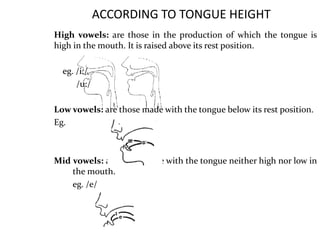
ACCORDING TO TONGUE HEIGHT 
High vowels: are those in the production of which the tongue is 
high in the mouth. It is raised above its rest position. 
eg. /i:/ 
/u:/ 
Lowvowels: are those made with the tongue below its rest position. 
Eg. 
Mid vowels: are those made with the tongue neither high nor low in 
the mouth. 
eg. /e/
ACCORDING TO THE PART OF THE TONGUE RAISED 
1. Front vowels: are those in the production of which the front of 
the tongue is the highest point. 
e.g. 
2. Back vowels: are those in the production of which the back of 
the tongue is the highest point. 
e.g. 
3. Central vowels: are those made with neither the front nor the 
back of the tongue. The tongue is neither high nor low in the 
mouth when central vowels are produced. 
e.g.
ACCORDING TO DEGREE OF LIP ROUNDING 
1. Rounded vowels: are those made with rounded lips. The corners of 
the lips are brought towards each other and the lips are pushed 
forwards. 
e.g./u://u/ /ɔː / /ɒ / 
2. Unrounded vowels (spread vowels): are those made with the lips 
spread. The corners of the lips are moved away from each other as for 
a smile. 
e.g. 
3. Neutral vowels: are those made with the lips neither rounded nor 
spread. 
e.g.
FRONT CENTRAL BACK 
HIGH 
MID 
LOW
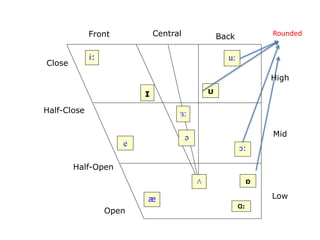
Front Central Back 
Close 
Half-Close 
Half-Open 
Open 
i: 
ɪ 
ɜ: 
ǝ 
e 
æ 
:c 
Ɑ: 
ɒ 
u: 
ʊ 
High 
Mid 
Low 
> 
Rounded
Parts of tongue 
Levels of 
tongue 
Front Central Back 
High long 
short 
Mid long 
short 
Low long 
short 
VOWEL CHART
Parts of tongue 
Levels of 
tongue 
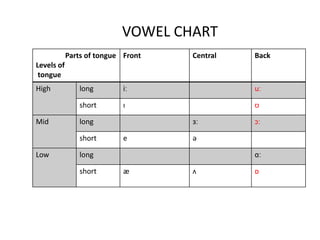
VOWEL CHART 
Front Central Back 
High long iː uː 
short ɪ ʊ 
Mid long ɜː ɔː 
short e ə 
Low long ɑː 
short æ ʌ ɒ
DIPHTHONGS 
1. Definition: 
- a glide from one vowel to another 
- Length: like long vowel 
- The first part is much longer and stronger than the second part 
e.g. /ai/ 
/eә/
CLASSIFICATION 
Diphthongs 
Centring 
(ending in /ә/) 
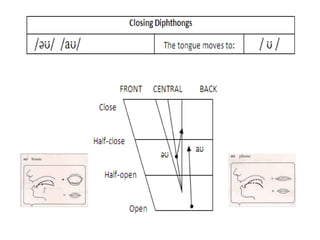
Closing 
(ending in /ɪ/) (ending in /ʊ /)
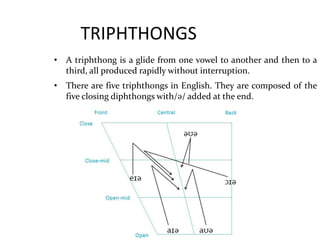
TRIPHTHONGS 
• A triphthong is a glide from one vowel to another and then to a 
third, all produced rapidly without interruption. 
• There are five triphthongs in English. They are composed of the 
five closing diphthongs with/ә/ added at the end.
DESCRIBING AND IDENTIFYING VOWELS 
1. Describing: long/short, high/mid/low, front/central/back, 
rounded/unrounded. 
e.g./e/: short mid front unrounded vowel 
2. Identifying 
e.g. long mid central unrounded vowel: /з:/ 
• high front short vowel 
• high back long vowel 
• low back long vowel 
• low back unrounded vowel 
• mid back to front diphthong 
• high back rounded short vowel 
• low central vowel
Phonemes vs. allophones 
phoneme allophone 
definition 
symbol 
example 
transcription
Phonemes vs. allophones 
phoneme allophone 
Definition 
symbol 
example /p/ /r/ [pʰen] [tr̥eɪn] 
[speɪn] [reɪn] 
transcription 
the smallest unit of sound in 
speech. 44 phonemes in 
English 
one of two or more 
variants of the same 
phoneme 
/ / [ ] 
Broad transription 
Phonemic transcription 
Narrow transcription 
Phonetic transcription 
more phonetic details such as 
aspiration, length, nasalization…., by 
using a wide variety of diacritics.
Allophonic variants of consonants 
1. Aspiration of stops: Voiceless stops are aspirated 
when they are syllable initials (or begin a stressed 
syllable) 
[pʰɪp] [tʰest] [kʰɪk] 
2. Fortis stops / p, t, k / are unaspirated after /s / in 
words such as spew, stew, skew 
3. Dentalisation of alveolars:[+alveolar]  [+dental] 
before [+dental] 
Eg. tenth [ten̪θ] 
[welθ̪] [eɪtθ̪] [æt ̪ðɪs] [wɪd̪ð]
Allophonic variants of consonants 
4. Devoicing of /w, l, r, j/ when they occur after 
initial fortis plosives 
[ple̥i] [kr̥uː] [tw̥ɪn] 
5. /l/ is velarised after a vowel or before a 
consonant(the back of the tongue rises toward 
the soft palate (the velum) (dark l) 
[fɪɫ] [puːɫ] [wɜːɫd]
Allophonic variants of consonants 
6. Lenis consonants /b d ɡ v ð z ʒ dʒ/ preceded 
by a voiceless sound or silence, or followed by a 
voiceless sound or silence are devoiced(these 
retain full voicing when they are surrounded by 
voiced sounds) 
• this boy /ðɪs bɔɪ/ [ð̥ɪs b̥ɔɪ] 
• my dog /maɪ dɒɡ/ [maɪ dɒɡ̊] 
• misbehave /mɪsbɪheɪv/ [mɪsb̥ɪheɪv̥] 
• She’s so good /ʃiːz səʊ ɡʊd/ [ʃiːz̥ səʊ ɡʊd̥]
Allophonic variants of vowels 
1. Nasalization of vowels: [vowel]  [+nasal] 
before [+nasal] 
Eg. [mæ̃n] [sɪŋ̃] [kʌ̃m ] 
2. Vowels are shortened by a following fortis 
consonant. 
Eg. [bʊ̆k] [tʃɜˑtʃ] 
[gə̆ʊt] [stɒ̆p] [lɑˑf] [briˑθ] [kɪs̆] [brʌʃ̆]
practice 
• Write the narrow transcription of the following 
words 
Tongue 
Vowel 
Sound 
Nose 
Hard palate 
Velum 
Consonant 
Plosive 
Breadth

Vowels

  • 1.
    Warm up •Bingo: All vowel sounds (monophthongs and diphthongs)
  • 2.
    Vowel bingo •Glide • Foot • Clear • Dark • Fortis • Teeth • Tone • Pitch • Sound • Stress • Word • Voice • Tongue • Nose • Glottis • Dialect • Larynx • phonetics
  • 3.
    LECTURE 3: VOWELS 1. Definition 2. Classification 3. Describing vowels 4. Identifying vowels 5. Diphthongs 6. Triphthongs
  • 4.
    DEFINITION • Vowelsare the sounds in the production of which none of the articulators come very close together so the passage of air-stream is relatively unobstructed and the air can get out freely. • Vowels are the type of sounds that depend mainly on the variations in the position of the tongue. They are normally voiced. • Vowels can be classified according to three variables: a. Tongue height. b. Part of the tongue which is raised c. Degree of lip rounding
  • 5.
    ACCORDING TO TONGUEHEIGHT High vowels: are those in the production of which the tongue is high in the mouth. It is raised above its rest position. eg. /i:/ /u:/ Lowvowels: are those made with the tongue below its rest position. Eg. Mid vowels: are those made with the tongue neither high nor low in the mouth. eg. /e/
  • 6.
    ACCORDING TO THEPART OF THE TONGUE RAISED 1. Front vowels: are those in the production of which the front of the tongue is the highest point. e.g. 2. Back vowels: are those in the production of which the back of the tongue is the highest point. e.g. 3. Central vowels: are those made with neither the front nor the back of the tongue. The tongue is neither high nor low in the mouth when central vowels are produced. e.g.
  • 7.
    ACCORDING TO DEGREEOF LIP ROUNDING 1. Rounded vowels: are those made with rounded lips. The corners of the lips are brought towards each other and the lips are pushed forwards. e.g./u://u/ /ɔː / /ɒ / 2. Unrounded vowels (spread vowels): are those made with the lips spread. The corners of the lips are moved away from each other as for a smile. e.g. 3. Neutral vowels: are those made with the lips neither rounded nor spread. e.g.
  • 8.
    FRONT CENTRAL BACK HIGH MID LOW
  • 9.
    Front Central Back Close Half-Close Half-Open Open i: ɪ ɜ: ǝ e æ :c Ɑ: ɒ u: ʊ High Mid Low > Rounded
  • 10.
    Parts of tongue Levels of tongue Front Central Back High long short Mid long short Low long short VOWEL CHART
  • 11.
    Parts of tongue Levels of tongue VOWEL CHART Front Central Back High long iː uː short ɪ ʊ Mid long ɜː ɔː short e ə Low long ɑː short æ ʌ ɒ
  • 12.
    DIPHTHONGS 1. Definition: - a glide from one vowel to another - Length: like long vowel - The first part is much longer and stronger than the second part e.g. /ai/ /eә/
  • 13.
    CLASSIFICATION Diphthongs Centring (ending in /ә/) Closing (ending in /ɪ/) (ending in /ʊ /)
  • 17.
    TRIPHTHONGS • Atriphthong is a glide from one vowel to another and then to a third, all produced rapidly without interruption. • There are five triphthongs in English. They are composed of the five closing diphthongs with/ә/ added at the end.
  • 18.
    DESCRIBING AND IDENTIFYINGVOWELS 1. Describing: long/short, high/mid/low, front/central/back, rounded/unrounded. e.g./e/: short mid front unrounded vowel 2. Identifying e.g. long mid central unrounded vowel: /з:/ • high front short vowel • high back long vowel • low back long vowel • low back unrounded vowel • mid back to front diphthong • high back rounded short vowel • low central vowel
  • 19.
    Phonemes vs. allophones phoneme allophone definition symbol example transcription
  • 20.
    Phonemes vs. allophones phoneme allophone Definition symbol example /p/ /r/ [pʰen] [tr̥eɪn] [speɪn] [reɪn] transcription the smallest unit of sound in speech. 44 phonemes in English one of two or more variants of the same phoneme / / [ ] Broad transription Phonemic transcription Narrow transcription Phonetic transcription more phonetic details such as aspiration, length, nasalization…., by using a wide variety of diacritics.
  • 21.
    Allophonic variants ofconsonants 1. Aspiration of stops: Voiceless stops are aspirated when they are syllable initials (or begin a stressed syllable) [pʰɪp] [tʰest] [kʰɪk] 2. Fortis stops / p, t, k / are unaspirated after /s / in words such as spew, stew, skew 3. Dentalisation of alveolars:[+alveolar]  [+dental] before [+dental] Eg. tenth [ten̪θ] [welθ̪] [eɪtθ̪] [æt ̪ðɪs] [wɪd̪ð]
  • 22.
    Allophonic variants ofconsonants 4. Devoicing of /w, l, r, j/ when they occur after initial fortis plosives [ple̥i] [kr̥uː] [tw̥ɪn] 5. /l/ is velarised after a vowel or before a consonant(the back of the tongue rises toward the soft palate (the velum) (dark l) [fɪɫ] [puːɫ] [wɜːɫd]
  • 23.
    Allophonic variants ofconsonants 6. Lenis consonants /b d ɡ v ð z ʒ dʒ/ preceded by a voiceless sound or silence, or followed by a voiceless sound or silence are devoiced(these retain full voicing when they are surrounded by voiced sounds) • this boy /ðɪs bɔɪ/ [ð̥ɪs b̥ɔɪ] • my dog /maɪ dɒɡ/ [maɪ dɒɡ̊] • misbehave /mɪsbɪheɪv/ [mɪsb̥ɪheɪv̥] • She’s so good /ʃiːz səʊ ɡʊd/ [ʃiːz̥ səʊ ɡʊd̥]
  • 24.
    Allophonic variants ofvowels 1. Nasalization of vowels: [vowel]  [+nasal] before [+nasal] Eg. [mæ̃n] [sɪŋ̃] [kʌ̃m ] 2. Vowels are shortened by a following fortis consonant. Eg. [bʊ̆k] [tʃɜˑtʃ] [gə̆ʊt] [stɒ̆p] [lɑˑf] [briˑθ] [kɪs̆] [brʌʃ̆]
  • 25.
    practice • Writethe narrow transcription of the following words Tongue Vowel Sound Nose Hard palate Velum Consonant Plosive Breadth