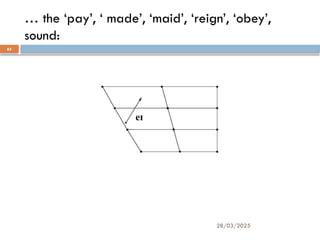
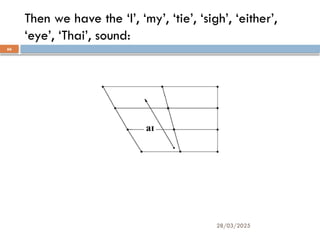
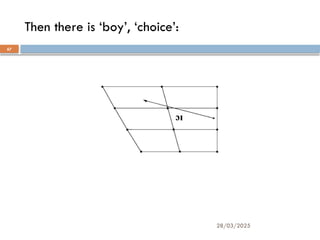
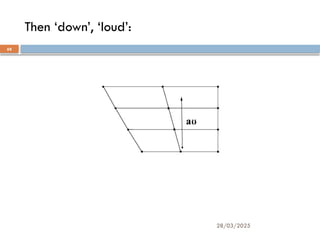
About Vowels:
2
Vowel-Consonant Distinction.
Vowels ( Phonetic Parameters).
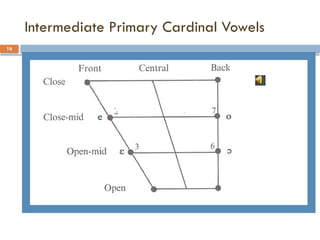
Cardinal Vowels.
1. Primary Cardinal Vowels
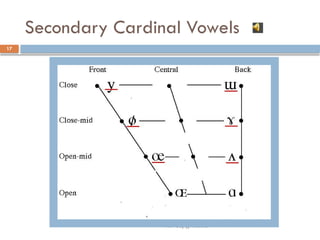
2. Secondary Cardinal Vowels
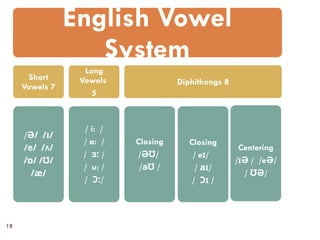
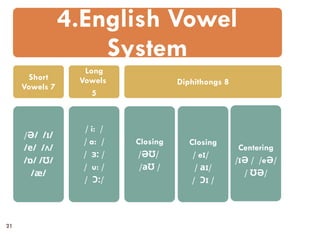
English Vowel System.
1. Short Vowels
2. Long Vowels
3. Diphthongs
3.
1. Vowel- ConsonantDistinction
3
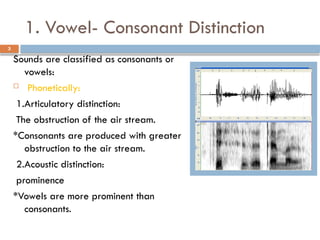
Sounds are classified as consonants or
vowels:
Phonetically:
1.Articulatory distinction:
The obstruction of the air stream.
*Consonants are produced with greater
obstruction to the air stream.
2.Acoustic distinction:
prominence
*Vowels are more prominent than
consonants.
4.
Problematic Sounds /w/,/j/ , /h/
4
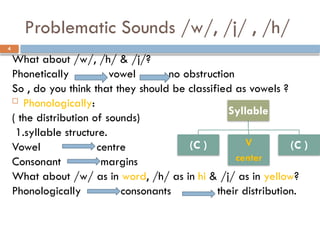
What about /w/, /h/ & /j/?
Phonetically vowel no obstruction
So , do you think that they should be classified as vowels ?
Phonologically:
( the distribution of sounds)
1.syllable structure.
Vowel centre
Consonant margins
What about /w/ as in word, /h/ as in hi & /j/ as in yellow?
Phonologically consonants their distribution.
Syllable
(C ) V
center
(C )
5.
Vowels
5
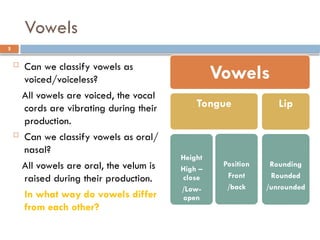
Can weclassify vowels as
voiced/voiceless?
All vowels are voiced, the vocal
cords are vibrating during their
production.
Can we classify vowels as oral/
nasal?
All vowels are oral, the velum is
raised during their production.
In what way do vowels differ
from each other?
Vowels
Tongue
Height
High –
close
/Low-
open
Position
Front
/back
Lip
Rounding
Rounded
/unrounded
6.
Variety in Vowels:
6
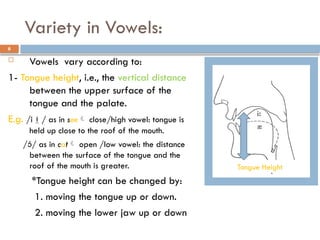
Vowels vary according to:
1- Tongue height, i.e., the vertical distance
between the upper surface of the
tongue and the palate.
E.g. /i/ as in see close/high vowel: tongue is
held up close to the roof of the mouth.
// as in cat open /low vowel: the distance
between the surface of the tongue and the
roof of the mouth is greater.
*Tongue height can be changed by:
1. moving the tongue up or down.
2. moving the lower jaw up or down
Tongue Height
7.
7
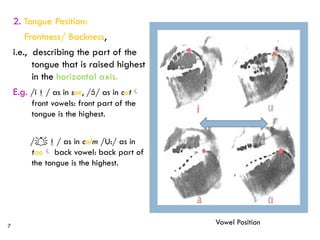
2. Tongue Position:
Frontness/Backness,
i.e., describing the part of the
tongue that is raised highest
in the horizontal axis.
E.g. /i/ as in see, // as in cat
front vowels: front part of the
tongue is the highest.
// as in calm /U:/ as in
too back vowel: back part of
the tongue is the highest.
Vowel Position
8.
8
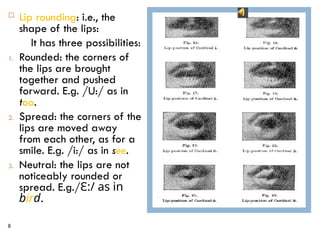
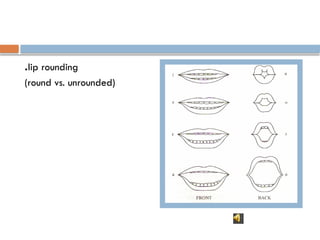
Lip rounding:i.e., the
shape of the lips:
It has three possibilities:
1. Rounded: the corners of
the lips are brought
together and pushed
forward. E.g. /U:/ as in
too.
2. Spread: the corners of the
lips are moved away
from each other, as for a
smile. E.g. /i:/ as in see.
3. Neutral: the lips are not
noticeably rounded or
spread. E.g./Ԑ:/ as in
bird.
9.
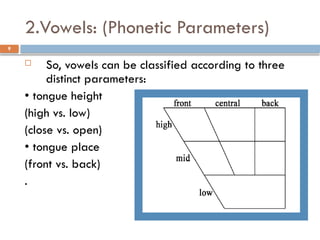
2.Vowels: (Phonetic Parameters)
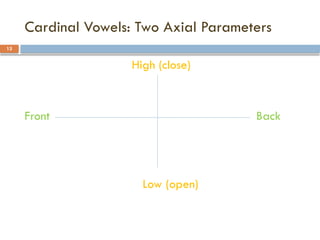
So, vowels can be classified according to three
distinct parameters:
• tongue height
(high vs. low)
(close vs. open)
• tongue place
(front vs. back)
.
9
2. Cardinal Vowels:
11
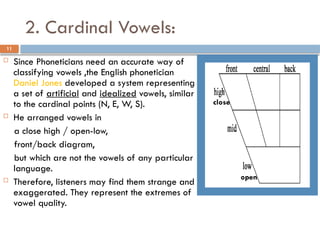
Since Phoneticians need an accurate way of
classifying vowels ,the English phonetician
Daniel Jones developed a system representing
a set of artificial and idealized vowels, similar
to the cardinal points (N, E, W, S).
He arranged vowels in
a close high / open-low,
front/back diagram,
but which are not the vowels of any particular
language.
Therefore, listeners may find them strange and
exaggerated. They represent the extremes of
vowel quality.
close
open
12.
12
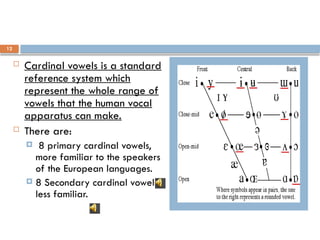
Cardinal vowelsis a standard
reference system which
represent the whole range of
vowels that the human vocal
apparatus can make.
There are:
8 primary cardinal vowels,
more familiar to the speakers
of the European languages.
8 Secondary cardinal vowels,
less familiar.
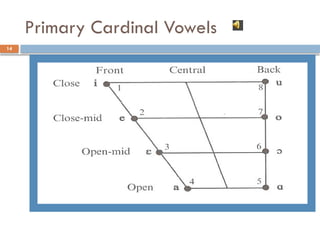
Corner Primary CardinalVowels
15
• Cardinal vowel no 1, [i],
described as the as close and as
front as possible to make.
• Cardinal vowel no 4, [а],
described as the as open and as
front as possible to make.
• Cardinal vowel no 5, [a],
described as the as open and as
back as possible to make.
• Cardinal vowel no 8, [u],
described as the as close and as
back as possible to make.
23
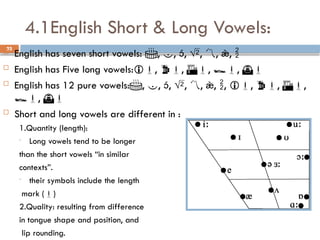
4.1English Short &Long Vowels:
23
English has seven short vowels: , , , , , ,
English has Five long vowels:, , , ,
English has 12 pure vowels:, , , , , , , , , ,
,
Short and long vowels are different in :
1.Quantity (length):
- Long vowels tend to be longer
than the short vowels “in similar
contexts”.
- their symbols include the length
mark ()
2.Quality: resulting from difference
in tongue shape and position, and
lip rounding.
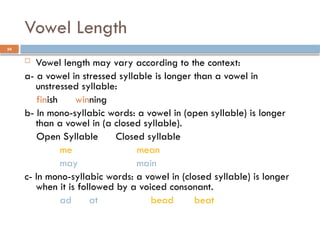
24.
24
Vowel Length
Vowellength may vary according to the context:
a- a vowel in stressed syllable is longer than a vowel in
unstressed syllable:
finish winning
b- In mono-syllabic words: a vowel in (open syllable) is longer
than a vowel in (a closed syllable).
Open Syllable Closed syllable
me mean
may main
c- In mono-syllabic words: a vowel in (closed syllable) is longer
when it is followed by a voiced consonant.
ad at bead beat
26
1. /i:/ asin ‘beat’, ‘mean’, ‘peace’
Description:
Tongue Height: nearly high
Tongue position: front
Lip rounding: spread
Tenseness: tense
/i:/: high, front , unrounded, tense.
Compared to short vowel/ /:
-It is nearer to Cardinal vowel no 1
[i]
-it is more high and front, and lips
position is slightly different.
-They are different in quality, and
quantity-length.
27.
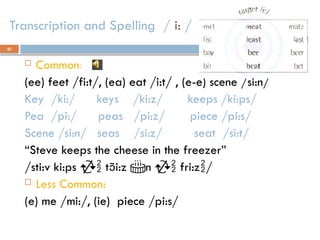
27
Transcription and Spelling/ i: /
Common:
(ee) feet /fi:t/, (ea) eat /i:t/ , (e-e) scene /si:n/
Key /ki:/ keys /ki:z/ keeps /ki:ps/
Pea /pi:/ peas /pi:z/ piece /pi:s/
Scene /si:n/ seas /si:z/ seat /si:t/
“Steve keeps the cheese in the freezer”
/sti:v ki:ps ti:z n fri:z/
Less Common:
(e) me /mi:/, (ie) piece /pi:s/
28.
28
2./ /as in ‘bit’ ‘fin’ ‘fish’
Description:
Tongue Height: intermediate
between high and mid-high.
Tongue position: front
Lip rounding: spread
Tenseness: lax
/ /: high, front, unrounded, lax
Compared to Car. V.1 [i], it is:
lower and nearer to the centre.
The lips are slightly spread.
28
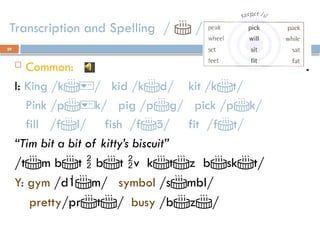
29.
29
Transcription and Spelling/ /
Common:
I: King /k/ kid /kd/ kit /kt/
Pink /pk/ pig /pg/ pick /pk/
fill /fl/ fish /f/ fit /ft/
“Tim bit a bit of kitty’s biscuit”
/tm bt bt v ktz bskt/
Y: gym /dm/ symbol /smbl/
pretty/prt/ busy /bz/
30.
30
Transcription and Spelling/ /
Less Common:
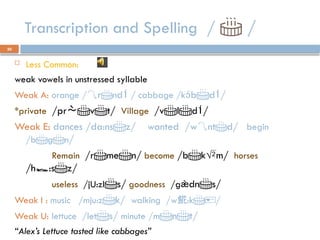
weak vowels in unstressed syllable
Weak A: orange /rnd / cabbage /kbd/
*private /prvt/ Village /vld/
Weak E: dances /da:nsz/ wanted /wntd/ begin
/bgn/
Remain /rmen/ become /bkm/ horses
/h:sz/
useless /jU:zls/ goodness /gdns/
Weak I : music /mju:zk/ walking /w:k/
Weak U: lettuce /lets/ minute /mnt/
“Alex’s Lettuce tasted like cabbages”
31.
31
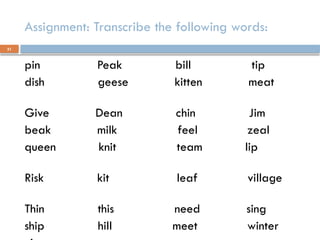
Assignment: Transcribe thefollowing words:
pin Peak bill tip
dish geese kitten meat
Give Dean chin Jim
beak milk feel zeal
queen knit team lip
Risk kit leaf village
Thin this need sing
ship hill meet winter
32.
32
3. /e/ asin ‘bet’ ‘men’ ‘yes’
Description:
Tongue Height: between mid-high
and mid-low
Tongue position: front
Lip rounding: slightly spread
Tenseness: lax
/e/: mid-low , front, unrounded, lax
Compared to Cardinal vowels:
It is between Car. V.2 [e] and
Car. V.3 []
32
33.
33
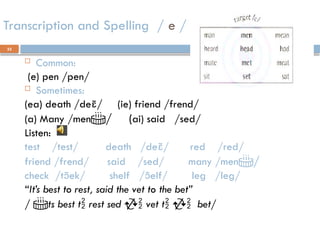
Transcription and Spelling/ e /
Common:
(e) pen /pen/
Sometimes:
(ea) death /de/ (ie) friend /frend/
(a) Many /men/ (ai) said /sed/
Listen:
test /test/ death /de/ red /red/
friend /frend/ said /sed/ many /men/
check /tek/ shelf /elf/ leg /leg/
“It’s best to rest, said the vet to the bet”
/ ts best t rest sed vet t bet/
34.
34
4. The ash/ / as in ‘bat’ ‘man’ ‘gas’
Description:
Tongue Height: intermediate
between mid-low and low
Tongue position: front
Lip rounding: slightly spread-
neutral
Tenseness: lax
/ /: low, front, unrounded, lax
Compared to Cardinal vowels:
It is not as low as Car. V.4 [].
34
35.
35
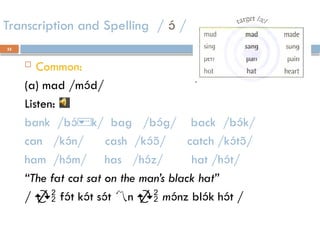
Transcription and Spelling/ /
Common:
(a) mad /md/
Listen:
bank /bk/ bag /bg/ back /bk/
can /kn/ cash /k/ catch /kt/
ham /hm/ has /hz/ hat /ht/
“The fat cat sat on the man’s black hat”
/ ft kt st n mnz blk ht /
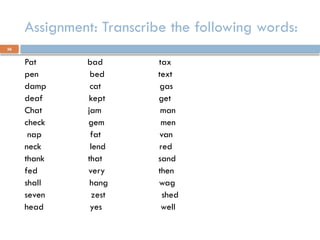
36.
36
Assignment: Transcribe thefollowing words:
Pat bad tax
pen bed text
damp cat gas
deaf kept get
Chat jam man
check gem men
nap fat van
neck lend red
thank that sand
fed very then
shall hang wag
seven zest shed
head yes well
38
5./a:/ as in‘card’, ‘half’, ‘pass’
Description:
Tongue Height: low
Tongue position: not fully back
Lip rounding: neutral
Tenseness: tense
/a:/: low, back, unrounded,
tense
Compared to Car. V.5 [],
it is:
low
not fully back
Lips are in neutral position
39.
39
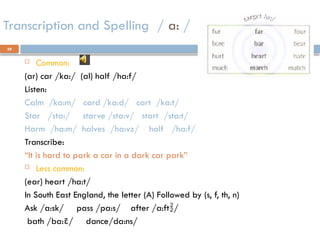
Transcription and Spelling/ a: /
Common:
(ar) car /ka:/ (al) half /ha:f/
Listen:
Calm /ka:m/ card /ka:d/ cart /ka:t/
Star /sta:/ starve /sta:v/ start /sta:t/
Harm /ha:m/ halves /ha:vz/ half /ha:f/
Transcribe:
“It is hard to park a car in a dark car park”
Less common:
(ear) heart /ha:t/
In South East England, the letter (A) Followed by (s, f, th, n)
Ask /a:sk/ pass /pa:s/ after /a:ft/
bath /ba:/ dance/da:ns/
40.
40
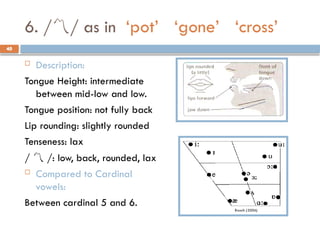
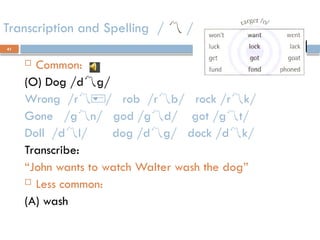
6. // asin ‘pot’ ‘gone’ ‘cross’
Description:
Tongue Height: intermediate
between mid-low and low.
Tongue position: not fully back
Lip rounding: slightly rounded
Tenseness: lax
/ /: low, back, rounded, lax
Compared to Cardinal
vowels:
Between cardinal 5 and 6.
40
41.
41
Transcription and Spelling/ /
Common:
(O) Dog /dg/
Wrong /r/ rob /rb/ rock /rk/
Gone /gn/ god /gd/ got /gt/
Doll /dl/ dog /dg/ dock /dk/
Transcribe:
“John wants to watch Walter wash the dog”
Less common:
(A) wash
42.
42
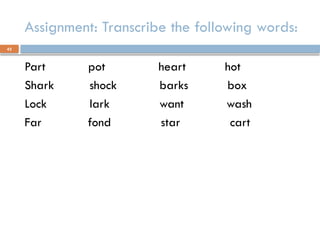
Assignment: Transcribe thefollowing words:
Part pot heart hot
Shark shock barks box
Lock lark want wash
Far fond star cart
43.
43
7. // asin ‘board’, ‘torn’, ‘horse’
Description:
Tongue Height: closer to mid-high
Tongue position: back
Lip rounding: fully rounded
Tenseness: tense
/ /: mid-high, back,
rounded, tense.
Compared to Cardinal vowels:
Between car. Vowel no. 6 []
and [ o ]. Closer to the latter.
44.
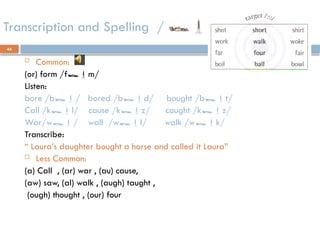
44
Transcription and Spelling/ /
Common:
(or) form /fm/
Listen:
bore /b/ bored /bd/ bought /bt/
Call /kl/ cause /kz/ caught /kz/
War/w/ wall /wl/ walk /wk/
Transcribe:
“ Laura’s daughter bought a horse and called it Laura”
Less Common:
(a) Call , (ar) war , (au) cause,
(aw) saw, (al) walk , (augh) taught ,
(ough) thought , (our) four
45.
45
8. // asin ‘put’ ‘pull’ ‘push’
Description:
Tongue Height: just above mid high
Tongue position: between back and
centre
Lip rounding: rounded
Tenseness: lax
/ /: mid-high, back, rounded, lax
Compared to Cardinal vowel no. 8
[u]:
It is more open and nearer to
centre.
45
46.
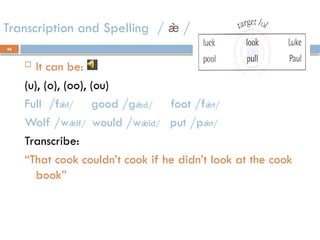
46
Transcription and Spelling/ /
It can be:
(u), (o), (oo), (ou)
Full /fl/ good /gd/ foot /ft/
Wolf /wlf/ would /wld/ put /pt/
Transcribe:
“That cook couldn’t cook if he didn’t look at the cook
book”
47.
47
9. /U:/ asin ‘food’, ‘soon’, ‘loose’
Description:
Tongue Height: nearly high
Tongue position: back
Lip rounding: rounded
Tenseness: tense
/U:/: high, back, rounded, tense.
Compared to Cardinal vowels
no 8 [u]:
It is the nearest, but much less
back and less high. The lips
are moderately rounded.
48.
48
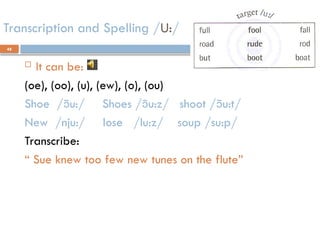
Transcription and Spelling/U:/
It can be:
(oe), (oo), (u), (ew), (o), (ou)
Shoe /u:/ Shoes /u:z/ shoot /u:t/
New /nju:/ lose /lu:z/ soup /su:p/
Transcribe:
“ Sue knew too few new tunes on the flute”
49.
49
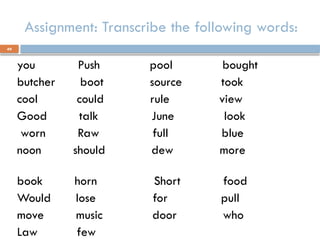
Assignment: Transcribe thefollowing words:
you Push pool bought
butcher boot source took
cool could rule view
Good talk June look
worn Raw full blue
noon should dew more
book horn Short food
Would lose for pull
move music door who
Law few
52
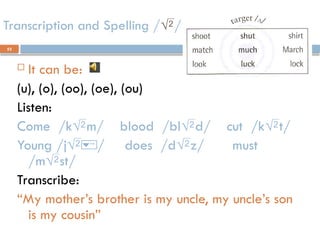
Transcription and Spelling//
It can be:
(u), (o), (oo), (oe), (ou)
Listen:
Come /km/ blood /bld/ cut /kt/
Young /j/ does /dz/ must
/mst/
Transcribe:
“My mother’s brother is my uncle, my uncle’s son
is my cousin”
53.
53
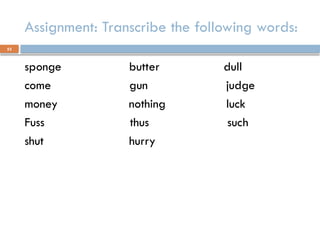
Assignment: Transcribe thefollowing words:
sponge butter dull
come gun judge
money nothing luck
Fuss thus such
shut hurry
54.
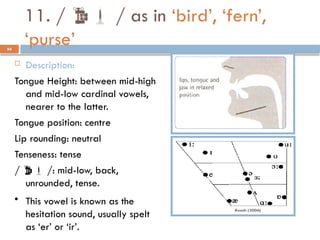
54
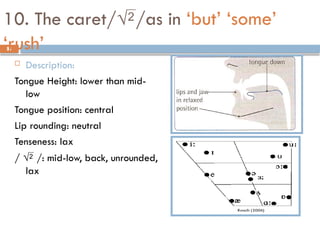
11. / / as in ‘bird’, ‘fern’,
‘purse’
Description:
Tongue Height: between mid-high
and mid-low cardinal vowels,
nearer to the latter.
Tongue position: centre
Lip rounding: neutral
Tenseness: tense
/ /: mid-low, back,
unrounded, tense.
• This vowel is known as the
hesitation sound, usually spelt
as ‘er’ or ‘ir’.
55.
55
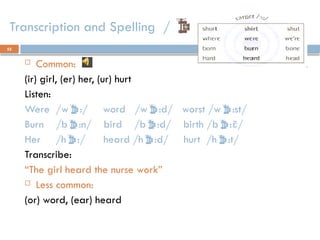
Transcription and Spelling/ /
Common:
(ir) girl, (er) her, (ur) hurt
Listen:
Were /w:/ word /w:d/ worst /w:st/
Burn /b:n/ bird /b:d/ birth /b:/
Her /h:/ heard /h:d/ hurt /h:t/
Transcribe:
“The girl heard the nurse work”
Less common:
(or) word, (ear) heard
56.
56
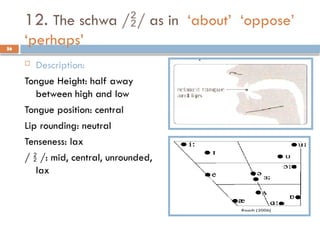
12. The schwa// as in ‘about’ ‘oppose’
‘perhaps’
56
Description:
Tongue Height: half away
between high and low
Tongue position: central
Lip rounding: neutral
Tenseness: lax
/ /: mid, central, unrounded,
lax
57.
57
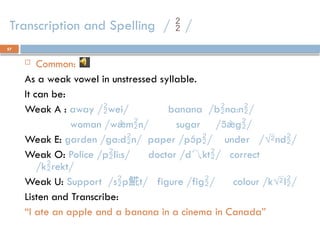
Transcription and Spelling/ /
Common:
As a weak vowel in unstressed syllable.
It can be:
Weak A : away /wei/ banana /bna:n/
woman /wmn/ sugar /g/
Weak E: garden /ga:dn/ paper /pp/ under /nd/
Weak O: Police /pli:s/ doctor /dkt/ correct
/krekt/
Weak U: Support /spt/ figure /fig/ colour /kl/
Listen and Transcribe:
“I ate an apple and a banana in a cinema in Canada”
58.
58
Assignment: Transcribe thefollowing words:
Picture Pearl actor turn
Girl center germ lemon
Salad Learn nurse modern
Shirt melody thirst agree
28/03/2025
61
… a diphthongis characterised by
a graceful movement from one
point to another, for this reason they
are also sometimes known as glides.
62.
28/03/2025
62
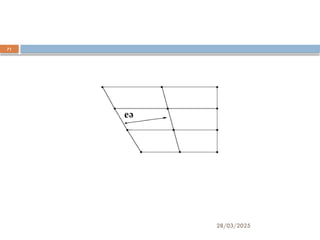
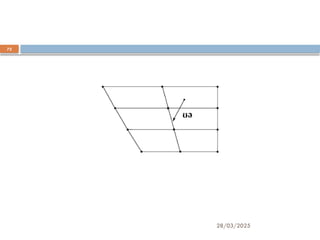
If one hasa clear idea of where
pure vowels are articulated on the
quadrilateral then interpreting the
diphthong symbols is not difficult.
63.
28/03/2025
63
Technically, English diphthongsare divided into
two groups:
Closing diphthongs – which tend to move from an
open to a close position, these roughly correspond
to Italian sounds
Centring diphthongs – which tend towards a central
position ( / @/ )
28/03/2025
69
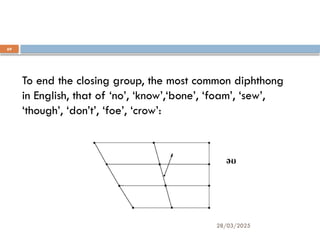
To end theclosing group, the most common diphthong
in English, that of ‘no’, ‘know’,‘bone’, ‘foam’, ‘sew’,
‘though’, ‘don’t’, ‘foe’, ‘crow’:
70.
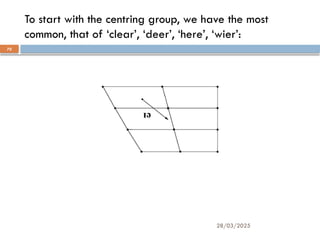
28/03/2025
70
To start withthe centring group, we have the most
common, that of ‘clear’, ‘deer’, ‘here’, ‘wier’:
28/03/2025
73
One or twofinal considerations:
Although the symbols indicating pure vowels and the
starting and closing points of diphthongs are often
the same they do not necessarily correspond to the
same points
Lip rounding is another variable, generally
associated with back vowels
74.
28/03/2025
74
Finally:
Diphthongs arethe element in a language which
are most liable to change. The majority of the
characteristics of a given accent are usually to be
found in this area, so understanding of the
underlying mechanics is vital if one wants to
understand accents and accent change.

![Corner Primary Cardinal Vowels
15
• Cardinal vowel no 1, [i],
described as the as close and as
front as possible to make.
• Cardinal vowel no 4, [а],
described as the as open and as
front as possible to make.
• Cardinal vowel no 5, [a],
described as the as open and as
back as possible to make.
• Cardinal vowel no 8, [u],
described as the as close and as
back as possible to make.](https://image.slidesharecdn.com/vowels-250328204517-dc6b622c/85/Vowels-15-320.jpg)
![26
1. /i:/ as in ‘beat’, ‘mean’, ‘peace’
Description:
Tongue Height: nearly high
Tongue position: front
Lip rounding: spread
Tenseness: tense
/i:/: high, front , unrounded, tense.
Compared to short vowel/ /:
-It is nearer to Cardinal vowel no 1
[i]
-it is more high and front, and lips
position is slightly different.
-They are different in quality, and
quantity-length.](https://image.slidesharecdn.com/vowels-250328204517-dc6b622c/85/Vowels-26-320.jpg)
![28
2./ / as in ‘bit’ ‘fin’ ‘fish’
Description:
Tongue Height: intermediate
between high and mid-high.
Tongue position: front
Lip rounding: spread
Tenseness: lax
/ /: high, front, unrounded, lax
Compared to Car. V.1 [i], it is:
lower and nearer to the centre.
The lips are slightly spread.
28](https://image.slidesharecdn.com/vowels-250328204517-dc6b622c/85/Vowels-28-320.jpg)
![32
3. /e/ as in ‘bet’ ‘men’ ‘yes’
Description:
Tongue Height: between mid-high
and mid-low
Tongue position: front
Lip rounding: slightly spread
Tenseness: lax
/e/: mid-low , front, unrounded, lax
Compared to Cardinal vowels:
It is between Car. V.2 [e] and
Car. V.3 []
32](https://image.slidesharecdn.com/vowels-250328204517-dc6b622c/85/Vowels-32-320.jpg)
![34
4. The ash / / as in ‘bat’ ‘man’ ‘gas’
Description:
Tongue Height: intermediate
between mid-low and low
Tongue position: front
Lip rounding: slightly spread-
neutral
Tenseness: lax
/ /: low, front, unrounded, lax
Compared to Cardinal vowels:
It is not as low as Car. V.4 [].
34](https://image.slidesharecdn.com/vowels-250328204517-dc6b622c/85/Vowels-34-320.jpg)
![38
5./a:/ as in ‘card’, ‘half’, ‘pass’
Description:
Tongue Height: low
Tongue position: not fully back
Lip rounding: neutral
Tenseness: tense
/a:/: low, back, unrounded,
tense
Compared to Car. V.5 [],
it is:
low
not fully back
Lips are in neutral position](https://image.slidesharecdn.com/vowels-250328204517-dc6b622c/85/Vowels-38-320.jpg)
![43
7. // as in ‘board’, ‘torn’, ‘horse’
Description:
Tongue Height: closer to mid-high
Tongue position: back
Lip rounding: fully rounded
Tenseness: tense
/ /: mid-high, back,
rounded, tense.
Compared to Cardinal vowels:
Between car. Vowel no. 6 []
and [ o ]. Closer to the latter.](https://image.slidesharecdn.com/vowels-250328204517-dc6b622c/85/Vowels-43-320.jpg)
![45
8. // as in ‘put’ ‘pull’ ‘push’
Description:
Tongue Height: just above mid high
Tongue position: between back and
centre
Lip rounding: rounded
Tenseness: lax
/ /: mid-high, back, rounded, lax
Compared to Cardinal vowel no. 8
[u]:
It is more open and nearer to
centre.
45](https://image.slidesharecdn.com/vowels-250328204517-dc6b622c/85/Vowels-45-320.jpg)
![47
9. /U:/ as in ‘food’, ‘soon’, ‘loose’
Description:
Tongue Height: nearly high
Tongue position: back
Lip rounding: rounded
Tenseness: tense
/U:/: high, back, rounded, tense.
Compared to Cardinal vowels
no 8 [u]:
It is the nearest, but much less
back and less high. The lips
are moderately rounded.](https://image.slidesharecdn.com/vowels-250328204517-dc6b622c/85/Vowels-47-320.jpg)