VOLUMETRIC ANALYSIS
Presented By,
GRACE SHAJI CHITTILAPPILLY
ASSISTANT PROFESSOR
DEPT. OF PHARMACEUTICAL CHEMISTRY
KARPAGAM COLLEGE OF PHARMACY
1
CONTENTS
1. INTRODUCTION
2. TYPES OF VOLUMETRIC ANALYSIS
3. DIFFERENT TECHNIQUES OF ANALYSIS
4. METHODS OF EXPRESSING CONCENTRATION
5. TITRIMETRIC ANALYSIS
6. FUNDAMENTALS OF VOLUMETRIC ANALYSIS
7. CLASSIFICATION OF TITRATION
8. PRIMARY STANDARD
9. SECONDARY STANDARD
10. METHODS OF TITRATION
2
INTRODUCTION
 When a completely unknown sample is presented to an analyst, the first requirement is usually to ascertain
what substances are present in it.
This fundamental problem may some times be encountered in the modified form of deciding what
impurities are present in a given sample or perhaps of confirming that certain specified impurities are
absent.
Having ascertained the nature of the constituent of a given sample, the analyst is then frequently called
upon to determine how much of each component or of specified components, is present.
The two important steps in analysis are identification and estimation of constituents of a compound.
The identification step is called Qualitative analysis.
The estimation step is called Quantitative analysis. 3
TYPES OF VOLUMETRIC ANALYSIS
A. QUALITATIVE ANALYSIS
B. QUANTITATIVE ANALYSIS
QUALITATIVE ANALYSIS
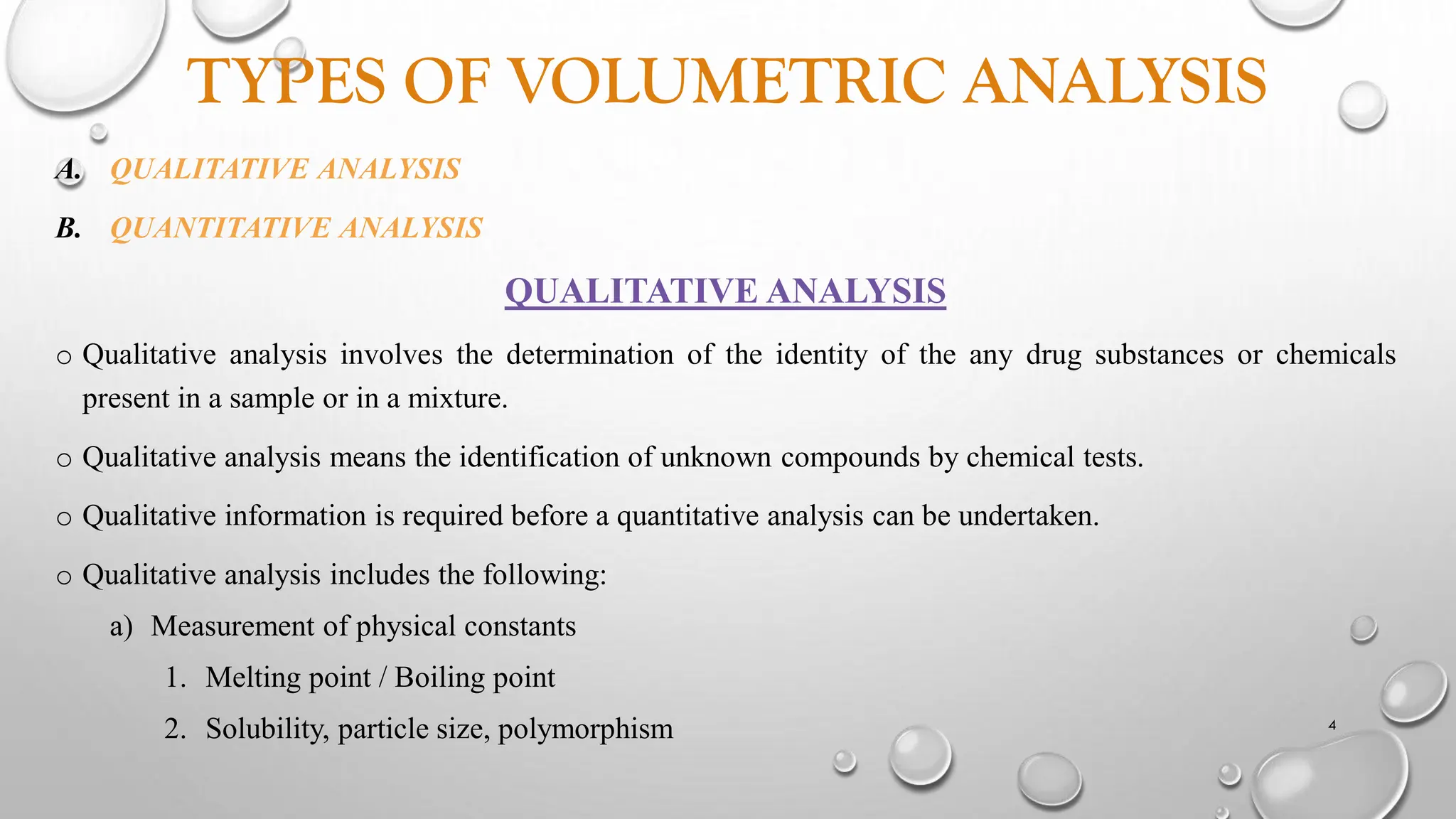
o Qualitative analysis involves the determination of the identity of the any drug substances or chemicals
present in a sample or in a mixture.
o Qualitative analysis means the identification of unknown compounds by chemical tests.
o Qualitative information is required before a quantitative analysis can be undertaken.
o Qualitative analysis includes the following:
a) Measurement of physical constants
1. Melting point / Boiling point
2. Solubility, particle size, polymorphism 4
3. Specific Gravity, Density, Refractive Index, Viscosity
4. Light absorption
5. Optical rotation, Specific rotation etc.
b) Functional group analysis
i. If inorganic: Identification of elements or acid / base radicals.
ii. If organic:
1. Aliphatic / aromatic
2. Saturated / unsaturated
3. Detection of special elements (if any)
4. Determination of functional group
QUANTITATIVE ANALYSIS
o Quantitative analysis means the estimation of the amount of a particular substance present in a sample.5
o The air of quantitative analysis is the determination of the quantitative contents of individual elements or
compounds present in a substance.
o Quantitative analysis is used to :
1. Ascertain the purity of chemicals or any drug or medicinal substance
2. Ascertain the exact quantity of the drug substances.
3. Ascertain the total activity of the drug substances:
(i) Biological assay – Bioassay
(ii) Microbiological assay
(iii)Pharmacological assay
LIMIT TESTS
o Limit test are quantitative or semi-quantitative tests which are designed to detect and limit small
quantities of impurities which are likely to be present in the substance.
6
o They may be of three types:
1. Tests in which there is no visible reaction
2. Comparison methods
3. Quantitative determinations
1. Tests in which there is no visible reaction
 It may be stated that on testing as prescribed there shall be no colour, opalescence or precipitate,
whichever is appropriate the particular test.
 Eg: Test for Barium and Calcium in dilute hypo phosphorous acid + addition of dil.H2SO4 under
precisely controlled conditions shall produce ‘no turbidity or precipitate’with in one hour.
2. Comparison Methods
 These tests require a standard containing a definite amt of impurity, to be set up at the same time
and under the same conditions as the test experiment. 7
o In this way, it is possible to compare the amount of the impurity in the substance with a standard of
known concentration and find out whether the impurity is within or excess of the limit prescribed.
o Eg: Limit test for Chloride
Limit test for Sulphate
Limit test for Iron
Limit test for Heavy metals
3. Quantitative determinations
o The quantitative determination of impurities are only applied in special circumstances, usually in those
case where the limit is not readily susceptible to simple and more direct chemical determination.
o Here the amount of impurity present is actually determined and compared with the numerical limit given
in the pharmacopoeia.
8
o Eg: Limits of soluble matter
Limits of insoluble matter
Limits of moisture and volatile matter
Limits of non volatile matter
Limits of residue on ignition
Loss on ignition on drying
Ash values
9
DIFFERENT TECHNIQUES OF ANALYSIS
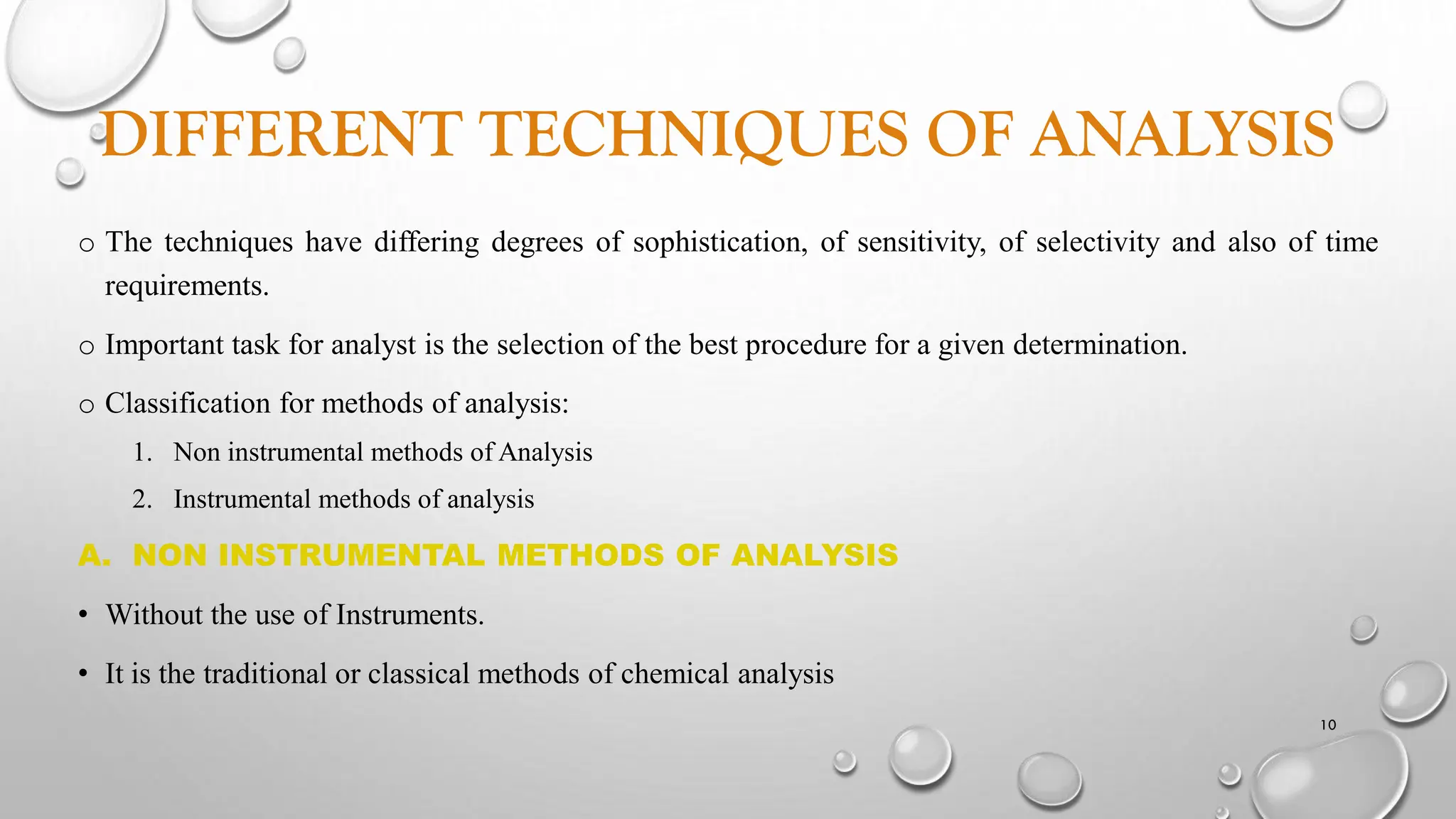
o The techniques have differing degrees of sophistication, of sensitivity, of selectivity and also of time
requirements.
o Important task for analyst is the selection of the best procedure for a given determination.
o Classification for methods of analysis:
1. Non instrumental methods of Analysis
2. Instrumental methods of analysis
A. NON INSTRUMENTAL METHODS OF ANALYSIS
• Without the use of Instruments.
• It is the traditional or classical methods of chemical analysis
10
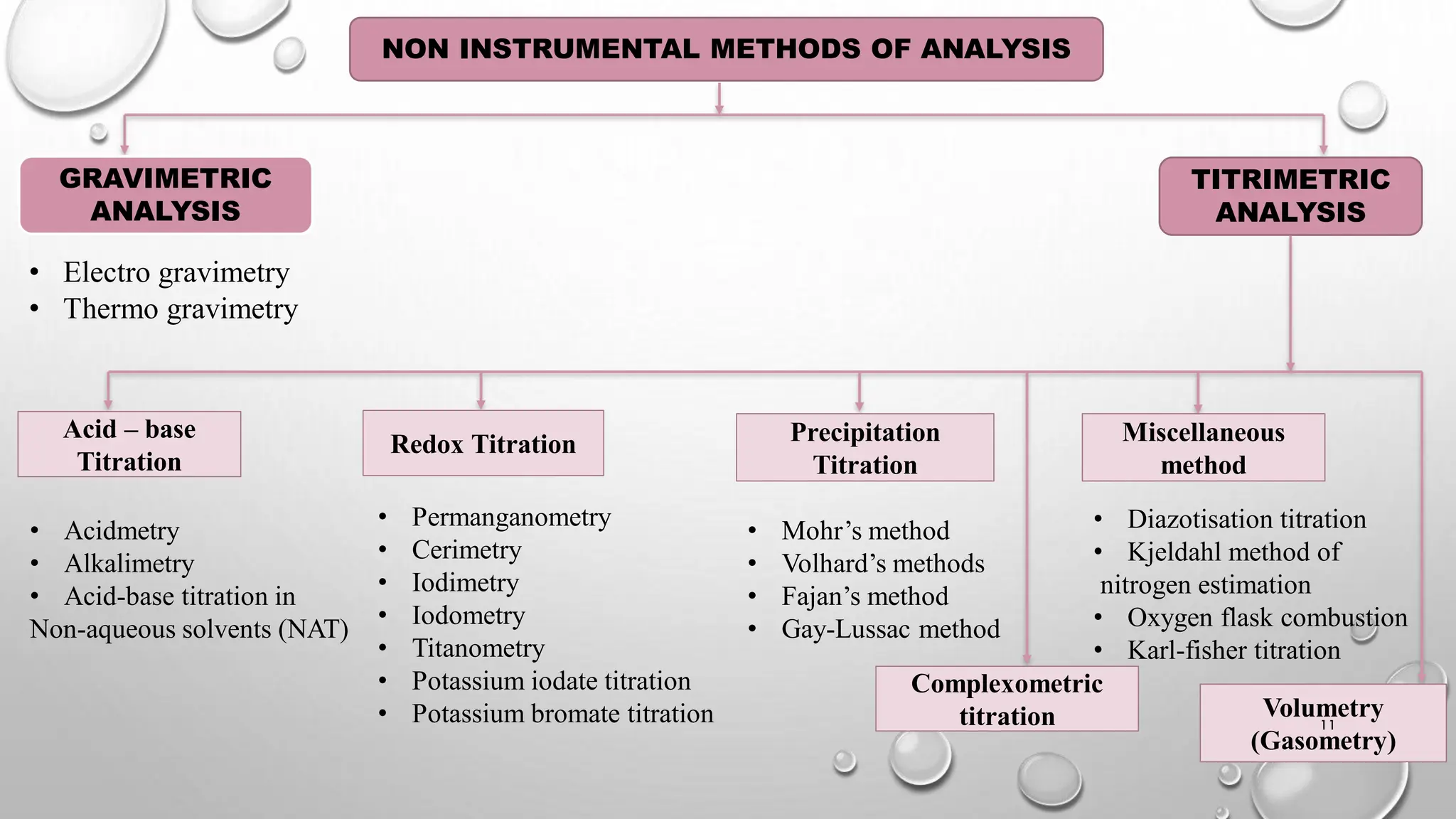
NON INSTRUMENTAL METHODS OF ANALYSIS
GRAVIMETRIC
ANALYSIS
TITRIMETRIC
ANALYSIS
• Electro gravimetry
• Thermo gravimetry
Acid – base
Titration
• Acidmetry
• Alkalimetry
• Acid-base titration in
Non-aqueous solvents (NAT)
Redox Titration
• Permanganometry
• Cerimetry
• Iodimetry
• Iodometry
• Titanometry
• Potassium iodate titration
• Potassium bromate titration
Precipitation
Titration
• Mohr’s method
• Volhard’s methods
• Fajan’s method
• Gay-Lussac method
Complexometric
titration
Miscellaneous
method
• Diazotisation titration
• Kjeldahl method of
nitrogen estimation
• Oxygen flask combustion
• Karl-fisher titration
Volumetry
(Gasometry)
11
B. INSTRUMENTAL METHODS OF ANALYSIS
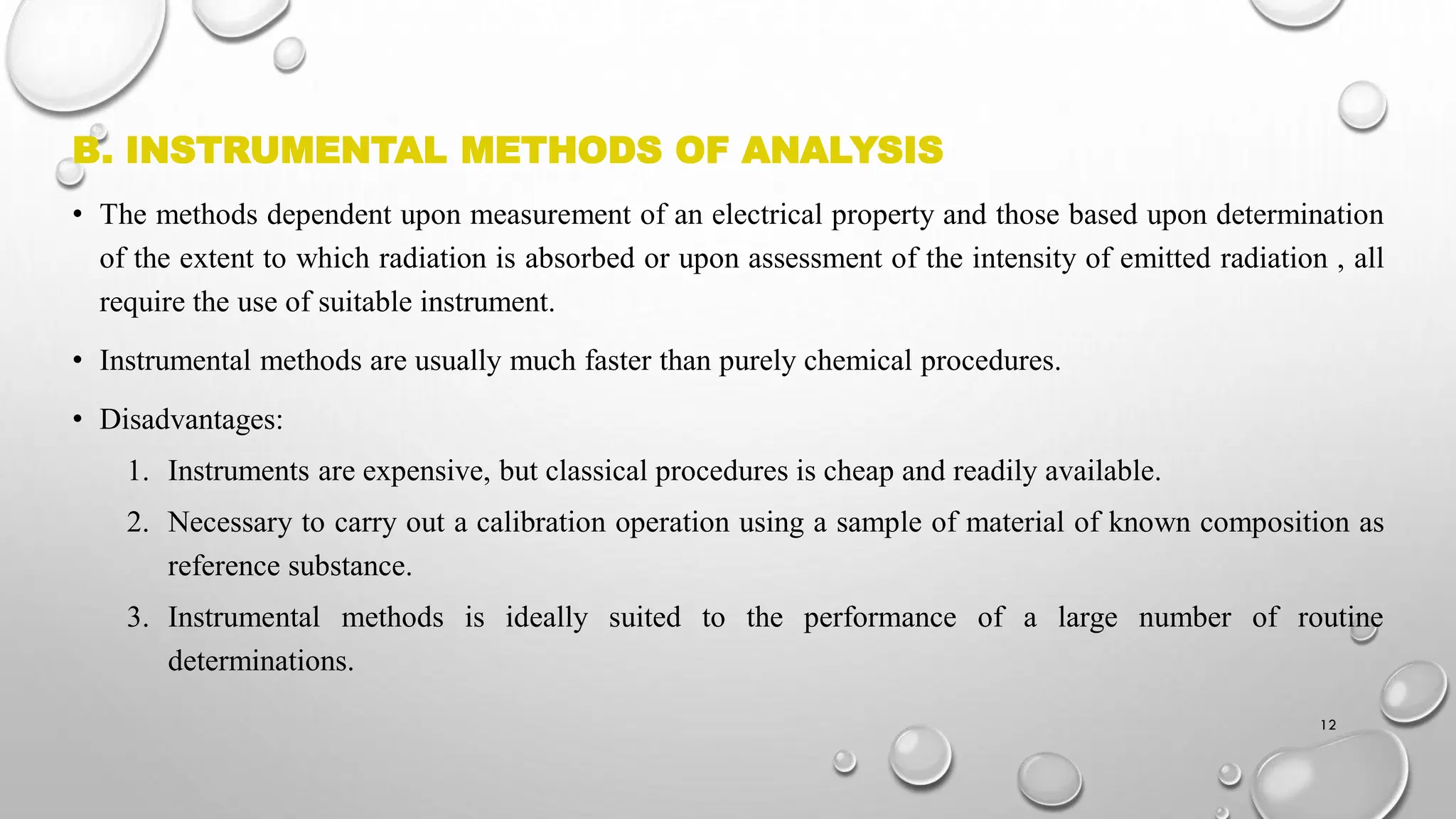
• The methods dependent upon measurement of an electrical property and those based upon determination
of the extent to which radiation is absorbed or upon assessment of the intensity of emitted radiation , all
require the use of suitable instrument.
• Instrumental methods are usually much faster than purely chemical procedures.
• Disadvantages:
1. Instruments are expensive, but classical procedures is cheap and readily available.
2. Necessary to carry out a calibration operation using a sample of material of known composition as
reference substance.
3. Instrumental methods is ideally suited to the performance of a large number of routine
determinations.
12
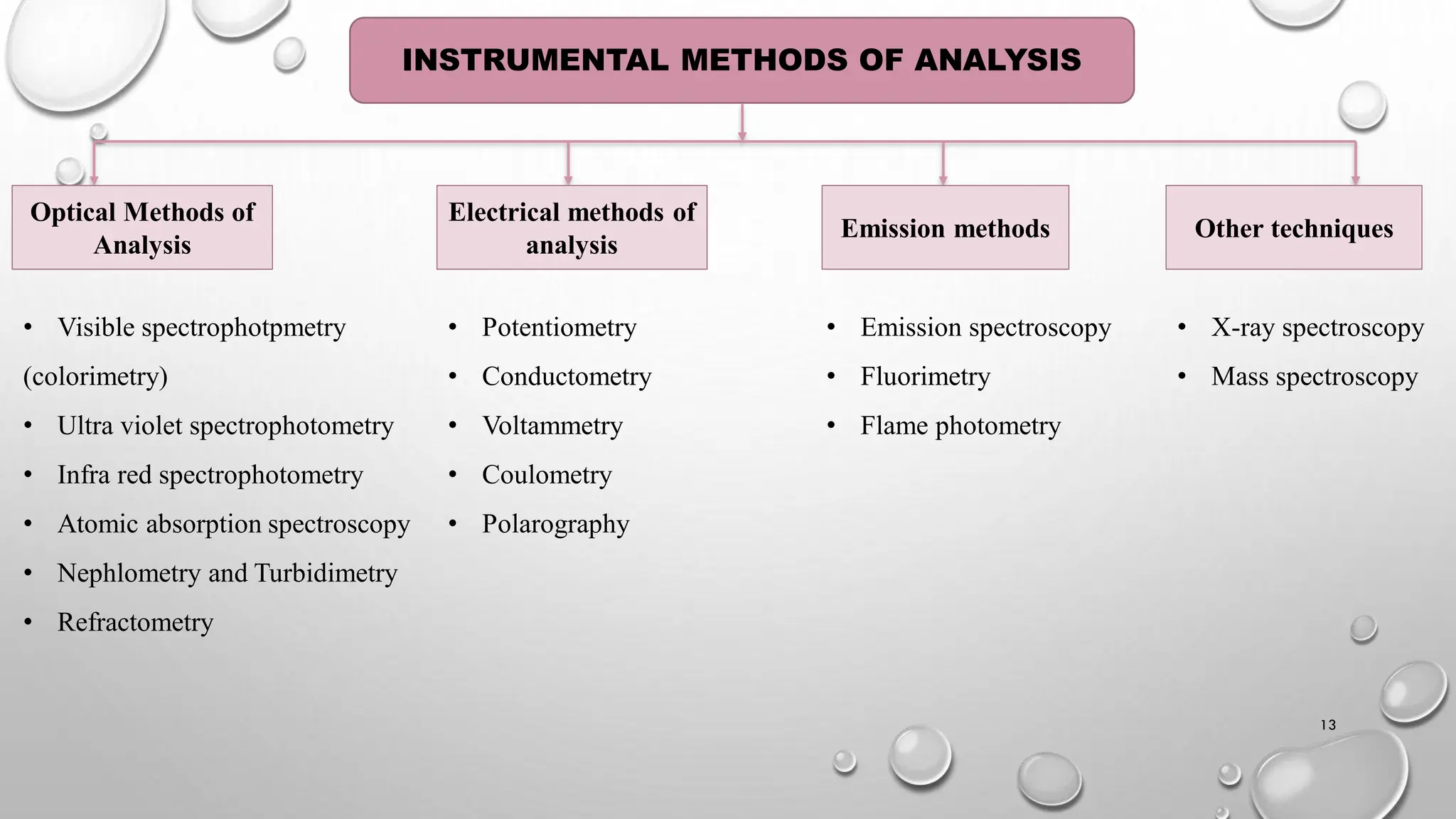
INSTRUMENTAL METHODS OF ANALYSIS
Optical Methods of
Analysis
• Visible spectrophotpmetry
(colorimetry)
• Ultra violet spectrophotometry
• Infra red spectrophotometry
• Atomic absorption spectroscopy
• Nephlometry and Turbidimetry
• Refractometry
Electrical methods of
analysis
• Potentiometry
• Conductometry
• Voltammetry
• Coulometry
• Polarography
Emission methods
• Emission spectroscopy
• Fluorimetry
• Flame photometry
Other techniques
• X-ray spectroscopy
• Mass spectroscopy
13
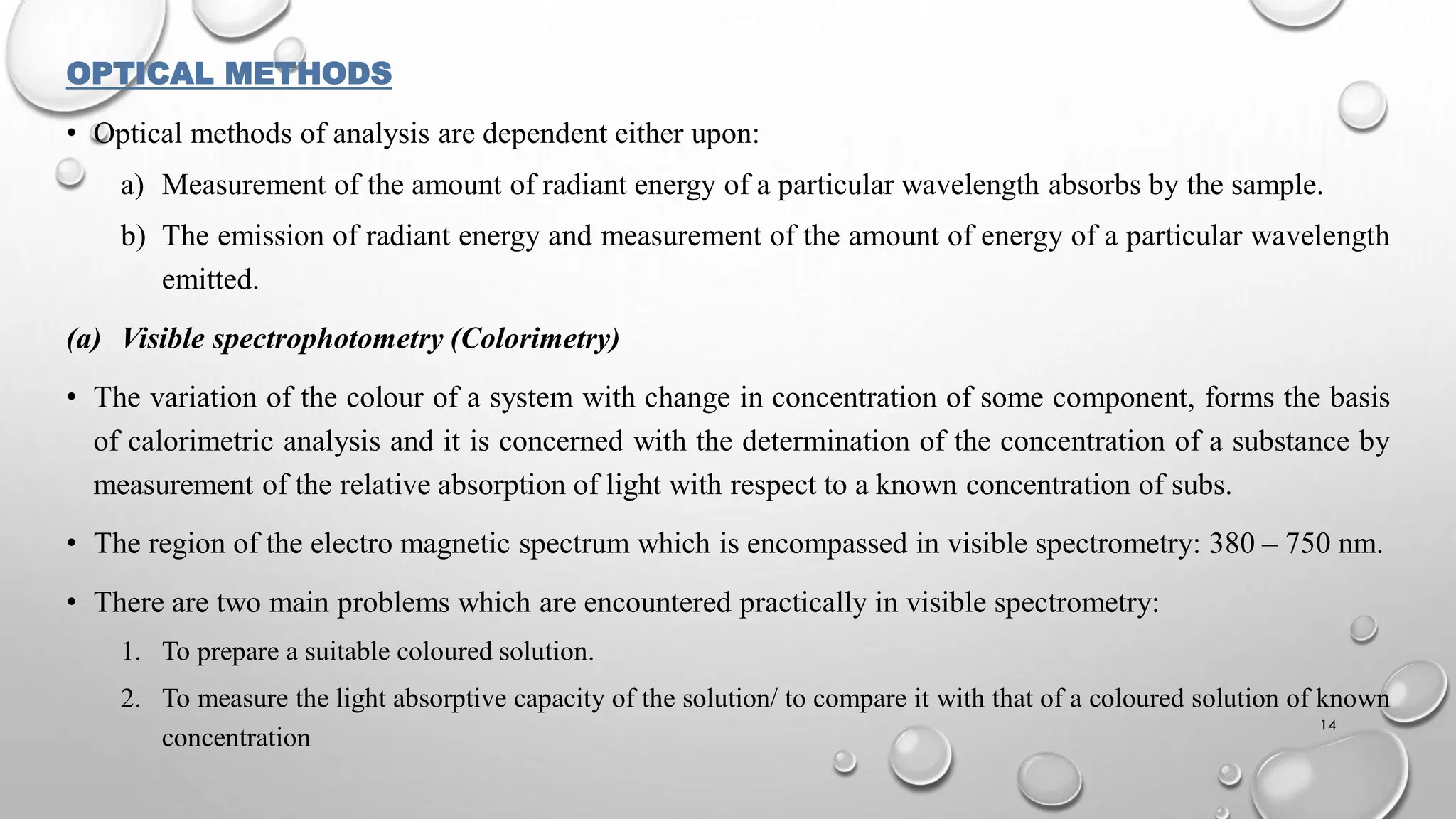
OPTICAL METHODS
• Optical methods of analysis are dependent either upon:
a) Measurement of the amount of radiant energy of a particular wavelength absorbs by the sample.
b) The emission of radiant energy and measurement of the amount of energy of a particular wavelength
emitted.
(a) Visible spectrophotometry (Colorimetry)
• The variation of the colour of a system with change in concentration of some component, forms the basis
of calorimetric analysis and it is concerned with the determination of the concentration of a substance by
measurement of the relative absorption of light with respect to a known concentration of subs.
• The region of the electro magnetic spectrum which is encompassed in visible spectrometry: 380 – 750 nm.
• There are two main problems which are encountered practically in visible spectrometry:
1. To prepare a suitable coloured solution.
2. To measure the light absorptive capacity of the solution/ to compare it with that of a coloured solution of known
concentration
14
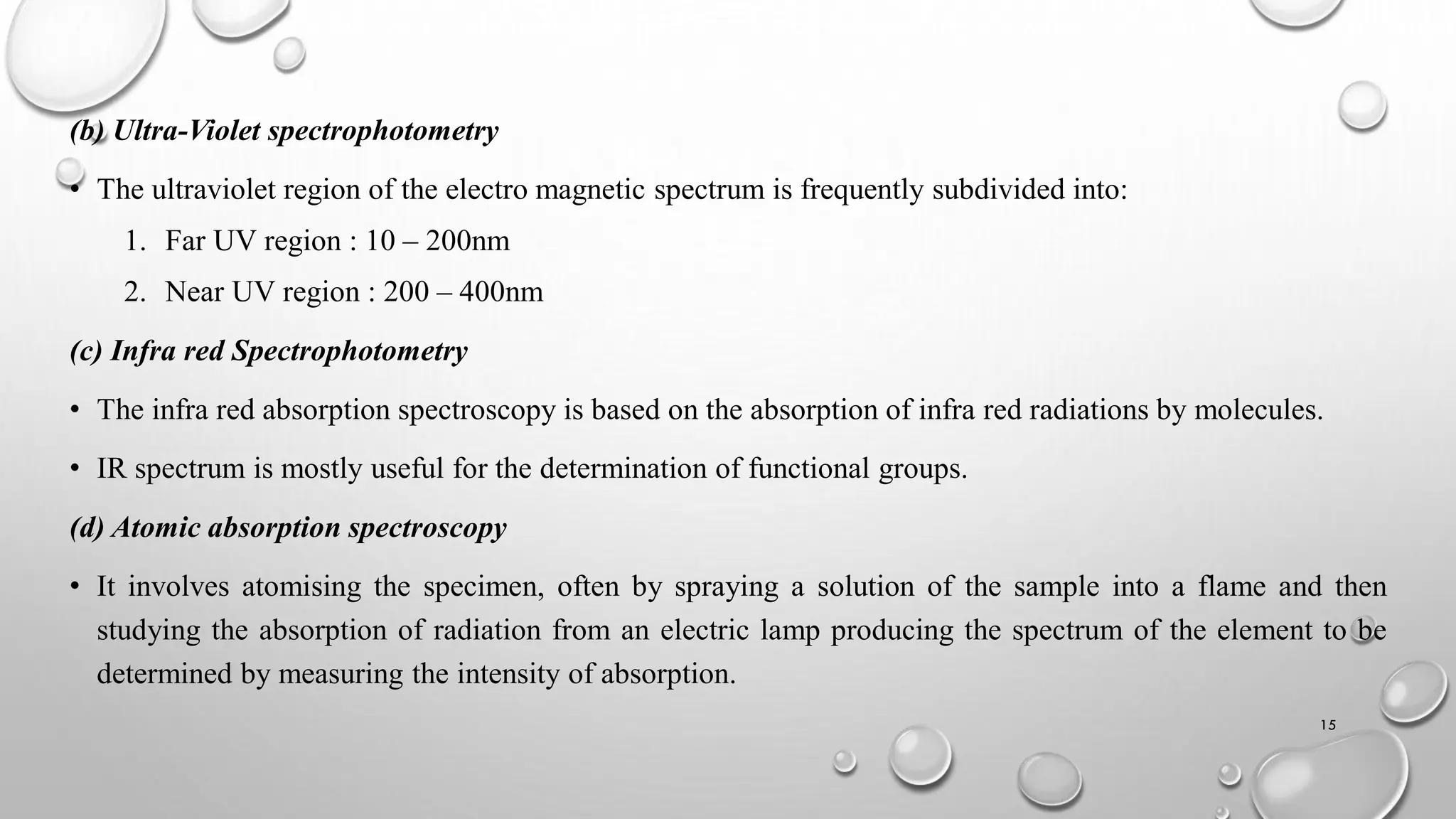
(b) Ultra-Violet spectrophotometry
• The ultraviolet region of the electro magnetic spectrum is frequently subdivided into:
1. Far UV region : 10 – 200nm
2. Near UV region : 200 – 400nm
(c) Infra red Spectrophotometry
• The infra red absorption spectroscopy is based on the absorption of infra red radiations by molecules.
• IR spectrum is mostly useful for the determination of functional groups.
(d) Atomic absorption spectroscopy
• It involves atomising the specimen, often by spraying a solution of the sample into a flame and then
studying the absorption of radiation from an electric lamp producing the spectrum of the element to be
determined by measuring the intensity of absorption.
15
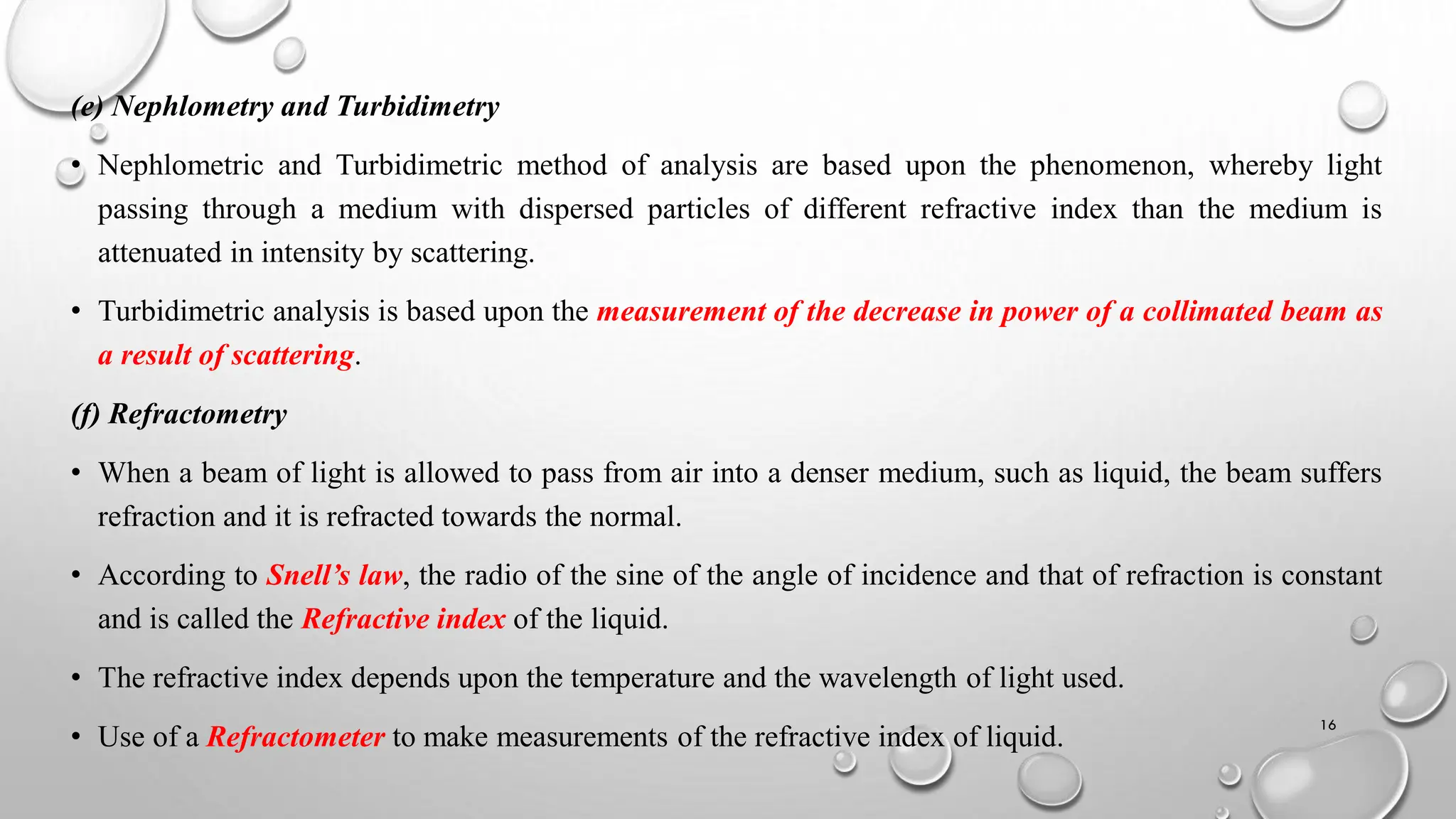
(e) Nephlometry and Turbidimetry
• Nephlometric and Turbidimetric method of analysis are based upon the phenomenon, whereby light
passing through a medium with dispersed particles of different refractive index than the medium is
attenuated in intensity by scattering.
• Turbidimetric analysis is based upon the measurement of the decrease in power of a collimated beam as
a result of scattering.
(f) Refractometry
• When a beam of light is allowed to pass from air into a denser medium, such as liquid, the beam suffers
refraction and it is refracted towards the normal.
• According to Snell’s law, the radio of the sine of the angle of incidence and that of refraction is constant
and is called the Refractive index of the liquid.
• The refractive index depends upon the temperature and the wavelength of light used.
• Use of a Refractometer to make measurements of the refractive index of liquid.
16
ELECTRICAL METHODS OF ANALYSIS
• Electrical methods of analysis involve the measurement of current, voltage or resistance in relation to the
concentration of certain species in solution.
(a) Potentiometry
• Potentiometry is based on the measurement of the potential of an electrode in equilibrium with an ion to
be determined.
• The potential of an electrode dipping into a solution of an electrolyte depends upon the concentration or
more correctly the activity of ions with which it is in equilibrium.
• Indicator electrode when measured in comparison with a reference electrode is related to concentration
changes in the solution being titrated.
(b) Conductometry
• Conductometric analysis based on measurement of the electrical conductivity of a solution .
• The migration of ions is responsible for the conduction of electricity in solutions.
17
• The two factors involved are the speed of the ions and their concentration.
(c) Polarography
• Polarography is an instrumental technique which consists in the measurement of potential difference as
current flow in solutions and the result so obtained can thus be interpreted in terms of the nature and
behaviour of many substances.
• The value of current flowing through the cell at any given applied voltage is measured with the help of an
instrument, called polarograph.
(d) Voltammetry
• Voltammetry comprises a group of electroanalytical methods that are based upon the potential current
behaviour of a polarisable electrode in the solution being analysed.
• In voltammetry, a measured small potential is impressed across a pair of electrodes, one of which is a
non-polarisable reference electrode and the other a polarisable inert electrode.
• The current which flows depends upon the composition of the solution. 18
(e) Coulometry
• Coulometric method of analysis are based on the exact measurement of quantity of electricity and time
needed to complete an electro-chemical reaction or to generate sufficient to react completely with a
specified reagent.
EMISSION METHODS
• Emission methods involve subjecting the sample to heat or electrical treatment so that atoms are raised to
excited states causing them to emit energy.
• It is the intensity of this emitted energy which is measured.
(a) Emission Spectroscopy
• In emission spectroscopic methods, characteristic radiation is produced when materials are introduced
into thermal or electrical sources.
• These sources excite the atoms or molecules in the ground state to energy levels above the ground state.
• As they return to lower energy states, the characteristic, radiation is emitted in the form of discreat
wavelengths of light called spectral lines.
19
• The analysis of the emitted light is carried out by making use of a spectrometer which sorts out and
records the spectral lines according to their wavelength.
(b) Flame photometry
• Emission of such characteristic radiation by sodium or other metal and the correlation of the emission
intensity with the concentration of the element form the basis of flame photometry, which is actually a
part of the broader sphere of emission spectroscopy.
(c) Fluorimetry
• Fluorimetry, in which a suitable subs in solution is excited by irradiation with visible or uv radiation.
• When an illuminating system emits the light of wavelength different form the incident light, the
phenomenon is termed Fluorescence and it takes place as soon as the light is absorbed and ceases as soon
as the light is stopped.
20
OTHER TECHNIQUES
(a) X- ray methods
• When high speed electrons collide with a solid target, X-rays are produced.
• Its Primary X-rays; arise because the electron beam may displace an electron lost is then replaced by one
from an outer shell; in this process energy is emitted as X-rays.
(b) Mass spectrometry
• In this technique, the material under examination is vaporised under a high vaccum and the vapour is
bombarded by a high energy electron beam.
• Many of the vapour molecules undergo fragmentation and produce ions of varying size.
• These ions can be distinguished by accelerating them in an electric field and then deflecting them in a
magnetic field where they follow paths dictated by their mass/charge ratio (m/c) to detection and
recording equipment, each kind of ion gives a peak in the mass spectrum.
21
METHODS OF EXPRESSING CONCENTRATION
• Solutions may be described as single phase systems composed of two or more chemical substances
representing homogenous molecular dispersions.
• The properties of a solution are uniform throughout the mixture because the dispersion of the solute
molecules indistinguishable by usual observation procedures.
• Colloidal solutions in contrast true solutions contain very small particles , but these are not of molecular
dimensions and may be observed by various techniques.
• The components of a solution are the solutes and the solvent.
CONCENTRATION EXPRESSIONS
o The concentration of solute in a solution may be expressed in many ways, depending upon the
convenience to those concerned with its use.
22
EXPRESSION OF STRENGTHS
I. Percent Concentration
o The term “percent” or more usually the symbol “%” is used with one of four different meanings in the
expression of concentrations according to circumstances.
1. Percent w/w (% w/w): expresses the number of grams of solute in 100gm of product.
eg:- H2SO4 – 98.0 %w/w, CH3COOH – 33%w/w
2. Percent w/v (% w/v): expresses the number of grams of solute in 100ml of product.
eg:- H2O2 solution 5 – 7%, BaCl2 solution 10%
3. Percent v/v (% v/v): expresses the number of milliliters of solute in 100ml of product.
eg:- Alcohol 95%v/v
4. Percent v/w (%v/w): expresses the number of milliliters of solute in 100gm of product.
5. Parts per million (ppm): when the concentration of a solution is expressed as parts per million (ppm), it means
weight in weight, unless otherwise specified ppm the number of grams of solute contained in 106 g of solution.
23
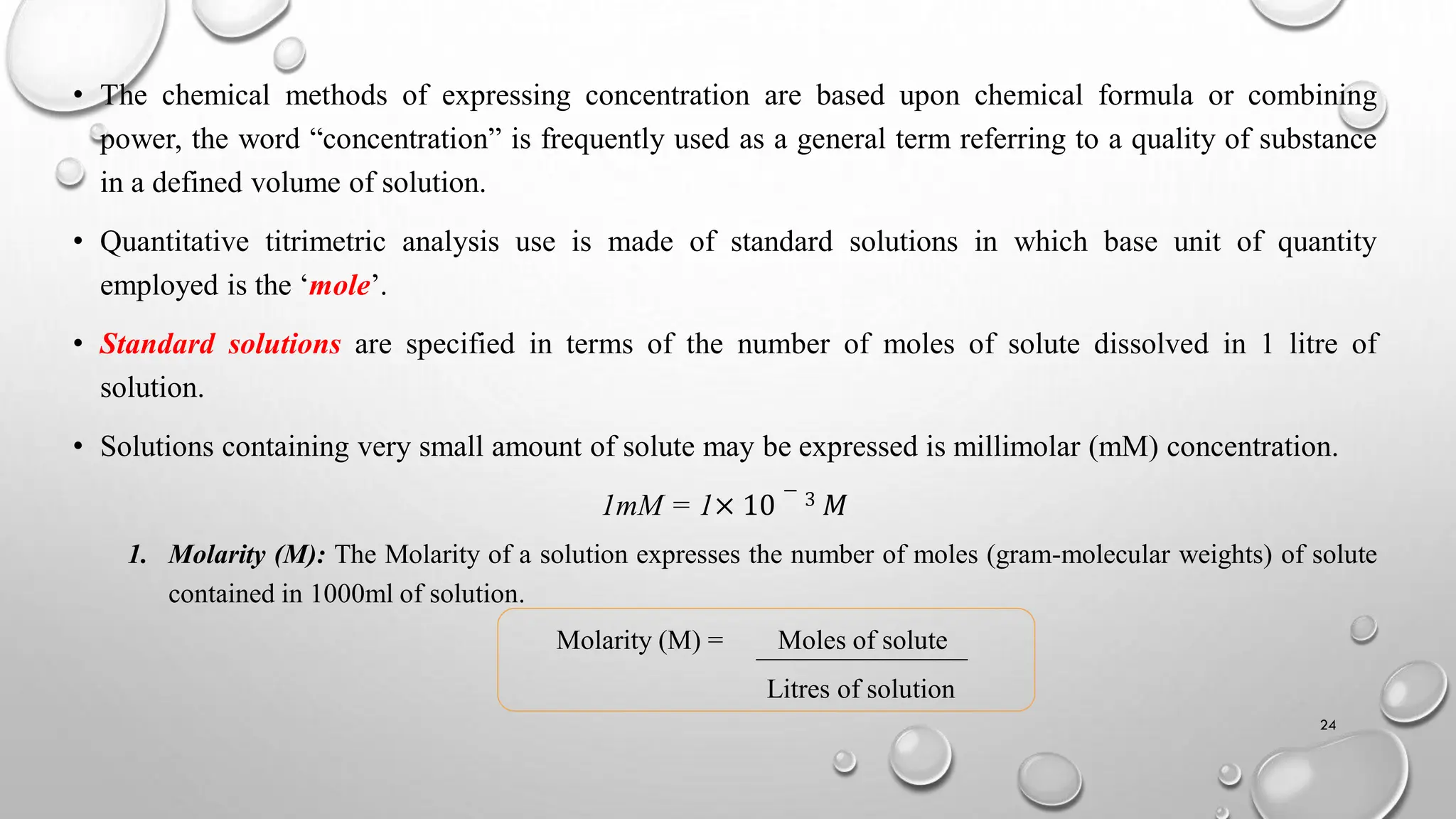
• The chemical methods of expressing concentration are based upon chemical formula or combining
power, the word “concentration” is frequently used as a general term referring to a quality of substance
in a defined volume of solution.
• Quantitative titrimetric analysis use is made of standard solutions in which base unit of quantity
employed is the ‘mole’.
• Standard solutions are specified in terms of the number of moles of solute dissolved in 1 litre of
solution.
• Solutions containing very small amount of solute may be expressed is millimolar (mM) concentration.
1mM = 1× 10
− 3 𝑀
1. Molarity (M): The Molarity of a solution expresses the number of moles (gram-molecular weights) of solute
contained in 1000ml of solution.
Molarity (M) = Moles of solute
Litres of solution
24
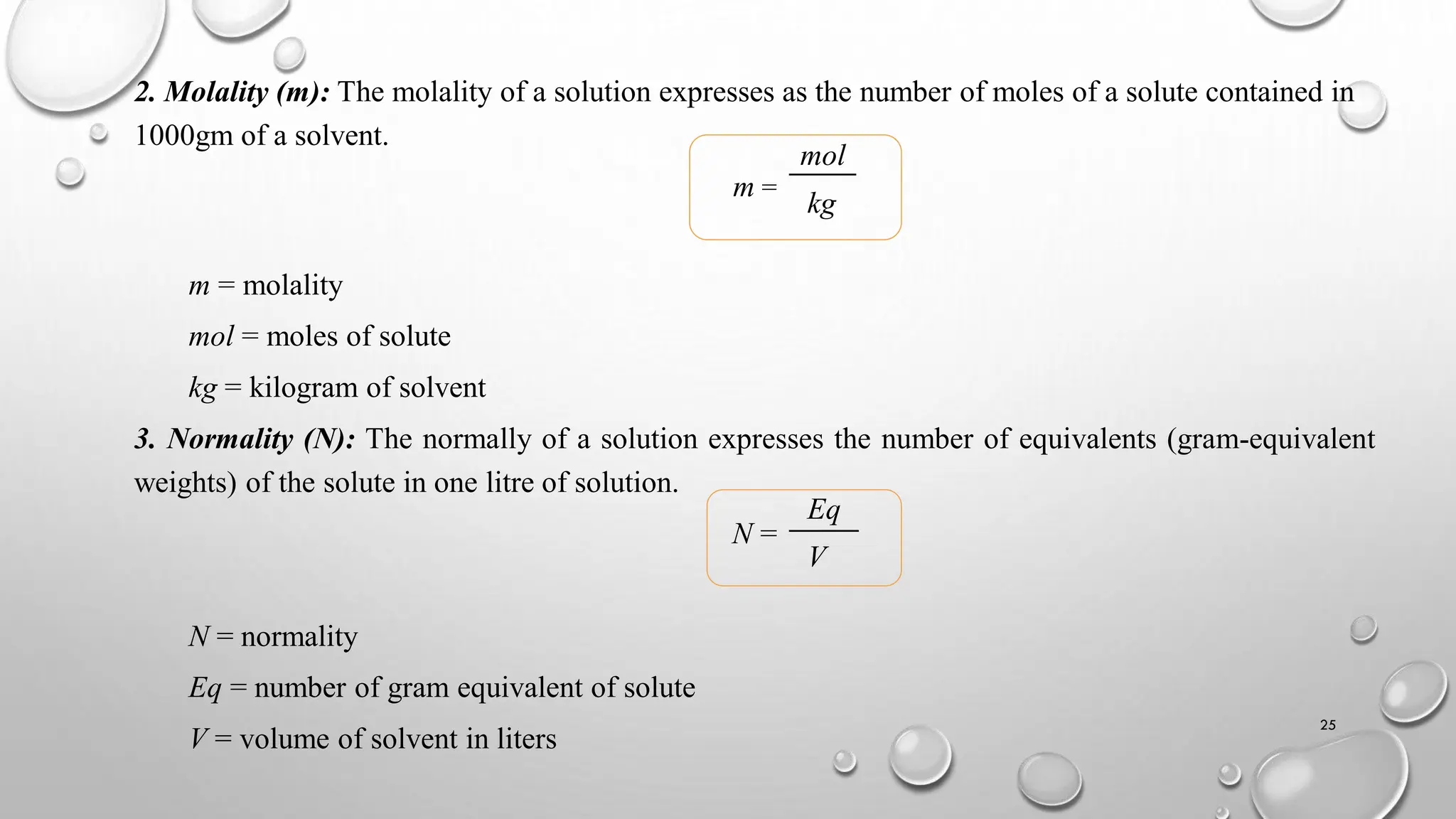
2. Molality (m): The molality of a solution expresses as the number of moles of a solute contained in
1000gm of a solvent.
m =
m = molality
mol = moles of solute
kg = kilogram of solvent
3. Normality (N): The normally of a solution expresses the number of equivalents (gram-equivalent
weights) of the solute in one litre of solution.
N =
N = normality
Eq = number of gram equivalent of solute
V = volume of solvent in liters
mol
kg
Eq
V
25
4. Saturated solution: A saturated solution is one which has dissolved all the solute it is capable of
holding at a given temperature. The temperature is a very crucial aspect of saturated solutions and unless
otherwise specified , the temperature is assumed to be 25oC.
5. Formality (F): Formality may be defined as the number of gram formula weight(GFW) of the solute
dissolved per litre of solution.
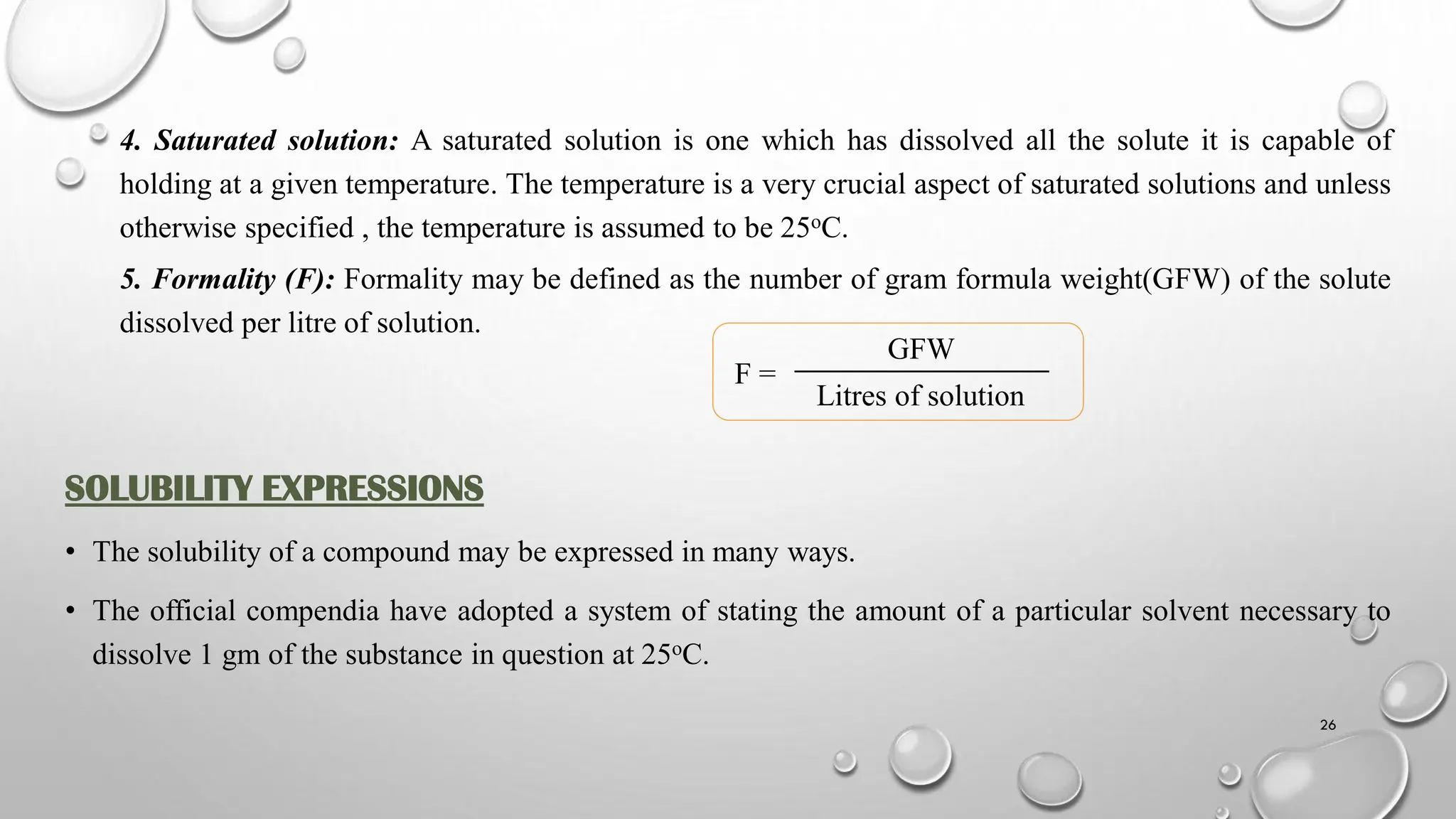
F =
SOLUBILITY EXPRESSIONS
• The solubility of a compound may be expressed in many ways.
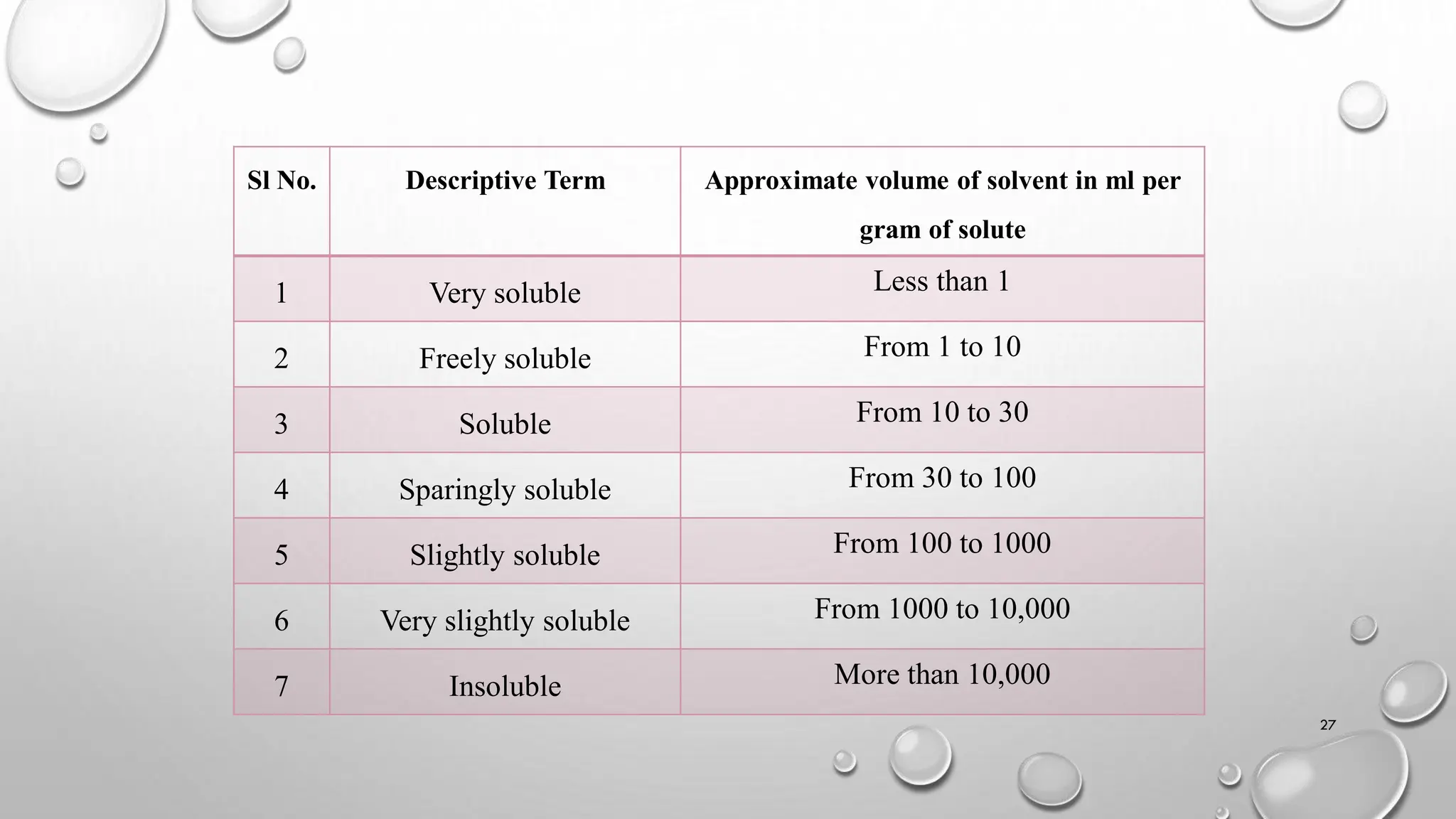
• The official compendia have adopted a system of stating the amount of a particular solvent necessary to
dissolve 1 gm of the substance in question at 25oC.
GFW
Litres of solution
26
Sl No. Descriptive Term Approximate volume of solvent in ml per
gram of solute
1 Very soluble Less than 1
2 Freely soluble From 1 to 10
3 Soluble From 10 to 30
4 Sparingly soluble From 30 to 100
5 Slightly soluble From 100 to 1000
6 Very slightly soluble From 1000 to 10,000
7 Insoluble More than 10,000
27
TITRIMETRIC ANALYSIS
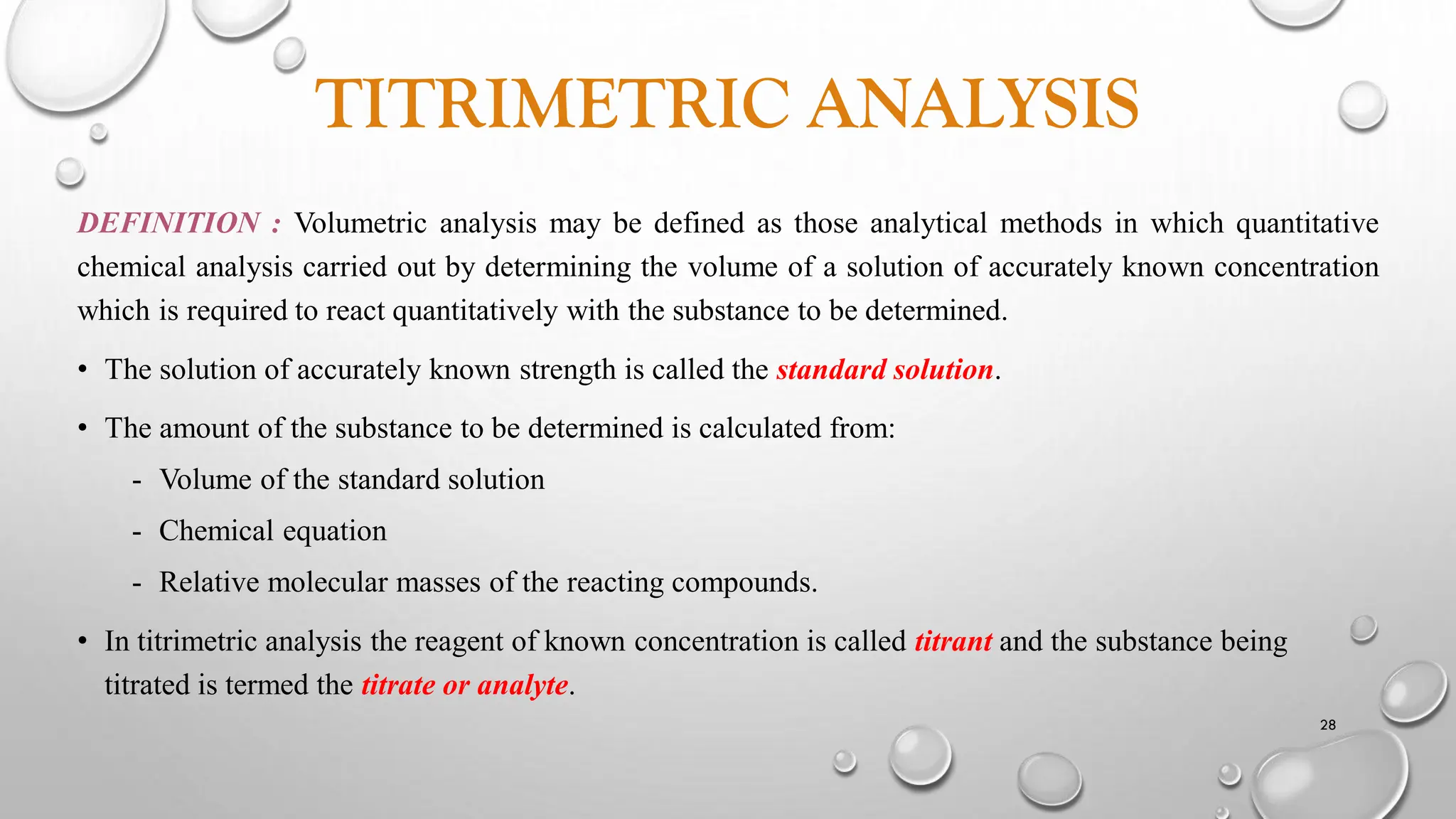
DEFINITION : Volumetric analysis may be defined as those analytical methods in which quantitative
chemical analysis carried out by determining the volume of a solution of accurately known concentration
which is required to react quantitatively with the substance to be determined.
• The solution of accurately known strength is called the standard solution.
• The amount of the substance to be determined is calculated from:
- Volume of the standard solution
- Chemical equation
- Relative molecular masses of the reacting compounds.
• In titrimetric analysis the reagent of known concentration is called titrant and the substance being
titrated is termed the titrate or analyte.
28
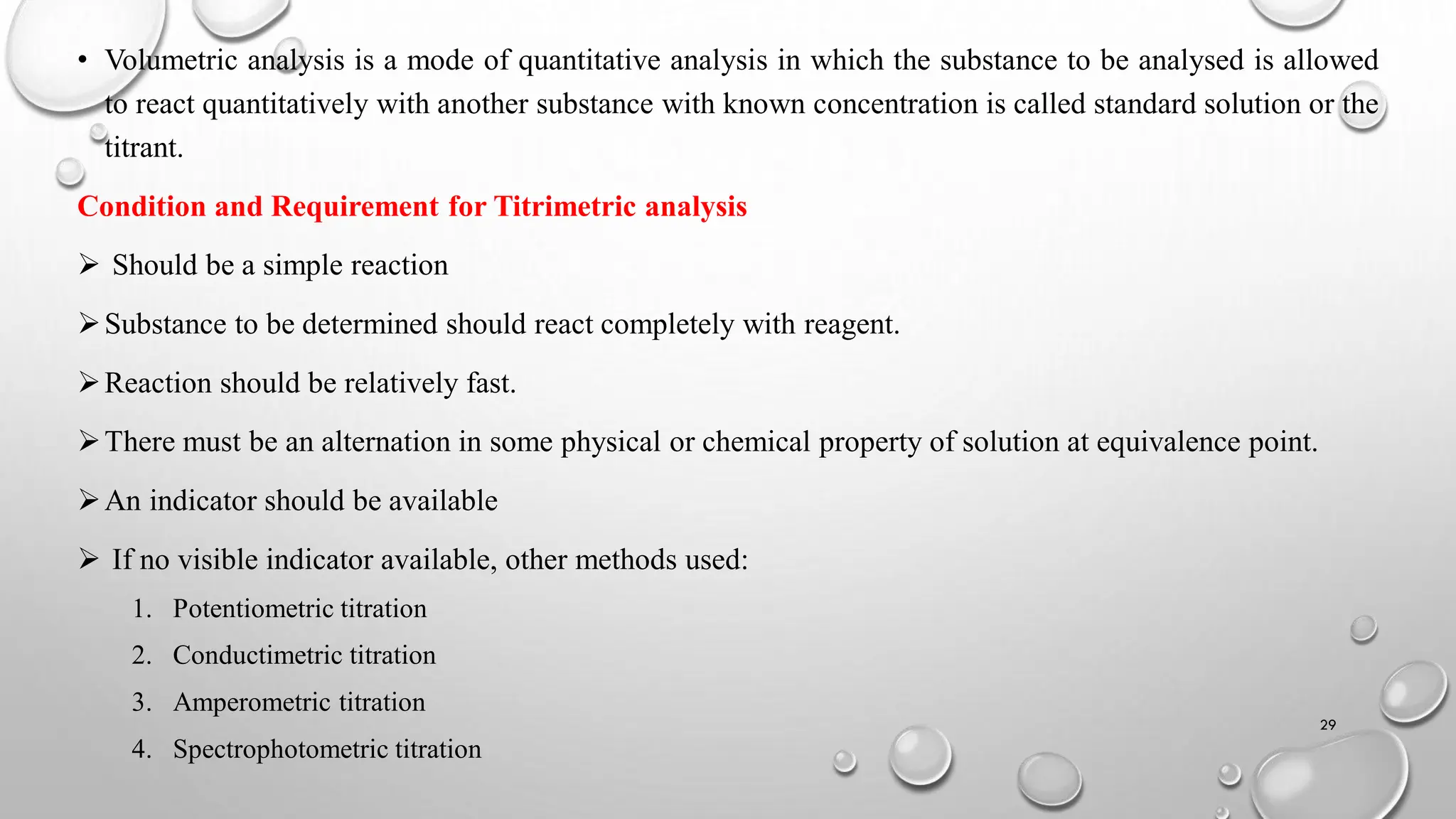
• Volumetric analysis is a mode of quantitative analysis in which the substance to be analysed is allowed
to react quantitatively with another substance with known concentration is called standard solution or the
titrant.
Condition and Requirement for Titrimetric analysis
 Should be a simple reaction
Substance to be determined should react completely with reagent.
Reaction should be relatively fast.
There must be an alternation in some physical or chemical property of solution at equivalence point.
An indicator should be available
 If no visible indicator available, other methods used:
1. Potentiometric titration
2. Conductimetric titration
3. Amperometric titration
4. Spectrophotometric titration
29
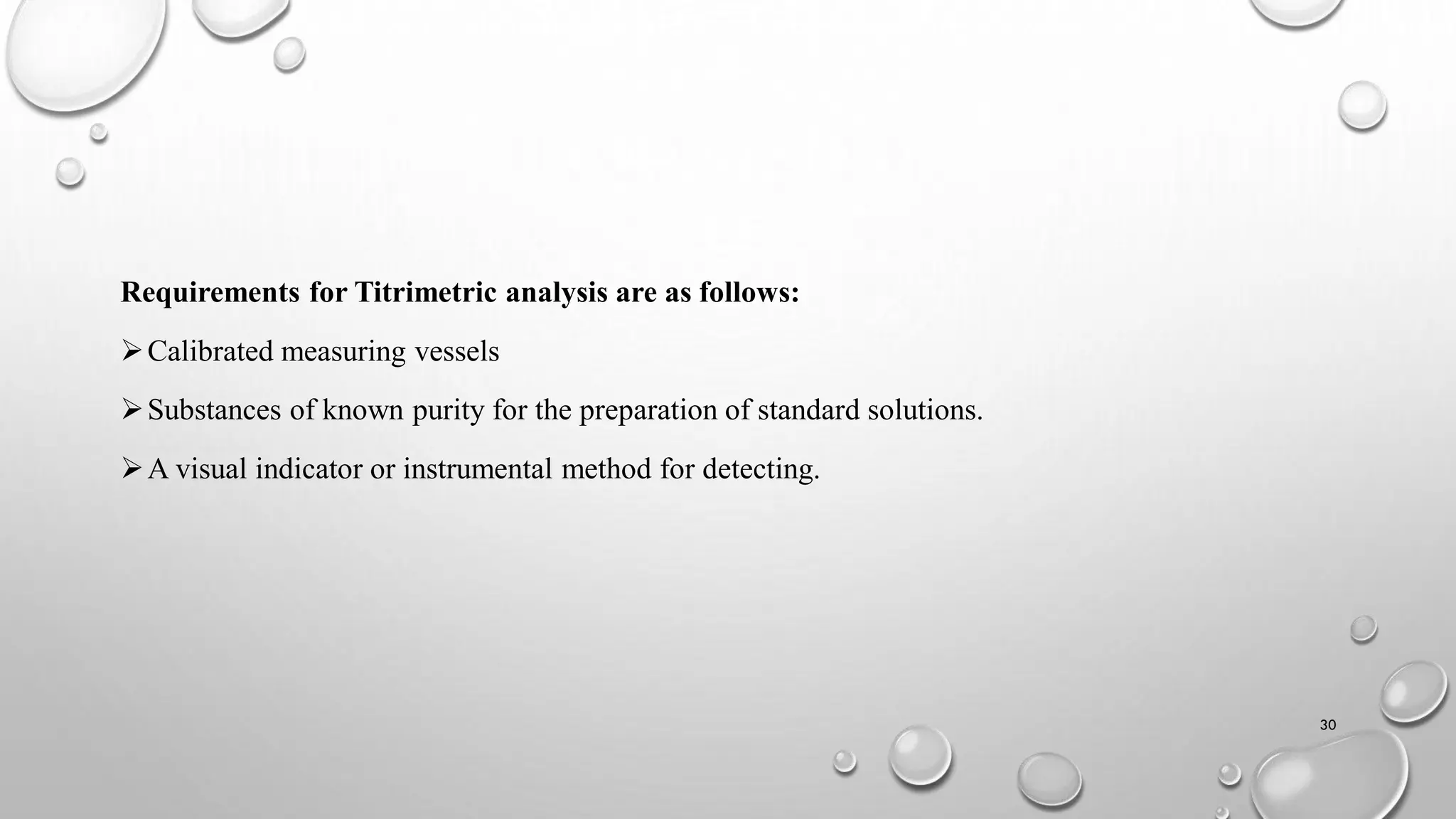
Requirements for Titrimetric analysis are as follows:
Calibrated measuring vessels
Substances of known purity for the preparation of standard solutions.
A visual indicator or instrumental method for detecting.
30
FUNDAMENTALS OF VOLUMETRIC ANALYSIS
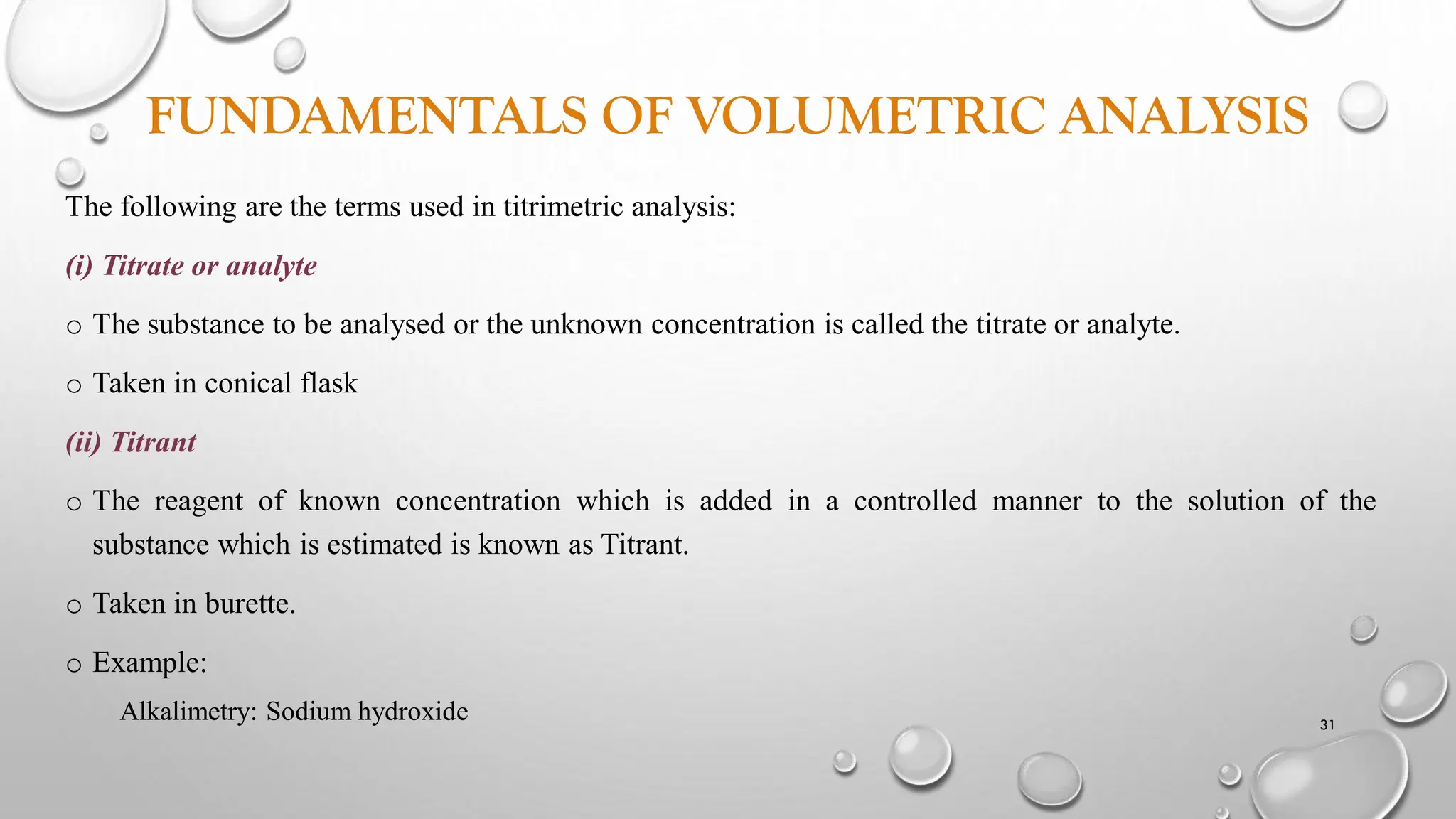
The following are the terms used in titrimetric analysis:
(i) Titrate or analyte
o The substance to be analysed or the unknown concentration is called the titrate or analyte.
o Taken in conical flask
(ii) Titrant
o The reagent of known concentration which is added in a controlled manner to the solution of the
substance which is estimated is known as Titrant.
o Taken in burette.
o Example:
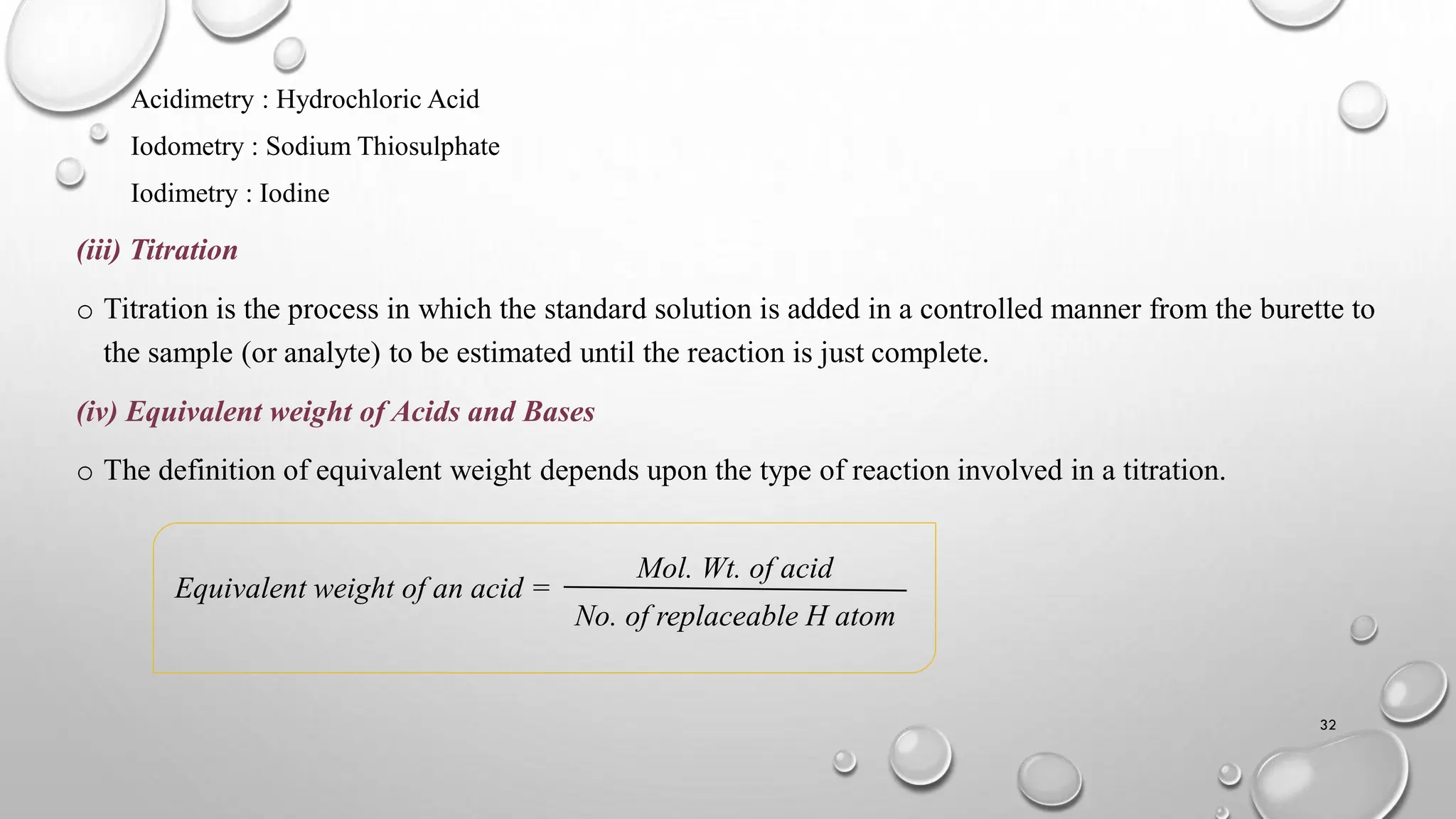
Alkalimetry: Sodium hydroxide 31
Acidimetry : Hydrochloric Acid
Iodometry : Sodium Thiosulphate
Iodimetry : Iodine
(iii) Titration
o Titration is the process in which the standard solution is added in a controlled manner from the burette to
the sample (or analyte) to be estimated until the reaction is just complete.
(iv) Equivalent weight of Acids and Bases
o The definition of equivalent weight depends upon the type of reaction involved in a titration.
Equivalent weight of an acid =
32
Mol. Wt. of acid
No. of replaceable H atom
(v) Indicator
o It is a complex organic compound which shows clear visual change after the reaction between titrant and
titrate is just complete.
o Eg:
Phenolphthalein
Methyl orange
Thymol blue
Methyl red
(vi) Titration errors
o In practice very small difference between theoretical end point and actual end point usually occur, it is
known as titration error.
Error =
33
Experimental value – Actual value
Actual value
(vii) End point
o End point is the point at which the indicator undergoes a maximum colour change for a small volume of
added titrant.
o We can detect the endpoint by using indicators or by an instrument or by any other methods.
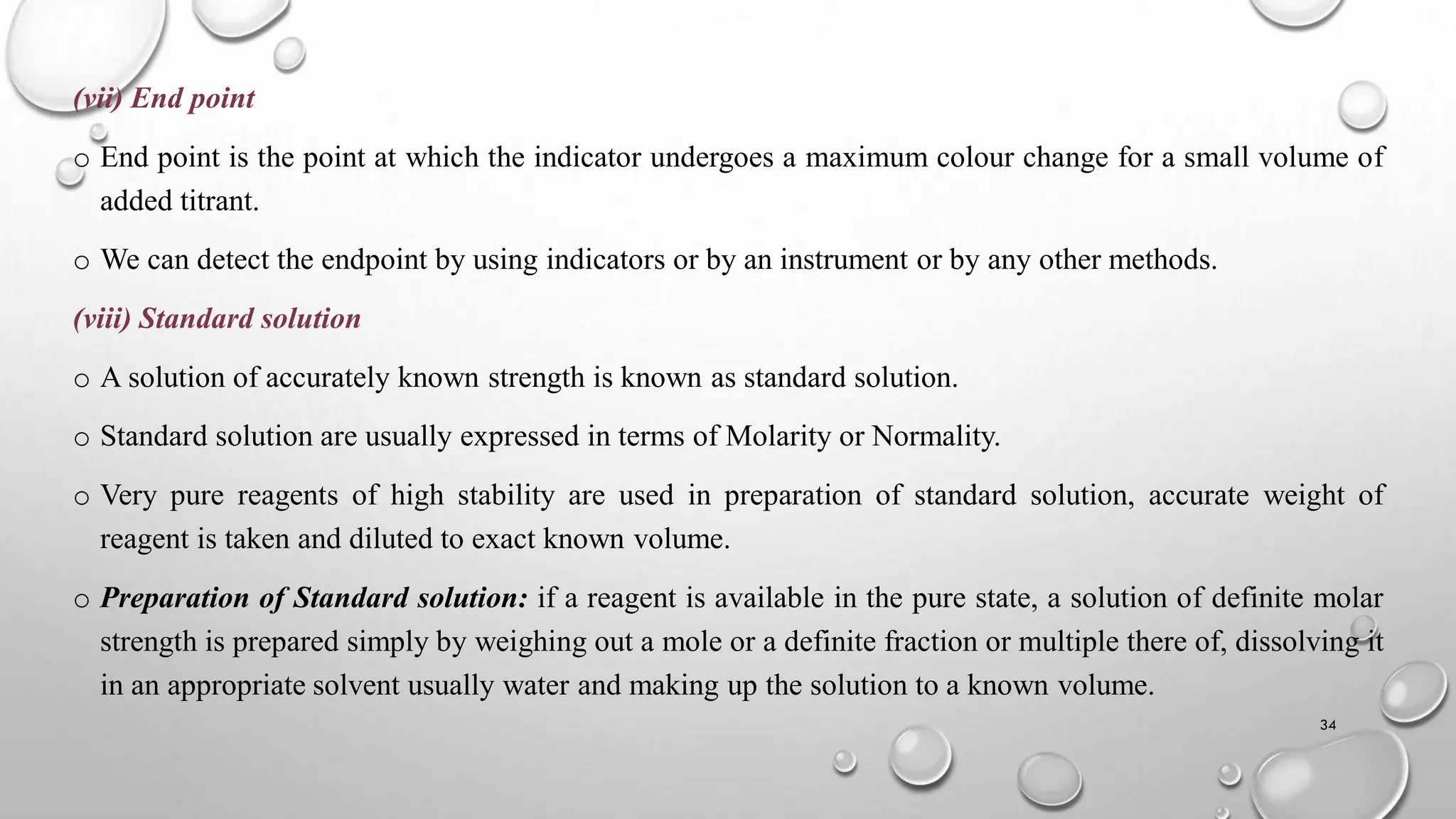
(viii) Standard solution
o A solution of accurately known strength is known as standard solution.
o Standard solution are usually expressed in terms of Molarity or Normality.
o Very pure reagents of high stability are used in preparation of standard solution, accurate weight of
reagent is taken and diluted to exact known volume.
o Preparation of Standard solution: if a reagent is available in the pure state, a solution of definite molar
strength is prepared simply by weighing out a mole or a definite fraction or multiple there of, dissolving it
in an appropriate solvent usually water and making up the solution to a known volume.
34
(ix) Standardisation
o The determination of the normality or molarity of a solution is known as standardisation.
o This may be accomplished by the use of another standard solution known as secondary standard or by
the use of weighed sample of a substance of known purity which is termed as primary standard.
35
CLASSIFICATION OF TITRIMETRIC ANALYSIS
• ACID – BASE TITRATION
• REDOX TITRATION
• COMPLEXOMETRIC TITRATION
• PRECIPITATION TITRATION
• NON – AQUEOUS TITRATION
36
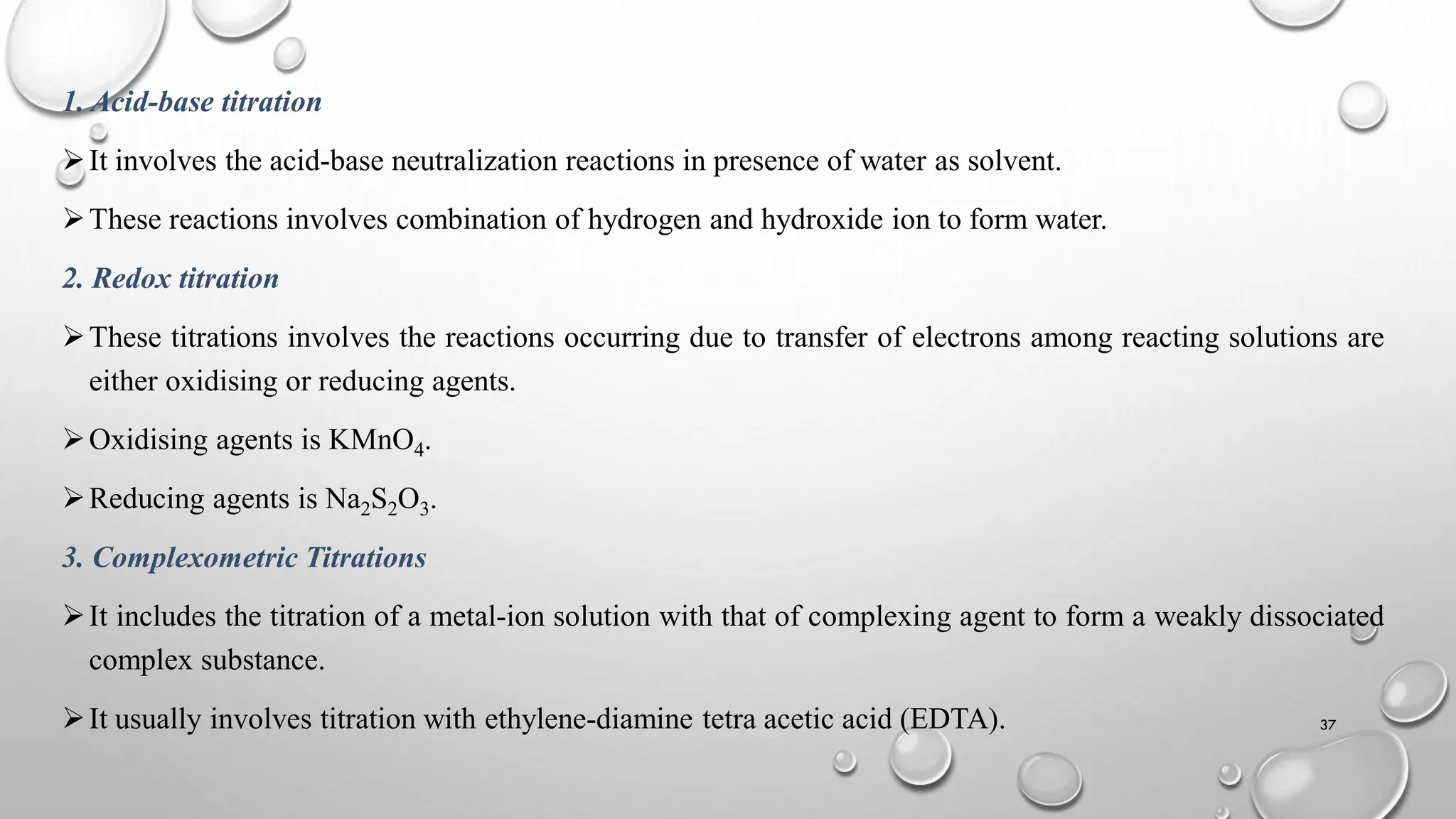
1. Acid-base titration
It involves the acid-base neutralization reactions in presence of water as solvent.
These reactions involves combination of hydrogen and hydroxide ion to form water.
2. Redox titration
These titrations involves the reactions occurring due to transfer of electrons among reacting solutions are
either oxidising or reducing agents.
Oxidising agents is KMnO4.
Reducing agents is Na2S2O3.
3. Complexometric Titrations
It includes the titration of a metal-ion solution with that of complexing agent to form a weakly dissociated
complex substance.
It usually involves titration with ethylene-diamine tetra acetic acid (EDTA). 37
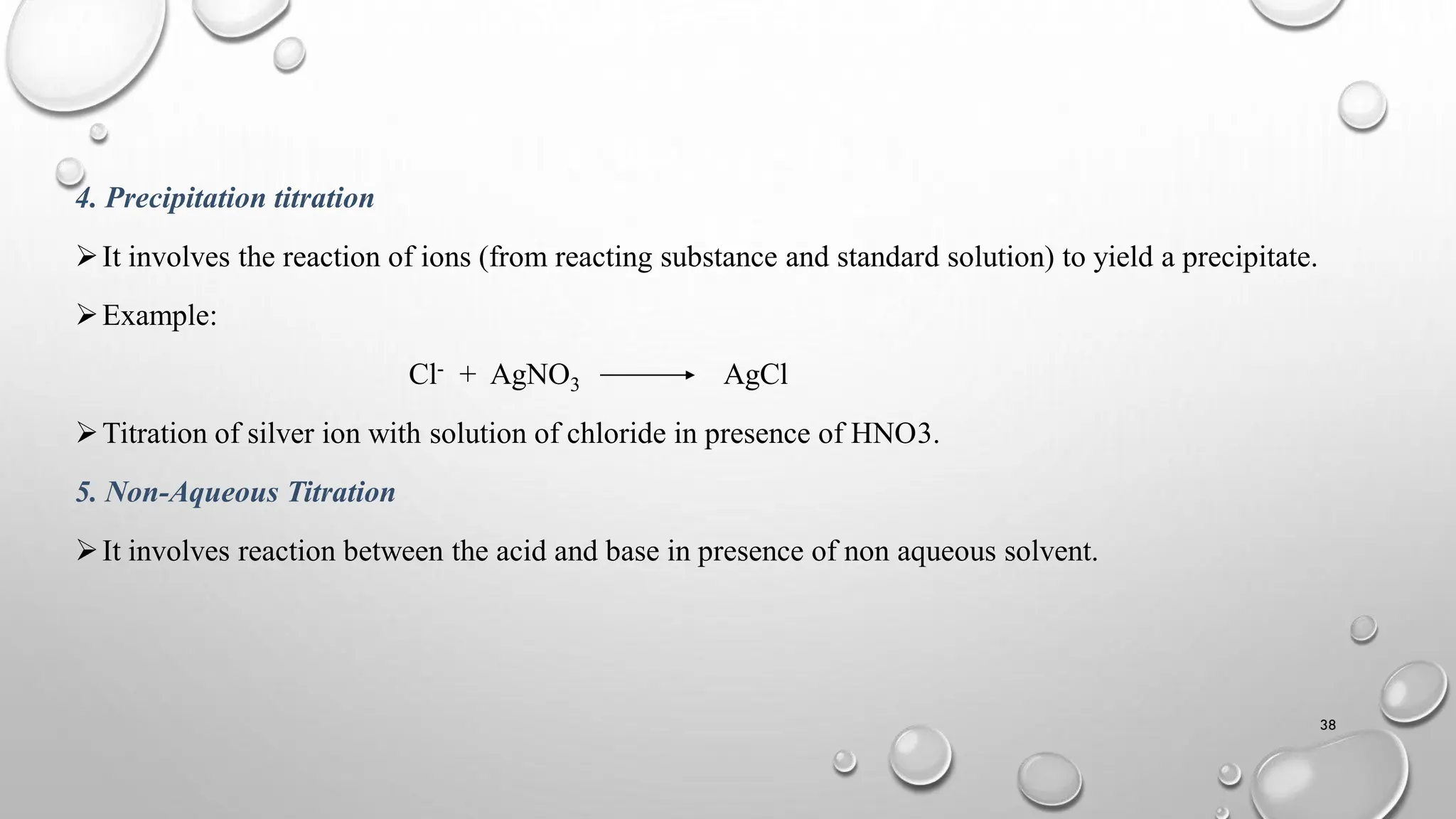
4. Precipitation titration
It involves the reaction of ions (from reacting substance and standard solution) to yield a precipitate.
Example:
Cl- + AgNO3 AgCl
Titration of silver ion with solution of chloride in presence of HNO3.
5. Non-Aqueous Titration
It involves reaction between the acid and base in presence of non aqueous solvent.
38
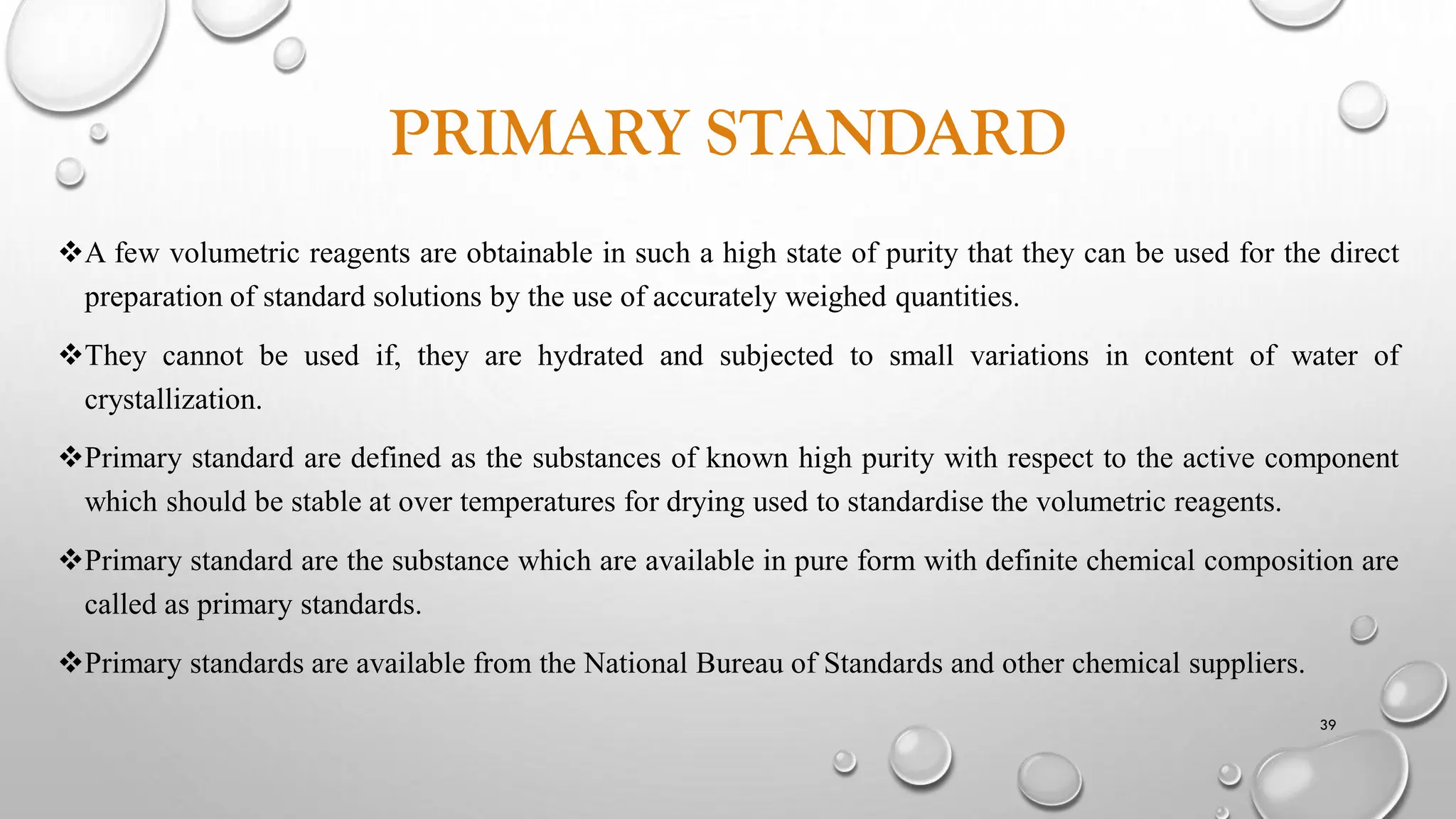
PRIMARY STANDARD
A few volumetric reagents are obtainable in such a high state of purity that they can be used for the direct
preparation of standard solutions by the use of accurately weighed quantities.
They cannot be used if, they are hydrated and subjected to small variations in content of water of
crystallization.
Primary standard are defined as the substances of known high purity with respect to the active component
which should be stable at over temperatures for drying used to standardise the volumetric reagents.
Primary standard are the substance which are available in pure form with definite chemical composition are
called as primary standards.
Primary standards are available from the National Bureau of Standards and other chemical suppliers.
39
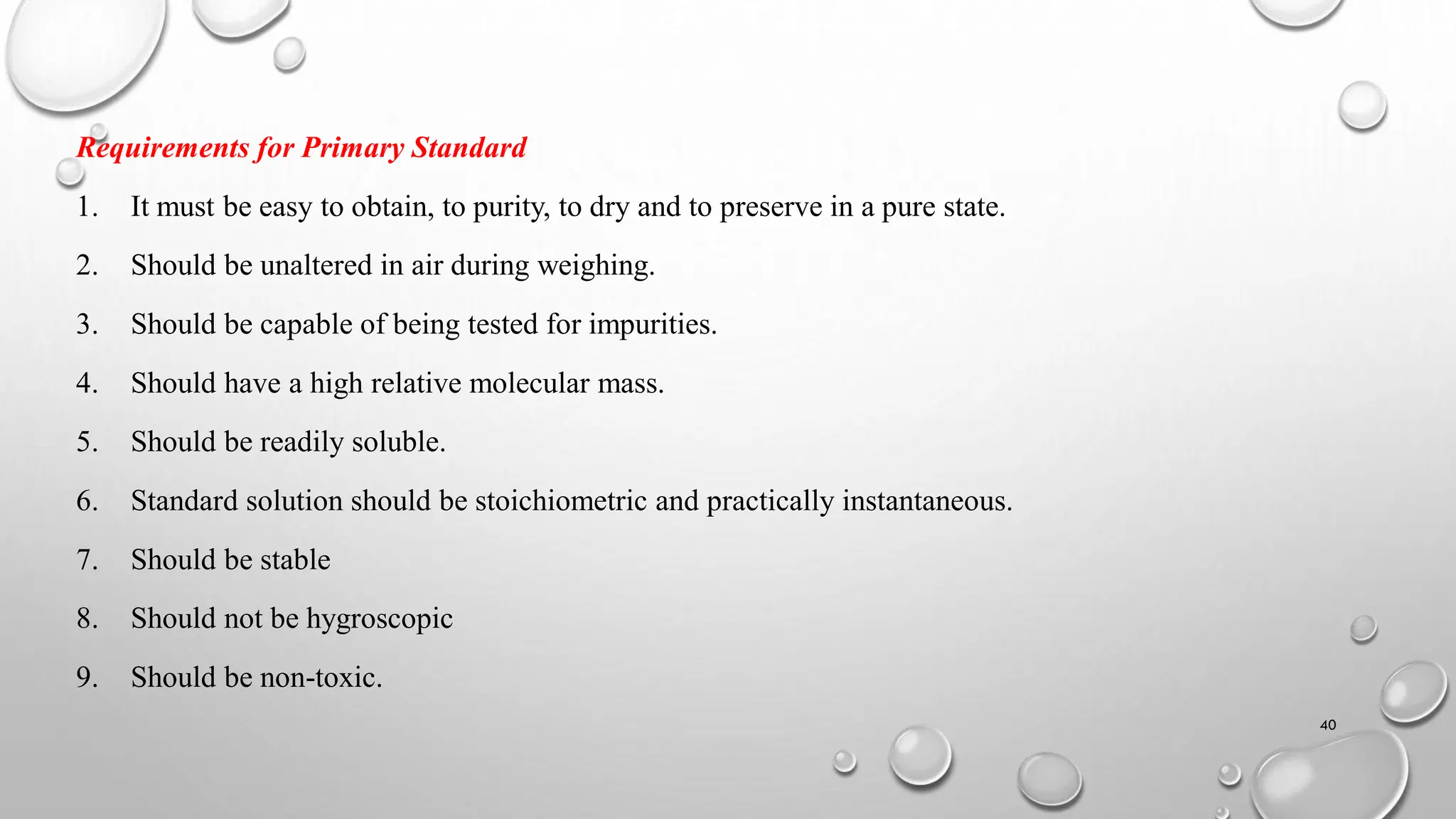
Requirements for Primary Standard
1. It must be easy to obtain, to purity, to dry and to preserve in a pure state.
2. Should be unaltered in air during weighing.
3. Should be capable of being tested for impurities.
4. Should have a high relative molecular mass.
5. Should be readily soluble.
6. Standard solution should be stoichiometric and practically instantaneous.
7. Should be stable
8. Should not be hygroscopic
9. Should be non-toxic.
40
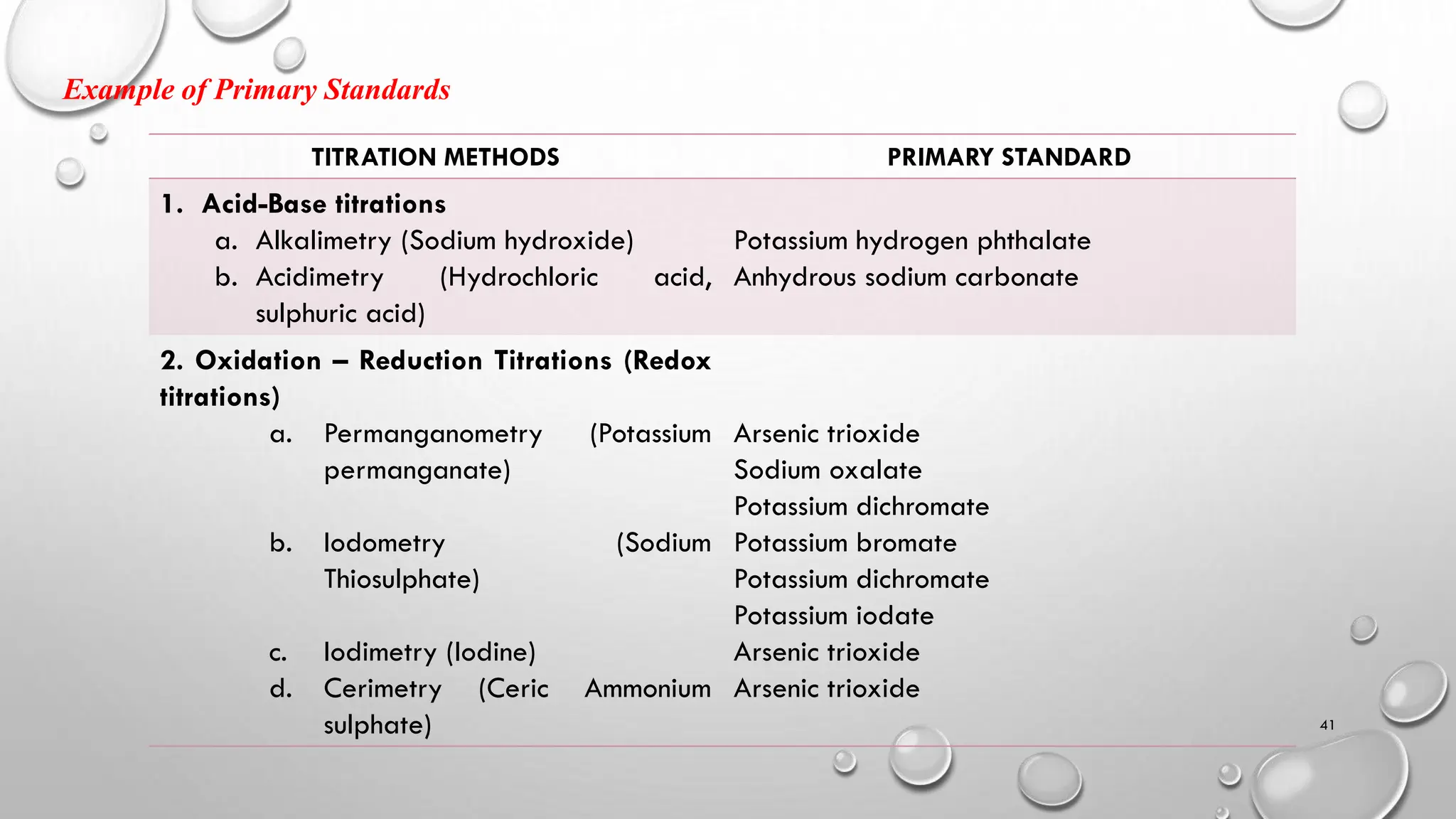
Example of Primary Standards
41
TITRATION METHODS PRIMARY STANDARD
1. Acid-Base titrations
a. Alkalimetry (Sodium hydroxide)
b. Acidimetry (Hydrochloric acid,
sulphuric acid)
Potassium hydrogen phthalate
Anhydrous sodium carbonate
2. Oxidation – Reduction Titrations (Redox
titrations)
a. Permanganometry (Potassium
permanganate)
b. Iodometry (Sodium
Thiosulphate)
c. Iodimetry (Iodine)
d. Cerimetry (Ceric Ammonium
sulphate)
Arsenic trioxide
Sodium oxalate
Potassium dichromate
Potassium bromate
Potassium dichromate
Potassium iodate
Arsenic trioxide
Arsenic trioxide
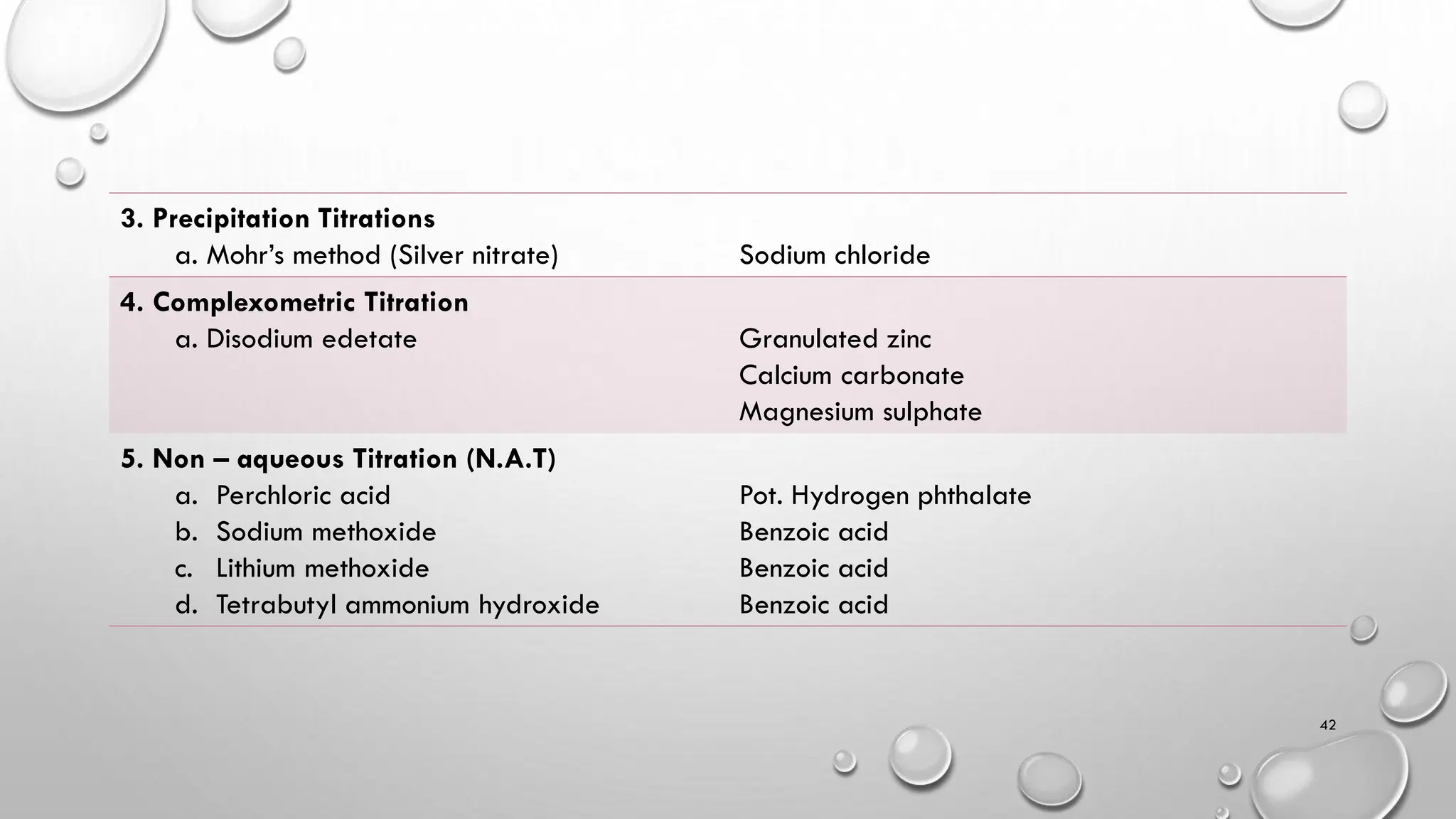
3. Precipitation Titrations
a. Mohr’s method (Silver nitrate) Sodium chloride
4. Complexometric Titration
a. Disodium edetate Granulated zinc
Calcium carbonate
Magnesium sulphate
5. Non – aqueous Titration (N.A.T)
a. Perchloric acid
b. Sodium methoxide
c. Lithium methoxide
d. Tetrabutyl ammonium hydroxide
Pot. Hydrogen phthalate
Benzoic acid
Benzoic acid
Benzoic acid
42
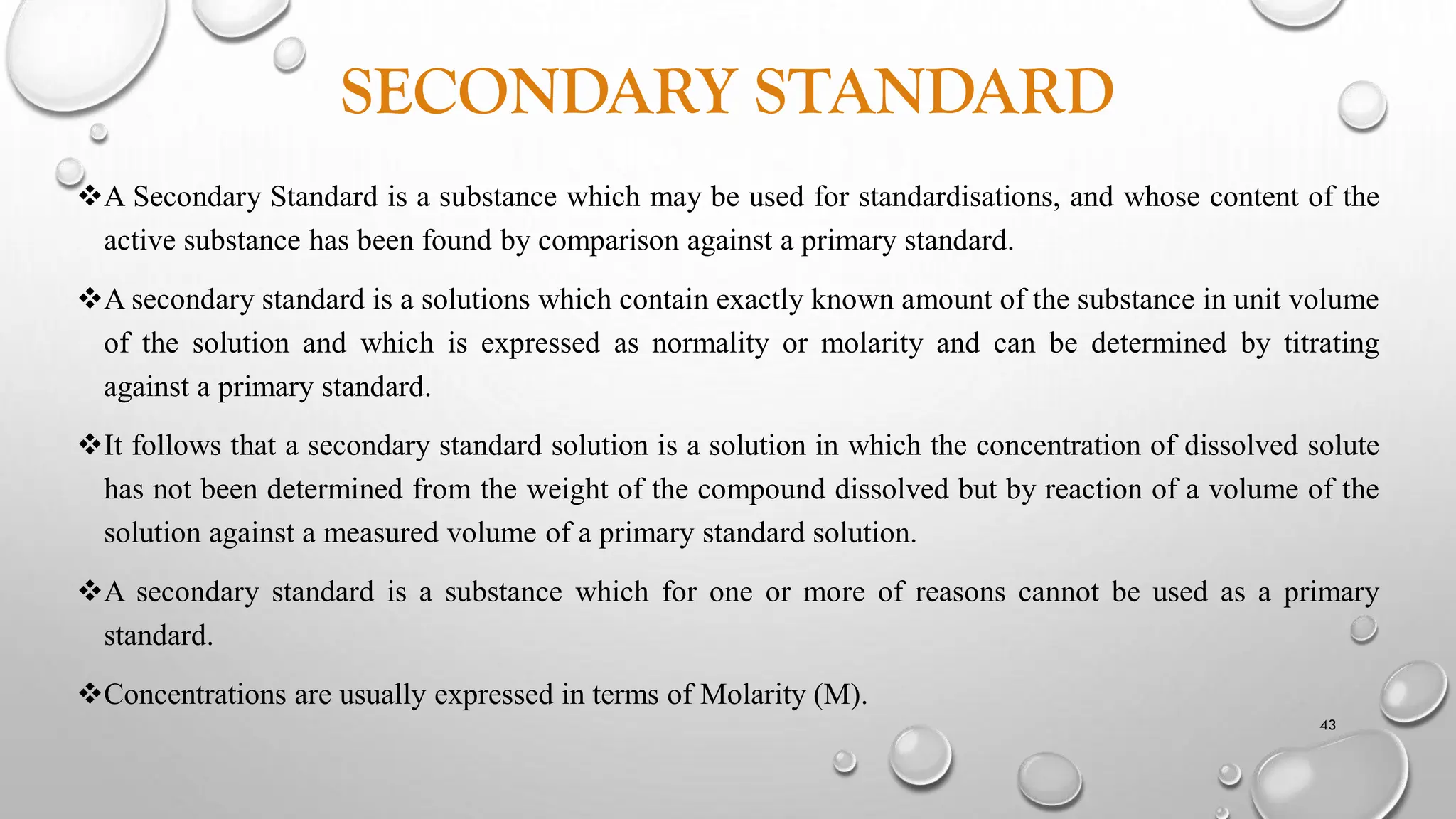
SECONDARY STANDARD
A Secondary Standard is a substance which may be used for standardisations, and whose content of the
active substance has been found by comparison against a primary standard.
A secondary standard is a solutions which contain exactly known amount of the substance in unit volume
of the solution and which is expressed as normality or molarity and can be determined by titrating
against a primary standard.
It follows that a secondary standard solution is a solution in which the concentration of dissolved solute
has not been determined from the weight of the compound dissolved but by reaction of a volume of the
solution against a measured volume of a primary standard solution.
A secondary standard is a substance which for one or more of reasons cannot be used as a primary
standard.
Concentrations are usually expressed in terms of Molarity (M).
43
Volumetric solution also known as standard solution are solutions of reagents of known concentrations
intended primarily for use in quantitative determinations.
Eg:
o Sodium hydroxide cannot be used as a primary standard for the reason that is absorbs water and
carbon dioxide from the atmosphere and the composition of its solution is subject to wide variations
at different periods.
o Sodium thiosulphate absorbs CO2 from the atmosphere and is decomposed.
o Potassium permanganate, Iodine etc are also variable at different times. Therefore these cannot be
used as primary standard.
44
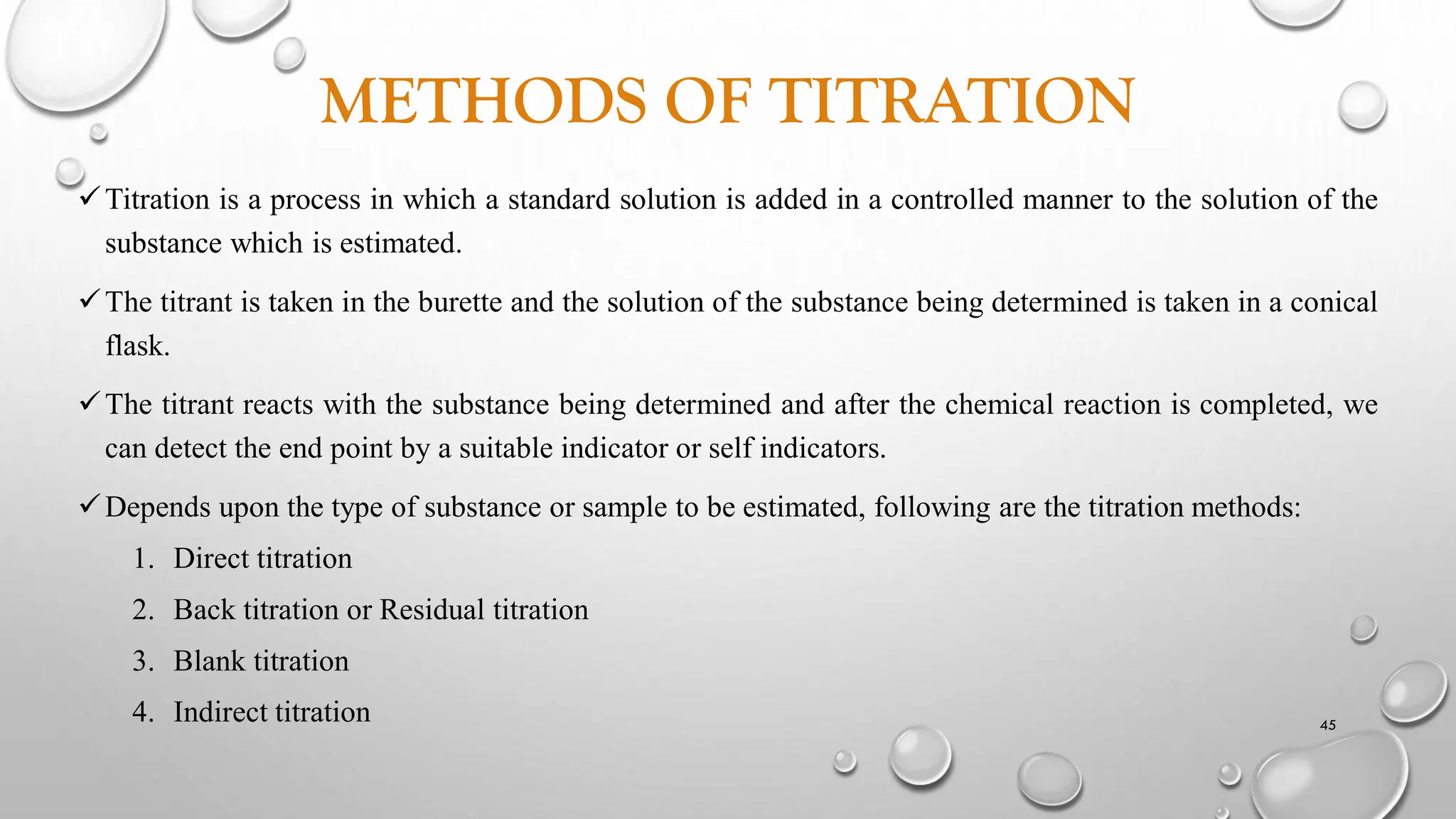
METHODS OF TITRATION
Titration is a process in which a standard solution is added in a controlled manner to the solution of the
substance which is estimated.
The titrant is taken in the burette and the solution of the substance being determined is taken in a conical
flask.
The titrant reacts with the substance being determined and after the chemical reaction is completed, we
can detect the end point by a suitable indicator or self indicators.
Depends upon the type of substance or sample to be estimated, following are the titration methods:
1. Direct titration
2. Back titration or Residual titration
3. Blank titration
4. Indirect titration 45
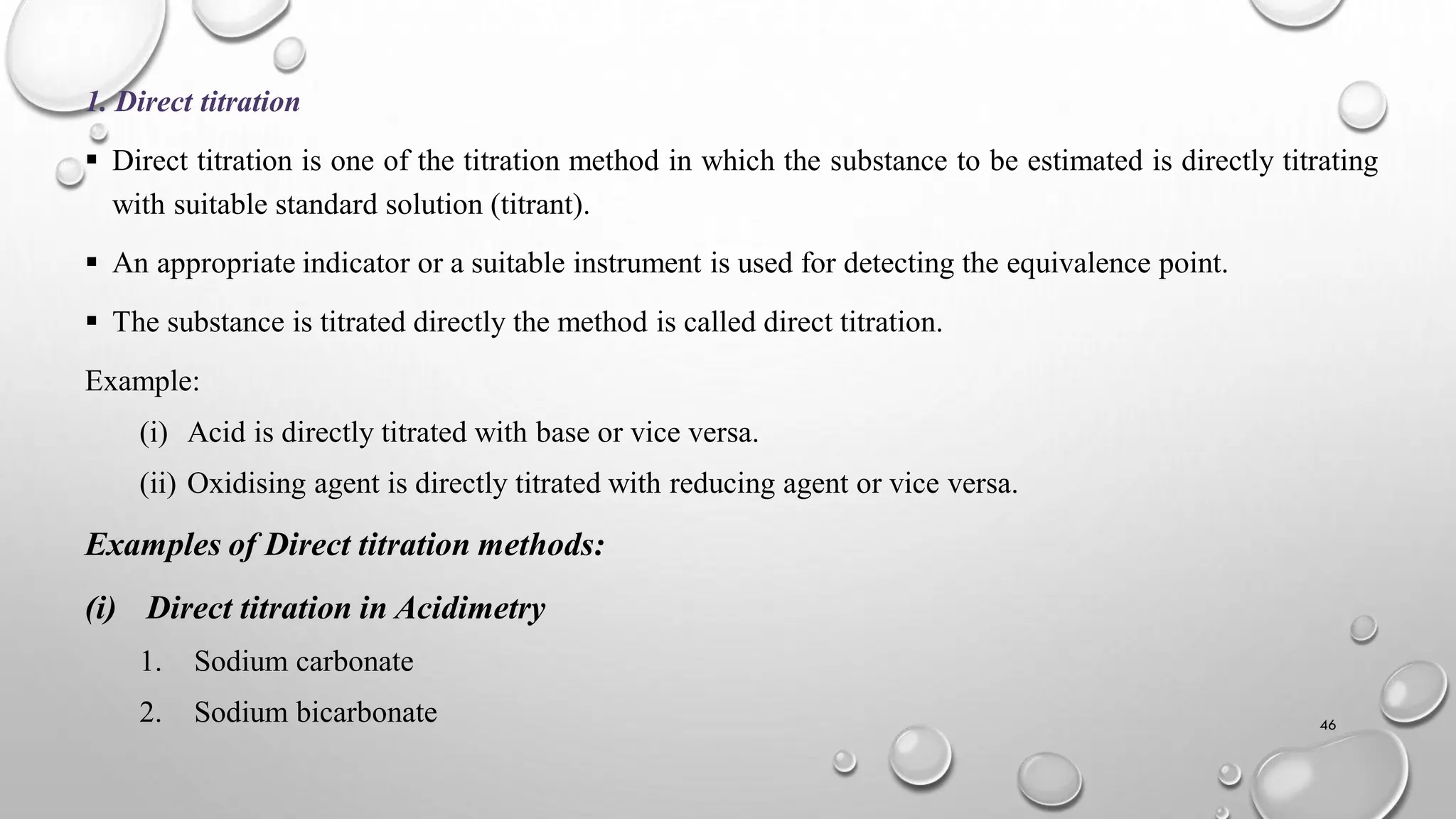
1. Direct titration
 Direct titration is one of the titration method in which the substance to be estimated is directly titrating
with suitable standard solution (titrant).
 An appropriate indicator or a suitable instrument is used for detecting the equivalence point.
 The substance is titrated directly the method is called direct titration.
Example:
(i) Acid is directly titrated with base or vice versa.
(ii) Oxidising agent is directly titrated with reducing agent or vice versa.
Examples of Direct titration methods:
(i) Direct titration in Acidimetry
1. Sodium carbonate
2. Sodium bicarbonate 46
3. Sodium Hydroxide
4. Potassium Hydroxide
(ii) Direct titration in Alkalimetry
1. Boric acid
2. Phosphoric acid
3. Benzoic acid
4. Citric acid
5. Salicylic acid
(iii) Direct titration in Precipitation titration
Following substance are assayed directly by titrating with Silver nitrate under Mohr’s method.
1. Sodium chloride and Dextrose Injn.
2. Potassium chloride
47
2. Back titration or Residual titration
 Determination involving back titration consist in the addition of excess of a standard volumetric
solution to a weighed amount of sample and determination of the excess (unreacted volumetric reagent
with sample) is titrated with other volumetric reagent of known concentration.
 The volume of reagent consumed by the sample is determined by subtracting the titre value with the
volume of known excess of volumetric reagent added initially.
 In following area, the direct titration is not possible quantitatively, hence back titration is performed:
1. Volatile substance: Volatile oils, Ammonia and other volatile substances which would be lost
during the titration.
2. Insoluble substance: Which requires excess volumetric solution to effect a quantitative reaction.
Eg:
Calcium carbonate, Calamine, Zinc oxide
Ammonium carbonate, Milk of Magnesia 48
3. Substances for which a quantitation reaction proceeds rapidly only in presence of excess of the
reagent.
Eg: lactic acid.
4. Substance which require heating with a volumetric reagent during the determination in which
decomposition or loss of the reactants or products would occur in the process.
Eg: Formaldelyde solution.
3. Blank titration
 Blank determinations are used if the volumetric solution is unstable or if it alters in strength during the
assay.
 Blank titration are the titration in which the determination is to be done using the same quantities of the
same reagents treated in the same manner as the solution or mixture containing the portion of the
substance under assay, but omitting the substance being examined.
49
4. Indirect titration
 When substance is not directly titratable then by using a chemical reaction, it can be precipitated
or removed from the reaction and the reaction product thus formed is titrated with suitable titrant.
This method of titration is called indirect titration.
 Eg:
Iodine – sodium thiosulphate titration
1. Assay of copper sulphate
2. Assay of bleaching powder
3. Phenol etc..
50
THANK YOU…
51
Chemistry is a Mystery of chemicals, Chemists are the Detectives who solve this Mystery…

VOLUMETRIC ANALYSIS .pdf

  • 1.
    VOLUMETRIC ANALYSIS Presented By, GRACESHAJI CHITTILAPPILLY ASSISTANT PROFESSOR DEPT. OF PHARMACEUTICAL CHEMISTRY KARPAGAM COLLEGE OF PHARMACY 1
  • 2.
    CONTENTS 1. INTRODUCTION 2. TYPESOF VOLUMETRIC ANALYSIS 3. DIFFERENT TECHNIQUES OF ANALYSIS 4. METHODS OF EXPRESSING CONCENTRATION 5. TITRIMETRIC ANALYSIS 6. FUNDAMENTALS OF VOLUMETRIC ANALYSIS 7. CLASSIFICATION OF TITRATION 8. PRIMARY STANDARD 9. SECONDARY STANDARD 10. METHODS OF TITRATION 2
  • 3.
    INTRODUCTION  When acompletely unknown sample is presented to an analyst, the first requirement is usually to ascertain what substances are present in it. This fundamental problem may some times be encountered in the modified form of deciding what impurities are present in a given sample or perhaps of confirming that certain specified impurities are absent. Having ascertained the nature of the constituent of a given sample, the analyst is then frequently called upon to determine how much of each component or of specified components, is present. The two important steps in analysis are identification and estimation of constituents of a compound. The identification step is called Qualitative analysis. The estimation step is called Quantitative analysis. 3
  • 4.
    TYPES OF VOLUMETRICANALYSIS A. QUALITATIVE ANALYSIS B. QUANTITATIVE ANALYSIS QUALITATIVE ANALYSIS o Qualitative analysis involves the determination of the identity of the any drug substances or chemicals present in a sample or in a mixture. o Qualitative analysis means the identification of unknown compounds by chemical tests. o Qualitative information is required before a quantitative analysis can be undertaken. o Qualitative analysis includes the following: a) Measurement of physical constants 1. Melting point / Boiling point 2. Solubility, particle size, polymorphism 4
  • 5.
    3. Specific Gravity,Density, Refractive Index, Viscosity 4. Light absorption 5. Optical rotation, Specific rotation etc. b) Functional group analysis i. If inorganic: Identification of elements or acid / base radicals. ii. If organic: 1. Aliphatic / aromatic 2. Saturated / unsaturated 3. Detection of special elements (if any) 4. Determination of functional group QUANTITATIVE ANALYSIS o Quantitative analysis means the estimation of the amount of a particular substance present in a sample.5
  • 6.
    o The airof quantitative analysis is the determination of the quantitative contents of individual elements or compounds present in a substance. o Quantitative analysis is used to : 1. Ascertain the purity of chemicals or any drug or medicinal substance 2. Ascertain the exact quantity of the drug substances. 3. Ascertain the total activity of the drug substances: (i) Biological assay – Bioassay (ii) Microbiological assay (iii)Pharmacological assay LIMIT TESTS o Limit test are quantitative or semi-quantitative tests which are designed to detect and limit small quantities of impurities which are likely to be present in the substance. 6
  • 7.
    o They maybe of three types: 1. Tests in which there is no visible reaction 2. Comparison methods 3. Quantitative determinations 1. Tests in which there is no visible reaction  It may be stated that on testing as prescribed there shall be no colour, opalescence or precipitate, whichever is appropriate the particular test.  Eg: Test for Barium and Calcium in dilute hypo phosphorous acid + addition of dil.H2SO4 under precisely controlled conditions shall produce ‘no turbidity or precipitate’with in one hour. 2. Comparison Methods  These tests require a standard containing a definite amt of impurity, to be set up at the same time and under the same conditions as the test experiment. 7
  • 8.
    o In thisway, it is possible to compare the amount of the impurity in the substance with a standard of known concentration and find out whether the impurity is within or excess of the limit prescribed. o Eg: Limit test for Chloride Limit test for Sulphate Limit test for Iron Limit test for Heavy metals 3. Quantitative determinations o The quantitative determination of impurities are only applied in special circumstances, usually in those case where the limit is not readily susceptible to simple and more direct chemical determination. o Here the amount of impurity present is actually determined and compared with the numerical limit given in the pharmacopoeia. 8
  • 9.
    o Eg: Limitsof soluble matter Limits of insoluble matter Limits of moisture and volatile matter Limits of non volatile matter Limits of residue on ignition Loss on ignition on drying Ash values 9
  • 10.
    DIFFERENT TECHNIQUES OFANALYSIS o The techniques have differing degrees of sophistication, of sensitivity, of selectivity and also of time requirements. o Important task for analyst is the selection of the best procedure for a given determination. o Classification for methods of analysis: 1. Non instrumental methods of Analysis 2. Instrumental methods of analysis A. NON INSTRUMENTAL METHODS OF ANALYSIS • Without the use of Instruments. • It is the traditional or classical methods of chemical analysis 10
  • 11.
    NON INSTRUMENTAL METHODSOF ANALYSIS GRAVIMETRIC ANALYSIS TITRIMETRIC ANALYSIS • Electro gravimetry • Thermo gravimetry Acid – base Titration • Acidmetry • Alkalimetry • Acid-base titration in Non-aqueous solvents (NAT) Redox Titration • Permanganometry • Cerimetry • Iodimetry • Iodometry • Titanometry • Potassium iodate titration • Potassium bromate titration Precipitation Titration • Mohr’s method • Volhard’s methods • Fajan’s method • Gay-Lussac method Complexometric titration Miscellaneous method • Diazotisation titration • Kjeldahl method of nitrogen estimation • Oxygen flask combustion • Karl-fisher titration Volumetry (Gasometry) 11
  • 12.
    B. INSTRUMENTAL METHODSOF ANALYSIS • The methods dependent upon measurement of an electrical property and those based upon determination of the extent to which radiation is absorbed or upon assessment of the intensity of emitted radiation , all require the use of suitable instrument. • Instrumental methods are usually much faster than purely chemical procedures. • Disadvantages: 1. Instruments are expensive, but classical procedures is cheap and readily available. 2. Necessary to carry out a calibration operation using a sample of material of known composition as reference substance. 3. Instrumental methods is ideally suited to the performance of a large number of routine determinations. 12
  • 13.
    INSTRUMENTAL METHODS OFANALYSIS Optical Methods of Analysis • Visible spectrophotpmetry (colorimetry) • Ultra violet spectrophotometry • Infra red spectrophotometry • Atomic absorption spectroscopy • Nephlometry and Turbidimetry • Refractometry Electrical methods of analysis • Potentiometry • Conductometry • Voltammetry • Coulometry • Polarography Emission methods • Emission spectroscopy • Fluorimetry • Flame photometry Other techniques • X-ray spectroscopy • Mass spectroscopy 13
  • 14.
    OPTICAL METHODS • Opticalmethods of analysis are dependent either upon: a) Measurement of the amount of radiant energy of a particular wavelength absorbs by the sample. b) The emission of radiant energy and measurement of the amount of energy of a particular wavelength emitted. (a) Visible spectrophotometry (Colorimetry) • The variation of the colour of a system with change in concentration of some component, forms the basis of calorimetric analysis and it is concerned with the determination of the concentration of a substance by measurement of the relative absorption of light with respect to a known concentration of subs. • The region of the electro magnetic spectrum which is encompassed in visible spectrometry: 380 – 750 nm. • There are two main problems which are encountered practically in visible spectrometry: 1. To prepare a suitable coloured solution. 2. To measure the light absorptive capacity of the solution/ to compare it with that of a coloured solution of known concentration 14
  • 15.
    (b) Ultra-Violet spectrophotometry •The ultraviolet region of the electro magnetic spectrum is frequently subdivided into: 1. Far UV region : 10 – 200nm 2. Near UV region : 200 – 400nm (c) Infra red Spectrophotometry • The infra red absorption spectroscopy is based on the absorption of infra red radiations by molecules. • IR spectrum is mostly useful for the determination of functional groups. (d) Atomic absorption spectroscopy • It involves atomising the specimen, often by spraying a solution of the sample into a flame and then studying the absorption of radiation from an electric lamp producing the spectrum of the element to be determined by measuring the intensity of absorption. 15
  • 16.
    (e) Nephlometry andTurbidimetry • Nephlometric and Turbidimetric method of analysis are based upon the phenomenon, whereby light passing through a medium with dispersed particles of different refractive index than the medium is attenuated in intensity by scattering. • Turbidimetric analysis is based upon the measurement of the decrease in power of a collimated beam as a result of scattering. (f) Refractometry • When a beam of light is allowed to pass from air into a denser medium, such as liquid, the beam suffers refraction and it is refracted towards the normal. • According to Snell’s law, the radio of the sine of the angle of incidence and that of refraction is constant and is called the Refractive index of the liquid. • The refractive index depends upon the temperature and the wavelength of light used. • Use of a Refractometer to make measurements of the refractive index of liquid. 16
  • 17.
    ELECTRICAL METHODS OFANALYSIS • Electrical methods of analysis involve the measurement of current, voltage or resistance in relation to the concentration of certain species in solution. (a) Potentiometry • Potentiometry is based on the measurement of the potential of an electrode in equilibrium with an ion to be determined. • The potential of an electrode dipping into a solution of an electrolyte depends upon the concentration or more correctly the activity of ions with which it is in equilibrium. • Indicator electrode when measured in comparison with a reference electrode is related to concentration changes in the solution being titrated. (b) Conductometry • Conductometric analysis based on measurement of the electrical conductivity of a solution . • The migration of ions is responsible for the conduction of electricity in solutions. 17
  • 18.
    • The twofactors involved are the speed of the ions and their concentration. (c) Polarography • Polarography is an instrumental technique which consists in the measurement of potential difference as current flow in solutions and the result so obtained can thus be interpreted in terms of the nature and behaviour of many substances. • The value of current flowing through the cell at any given applied voltage is measured with the help of an instrument, called polarograph. (d) Voltammetry • Voltammetry comprises a group of electroanalytical methods that are based upon the potential current behaviour of a polarisable electrode in the solution being analysed. • In voltammetry, a measured small potential is impressed across a pair of electrodes, one of which is a non-polarisable reference electrode and the other a polarisable inert electrode. • The current which flows depends upon the composition of the solution. 18
  • 19.
    (e) Coulometry • Coulometricmethod of analysis are based on the exact measurement of quantity of electricity and time needed to complete an electro-chemical reaction or to generate sufficient to react completely with a specified reagent. EMISSION METHODS • Emission methods involve subjecting the sample to heat or electrical treatment so that atoms are raised to excited states causing them to emit energy. • It is the intensity of this emitted energy which is measured. (a) Emission Spectroscopy • In emission spectroscopic methods, characteristic radiation is produced when materials are introduced into thermal or electrical sources. • These sources excite the atoms or molecules in the ground state to energy levels above the ground state. • As they return to lower energy states, the characteristic, radiation is emitted in the form of discreat wavelengths of light called spectral lines. 19
  • 20.
    • The analysisof the emitted light is carried out by making use of a spectrometer which sorts out and records the spectral lines according to their wavelength. (b) Flame photometry • Emission of such characteristic radiation by sodium or other metal and the correlation of the emission intensity with the concentration of the element form the basis of flame photometry, which is actually a part of the broader sphere of emission spectroscopy. (c) Fluorimetry • Fluorimetry, in which a suitable subs in solution is excited by irradiation with visible or uv radiation. • When an illuminating system emits the light of wavelength different form the incident light, the phenomenon is termed Fluorescence and it takes place as soon as the light is absorbed and ceases as soon as the light is stopped. 20
  • 21.
    OTHER TECHNIQUES (a) X-ray methods • When high speed electrons collide with a solid target, X-rays are produced. • Its Primary X-rays; arise because the electron beam may displace an electron lost is then replaced by one from an outer shell; in this process energy is emitted as X-rays. (b) Mass spectrometry • In this technique, the material under examination is vaporised under a high vaccum and the vapour is bombarded by a high energy electron beam. • Many of the vapour molecules undergo fragmentation and produce ions of varying size. • These ions can be distinguished by accelerating them in an electric field and then deflecting them in a magnetic field where they follow paths dictated by their mass/charge ratio (m/c) to detection and recording equipment, each kind of ion gives a peak in the mass spectrum. 21
  • 22.
    METHODS OF EXPRESSINGCONCENTRATION • Solutions may be described as single phase systems composed of two or more chemical substances representing homogenous molecular dispersions. • The properties of a solution are uniform throughout the mixture because the dispersion of the solute molecules indistinguishable by usual observation procedures. • Colloidal solutions in contrast true solutions contain very small particles , but these are not of molecular dimensions and may be observed by various techniques. • The components of a solution are the solutes and the solvent. CONCENTRATION EXPRESSIONS o The concentration of solute in a solution may be expressed in many ways, depending upon the convenience to those concerned with its use. 22
  • 23.
    EXPRESSION OF STRENGTHS I.Percent Concentration o The term “percent” or more usually the symbol “%” is used with one of four different meanings in the expression of concentrations according to circumstances. 1. Percent w/w (% w/w): expresses the number of grams of solute in 100gm of product. eg:- H2SO4 – 98.0 %w/w, CH3COOH – 33%w/w 2. Percent w/v (% w/v): expresses the number of grams of solute in 100ml of product. eg:- H2O2 solution 5 – 7%, BaCl2 solution 10% 3. Percent v/v (% v/v): expresses the number of milliliters of solute in 100ml of product. eg:- Alcohol 95%v/v 4. Percent v/w (%v/w): expresses the number of milliliters of solute in 100gm of product. 5. Parts per million (ppm): when the concentration of a solution is expressed as parts per million (ppm), it means weight in weight, unless otherwise specified ppm the number of grams of solute contained in 106 g of solution. 23
  • 24.
    • The chemicalmethods of expressing concentration are based upon chemical formula or combining power, the word “concentration” is frequently used as a general term referring to a quality of substance in a defined volume of solution. • Quantitative titrimetric analysis use is made of standard solutions in which base unit of quantity employed is the ‘mole’. • Standard solutions are specified in terms of the number of moles of solute dissolved in 1 litre of solution. • Solutions containing very small amount of solute may be expressed is millimolar (mM) concentration. 1mM = 1× 10 − 3 𝑀 1. Molarity (M): The Molarity of a solution expresses the number of moles (gram-molecular weights) of solute contained in 1000ml of solution. Molarity (M) = Moles of solute Litres of solution 24
  • 25.
    2. Molality (m):The molality of a solution expresses as the number of moles of a solute contained in 1000gm of a solvent. m = m = molality mol = moles of solute kg = kilogram of solvent 3. Normality (N): The normally of a solution expresses the number of equivalents (gram-equivalent weights) of the solute in one litre of solution. N = N = normality Eq = number of gram equivalent of solute V = volume of solvent in liters mol kg Eq V 25
  • 26.
    4. Saturated solution:A saturated solution is one which has dissolved all the solute it is capable of holding at a given temperature. The temperature is a very crucial aspect of saturated solutions and unless otherwise specified , the temperature is assumed to be 25oC. 5. Formality (F): Formality may be defined as the number of gram formula weight(GFW) of the solute dissolved per litre of solution. F = SOLUBILITY EXPRESSIONS • The solubility of a compound may be expressed in many ways. • The official compendia have adopted a system of stating the amount of a particular solvent necessary to dissolve 1 gm of the substance in question at 25oC. GFW Litres of solution 26
  • 27.
    Sl No. DescriptiveTerm Approximate volume of solvent in ml per gram of solute 1 Very soluble Less than 1 2 Freely soluble From 1 to 10 3 Soluble From 10 to 30 4 Sparingly soluble From 30 to 100 5 Slightly soluble From 100 to 1000 6 Very slightly soluble From 1000 to 10,000 7 Insoluble More than 10,000 27
  • 28.
    TITRIMETRIC ANALYSIS DEFINITION :Volumetric analysis may be defined as those analytical methods in which quantitative chemical analysis carried out by determining the volume of a solution of accurately known concentration which is required to react quantitatively with the substance to be determined. • The solution of accurately known strength is called the standard solution. • The amount of the substance to be determined is calculated from: - Volume of the standard solution - Chemical equation - Relative molecular masses of the reacting compounds. • In titrimetric analysis the reagent of known concentration is called titrant and the substance being titrated is termed the titrate or analyte. 28
  • 29.
    • Volumetric analysisis a mode of quantitative analysis in which the substance to be analysed is allowed to react quantitatively with another substance with known concentration is called standard solution or the titrant. Condition and Requirement for Titrimetric analysis  Should be a simple reaction Substance to be determined should react completely with reagent. Reaction should be relatively fast. There must be an alternation in some physical or chemical property of solution at equivalence point. An indicator should be available  If no visible indicator available, other methods used: 1. Potentiometric titration 2. Conductimetric titration 3. Amperometric titration 4. Spectrophotometric titration 29
  • 30.
    Requirements for Titrimetricanalysis are as follows: Calibrated measuring vessels Substances of known purity for the preparation of standard solutions. A visual indicator or instrumental method for detecting. 30
  • 31.
    FUNDAMENTALS OF VOLUMETRICANALYSIS The following are the terms used in titrimetric analysis: (i) Titrate or analyte o The substance to be analysed or the unknown concentration is called the titrate or analyte. o Taken in conical flask (ii) Titrant o The reagent of known concentration which is added in a controlled manner to the solution of the substance which is estimated is known as Titrant. o Taken in burette. o Example: Alkalimetry: Sodium hydroxide 31
  • 32.
    Acidimetry : HydrochloricAcid Iodometry : Sodium Thiosulphate Iodimetry : Iodine (iii) Titration o Titration is the process in which the standard solution is added in a controlled manner from the burette to the sample (or analyte) to be estimated until the reaction is just complete. (iv) Equivalent weight of Acids and Bases o The definition of equivalent weight depends upon the type of reaction involved in a titration. Equivalent weight of an acid = 32 Mol. Wt. of acid No. of replaceable H atom
  • 33.
    (v) Indicator o Itis a complex organic compound which shows clear visual change after the reaction between titrant and titrate is just complete. o Eg: Phenolphthalein Methyl orange Thymol blue Methyl red (vi) Titration errors o In practice very small difference between theoretical end point and actual end point usually occur, it is known as titration error. Error = 33 Experimental value – Actual value Actual value
  • 34.
    (vii) End point oEnd point is the point at which the indicator undergoes a maximum colour change for a small volume of added titrant. o We can detect the endpoint by using indicators or by an instrument or by any other methods. (viii) Standard solution o A solution of accurately known strength is known as standard solution. o Standard solution are usually expressed in terms of Molarity or Normality. o Very pure reagents of high stability are used in preparation of standard solution, accurate weight of reagent is taken and diluted to exact known volume. o Preparation of Standard solution: if a reagent is available in the pure state, a solution of definite molar strength is prepared simply by weighing out a mole or a definite fraction or multiple there of, dissolving it in an appropriate solvent usually water and making up the solution to a known volume. 34
  • 35.
    (ix) Standardisation o Thedetermination of the normality or molarity of a solution is known as standardisation. o This may be accomplished by the use of another standard solution known as secondary standard or by the use of weighed sample of a substance of known purity which is termed as primary standard. 35
  • 36.
    CLASSIFICATION OF TITRIMETRICANALYSIS • ACID – BASE TITRATION • REDOX TITRATION • COMPLEXOMETRIC TITRATION • PRECIPITATION TITRATION • NON – AQUEOUS TITRATION 36
  • 37.
    1. Acid-base titration Itinvolves the acid-base neutralization reactions in presence of water as solvent. These reactions involves combination of hydrogen and hydroxide ion to form water. 2. Redox titration These titrations involves the reactions occurring due to transfer of electrons among reacting solutions are either oxidising or reducing agents. Oxidising agents is KMnO4. Reducing agents is Na2S2O3. 3. Complexometric Titrations It includes the titration of a metal-ion solution with that of complexing agent to form a weakly dissociated complex substance. It usually involves titration with ethylene-diamine tetra acetic acid (EDTA). 37
  • 38.
    4. Precipitation titration Itinvolves the reaction of ions (from reacting substance and standard solution) to yield a precipitate. Example: Cl- + AgNO3 AgCl Titration of silver ion with solution of chloride in presence of HNO3. 5. Non-Aqueous Titration It involves reaction between the acid and base in presence of non aqueous solvent. 38
  • 39.
    PRIMARY STANDARD A fewvolumetric reagents are obtainable in such a high state of purity that they can be used for the direct preparation of standard solutions by the use of accurately weighed quantities. They cannot be used if, they are hydrated and subjected to small variations in content of water of crystallization. Primary standard are defined as the substances of known high purity with respect to the active component which should be stable at over temperatures for drying used to standardise the volumetric reagents. Primary standard are the substance which are available in pure form with definite chemical composition are called as primary standards. Primary standards are available from the National Bureau of Standards and other chemical suppliers. 39
  • 40.
    Requirements for PrimaryStandard 1. It must be easy to obtain, to purity, to dry and to preserve in a pure state. 2. Should be unaltered in air during weighing. 3. Should be capable of being tested for impurities. 4. Should have a high relative molecular mass. 5. Should be readily soluble. 6. Standard solution should be stoichiometric and practically instantaneous. 7. Should be stable 8. Should not be hygroscopic 9. Should be non-toxic. 40
  • 41.
    Example of PrimaryStandards 41 TITRATION METHODS PRIMARY STANDARD 1. Acid-Base titrations a. Alkalimetry (Sodium hydroxide) b. Acidimetry (Hydrochloric acid, sulphuric acid) Potassium hydrogen phthalate Anhydrous sodium carbonate 2. Oxidation – Reduction Titrations (Redox titrations) a. Permanganometry (Potassium permanganate) b. Iodometry (Sodium Thiosulphate) c. Iodimetry (Iodine) d. Cerimetry (Ceric Ammonium sulphate) Arsenic trioxide Sodium oxalate Potassium dichromate Potassium bromate Potassium dichromate Potassium iodate Arsenic trioxide Arsenic trioxide
  • 42.
    3. Precipitation Titrations a.Mohr’s method (Silver nitrate) Sodium chloride 4. Complexometric Titration a. Disodium edetate Granulated zinc Calcium carbonate Magnesium sulphate 5. Non – aqueous Titration (N.A.T) a. Perchloric acid b. Sodium methoxide c. Lithium methoxide d. Tetrabutyl ammonium hydroxide Pot. Hydrogen phthalate Benzoic acid Benzoic acid Benzoic acid 42
  • 43.
    SECONDARY STANDARD A SecondaryStandard is a substance which may be used for standardisations, and whose content of the active substance has been found by comparison against a primary standard. A secondary standard is a solutions which contain exactly known amount of the substance in unit volume of the solution and which is expressed as normality or molarity and can be determined by titrating against a primary standard. It follows that a secondary standard solution is a solution in which the concentration of dissolved solute has not been determined from the weight of the compound dissolved but by reaction of a volume of the solution against a measured volume of a primary standard solution. A secondary standard is a substance which for one or more of reasons cannot be used as a primary standard. Concentrations are usually expressed in terms of Molarity (M). 43
  • 44.
    Volumetric solution alsoknown as standard solution are solutions of reagents of known concentrations intended primarily for use in quantitative determinations. Eg: o Sodium hydroxide cannot be used as a primary standard for the reason that is absorbs water and carbon dioxide from the atmosphere and the composition of its solution is subject to wide variations at different periods. o Sodium thiosulphate absorbs CO2 from the atmosphere and is decomposed. o Potassium permanganate, Iodine etc are also variable at different times. Therefore these cannot be used as primary standard. 44
  • 45.
    METHODS OF TITRATION Titrationis a process in which a standard solution is added in a controlled manner to the solution of the substance which is estimated. The titrant is taken in the burette and the solution of the substance being determined is taken in a conical flask. The titrant reacts with the substance being determined and after the chemical reaction is completed, we can detect the end point by a suitable indicator or self indicators. Depends upon the type of substance or sample to be estimated, following are the titration methods: 1. Direct titration 2. Back titration or Residual titration 3. Blank titration 4. Indirect titration 45
  • 46.
    1. Direct titration Direct titration is one of the titration method in which the substance to be estimated is directly titrating with suitable standard solution (titrant).  An appropriate indicator or a suitable instrument is used for detecting the equivalence point.  The substance is titrated directly the method is called direct titration. Example: (i) Acid is directly titrated with base or vice versa. (ii) Oxidising agent is directly titrated with reducing agent or vice versa. Examples of Direct titration methods: (i) Direct titration in Acidimetry 1. Sodium carbonate 2. Sodium bicarbonate 46
  • 47.
    3. Sodium Hydroxide 4.Potassium Hydroxide (ii) Direct titration in Alkalimetry 1. Boric acid 2. Phosphoric acid 3. Benzoic acid 4. Citric acid 5. Salicylic acid (iii) Direct titration in Precipitation titration Following substance are assayed directly by titrating with Silver nitrate under Mohr’s method. 1. Sodium chloride and Dextrose Injn. 2. Potassium chloride 47
  • 48.
    2. Back titrationor Residual titration  Determination involving back titration consist in the addition of excess of a standard volumetric solution to a weighed amount of sample and determination of the excess (unreacted volumetric reagent with sample) is titrated with other volumetric reagent of known concentration.  The volume of reagent consumed by the sample is determined by subtracting the titre value with the volume of known excess of volumetric reagent added initially.  In following area, the direct titration is not possible quantitatively, hence back titration is performed: 1. Volatile substance: Volatile oils, Ammonia and other volatile substances which would be lost during the titration. 2. Insoluble substance: Which requires excess volumetric solution to effect a quantitative reaction. Eg: Calcium carbonate, Calamine, Zinc oxide Ammonium carbonate, Milk of Magnesia 48
  • 49.
    3. Substances forwhich a quantitation reaction proceeds rapidly only in presence of excess of the reagent. Eg: lactic acid. 4. Substance which require heating with a volumetric reagent during the determination in which decomposition or loss of the reactants or products would occur in the process. Eg: Formaldelyde solution. 3. Blank titration  Blank determinations are used if the volumetric solution is unstable or if it alters in strength during the assay.  Blank titration are the titration in which the determination is to be done using the same quantities of the same reagents treated in the same manner as the solution or mixture containing the portion of the substance under assay, but omitting the substance being examined. 49
  • 50.
    4. Indirect titration When substance is not directly titratable then by using a chemical reaction, it can be precipitated or removed from the reaction and the reaction product thus formed is titrated with suitable titrant. This method of titration is called indirect titration.  Eg: Iodine – sodium thiosulphate titration 1. Assay of copper sulphate 2. Assay of bleaching powder 3. Phenol etc.. 50
  • 51.
    THANK YOU… 51 Chemistry isa Mystery of chemicals, Chemists are the Detectives who solve this Mystery…