Neelima Yadav
Assitant Professor
Dr. C.V. Raman Intitute Of Pharmacy
Bilaspur,(C.G.)
Different techniques of analysis
ANALYTICAL TECHNIQUES:-
The “analytical technique” is a method that is used to determine a chemical or physical property of a chemical substance, chemical
element, or mixture. There are a wide variety of techniques used for analysis, from simple weighing (gravimetric analysis)
to titrations (titrimetric) to very advanced techniques using highly specialized instrumentation. The most common techniques used
in analytical chemistry are the following:-
1.Chemical methods:-
a)Titrimetric or volumetric method b)Gravimetric methods c)Gasometric analysis
2.Electroanalytical methods:-
a)Potentiometry b) Voltammetry c) Coulometry d) Polarography
3. Spectroscopy
4. Chromatography
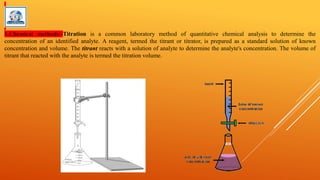
1.Chemical methods:-Titration is a common laboratory method of quantitative chemical analysis to determine the
concentration of an identified analyte. A reagent, termed the titrant or titrator, is prepared as a standard solution of known
concentration and volume. The titrant reacts with a solution of analyte to determine the analyte's concentration. The volume of
titrant that reacted with the analyte is termed the titration volume.
a)Titrimetric or volumetric method:-
It involves reaction of substance to be determined with an appropriate reagent as a standard solution, and volume of solution
required to complete the reaction is determined. Volumetric methods require simple and less apparatus and they are susceptible of
high accuracy.
Various types of titrimetric methods are:
i)Acid-base titrations (neutralization reactions)
ii)Complexometric titrations
iii)Precipitation titrations
iv)Oxidation reduction titrations
v)Non aqueous titrations
b)Gravimetric methods:-
In gravimetric analysis, a substance to be determined is converted into an insoluble precipitate in the purest form, which is then
collected and weighed. It is the time consuming process.
In electrogravimetry, electrolysis of the sample is carried out on the electrodes is weighed after drying.
Thermogravimetry (TG) records the change in weight, differential thermal analysis (DTA) records the difference in temperature
between test substance and an inert reference material, differential scanning calorimetry (DSC) records the energy needed to
establish a zero temperature difference between a test substance and reference material.
c)Gasometric analysis:-
Gasometry involves measurement of the volume of gas evolved or absorbed in a chemical reaction.
Some of the gases which are analyzed by Gasometry are CO2 , N2O,cyclopropane, amyl nitrate, ethylene, N2, helium etc.
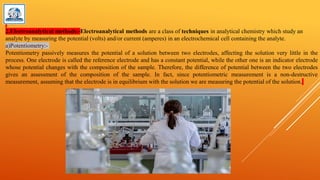
2.Electroanalytical methods:-Electroanalytical methods are a class of techniques in analytical chemistry which study an
analyte by measuring the potential (volts) and/or current (amperes) in an electrochemical cell containing the analyte.
a)Potentiometry:-
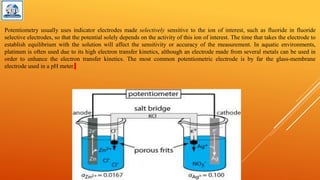
Potentiometry passively measures the potential of a solution between two electrodes, affecting the solution very little in the
process. One electrode is called the reference electrode and has a constant potential, while the other one is an indicator electrode
whose potential changes with the composition of the sample. Therefore, the difference of potential between the two electrodes
gives an assessment of the composition of the sample. In fact, since potentiometric measurement is a non-destructive
measurement, assuming that the electrode is in equilibrium with the solution we are measuring the potential of the solution.
Potentiometry usually uses indicator electrodes made selectively sensitive to the ion of interest, such as fluoride in fluoride
selective electrodes, so that the potential solely depends on the activity of this ion of interest. The time that takes the electrode to
establish equilibrium with the solution will affect the sensitivity or accuracy of the measurement. In aquatic environments,
platinum is often used due to its high electron transfer kinetics, although an electrode made from several metals can be used in
order to enhance the electron transfer kinetics. The most common potentiometric electrode is by far the glass-membrane
electrode used in a pH meter.
b) Voltammetry:-
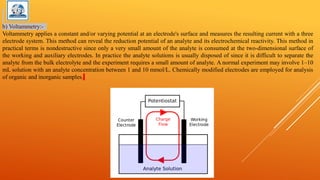
Voltammetry applies a constant and/or varying potential at an electrode's surface and measures the resulting current with a three
electrode system. This method can reveal the reduction potential of an analyte and its electrochemical reactivity. This method in
practical terms is nondestructive since only a very small amount of the analyte is consumed at the two-dimensional surface of
the working and auxiliary electrodes. In practice the analyte solutions is usually disposed of since it is difficult to separate the
analyte from the bulk electrolyte and the experiment requires a small amount of analyte. A normal experiment may involve 1–10
mL solution with an analyte concentration between 1 and 10 mmol/L. Chemically modified electrodes are employed for analysis
of organic and inorganic samples.
c) Coulometry:-
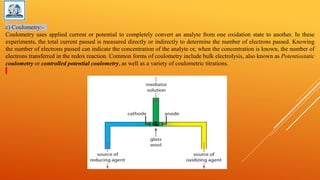
Coulometry uses applied current or potential to completely convert an analyte from one oxidation state to another. In these
experiments, the total current passed is measured directly or indirectly to determine the number of electrons passed. Knowing
the number of electrons passed can indicate the concentration of the analyte or, when the concentration is known, the number of
electrons transferred in the redox reaction. Common forms of coulometry include bulk electrolysis, also known as Potentiostatic
coulometry or controlled potential coulometry, as well as a variety of coulometric titrations.
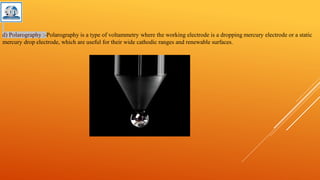
d) Polarography :-Polarography is a type of voltammetry where the working electrode is a dropping mercury electrode or a static
mercury drop electrode, which are useful for their wide cathodic ranges and renewable surfaces.
3. Spectroscopy:-
Spectroscopy is the study of the interaction between matter and electromagnetic radiation as a function of the wavelength
or frequency of the radiation. Classification of spectroscopy are follows as:-
1.Spectrophotometry
2.Near infrared spectroscopy (NIRS)
3.Nuclear magnetic resonance (NMR)
4.Fluorimetry and Phosphorimetry
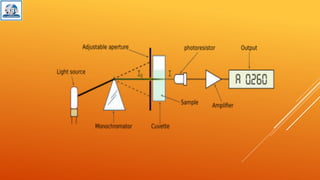
1.Spectrophotometry:-Spectrophotometry is a branch of electromagnetic spectroscopy concerned with the quantitative
measurement of the reflection or transmission properties of a material as a function of wavelength. Spectrophotometry
uses photometers, known as spectrophotometers, that can measure the intensity of a light beam at different wavelengths. Although
spectrophotometry is most commonly applied to ultraviolet, visible, and infrared radiation, modern spectrophotometers can
interrogate wide swaths of the electromagnetic spectrum, including x-ray, ultraviolet, visible, infrared, and/or microwave
wavelengths.
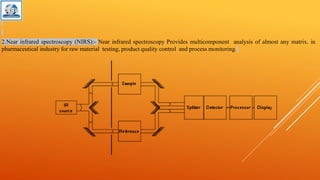
2.Near infrared spectroscopy (NIRS):- Near infrared spectroscopy Provides multicomponent analysis of almost any matrix. in
pharmaceutical industry for raw material testing, product quality control and process monitoring.
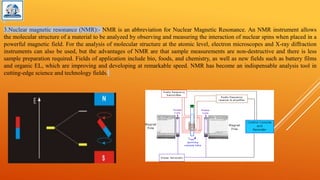
3.Nuclear magnetic resonance (NMR):- NMR is an abbreviation for Nuclear Magnetic Resonance. An NMR instrument allows
the molecular structure of a material to be analyzed by observing and measuring the interaction of nuclear spins when placed in a
powerful magnetic field. For the analysis of molecular structure at the atomic level, electron microscopes and X-ray diffraction
instruments can also be used, but the advantages of NMR are that sample measurements are non-destructive and there is less
sample preparation required. Fields of application include bio, foods, and chemistry, as well as new fields such as battery films
and organic EL, which are improving and developing at remarkable speed. NMR has become an indispensable analysis tool in
cutting-edge science and technology fields.
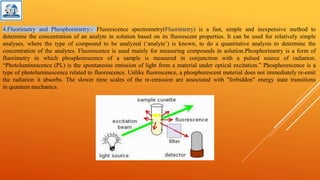
4.Fluorimetry and Phosphorimetry:- Fluorescence spectrometry(Fluorimetry) is a fast, simple and inexpensive method to
determine the concentration of an analyte in solution based on its fluorescent properties. It can be used for relatively simple
analyses, where the type of compound to be analyzed (‘analyte’) is known, to do a quantitative analysis to determine the
concentration of the analytes. Fluorescence is used mainly for measuring compounds in solution.Phosphorimetry is a form of
fluorimetry in which phosphorescence of a sample is measured in conjunction with a pulsed source of radiation.
“Photoluminescence (PL) is the spontaneous emission of light from a material under optical excitation.” Phosphorescence is a
type of photoluminescence related to fluorescence. Unlike fluorescence, a phosphorescent material does not immediately re-emit
the radiation it absorbs. The slower time scales of the re-emission are associated with "forbidden" energy state transitions
in quantum mechanics.
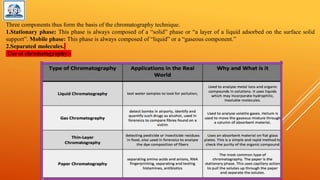
4. Chromatography:- Chromatography is a laboratory technique for the separation of a mixture. The mixture is dissolved in a
fluid (gas, solvent, water, ) called the mobile phase which carries it through a system (a column, a capillary tube, a plate, or a
sheet) on which is fixed a material called the stationary phase.
Three components thus form the basis of the chromatography technique.
1.Stationary phase: This phase is always composed of a “solid” phase or “a layer of a liquid adsorbed on the surface solid
support”. Mobile phase: This phase is always composed of “liquid” or a “gaseous component.”
2.Separated molecules.
Use of chromatography:-
Thank you

Different techniques of pharmaceutical analysis

  • 1.
    Neelima Yadav Assitant Professor Dr.C.V. Raman Intitute Of Pharmacy Bilaspur,(C.G.) Different techniques of analysis
  • 2.
    ANALYTICAL TECHNIQUES:- The “analyticaltechnique” is a method that is used to determine a chemical or physical property of a chemical substance, chemical element, or mixture. There are a wide variety of techniques used for analysis, from simple weighing (gravimetric analysis) to titrations (titrimetric) to very advanced techniques using highly specialized instrumentation. The most common techniques used in analytical chemistry are the following:- 1.Chemical methods:- a)Titrimetric or volumetric method b)Gravimetric methods c)Gasometric analysis 2.Electroanalytical methods:- a)Potentiometry b) Voltammetry c) Coulometry d) Polarography 3. Spectroscopy 4. Chromatography
  • 3.
    1.Chemical methods:-Titration isa common laboratory method of quantitative chemical analysis to determine the concentration of an identified analyte. A reagent, termed the titrant or titrator, is prepared as a standard solution of known concentration and volume. The titrant reacts with a solution of analyte to determine the analyte's concentration. The volume of titrant that reacted with the analyte is termed the titration volume.
  • 4.
    a)Titrimetric or volumetricmethod:- It involves reaction of substance to be determined with an appropriate reagent as a standard solution, and volume of solution required to complete the reaction is determined. Volumetric methods require simple and less apparatus and they are susceptible of high accuracy. Various types of titrimetric methods are: i)Acid-base titrations (neutralization reactions) ii)Complexometric titrations iii)Precipitation titrations iv)Oxidation reduction titrations v)Non aqueous titrations b)Gravimetric methods:- In gravimetric analysis, a substance to be determined is converted into an insoluble precipitate in the purest form, which is then collected and weighed. It is the time consuming process. In electrogravimetry, electrolysis of the sample is carried out on the electrodes is weighed after drying. Thermogravimetry (TG) records the change in weight, differential thermal analysis (DTA) records the difference in temperature between test substance and an inert reference material, differential scanning calorimetry (DSC) records the energy needed to establish a zero temperature difference between a test substance and reference material. c)Gasometric analysis:- Gasometry involves measurement of the volume of gas evolved or absorbed in a chemical reaction. Some of the gases which are analyzed by Gasometry are CO2 , N2O,cyclopropane, amyl nitrate, ethylene, N2, helium etc.
  • 5.
    2.Electroanalytical methods:-Electroanalytical methodsare a class of techniques in analytical chemistry which study an analyte by measuring the potential (volts) and/or current (amperes) in an electrochemical cell containing the analyte. a)Potentiometry:- Potentiometry passively measures the potential of a solution between two electrodes, affecting the solution very little in the process. One electrode is called the reference electrode and has a constant potential, while the other one is an indicator electrode whose potential changes with the composition of the sample. Therefore, the difference of potential between the two electrodes gives an assessment of the composition of the sample. In fact, since potentiometric measurement is a non-destructive measurement, assuming that the electrode is in equilibrium with the solution we are measuring the potential of the solution.
  • 6.
    Potentiometry usually usesindicator electrodes made selectively sensitive to the ion of interest, such as fluoride in fluoride selective electrodes, so that the potential solely depends on the activity of this ion of interest. The time that takes the electrode to establish equilibrium with the solution will affect the sensitivity or accuracy of the measurement. In aquatic environments, platinum is often used due to its high electron transfer kinetics, although an electrode made from several metals can be used in order to enhance the electron transfer kinetics. The most common potentiometric electrode is by far the glass-membrane electrode used in a pH meter.
  • 7.
    b) Voltammetry:- Voltammetry appliesa constant and/or varying potential at an electrode's surface and measures the resulting current with a three electrode system. This method can reveal the reduction potential of an analyte and its electrochemical reactivity. This method in practical terms is nondestructive since only a very small amount of the analyte is consumed at the two-dimensional surface of the working and auxiliary electrodes. In practice the analyte solutions is usually disposed of since it is difficult to separate the analyte from the bulk electrolyte and the experiment requires a small amount of analyte. A normal experiment may involve 1–10 mL solution with an analyte concentration between 1 and 10 mmol/L. Chemically modified electrodes are employed for analysis of organic and inorganic samples.
  • 8.
    c) Coulometry:- Coulometry usesapplied current or potential to completely convert an analyte from one oxidation state to another. In these experiments, the total current passed is measured directly or indirectly to determine the number of electrons passed. Knowing the number of electrons passed can indicate the concentration of the analyte or, when the concentration is known, the number of electrons transferred in the redox reaction. Common forms of coulometry include bulk electrolysis, also known as Potentiostatic coulometry or controlled potential coulometry, as well as a variety of coulometric titrations.
  • 9.
    d) Polarography :-Polarographyis a type of voltammetry where the working electrode is a dropping mercury electrode or a static mercury drop electrode, which are useful for their wide cathodic ranges and renewable surfaces.
  • 10.
    3. Spectroscopy:- Spectroscopy isthe study of the interaction between matter and electromagnetic radiation as a function of the wavelength or frequency of the radiation. Classification of spectroscopy are follows as:- 1.Spectrophotometry 2.Near infrared spectroscopy (NIRS) 3.Nuclear magnetic resonance (NMR) 4.Fluorimetry and Phosphorimetry 1.Spectrophotometry:-Spectrophotometry is a branch of electromagnetic spectroscopy concerned with the quantitative measurement of the reflection or transmission properties of a material as a function of wavelength. Spectrophotometry uses photometers, known as spectrophotometers, that can measure the intensity of a light beam at different wavelengths. Although spectrophotometry is most commonly applied to ultraviolet, visible, and infrared radiation, modern spectrophotometers can interrogate wide swaths of the electromagnetic spectrum, including x-ray, ultraviolet, visible, infrared, and/or microwave wavelengths.
  • 12.
    2.Near infrared spectroscopy(NIRS):- Near infrared spectroscopy Provides multicomponent analysis of almost any matrix. in pharmaceutical industry for raw material testing, product quality control and process monitoring.
  • 13.
    3.Nuclear magnetic resonance(NMR):- NMR is an abbreviation for Nuclear Magnetic Resonance. An NMR instrument allows the molecular structure of a material to be analyzed by observing and measuring the interaction of nuclear spins when placed in a powerful magnetic field. For the analysis of molecular structure at the atomic level, electron microscopes and X-ray diffraction instruments can also be used, but the advantages of NMR are that sample measurements are non-destructive and there is less sample preparation required. Fields of application include bio, foods, and chemistry, as well as new fields such as battery films and organic EL, which are improving and developing at remarkable speed. NMR has become an indispensable analysis tool in cutting-edge science and technology fields.
  • 14.
    4.Fluorimetry and Phosphorimetry:-Fluorescence spectrometry(Fluorimetry) is a fast, simple and inexpensive method to determine the concentration of an analyte in solution based on its fluorescent properties. It can be used for relatively simple analyses, where the type of compound to be analyzed (‘analyte’) is known, to do a quantitative analysis to determine the concentration of the analytes. Fluorescence is used mainly for measuring compounds in solution.Phosphorimetry is a form of fluorimetry in which phosphorescence of a sample is measured in conjunction with a pulsed source of radiation. “Photoluminescence (PL) is the spontaneous emission of light from a material under optical excitation.” Phosphorescence is a type of photoluminescence related to fluorescence. Unlike fluorescence, a phosphorescent material does not immediately re-emit the radiation it absorbs. The slower time scales of the re-emission are associated with "forbidden" energy state transitions in quantum mechanics.
  • 15.
    4. Chromatography:- Chromatographyis a laboratory technique for the separation of a mixture. The mixture is dissolved in a fluid (gas, solvent, water, ) called the mobile phase which carries it through a system (a column, a capillary tube, a plate, or a sheet) on which is fixed a material called the stationary phase.
  • 16.
    Three components thusform the basis of the chromatography technique. 1.Stationary phase: This phase is always composed of a “solid” phase or “a layer of a liquid adsorbed on the surface solid support”. Mobile phase: This phase is always composed of “liquid” or a “gaseous component.” 2.Separated molecules. Use of chromatography:-
  • 17.