Program: B. Pharmacy
Class: First Year
Semester : I
Course: Pharmaceutical Analysis-I
Sub Code: BP102T
Unit: I
Lecture 01: Introduction to Analysis
1
 PharmaceuticalAnalysis may be defined as the application of analytical
procedures used to determine the purity, safety and quality of drugs and
chemicals
 Pharmaceutical analysis is a branch of practical chemistry that involves a
series of process for identification, determination, quantification and
purification of a substance, separation of the components of a solution or
mixture, or determination of structure of chemical compounds.
 The substance may be a single compound or a mixture of
compounds and it may be in any of the dosage form.
 The substance used as pharmaceuticals are animals, plants, micro
organisms, minerals and various synthetic products.
2
 Objectives
 Upon completion of the course a student shall be able to understand –
 The principles of volumetric and electrochemical analysis.
 Carry out various volumetric and electrochemical titrations.
 Develop analytical skills.
3
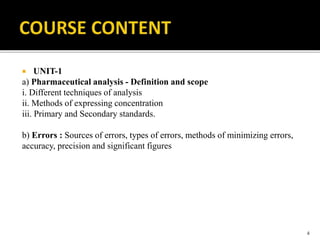
 UNIT-1
a) Pharmaceutical analysis - Definition and scope
i. Different techniques of analysis
ii. Methods of expressing concentration
iii. Primary and Secondary standards.
b) Errors : Sources of errors, types of errors, methods of minimizing errors,
accuracy, precision and significant figures
4
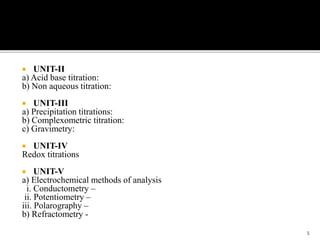
 UNIT-II
a) Acid base titration:
b) Non aqueous titration:
 UNIT-III
a) Precipitation titrations:
b) Complexometric titration:
c) Gravimetry:
 UNIT-IV
Redox titrations
 UNIT-V
a) Electrochemical methods of analysis
i. Conductometry –
ii. Potentiometry –
iii. Polarography –
b) Refractometry -
5
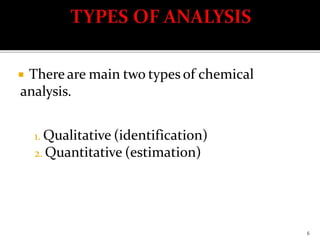
 There are main two types of chemical
analysis.
1. Qualitative (identification)
2. Quantitative (estimation)
6
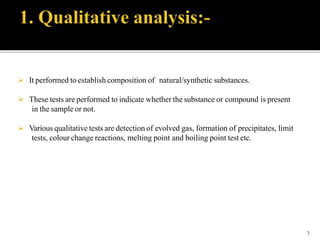
 It performed to establish composition of natural/synthetic substances.
 These tests are performed to indicate whether the substance or compound is present
in the sample or not.
 Various qualitative tests are detection of evolved gas, formation of precipitates, limit
tests, colour change reactions, melting point and boiling point test etc.
7
These techniques are mainly used to quantify any compound or substance
in the sample.
 These techniques are based in:-
 The quantitative performance of suitable chemical reaction and either
measuring the amount of reagent added to complete the reaction or
measuring the amount of reaction product obtained
 The charactaristic movement of a substance through a defined medium
under controlled conditions.
 Electrical measurement
 Measurement of some spectroscopic properties of the compound.
8
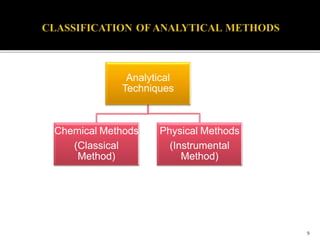
Analytical
Techniques
Chemical Methods
(Classical
Method)
Physical Methods
(Instrumental
Method)
9
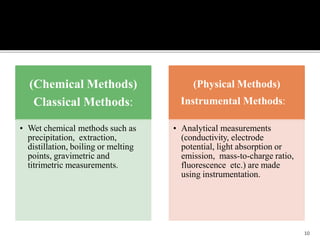
(Chemical Methods)
Classical Methods:
• Wet chemical methods such as
precipitation, extraction,
distillation, boiling or melting
points, gravimetric and
titrimetric measurements.
(Physical Methods)
Instrumental Methods:
• Analytical measurements
(conductivity, electrode
potential, light absorption or
emission, mass-to-charge ratio,
fluorescence etc.) are made
using instrumentation.
10
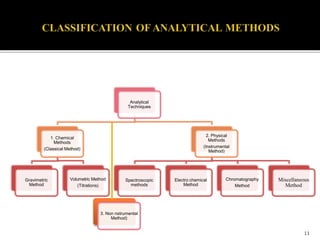
Analytical
Techniques
1. Chemical
Methods
(Classical Method)
Gravimetric
Method
Volumetric Method
(Titrations)
2. Physical
Methods
(Instrumental
Method)
Spectroscopic
methods
Electro chemical
Method
Chromatography
Method
Miscellaneous
Method
3. Non nstrumental
Method)
11
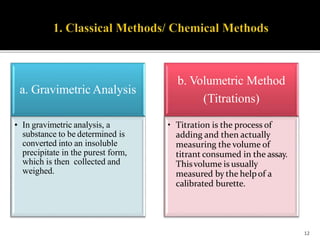
a. Gravimetric Analysis
• In gravimetric analysis, a
substance to be determined is
converted into an insoluble
precipitate in the purest form,
which is then collected and
weighed.
b. Volumetric Method
(Titrations)
• Titration is the process of
adding and then actually
measuring the volume of
titrant consumed in the assay.
Thisvolume is usually
measured by the helpof a
calibrated burette.
12
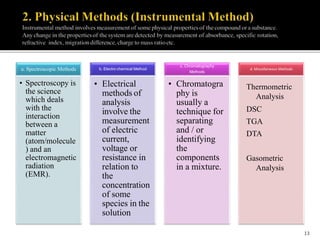
a. Spectroscopic Methods
• Spectroscopy is
the science
which deals
with the
interaction
between a
matter
(atom/molecule
) and an
electromagnetic
radiation
(EMR).
b. Electro chemical Method
• Electrical
methods of
analysis
involve the
measurement
of electric
current,
voltage or
resistance in
relation to
the
concentration
of some
species in the
solution
c. Chromatography
Methods
• Chromatogra
phy is
usually a
technique for
separating
and / or
identifying
the
components
in a mixture.
d. Miscellaneous Methods
Thermometric
Analysis
DSC
TGA
DTA
Gasometric
Analysis
13
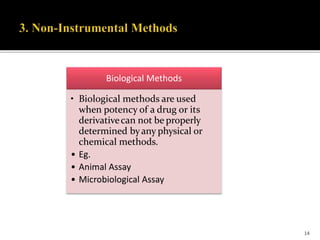
Biological Methods
• Biological methods are used
when potency of a drug or its
derivativecan not be properly
determined byany physical or
chemical methods.
• Eg.
• Animal Assay
• Microbiological Assay
14
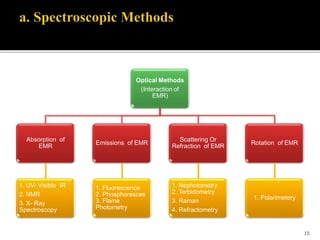
Optical Methods
(Interaction of
EMR)
Absorption of
EMR
1. UV- Visible IR
2. NMR
3. X- Ray
Spectroscopy
Emissions of EMR
1. Fluorescence
2. Phosphoresces
3. Flame
Photometry
Scattering Or
Refraction of EMR
1. Nepholometry
2. Terbidometry
3. Raman
4. Refractometry
Rotation of EMR
1. Polarimetery
15
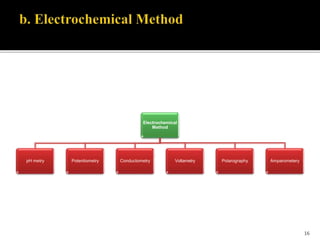
Electrochemical
Method
pH metry Potentiometry Conductometry Voltametry Polarography Amparometery
16
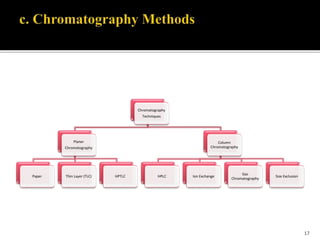
Chromatography
Techniques
Planer
Chromatography
Paper Thin Layer (TLC) HPTLC
Column
Chromatography
HPLC Ion Exchange
Gas
Chromatography
Size Exclusion
17
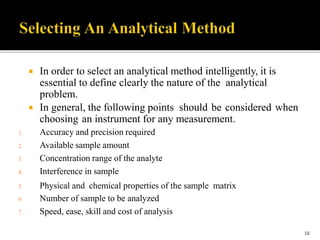
 In order to select an analytical method intelligently, it is
essential to define clearly the nature of the analytical
problem.
 In general, the following points should be considered when
choosing an instrument for any measurement.
1. Accuracy and precision required
2. Available sample amount
3. Concentration range of the analyte
4. Interference in sample
5. Physical and chemical properties of the sample matrix
6. Number of sample to be analyzed
7. Speed, ease, skill and cost of analysis
18
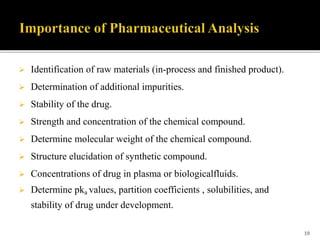
 Identification of raw materials (in-process and finished product).
 Determination of additional impurities.
 Stability of the drug.
 Strength and concentration of the chemical compound.
 Determine molecular weight of the chemical compound.
 Structure elucidation of synthetic compound.
 Concentrations of drug in plasma or biologicalfluids.
 Determine pka values, partition coefficients , solubilities, and
stability of drug under development.
19
1. Clinical analysis - blood, urine, feces, cellular fluids, etc., for use in diagnosis.
2. Pharmaceutical analysis - establish the physical properties, toxicity,
metabolites, quality control, etc.
3. Environmental analysis - pollutants, soil and water analysis,
pesticides.
4. Forensic analysis - analysis related to criminology; DNA finger printing,
finger print detection; blood analysis.
5. Industrial quality control - required by most companies to control product
quality.
6. Bioanalytical chemistry and analysis - detection and/or analysis of
biological components (i.e., proteins, DNA, RNA, carbohydrates,
metabolites, etc.).
20
1. Mahadik K. R., Wadodkar S.G., More H. N, Pharmaceutical
Analysis, Vol. I and II, Nirali Prakashan.
2. Kar Ashutosh, Pharmaceutical Drug Analysis, Minerva
Press, New Delhi.
3. Day R. A. & Underwood A. L. Quantitative Analysis. 5/Ed.,
Prentice Hall of India Pvt.Ltd. New Delhi.
4. Skoog, A. D. West, D. M. et al. Fundamentals of Analytical
Chemistry. 8/ Ed. Thomson Brookslcole.
5. Willard Merit. Dean Settle, Instrumental Methods of
Analysis, 7/Ed, CBS Publisher & Distributor.
6. Sharma, B. K. Instrumental Methods of Chemical Analysis,
Goel Publishing House.
21
22

Ppt 1 introduction to analysis

  • 1.
    Program: B. Pharmacy Class:First Year Semester : I Course: Pharmaceutical Analysis-I Sub Code: BP102T Unit: I Lecture 01: Introduction to Analysis 1
  • 2.
     PharmaceuticalAnalysis maybe defined as the application of analytical procedures used to determine the purity, safety and quality of drugs and chemicals  Pharmaceutical analysis is a branch of practical chemistry that involves a series of process for identification, determination, quantification and purification of a substance, separation of the components of a solution or mixture, or determination of structure of chemical compounds.  The substance may be a single compound or a mixture of compounds and it may be in any of the dosage form.  The substance used as pharmaceuticals are animals, plants, micro organisms, minerals and various synthetic products. 2
  • 3.
     Objectives  Uponcompletion of the course a student shall be able to understand –  The principles of volumetric and electrochemical analysis.  Carry out various volumetric and electrochemical titrations.  Develop analytical skills. 3
  • 4.
     UNIT-1 a) Pharmaceuticalanalysis - Definition and scope i. Different techniques of analysis ii. Methods of expressing concentration iii. Primary and Secondary standards. b) Errors : Sources of errors, types of errors, methods of minimizing errors, accuracy, precision and significant figures 4
  • 5.
     UNIT-II a) Acidbase titration: b) Non aqueous titration:  UNIT-III a) Precipitation titrations: b) Complexometric titration: c) Gravimetry:  UNIT-IV Redox titrations  UNIT-V a) Electrochemical methods of analysis i. Conductometry – ii. Potentiometry – iii. Polarography – b) Refractometry - 5
  • 6.
     There aremain two types of chemical analysis. 1. Qualitative (identification) 2. Quantitative (estimation) 6
  • 7.
     It performedto establish composition of natural/synthetic substances.  These tests are performed to indicate whether the substance or compound is present in the sample or not.  Various qualitative tests are detection of evolved gas, formation of precipitates, limit tests, colour change reactions, melting point and boiling point test etc. 7
  • 8.
    These techniques aremainly used to quantify any compound or substance in the sample.  These techniques are based in:-  The quantitative performance of suitable chemical reaction and either measuring the amount of reagent added to complete the reaction or measuring the amount of reaction product obtained  The charactaristic movement of a substance through a defined medium under controlled conditions.  Electrical measurement  Measurement of some spectroscopic properties of the compound. 8
  • 9.
  • 10.
    (Chemical Methods) Classical Methods: •Wet chemical methods such as precipitation, extraction, distillation, boiling or melting points, gravimetric and titrimetric measurements. (Physical Methods) Instrumental Methods: • Analytical measurements (conductivity, electrode potential, light absorption or emission, mass-to-charge ratio, fluorescence etc.) are made using instrumentation. 10
  • 11.
    Analytical Techniques 1. Chemical Methods (Classical Method) Gravimetric Method VolumetricMethod (Titrations) 2. Physical Methods (Instrumental Method) Spectroscopic methods Electro chemical Method Chromatography Method Miscellaneous Method 3. Non nstrumental Method) 11
  • 12.
    a. Gravimetric Analysis •In gravimetric analysis, a substance to be determined is converted into an insoluble precipitate in the purest form, which is then collected and weighed. b. Volumetric Method (Titrations) • Titration is the process of adding and then actually measuring the volume of titrant consumed in the assay. Thisvolume is usually measured by the helpof a calibrated burette. 12
  • 13.
    a. Spectroscopic Methods •Spectroscopy is the science which deals with the interaction between a matter (atom/molecule ) and an electromagnetic radiation (EMR). b. Electro chemical Method • Electrical methods of analysis involve the measurement of electric current, voltage or resistance in relation to the concentration of some species in the solution c. Chromatography Methods • Chromatogra phy is usually a technique for separating and / or identifying the components in a mixture. d. Miscellaneous Methods Thermometric Analysis DSC TGA DTA Gasometric Analysis 13
  • 14.
    Biological Methods • Biologicalmethods are used when potency of a drug or its derivativecan not be properly determined byany physical or chemical methods. • Eg. • Animal Assay • Microbiological Assay 14
  • 15.
    Optical Methods (Interaction of EMR) Absorptionof EMR 1. UV- Visible IR 2. NMR 3. X- Ray Spectroscopy Emissions of EMR 1. Fluorescence 2. Phosphoresces 3. Flame Photometry Scattering Or Refraction of EMR 1. Nepholometry 2. Terbidometry 3. Raman 4. Refractometry Rotation of EMR 1. Polarimetery 15
  • 16.
    Electrochemical Method pH metry PotentiometryConductometry Voltametry Polarography Amparometery 16
  • 17.
    Chromatography Techniques Planer Chromatography Paper Thin Layer(TLC) HPTLC Column Chromatography HPLC Ion Exchange Gas Chromatography Size Exclusion 17
  • 18.
     In orderto select an analytical method intelligently, it is essential to define clearly the nature of the analytical problem.  In general, the following points should be considered when choosing an instrument for any measurement. 1. Accuracy and precision required 2. Available sample amount 3. Concentration range of the analyte 4. Interference in sample 5. Physical and chemical properties of the sample matrix 6. Number of sample to be analyzed 7. Speed, ease, skill and cost of analysis 18
  • 19.
     Identification ofraw materials (in-process and finished product).  Determination of additional impurities.  Stability of the drug.  Strength and concentration of the chemical compound.  Determine molecular weight of the chemical compound.  Structure elucidation of synthetic compound.  Concentrations of drug in plasma or biologicalfluids.  Determine pka values, partition coefficients , solubilities, and stability of drug under development. 19
  • 20.
    1. Clinical analysis- blood, urine, feces, cellular fluids, etc., for use in diagnosis. 2. Pharmaceutical analysis - establish the physical properties, toxicity, metabolites, quality control, etc. 3. Environmental analysis - pollutants, soil and water analysis, pesticides. 4. Forensic analysis - analysis related to criminology; DNA finger printing, finger print detection; blood analysis. 5. Industrial quality control - required by most companies to control product quality. 6. Bioanalytical chemistry and analysis - detection and/or analysis of biological components (i.e., proteins, DNA, RNA, carbohydrates, metabolites, etc.). 20
  • 21.
    1. Mahadik K.R., Wadodkar S.G., More H. N, Pharmaceutical Analysis, Vol. I and II, Nirali Prakashan. 2. Kar Ashutosh, Pharmaceutical Drug Analysis, Minerva Press, New Delhi. 3. Day R. A. & Underwood A. L. Quantitative Analysis. 5/Ed., Prentice Hall of India Pvt.Ltd. New Delhi. 4. Skoog, A. D. West, D. M. et al. Fundamentals of Analytical Chemistry. 8/ Ed. Thomson Brookslcole. 5. Willard Merit. Dean Settle, Instrumental Methods of Analysis, 7/Ed, CBS Publisher & Distributor. 6. Sharma, B. K. Instrumental Methods of Chemical Analysis, Goel Publishing House. 21
  • 22.