Presented By :- Miss. Rahee B Chougule
Assistant Professor
Department of Pharmaceutical Chemistry
 Assay:- is an investigative (analytic) procedure in Laboratory for
qualitatively assessing or quantitatively measuring the presence, amount,
or functional activity of a target entity (the analyte).
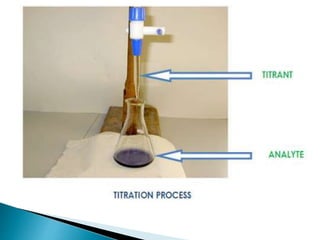
 Analyte:- It is the chemical entity under assay e.g., HCl.
 Titrant:- It is the solution of known strength (or concentration) employed
in the assay e.g., NaOH.
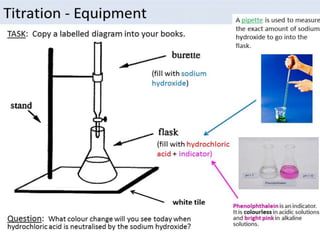
 Titration:- is the process of adding and then actually measuring the
volume of Titrant consumed in the assay. This volume is usually measured
by the help of a calibrated burette.
Basics of Analysis
 Indicator:-is a chemical substance sensitive enough to display an apparent
change in colour very close to the point in the on going titration process at which
equivalent quantities of analyte and titrant. E.g. Methylene blue
 Equivalence Point (or StoichiometricPoint):-is the point at which one species
neutralize the opposite species or is visibly spotted by the use of indicators.
example The point at which Acid neutralize the base is Equivalence Point.
End point :-The point at which color start to change during titration process.
Titration Error:-Difference between end point and equivalent point is called
Titration Error.
Standardization :-is the actual determination of either the normality or the
molarity of a solution.
Primary Standard is the substance of known purity (‘AnalaR’-grade reagents)
whose carefully weighed quantity helps in the standardization of an unknown
solution. E.g.. Na2CO3
Secondary Standard is another standard solution that is used for standardization of
an unknown solution. e.g.:-NaOH
Titer is the weight of a substance chemically equivalent to 1 ml of a standard
solution.
 Example : 1 ml of 1 N HCl contains 0.03646 g of HCl and hence is chemically
equivalent to 0.04000 g of NaOH.
Pharmaceutical analysis is a branch of chemistry that
involves a series of process for identification,
determination, quantification and purification of a
substance, separation of the components of a solution
or mixture, or determination of structure of chemical
compounds.
Pharmaceutical analysis
1. Manufacturing:- Impurities require both qualitative and
quantitative analysis
2. Raw materials to be checked to ensure that the essential
components are present within predominant range. Also to check
impurities which do not exceed than certain specified limit.
3. Geographical surveys require analysis to determine the
composition of soil sample and numerous rock samples collected
from the field.
4. Analysis of air, water and soil sample should be carried out to
determine the level of pollution
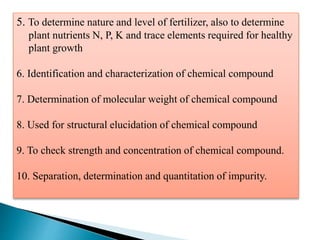
5. To determine nature and level of fertilizer, also to determine
plant nutrients N, P, K and trace elements required for healthy
plant growth
6. Identification and characterization of chemical compound
7. Determination of molecular weight of chemical compound
8. Used for structural elucidation of chemical compound
9. To check strength and concentration of chemical compound.
10. Separation, determination and quantitation of impurity.
 There are main two types of techniques analysis.
1. Qualitative (identification)
2. Quantitative (estimation)
Different techniques of
Analysis
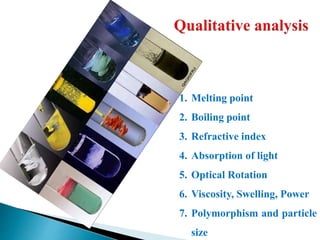
Qualitative analysis :-
is performed to establish composition of natural/synthetic
substances.
These tests are performed to indicate whether the substance or
compound is present in the sample or not.
Various qualitative tests are detection of evolved gas, formation
of precipitates, limit tests, color change reactions, melting point
and boiling point test etc.
It also gives information about identification of chemical
constituents i.e. Acidic/Basic/Neutral etc.
Quantitative analysis:-
Quantitative analytical techniques are mainly used to quantify
any compound or substance in the sample i.e. exactly how much.
In this analysis the amount concentration of an analyte may be
determined & expressed in a numerical value in appropriate units.
1. Melting point
2. Boiling point
3. Refractive index
4. Absorption of light
5. Optical Rotation
6. Viscosity, Swelling, Power
7. Polymorphism and particle
size
Quantitative analysis
1.Chemical methods
a) Volumetric or titrimetric methods
b) Gravimetric methods
c) Gasometric analysis
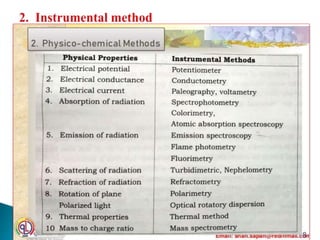
2.Electrical methods
3.Instrumental methods
4.Biological and microbiological
1. Macro Analysis-0.1g
2. Meso (Semi micro) Analysis-0.01 to 0.1g
3. Micro Analysis-0.001g to 0.01g
4. Submicro Analysis-0.0001g to 0.001g
5. Ultra-micro Analysis-0.0001g
The chemical analysis is classified on the basis of
sample size
Among all the semi micro analysis is widely used
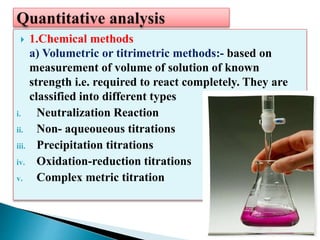
 1.Chemical methods
a) Volumetric or titrimetric methods:- based on
measurement of volume of solution of known
strength i.e. required to react completely. They are
classified into different types
i. Neutralization Reaction
ii. Non- aqueoueous titrations
iii. Precipitation titrations
iv. Oxidation-reduction titrations
v. Complex metric titration
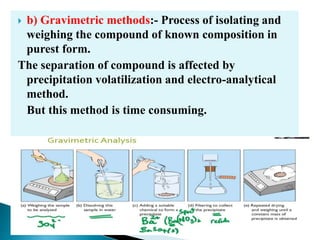
 b) Gravimetric methods:- Process of isolating and
weighing the compound of known composition in
purest form.
The separation of compound is affected by
precipitation volatilization and electro-analytical
method.
But this method is time consuming.
C)Gasometric method :- It involves
measurement of gases. They measure the
volume of gas liberated in a reaction .
Following gases are determined by
gasometrical analysis :- Cyclpropane, CO2,
NO2, O2, N2, Amyl nitrate etc.
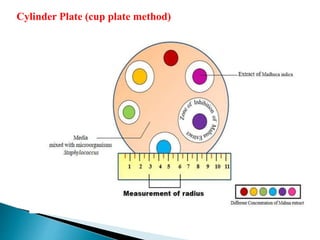
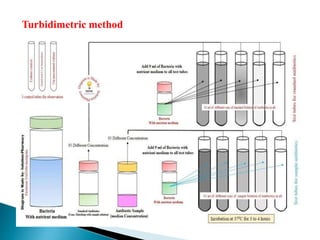
3. Microbiological Method:-
Microbiological methods are used to observe potency of
antibiotic or anti-microbial agents. In antimicrobial
assay, inhibition of growth of bacteria of the sample is
compared with that of the standard antibiotic. These
methods include
 Cylinder Plate (cup plate method)
 Turbidimetric method
Cylinder Plate (cup plate method)
Turbidimetric method
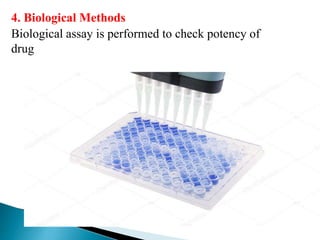
4. Biological Methods
Biological assay is performed to check potency of
drug
In all the techniques of quantitative analysis the use of solutions
requires some basis for the expression of solution concentration.
1. Percent Concentration
2. Parts per Million(PPM)
3. Parts per billion(PPB)
4. Molarity
5. Molality
6. Normality
7. Formal solutions
Methods of Expressing Concentrations
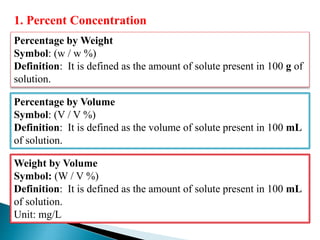
Percentage by Weight
Symbol: (w / w %)
Definition: It is defined as the amount of solute present in 100 g of
solution.
Percentage by Volume
Symbol: (V / V %)
Definition: It is defined as the volume of solute present in 100 mL
of solution.
Weight by Volume
Symbol: (W / V %)
Definition: It is defined as the amount of solute present in 100 mL
of solution.
Unit: mg/L
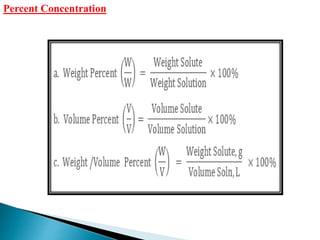
1. Percent Concentration
Percent Concentration
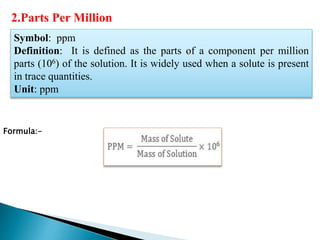
Symbol: ppm
Definition: It is defined as the parts of a component per million
parts (106) of the solution. It is widely used when a solute is present
in trace quantities.
Unit: ppm
Formula:-
2.Parts Per Million
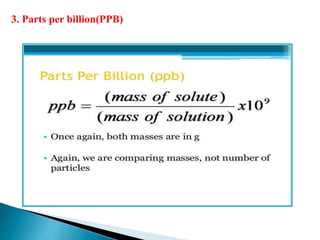
3. Parts per billion(PPB)
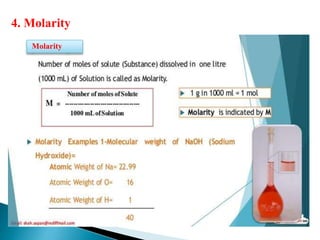
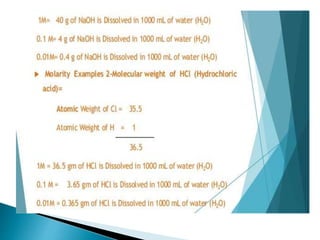
4. Molarity
Molarity
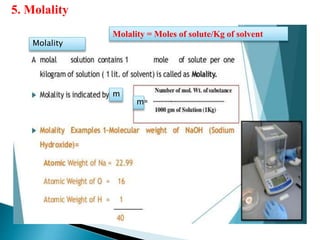
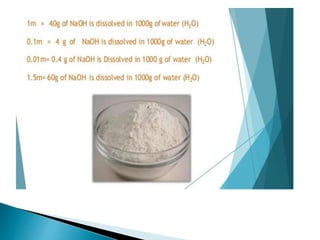
Molality
5. Molality
Molality = Moles of solute/Kg of solvent
m
m
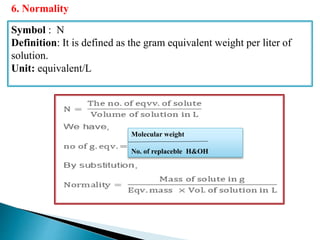
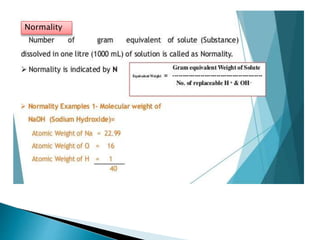
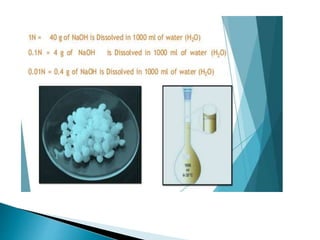
Symbol : N
Definition: It is defined as the gram equivalent weight per liter of
solution.
Unit: equivalent/L
6. Normality
Molecular weight
No. of replaceble H&OH
Normality
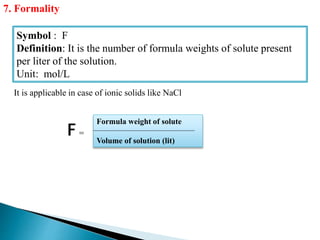
Symbol : F
Definition: It is the number of formula weights of solute present
per liter of the solution.
Unit: mol/L
It is applicable in case of ionic solids like NaCl
7. Formality
Formula weight of solute
Volume of solution (lit)
F =
Books Referred:-
1. Dr. H. N. More, Dr. K. R. Mahadik et al., “Pharmaceutical Analysis” volume – I.
2. Dr. K. S. Jain, Ms. D. K. Kadam et al., “Pharmaceutical Analysis” Niral
Publication.
Thank you

Defination & scope.pptx

  • 1.
    Presented By :-Miss. Rahee B Chougule Assistant Professor Department of Pharmaceutical Chemistry
  • 2.
     Assay:- isan investigative (analytic) procedure in Laboratory for qualitatively assessing or quantitatively measuring the presence, amount, or functional activity of a target entity (the analyte).  Analyte:- It is the chemical entity under assay e.g., HCl.  Titrant:- It is the solution of known strength (or concentration) employed in the assay e.g., NaOH.  Titration:- is the process of adding and then actually measuring the volume of Titrant consumed in the assay. This volume is usually measured by the help of a calibrated burette. Basics of Analysis
  • 5.
     Indicator:-is achemical substance sensitive enough to display an apparent change in colour very close to the point in the on going titration process at which equivalent quantities of analyte and titrant. E.g. Methylene blue  Equivalence Point (or StoichiometricPoint):-is the point at which one species neutralize the opposite species or is visibly spotted by the use of indicators. example The point at which Acid neutralize the base is Equivalence Point. End point :-The point at which color start to change during titration process. Titration Error:-Difference between end point and equivalent point is called Titration Error.
  • 6.
    Standardization :-is theactual determination of either the normality or the molarity of a solution. Primary Standard is the substance of known purity (‘AnalaR’-grade reagents) whose carefully weighed quantity helps in the standardization of an unknown solution. E.g.. Na2CO3 Secondary Standard is another standard solution that is used for standardization of an unknown solution. e.g.:-NaOH Titer is the weight of a substance chemically equivalent to 1 ml of a standard solution.  Example : 1 ml of 1 N HCl contains 0.03646 g of HCl and hence is chemically equivalent to 0.04000 g of NaOH.
  • 7.
    Pharmaceutical analysis isa branch of chemistry that involves a series of process for identification, determination, quantification and purification of a substance, separation of the components of a solution or mixture, or determination of structure of chemical compounds. Pharmaceutical analysis
  • 8.
    1. Manufacturing:- Impuritiesrequire both qualitative and quantitative analysis 2. Raw materials to be checked to ensure that the essential components are present within predominant range. Also to check impurities which do not exceed than certain specified limit. 3. Geographical surveys require analysis to determine the composition of soil sample and numerous rock samples collected from the field. 4. Analysis of air, water and soil sample should be carried out to determine the level of pollution
  • 9.
    5. To determinenature and level of fertilizer, also to determine plant nutrients N, P, K and trace elements required for healthy plant growth 6. Identification and characterization of chemical compound 7. Determination of molecular weight of chemical compound 8. Used for structural elucidation of chemical compound 9. To check strength and concentration of chemical compound. 10. Separation, determination and quantitation of impurity.
  • 10.
     There aremain two types of techniques analysis. 1. Qualitative (identification) 2. Quantitative (estimation) Different techniques of Analysis
  • 11.
    Qualitative analysis :- isperformed to establish composition of natural/synthetic substances. These tests are performed to indicate whether the substance or compound is present in the sample or not. Various qualitative tests are detection of evolved gas, formation of precipitates, limit tests, color change reactions, melting point and boiling point test etc. It also gives information about identification of chemical constituents i.e. Acidic/Basic/Neutral etc.
  • 12.
    Quantitative analysis:- Quantitative analyticaltechniques are mainly used to quantify any compound or substance in the sample i.e. exactly how much. In this analysis the amount concentration of an analyte may be determined & expressed in a numerical value in appropriate units.
  • 13.
    1. Melting point 2.Boiling point 3. Refractive index 4. Absorption of light 5. Optical Rotation 6. Viscosity, Swelling, Power 7. Polymorphism and particle size
  • 14.
    Quantitative analysis 1.Chemical methods a)Volumetric or titrimetric methods b) Gravimetric methods c) Gasometric analysis 2.Electrical methods 3.Instrumental methods 4.Biological and microbiological
  • 15.
    1. Macro Analysis-0.1g 2.Meso (Semi micro) Analysis-0.01 to 0.1g 3. Micro Analysis-0.001g to 0.01g 4. Submicro Analysis-0.0001g to 0.001g 5. Ultra-micro Analysis-0.0001g The chemical analysis is classified on the basis of sample size Among all the semi micro analysis is widely used
  • 16.
     1.Chemical methods a)Volumetric or titrimetric methods:- based on measurement of volume of solution of known strength i.e. required to react completely. They are classified into different types i. Neutralization Reaction ii. Non- aqueoueous titrations iii. Precipitation titrations iv. Oxidation-reduction titrations v. Complex metric titration

  • 17.
     b) Gravimetricmethods:- Process of isolating and weighing the compound of known composition in purest form. The separation of compound is affected by precipitation volatilization and electro-analytical method. But this method is time consuming.
  • 18.
    C)Gasometric method :-It involves measurement of gases. They measure the volume of gas liberated in a reaction . Following gases are determined by gasometrical analysis :- Cyclpropane, CO2, NO2, O2, N2, Amyl nitrate etc.
  • 20.
    3. Microbiological Method:- Microbiologicalmethods are used to observe potency of antibiotic or anti-microbial agents. In antimicrobial assay, inhibition of growth of bacteria of the sample is compared with that of the standard antibiotic. These methods include  Cylinder Plate (cup plate method)  Turbidimetric method
  • 21.
    Cylinder Plate (cupplate method)
  • 22.
  • 23.
    4. Biological Methods Biologicalassay is performed to check potency of drug
  • 24.
    In all thetechniques of quantitative analysis the use of solutions requires some basis for the expression of solution concentration. 1. Percent Concentration 2. Parts per Million(PPM) 3. Parts per billion(PPB) 4. Molarity 5. Molality 6. Normality 7. Formal solutions Methods of Expressing Concentrations
  • 25.
    Percentage by Weight Symbol:(w / w %) Definition: It is defined as the amount of solute present in 100 g of solution. Percentage by Volume Symbol: (V / V %) Definition: It is defined as the volume of solute present in 100 mL of solution. Weight by Volume Symbol: (W / V %) Definition: It is defined as the amount of solute present in 100 mL of solution. Unit: mg/L 1. Percent Concentration
  • 26.
  • 27.
    Symbol: ppm Definition: Itis defined as the parts of a component per million parts (106) of the solution. It is widely used when a solute is present in trace quantities. Unit: ppm Formula:- 2.Parts Per Million
  • 28.
    3. Parts perbillion(PPB)
  • 29.
  • 31.
    Molality 5. Molality Molality =Moles of solute/Kg of solvent m m
  • 33.
    Symbol : N Definition:It is defined as the gram equivalent weight per liter of solution. Unit: equivalent/L 6. Normality Molecular weight No. of replaceble H&OH
  • 34.
  • 36.
    Symbol : F Definition:It is the number of formula weights of solute present per liter of the solution. Unit: mol/L It is applicable in case of ionic solids like NaCl 7. Formality Formula weight of solute Volume of solution (lit) F =
  • 37.
    Books Referred:- 1. Dr.H. N. More, Dr. K. R. Mahadik et al., “Pharmaceutical Analysis” volume – I. 2. Dr. K. S. Jain, Ms. D. K. Kadam et al., “Pharmaceutical Analysis” Niral Publication.
  • 38.