CLASSIFICATION OF
ORGANIC
COMPOUNDS
By,
GRACE SHAJI CHITTILAPPILLY
ASSISTANT PROFESSOR
DEPT. OF PHARMACEUTICAL CHEMISTRY
KARPAGAM COLLEGE OF PHARMACY, COIMBATORE - 32
UNIT - I
“Classification of Organic
Compounds”
Organic compounds can be classified on the basis of following two ways:
1) On the basis of structure, and
2) On the basis of functional group
POC-I, Unit 1: Classification of Organic Compounds 2
On the Basis of Structure
POC-I, Unit 1: Classification of Organic Compounds 3
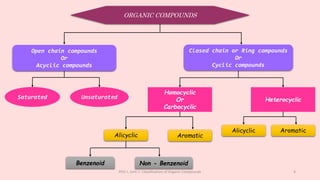
ORGANIC COMPOUNDS
Open chain compounds
Or
Acyclic compounds
Closed chain or Ring compounds
Or
Cyclic compounds
Saturated Unsaturated
Homocyclic
Or
Carbocyclic
Heterocyclic
Alicyclic Aromatic
Alicyclic Aromatic
Benzenoid Non - Benzenoid
POC-I, Unit 1: Classification of Organic Compounds 4
1. Acyclic or Open Chain Compound
oThese organic compounds have open chain skeleton.
o Its divided in to two types: Saturated and Unsaturated
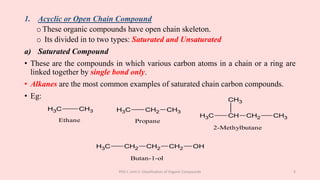
a) Saturated Compound
• These are the compounds in which various carbon atoms in a chain or a ring are
linked together by single bond only.
• Alkanes are the most common examples of saturated chain carbon compounds.
• Eg:
C
H3 CH3
Ethane
C
H3 CH2 CH3
C
H3 CH
CH3
CH2 CH3
C
H3 CH2 CH2 CH2 OH
Propane
2-Methylbutane
Butan-1-ol
POC-I, Unit 1: Classification of Organic Compounds 5
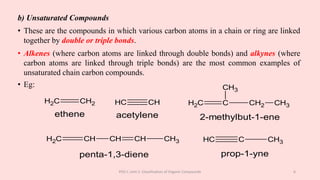
b) Unsaturated Compounds
• These are the compounds in which various carbon atoms in a chain or ring are linked
together by double or triple bonds.
• Alkenes (where carbon atoms are linked through double bonds) and alkynes (where
carbon atoms are linked through triple bonds) are the most common examples of
unsaturated chain carbon compounds.
• Eg:
POC-I, Unit 1: Classification of Organic Compounds 6
C
H2 CH2 C
H CH C
H2 C CH2 CH3
CH3
C
H2 CH CH CH CH3 C
H C CH3
ethene acetylene 2-methylbut-1-ene
penta-1,3-diene prop-1-yne
2. Cyclic or closed chain compounds
oThese are organic compounds have closed rings structure.
oThey are divided into two: Homocyclic or Carbocyclic compounds and
Heterocyclic compounds.
a) Homocyclic or Carbocyclic compounds
• In these organic compounds , the ring of compound has carbon atoms only.
• These compounds are further classified into:
(i) Alicyclic compounds
(ii) Aromatic compounds
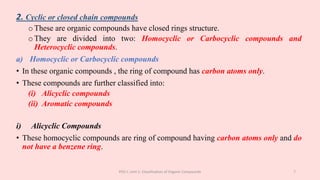
i) Alicyclic Compounds
• These homocyclic compounds are ring of compound having carbon atoms only and do
not have a benzene ring.
POC-I, Unit 1: Classification of Organic Compounds 7
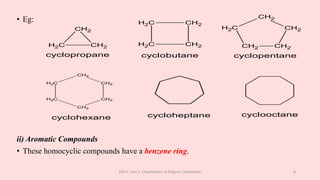
• Eg:
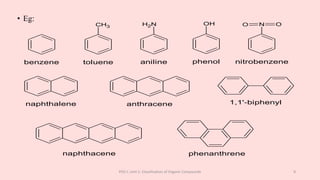
ii) Aromatic Compounds
• These homocyclic compounds have a benzene ring.
POC-I, Unit 1: Classification of Organic Compounds 8
C
H2
CH2
CH2
C
H2
C
H2 CH2
CH2
C
H2
CH2
CH2
CH2 CH2
C
H2
CH2
CH2
C
H2 CH2
CH2
cyclopropane cyclobutane cyclopentane
cyclohexane cycloheptane cyclooctane
• Eg:
POC-I, Unit 1: Classification of Organic Compounds 9
CH3 N
H2 OH N O
O
benzene toluene aniline phenol nitrobenzene
naphthalene anthracene 1,1'-biphenyl
phenanthrene
naphthacene
• They are divided into two:
 Benzenoid Compounds
 Non-benzenoid Compounds
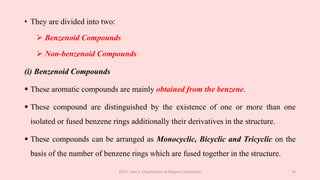
(i) Benzenoid Compounds
 These aromatic compounds are mainly obtained from the benzene.
 These compound are distinguished by the existence of one or more than one
isolated or fused benzene rings additionally their derivatives in the structure.
 These compounds can be arranged as Monocyclic, Bicyclic and Tricyclic on the
basis of the number of benzene rings which are fused together in the structure.
POC-I, Unit 1: Classification of Organic Compounds 10
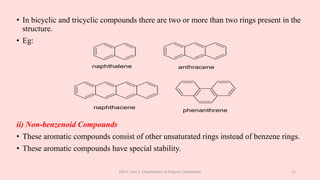
• In bicyclic and tricyclic compounds there are two or more than two rings present in the
structure.
• Eg:
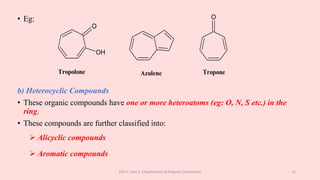
ii) Non-benzenoid Compounds
• These aromatic compounds consist of other unsaturated rings instead of benzene rings.
• These aromatic compounds have special stability.
POC-I, Unit 1: Classification of Organic Compounds 11
naphthalene anthracene
phenanthrene
naphthacene
• Eg:
b) Heterocyclic Compounds
• These organic compounds have one or more heteroatoms (eg: O, N, S etc.) in the
ring.
• These compounds are further classified into:
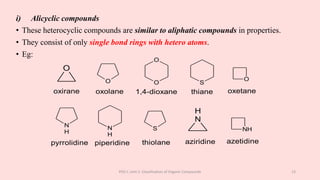
 Alicyclic compounds
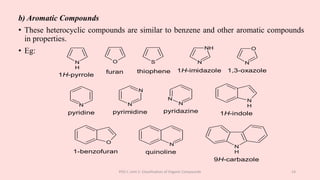
 Aromatic compounds
POC-I, Unit 1: Classification of Organic Compounds 12
O
OH
Tropolone Azulene
O
Tropone
i) Alicyclic compounds
• These heterocyclic compounds are similar to aliphatic compounds in properties.
• They consist of only single bond rings with hetero atoms.
• Eg:
POC-I, Unit 1: Classification of Organic Compounds 13
O
O
O
O
N
H
N
H
S
S
N
H
piperidine
oxirane
O
NH
oxolane 1,4-dioxane thiane oxetane
pyrrolidine thiolane aziridine azetidine
b) Aromatic Compounds
• These heterocyclic compounds are similar to benzene and other aromatic compounds
in properties.
• Eg:
POC-I, Unit 1: Classification of Organic Compounds 14
O
N
H
N
S
NH
N
O
N
N
N N
N N
H
O N N
H
1H-pyrrole
furan thiophene 1H-imidazole 1,3-oxazole
pyridine pyrimidine pyridazine 1H-indole
1-benzofuran quinoline
9H-carbazole
On the Basis of Functional Group
POC-I, Unit 1: Classification of Organic Compounds 15
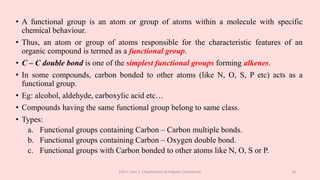
• A functional group is an atom or group of atoms within a molecule with specific
chemical behaviour.
• Thus, an atom or group of atoms responsible for the characteristic features of an
organic compound is termed as a functional group.
• C – C double bond is one of the simplest functional groups forming alkenes.
• In some compounds, carbon bonded to other atoms (like N, O, S, P etc) acts as a
functional group.
• Eg: alcohol, aldehyde, carboxylic acid etc…
• Compounds having the same functional group belong to same class.
• Types:
a. Functional groups containing Carbon – Carbon multiple bonds.
b. Functional groups containing Carbon – Oxygen double bond.
c. Functional groups with Carbon bonded to other atoms like N, O, S or P.
POC-I, Unit 1: Classification of Organic Compounds 16
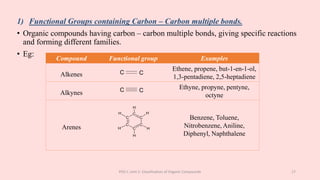
1) Functional Groups containing Carbon – Carbon multiple bonds.
• Organic compounds having carbon – carbon multiple bonds, giving specific reactions
and forming different families.
• Eg:
POC-I, Unit 1: Classification of Organic Compounds 17
Compound Functional group Examples
Alkenes
Ethene, propene, but-1-en-1-ol,
1,3-pentadiene, 2,5-heptadiene
Alkynes
Ethyne, propyne, pentyne,
octyne
Arenes
Benzene, Toluene,
Nitrobenzene, Aniline,
Diphenyl, Naphthalene
C C
C C
C
C
C
C
C
C
H
H
H
H
H
H
POC-I, Unit 1: Classification of Organic Compounds 18
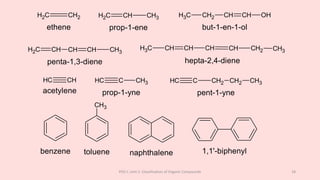
C
H2 CH2 C
H2 CH CH3 C
H3 CH2 CH CH OH
ethene prop-1-ene but-1-en-1-ol
C
H2 CH CH CH CH3
C
H3 CH CH CH CH CH2 CH3
penta-1,3-diene hepta-2,4-diene
C
H CH C
H C CH3 C
H C CH2 CH2 CH3
acetylene prop-1-yne pent-1-yne
CH3
benzene toluene naphthalene 1,1'-biphenyl
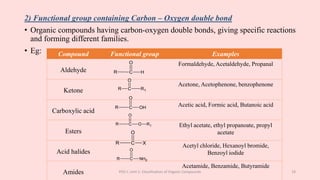
2) Functional group containing Carbon – Oxygen double bond
• Organic compounds having carbon-oxygen double bonds, giving specific reactions
and forming different families.
• Eg:
POC-I, Unit 1: Classification of Organic Compounds 19
Compound Functional group Examples
Aldehyde
Formaldehyde, Acetaldehyde, Propanal
Ketone
Acetone, Acetophenone, benzophenone
Carboxylic acid
Acetic acid, Formic acid, Butanoic acid
Esters
Ethyl acetate, ethyl propanoate, propyl
acetate
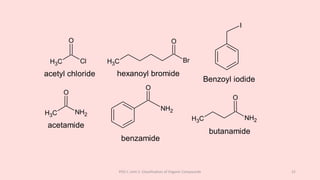
Acid halides
Acetyl chloride, Hexanoyl bromide,
Benzoyl iodide
Amides
Acetamide, Benzamide, Butyramide
R C
O
H
R C R1
O
R C
O
OH
R C
O
O R1
R C
O
X
R C
O
NH2
POC-I, Unit 1: Classification of Organic Compounds 20
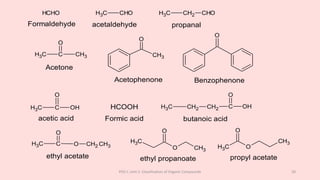
HCHO C
H3 CHO C
H3 CH2 CHO
Formaldehyde acetaldehyde propanal
C
H3 C CH3
O
CH3
O
O
Acetone
Acetophenone Benzophenone
C
H3 C
O
OH HCOOH C
H3 CH2 CH2 C
O
OH
acetic acid Formic acid butanoic acid
C
H3 C O
O
CH2 CH3 O CH3
C
H3
O
ethyl propanoate
ethyl acetate
C
H3 O
CH3
O
propyl acetate
POC-I, Unit 1: Classification of Organic Compounds 21
C
H3 Cl
O
C
H3
Br
O
I
acetyl chloride hexanoyl bromide
Benzoyl iodide
C
H3
NH2
O
NH2
O
acetamide
benzamide
C
H3 NH2
O
butanamide
3) Functional groups with Carbon Bonded to Other atoms like N, O, S or P
• The functional groups in some organic compounds carry carbon linked to other atoms
(like N, O, S or P) via single or double bonds.
• Eg:
POC-I, Unit 1: Classification of Organic Compounds 22
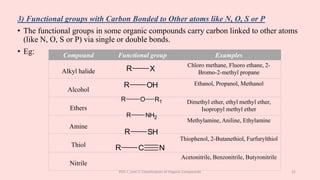
Compound Functional group Examples
Alkyl halide
Chloro methane, Fluoro ethane, 2-
Bromo-2-methyl propane
Alcohol
Ethanol, Propanol, Methanol
Ethers
Dimethyl ether, ethyl methyl ether,
Isopropyl methyl ether
Amine
Methylamine, Aniline, Ethylamine
Thiol
Thiophenol, 2-Butanethiol, Furfurylthiol
Nitrile
Acetonitrile, Benzonitrile, Butyronitrile
R X
R OH
R O R1
R NH2
R SH
R C N
POC-I, Unit 1: Classification of Organic Compounds 23
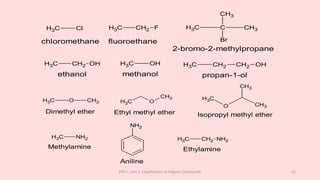
C
H3 CH2 OH C
H3 OH C
H3 CH2 CH2 OH
C
H3 Cl C
H3 CH2 F C
H3 C CH3
CH3
Br
chloromethane fluoroethane
2-bromo-2-methylpropane
ethanol methanol propan-1-ol
C
H3 O CH3 C
H3 O
CH3 C
H3
O CH3
CH3
C
H3 NH2
NH2
C
H3 CH2 NH2
Dimethyl ether Ethyl methyl ether Isopropyl methyl ether
Methylamine
Aniline
Ethylamine
POC-I, Unit 1: Classification of Organic Compounds 24
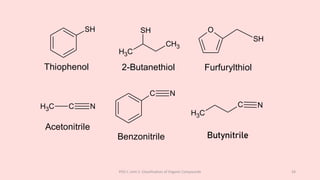
SH
C
H3
CH3
SH O
SH
C
H3 C N
C N
C
H3
C N
Thiophenol Furfurylthiol
2-Butanethiol
Acetonitrile
Benzonitrile Butynitrile
THANK
YOU…..
POC-I, Unit 1: Classification of Organic Compounds 25

CLASSIFICATION OF ORGANIC COMPOUNDS.pptx

  • 1.
    CLASSIFICATION OF ORGANIC COMPOUNDS By, GRACE SHAJICHITTILAPPILLY ASSISTANT PROFESSOR DEPT. OF PHARMACEUTICAL CHEMISTRY KARPAGAM COLLEGE OF PHARMACY, COIMBATORE - 32 UNIT - I
  • 2.
    “Classification of Organic Compounds” Organiccompounds can be classified on the basis of following two ways: 1) On the basis of structure, and 2) On the basis of functional group POC-I, Unit 1: Classification of Organic Compounds 2
  • 3.
    On the Basisof Structure POC-I, Unit 1: Classification of Organic Compounds 3
  • 4.
    ORGANIC COMPOUNDS Open chaincompounds Or Acyclic compounds Closed chain or Ring compounds Or Cyclic compounds Saturated Unsaturated Homocyclic Or Carbocyclic Heterocyclic Alicyclic Aromatic Alicyclic Aromatic Benzenoid Non - Benzenoid POC-I, Unit 1: Classification of Organic Compounds 4
  • 5.
    1. Acyclic orOpen Chain Compound oThese organic compounds have open chain skeleton. o Its divided in to two types: Saturated and Unsaturated a) Saturated Compound • These are the compounds in which various carbon atoms in a chain or a ring are linked together by single bond only. • Alkanes are the most common examples of saturated chain carbon compounds. • Eg: C H3 CH3 Ethane C H3 CH2 CH3 C H3 CH CH3 CH2 CH3 C H3 CH2 CH2 CH2 OH Propane 2-Methylbutane Butan-1-ol POC-I, Unit 1: Classification of Organic Compounds 5
  • 6.
    b) Unsaturated Compounds •These are the compounds in which various carbon atoms in a chain or ring are linked together by double or triple bonds. • Alkenes (where carbon atoms are linked through double bonds) and alkynes (where carbon atoms are linked through triple bonds) are the most common examples of unsaturated chain carbon compounds. • Eg: POC-I, Unit 1: Classification of Organic Compounds 6 C H2 CH2 C H CH C H2 C CH2 CH3 CH3 C H2 CH CH CH CH3 C H C CH3 ethene acetylene 2-methylbut-1-ene penta-1,3-diene prop-1-yne
  • 7.
    2. Cyclic orclosed chain compounds oThese are organic compounds have closed rings structure. oThey are divided into two: Homocyclic or Carbocyclic compounds and Heterocyclic compounds. a) Homocyclic or Carbocyclic compounds • In these organic compounds , the ring of compound has carbon atoms only. • These compounds are further classified into: (i) Alicyclic compounds (ii) Aromatic compounds i) Alicyclic Compounds • These homocyclic compounds are ring of compound having carbon atoms only and do not have a benzene ring. POC-I, Unit 1: Classification of Organic Compounds 7
  • 8.
    • Eg: ii) AromaticCompounds • These homocyclic compounds have a benzene ring. POC-I, Unit 1: Classification of Organic Compounds 8 C H2 CH2 CH2 C H2 C H2 CH2 CH2 C H2 CH2 CH2 CH2 CH2 C H2 CH2 CH2 C H2 CH2 CH2 cyclopropane cyclobutane cyclopentane cyclohexane cycloheptane cyclooctane
  • 9.
    • Eg: POC-I, Unit1: Classification of Organic Compounds 9 CH3 N H2 OH N O O benzene toluene aniline phenol nitrobenzene naphthalene anthracene 1,1'-biphenyl phenanthrene naphthacene
  • 10.
    • They aredivided into two:  Benzenoid Compounds  Non-benzenoid Compounds (i) Benzenoid Compounds  These aromatic compounds are mainly obtained from the benzene.  These compound are distinguished by the existence of one or more than one isolated or fused benzene rings additionally their derivatives in the structure.  These compounds can be arranged as Monocyclic, Bicyclic and Tricyclic on the basis of the number of benzene rings which are fused together in the structure. POC-I, Unit 1: Classification of Organic Compounds 10
  • 11.
    • In bicyclicand tricyclic compounds there are two or more than two rings present in the structure. • Eg: ii) Non-benzenoid Compounds • These aromatic compounds consist of other unsaturated rings instead of benzene rings. • These aromatic compounds have special stability. POC-I, Unit 1: Classification of Organic Compounds 11 naphthalene anthracene phenanthrene naphthacene
  • 12.
    • Eg: b) HeterocyclicCompounds • These organic compounds have one or more heteroatoms (eg: O, N, S etc.) in the ring. • These compounds are further classified into:  Alicyclic compounds  Aromatic compounds POC-I, Unit 1: Classification of Organic Compounds 12 O OH Tropolone Azulene O Tropone
  • 13.
    i) Alicyclic compounds •These heterocyclic compounds are similar to aliphatic compounds in properties. • They consist of only single bond rings with hetero atoms. • Eg: POC-I, Unit 1: Classification of Organic Compounds 13 O O O O N H N H S S N H piperidine oxirane O NH oxolane 1,4-dioxane thiane oxetane pyrrolidine thiolane aziridine azetidine
  • 14.
    b) Aromatic Compounds •These heterocyclic compounds are similar to benzene and other aromatic compounds in properties. • Eg: POC-I, Unit 1: Classification of Organic Compounds 14 O N H N S NH N O N N N N N N H O N N H 1H-pyrrole furan thiophene 1H-imidazole 1,3-oxazole pyridine pyrimidine pyridazine 1H-indole 1-benzofuran quinoline 9H-carbazole
  • 15.
    On the Basisof Functional Group POC-I, Unit 1: Classification of Organic Compounds 15
  • 16.
    • A functionalgroup is an atom or group of atoms within a molecule with specific chemical behaviour. • Thus, an atom or group of atoms responsible for the characteristic features of an organic compound is termed as a functional group. • C – C double bond is one of the simplest functional groups forming alkenes. • In some compounds, carbon bonded to other atoms (like N, O, S, P etc) acts as a functional group. • Eg: alcohol, aldehyde, carboxylic acid etc… • Compounds having the same functional group belong to same class. • Types: a. Functional groups containing Carbon – Carbon multiple bonds. b. Functional groups containing Carbon – Oxygen double bond. c. Functional groups with Carbon bonded to other atoms like N, O, S or P. POC-I, Unit 1: Classification of Organic Compounds 16
  • 17.
    1) Functional Groupscontaining Carbon – Carbon multiple bonds. • Organic compounds having carbon – carbon multiple bonds, giving specific reactions and forming different families. • Eg: POC-I, Unit 1: Classification of Organic Compounds 17 Compound Functional group Examples Alkenes Ethene, propene, but-1-en-1-ol, 1,3-pentadiene, 2,5-heptadiene Alkynes Ethyne, propyne, pentyne, octyne Arenes Benzene, Toluene, Nitrobenzene, Aniline, Diphenyl, Naphthalene C C C C C C C C C C H H H H H H
  • 18.
    POC-I, Unit 1:Classification of Organic Compounds 18 C H2 CH2 C H2 CH CH3 C H3 CH2 CH CH OH ethene prop-1-ene but-1-en-1-ol C H2 CH CH CH CH3 C H3 CH CH CH CH CH2 CH3 penta-1,3-diene hepta-2,4-diene C H CH C H C CH3 C H C CH2 CH2 CH3 acetylene prop-1-yne pent-1-yne CH3 benzene toluene naphthalene 1,1'-biphenyl
  • 19.
    2) Functional groupcontaining Carbon – Oxygen double bond • Organic compounds having carbon-oxygen double bonds, giving specific reactions and forming different families. • Eg: POC-I, Unit 1: Classification of Organic Compounds 19 Compound Functional group Examples Aldehyde Formaldehyde, Acetaldehyde, Propanal Ketone Acetone, Acetophenone, benzophenone Carboxylic acid Acetic acid, Formic acid, Butanoic acid Esters Ethyl acetate, ethyl propanoate, propyl acetate Acid halides Acetyl chloride, Hexanoyl bromide, Benzoyl iodide Amides Acetamide, Benzamide, Butyramide R C O H R C R1 O R C O OH R C O O R1 R C O X R C O NH2
  • 20.
    POC-I, Unit 1:Classification of Organic Compounds 20 HCHO C H3 CHO C H3 CH2 CHO Formaldehyde acetaldehyde propanal C H3 C CH3 O CH3 O O Acetone Acetophenone Benzophenone C H3 C O OH HCOOH C H3 CH2 CH2 C O OH acetic acid Formic acid butanoic acid C H3 C O O CH2 CH3 O CH3 C H3 O ethyl propanoate ethyl acetate C H3 O CH3 O propyl acetate
  • 21.
    POC-I, Unit 1:Classification of Organic Compounds 21 C H3 Cl O C H3 Br O I acetyl chloride hexanoyl bromide Benzoyl iodide C H3 NH2 O NH2 O acetamide benzamide C H3 NH2 O butanamide
  • 22.
    3) Functional groupswith Carbon Bonded to Other atoms like N, O, S or P • The functional groups in some organic compounds carry carbon linked to other atoms (like N, O, S or P) via single or double bonds. • Eg: POC-I, Unit 1: Classification of Organic Compounds 22 Compound Functional group Examples Alkyl halide Chloro methane, Fluoro ethane, 2- Bromo-2-methyl propane Alcohol Ethanol, Propanol, Methanol Ethers Dimethyl ether, ethyl methyl ether, Isopropyl methyl ether Amine Methylamine, Aniline, Ethylamine Thiol Thiophenol, 2-Butanethiol, Furfurylthiol Nitrile Acetonitrile, Benzonitrile, Butyronitrile R X R OH R O R1 R NH2 R SH R C N
  • 23.
    POC-I, Unit 1:Classification of Organic Compounds 23 C H3 CH2 OH C H3 OH C H3 CH2 CH2 OH C H3 Cl C H3 CH2 F C H3 C CH3 CH3 Br chloromethane fluoroethane 2-bromo-2-methylpropane ethanol methanol propan-1-ol C H3 O CH3 C H3 O CH3 C H3 O CH3 CH3 C H3 NH2 NH2 C H3 CH2 NH2 Dimethyl ether Ethyl methyl ether Isopropyl methyl ether Methylamine Aniline Ethylamine
  • 24.
    POC-I, Unit 1:Classification of Organic Compounds 24 SH C H3 CH3 SH O SH C H3 C N C N C H3 C N Thiophenol Furfurylthiol 2-Butanethiol Acetonitrile Benzonitrile Butynitrile
  • 25.
    THANK YOU….. POC-I, Unit 1:Classification of Organic Compounds 25