Voltmeter
Content
• Direct Coupled DC Voltmeter.
• Chopper Type DC Voltmeter.
• Solid State DC Voltmeter.
• AC Voltmeter using Rectifier.
Direct Coupled DC Voltmeter
• This type of voltmeter is very common because of its low cost.
• This instrument can be used only to measure voltages of the
order of milli-volts owing to limited amplifier gain.
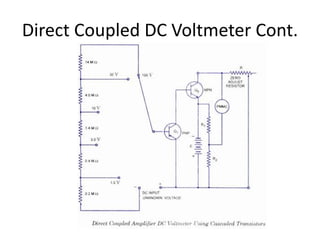
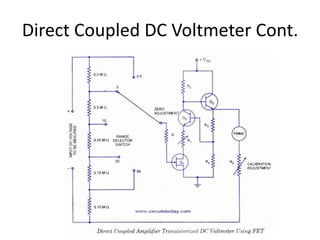
• The circuit diagram for a direct coupled amplifier dc voltmeter
using cascaded transistors.
• An attenuator is used in input stage to select voltage range.
• A transistor is a current controlled device so resistance is
inserted in series with the transistor Q1 to select the voltage
range.
Direct Coupled DC Voltmeter Cont.
• Two transistors in cascaded connections are used instead of
using a single transistor for amplification in order to keep the
sensitivity of the circuit high.
• Transistors Q1 and Q2 are taken complement to each other
and are directly coupled to minimize the number of
components in the circuit.
• They form a direct coupled amplifier. A variable resistance R is
put in the circuit for zero adjustment of the PMMC.
• R controls the bucking current from the supply E to buck out
the quiescent current.
Disadvantage
• The draw-back of such a voltmeter is that it has to work under
specified ambient temperature to get the required accuracy
otherwise excessive drift problem occurs during operation.
Direct Coupled DC Voltmeter Cont.
Advantages
• The high input impedance, this circuit has another advantage
that when input voltage exceeds its limit, amplifier gets
saturated which limits the current passing through the PMMC
meter. So meter does not burn out.
Chopper Type DC Voltmeter
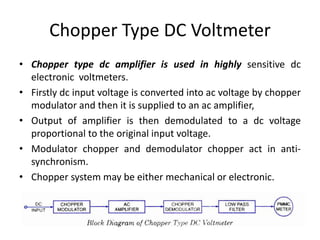
• Chopper type dc amplifier is used in highly sensitive dc
electronic voltmeters.
• Firstly dc input voltage is converted into ac voltage by chopper
modulator and then it is supplied to an ac amplifier,
• Output of amplifier is then demodulated to a dc voltage
proportional to the original input voltage.
• Modulator chopper and demodulator chopper act in anti-
synchronism.
• Chopper system may be either mechanical or electronic.
Chopper Type DC Voltmeter Cont.
Chopper Type DC Voltmeter Working
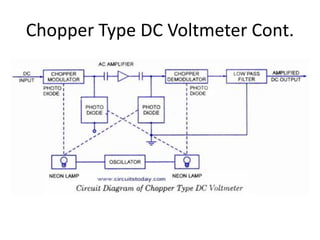
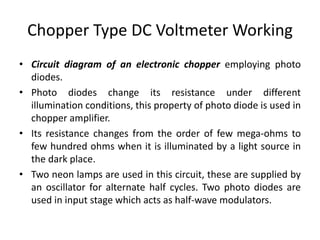
• Circuit diagram of an electronic chopper employing photo
diodes.
• Photo diodes change its resistance under different
illumination conditions, this property of photo diode is used in
chopper amplifier.
• Its resistance changes from the order of few mega-ohms to
few hundred ohms when it is illuminated by a light source in
the dark place.
• Two neon lamps are used in this circuit, these are supplied by
an oscillator for alternate half cycles. Two photo diodes are
used in input stage which acts as half-wave modulators.
Chopper Type DC Voltmeter Working Cont.
• Output of chopper modulator is a square wave voltage
(proportional to the input signal) .
• Square wave is supplied to the ac amplifier through a
capacitor. Amplified output is again passed through a
capacitor and then fed to chopper demodulator.
• Capacitor is used to remove dc drift from the signal.
• Chopper demodulator gives a dc output voltage (proportional
to the input voltage) which is passed through the low pass
filter to remove any residual ac component.
• Now this dc output voltage is supplied to the PMMC meter for
measurement of input voltage.
Advantage
• The input impedance of a Chopper Amplifier is usually of the
order of 10 MΩ or higher, except on very low input ranges.
• The drift in an ordinary dc amplifier is of the order of mV. The
full scale range of an ordinary dc amplifier is limited to
measuring input signal of 1— 100 mV. In a chopper modulator
system with the use of ac amplifier, drift can be cut down by a
factor of 100, thus allowing an input signal range of about
0.01 mV = 10 μV full scale to be handled.
Applications
• In chopper amplifier dc voltmeter, input impedance is of the
order of hundred mega-ohms and it has sensitivity of one
micro-volt per scale division.
Solid State DC Voltmeter
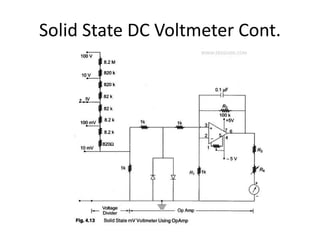
• Solid State Voltmeter is designed using Semiconductor
Devices( like: Op-Amp, Transistor, Diodes).
• Op-amp is a directly coupled very high gain amplifier. The gain
of the Op-Amp can be adjusted to any suitable lower value by
providing appropriate resistance between its output terminal,
and Neg. Feedback is provided using inverting terminal of Op-
Amp.
• The ratio R2/R1 determines the gain of an amplifier circuit.
• The two diodes used are for IC protection. Under normal
conditions, they are non-conducting, as the maximum voltage
across them is 10 mV.
Solid State DC Voltmeter Cont.
• If an excessive voltage, say more than 100 mV appears across
them, then depending upon the polarity of the voltage, one of
the diode conducts and protects the IC.
• A μA scale of 50 — 1000 µA full scale deflection can be used
as an indicator. R4 is adjusted to get maximum full scale
deflection.
AC Voltmeter using Rectifier
• Rectifier type instruments generally use a PMMC movement
along with a rectifier arrangement.
• Silicon diodes are preferred because of their low reverse
current and high forward current ratings.
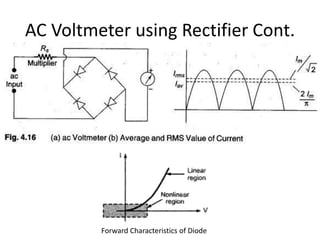
• an ac voltmeter circuit consisting of a multiplier, a bridge
rectifier and a PMMC movement.
• The bridge rectifier provides a full wave pulsating dc. Due to
the inertia of the movable coil, the meter indicates a steady
deflection proportional to the average value of the current.
• The meter scale is usually calibrated to give the RMS value of
an alternating sine wave input.
AC Voltmeter using Rectifier Cont.
Forward Characteristics of Diode
AC Voltmeter using Rectifier Cont.
• Practical rectifiers are non-linear devices particularly at low
values of forward current.
• Hence the meter scale is non-linear and is generally crowded
at the lower end of a low range voltmeter. In this part the
meter has low sensitivity because of the high
forward resistance of the diode. Also,
the diode resistance depends on the temperature.
AC Voltmeter using Rectifier Cont.
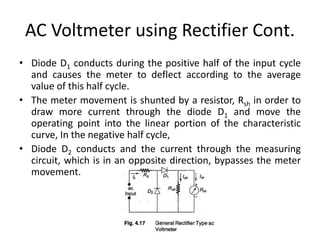
• Diode D1 conducts during the positive half of the input cycle
and causes the meter to deflect according to the average
value of this half cycle.
• The meter movement is shunted by a resistor, Rsh in order to
draw more current through the diode D1 and move the
operating point into the linear portion of the characteristic
curve, In the negative half cycle,
• Diode D2 conducts and the current through the measuring
circuit, which is in an opposite direction, bypasses the meter
movement.

Voltmeter

  • 1.
  • 2.
    Content • Direct CoupledDC Voltmeter. • Chopper Type DC Voltmeter. • Solid State DC Voltmeter. • AC Voltmeter using Rectifier.
  • 3.
    Direct Coupled DCVoltmeter • This type of voltmeter is very common because of its low cost. • This instrument can be used only to measure voltages of the order of milli-volts owing to limited amplifier gain. • The circuit diagram for a direct coupled amplifier dc voltmeter using cascaded transistors. • An attenuator is used in input stage to select voltage range. • A transistor is a current controlled device so resistance is inserted in series with the transistor Q1 to select the voltage range.
  • 4.
    Direct Coupled DCVoltmeter Cont.
  • 5.
    Direct Coupled DCVoltmeter Cont. • Two transistors in cascaded connections are used instead of using a single transistor for amplification in order to keep the sensitivity of the circuit high. • Transistors Q1 and Q2 are taken complement to each other and are directly coupled to minimize the number of components in the circuit. • They form a direct coupled amplifier. A variable resistance R is put in the circuit for zero adjustment of the PMMC. • R controls the bucking current from the supply E to buck out the quiescent current.
  • 6.
    Disadvantage • The draw-backof such a voltmeter is that it has to work under specified ambient temperature to get the required accuracy otherwise excessive drift problem occurs during operation.
  • 7.
    Direct Coupled DCVoltmeter Cont.
  • 8.
    Advantages • The highinput impedance, this circuit has another advantage that when input voltage exceeds its limit, amplifier gets saturated which limits the current passing through the PMMC meter. So meter does not burn out.
  • 9.
    Chopper Type DCVoltmeter • Chopper type dc amplifier is used in highly sensitive dc electronic voltmeters. • Firstly dc input voltage is converted into ac voltage by chopper modulator and then it is supplied to an ac amplifier, • Output of amplifier is then demodulated to a dc voltage proportional to the original input voltage. • Modulator chopper and demodulator chopper act in anti- synchronism. • Chopper system may be either mechanical or electronic.
  • 10.
    Chopper Type DCVoltmeter Cont.
  • 11.
    Chopper Type DCVoltmeter Working • Circuit diagram of an electronic chopper employing photo diodes. • Photo diodes change its resistance under different illumination conditions, this property of photo diode is used in chopper amplifier. • Its resistance changes from the order of few mega-ohms to few hundred ohms when it is illuminated by a light source in the dark place. • Two neon lamps are used in this circuit, these are supplied by an oscillator for alternate half cycles. Two photo diodes are used in input stage which acts as half-wave modulators.
  • 12.
    Chopper Type DCVoltmeter Working Cont. • Output of chopper modulator is a square wave voltage (proportional to the input signal) . • Square wave is supplied to the ac amplifier through a capacitor. Amplified output is again passed through a capacitor and then fed to chopper demodulator. • Capacitor is used to remove dc drift from the signal. • Chopper demodulator gives a dc output voltage (proportional to the input voltage) which is passed through the low pass filter to remove any residual ac component. • Now this dc output voltage is supplied to the PMMC meter for measurement of input voltage.
  • 13.
    Advantage • The inputimpedance of a Chopper Amplifier is usually of the order of 10 MΩ or higher, except on very low input ranges. • The drift in an ordinary dc amplifier is of the order of mV. The full scale range of an ordinary dc amplifier is limited to measuring input signal of 1— 100 mV. In a chopper modulator system with the use of ac amplifier, drift can be cut down by a factor of 100, thus allowing an input signal range of about 0.01 mV = 10 μV full scale to be handled.
  • 14.
    Applications • In chopperamplifier dc voltmeter, input impedance is of the order of hundred mega-ohms and it has sensitivity of one micro-volt per scale division.
  • 15.
    Solid State DCVoltmeter • Solid State Voltmeter is designed using Semiconductor Devices( like: Op-Amp, Transistor, Diodes). • Op-amp is a directly coupled very high gain amplifier. The gain of the Op-Amp can be adjusted to any suitable lower value by providing appropriate resistance between its output terminal, and Neg. Feedback is provided using inverting terminal of Op- Amp. • The ratio R2/R1 determines the gain of an amplifier circuit. • The two diodes used are for IC protection. Under normal conditions, they are non-conducting, as the maximum voltage across them is 10 mV.
  • 16.
    Solid State DCVoltmeter Cont.
  • 17.
    Solid State DCVoltmeter Cont. • If an excessive voltage, say more than 100 mV appears across them, then depending upon the polarity of the voltage, one of the diode conducts and protects the IC. • A μA scale of 50 — 1000 µA full scale deflection can be used as an indicator. R4 is adjusted to get maximum full scale deflection.
  • 18.
    AC Voltmeter usingRectifier • Rectifier type instruments generally use a PMMC movement along with a rectifier arrangement. • Silicon diodes are preferred because of their low reverse current and high forward current ratings. • an ac voltmeter circuit consisting of a multiplier, a bridge rectifier and a PMMC movement. • The bridge rectifier provides a full wave pulsating dc. Due to the inertia of the movable coil, the meter indicates a steady deflection proportional to the average value of the current. • The meter scale is usually calibrated to give the RMS value of an alternating sine wave input.
  • 19.
    AC Voltmeter usingRectifier Cont. Forward Characteristics of Diode
  • 20.
    AC Voltmeter usingRectifier Cont. • Practical rectifiers are non-linear devices particularly at low values of forward current. • Hence the meter scale is non-linear and is generally crowded at the lower end of a low range voltmeter. In this part the meter has low sensitivity because of the high forward resistance of the diode. Also, the diode resistance depends on the temperature.
  • 21.
    AC Voltmeter usingRectifier Cont. • Diode D1 conducts during the positive half of the input cycle and causes the meter to deflect according to the average value of this half cycle. • The meter movement is shunted by a resistor, Rsh in order to draw more current through the diode D1 and move the operating point into the linear portion of the characteristic curve, In the negative half cycle, • Diode D2 conducts and the current through the measuring circuit, which is in an opposite direction, bypasses the meter movement.