Electronic Ammeter and Voltmeter
Content
• Basic Ammeter
• Multirange Ammeter
• Numerical based on range of Ammeter
• Basic Voltmeter
• Multirange Voltmeter
• Numerical based on Voltmeter
• Electronic Voltmeter (EVM)
Basic Ammeter
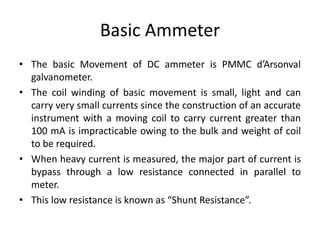
• The basic Movement of DC ammeter is PMMC d’Arsonval
galvanometer.
• The coil winding of basic movement is small, light and can
carry very small currents since the construction of an accurate
instrument with a moving coil to carry current greater than
100 mA is impracticable owing to the bulk and weight of coil
to be required.
• When heavy current is measured, the major part of current is
bypass through a low resistance connected in parallel to
meter.
• This low resistance is known as “Shunt Resistance”.
Basic Ammeter cont.
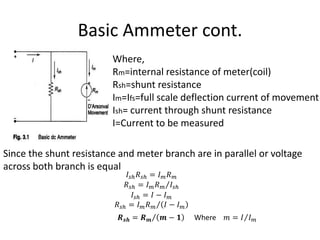
Where,
Rm=internal resistance of meter(coil)
Rsh=shunt resistance
Im=Ifs=full scale deflection current of movement
Ish= current through shunt resistance
I=Current to be measured
Since the shunt resistance and meter branch are in parallel or voltage
across both branch is equal
𝐼𝑠ℎ 𝑅 𝑠ℎ = 𝐼 𝑚 𝑅 𝑚
𝑅 𝑠ℎ = Τ𝐼 𝑚 𝑅 𝑚 𝐼𝑠ℎ
𝐼𝑠ℎ = 𝐼 − 𝐼 𝑚
𝑅 𝑠ℎ = Τ𝐼 𝑚 𝑅 𝑚 𝐼 − 𝐼 𝑚
𝑹 𝒔𝒉 = Τ𝑹 𝒎 𝒎 − 𝟏 Where 𝑚 = Τ𝐼 𝐼 𝑚
Multirange Ammeter
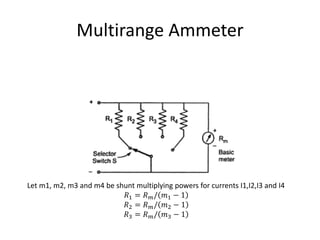
Let m1, m2, m3 and m4 be shunt multiplying powers for currents I1,I2,I3 and I4
𝑅1 = 𝑅 𝑚/ 𝑚1 − 1
𝑅2 = 𝑅 𝑚/ 𝑚2 − 1
𝑅3 = 𝑅 𝑚/ 𝑚3 − 1
Multirange Ammeter cont.
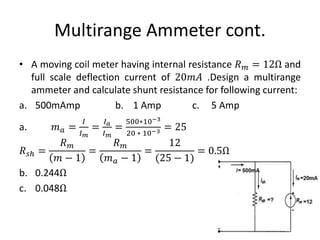
• A moving coil meter having internal resistance 𝑅 𝑚 = 12Ω and
full scale deflection current of 20𝑚𝐴 .Design a multirange
ammeter and calculate shunt resistance for following current:
a. 500mAmp b. 1 Amp c. 5 Amp
a. 𝑚 𝑎 =
𝐼
𝐼 𝑚
=
𝐼 𝑎
𝐼 𝑚
=
500∗10−3
20 ∗ 10−3 = 25
𝑅 𝑠ℎ =
𝑅 𝑚
𝑚 − 1
=
𝑅 𝑚
𝑚 𝑎 − 1
=
12
(25 − 1)
= 0.5Ω
b. 0.244Ω
c. 0.048Ω
Numerical
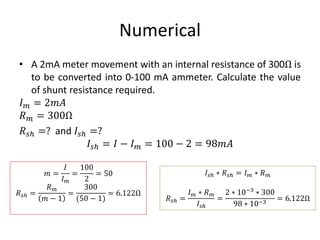
• A 2mA meter movement with an internal resistance of 300Ω is
to be converted into 0-100 mA ammeter. Calculate the value
of shunt resistance required.
𝐼 𝑚 = 2𝑚𝐴
𝑅 𝑚 = 300Ω
𝑅 𝑠ℎ =? and 𝐼𝑠ℎ =?
𝐼𝑠ℎ = 𝐼 − 𝐼 𝑚 = 100 − 2 = 98𝑚𝐴
𝑚 =
𝐼
𝐼 𝑚
=
100
2
= 50
𝑅 𝑠ℎ =
𝑅 𝑚
𝑚 − 1
=
300
(50 − 1)
= 6.122Ω
𝐼𝑠ℎ ∗ 𝑅 𝑠ℎ = 𝐼 𝑚 ∗ 𝑅 𝑚
𝑅 𝑠ℎ =
𝐼 𝑚 ∗ 𝑅 𝑚
𝐼𝑠ℎ
=
2 ∗ 10−3
∗ 300
98 ∗ 10−3
= 6.122Ω
Numerical
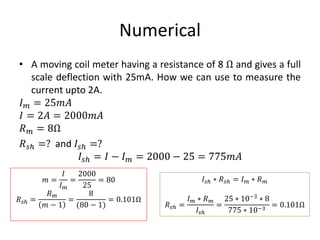
• A moving coil meter having a resistance of 8 Ω and gives a full
scale deflection with 25mA. How we can use to measure the
current upto 2A.
𝐼 𝑚 = 25𝑚𝐴
𝐼 = 2𝐴 = 2000𝑚𝐴
𝑅 𝑚 = 8Ω
𝑅 𝑠ℎ =? and 𝐼𝑠ℎ =?
𝐼𝑠ℎ = 𝐼 − 𝐼 𝑚 = 2000 − 25 = 775𝑚𝐴
𝑚 =
𝐼
𝐼 𝑚
=
2000
25
= 80
𝑅 𝑠ℎ =
𝑅 𝑚
𝑚 − 1
=
8
(80 − 1)
= 0.101Ω
𝐼𝑠ℎ ∗ 𝑅 𝑠ℎ = 𝐼 𝑚 ∗ 𝑅 𝑚
𝑅 𝑠ℎ =
𝐼 𝑚 ∗ 𝑅 𝑚
𝐼𝑠ℎ
=
25 ∗ 10−3
∗ 8
775 ∗ 10−3
= 0.101Ω
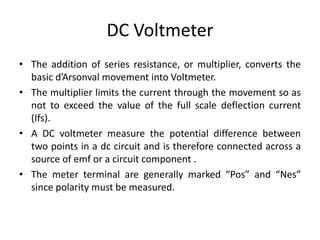
DC Voltmeter
• The addition of series resistance, or multiplier, converts the
basic d’Arsonval movement into Voltmeter.
• The multiplier limits the current through the movement so as
not to exceed the value of the full scale deflection current
(Ifs).
• A DC voltmeter measure the potential difference between
two points in a dc circuit and is therefore connected across a
source of emf or a circuit component .
• The meter terminal are generally marked “Pos” and “Nes”
since polarity must be measured.
DC Voltmeter cont.
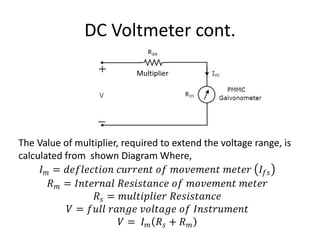
Multiplier
The Value of multiplier, required to extend the voltage range, is
calculated from shown Diagram Where,
𝐼 𝑚 = 𝑑𝑒𝑓𝑙𝑒𝑐𝑡𝑖𝑜𝑛 𝑐𝑢𝑟𝑟𝑒𝑛𝑡 𝑜𝑓 𝑚𝑜𝑣𝑒𝑚𝑒𝑛𝑡 𝑚𝑒𝑡𝑒𝑟 𝐼𝑓𝑠
𝑅 𝑚 = 𝐼𝑛𝑡𝑒𝑟𝑛𝑎𝑙 𝑅𝑒𝑠𝑖𝑠𝑡𝑎𝑛𝑐𝑒 𝑜𝑓 𝑚𝑜𝑣𝑒𝑚𝑒𝑛𝑡 𝑚𝑒𝑡𝑒𝑟
𝑅 𝑠 = 𝑚𝑢𝑙𝑡𝑖𝑝𝑙𝑖𝑒𝑟 𝑅𝑒𝑠𝑖𝑠𝑡𝑎𝑛𝑐𝑒
𝑉 = 𝑓𝑢𝑙𝑙 𝑟𝑎𝑛𝑔𝑒 𝑣𝑜𝑙𝑡𝑎𝑔𝑒 𝑜𝑓 𝐼𝑛𝑠𝑡𝑟𝑢𝑚𝑒𝑛𝑡
𝑉 = 𝐼 𝑚 𝑅 𝑠 + 𝑅 𝑚
Multi Range Voltmeter
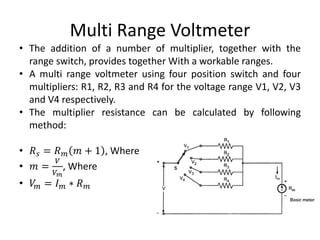
• The addition of a number of multiplier, together with the
range switch, provides together With a workable ranges.
• A multi range voltmeter using four position switch and four
multipliers: R1, R2, R3 and R4 for the voltage range V1, V2, V3
and V4 respectively.
• The multiplier resistance can be calculated by following
method:
• 𝑅 𝑠 = 𝑅 𝑚 𝑚 + 1 , Where
• 𝑚 =
𝑉
𝑉 𝑚
, Where
• 𝑉𝑚 = 𝐼 𝑚 ∗ 𝑅 𝑚
Numerical
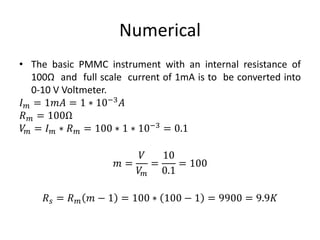
• The basic PMMC instrument with an internal resistance of
100Ω and full scale current of 1mA is to be converted into
0-10 V Voltmeter.
𝐼 𝑚 = 1𝑚𝐴 = 1 ∗ 10−3 𝐴
𝑅 𝑚 = 100Ω
𝑉𝑚 = 𝐼 𝑚 ∗ 𝑅 𝑚 = 100 ∗ 1 ∗ 10−3 = 0.1
𝑚 =
𝑉
𝑉𝑚
=
10
0.1
= 100
𝑅 𝑠 = 𝑅 𝑚 𝑚 − 1 = 100 ∗ 100 − 1 = 9900 = 9.9𝐾
Electronic Voltmeter
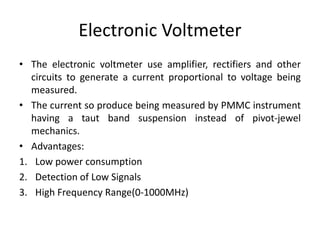
• The electronic voltmeter use amplifier, rectifiers and other
circuits to generate a current proportional to voltage being
measured.
• The current so produce being measured by PMMC instrument
having a taut band suspension instead of pivot-jewel
mechanics.
• Advantages:
1. Low power consumption
2. Detection of Low Signals
3. High Frequency Range(0-1000MHz)
Electronic Voltmeter cont.
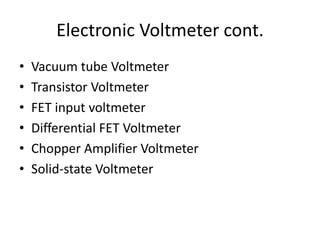
• Vacuum tube Voltmeter
• Transistor Voltmeter
• FET input voltmeter
• Differential FET Voltmeter
• Chopper Amplifier Voltmeter
• Solid-state Voltmeter
Vacuum tube Voltmeter
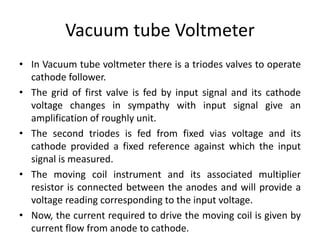
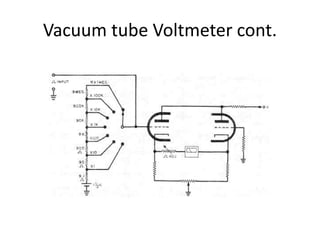
• In Vacuum tube voltmeter there is a triodes valves to operate
cathode follower.
• The grid of first valve is fed by input signal and its cathode
voltage changes in sympathy with input signal give an
amplification of roughly unit.
• The second triodes is fed from fixed vias voltage and its
cathode provided a fixed reference against which the input
signal is measured.
• The moving coil instrument and its associated multiplier
resistor is connected between the anodes and will provide a
voltage reading corresponding to the input voltage.
• Now, the current required to drive the moving coil is given by
current flow from anode to cathode.
Vacuum tube Voltmeter cont.
• Advantages:
1. The effective input impedance of a cathode follower
circuit is very high.
2. The bias level applied to the grid second valve is made
variable so that meter reading can be set to zero, when
input to terminal are short together.
• Disadvantages:
1. It required a AC power supply.
2. The valves of Vacuum tube generates a lot of heat. So, it
take lot time to settle down to stable before any other
measurement done
Transistor Voltmeter
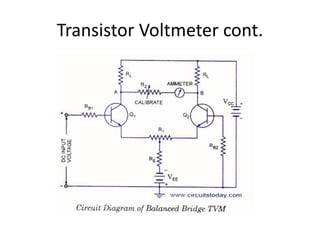
• Transistor Differential amplifier circuit is used as Transistor
voltmeter.
• It has very high input resistance.
• The temperature is also compensated through emitter
resistance Re.
Transistor Voltmeter cont.
• Advantages:
1. It do not required any warn up time.
2. It is compact, light weight and well suitable for field work.
3. It can also be design as a battery operated.
• Disadvantages:
1. Sensitivity is low as compare to VTEM.
2. Accuracy of instrument is only for ambient temperature
only.(Drift Current)

Ammeter&voltmeter

  • 1.
  • 2.
    Content • Basic Ammeter •Multirange Ammeter • Numerical based on range of Ammeter • Basic Voltmeter • Multirange Voltmeter • Numerical based on Voltmeter • Electronic Voltmeter (EVM)
  • 3.
    Basic Ammeter • Thebasic Movement of DC ammeter is PMMC d’Arsonval galvanometer. • The coil winding of basic movement is small, light and can carry very small currents since the construction of an accurate instrument with a moving coil to carry current greater than 100 mA is impracticable owing to the bulk and weight of coil to be required. • When heavy current is measured, the major part of current is bypass through a low resistance connected in parallel to meter. • This low resistance is known as “Shunt Resistance”.
  • 4.
    Basic Ammeter cont. Where, Rm=internalresistance of meter(coil) Rsh=shunt resistance Im=Ifs=full scale deflection current of movement Ish= current through shunt resistance I=Current to be measured Since the shunt resistance and meter branch are in parallel or voltage across both branch is equal 𝐼𝑠ℎ 𝑅 𝑠ℎ = 𝐼 𝑚 𝑅 𝑚 𝑅 𝑠ℎ = Τ𝐼 𝑚 𝑅 𝑚 𝐼𝑠ℎ 𝐼𝑠ℎ = 𝐼 − 𝐼 𝑚 𝑅 𝑠ℎ = Τ𝐼 𝑚 𝑅 𝑚 𝐼 − 𝐼 𝑚 𝑹 𝒔𝒉 = Τ𝑹 𝒎 𝒎 − 𝟏 Where 𝑚 = Τ𝐼 𝐼 𝑚
  • 5.
    Multirange Ammeter Let m1,m2, m3 and m4 be shunt multiplying powers for currents I1,I2,I3 and I4 𝑅1 = 𝑅 𝑚/ 𝑚1 − 1 𝑅2 = 𝑅 𝑚/ 𝑚2 − 1 𝑅3 = 𝑅 𝑚/ 𝑚3 − 1
  • 6.
    Multirange Ammeter cont. •A moving coil meter having internal resistance 𝑅 𝑚 = 12Ω and full scale deflection current of 20𝑚𝐴 .Design a multirange ammeter and calculate shunt resistance for following current: a. 500mAmp b. 1 Amp c. 5 Amp a. 𝑚 𝑎 = 𝐼 𝐼 𝑚 = 𝐼 𝑎 𝐼 𝑚 = 500∗10−3 20 ∗ 10−3 = 25 𝑅 𝑠ℎ = 𝑅 𝑚 𝑚 − 1 = 𝑅 𝑚 𝑚 𝑎 − 1 = 12 (25 − 1) = 0.5Ω b. 0.244Ω c. 0.048Ω
  • 7.
    Numerical • A 2mAmeter movement with an internal resistance of 300Ω is to be converted into 0-100 mA ammeter. Calculate the value of shunt resistance required. 𝐼 𝑚 = 2𝑚𝐴 𝑅 𝑚 = 300Ω 𝑅 𝑠ℎ =? and 𝐼𝑠ℎ =? 𝐼𝑠ℎ = 𝐼 − 𝐼 𝑚 = 100 − 2 = 98𝑚𝐴 𝑚 = 𝐼 𝐼 𝑚 = 100 2 = 50 𝑅 𝑠ℎ = 𝑅 𝑚 𝑚 − 1 = 300 (50 − 1) = 6.122Ω 𝐼𝑠ℎ ∗ 𝑅 𝑠ℎ = 𝐼 𝑚 ∗ 𝑅 𝑚 𝑅 𝑠ℎ = 𝐼 𝑚 ∗ 𝑅 𝑚 𝐼𝑠ℎ = 2 ∗ 10−3 ∗ 300 98 ∗ 10−3 = 6.122Ω
  • 8.
    Numerical • A movingcoil meter having a resistance of 8 Ω and gives a full scale deflection with 25mA. How we can use to measure the current upto 2A. 𝐼 𝑚 = 25𝑚𝐴 𝐼 = 2𝐴 = 2000𝑚𝐴 𝑅 𝑚 = 8Ω 𝑅 𝑠ℎ =? and 𝐼𝑠ℎ =? 𝐼𝑠ℎ = 𝐼 − 𝐼 𝑚 = 2000 − 25 = 775𝑚𝐴 𝑚 = 𝐼 𝐼 𝑚 = 2000 25 = 80 𝑅 𝑠ℎ = 𝑅 𝑚 𝑚 − 1 = 8 (80 − 1) = 0.101Ω 𝐼𝑠ℎ ∗ 𝑅 𝑠ℎ = 𝐼 𝑚 ∗ 𝑅 𝑚 𝑅 𝑠ℎ = 𝐼 𝑚 ∗ 𝑅 𝑚 𝐼𝑠ℎ = 25 ∗ 10−3 ∗ 8 775 ∗ 10−3 = 0.101Ω
  • 9.
    DC Voltmeter • Theaddition of series resistance, or multiplier, converts the basic d’Arsonval movement into Voltmeter. • The multiplier limits the current through the movement so as not to exceed the value of the full scale deflection current (Ifs). • A DC voltmeter measure the potential difference between two points in a dc circuit and is therefore connected across a source of emf or a circuit component . • The meter terminal are generally marked “Pos” and “Nes” since polarity must be measured.
  • 10.
    DC Voltmeter cont. Multiplier TheValue of multiplier, required to extend the voltage range, is calculated from shown Diagram Where, 𝐼 𝑚 = 𝑑𝑒𝑓𝑙𝑒𝑐𝑡𝑖𝑜𝑛 𝑐𝑢𝑟𝑟𝑒𝑛𝑡 𝑜𝑓 𝑚𝑜𝑣𝑒𝑚𝑒𝑛𝑡 𝑚𝑒𝑡𝑒𝑟 𝐼𝑓𝑠 𝑅 𝑚 = 𝐼𝑛𝑡𝑒𝑟𝑛𝑎𝑙 𝑅𝑒𝑠𝑖𝑠𝑡𝑎𝑛𝑐𝑒 𝑜𝑓 𝑚𝑜𝑣𝑒𝑚𝑒𝑛𝑡 𝑚𝑒𝑡𝑒𝑟 𝑅 𝑠 = 𝑚𝑢𝑙𝑡𝑖𝑝𝑙𝑖𝑒𝑟 𝑅𝑒𝑠𝑖𝑠𝑡𝑎𝑛𝑐𝑒 𝑉 = 𝑓𝑢𝑙𝑙 𝑟𝑎𝑛𝑔𝑒 𝑣𝑜𝑙𝑡𝑎𝑔𝑒 𝑜𝑓 𝐼𝑛𝑠𝑡𝑟𝑢𝑚𝑒𝑛𝑡 𝑉 = 𝐼 𝑚 𝑅 𝑠 + 𝑅 𝑚
  • 11.
    Multi Range Voltmeter •The addition of a number of multiplier, together with the range switch, provides together With a workable ranges. • A multi range voltmeter using four position switch and four multipliers: R1, R2, R3 and R4 for the voltage range V1, V2, V3 and V4 respectively. • The multiplier resistance can be calculated by following method: • 𝑅 𝑠 = 𝑅 𝑚 𝑚 + 1 , Where • 𝑚 = 𝑉 𝑉 𝑚 , Where • 𝑉𝑚 = 𝐼 𝑚 ∗ 𝑅 𝑚
  • 12.
    Numerical • The basicPMMC instrument with an internal resistance of 100Ω and full scale current of 1mA is to be converted into 0-10 V Voltmeter. 𝐼 𝑚 = 1𝑚𝐴 = 1 ∗ 10−3 𝐴 𝑅 𝑚 = 100Ω 𝑉𝑚 = 𝐼 𝑚 ∗ 𝑅 𝑚 = 100 ∗ 1 ∗ 10−3 = 0.1 𝑚 = 𝑉 𝑉𝑚 = 10 0.1 = 100 𝑅 𝑠 = 𝑅 𝑚 𝑚 − 1 = 100 ∗ 100 − 1 = 9900 = 9.9𝐾
  • 13.
    Electronic Voltmeter • Theelectronic voltmeter use amplifier, rectifiers and other circuits to generate a current proportional to voltage being measured. • The current so produce being measured by PMMC instrument having a taut band suspension instead of pivot-jewel mechanics. • Advantages: 1. Low power consumption 2. Detection of Low Signals 3. High Frequency Range(0-1000MHz)
  • 14.
    Electronic Voltmeter cont. •Vacuum tube Voltmeter • Transistor Voltmeter • FET input voltmeter • Differential FET Voltmeter • Chopper Amplifier Voltmeter • Solid-state Voltmeter
  • 15.
    Vacuum tube Voltmeter •In Vacuum tube voltmeter there is a triodes valves to operate cathode follower. • The grid of first valve is fed by input signal and its cathode voltage changes in sympathy with input signal give an amplification of roughly unit. • The second triodes is fed from fixed vias voltage and its cathode provided a fixed reference against which the input signal is measured. • The moving coil instrument and its associated multiplier resistor is connected between the anodes and will provide a voltage reading corresponding to the input voltage. • Now, the current required to drive the moving coil is given by current flow from anode to cathode.
  • 16.
  • 17.
    Vacuum tube Voltmetercont. • Advantages: 1. The effective input impedance of a cathode follower circuit is very high. 2. The bias level applied to the grid second valve is made variable so that meter reading can be set to zero, when input to terminal are short together. • Disadvantages: 1. It required a AC power supply. 2. The valves of Vacuum tube generates a lot of heat. So, it take lot time to settle down to stable before any other measurement done
  • 18.
    Transistor Voltmeter • TransistorDifferential amplifier circuit is used as Transistor voltmeter. • It has very high input resistance. • The temperature is also compensated through emitter resistance Re.
  • 19.
  • 20.
    Transistor Voltmeter cont. •Advantages: 1. It do not required any warn up time. 2. It is compact, light weight and well suitable for field work. 3. It can also be design as a battery operated. • Disadvantages: 1. Sensitivity is low as compare to VTEM. 2. Accuracy of instrument is only for ambient temperature only.(Drift Current)