VITAMIN B12
PRODUCTION
• Vitamin B12 which was originally discovered as the anti-pernicious anemia
factor in the early 1920s.
• Vitamin B12, also known as cyanocobalamin, belongs to the cobalamin
family of compound
• This vitamin is required in trace amounts (approximately 1 mg/day) to assist
the action of two enzymes, methionine synthase and (R)-methylmalonyl-
CoA mutase.
• Cyanocobalamin(vitamin B12) is the industrially produced stable cobalamin
form which is not found in nature
2
Vitamin B12 uses
In Food
• Vitamin B12 is used as nutrition supplements in food.
• In Beverage
• Vitamin B12 is used as nutrition supplements in beverage.
• In Pharmaceutical
• Vitamin B12 can be used as Nutritional therapy in Pharmaceutical in
treatment of vitamin B12 deficiency and pernicious anemia, liver disease,
neuritis, neuralgia.
• In Health and Personal care
• Vitamin B12 used as Skin-Conditioning Agent .SKIN CONDITIONING in
Cosmetics.
• In Agriculture/Animal Feed/Poultry
• Vitamin B12 can be used as supplement in Agriculture/Animal Feed/Poultry
products such as in cattle, sheep.
3
Structure
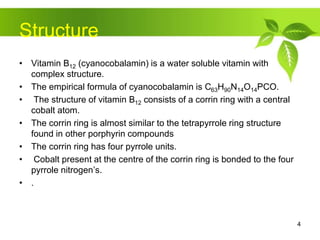
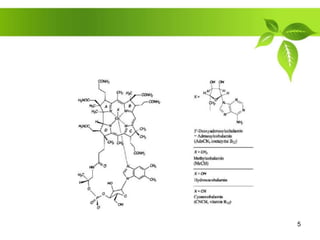
• Vitamin B12 (cyanocobalamin) is a water soluble vitamin with
complex structure.
• The empirical formula of cyanocobalamin is C63H90N14O14PCO.
• The structure of vitamin B12 consists of a corrin ring with a central
cobalt atom.
• The corrin ring is almost similar to the tetrapyrrole ring structure
found in other porphyrin compounds
• The corrin ring has four pyrrole units.
• Cobalt present at the centre of the corrin ring is bonded to the four
pyrrole nitrogen’s.
• .
4
5
6
Biosynthetic pathway of vitamin B12
• Two different biosynthetic routes for vitamin B12 exist in nature:
• • aerobic, or oxygen-dependent pathway that is found in organisms
like P. denitrificans,
• anaerobic, oxygen-independent pathway investigated
• in organisms like P. shermanii, Salmonella typhimurium
• and Bacillus megaterium.
• Mutagenic treatments have resulted in improved activity, but in all
cases cobalt ions and 5,6- -dimethylbenzimidazole (5,6-DMBI) have
to be added in addition to the precursors such as glycine, threonine,
• and aminopropanol
7
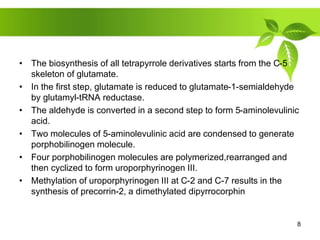
• The biosynthesis of all tetrapyrrole derivatives starts from the C-5
skeleton of glutamate.
• In the first step, glutamate is reduced to glutamate-1-semialdehyde
by glutamyl-tRNA reductase.
• The aldehyde is converted in a second step to form 5-aminolevulinic
acid.
• Two molecules of 5-aminolevulinic acid are condensed to generate
porphobilinogen molecule.
• Four porphobilinogen molecules are polymerized,rearranged and
then cyclized to form uroporphyrinogen III.
• Methylation of uroporphyrinogen III at C-2 and C-7 results in the
synthesis of precorrin-2, a dimethylated dipyrrocorphin
8
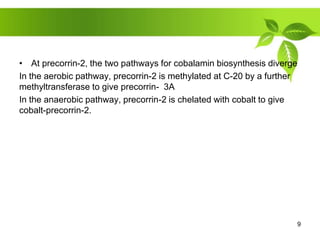
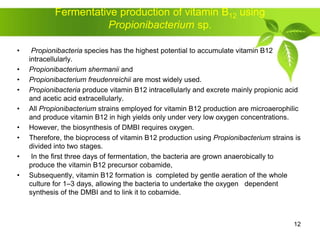
• At precorrin-2, the two pathways for cobalamin biosynthesis diverge
In the aerobic pathway, precorrin-2 is methylated at C-20 by a further
methyltransferase to give precorrin- 3A
In the anaerobic pathway, precorrin-2 is chelated with cobalt to give
cobalt-precorrin-2.
9
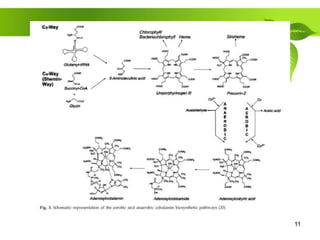
• Under aerobic conditions, the C-20 atom of precorrin-3A is oxidized
• by molecular oxygen, sustained by a Fe4S4 cluster containing protein
(CobG), with the subsequent release of C-20 as acetate.
• Under anaerobic conditions, the ring contraction process is likely to be
mediated via the complexed cobalt ion with its ability to assume different
valence states (+1 to +3) to assist in the oxidation, resulting
• in the release of C-20 as acetaldehyde.
• While the B12 biosynthetic pathways diverge at precorrin- 2, they do join
again at the level of adenosylco-byric acid, which is converted into
cobinamide
10
11
Fermentative production of vitamin B12 using
Propionibacterium sp.
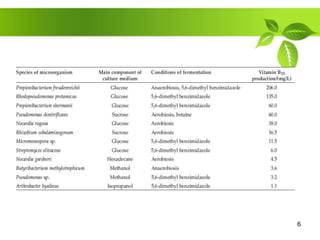
• Propionibacteria species has the highest potential to accumulate vitamin B12
intracellularly.
• Propionibacterium shermanii and
• Propionibacterium freudenreichii are most widely used.
• Propionibacteria produce vitamin B12 intracellularly and excrete mainly propionic acid
and acetic acid extracellularly.
• All Propionibacterium strains employed for vitamin B12 production are microaerophilic
and produce vitamin B12 in high yields only under very low oxygen concentrations.
• However, the biosynthesis of DMBI requires oxygen.
• Therefore, the bioprocess of vitamin B12 production using Propionibacterium strains is
divided into two stages.
• In the first three days of fermentation, the bacteria are grown anaerobically to
produce the vitamin B12 precursor cobamide,
• Subsequently, vitamin B12 formation is completed by gentle aeration of the whole
culture for 1–3 days, allowing the bacteria to undertake the oxygen dependent
synthesis of the DMBI and to link it to cobamide.
12
• 30–170 g/L of sucrose
• optimal vitamin B12 production required a temperature of 40 °C
• aerobic conditions (0.5 vvm aeration at 100 rpm)
• pH value of 6.5.
13
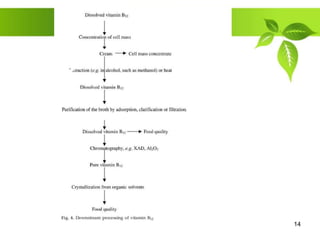
14
15

Vitamin b12 production.ppt

  • 1.
  • 2.
    • Vitamin B12which was originally discovered as the anti-pernicious anemia factor in the early 1920s. • Vitamin B12, also known as cyanocobalamin, belongs to the cobalamin family of compound • This vitamin is required in trace amounts (approximately 1 mg/day) to assist the action of two enzymes, methionine synthase and (R)-methylmalonyl- CoA mutase. • Cyanocobalamin(vitamin B12) is the industrially produced stable cobalamin form which is not found in nature 2
  • 3.
    Vitamin B12 uses InFood • Vitamin B12 is used as nutrition supplements in food. • In Beverage • Vitamin B12 is used as nutrition supplements in beverage. • In Pharmaceutical • Vitamin B12 can be used as Nutritional therapy in Pharmaceutical in treatment of vitamin B12 deficiency and pernicious anemia, liver disease, neuritis, neuralgia. • In Health and Personal care • Vitamin B12 used as Skin-Conditioning Agent .SKIN CONDITIONING in Cosmetics. • In Agriculture/Animal Feed/Poultry • Vitamin B12 can be used as supplement in Agriculture/Animal Feed/Poultry products such as in cattle, sheep. 3
  • 4.
    Structure • Vitamin B12(cyanocobalamin) is a water soluble vitamin with complex structure. • The empirical formula of cyanocobalamin is C63H90N14O14PCO. • The structure of vitamin B12 consists of a corrin ring with a central cobalt atom. • The corrin ring is almost similar to the tetrapyrrole ring structure found in other porphyrin compounds • The corrin ring has four pyrrole units. • Cobalt present at the centre of the corrin ring is bonded to the four pyrrole nitrogen’s. • . 4
  • 5.
  • 6.
  • 7.
    Biosynthetic pathway ofvitamin B12 • Two different biosynthetic routes for vitamin B12 exist in nature: • • aerobic, or oxygen-dependent pathway that is found in organisms like P. denitrificans, • anaerobic, oxygen-independent pathway investigated • in organisms like P. shermanii, Salmonella typhimurium • and Bacillus megaterium. • Mutagenic treatments have resulted in improved activity, but in all cases cobalt ions and 5,6- -dimethylbenzimidazole (5,6-DMBI) have to be added in addition to the precursors such as glycine, threonine, • and aminopropanol 7
  • 8.
    • The biosynthesisof all tetrapyrrole derivatives starts from the C-5 skeleton of glutamate. • In the first step, glutamate is reduced to glutamate-1-semialdehyde by glutamyl-tRNA reductase. • The aldehyde is converted in a second step to form 5-aminolevulinic acid. • Two molecules of 5-aminolevulinic acid are condensed to generate porphobilinogen molecule. • Four porphobilinogen molecules are polymerized,rearranged and then cyclized to form uroporphyrinogen III. • Methylation of uroporphyrinogen III at C-2 and C-7 results in the synthesis of precorrin-2, a dimethylated dipyrrocorphin 8
  • 9.
    • At precorrin-2,the two pathways for cobalamin biosynthesis diverge In the aerobic pathway, precorrin-2 is methylated at C-20 by a further methyltransferase to give precorrin- 3A In the anaerobic pathway, precorrin-2 is chelated with cobalt to give cobalt-precorrin-2. 9
  • 10.
    • Under aerobicconditions, the C-20 atom of precorrin-3A is oxidized • by molecular oxygen, sustained by a Fe4S4 cluster containing protein (CobG), with the subsequent release of C-20 as acetate. • Under anaerobic conditions, the ring contraction process is likely to be mediated via the complexed cobalt ion with its ability to assume different valence states (+1 to +3) to assist in the oxidation, resulting • in the release of C-20 as acetaldehyde. • While the B12 biosynthetic pathways diverge at precorrin- 2, they do join again at the level of adenosylco-byric acid, which is converted into cobinamide 10
  • 11.
  • 12.
    Fermentative production ofvitamin B12 using Propionibacterium sp. • Propionibacteria species has the highest potential to accumulate vitamin B12 intracellularly. • Propionibacterium shermanii and • Propionibacterium freudenreichii are most widely used. • Propionibacteria produce vitamin B12 intracellularly and excrete mainly propionic acid and acetic acid extracellularly. • All Propionibacterium strains employed for vitamin B12 production are microaerophilic and produce vitamin B12 in high yields only under very low oxygen concentrations. • However, the biosynthesis of DMBI requires oxygen. • Therefore, the bioprocess of vitamin B12 production using Propionibacterium strains is divided into two stages. • In the first three days of fermentation, the bacteria are grown anaerobically to produce the vitamin B12 precursor cobamide, • Subsequently, vitamin B12 formation is completed by gentle aeration of the whole culture for 1–3 days, allowing the bacteria to undertake the oxygen dependent synthesis of the DMBI and to link it to cobamide. 12
  • 13.
    • 30–170 g/Lof sucrose • optimal vitamin B12 production required a temperature of 40 °C • aerobic conditions (0.5 vvm aeration at 100 rpm) • pH value of 6.5. 13
  • 14.
  • 15.