Production of Vitamin
B12
Presented by:- Lokesh Patil
B.Ph 5th sem, 3rd year
INTRODUCTION
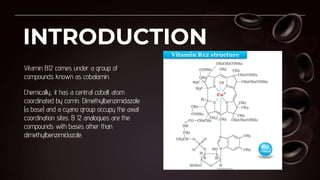
Vitamin B12 comes under a group of
compounds known as cobalamin.
Chemically, it has a central cobalt atom
coordinated by corrin. Dimethylbenzimidazole
(a base) and a cyano group occupy the axial
coordination sites. B 12 analogues are the
compounds with bases other than
dimethylbenzimidazole.
Commercial scale Prod.
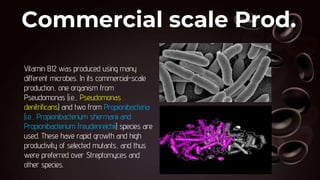
Vitamin B12 was produced using many
different microbes. In its commercial-scale
production, one organism from
Pseudomonas (i.e., Pseudomonas
denitrificans) and two from Propionibacteria
(i.e., Propionibacterium shermanii and
Propionibacterium freudenreichii) species are
used. These have rapid growth and high
productivity of selected mutants, and thus
were preferred over Streptomyces and
other species.
Laboratory scale Prod.
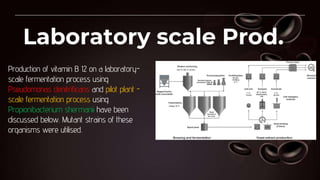
Production of vitamin B 12 on a laboratory-
scale fermentation process using
Pseudomonas denitrificans and pilot plant -
scale fermentation process using
Propionibacterium shermanii have been
discussed below. Mutant strains of these
organisms were utilised.
Fermentation of
Pseudomonas denitrificans
Comm.
Commercially producing mutants were developed from the original wild-type of P.
denitrificans isolated by Miller and Rosenblum in 1960, and the process was described by
Florent and Ninent in 1979. This process yielded about 60mg/l in the laboratory.
Sugar beet molasses containing 5 -10% betaine (trimethyl glycine) serves as the
carbohydrate source. Betaine stimulates vitamin B12 production by promoting the
synthesis of Ala -synthetase, responsible for the production of aminolevulinic acid, which
is the first intermediate of the pathway of cobalamin biosynthesis.
Fermentation of
Pseudomonas denitrificans
Comm.
The growth of Pseudomonas and vitamin B 12 biosynthesis are carried out under aerated
conditions with agitation. Cobalamin biosynthesis by Pseudomonas denitrificans requires
an external supply of 5,6-dimethylbenzimidazole (5,6-DBl) and cobalt salt.
Fermentation of
Pseudomonas denitrificans
(Recent method)
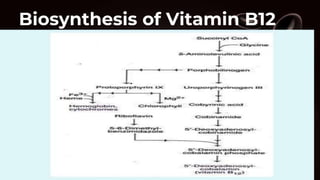
Biosynthesis of Vitamin B12
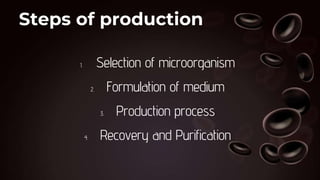
Steps of production
1. Selection of microorganism
2. Formulation of medium
3. Production process
4. Recovery and Purification
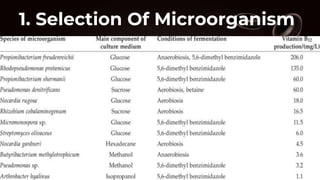
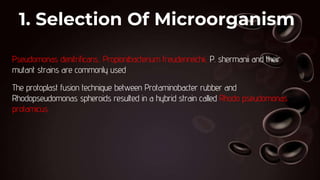
1. Selection Of Microorganism
Pseudomonas denitrificans, Propionibacterium freudenreichii, P. shermanii and their
mutant strains are commonly used
The protoplast fusion technique between Protaminobacter rubber and
Rhodopseudomonas spheroids resulted in a hybrid strain called Rhodo pseudomonas
protamicus.
2. Formulation of medium
• Medium should contain all the nutrient to support adequate growth of
microorganisms.
• Medium should be readily available at low cost and are nutritionally
safe.
• Carbon source:- Glucose, alcohols and hydrocarbons
• Beet molasses medium supplemented with cobalt chloride is also used
as source
3. Production process
• Process is carried out by adding cobalt in 2 phases
 Anaerobic phase: The preliminary phase may take 2-4 days. In this phase 5’-
deoxyadenosylcobinamide is predominantly produced
 Aerobic phase:- In this phase 5,6-dimethyl benzimidazole is produced from riboflavin which is
incorporated to finally form a coenzyme of vitamin B12 namely 5’-deoxyadenosylcobalamine
• Bulk production is submerged bacterial fermentation with beet molasses medium
supplemented with cobalt chloride
• pH 7.5
• Temperature:- 300C
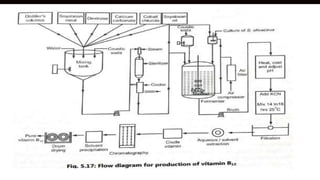
4. Recovery and Purification
• Cobalamine produced by fermentation are mostly bound to the cells. They can be
solubilized by heat treatment at 80-1200C for about 30 mins at pH 6.5 to 8.5
• Solid and mycelium are filtered or centrifuged and fermentation broth collected
• Cobalamine can be converted to more stable cyanocobalamines
• This vitamin B12 is around 80% pure and can be directly used as a feed additive.
However, for medical use (Treatment of pernicious anemia) Vitamin B12 should be
further purified (95-98% purity) by adsorbing IRC-50 resin and then eluted with a
phenolic compound
• Cyanocobalamine present in solvent gets crystallized by evaporation.
Uses of Vitamin B12
• Helps in RBC formation thereby preventing anemia
• Reduce the birth defects in beginning stages of pregnancy
• Support the bone health and prevent osteoporosis
• Reduce the risk of macular degeneration
• Improve mood and symptoms of depression
• Improve heart health by decreasing homocysteine
• Improves the health of hair, skin and nails

Vitamin B12 production.pptx

  • 1.
    Production of Vitamin B12 Presentedby:- Lokesh Patil B.Ph 5th sem, 3rd year
  • 2.
    INTRODUCTION Vitamin B12 comesunder a group of compounds known as cobalamin. Chemically, it has a central cobalt atom coordinated by corrin. Dimethylbenzimidazole (a base) and a cyano group occupy the axial coordination sites. B 12 analogues are the compounds with bases other than dimethylbenzimidazole.
  • 3.
    Commercial scale Prod. VitaminB12 was produced using many different microbes. In its commercial-scale production, one organism from Pseudomonas (i.e., Pseudomonas denitrificans) and two from Propionibacteria (i.e., Propionibacterium shermanii and Propionibacterium freudenreichii) species are used. These have rapid growth and high productivity of selected mutants, and thus were preferred over Streptomyces and other species.
  • 4.
    Laboratory scale Prod. Productionof vitamin B 12 on a laboratory- scale fermentation process using Pseudomonas denitrificans and pilot plant - scale fermentation process using Propionibacterium shermanii have been discussed below. Mutant strains of these organisms were utilised.
  • 6.
    Fermentation of Pseudomonas denitrificans Comm. Commerciallyproducing mutants were developed from the original wild-type of P. denitrificans isolated by Miller and Rosenblum in 1960, and the process was described by Florent and Ninent in 1979. This process yielded about 60mg/l in the laboratory. Sugar beet molasses containing 5 -10% betaine (trimethyl glycine) serves as the carbohydrate source. Betaine stimulates vitamin B12 production by promoting the synthesis of Ala -synthetase, responsible for the production of aminolevulinic acid, which is the first intermediate of the pathway of cobalamin biosynthesis.
  • 7.
    Fermentation of Pseudomonas denitrificans Comm. Thegrowth of Pseudomonas and vitamin B 12 biosynthesis are carried out under aerated conditions with agitation. Cobalamin biosynthesis by Pseudomonas denitrificans requires an external supply of 5,6-dimethylbenzimidazole (5,6-DBl) and cobalt salt.
  • 8.
  • 9.
  • 10.
    Steps of production 1.Selection of microorganism 2. Formulation of medium 3. Production process 4. Recovery and Purification
  • 11.
    1. Selection OfMicroorganism
  • 12.
    1. Selection OfMicroorganism Pseudomonas denitrificans, Propionibacterium freudenreichii, P. shermanii and their mutant strains are commonly used The protoplast fusion technique between Protaminobacter rubber and Rhodopseudomonas spheroids resulted in a hybrid strain called Rhodo pseudomonas protamicus.
  • 13.
    2. Formulation ofmedium • Medium should contain all the nutrient to support adequate growth of microorganisms. • Medium should be readily available at low cost and are nutritionally safe. • Carbon source:- Glucose, alcohols and hydrocarbons • Beet molasses medium supplemented with cobalt chloride is also used as source
  • 14.
    3. Production process •Process is carried out by adding cobalt in 2 phases  Anaerobic phase: The preliminary phase may take 2-4 days. In this phase 5’- deoxyadenosylcobinamide is predominantly produced  Aerobic phase:- In this phase 5,6-dimethyl benzimidazole is produced from riboflavin which is incorporated to finally form a coenzyme of vitamin B12 namely 5’-deoxyadenosylcobalamine • Bulk production is submerged bacterial fermentation with beet molasses medium supplemented with cobalt chloride • pH 7.5 • Temperature:- 300C
  • 15.
    4. Recovery andPurification • Cobalamine produced by fermentation are mostly bound to the cells. They can be solubilized by heat treatment at 80-1200C for about 30 mins at pH 6.5 to 8.5 • Solid and mycelium are filtered or centrifuged and fermentation broth collected • Cobalamine can be converted to more stable cyanocobalamines • This vitamin B12 is around 80% pure and can be directly used as a feed additive. However, for medical use (Treatment of pernicious anemia) Vitamin B12 should be further purified (95-98% purity) by adsorbing IRC-50 resin and then eluted with a phenolic compound • Cyanocobalamine present in solvent gets crystallized by evaporation.
  • 17.
    Uses of VitaminB12 • Helps in RBC formation thereby preventing anemia • Reduce the birth defects in beginning stages of pregnancy • Support the bone health and prevent osteoporosis • Reduce the risk of macular degeneration • Improve mood and symptoms of depression • Improve heart health by decreasing homocysteine • Improves the health of hair, skin and nails