09/20/2025
2
Objective
At theend of this presentation you should able to:-
Highlight some of the Diseases caused by failures in DNA repair mechanisms
Define XP,AT and Fanconin anemia
Know some of the cause of this disorders
Discuss some of the genes related to those diseases
09/20/2025
4
Introduction
Diseases causedby failures in DNA repair mechanisms are collectively known as
DNA repair disorders or syndromes.
These disorders can result from mutations in genes responsible for various
aspects of DNA repair processes, some examples are :
Xeroderma Pigmentosum (XP)
Ataxia Telangiectasia (AT)
Fanconi anemia:
5.
09/20/2025
5
1. Xeroderma Pigmentosum(XP)
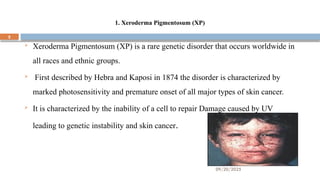
Xeroderma Pigmentosum (XP) is a rare genetic disorder that occurs worldwide in
all races and ethnic groups.
First described by Hebra and Kaposi in 1874 the disorder is characterized by
marked photosensitivity and premature onset of all major types of skin cancer.
It is characterized by the inability of a cell to repair Damage caused by UV
leading to genetic instability and skin cancer.
6.
09/20/2025
6
Xeroderma Pigmentosum (XP)cont.…..
Xeroderma Pigmentosum (XP) is primarily caused by defects in the nucleotide
excision repair (NER) pathway,
which is responsible for repairing DNA damage induced by ultraviolet (UV)
radiation.
The mechanisms underlying XP involve the impairment of various stages of the
NER process.
7.
09/20/2025
7
Xeroderma Pigmentosum (XP)cont.…..
Overall, the defective NER pathway in individuals with XP results in the
accumulation of UV-induced DNA damage.
Leading to increased susceptibility to sunburn, skin pigmentation changes, and a
significantly elevated risk of developing various forms of skin cancer.
Understanding the mechanisms underlying XP provides insights into the
fundamental processes of DNA repair and the consequences of its dysfunction on
human health.
8.
09/20/2025
8
Causes of XP
Autosomal recessive genetic disorder
Nucleotide excision repair(NER) enzymes are mutated
Reduced or eliminated number of NER enzymes
Metastatic malignant melanoma
Squamos cell carcinoma
9.
09/20/2025
9
Cont.…..
The productsof seven of XP genes (XP-A through G) are involved in the repair
of ultraviolet-induced photoproducts in DNA by the process of nucleotide
excision repair (NER).
The XPC and XPE proteins are needed to recognize the photoproducts in DNA.
XPB and XPD are part of a protein complex TFIIH, which opens up the structure
of the DNA around the site of the photoproduct.
10.
09/20/2025
10
Cont.…..
XPA proteinverifies that proteins are in the correct position and then the
nucleases XPG and XPF cut the DNA on either side of the damage, so that the
damaged section can be removed and replaced with intact DNA.
Patients defective in the XPC or XPE genes do not, in general, have the extreme
sunburn reactions or neurological abnormalities.
Defects in the eighth XP gene do not affect NER .
11.
09/20/2025
11
Cont.…..
The DNApolymerases that normally replicate DNA cannot deal with damage in
the DNA template and specialised polymerases have to be employed to get past
the damage.
For UV damage, the cell uses DNA polymerase η, encoded by the
gene POLH and this gene is mutated in XP-V patients .
Like XP-C and XP-E patients, XP-V patients rarely have extreme sunburn
reactions or neurological problems.
12.
09/20/2025
12
Signs and Symptomsof XP
Severe sunburn.
Development of many freckles at an early age.
Rough-surfaced growths (solar keratoses), and skin cancers.
Eyes that are painfully sensitive to the sun and may easily become
irritated, bloodshot and clouded.
Blistering or freckling on minimum sun exposure.
13.
09/20/2025
13
Diagnosis
Before birth:
Amniocentesis
Chorionic villous sampling
After birth:
Severe sunburn after first exposure to the sunlight
Based on clinical findings and family history,
skin, eye, and nervous system
By measuring the DNA repair factor from skin or blood sample
09/20/2025
15
2. Ataxia Telangiecsta
Ataxia Telangiectasia (AT)—also known as Louis-Bar syndrome, cerebello-
oculocutaneous telangiectasia, or immunodeficiency with ataxia telangiectasia.
Ataxia-telangiectasia (AT) is a rare inherited condition that affects the nervous
system, the immune system and other body systems.
It is characterized by the presence of:
• Progressive ataxia (lack of coordination) due to a defect in the cerebellum
• Oculomotor apraxia (difficulty moving the eyes from side to side)
16.
09/20/2025
16
Ataxia Telangiecsta cont.…
•Choreoathetosis (abnormal movements)
• Telangiectasias (dilated blood vessels) on the whites of the eyes and the skin
• Weakened immune system resulting in frequent infections
• Sensitivity to ionizing radiation
• Increased risk to develop leukemia (cancer of blood-forming cells) and
lymphoma (cancer of immune system cells) and some other cancers
17.
09/20/2025
17
Causes
AT developswhen there are alterations in a specific gene known as ATM, located on
chromosome 11 at position q22.3.
The ATM gene has the ability to produce an enzyme called a “serine/threonine
kinase" that has several important functions:
It acts as a tumor suppressor.
It interacts with other proteins when DNA damage occurs following exposure to UV
radiation .
The ATM enzyme coordinates DNA repair by activating other proteins.
18.
09/20/2025
18
Cause cont.….
Itis believed that through a combination of these mechanisms, the ATM enzyme aids in
the prevention of specific types of cancer, such as leukemia and lymphoma.
Patients with AT carry an alteration in both copies of the ATM gene in all the cells of
their body.
When both copies of the ATM gene are altered within the cells of an individual with AT,
• The altered gene copies will make less of the ATM protein or an ATM protein that does
not function properly.
19.
09/20/2025
19
Causes cont.….
Asa result, cells are hypersensitive to radiation and instead of repairing damaged
DNA,
The defective ATM proteins allow for alterations to accumulate in other genes.
When this happens, individuals with AT are at an increased risk to develop leukemia
and lymphoma.
Additionally, altered ATM genes may allow cells to die inappropriately, particularly
in the cerebellum.
This can result in the neurological symptoms that occur in AT.
20.
09/20/2025
20
How is Ataxia-telangiectasiainherited?
Individuals who have two non-working copies of a gene that results in the
manifestation of disease are said to have an “autosomal recessive” condition.
AT is an example of an autosomal recessive condition.
Since AT is inherited in an autosomal recessive manner, both parents carry one
normal copy of the ATM gene and one altered copy of the ATM gene.
An altered ATM gene must then be passed on from each parent in order for the
child to be affected with AT.
21.
09/20/2025
21
Diagnosis
The diagnosisof AT relies primarily on the presence of certain clinical findings.
Children with AT between ages 1 and 4 may show signs of :
• Progressive cerebellar dysfunction, such as slurred speech
• Oculomotor apraxia (difficulty moving the eyes from side to side)
• Gait ataxia (unstable walk)
• Truncal ataxia (unable to maintain normal posture)
22.
09/20/2025
22
Testing for AT
Serum alpha-fetoprotein (AFP) concentration: The elevated level of the AFP
protein.
Chromosome analysis:
Assessment of the levels of the ATM protein: Specific tests can be done to
determine whether the ATM protein is present within cells, such as white blood cells.
Radio sensitivity assay: This test is performed in a lab and measures the DNA repair
function within a cell when it has been exposed to radiation.
23.
09/20/2025
23
Treatments for theDisorder
Unfortunately, there are no treatments for the disorder. Treatment is symptomatic
and supportive.
Physical, occupational and speech therapies and exercise may help maintain
function.
Some people with A-T need additional immunizations, antibiotics to provide
protection from infections, and/or infusions of immunoglobulins.
24.
09/20/2025
24
3.Fanconi anemia
Fanconianemia (FA) is a very rare genetic disease with an incidence of 1 in
160,000 individuals worldwide.
Fanconi anemia is a condition that affects many parts of the body.
People with this condition may have bone marrow failure, physical abnormalities,
organ defects, and an increased risk of certain cancers.
Fanconi anemia is the result of a genetic defect in a cluster of proteins
responsible for DNA repair.
25.
09/20/2025
25
What genes arerelated to Fanconi Anemia
Mutations in at least 15 genes can cause Fanconi anemia.
Proteins produced from these genes are involved in a cell process known as the
“FA pathway.”
The FA pathway is turned on (activated) when the process of making new copies
of DNA, called DNA replication, is blocked due to DNA damage.
The FA pathway sends certain proteins to the area of damage, which trigger DNA
repair so DNA replication can continue.
26.
09/20/2025
26
Cont.….
The FApathway is particularly responsive to a certain type of DNA damage
known as interstrand cross-links (ICLs).
ICLs occur when two DNA building blocks (nucleotides) on opposite strands of
DNA are abnormally attached or linked together, which stops the process of DNA
replication.
ICLs can be caused by a buildup of toxic substances produced in the body.
Eight proteins associated with Fanconi anemia group together to form a complex
known as the FA core complex.
27.
09/20/2025
27
Cont.….
The FAcore complex activates two proteins, called FANCD2 and FANCI.
The activation of these two proteins brings DNA repair proteins to the area of the
ICL so the cross-link can be removed and DNA replication can continue.
Eighty to 90 percent of cases of Fanconi anemia are due to mutations in one of
three genes, FANCA,FANCC, and FANCG.
Mutations in any of the many genes associated with the FA core complex will
cause the complex to be nonfunctional and disrupt the entire FA pathway.
28.
09/20/2025
28
Cont.….
As aresult, DNA damage is not repaired efficiently and ICLs build up over time.
The ICLs stall DNA replication, ultimately resulting in either abnormal cell death
due to an inability make new DNA molecules or uncontrolled cell growth due to
a lack of DNA repair processes.
Cells that divide quickly, such as bone marrow cells and cells of the developing
fetus, are particularly affected.
The death of these cells results in the decrease in blood cells and the physical
abnormalities characteristic of Fanconi anemia.
29.
09/20/2025
29
How do peopleinherit Fanconi anemia?
Fanconi anemia is most often inherited in an autosomal recessive pattern, which
means both copies of the gene in each cell have mutations.
The parents of an individual with an autosomal recessive condition each carry
one copy of the mutated gene, but they typically do not show signs and symptoms
of the condition.
Very rarely, this condition is inherited in an X-linked recessive pattern. The gene
associated with X-linked recessive Fanconi anemia is located on the X
chromosome
30.
09/20/2025
30
Pathogenesis
Clinically, hematologicalabnormalities are the most serious symptoms in FA.
Symptoms appear progressively, and often lead to complete bone marrow failure
and many other diseases.
Major haematological complication associated with FA is bone marrow failure,
defined as inadequate blood cell production.
Detection of decreasing blood count is generally the first sign used to assess
necessity of treatment and possible transplant.
31.
09/20/2025
31
Diagnosis and Treatment
Patients are usually smaller than average.
Blood tests may show a low WBC, RBC, and platelet count.
Fatigue, Frequent infections and Easy bruising.
Treatments include:
Bone marrow transplant.
Growth factors.
Hematopoietic (blood-stimulating) growth factors are used to stimulate WBC production.
Androgens.
Male hormones often stimulate the production of RBCs and platelets.
32.
09/20/2025
32
Reference
1. Halpern, J.;Hopping, B.; Brostoff, J. (2008)“Photosensitivity, corneal scarring and developmental
delay: Xeroderma Pigmentosum in a tropical country”.. Cases journal. 1:254.doi:10.1186/1757-1626-
1-254.PMC 2577106. PMID 189378553)
2. Lehmann AR, McGibbon D, Stefanini M (2011). Xeroderma pigmentosum. 2011 ;Orphanet J Rare
Dis. 6: 70. Nov 1;6:70. doi: 10.1186/1750-1172-6-70.
3. Alberts, Johnson, Lewis, Raff, Roberts, Walter. “Inherited Syndroms With Defects in DNA Repair.” Molecular
Biology of the Cell. October 15, 2004
4. Ataxia-telangiectasia." - Genetics Home Reference. N.p., n.d. Web. 18 Mar. 2014.
5. "Ataxia Telangiectasia - National Cancer Institute." Ataxia Telangiectasia - National Cancer Institute.
N.p., n.d. Web. 18 Mar. 2014.
6. Thompson, E, Dragovic, RL, Campbell, IG. “FANCA: Fanconi Anemia.” PubMed. April 29, 2005.



![CTEV [ clubfoot] DR ARUN LAL ,DR MOHAMED ASHRAF travancore medical college k...](https://cdn.slidesharecdn.com/ss_thumbnails/ctevclubfootdrarunlaldrmohamedashraftravancoremedicalcollegekollamkeralaindia-260208063247-18fc466c-thumbnail.jpg?width=640&height=640&fit=bounds)


