ASSESSMENT, PRIORITIZATION AND INTERVENTION OF HEALTH
AND HEALTH RELATED PROBLEMS IN BUTAJIRA HEALTH CENTER
CATCHMENT AREA, BUTAJIRA TOWN ADIMINSTRATION, SNNPR,
ETHIOPIA, 2022.
Advisors: Mr. DENEBO -------BSc,
MSc)
Mr. MASTAWAL ----( BSc)
July ,2022
Butajira, Ethiopia
1. Introduction
2. justification
3. Significance
4. Objective
5. Methods and Materials
6. result
7. Identified problem
8 priortized problem
9. Action plan
Presentation Outline
Introduction
 Community based Education (CBE) is a means
of achieving educational relevance to
community needs and consists of learning
activates that use the community -oriented
education program (Abrham H et al 2009)
 It designed on three main phases; which are team
training program (TTP), community based training
program (CBTP), and community health assessment
(CHA), sometimes SRE (student research project), & the
one which mainly used in an undergraduate level is the
CBTP.
 Sustaining a healthy community is the goal of every part of the
world.
 However, achieving this goal requires careful planning and
organized community members, health organizations, academic
institutions, and various government agencies.
 Although, in terms of education, technology, health resources, and
per capita purchasing power are higher in United States, it fails to
deliver the best health care at a reasonable cost. About 45 million
(15.6%) US population is not covered by health insurance. (US
Bureu of census et al 2006)
Intro cont…
 Health and health related problems are worsening
in the world.
 These problems are more rampant in developing
nations as compared to those in the developed
world,
 Ethiopia as being one of the countries in the
developing nations, have been encountering
much of their burdens which aggravated the
health problem.
 Those problems could have been minimized by
good health services management and strong
political commitment as well as community
participation (Atekur D et al20012)
Cont…..
 In Ethiopia 35% of house-holds get drinking
water from unimproved source in average it is
from 3% in urban and 43% in rural.
 More than half of rural house-holds (53%)
travel greater than or equal to 30 minutes
round the trip to fetch the drinking water
(National Center for Health Statistics (2006).
 About four in every ten Ethiopian women (41
%) did not receive any antenatal care for their
last birth in the five years preceding the
survey.
Cont…..
 The disease burden responsible for 74% of
deaths and 81% of disability adjusted years
lost per year is dominated by malaria, prenatal
and maternal death, URTI, Nutritional
deficiency (malnutrition), diarrheal and
HIV/AIDS
 Communicable diseases, maternal and child
health problems, nutritional problems, maternal
and child health problems are the major
challenging health care related problems in
Ethiopia (CDC et al 2013)
Cont…..
cont
 As most of health related problems in
Ethiopia are preventable, community health
assessment is an important tool to identify
health status, health related problems, and
factors that could affect the society’s health.
 As stated above, there are wide ranges of
health and health related problem around the
globe including our country. So, this study
aims to assess community health and health
related problems of BHCcatchment area
Significance
 As most of health related problems in Ethiopia
are preventable, community health
assessment is an important tool to identify
health status, health related problems, and
factors that could affect the society’s health.
 This study will provide valuable information for
the government organization, NGOs, the
people as a whole. It makes health sector
bureaus and the community as a hole to focus
on the listed main problems.
Cont…..
 The study would also help the students to
increase team work sprit, tolerance, problem
solving ability and to make them familiar for the
problem of the society for better solution.
 The recommendations from this survey will also
be helpful for local health planners to consider
during their planning. This survey will also provide
baseline information and directions for further
research activities in the area.
Objective of the Study
General Objective
 To assess, prioritize and intervene on health and health related
problems of Butajira health center catchment community,
Meskan woreda, Gurage zone, SNNPR, Ethiopia from Julay 1-
Julay 29 2022.
Specific objectives
 To Assess health and health related problems of Butajira
health center catchment community
 To prioritize health and health related problems of Butajira
health center catchment community.
 To intervene health and health related problems of Butajira
health center catchment community.
METHOD AND MATERIALS
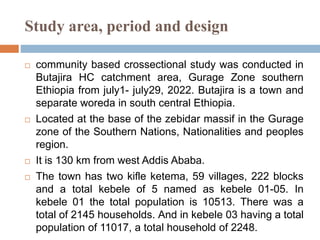
Study area, period and design
 community based crossectional study was conducted in
Butajira HC catchment area, Gurage Zone southern
Ethiopia from july1- july29, 2022. Butajira is a town and
separate woreda in south central Ethiopia.
 Located at the base of the zebidar massif in the Gurage
zone of the Southern Nations, Nationalities and peoples
region.
 It is 130 km from west Addis Ababa.
 The town has two kifle ketema, 59 villages, 222 blocks
and a total kebele of 5 named as kebele 01-05. In
kebele 01 the total population is 10513. There was a
total of 2145 households. And in kebele 03 having a total
population of 11017, a total household of 2248.
Population
Source population
 The source population was all households in
Butajira town.
Study Population
 The study population was selected households
in Butajira town.
Eligibility criteria
Inclusion criteria
 An individual who lives at least six months in study area.
 House hold who are temporarily away but comeback
within days,
 Selected household whose age is greater than 18 years.
Exclusion criteria
 individuals who are unconscious or sick during the
interview,
 forlorn house
 Absence of household’s members during visit 3 revisit.
Sample Size determination
 The sample size was determined by using a formula
for estimating a single population proportion assuming
confidence level of 95%, 5% marginal error with
proportion of 73.9% (proportion of modern
contraceptive users among family planning users in
hosanna town southern Ethiopia)[31] and 5%
allowance for non-respondent rate.
 Where,
 P =73.9%
 d=marginal error of 5%=0.05.
 Z=confidence interval of 95% and Zα/2 is the value of
the standard normal distribution corresponding to a
significance level of alpha (α) 0.05, which is 1.96.
Cont…..
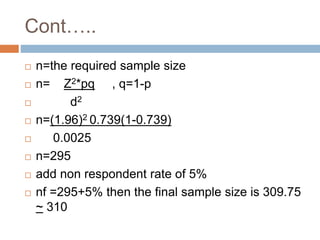
 n=the required sample size
 n= Z2*pq , q=1-p
 d2
 n=(1.96)2 0.739(1-0.739)
 0.0025
 n=295
 add non respondent rate of 5%
 nf =295+5% then the final sample size is 309.75
~ 310
Sampling procedure
 Butajira health center catchment consists
of 5 kebeles and among those 2 kebeles
was selected randomly by lottery method
for the study.
 The sample size was distributed
proportionally for each selected kebeles
 Finally, study participants was selected by
using systematic random sampling
method (each kth).
Study variables
 Dependent Variable
 Health and health related problems
 Independent variables
 Socio demographic factors:-Age, Sex,
Religion, Ethnicity, Age at the birth of last child,
Educational status of both women and their
husbands, Occupation, Income and Family
size
 Maternal (obstetric) and child health characteristics:
- Gravidity (birth order), Parity ,Desire/ wontedness of
pregnancy, Frequency of ANC visits, Place of delivery,
Course of pregnancy, Mode of delivery, Neonatal illness,
Neonatal death, Birth outcome and Health service
utilization
 Environmental health factors: availability of latrine,
Hand washing facility, Distance to nearby health facility,
Housing conditions
Operational definition
 Satisfactory – A house which has one or more windows for
each room which are functional , adequate lighting in all
rooms and roof with clean ceiling
 Moderate - A house which has one window but functions
partially, lighting is not reach in all rooms and roof with no
ceiling and dirty
 Low – No windows or windows closed all the time or non-
functional, no lightning and darkened and roof without ceiling
 Daily water consumption (WHO 2016)
 ADEQUATE >20L/individual/day
> 100L/household/day
 Inadequate < 20L/individual/day
<100L/household/day
Cont…
 Time from home to water source(EDHS 2016)
 Accesseble < 30 min
 Non accesseble >= 30 min
Data collection instrument and
quality control
 Data was collected using structured
interviewer questionnaire and observational
based. Data was collected by group members
after having common understanding on the
questionnaire. To ensure quality of data, all
data collected from respondents was checked
for completeness, clarity and consistency.
Cont….
 Any misunderstanding or ambiguity was
solved before data analysis by data editing
and checking, during data collection by
supervision and feedback giving was cleared.
We would mark the Households with
chalk/marker after interviewing. Strict
supervision was done by Group leaders and
site supervisor.
Data processing and analysis
 The data was cleaned for inconsistencies and
missing values and coded and entered in to
SPSS (Statistical Package for Social science)
version 22 for analysis.
 Finally, the finding was presented in
proportion, frequencies and percentage in
tables for categorical variables. Charts like pie
chart, bar chart was used to summarize
categorical variables and histogram was used
for continuous covariates.
Ethical Consideration
 All the ethical issues was considered &
requested by using a legal letter written by the
college medicine & health science for Butajira
town health center before the beginning of
process of data collection. The purpose of study
will be briefly explained for the respondents and
verbal informed consent will be also obtained
from the respondents.
Dissemination of results
 After writing the report, the result would be
submitted to CMHS CBE office, Butajira town
administration health unit, Butajira town
administrative office and disseminated to all
invited guests.
RESULTS
Socio demographic status of the respondents
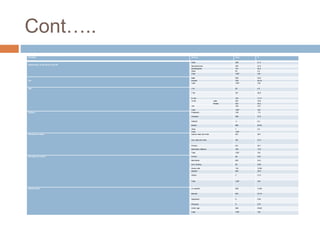
In this study, 310 households were successfully
interviewed and making respondent rate of 100%. There
were 1397 total population in the study, of these 759
(54.3%) are females and 638 (45.6%) were males.
Majority of them 889 (63.63 %) were Islamic religion
followers. About 579 (48.8%) were at age b/n 15-49.
Majority of 604 (43.2 %) were merchant, 603(43.16%)
were married, and 421 (30.1%) in primary or 1-8 level.
Cont…..
Variables Options Freq. %
Relationship to the head of the HH
Head 298 21.3
Spouse(wives) 305 21.8
Son/daughter 731 52.3
Other 63 4.5
Total 1397 100
Sex
Male 638 45.6
Female 759 54.33
Total 1397 100
Age <1yr 63 4.5
1-5yr 321 22.9
5-14yr 184 13.17
15-49 male 257 18.6
female 422 30.2
>50 150 10.7
Total 1397 100
Religion Protestant 109 7.8
Orthodox 388 27.8
Catholic 4 0.3
Muslim 889 63.63
Other 7 0.5
Total 1397
Educational status Cannot read and write 401 28.7
Can read and write 391 27.9
Primary 421 30.1
Secondary &above 184 13.8
Total 1397 100
Occupational status Farmer 96 6.87
Merchants 604 43.2
Gov’t employ 82 5.86
House wife 153 10.95
Student 460 32.9
Others 2 0.14
Total 1397 100
Marital status un married 209 14.96
Married 603 43.16
Separated 9 0.64
Widowed 8 0.57
Under age 568 40.65
Total 1397 100
VITAL STATISTICS
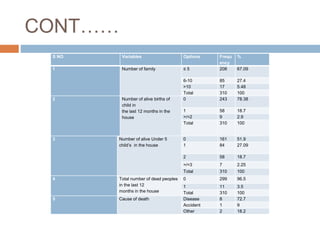
 Among 310 total households, Majority of
208(67.09%) were include family number of
less than five.
 The number of alive under five children found
in the total number of household were 320.
According to our survey the total number of
deaths in the last 12 month is 11, in which
most of them or 8 were dead as result of
disease.
CONT……
S NO Variables Options Frequ
ency
%
1 Number of family ≤ 5 208 67.09
6-10 85 27.4
>10 17 5.48
Total 310 100
2 Number of alive births of
child in
the last 12 months in the
house
0 243 78.38
1 58 18.7
>/=2 9 2.9
Total 310 100
3 Number of alive Under 5
child’s in the house
0 161 51.9
1 84 27.09
2 58 18.7
>/=3 7 2.25
Total 310 100
4 Total number of dead peoples
in the last 12
months in the house
0 299 96.5
1 11 3.5
Total 310 100
5 Cause of death Disease 8 72.7
Accident 1 9
Other 2 18.2
ENVIROMENTAL
CONDTION
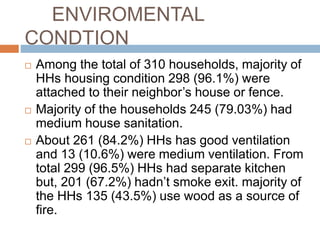
 Among the total of 310 households, majority of
HHs housing condition 298 (96.1%) were
attached to their neighbor’s house or fence.
 Majority of the households 245 (79.03%) had
medium house sanitation.
 About 261 (84.2%) HHs has good ventilation
and 13 (10.6%) were medium ventilation. From
total 299 (96.5%) HHs had separate kitchen
but, 201 (67.2%) hadn’t smoke exit. majority of
the HHs 135 (43.5%) use wood as a source of
fire.
Water supply
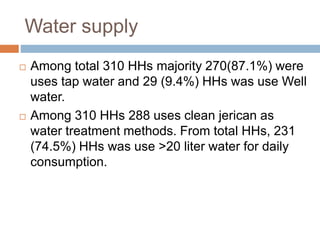
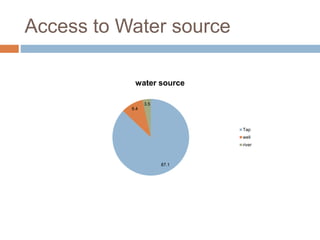
 Among total 310 HHs majority 270(87.1%) were
uses tap water and 29 (9.4%) HHs was use Well
water.
 Among 310 HHs 288 uses clean jerican as
water treatment methods. From total HHs, 231
(74.5%) HHs was use >20 liter water for daily
consumption.
Access to Water source
87.1
9.4
3.5
water source
Tap
well
river
Maternal and child health related characteristics
 Among 310 HHs in our study; 422 (30.2 %) were
reproductive age groups, among them 31 (7.3%) were
pregnant womens.
 Among those pregnant womens almost all 28 (90.3%)
were start ANC follow up and the remaining 3 were not
attending ANC. From those who does not have ANC
follow up, 2 (66.66) was due to lack of awarness about
ANC.
 Among those reproductive age groups 3 (0.71%) were
history of abortion in the last one year. In total 63
mothers gave birth in the last one years but from those
mothers who can gave birth in the last one year 4 (6.4%)
were at home and 59(93.6%) were at health center.
Maternal TT vaccination status
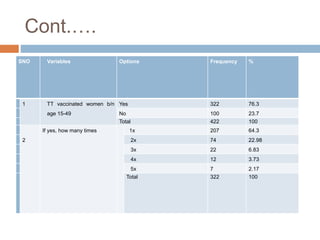
 Among those reproductive age women’s 322
(76.3%) women’s were TT vaccinated. From
all, 31 pregnant women’s majority 27 (87.09%)
were TT vaccinated at least 1x.
Cont.….
SNO Variables Options Frequency %
1 TT vaccinated women b/n
age 15-49
Yes 322 76.3
No 100 23.7
Total 422 100
2
If yes, how many times 1x 207 64.3
2x 74 22.98
3x 22 6.83
4x 12 3.73
5x 7 2.17
Total 322 100
Child immunization
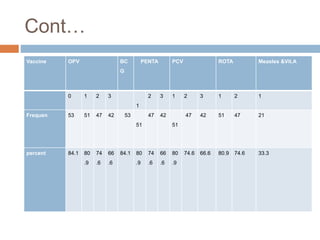
 Among 63 children born in the past 12 month 53
of them had been vaccinated at least once and
from those only 21were take measles and vit A .
Cont…
Vaccine OPV BC
G
PENTA PCV ROTA Measles &Vit.A
0 1 2 3
1
2 3 1 2 3 1 2 1
Frequen 53 51 47 42 53
51
47 42
51
47 42 51 47 21
percent 84.1 80
.9
74
.6
66
.6
84.1 80
.9
74
.6
66
.6
80
.9
74.6 66.6 80.9 74.6 33.3
Child feeding….
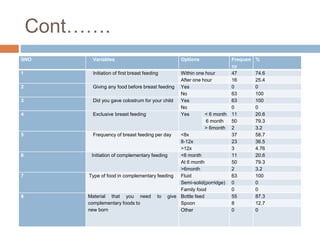
 Among 63 women’s who have child less than 1
year , majority 47 (74.6%) were initiate breast feed
within one hour while the rest can’t.
 Among those women’s no one gave any food
before breast feed but all 63 (100%) were gave
colostrum for their new born.
 Majority 50 (79.3%) women’s were exclusively
breast feed until six month then start
complementary feed. Majority 55 (87.3%) of
women’s need bottle feed to start.
Cont…….
SNO Variables Options Frequen
cy
%
1 Initiation of first breast feeding Within one hour 47 74.6
After one hour 16 25.4
2 Giving any food before breast feeding Yes 0 0
No 63 100
3 Did you gave colostrum for your child Yes 63 100
No 0 0
4 Exclusive breast feeding Yes < 6 month 11 20.6
6 month 50 79.3
> 6month 2 3.2
5 Frequency of breast feeding per day <8x 37 58.7
8-12x 23 36.5
>12x 3 4.76
6 Initiation of complementary feeding <6 month 11 20.6
At 6 month 50 79.3
>6month 2 3.2
7 Type of food in complementary feeding Fluid 63 100
Semi-solid(porridge) 0 0
Family food 0 0
8 Material that you need to give
complementary foods to
new born
Bottle feed 55 87.3
Spoon 8 12.7
Other 0 0
Family feeding habit
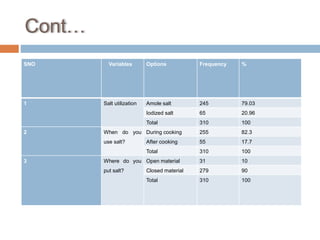
 Among total HHs majority 245 (79.03%) were
use amole salt but 255 (82.3%) were use salt
while during cooking
 majority 279(90%) HHs put salt by closed
material.
Cont…
SNO Variables Options Frequency %
1 Salt utilization Amole salt 245 79.03
Iodized salt 65 20.96
Total 310 100
2 When do you
use salt?
During cooking 255 82.3
After cooking 55 17.7
Total 310 100
3 Where do you
put salt?
Open material 31 10
Closed material 279 90
Total 310 100
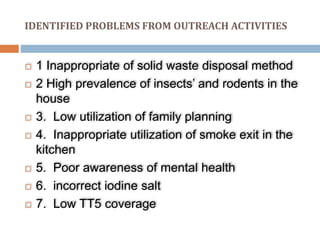
IDENTIFIED PROBLEMS FROM OUTREACH ACTIVITIES
 1 Inappropriate of solid waste disposal method
 2 High prevalence of insects’ and rodents in the
house
 3. Low utilization of family planning
 4. Inappropriate utilization of smoke exit in the
kitchen
 5. Poor awareness of mental health
 6. incorrect iodine salt
 7. Low TT5 coverage
CONT………
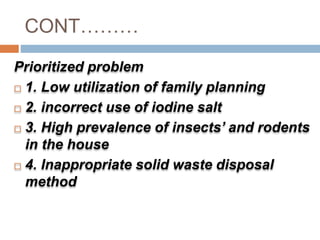
Prioritized problem
 1. Low utilization of family planning
 2. incorrect use of iodine salt
 3. High prevalence of insects’ and rodents
in the house
 4. Inappropriate solid waste disposal
method
SITUATIONAL ANALYSIS OF Butajira
HEALTH CENTER
BACKGROUND OF THE BUTAJIRA HEALTH
CENTER
 Butajira Health center is found in Butajira town.
It is situated at the border of the town.Butajira
health centre has 5 kebele under its
catchment.
 Total number of population using health center
are 55074 organized in 11239 households.
 The medical staffs of Butajira health center
are; 5 Medical Doctor, 16 Public health
officers, 2 BSC nurse and 38 Clinical nurses, 3
Midwifery, 8 laboratory technicians, 9
Druggists, 2 Environmental health ,3 HIT and
11 health extension workers.
Cont…
 The administrative and supportive staffs of BHC
are 1 head of the health centre, 1 human
resource officer, 2 purchaser, 1auditor, 4 cashier,
5 daily cash collector, 3 guards, 6 runners and 8
cleaners.

Main services provided in the Butajira
health center
 Outpatient treatment services
 Emergency treatment services
 ANC, delivery &PNC services
 Vaccination services(EPI)
 Laboratory services
 ART
 Leprosy & TB services
 Pharmacy services

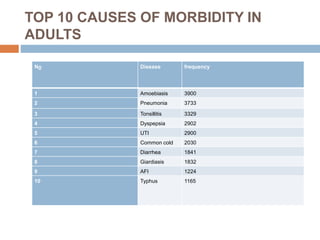
TOP 10 CAUSES OF MORBIDITY IN
ADULTS
No Disease frequency
1 Amoebiasis 3900
2 Pneumonia 3733
3 Tonsillitis 3329
4 Dyspepsia 2902
5 UTI 2900
6 Common cold 2030
7 Diarrhea 1841
8 Giardiasis 1832
9 AFI 1224
10 Typhus 1165
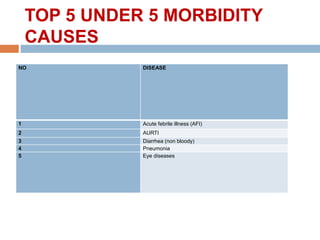
TOP 5 UNDER 5 MORBIDITY
CAUSES
NO DISEASE
1 Acute febrile illness (AFI)
2 AURTI
3 Diarrhea (non bloody)
4 Pneumonia
5 Eye diseases
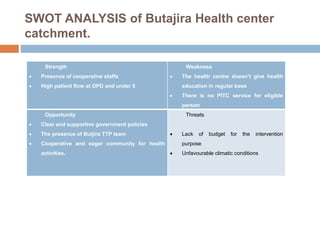
SWOT ANALYSIS of Butajira Health center
catchment.
Strength
 Presence of cooperative staffs
 High patient flow at OPD and under 5
Weakness
 The health centre doesn’t give health
education in regular base
 There is no PITC service for eligible
person
Opportunity
 Clear and supportive government policies
 The presence of Butjira TTP team
 Cooperative and eager community for health
activities.
Threats
 Lack of budget for the intervention
purpose
 Unfavourable climatic conditions
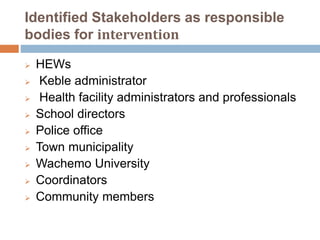
Identified Stakeholders as responsible
bodies for intervention
 HEWs
 Keble administrator
 Health facility administrators and professionals
 School directors
 Police office
 Town municipality
 Wachemo University
 Coordinators
 Community members
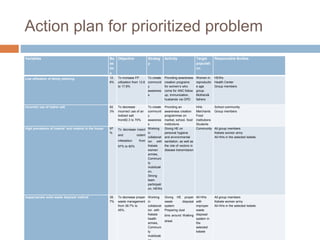
Action plan for prioritized problem
Variables Ba
se
lin
e
Objective Strateg
y
Activity Target
populati
on
Responsible Bodies
Low utilization of family planning 12.
6%
To increase FP
utilization from 12.6
to 17.8%
To create
communit
y
awarenes
s
Providing awareness
creation programs
for women’s who
come for ANC follow
up, Immunization,
husbands via OPD
Women in
reproductiv
e age
group
Mothers&
fathers
HEWs
Health Center
Group members
Incorrect use of iodine salt 82.
3%
To decrease
incorrect use of an
Iodized salt
from82.3 to 70%
To create
communit
y
awarenes
s
Providing an
awareness creation
programmes on
market, school, food
institutions
HHs
Merchants
Food
institutions
Students
School community
Group members
High prevalence of insects’ and rodents in the house 97
%
To decrease insect
and rodent
infestation from
97% to 60%
Working
in
collaborat
ion with
Kebele
women
armies,
Communi
ty
mobilizati
on,
Strong
team
participati
on, HEWs
Giving HE on
personal hygiene
and environmental
sanitation, as well as
the role of vectors in
disease transmission
Community All group members
Kebele women army
All HHs in the selected kebele
Inappropriate solid waste disposal method 39.
7%
To decrease proper
waste management
from 39.7% to
45%.
Working
in
collaborat
ion with
Kebele
health
armies,
Communi
ty
mobilizati
Giving HE proper
waste disposal
system
Preparing dust
bins around Walking
street.
All HHs
with
improper
waste
disposal
system in
the
selected
kebele
All group members
Kebele women army
All HHs in the selected kebele
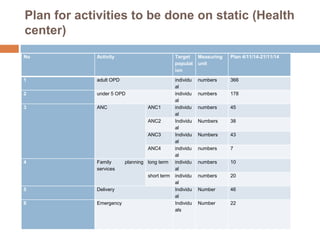
Plan for activities to be done on static (Health
center)
No Activity Target
populat
ion
Measuring
unit
Plan 4/11/14-21/11/14
1 adult OPD individu
al
numbers 366
2 under 5 OPD individu
al
numbers 178
3 ANC ANC1 individu
al
numbers 45
ANC2 Individu
al
Numbers 38
ANC3 Individu
al
Numbers 43
ANC4 individu
al
numbers 7
4 Family planning
services
long term individu
al
numbers 10
short term individu
al
numbers 20
5 Delivery Individu
al
Number 46
6 Emergency Individu
als
Number 22
Reference
 Abraham H .Assessment of Health and health related problem,
Jimma University, 2009.
 AtekurD 2012, Basic concept of research methods for health
and health related problems)
 CDC in Ethiopia Fact Sheet. Publication Date, August 2013.
 National Center for Health Statistics (2006), United States with
chart Book on trends on the health of Americans. Hyattsville,
MD
 US Bureau of the Census (2005). Statistical Abstract of the
United States: 2006. Washington, DC.(2006)

!!Power point TTP Butajira.pptx

  • 1.
    ASSESSMENT, PRIORITIZATION ANDINTERVENTION OF HEALTH AND HEALTH RELATED PROBLEMS IN BUTAJIRA HEALTH CENTER CATCHMENT AREA, BUTAJIRA TOWN ADIMINSTRATION, SNNPR, ETHIOPIA, 2022. Advisors: Mr. DENEBO -------BSc, MSc) Mr. MASTAWAL ----( BSc) July ,2022 Butajira, Ethiopia
  • 2.
    1. Introduction 2. justification 3.Significance 4. Objective 5. Methods and Materials 6. result 7. Identified problem 8 priortized problem 9. Action plan Presentation Outline
  • 3.
    Introduction  Community basedEducation (CBE) is a means of achieving educational relevance to community needs and consists of learning activates that use the community -oriented education program (Abrham H et al 2009)  It designed on three main phases; which are team training program (TTP), community based training program (CBTP), and community health assessment (CHA), sometimes SRE (student research project), & the one which mainly used in an undergraduate level is the CBTP.
  • 4.
     Sustaining ahealthy community is the goal of every part of the world.  However, achieving this goal requires careful planning and organized community members, health organizations, academic institutions, and various government agencies.  Although, in terms of education, technology, health resources, and per capita purchasing power are higher in United States, it fails to deliver the best health care at a reasonable cost. About 45 million (15.6%) US population is not covered by health insurance. (US Bureu of census et al 2006) Intro cont…
  • 5.
     Health andhealth related problems are worsening in the world.  These problems are more rampant in developing nations as compared to those in the developed world,  Ethiopia as being one of the countries in the developing nations, have been encountering much of their burdens which aggravated the health problem.  Those problems could have been minimized by good health services management and strong political commitment as well as community participation (Atekur D et al20012) Cont…..
  • 6.
     In Ethiopia35% of house-holds get drinking water from unimproved source in average it is from 3% in urban and 43% in rural.  More than half of rural house-holds (53%) travel greater than or equal to 30 minutes round the trip to fetch the drinking water (National Center for Health Statistics (2006).  About four in every ten Ethiopian women (41 %) did not receive any antenatal care for their last birth in the five years preceding the survey. Cont…..
  • 7.
     The diseaseburden responsible for 74% of deaths and 81% of disability adjusted years lost per year is dominated by malaria, prenatal and maternal death, URTI, Nutritional deficiency (malnutrition), diarrheal and HIV/AIDS  Communicable diseases, maternal and child health problems, nutritional problems, maternal and child health problems are the major challenging health care related problems in Ethiopia (CDC et al 2013) Cont…..
  • 8.
    cont  As mostof health related problems in Ethiopia are preventable, community health assessment is an important tool to identify health status, health related problems, and factors that could affect the society’s health.  As stated above, there are wide ranges of health and health related problem around the globe including our country. So, this study aims to assess community health and health related problems of BHCcatchment area
  • 9.
    Significance  As mostof health related problems in Ethiopia are preventable, community health assessment is an important tool to identify health status, health related problems, and factors that could affect the society’s health.  This study will provide valuable information for the government organization, NGOs, the people as a whole. It makes health sector bureaus and the community as a hole to focus on the listed main problems.
  • 10.
    Cont…..  The studywould also help the students to increase team work sprit, tolerance, problem solving ability and to make them familiar for the problem of the society for better solution.  The recommendations from this survey will also be helpful for local health planners to consider during their planning. This survey will also provide baseline information and directions for further research activities in the area.
  • 11.
    Objective of theStudy General Objective  To assess, prioritize and intervene on health and health related problems of Butajira health center catchment community, Meskan woreda, Gurage zone, SNNPR, Ethiopia from Julay 1- Julay 29 2022. Specific objectives  To Assess health and health related problems of Butajira health center catchment community  To prioritize health and health related problems of Butajira health center catchment community.  To intervene health and health related problems of Butajira health center catchment community.
  • 12.
  • 13.
    Study area, periodand design  community based crossectional study was conducted in Butajira HC catchment area, Gurage Zone southern Ethiopia from july1- july29, 2022. Butajira is a town and separate woreda in south central Ethiopia.  Located at the base of the zebidar massif in the Gurage zone of the Southern Nations, Nationalities and peoples region.  It is 130 km from west Addis Ababa.  The town has two kifle ketema, 59 villages, 222 blocks and a total kebele of 5 named as kebele 01-05. In kebele 01 the total population is 10513. There was a total of 2145 households. And in kebele 03 having a total population of 11017, a total household of 2248.
  • 14.
    Population Source population  Thesource population was all households in Butajira town. Study Population  The study population was selected households in Butajira town.
  • 15.
    Eligibility criteria Inclusion criteria An individual who lives at least six months in study area.  House hold who are temporarily away but comeback within days,  Selected household whose age is greater than 18 years. Exclusion criteria  individuals who are unconscious or sick during the interview,  forlorn house  Absence of household’s members during visit 3 revisit.
  • 16.
    Sample Size determination The sample size was determined by using a formula for estimating a single population proportion assuming confidence level of 95%, 5% marginal error with proportion of 73.9% (proportion of modern contraceptive users among family planning users in hosanna town southern Ethiopia)[31] and 5% allowance for non-respondent rate.  Where,  P =73.9%  d=marginal error of 5%=0.05.  Z=confidence interval of 95% and Zα/2 is the value of the standard normal distribution corresponding to a significance level of alpha (α) 0.05, which is 1.96.
  • 17.
    Cont…..  n=the requiredsample size  n= Z2*pq , q=1-p  d2  n=(1.96)2 0.739(1-0.739)  0.0025  n=295  add non respondent rate of 5%  nf =295+5% then the final sample size is 309.75 ~ 310
  • 18.
    Sampling procedure  Butajirahealth center catchment consists of 5 kebeles and among those 2 kebeles was selected randomly by lottery method for the study.  The sample size was distributed proportionally for each selected kebeles  Finally, study participants was selected by using systematic random sampling method (each kth).
  • 19.
    Study variables  DependentVariable  Health and health related problems  Independent variables  Socio demographic factors:-Age, Sex, Religion, Ethnicity, Age at the birth of last child, Educational status of both women and their husbands, Occupation, Income and Family size
  • 20.
     Maternal (obstetric)and child health characteristics: - Gravidity (birth order), Parity ,Desire/ wontedness of pregnancy, Frequency of ANC visits, Place of delivery, Course of pregnancy, Mode of delivery, Neonatal illness, Neonatal death, Birth outcome and Health service utilization  Environmental health factors: availability of latrine, Hand washing facility, Distance to nearby health facility, Housing conditions
  • 21.
    Operational definition  Satisfactory– A house which has one or more windows for each room which are functional , adequate lighting in all rooms and roof with clean ceiling  Moderate - A house which has one window but functions partially, lighting is not reach in all rooms and roof with no ceiling and dirty  Low – No windows or windows closed all the time or non- functional, no lightning and darkened and roof without ceiling  Daily water consumption (WHO 2016)  ADEQUATE >20L/individual/day > 100L/household/day  Inadequate < 20L/individual/day <100L/household/day
  • 22.
    Cont…  Time fromhome to water source(EDHS 2016)  Accesseble < 30 min  Non accesseble >= 30 min
  • 23.
    Data collection instrumentand quality control  Data was collected using structured interviewer questionnaire and observational based. Data was collected by group members after having common understanding on the questionnaire. To ensure quality of data, all data collected from respondents was checked for completeness, clarity and consistency.
  • 24.
    Cont….  Any misunderstandingor ambiguity was solved before data analysis by data editing and checking, during data collection by supervision and feedback giving was cleared. We would mark the Households with chalk/marker after interviewing. Strict supervision was done by Group leaders and site supervisor.
  • 25.
    Data processing andanalysis  The data was cleaned for inconsistencies and missing values and coded and entered in to SPSS (Statistical Package for Social science) version 22 for analysis.  Finally, the finding was presented in proportion, frequencies and percentage in tables for categorical variables. Charts like pie chart, bar chart was used to summarize categorical variables and histogram was used for continuous covariates.
  • 26.
    Ethical Consideration  Allthe ethical issues was considered & requested by using a legal letter written by the college medicine & health science for Butajira town health center before the beginning of process of data collection. The purpose of study will be briefly explained for the respondents and verbal informed consent will be also obtained from the respondents.
  • 27.
    Dissemination of results After writing the report, the result would be submitted to CMHS CBE office, Butajira town administration health unit, Butajira town administrative office and disseminated to all invited guests.
  • 28.
    RESULTS Socio demographic statusof the respondents In this study, 310 households were successfully interviewed and making respondent rate of 100%. There were 1397 total population in the study, of these 759 (54.3%) are females and 638 (45.6%) were males. Majority of them 889 (63.63 %) were Islamic religion followers. About 579 (48.8%) were at age b/n 15-49. Majority of 604 (43.2 %) were merchant, 603(43.16%) were married, and 421 (30.1%) in primary or 1-8 level.
  • 29.
    Cont….. Variables Options Freq.% Relationship to the head of the HH Head 298 21.3 Spouse(wives) 305 21.8 Son/daughter 731 52.3 Other 63 4.5 Total 1397 100 Sex Male 638 45.6 Female 759 54.33 Total 1397 100 Age <1yr 63 4.5 1-5yr 321 22.9 5-14yr 184 13.17 15-49 male 257 18.6 female 422 30.2 >50 150 10.7 Total 1397 100 Religion Protestant 109 7.8 Orthodox 388 27.8 Catholic 4 0.3 Muslim 889 63.63 Other 7 0.5 Total 1397 Educational status Cannot read and write 401 28.7 Can read and write 391 27.9 Primary 421 30.1 Secondary &above 184 13.8 Total 1397 100 Occupational status Farmer 96 6.87 Merchants 604 43.2 Gov’t employ 82 5.86 House wife 153 10.95 Student 460 32.9 Others 2 0.14 Total 1397 100 Marital status un married 209 14.96 Married 603 43.16 Separated 9 0.64 Widowed 8 0.57 Under age 568 40.65 Total 1397 100
  • 30.
    VITAL STATISTICS  Among310 total households, Majority of 208(67.09%) were include family number of less than five.  The number of alive under five children found in the total number of household were 320. According to our survey the total number of deaths in the last 12 month is 11, in which most of them or 8 were dead as result of disease.
  • 31.
    CONT…… S NO VariablesOptions Frequ ency % 1 Number of family ≤ 5 208 67.09 6-10 85 27.4 >10 17 5.48 Total 310 100 2 Number of alive births of child in the last 12 months in the house 0 243 78.38 1 58 18.7 >/=2 9 2.9 Total 310 100 3 Number of alive Under 5 child’s in the house 0 161 51.9 1 84 27.09 2 58 18.7 >/=3 7 2.25 Total 310 100 4 Total number of dead peoples in the last 12 months in the house 0 299 96.5 1 11 3.5 Total 310 100 5 Cause of death Disease 8 72.7 Accident 1 9 Other 2 18.2
  • 32.
    ENVIROMENTAL CONDTION  Among thetotal of 310 households, majority of HHs housing condition 298 (96.1%) were attached to their neighbor’s house or fence.  Majority of the households 245 (79.03%) had medium house sanitation.  About 261 (84.2%) HHs has good ventilation and 13 (10.6%) were medium ventilation. From total 299 (96.5%) HHs had separate kitchen but, 201 (67.2%) hadn’t smoke exit. majority of the HHs 135 (43.5%) use wood as a source of fire.
  • 33.
    Water supply  Amongtotal 310 HHs majority 270(87.1%) were uses tap water and 29 (9.4%) HHs was use Well water.  Among 310 HHs 288 uses clean jerican as water treatment methods. From total HHs, 231 (74.5%) HHs was use >20 liter water for daily consumption.
  • 34.
    Access to Watersource 87.1 9.4 3.5 water source Tap well river
  • 35.
    Maternal and childhealth related characteristics  Among 310 HHs in our study; 422 (30.2 %) were reproductive age groups, among them 31 (7.3%) were pregnant womens.  Among those pregnant womens almost all 28 (90.3%) were start ANC follow up and the remaining 3 were not attending ANC. From those who does not have ANC follow up, 2 (66.66) was due to lack of awarness about ANC.  Among those reproductive age groups 3 (0.71%) were history of abortion in the last one year. In total 63 mothers gave birth in the last one years but from those mothers who can gave birth in the last one year 4 (6.4%) were at home and 59(93.6%) were at health center.
  • 36.
    Maternal TT vaccinationstatus  Among those reproductive age women’s 322 (76.3%) women’s were TT vaccinated. From all, 31 pregnant women’s majority 27 (87.09%) were TT vaccinated at least 1x.
  • 37.
    Cont.…. SNO Variables OptionsFrequency % 1 TT vaccinated women b/n age 15-49 Yes 322 76.3 No 100 23.7 Total 422 100 2 If yes, how many times 1x 207 64.3 2x 74 22.98 3x 22 6.83 4x 12 3.73 5x 7 2.17 Total 322 100
  • 38.
    Child immunization  Among63 children born in the past 12 month 53 of them had been vaccinated at least once and from those only 21were take measles and vit A .
  • 39.
    Cont… Vaccine OPV BC G PENTAPCV ROTA Measles &Vit.A 0 1 2 3 1 2 3 1 2 3 1 2 1 Frequen 53 51 47 42 53 51 47 42 51 47 42 51 47 21 percent 84.1 80 .9 74 .6 66 .6 84.1 80 .9 74 .6 66 .6 80 .9 74.6 66.6 80.9 74.6 33.3
  • 40.
    Child feeding….  Among63 women’s who have child less than 1 year , majority 47 (74.6%) were initiate breast feed within one hour while the rest can’t.  Among those women’s no one gave any food before breast feed but all 63 (100%) were gave colostrum for their new born.  Majority 50 (79.3%) women’s were exclusively breast feed until six month then start complementary feed. Majority 55 (87.3%) of women’s need bottle feed to start.
  • 41.
    Cont……. SNO Variables OptionsFrequen cy % 1 Initiation of first breast feeding Within one hour 47 74.6 After one hour 16 25.4 2 Giving any food before breast feeding Yes 0 0 No 63 100 3 Did you gave colostrum for your child Yes 63 100 No 0 0 4 Exclusive breast feeding Yes < 6 month 11 20.6 6 month 50 79.3 > 6month 2 3.2 5 Frequency of breast feeding per day <8x 37 58.7 8-12x 23 36.5 >12x 3 4.76 6 Initiation of complementary feeding <6 month 11 20.6 At 6 month 50 79.3 >6month 2 3.2 7 Type of food in complementary feeding Fluid 63 100 Semi-solid(porridge) 0 0 Family food 0 0 8 Material that you need to give complementary foods to new born Bottle feed 55 87.3 Spoon 8 12.7 Other 0 0
  • 42.
    Family feeding habit Among total HHs majority 245 (79.03%) were use amole salt but 255 (82.3%) were use salt while during cooking  majority 279(90%) HHs put salt by closed material.
  • 43.
    Cont… SNO Variables OptionsFrequency % 1 Salt utilization Amole salt 245 79.03 Iodized salt 65 20.96 Total 310 100 2 When do you use salt? During cooking 255 82.3 After cooking 55 17.7 Total 310 100 3 Where do you put salt? Open material 31 10 Closed material 279 90 Total 310 100
  • 44.
    IDENTIFIED PROBLEMS FROMOUTREACH ACTIVITIES  1 Inappropriate of solid waste disposal method  2 High prevalence of insects’ and rodents in the house  3. Low utilization of family planning  4. Inappropriate utilization of smoke exit in the kitchen  5. Poor awareness of mental health  6. incorrect iodine salt  7. Low TT5 coverage
  • 45.
    CONT……… Prioritized problem  1.Low utilization of family planning  2. incorrect use of iodine salt  3. High prevalence of insects’ and rodents in the house  4. Inappropriate solid waste disposal method
  • 46.
    SITUATIONAL ANALYSIS OFButajira HEALTH CENTER
  • 47.
    BACKGROUND OF THEBUTAJIRA HEALTH CENTER  Butajira Health center is found in Butajira town. It is situated at the border of the town.Butajira health centre has 5 kebele under its catchment.  Total number of population using health center are 55074 organized in 11239 households.  The medical staffs of Butajira health center are; 5 Medical Doctor, 16 Public health officers, 2 BSC nurse and 38 Clinical nurses, 3 Midwifery, 8 laboratory technicians, 9 Druggists, 2 Environmental health ,3 HIT and 11 health extension workers.
  • 48.
    Cont…  The administrativeand supportive staffs of BHC are 1 head of the health centre, 1 human resource officer, 2 purchaser, 1auditor, 4 cashier, 5 daily cash collector, 3 guards, 6 runners and 8 cleaners. 
  • 49.
    Main services providedin the Butajira health center  Outpatient treatment services  Emergency treatment services  ANC, delivery &PNC services  Vaccination services(EPI)  Laboratory services  ART  Leprosy & TB services  Pharmacy services 
  • 50.
    TOP 10 CAUSESOF MORBIDITY IN ADULTS No Disease frequency 1 Amoebiasis 3900 2 Pneumonia 3733 3 Tonsillitis 3329 4 Dyspepsia 2902 5 UTI 2900 6 Common cold 2030 7 Diarrhea 1841 8 Giardiasis 1832 9 AFI 1224 10 Typhus 1165
  • 51.
    TOP 5 UNDER5 MORBIDITY CAUSES NO DISEASE 1 Acute febrile illness (AFI) 2 AURTI 3 Diarrhea (non bloody) 4 Pneumonia 5 Eye diseases
  • 52.
    SWOT ANALYSIS ofButajira Health center catchment. Strength  Presence of cooperative staffs  High patient flow at OPD and under 5 Weakness  The health centre doesn’t give health education in regular base  There is no PITC service for eligible person Opportunity  Clear and supportive government policies  The presence of Butjira TTP team  Cooperative and eager community for health activities. Threats  Lack of budget for the intervention purpose  Unfavourable climatic conditions
  • 53.
    Identified Stakeholders asresponsible bodies for intervention  HEWs  Keble administrator  Health facility administrators and professionals  School directors  Police office  Town municipality  Wachemo University  Coordinators  Community members
  • 54.
    Action plan forprioritized problem Variables Ba se lin e Objective Strateg y Activity Target populati on Responsible Bodies Low utilization of family planning 12. 6% To increase FP utilization from 12.6 to 17.8% To create communit y awarenes s Providing awareness creation programs for women’s who come for ANC follow up, Immunization, husbands via OPD Women in reproductiv e age group Mothers& fathers HEWs Health Center Group members Incorrect use of iodine salt 82. 3% To decrease incorrect use of an Iodized salt from82.3 to 70% To create communit y awarenes s Providing an awareness creation programmes on market, school, food institutions HHs Merchants Food institutions Students School community Group members High prevalence of insects’ and rodents in the house 97 % To decrease insect and rodent infestation from 97% to 60% Working in collaborat ion with Kebele women armies, Communi ty mobilizati on, Strong team participati on, HEWs Giving HE on personal hygiene and environmental sanitation, as well as the role of vectors in disease transmission Community All group members Kebele women army All HHs in the selected kebele Inappropriate solid waste disposal method 39. 7% To decrease proper waste management from 39.7% to 45%. Working in collaborat ion with Kebele health armies, Communi ty mobilizati Giving HE proper waste disposal system Preparing dust bins around Walking street. All HHs with improper waste disposal system in the selected kebele All group members Kebele women army All HHs in the selected kebele
  • 55.
    Plan for activitiesto be done on static (Health center) No Activity Target populat ion Measuring unit Plan 4/11/14-21/11/14 1 adult OPD individu al numbers 366 2 under 5 OPD individu al numbers 178 3 ANC ANC1 individu al numbers 45 ANC2 Individu al Numbers 38 ANC3 Individu al Numbers 43 ANC4 individu al numbers 7 4 Family planning services long term individu al numbers 10 short term individu al numbers 20 5 Delivery Individu al Number 46 6 Emergency Individu als Number 22
  • 56.
    Reference  Abraham H.Assessment of Health and health related problem, Jimma University, 2009.  AtekurD 2012, Basic concept of research methods for health and health related problems)  CDC in Ethiopia Fact Sheet. Publication Date, August 2013.  National Center for Health Statistics (2006), United States with chart Book on trends on the health of Americans. Hyattsville, MD  US Bureau of the Census (2005). Statistical Abstract of the United States: 2006. Washington, DC.(2006)