Introduction to epidemiology
BY: Temesgen T(MPHE)
1
3/19/2024
Outline
Introduction
Definition of epidemiology
types
assumption
scope
features
application
historical back ground
Branch of epidemiology
2
3/19/2024
At the end of the class, the learner will be able to
Describe epidemiological concepts of Health and
Health related events
Explain scope, feature , application and purpose
of epidemiological investigations
3
Objectives of the course
3/19/2024
Introduction
Health:-
• Definition of health has negative and
positive models:
Negative model- defines health as the absence
of the constraints of health. That is you are
healthy if you are not ill.
The renewal of health in a diseased individual
is the removal of the disease.
This model equates health with the absence of
disease
4
3/19/2024
Positive model is by WHO- a state of
complete physical, mental and social well
being and not merely the absence of
disease or infirmity. This definition is also
simplified to “ The ability to lead a socially
and economically productive life”
5
3/19/2024
• Disease- is a physiological/psychological
dysfunction
• Illness- a subjective state of the person
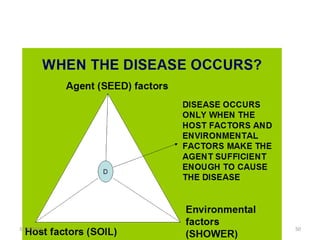
who feels aware of not being well
• Sickness- is a state of social dysfunction
that is a role that the individual assumes
when ill
6
3/19/2024
Community- refers to a group of people who
share some thing in common.
Examples of common denominators may be
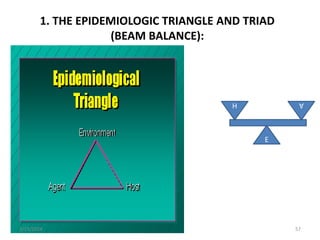
neighborhood, work place, race, religion or
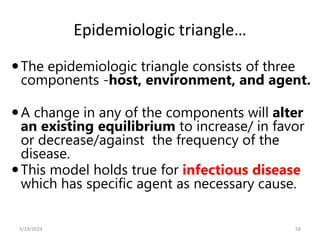
social activity.
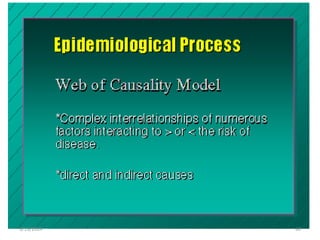
Communities are characterized by people’s
engagement in activities that demand
interrelationship of efforts, they give rise to
shared culture, and they are often sited in a
particular geographic location.
7
3/19/2024
Community medicine- is a system of
delivery of comprehensive health care to
the people by a health team to improve
the health of a community.
• Thus it embraces the preventive and social
medicine along with curative and
promotive health services.
8
3/19/2024
the community replaces the individual
patients as the primary focus of concern.
The problem here is to evaluate the health
of a defined community including those
members who would benefit from, but
could not seek medical care.
These approach requires techniques and
skills in addition to those needed for
clinical practice.
9
3/19/2024
Clinical medicine- medical care of
individuals.
Typically these are sick people who have
presented for help.
In community medicine, the community
replaces the individual patients as the
primary focus of concern.
10
3/19/2024
• Community diagnosis- is the process of
identification and detailed description of the
most important problems of a given community.
• It may be broad or narrow in scope, and may
deal with only a single topic or a single sub
group.
11
3/19/2024
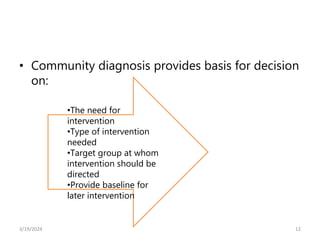
• Community diagnosis provides basis for decision
on:
12
•The need for
intervention
•Type of intervention
needed
•Target group at whom
intervention should be
directed
•Provide baseline for
later intervention
3/19/2024
• Public health- Is the science and art of
preventing diseases, prolonging life and
promoting health by community efforts
and governments action.
13
3/19/2024
• Public health is:
14
Preventing disease
Prolonging life
Improving quality of life
Eliminating health
inequalities
Organizing community to
promote active participation
3/19/2024
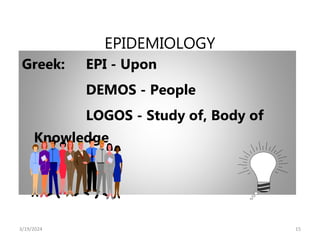
EPIDEMIOLOGY
Greek: EPI - Upon
DEMOS - People
LOGOS - Study of, Body of
Knowledge
15
3/19/2024
DEFINITIONS OF EPIDEMIOLOGY
The study of the distribution and determinants
of disease frequency in human populations.
(1970)
The study of the distribution and determinants
of health-related states or events in specified
populations, and the application of this study to
control health problems. (1988)
16
3/19/2024
17
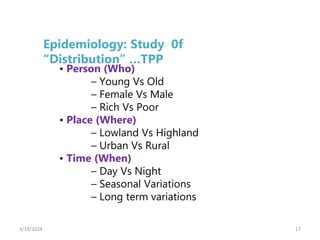
• Person (Who)
– Young Vs Old
– Female Vs Male
– Rich Vs Poor
• Place (Where)
– Lowland Vs Highland
– Urban Vs Rural
• Time (When)
– Day Vs Night
– Seasonal Variations
– Long term variations
Epidemiology: Study 0f
“Distribution” …TPP
3/19/2024
18
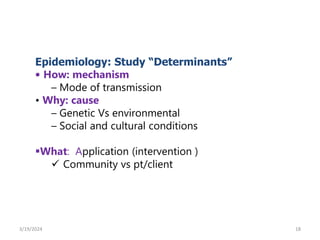
Epidemiology: Study “Determinants”
• How: mechanism
– Mode of transmission
• Why: cause
– Genetic Vs environmental
– Social and cultural conditions
What: Application (intervention )
 Community vs pt/client
3/19/2024
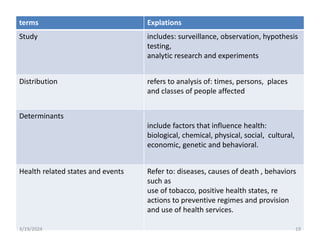
terms Explations
Study includes: surveillance, observation, hypothesis
testing,
analytic research and experiments
Distribution refers to analysis of: times, persons, places
and classes of people affected
Determinants
include factors that influence health:
biological, chemical, physical, social, cultural,
economic, genetic and behavioral.
Health related states and events Refer to: diseases, causes of death , behaviors
such as
use of tobacco, positive health states, re
actions to preventive regimes and provision
and use of health services.
3/19/2024 19
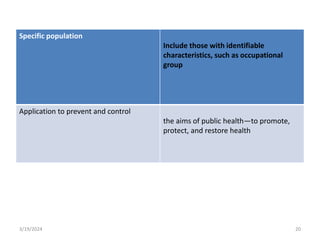
Specific population
Include those with identifiable
characteristics, such as occupational
group
Application to prevent and control
the aims of public health—to promote,
protect, and restore health
3/19/2024 20
Two Broad Types of Epidemiology
Examining the distribution of a disease in a
population, and observing the basic features of
its distribution in terms of time, place, and
person. Generating hypothesis
Typical study designs:
• community health survey (approximate
synonyms - cross-sectional study, descriptive
study)
21
DESCRIPTIVE EPIDEMIOLOGY
3/19/2024
22
Testing a specific hypothesis about the
relationship of a disease to a putative cause,
by conducting an epidemiologic study that
relates the exposure of interest to the disease of
interest.
Typical study designs: cohort, case-control
ANALYTIC EPIDEMIOLOGY
3/19/2024
Two fundamental assumptions
1. Non-random distribution of diseases; i.e.
disease occurrence in a population is not
random or by chance
2. Human disease has causal and protective
factors that can be identified through
systematic investigation of different
population or subgroups of individuals
within population in different places or at
different times
23
3/19/2024
24
Studies are conducted on human population
Examines Patterns of events in groups of
people
Can establish cause and effect relationship
without the knowledge of biologic mechanism
eg. Smoking and lung cancer
Covers a wide range of conditions
• From infectious to non-infectious
• From simple survey to complex drug trials
Features of
Epidemiology
3/19/2024
25
• Elucidation of the natural history of disease
• Description of the health status of the
population
• Establishing causation of disease
• Evaluating efficaciousness and effectiveness of
interventions
• Supply information for decision:
– Individual: behavioral changes… smoking,
contraception, sexual
– Public health : Planning interventions, priority
setting, resource allocation, evaluating
effectiveness of intervention (evaluation)
Application of
Epidemiology
3/19/2024
SCOPE OF EPIDEMIOLOGY:
26
Since 5th
century
Epidemic of communicable diseases
Endemic communicable
diseases &
Non communicable diseases
Middle of
20th century
Chronic diseases,
injuries,
birth defects
MCH
Occupational health
Env’tal health
Past 25 yrs
Health related behavior
recently
Genetic markers of disease risks
▲ +
▲+
▲+
▲+
3/19/2024
Brief History of Epidemiology
460 B.C – Hippocrates, the father of
modern medicine. Suggested human
disease might be related to personal and
environmental factors.
1662 - John Graunt – tried to quantify
patterns of birth, death and disease
occurrence, noting male female disparities,
high infant mortality, urban and rural
differences, and seasonal variations.
27
3/19/2024
History of epidemiology…
1747 - Lind used an "experimental" approach to
prove the cause of scurvy.
1787-1872. Alexandre Louis, sometimes called the
“Father of Epidemiology”, Using quantitative
reasoning demonstrated effectiveness of health
interventions
1839 - William Farr extended the epidemiologic
analysis of morbidity and mortality data, looking at
effects of marital status, occupation, and altitude
1854 - John Snow demonstrated that the risk of
mortality due to cholera was related to the drinking
water provided by a particular supplier in London
28
3/19/2024
1937 Austin Bradford Hill, suggested the
criteria for establishing causation from
epidemiological studies.
• 1950's-1970's. Major epidemiology
successes in the area of non-infectious
diseases
• 1970-: development of the 21st century
epidemiology
29
3/19/2024
Evolution in Epidemiology
First – “environmental’’ disease occur due to
bad air
Second –”Germ theory”: infectious disease
era
Third ”Chronic disease era” (Modern
Epidemiology): focus on risk-factor at
individual level
Fourth- “Multi-level causality” (21st
Century): focus on risk factors as well as
causal pathways at the societal level and with
pathogenesis at the molecular level.
30
3/19/2024
Purposes/use of epidemiology:
1. population/community health diagnosis:
- To assess health of a community, relevant
sources of data must be identified and analyzed
by time, person and place
2. Individual decision:
1950’s - cancer- higher among smokers
1970’s- exercise + proper diet – reduced HDs
Mid 1980’s – risk of HIV related to behavior
– These and hundreds of epidemiologic findings have
helped individuals to make decisions.
31
3/19/2024
3. Completing the clinical picture
(elucidation of the natural history of
diseases):
-Epidemiologic findings contribute to
physicians understanding of the clinical
picture &natural history of disease.
4. Search for causes of diseases:
It has been said that epidemiology can
never prove causative, nevertheless
provides enough information for action.
5. Classification of diseases
6. Monitoring of health programs
32
3/19/2024
Branch of Epidemiology
Surveillance/field epidemiology :-
-Outbreak investigation ,
-Epidemic control
Descriptive epidemiology
-examination of pattern of occurrence disease and
injuries and their determinants
Microbial/infectious epidemiology
- Biology and ecology of pathogenic MO , life cycle,
with their interaction to human and non human
host .
33
3/19/2024
• Risk factor epidemiology
– Searching for exposure –disease association
that may provide insight to etiology and
way for prevention
• Clinical epidemiology
– Evaluation of health care – assess accuracy ,
efficacy , effectiveness , and unintended
consequences of method of prevention, early
detection, diagnosis , treatment and
management of health condition.
34
Branch of Epidemiology
3/19/2024
• Social epidemiology
– Interpersonal and community level factors
influencing health at population.
• Molecular epidemiology
– Investigating disease at molecular level to
precisely characterize pathologic process
and exposure to elucidate mechanism of
pathogenesis and to identify precursor
condition
35
Branch of Epidemiology
3/19/2024
• Genetic epidemiology
– Coming together with molecular biology ,
population studies and statistical model with
emphasizing on heritable influence on disease
susceptibility and expression
• Big epidemiology
– Multisite collaborative trials , such hypertension
follow up program(HFP), coronary primary
prevention program trials (CPPPT), multiple risk
factors trials(MRFT), women’s heath
initiatives(WHI)
36
Branch of Epidemiology
3/19/2024
Theory of disease causation
3/19/2024 37
Outline
• Define cause
• Explain different theories of causation
• Identify types of Causal Relationships
• Mention different disease models and
application
38
3/19/2024
CONCEPT OF DISEASE CAUSATION:
Definition:
The cause of a disease is an event,
condition or a characteristic that
precedes the disease event and with out
of which the disease event either would
not occurred at all or would not have
occurred until some later time.
39
3/19/2024
Cause
• Definition of cause
– Something that is necessary for a disease to
develop at the moment that it occurs
– Can be a condition, a thing, an event or a
characteristic
• Epidemiologic concept of causation
– Multi-factorial etiology
• more than one factor must be present for disease
to develop
40
3/19/2024
Cause type
• Sufficient cause
– Collection of minimal causes that produce the
disease
– A+b+c (sufficient)=d
• Component cause
– Specific component of sufficient cause
– A+b+c=d , a, b, &c are component cause
41
3/19/2024
• Necessary cause
– Component cause which is part of every sufficient
cause
– Etiologic agent
– a+b+c=d c = is necessary cause
– e+f+c= d
• Causal complement
– The set of all other component causes in all sufficient
causes in which a causal factor participates
– a+b+c=d
– h+g+t=d
42
3/19/2024
WHAT DOES CAUSE DISEASE?
There are different theories :
• Supernatural
• Hippocratic
• Single germ
• Classic epidemiologic
• Ecological
• Multi factorial causation
43
3/19/2024
1.SUPERNATURAL THEORY :
• In the early past, the disease was thought god
or due to the evil force of the demons. mainly
due to either the curse of
• At least 10% of the people in developed countries
and 30% in developing countries still believe in
supernatural origin;
• Even today superstitions are becoming major
obstacles in disease control
• But, most of the literates view that disease is the
result of microbes 44
3/19/2024
2. Hippocratic theory :
• Hippocrates is credited with being the first
physician to reject superstitions and
beliefs that credited supernatural or divine
forces with causing illness.
• He separated the discipline of medicine
from religion, believing and arguing
that disease was not a punishment
inflicted by the gods but rather the
product of environmental factors, diet
and living habits.
45
3/19/2024
3. Single germ theory/Henle-koch
postulates
• Sometimes called “pure determinism”
• Each disease will be caused by a germ
• Without that germ that disease will not be
caused
• By introducing that germ , that disease can
be caused in animals experimentally
• And that germ can again be isolated from
that sick animal experimented with.
46
3/19/2024
4. Classic Epidemiologic Theory
Agents:
–Living organisms
–Exogenous chemicals
–Genetic traits
–Psychological factors and stress
–Nutritive elements
–Endogenous chemicals
–Physical forces
47
3/19/2024
48
•
– Host factors: Host factors are intrinsic factors that
influence an individual’s exposure, susceptibility, or
response to a causative agent.
– Age, race, sex, socioeconomic status, and behaviors
(smoking, drug abuse, lifestyle, sexual practices and
contraception, eating habits) are just some of the many
host factors which affect a person’s likelihood of
exposure
– Immunity and immunologic response
– Host behavior
• )
3/19/2024
• Environmental factors: Environmental factors
are extrinsic factors which affect the agent and
the opportunity for exposure.
• Physical environment (heat, cold, moisture)
• Biologic environment (flora, fauna)
• Social environment (economic, political,
culture)
49
3/19/2024
50
3/19/2024
5. THE ECOLOGICAL THEORY
• Since disease arises within an ecological system, a
basic principle of epidemiology is that an
ecological approach is necessary to explain the
occurrence of disease.
• Interactions among humans, other living
creatures, plants, animals, micro organisms,
ecosystems, and climate, geography, and
topography are so complex that despite much
study we are often uncertain what is really
happening.
51
3/19/2024
6. Multi factorial causation theory
• Pettenkoffer contradicted the un-ifactorial
theory of disease causation and
emphasized that disease is Multi-factorial
in causation.
• Several causes or factors acting jointly,
cumulatively, by complementing or in an
unexplained manner will lead to the
disease.
52
3/19/2024
Causal Relationships:
A causal pathway may be direct or indirect:
• Direct causation, A causes B without
intermediate effects
• Indirect causation, A causes B, but with
intermediate effects
• In human biology, intermediate steps are
almost always present in any causal process:
53
3/19/2024
Types of Causal Relationships:
1.Necessary and sufficient
without the factor, disease never develops
 With the factor, disease always develops (this
situation rarely occurs (eg rabies )
2.Necessary but not sufficient
 The factor in and of itself is not enough to cause
disease
 Multiple factors are required, usually in a specific
temporal sequence (such as , tuberculosis )
54
3/19/2024
3.Sufficient but not necessary
The factor alone can cause disease but so can other
factors cause in its absence
eg. Benzene or radiation can cause leukemia without
the presence of the other
4. Neither sufficient nor necessary
 The factor neither cause disease on its own, nor is it
the only factor that can cause that disease, but it can
cause by different factors.
 This is the probable model for chronic disease
relationships (Eg less physical activity or +…or + -
CHD)
55
3/19/2024
DISEASE MODELS:
• Models are purposely simplified
representations.
• The purpose of the model is to facilitate
the understanding of nature, which is
complex.
• There are different disease causation
models, the following are the widely used
ones:
56
3/19/2024
1. THE EPIDEMIOLOGIC TRIANGLE AND TRIAD
(BEAM BALANCE):
57
E
H A
3/19/2024
Epidemiologic triangle…
The epidemiologic triangle consists of three
components -host, environment, and agent.
A change in any of the components will alter
an existing equilibrium to increase/ in favor
or decrease/against the frequency of the
disease.
This model holds true for infectious disease
which has specific agent as necessary cause.
58
3/19/2024
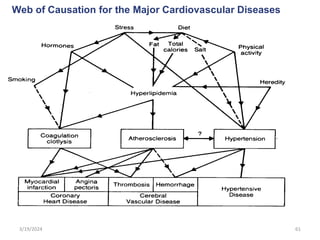
2. THE WEB OF CAUSATION MODEL:
• The process that actually generates
disease or leads to injury is much more
complex.
• This complexity is better portrayed in a
second model called the web of causation.
• The web of causation was especially
developed to enhance understanding of
chronic diseases
59
3/19/2024
60
3/19/2024
61
Web of Causation for the Major Cardiovascular Diseases
3/19/2024
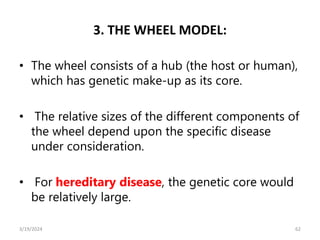
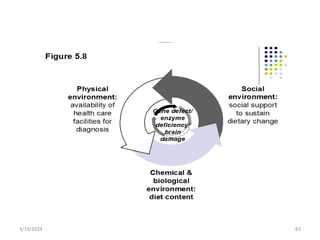
3. THE WHEEL MODEL:
• The wheel consists of a hub (the host or human),
which has genetic make-up as its core.
• The relative sizes of the different components of
the wheel depend upon the specific disease
under consideration.
• For hereditary disease, the genetic core would
be relatively large.
62
3/19/2024
63
Genetic
core
Social env’t
• culture
•Political
•Economy
Biological env’t
• flora
•fauna
Physical env’t
•Hot
•Cold
•Humidity
Fig. wheel model
Figure 5.8
Physical
environment:
availability of
health care
facilities for
diagnosis
Social
environment:
social support
to sustain
dietary change
Chemical &
biological
environment:
diet content
Gene defect/
enzyme
deficiency/
brain
damage
3/19/2024
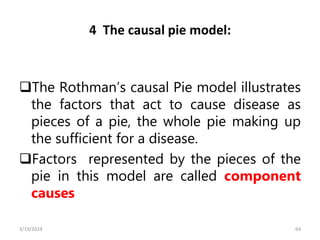
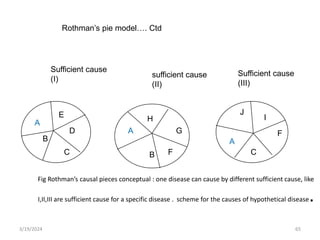
4 The causal pie model:
The Rothman’s causal Pie model illustrates
the factors that act to cause disease as
pieces of a pie, the whole pie making up
the sufficient for a disease.
Factors represented by the pieces of the
pie in this model are called component
causes
64
3/19/2024
65
Fig Rothman’s causal pieces conceptual : one disease can cause by different sufficient cause, like
I,II,III are sufficient cause for a specific disease . scheme for the causes of hypothetical disease.
A
B
C
D
E
A
B F
G
H
A
C
F
I
J
Sufficient cause
(I)
sufficient cause
(II)
Sufficient cause
(III)
Rothman’s pie model…. Ctd
3/19/2024

EPIDE -1.pptx assignment epidomology part one

  • 1.
    Introduction to epidemiology BY:Temesgen T(MPHE) 1 3/19/2024
  • 2.
  • 3.
    At the endof the class, the learner will be able to Describe epidemiological concepts of Health and Health related events Explain scope, feature , application and purpose of epidemiological investigations 3 Objectives of the course 3/19/2024
  • 4.
    Introduction Health:- • Definition ofhealth has negative and positive models: Negative model- defines health as the absence of the constraints of health. That is you are healthy if you are not ill. The renewal of health in a diseased individual is the removal of the disease. This model equates health with the absence of disease 4 3/19/2024
  • 5.
    Positive model isby WHO- a state of complete physical, mental and social well being and not merely the absence of disease or infirmity. This definition is also simplified to “ The ability to lead a socially and economically productive life” 5 3/19/2024
  • 6.
    • Disease- isa physiological/psychological dysfunction • Illness- a subjective state of the person who feels aware of not being well • Sickness- is a state of social dysfunction that is a role that the individual assumes when ill 6 3/19/2024
  • 7.
    Community- refers toa group of people who share some thing in common. Examples of common denominators may be neighborhood, work place, race, religion or social activity. Communities are characterized by people’s engagement in activities that demand interrelationship of efforts, they give rise to shared culture, and they are often sited in a particular geographic location. 7 3/19/2024
  • 8.
    Community medicine- isa system of delivery of comprehensive health care to the people by a health team to improve the health of a community. • Thus it embraces the preventive and social medicine along with curative and promotive health services. 8 3/19/2024
  • 9.
    the community replacesthe individual patients as the primary focus of concern. The problem here is to evaluate the health of a defined community including those members who would benefit from, but could not seek medical care. These approach requires techniques and skills in addition to those needed for clinical practice. 9 3/19/2024
  • 10.
    Clinical medicine- medicalcare of individuals. Typically these are sick people who have presented for help. In community medicine, the community replaces the individual patients as the primary focus of concern. 10 3/19/2024
  • 11.
    • Community diagnosis-is the process of identification and detailed description of the most important problems of a given community. • It may be broad or narrow in scope, and may deal with only a single topic or a single sub group. 11 3/19/2024
  • 12.
    • Community diagnosisprovides basis for decision on: 12 •The need for intervention •Type of intervention needed •Target group at whom intervention should be directed •Provide baseline for later intervention 3/19/2024
  • 13.
    • Public health-Is the science and art of preventing diseases, prolonging life and promoting health by community efforts and governments action. 13 3/19/2024
  • 14.
    • Public healthis: 14 Preventing disease Prolonging life Improving quality of life Eliminating health inequalities Organizing community to promote active participation 3/19/2024
  • 15.
    EPIDEMIOLOGY Greek: EPI -Upon DEMOS - People LOGOS - Study of, Body of Knowledge 15 3/19/2024
  • 16.
    DEFINITIONS OF EPIDEMIOLOGY Thestudy of the distribution and determinants of disease frequency in human populations. (1970) The study of the distribution and determinants of health-related states or events in specified populations, and the application of this study to control health problems. (1988) 16 3/19/2024
  • 17.
    17 • Person (Who) –Young Vs Old – Female Vs Male – Rich Vs Poor • Place (Where) – Lowland Vs Highland – Urban Vs Rural • Time (When) – Day Vs Night – Seasonal Variations – Long term variations Epidemiology: Study 0f “Distribution” …TPP 3/19/2024
  • 18.
    18 Epidemiology: Study “Determinants” •How: mechanism – Mode of transmission • Why: cause – Genetic Vs environmental – Social and cultural conditions What: Application (intervention )  Community vs pt/client 3/19/2024
  • 19.
    terms Explations Study includes:surveillance, observation, hypothesis testing, analytic research and experiments Distribution refers to analysis of: times, persons, places and classes of people affected Determinants include factors that influence health: biological, chemical, physical, social, cultural, economic, genetic and behavioral. Health related states and events Refer to: diseases, causes of death , behaviors such as use of tobacco, positive health states, re actions to preventive regimes and provision and use of health services. 3/19/2024 19
  • 20.
    Specific population Include thosewith identifiable characteristics, such as occupational group Application to prevent and control the aims of public health—to promote, protect, and restore health 3/19/2024 20
  • 21.
    Two Broad Typesof Epidemiology Examining the distribution of a disease in a population, and observing the basic features of its distribution in terms of time, place, and person. Generating hypothesis Typical study designs: • community health survey (approximate synonyms - cross-sectional study, descriptive study) 21 DESCRIPTIVE EPIDEMIOLOGY 3/19/2024
  • 22.
    22 Testing a specifichypothesis about the relationship of a disease to a putative cause, by conducting an epidemiologic study that relates the exposure of interest to the disease of interest. Typical study designs: cohort, case-control ANALYTIC EPIDEMIOLOGY 3/19/2024
  • 23.
    Two fundamental assumptions 1.Non-random distribution of diseases; i.e. disease occurrence in a population is not random or by chance 2. Human disease has causal and protective factors that can be identified through systematic investigation of different population or subgroups of individuals within population in different places or at different times 23 3/19/2024
  • 24.
    24 Studies are conductedon human population Examines Patterns of events in groups of people Can establish cause and effect relationship without the knowledge of biologic mechanism eg. Smoking and lung cancer Covers a wide range of conditions • From infectious to non-infectious • From simple survey to complex drug trials Features of Epidemiology 3/19/2024
  • 25.
    25 • Elucidation ofthe natural history of disease • Description of the health status of the population • Establishing causation of disease • Evaluating efficaciousness and effectiveness of interventions • Supply information for decision: – Individual: behavioral changes… smoking, contraception, sexual – Public health : Planning interventions, priority setting, resource allocation, evaluating effectiveness of intervention (evaluation) Application of Epidemiology 3/19/2024
  • 26.
    SCOPE OF EPIDEMIOLOGY: 26 Since5th century Epidemic of communicable diseases Endemic communicable diseases & Non communicable diseases Middle of 20th century Chronic diseases, injuries, birth defects MCH Occupational health Env’tal health Past 25 yrs Health related behavior recently Genetic markers of disease risks ▲ + ▲+ ▲+ ▲+ 3/19/2024
  • 27.
    Brief History ofEpidemiology 460 B.C – Hippocrates, the father of modern medicine. Suggested human disease might be related to personal and environmental factors. 1662 - John Graunt – tried to quantify patterns of birth, death and disease occurrence, noting male female disparities, high infant mortality, urban and rural differences, and seasonal variations. 27 3/19/2024
  • 28.
    History of epidemiology… 1747- Lind used an "experimental" approach to prove the cause of scurvy. 1787-1872. Alexandre Louis, sometimes called the “Father of Epidemiology”, Using quantitative reasoning demonstrated effectiveness of health interventions 1839 - William Farr extended the epidemiologic analysis of morbidity and mortality data, looking at effects of marital status, occupation, and altitude 1854 - John Snow demonstrated that the risk of mortality due to cholera was related to the drinking water provided by a particular supplier in London 28 3/19/2024
  • 29.
    1937 Austin BradfordHill, suggested the criteria for establishing causation from epidemiological studies. • 1950's-1970's. Major epidemiology successes in the area of non-infectious diseases • 1970-: development of the 21st century epidemiology 29 3/19/2024
  • 30.
    Evolution in Epidemiology First– “environmental’’ disease occur due to bad air Second –”Germ theory”: infectious disease era Third ”Chronic disease era” (Modern Epidemiology): focus on risk-factor at individual level Fourth- “Multi-level causality” (21st Century): focus on risk factors as well as causal pathways at the societal level and with pathogenesis at the molecular level. 30 3/19/2024
  • 31.
    Purposes/use of epidemiology: 1.population/community health diagnosis: - To assess health of a community, relevant sources of data must be identified and analyzed by time, person and place 2. Individual decision: 1950’s - cancer- higher among smokers 1970’s- exercise + proper diet – reduced HDs Mid 1980’s – risk of HIV related to behavior – These and hundreds of epidemiologic findings have helped individuals to make decisions. 31 3/19/2024
  • 32.
    3. Completing theclinical picture (elucidation of the natural history of diseases): -Epidemiologic findings contribute to physicians understanding of the clinical picture &natural history of disease. 4. Search for causes of diseases: It has been said that epidemiology can never prove causative, nevertheless provides enough information for action. 5. Classification of diseases 6. Monitoring of health programs 32 3/19/2024
  • 33.
    Branch of Epidemiology Surveillance/fieldepidemiology :- -Outbreak investigation , -Epidemic control Descriptive epidemiology -examination of pattern of occurrence disease and injuries and their determinants Microbial/infectious epidemiology - Biology and ecology of pathogenic MO , life cycle, with their interaction to human and non human host . 33 3/19/2024
  • 34.
    • Risk factorepidemiology – Searching for exposure –disease association that may provide insight to etiology and way for prevention • Clinical epidemiology – Evaluation of health care – assess accuracy , efficacy , effectiveness , and unintended consequences of method of prevention, early detection, diagnosis , treatment and management of health condition. 34 Branch of Epidemiology 3/19/2024
  • 35.
    • Social epidemiology –Interpersonal and community level factors influencing health at population. • Molecular epidemiology – Investigating disease at molecular level to precisely characterize pathologic process and exposure to elucidate mechanism of pathogenesis and to identify precursor condition 35 Branch of Epidemiology 3/19/2024
  • 36.
    • Genetic epidemiology –Coming together with molecular biology , population studies and statistical model with emphasizing on heritable influence on disease susceptibility and expression • Big epidemiology – Multisite collaborative trials , such hypertension follow up program(HFP), coronary primary prevention program trials (CPPPT), multiple risk factors trials(MRFT), women’s heath initiatives(WHI) 36 Branch of Epidemiology 3/19/2024
  • 37.
    Theory of diseasecausation 3/19/2024 37
  • 38.
    Outline • Define cause •Explain different theories of causation • Identify types of Causal Relationships • Mention different disease models and application 38 3/19/2024
  • 39.
    CONCEPT OF DISEASECAUSATION: Definition: The cause of a disease is an event, condition or a characteristic that precedes the disease event and with out of which the disease event either would not occurred at all or would not have occurred until some later time. 39 3/19/2024
  • 40.
    Cause • Definition ofcause – Something that is necessary for a disease to develop at the moment that it occurs – Can be a condition, a thing, an event or a characteristic • Epidemiologic concept of causation – Multi-factorial etiology • more than one factor must be present for disease to develop 40 3/19/2024
  • 41.
    Cause type • Sufficientcause – Collection of minimal causes that produce the disease – A+b+c (sufficient)=d • Component cause – Specific component of sufficient cause – A+b+c=d , a, b, &c are component cause 41 3/19/2024
  • 42.
    • Necessary cause –Component cause which is part of every sufficient cause – Etiologic agent – a+b+c=d c = is necessary cause – e+f+c= d • Causal complement – The set of all other component causes in all sufficient causes in which a causal factor participates – a+b+c=d – h+g+t=d 42 3/19/2024
  • 43.
    WHAT DOES CAUSEDISEASE? There are different theories : • Supernatural • Hippocratic • Single germ • Classic epidemiologic • Ecological • Multi factorial causation 43 3/19/2024
  • 44.
    1.SUPERNATURAL THEORY : •In the early past, the disease was thought god or due to the evil force of the demons. mainly due to either the curse of • At least 10% of the people in developed countries and 30% in developing countries still believe in supernatural origin; • Even today superstitions are becoming major obstacles in disease control • But, most of the literates view that disease is the result of microbes 44 3/19/2024
  • 45.
    2. Hippocratic theory: • Hippocrates is credited with being the first physician to reject superstitions and beliefs that credited supernatural or divine forces with causing illness. • He separated the discipline of medicine from religion, believing and arguing that disease was not a punishment inflicted by the gods but rather the product of environmental factors, diet and living habits. 45 3/19/2024
  • 46.
    3. Single germtheory/Henle-koch postulates • Sometimes called “pure determinism” • Each disease will be caused by a germ • Without that germ that disease will not be caused • By introducing that germ , that disease can be caused in animals experimentally • And that germ can again be isolated from that sick animal experimented with. 46 3/19/2024
  • 47.
    4. Classic EpidemiologicTheory Agents: –Living organisms –Exogenous chemicals –Genetic traits –Psychological factors and stress –Nutritive elements –Endogenous chemicals –Physical forces 47 3/19/2024
  • 48.
    48 • – Host factors:Host factors are intrinsic factors that influence an individual’s exposure, susceptibility, or response to a causative agent. – Age, race, sex, socioeconomic status, and behaviors (smoking, drug abuse, lifestyle, sexual practices and contraception, eating habits) are just some of the many host factors which affect a person’s likelihood of exposure – Immunity and immunologic response – Host behavior • ) 3/19/2024
  • 49.
    • Environmental factors:Environmental factors are extrinsic factors which affect the agent and the opportunity for exposure. • Physical environment (heat, cold, moisture) • Biologic environment (flora, fauna) • Social environment (economic, political, culture) 49 3/19/2024
  • 50.
  • 51.
    5. THE ECOLOGICALTHEORY • Since disease arises within an ecological system, a basic principle of epidemiology is that an ecological approach is necessary to explain the occurrence of disease. • Interactions among humans, other living creatures, plants, animals, micro organisms, ecosystems, and climate, geography, and topography are so complex that despite much study we are often uncertain what is really happening. 51 3/19/2024
  • 52.
    6. Multi factorialcausation theory • Pettenkoffer contradicted the un-ifactorial theory of disease causation and emphasized that disease is Multi-factorial in causation. • Several causes or factors acting jointly, cumulatively, by complementing or in an unexplained manner will lead to the disease. 52 3/19/2024
  • 53.
    Causal Relationships: A causalpathway may be direct or indirect: • Direct causation, A causes B without intermediate effects • Indirect causation, A causes B, but with intermediate effects • In human biology, intermediate steps are almost always present in any causal process: 53 3/19/2024
  • 54.
    Types of CausalRelationships: 1.Necessary and sufficient without the factor, disease never develops  With the factor, disease always develops (this situation rarely occurs (eg rabies ) 2.Necessary but not sufficient  The factor in and of itself is not enough to cause disease  Multiple factors are required, usually in a specific temporal sequence (such as , tuberculosis ) 54 3/19/2024
  • 55.
    3.Sufficient but notnecessary The factor alone can cause disease but so can other factors cause in its absence eg. Benzene or radiation can cause leukemia without the presence of the other 4. Neither sufficient nor necessary  The factor neither cause disease on its own, nor is it the only factor that can cause that disease, but it can cause by different factors.  This is the probable model for chronic disease relationships (Eg less physical activity or +…or + - CHD) 55 3/19/2024
  • 56.
    DISEASE MODELS: • Modelsare purposely simplified representations. • The purpose of the model is to facilitate the understanding of nature, which is complex. • There are different disease causation models, the following are the widely used ones: 56 3/19/2024
  • 57.
    1. THE EPIDEMIOLOGICTRIANGLE AND TRIAD (BEAM BALANCE): 57 E H A 3/19/2024
  • 58.
    Epidemiologic triangle… The epidemiologictriangle consists of three components -host, environment, and agent. A change in any of the components will alter an existing equilibrium to increase/ in favor or decrease/against the frequency of the disease. This model holds true for infectious disease which has specific agent as necessary cause. 58 3/19/2024
  • 59.
    2. THE WEBOF CAUSATION MODEL: • The process that actually generates disease or leads to injury is much more complex. • This complexity is better portrayed in a second model called the web of causation. • The web of causation was especially developed to enhance understanding of chronic diseases 59 3/19/2024
  • 60.
  • 61.
    61 Web of Causationfor the Major Cardiovascular Diseases 3/19/2024
  • 62.
    3. THE WHEELMODEL: • The wheel consists of a hub (the host or human), which has genetic make-up as its core. • The relative sizes of the different components of the wheel depend upon the specific disease under consideration. • For hereditary disease, the genetic core would be relatively large. 62 3/19/2024
  • 63.
    63 Genetic core Social env’t • culture •Political •Economy Biologicalenv’t • flora •fauna Physical env’t •Hot •Cold •Humidity Fig. wheel model Figure 5.8 Physical environment: availability of health care facilities for diagnosis Social environment: social support to sustain dietary change Chemical & biological environment: diet content Gene defect/ enzyme deficiency/ brain damage 3/19/2024
  • 64.
    4 The causalpie model: The Rothman’s causal Pie model illustrates the factors that act to cause disease as pieces of a pie, the whole pie making up the sufficient for a disease. Factors represented by the pieces of the pie in this model are called component causes 64 3/19/2024
  • 65.
    65 Fig Rothman’s causalpieces conceptual : one disease can cause by different sufficient cause, like I,II,III are sufficient cause for a specific disease . scheme for the causes of hypothetical disease. A B C D E A B F G H A C F I J Sufficient cause (I) sufficient cause (II) Sufficient cause (III) Rothman’s pie model…. Ctd 3/19/2024