

STREPTOKI
NASE
Dr.U.Srinivasa, M.Pharm, Ph.D
Introduction:
•A blood clot (thrombus) developed in the
circulatory system can cause vascular blockage
leading to serious consequences including
death.
• A healthy hemostatic system suppresses the
development of blood clots in normal
circulation, but reacts extensively in the event
of vascular injury to prevent blood loss.
Outcomes of a failed homeostasis include
stroke, pulmonary embolism, deep vain
thrombosis and acute myocardial infraction.
STREPTOCOCCAL FIBRINOLYSIS
These enzyme activates a fibrinolytic
enzyme in human serum, which splits fibrin
into smaller fragments, thus it causes rapid
dissolution of blood clots and fibrinous
exudates. Therefore, streptokinase acts
indirectly upon a substrate of fibrin or
fibrinogen.
SOURCE
This enzyme is produced by certain bacteria. The
most frequently employed for manufacture are:
haemolytic streptococci, particularly those of the
lancefied groups A, human C and G.
Steptodornase is a related enzyme, which act
directly upon a substrate of
deoxyribonucleoproteins (DNA).
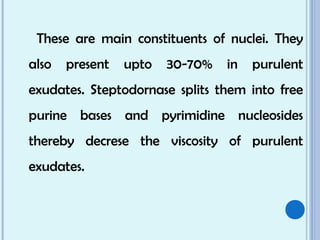
These are main constituents of nuclei. They
also present upto 30-70% in purulent
exudates. Steptodornase splits them into free
purine bases and pyrimidine nucleosides
thereby decrese the viscosity of purulent
exudates.
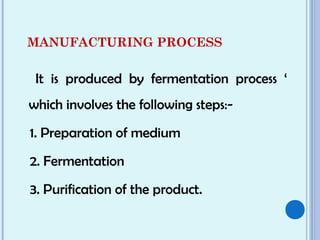
MANUFACTURING PROCESS
It is produced by fermentation process ‘
which involves the following steps:-
1. Preparation of medium
2. Fermentation
3. Purification of the product.
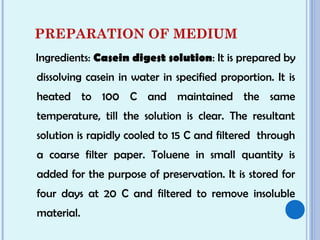
PREPARATION OF MEDIUM
Ingredients: Casein digest solution: It is prepared by
dissolving casein in water in specified proportion. It is
heated to 100 C and maintained the same
temperature, till the solution is clear. The resultant
solution is rapidly cooled to 15 C and filtered through
a coarse filter paper. Toluene in small quantity is
added for the purpose of preservation. It is stored for
four days at 20 C and filtered to remove insoluble
material.
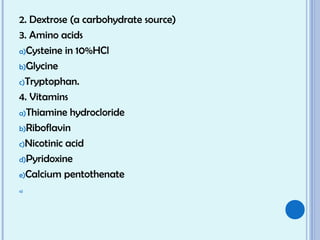
2. Dextrose (a carbohydrate source)
3. Amino acids
a)Cysteine in 10%HCl
b)Glycine
c)Tryptophan.
4. Vitamins
a)Thiamine hydrocloride
b)Riboflavin
c)Nicotinic acid
d)Pyridoxine
e)Calcium pentothenate
a)
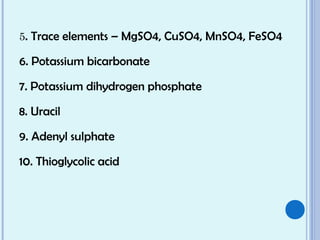
5. Trace elements – MgSO4, CuSO4, MnSO4, FeSO4
6. Potassium bicarbonate
7. Potassium dihydrogen phosphate
8. Uracil
9. Adenyl sulphate
10. Thioglycolic acid
FERMENTATION
Sterilized medium is inoculated with seed
inoculation of bacterium; S. haemolyticus
having a bacterial count of 20 billions/ml.
fermentation is carried out in a tank for 14hrs
at 37C. During this period no pH adjustment,
aeration or modification are made.
Later, dextrose 50% is added and pH is
adjusted to 6 at 15 min. interval with 5N
sodium hydroxide. After each adjustment of
pH, 50% dextrose is added. Fermentation is
continued till bacterial count ceases to
increase(about 3 hrs).At this stage
fermentation medium contains appx. 1000
units/ml
PURIFICATION
Crude streptokinase is first dialysed against
phosphate buffer then it is applied on
modified cellulosic columns and eluted with
phosphate buffer with increasing pH and
molarity(increasing pH 5.8 to 8.5 and
molarity 0.005to 0.1 M).
 pH and molarity are the important factors in
purification.
 At 0.1 M: streptokinase is eluted
 > 0.1 M: improper adsorption and separation pH
 > 8.5:adsorption capacity of cellulose decreases
 < 5.8:streptokinase is precipitated
 At pH 8 and molarity 0.75, impurities are eluted.
PURIFICATION BY DEAE
CELLULOSE
Crude streptokinase, phosphate buffer 0.2 M and
DEAE cellulose in the proportion of 3:2:1 are stirred
for 1 hour and filtered. Cake is washed with
phosphate buffer 0.025 m by stirring for 30 mins. It
is again filtered and cake is suspended in 0.1 m
phosphate buffer by stirring for 1 hour. Filterate is
collected which contains pure streptokinase.
USES
Treatment of thromboembolic disorders for
the lysis of pulmonary emboli, arterial
thrombus, deep vein thrombus and acute
coronary artery thrombosis.
Streptokinase by Dr.U.Srinivasa, Professor and Head, Srinivas college of pharmacy, Mangalore

Streptokinase by Dr.U.Srinivasa, Professor and Head, Srinivas college of pharmacy, Mangalore

  • 1.
  • 2.
    Introduction: •A blood clot(thrombus) developed in the circulatory system can cause vascular blockage leading to serious consequences including death. • A healthy hemostatic system suppresses the development of blood clots in normal circulation, but reacts extensively in the event of vascular injury to prevent blood loss.
  • 3.
    Outcomes of afailed homeostasis include stroke, pulmonary embolism, deep vain thrombosis and acute myocardial infraction.
  • 4.
    STREPTOCOCCAL FIBRINOLYSIS These enzymeactivates a fibrinolytic enzyme in human serum, which splits fibrin into smaller fragments, thus it causes rapid dissolution of blood clots and fibrinous exudates. Therefore, streptokinase acts indirectly upon a substrate of fibrin or fibrinogen.
  • 5.
    SOURCE This enzyme isproduced by certain bacteria. The most frequently employed for manufacture are: haemolytic streptococci, particularly those of the lancefied groups A, human C and G. Steptodornase is a related enzyme, which act directly upon a substrate of deoxyribonucleoproteins (DNA).
  • 6.
    These are mainconstituents of nuclei. They also present upto 30-70% in purulent exudates. Steptodornase splits them into free purine bases and pyrimidine nucleosides thereby decrese the viscosity of purulent exudates.
  • 7.
    MANUFACTURING PROCESS It isproduced by fermentation process ‘ which involves the following steps:- 1. Preparation of medium 2. Fermentation 3. Purification of the product.
  • 8.
    PREPARATION OF MEDIUM Ingredients:Casein digest solution: It is prepared by dissolving casein in water in specified proportion. It is heated to 100 C and maintained the same temperature, till the solution is clear. The resultant solution is rapidly cooled to 15 C and filtered through a coarse filter paper. Toluene in small quantity is added for the purpose of preservation. It is stored for four days at 20 C and filtered to remove insoluble material.
  • 9.
    2. Dextrose (acarbohydrate source) 3. Amino acids a)Cysteine in 10%HCl b)Glycine c)Tryptophan. 4. Vitamins a)Thiamine hydrocloride b)Riboflavin c)Nicotinic acid d)Pyridoxine e)Calcium pentothenate a)
  • 10.
    5. Trace elements– MgSO4, CuSO4, MnSO4, FeSO4 6. Potassium bicarbonate 7. Potassium dihydrogen phosphate 8. Uracil 9. Adenyl sulphate 10. Thioglycolic acid
  • 11.
    FERMENTATION Sterilized medium isinoculated with seed inoculation of bacterium; S. haemolyticus having a bacterial count of 20 billions/ml. fermentation is carried out in a tank for 14hrs at 37C. During this period no pH adjustment, aeration or modification are made.
  • 12.
    Later, dextrose 50%is added and pH is adjusted to 6 at 15 min. interval with 5N sodium hydroxide. After each adjustment of pH, 50% dextrose is added. Fermentation is continued till bacterial count ceases to increase(about 3 hrs).At this stage fermentation medium contains appx. 1000 units/ml
  • 13.
    PURIFICATION Crude streptokinase isfirst dialysed against phosphate buffer then it is applied on modified cellulosic columns and eluted with phosphate buffer with increasing pH and molarity(increasing pH 5.8 to 8.5 and molarity 0.005to 0.1 M).
  • 14.
     pH andmolarity are the important factors in purification.  At 0.1 M: streptokinase is eluted  > 0.1 M: improper adsorption and separation pH  > 8.5:adsorption capacity of cellulose decreases  < 5.8:streptokinase is precipitated  At pH 8 and molarity 0.75, impurities are eluted.
  • 15.
    PURIFICATION BY DEAE CELLULOSE Crudestreptokinase, phosphate buffer 0.2 M and DEAE cellulose in the proportion of 3:2:1 are stirred for 1 hour and filtered. Cake is washed with phosphate buffer 0.025 m by stirring for 30 mins. It is again filtered and cake is suspended in 0.1 m phosphate buffer by stirring for 1 hour. Filterate is collected which contains pure streptokinase.
  • 16.
    USES Treatment of thromboembolicdisorders for the lysis of pulmonary emboli, arterial thrombus, deep vein thrombus and acute coronary artery thrombosis.