IGNTU AMARKANTAK M.P.
Department Of Biotechnology
TYPES OF MICROBIAL CULTURE
AND ITS GROWTH KINETICS
Presented By
Dileep Kumar Banjare
B.Sc. 5th Semester
CONTENTS
1. Definition
2. Phases of growth culture and curve
3. Advantages and disadvantages
Definition
A microbial culture is a method of multiplying
microbial organisms by letting them produce in
predetermined culture medium under controlled
laboratory conditions.
Phases Of Culture
1. Batch Culture
2. Fed-batch Culture
3. Continuous Culture
1. Batch Culture
In Batch Fermentation the sterile growth
Medium is inoculated with appropriate
microorganisms and fermentation proceeds
without addition of any fresh growth
medium.
After inoculating the medium and start
measuring the biomass at different time
intervals, you may find six different
phases.
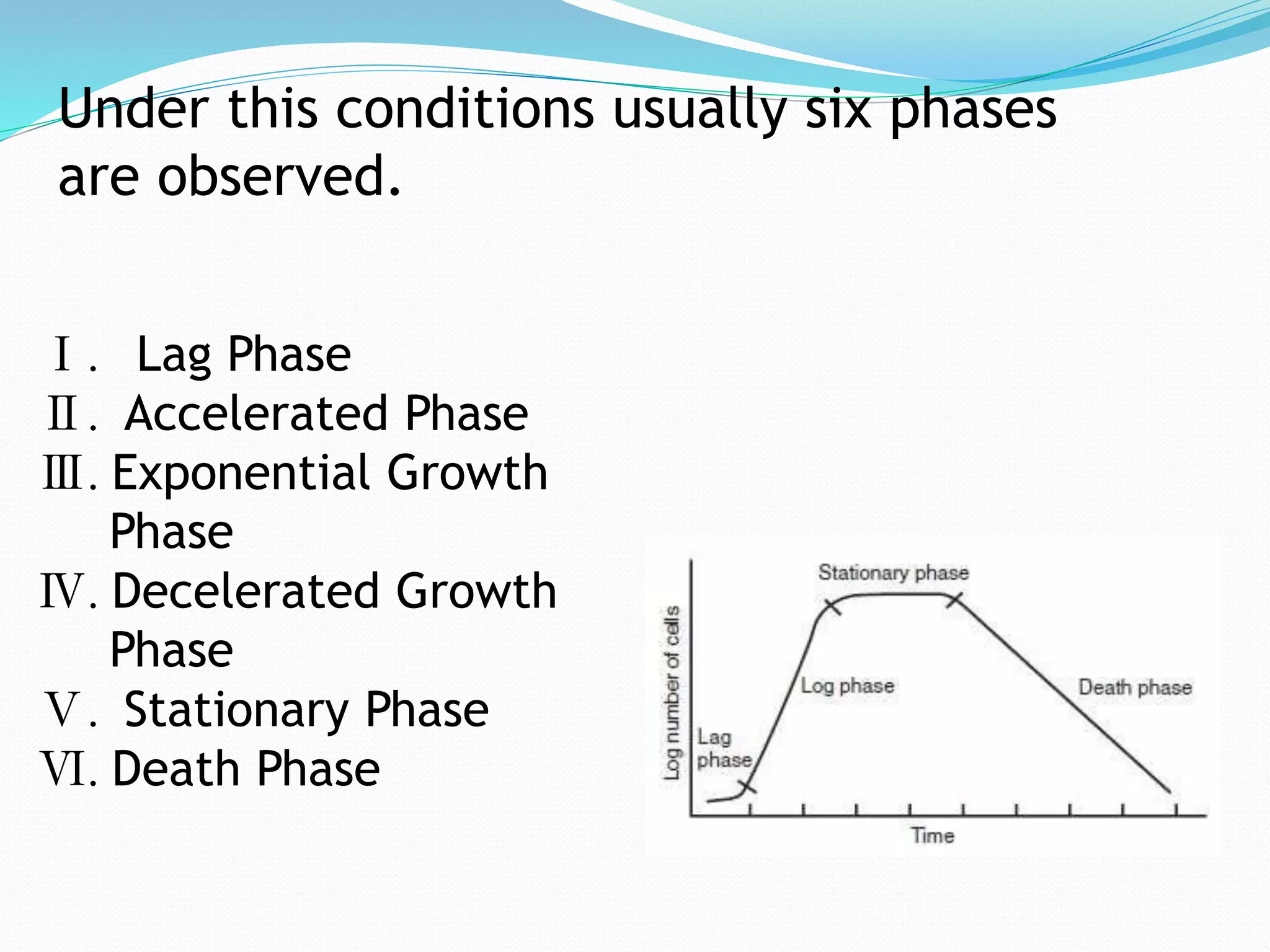
Under this conditions usually six phases
are observed.
Ⅰ. Lag Phase
Ⅱ. Accelerated Phase
Ⅲ. Exponential Growth
Phase
Ⅳ. Decelerated Growth
Phase
Ⅴ. Stationary Phase
Ⅵ. Death Phase
Ⅰ. Lag Phase
Lag phase is an initial phase period of cultivation
During which the change of cell number is zero or
negligible.
Even though the cell number doesn’t increases, the
Cells may grow in size during this period.
Ⅱ. Acceleration Phase
At the end of lag phase, when growth begins the
division rate increases gradually and reaches a
maximum value, and it is called acceleration phase.
Under the log phase the cell mass undergoes several
doublings and specific growth rate remains constant
due to enough nutrients.
Ⅲ. Log Or Exponential Phase
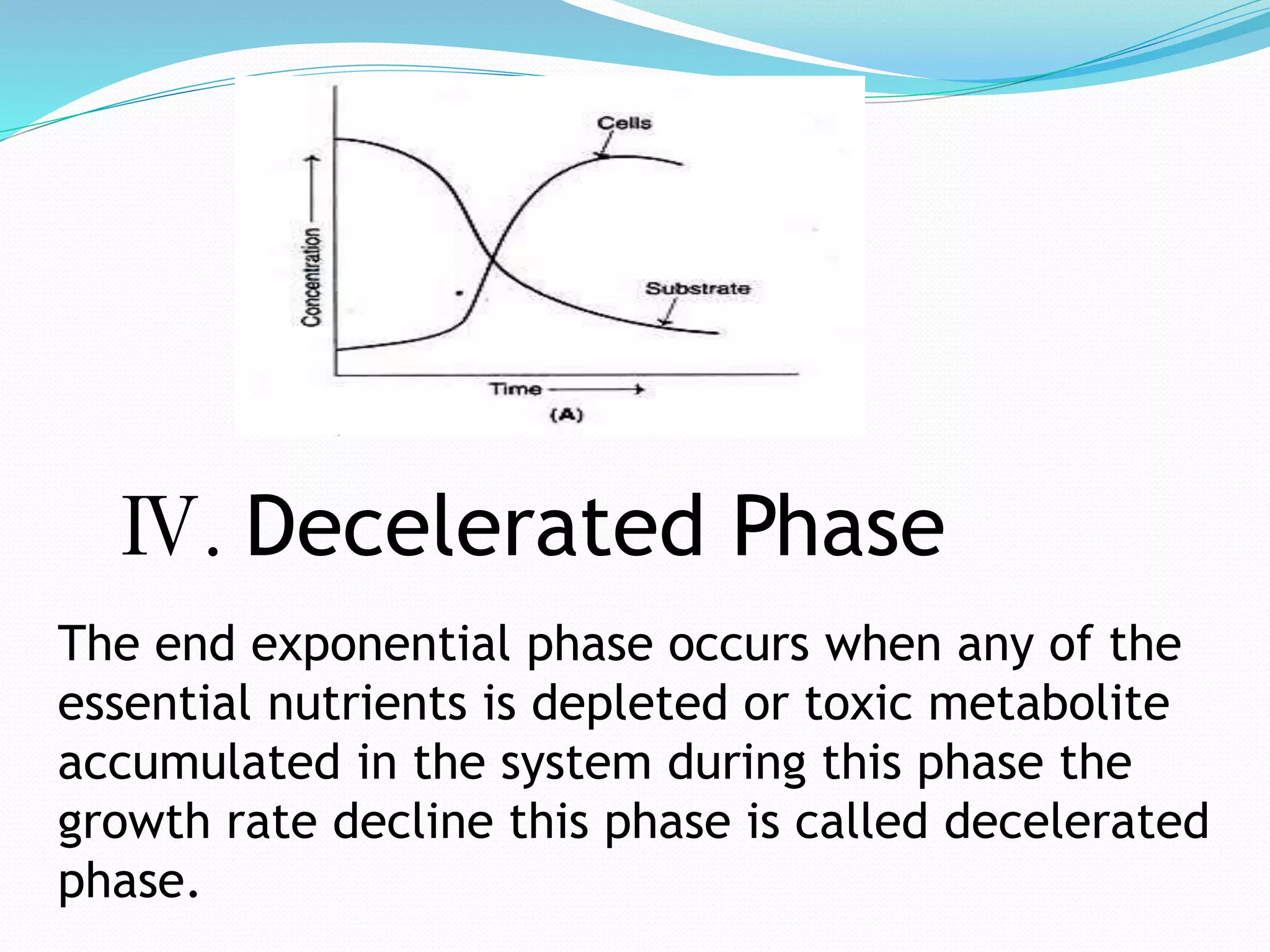
Ⅳ. Decelerated Phase
The end exponential phase occurs when any of the
essential nutrients is depleted or toxic metabolite
accumulated in the system during this phase the
growth rate decline this phase is called decelerated
phase.
Ⅴ. Stationary Phase
As the media start depleting the concentration
of metabolites increases the growth is
inhibited. The increase in cell mass ceases the
cell enters stationary phase.
Ⅵ. Death phase
This is the death phase where the cells will start to
lyses and the cell density decreases.
Decline in the number of viable cells.
2. Fed-batch Fermentation
In fed-batch fermentation
nutrients are add
incrementally at various
time, regular interval of
time no growth media and
micro-organisms are remove
until the end of process, this
addition is prolonged to log
phase and stationary phase,
thereby increasing the
biomass and the amount of
metabolites.
3.Continuous fermentation
In continuous fermentation fresh
growth medium is added
continuously during fermentation
but there is also continuous
removal of an equal volume of
medium containing suspended
microorganism.
In this type – a steady-state
conditions of the total number
of cells and the volume in the
bioreactor is maintained.
Advantage Disadvantage
1. Continuously is not used
in small fermentation.
2. Continuously
fermentation can be
easily centrifuge.
3. Avoids down time to batch
time.
4. Physiological state of cell
during continuous
fermentation is more
uniform thus production
yield much consistence.
1. Due to larger
during
fermentation
500-600 Hrs,
some cells may
be lose.
2. Sterility
maintain is very
tough.
THANK YOU

microbial culture and its growth kinetics

  • 1.
    IGNTU AMARKANTAK M.P. DepartmentOf Biotechnology TYPES OF MICROBIAL CULTURE AND ITS GROWTH KINETICS Presented By Dileep Kumar Banjare B.Sc. 5th Semester
  • 2.
    CONTENTS 1. Definition 2. Phasesof growth culture and curve 3. Advantages and disadvantages
  • 3.
    Definition A microbial cultureis a method of multiplying microbial organisms by letting them produce in predetermined culture medium under controlled laboratory conditions. Phases Of Culture 1. Batch Culture 2. Fed-batch Culture 3. Continuous Culture
  • 4.
    1. Batch Culture InBatch Fermentation the sterile growth Medium is inoculated with appropriate microorganisms and fermentation proceeds without addition of any fresh growth medium. After inoculating the medium and start measuring the biomass at different time intervals, you may find six different phases.
  • 5.
    Under this conditionsusually six phases are observed. Ⅰ. Lag Phase Ⅱ. Accelerated Phase Ⅲ. Exponential Growth Phase Ⅳ. Decelerated Growth Phase Ⅴ. Stationary Phase Ⅵ. Death Phase
  • 6.
    Ⅰ. Lag Phase Lagphase is an initial phase period of cultivation During which the change of cell number is zero or negligible. Even though the cell number doesn’t increases, the Cells may grow in size during this period.
  • 7.
    Ⅱ. Acceleration Phase Atthe end of lag phase, when growth begins the division rate increases gradually and reaches a maximum value, and it is called acceleration phase. Under the log phase the cell mass undergoes several doublings and specific growth rate remains constant due to enough nutrients. Ⅲ. Log Or Exponential Phase
  • 8.
    Ⅳ. Decelerated Phase Theend exponential phase occurs when any of the essential nutrients is depleted or toxic metabolite accumulated in the system during this phase the growth rate decline this phase is called decelerated phase.
  • 9.
    Ⅴ. Stationary Phase Asthe media start depleting the concentration of metabolites increases the growth is inhibited. The increase in cell mass ceases the cell enters stationary phase. Ⅵ. Death phase This is the death phase where the cells will start to lyses and the cell density decreases. Decline in the number of viable cells.
  • 10.
    2. Fed-batch Fermentation Infed-batch fermentation nutrients are add incrementally at various time, regular interval of time no growth media and micro-organisms are remove until the end of process, this addition is prolonged to log phase and stationary phase, thereby increasing the biomass and the amount of metabolites.
  • 11.
    3.Continuous fermentation In continuousfermentation fresh growth medium is added continuously during fermentation but there is also continuous removal of an equal volume of medium containing suspended microorganism. In this type – a steady-state conditions of the total number of cells and the volume in the bioreactor is maintained.
  • 12.
    Advantage Disadvantage 1. Continuouslyis not used in small fermentation. 2. Continuously fermentation can be easily centrifuge. 3. Avoids down time to batch time. 4. Physiological state of cell during continuous fermentation is more uniform thus production yield much consistence. 1. Due to larger during fermentation 500-600 Hrs, some cells may be lose. 2. Sterility maintain is very tough.
  • 13.