Dr.K.Gajalakshmi
Assistant professor,
PSGR krishnammal college for Women,
Coimbatore
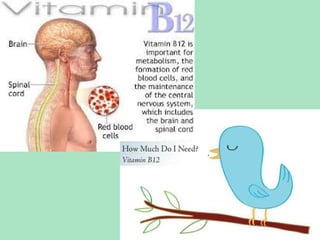
• vitamin B12, vitamin B12 or vitamin B-12, also
called cobalamin, is a water-soluble vitamin with a
key role in the normal functioning of the brain and
nervous system, and for the formation of blood. It is
one of the eight B vitamins.
• It is normally involved in the metabolism of every
cell of the human body, especially affecting DNA
synthesis and regulation, but also fatty acid synthesis
and energy production.
• Vitamin B12 is important for the way the body
works, and people who don't have enough of it may
feel tired or have a lack of energy.
• Vitamin B12 helps in the production of healthy
red blood cells that carry oxygen around the
body.
• Not having enough vitamin B12 is called
vitamin B12 deficiency anaemia.
• This condition makes the body produce larger
than normal red blood cells, described as
megaloblastic or macrocytic, which don't do
their job as well.
• Once diagnosed, vitamin B12 deficiency can
usually be treated successfully with B12
injections and sometimes with B12 tablets.
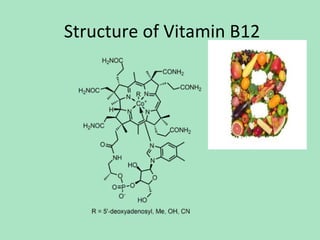
Structure of Vitamin B12
• Species from the following genera are known to synthesize
B12: Acetobacterium, Aerobacter, Agrobacterium, Alcaligenes,
Azotobacter, Bacillus, Clostridium, Corynebacterium,
Flavobacterium, Lactobacillus, Micromonospora,
Mycobacterium, Nocardia, Propionibacterium,
Protaminobacter, Proteus, Pseudomonas, Rhizobium,
Salmonella, Serratia, Streptomyces, Streptococcus and
Xanthomonas.
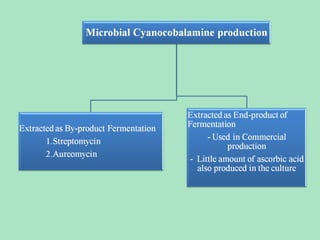
• Industrial production of B12 is through fermentation of
selected microorganisms. Streptomyces griseus, a bacterium
once thought to be a yeast, was the commercial source of
vitamin B12 for many years.[48][49] The species Pseudomonas
denitrificans and Propionibacterium shermanii are more
commonly used today
•

•
•
•

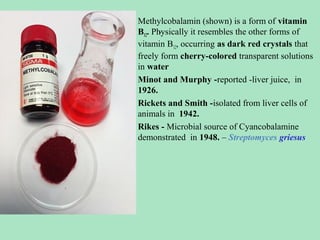
Methylcobalamin (shown) is a form of vitamin
.
B12. Physically it resembles the other forms of
vitamin B12, occurring as dark red crystals that
freely form cherry-colored transparent solutions
in water
Minot and Murphy -reported -liver juice, in
1926.
Rickets and Smith -isolated from liver cells of
animals in 1942.
Rikes - Microbial source of Cyancobalamine
demonstrated in 1948. – Streptomyces griesus
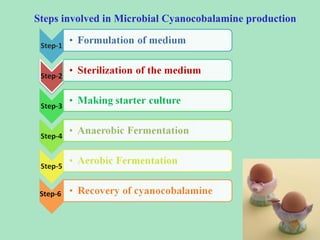
Steps involved in Microbial Cyanocobalamine production

Step-6
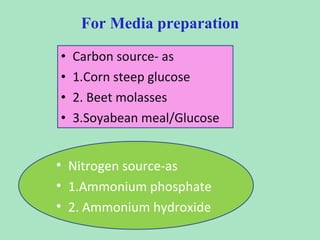
For Media preparation
•
•
•
•

Carbon source- as
1.Corn steep glucose
2. Beet molasses
3.Soyabean meal/Glucose

• Nitrogen source-as
• 1.Ammonium phosphate
• 2. Ammonium hydroxide
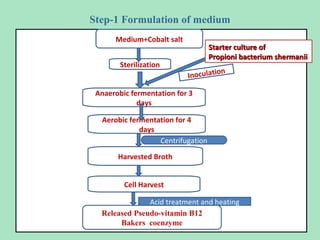
Step-1 Formulation of medium
Medium+Cobalt salt
Medium+ Cobalt salt
Sterilization

Starter culture of
Propioni bacterium shermanii
o
Inoculati

n

Anaerobic fermentation for 3
days
Aerobic fermentation for 4
days
Centrifugation
Harvested Broth
Cell Harvest
Acid treatment and heating
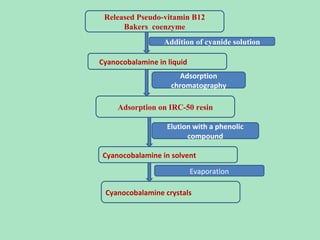
Released Pseudo-vitamin B12
Bakers coenzyme
Released Pseudo-vitamin B12
Bakers coenzyme
Addition of cyanide solution
Cyanocobalamine in liquid
Adsorption
chromatography
Adsorption on IRC-50 resin
Elution with a phenolic
compound
Cyanocobalamine in solvent
Evaporation
Cyanocobalamine crystals
2. Sterilization
• Prepared medium is sterilized by autoclaving
• The sterilized medium is then used for fermentation.
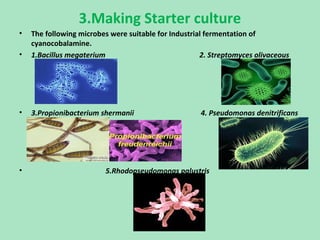
3.Making Starter culture
•
•

The following microbes were suitable for Industrial fermentation of
cyanocobalamine.
1.Bacillus megaterium
2. Streptomyces olivaceous

•

3.Propionibacterium shermanii

•

4. Pseudomonas denitrificans

5.Rhodopseudomonas palustris
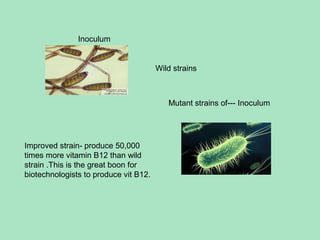
Inoculum

Wild strains

Mutant strains of--- Inoculum

Improved strain- produce 50,000
times more vitamin B12 than wild
strain .This is the great boon for
biotechnologists to produce vit B12.
Batch fermentation
• Most fermentations are batch processes
• Nutrients and the inoculum are added to the sterile fermenter and left
to get on with it!
• Anti-foaming agent may be added.
• Once the desired amount of product is present in the fermenter the
contents are drained off and the product is extracted.
• After emptying, the tank is cleaned & prepared for a new batch.
Continuous fermentation
• Some products are made by a continuous
culture system.
• Sterile medium is added to the fermentation
with a balancing withdrawal of broth for
product extraction.
• UPSTREAM PROCESSING
• Upstream processing encompasses any
technology that leads to the synthesis of a
product. Upstream includes the exploration,
development and production.
• DOWNSTREAM PROCESSING
The extraction and purification of a
biotechnological product from fermentation is
referred to as downstream processing
Aerobic Fermentation
• It is a Batch fermentation
• Continuous fermentation also found to be effective.
• Sterilized medium is filled in stirred tank fermenter
1% of inoculum (Starter culture) is added in to the
fermenter.
• Anaerobic condition is maintained to encourage the
production of 5,6-dimethyl benzimidazole
cobalamide (DBC) by P.shermanii
Aerobic Fermentation
• Anaerobic Fermentation is over sterile air is pumped
in to the fermenter.
• The culture is stirred well for proper aeration
• Aerobic fermentation is performed for 4 days.
• During this process some amount of DBC and pseudo
vitaminB12 (adeninyl cobalamine) are produced.
• DBC and pseudovitaminB12 (adeninyl cobalamine)
are immediate precursors of cyanocobalamine
Recovery of Cyanocobalamine
• Inside the microbial cells the cyanocobalamine exits in the
form of natural substances such as DBC and
pseudovitaminB12 .
• The cultured broth contains 10-23mg vitB12 per liter.
• It is harvested and centrifuged at high speed to get a
concentrated mass of cells.
• The cell mass is treated with a dilute acid and heat stock at
10-30o C.
• During this treatment precursors of pseudovitaminB12 are
released free.
• Then it is treated with Cyanide solution to split the DBC and
pseudovitamin B12 .
• As a result cyanocobalamine (Vit B12) is released free in the
solution.
• Cyanocobalamine in the liquid is seperated by using an
adsorption column chromatography with IRC-50 resin. The
adsorbed cyanocobalamine is then eluted out of the column
using phenolic solvent.
• The solvent fraction is evaporated by exposing it to
atmospheric air.
• As result crystals of cyanocobalamine is let in the vessel. It is
stored for future use.
USES
• It is a food preservative
• It is a co-factor
• It is a protective medicine
 vitamin B12

vitamin B12

  • 1.
  • 3.
    • vitamin B12,vitamin B12 or vitamin B-12, also called cobalamin, is a water-soluble vitamin with a key role in the normal functioning of the brain and nervous system, and for the formation of blood. It is one of the eight B vitamins. • It is normally involved in the metabolism of every cell of the human body, especially affecting DNA synthesis and regulation, but also fatty acid synthesis and energy production. • Vitamin B12 is important for the way the body works, and people who don't have enough of it may feel tired or have a lack of energy.
  • 4.
    • Vitamin B12helps in the production of healthy red blood cells that carry oxygen around the body. • Not having enough vitamin B12 is called vitamin B12 deficiency anaemia. • This condition makes the body produce larger than normal red blood cells, described as megaloblastic or macrocytic, which don't do their job as well. • Once diagnosed, vitamin B12 deficiency can usually be treated successfully with B12 injections and sometimes with B12 tablets.
  • 5.
  • 6.
    • Species fromthe following genera are known to synthesize B12: Acetobacterium, Aerobacter, Agrobacterium, Alcaligenes, Azotobacter, Bacillus, Clostridium, Corynebacterium, Flavobacterium, Lactobacillus, Micromonospora, Mycobacterium, Nocardia, Propionibacterium, Protaminobacter, Proteus, Pseudomonas, Rhizobium, Salmonella, Serratia, Streptomyces, Streptococcus and Xanthomonas. • Industrial production of B12 is through fermentation of selected microorganisms. Streptomyces griseus, a bacterium once thought to be a yeast, was the commercial source of vitamin B12 for many years.[48][49] The species Pseudomonas denitrificans and Propionibacterium shermanii are more commonly used today
  • 7.
    • • • • Methylcobalamin (shown) isa form of vitamin . B12. Physically it resembles the other forms of vitamin B12, occurring as dark red crystals that freely form cherry-colored transparent solutions in water Minot and Murphy -reported -liver juice, in 1926. Rickets and Smith -isolated from liver cells of animals in 1942. Rikes - Microbial source of Cyancobalamine demonstrated in 1948. – Streptomyces griesus
  • 9.
    Steps involved inMicrobial Cyanocobalamine production Step-6
  • 10.
    For Media preparation • • • • Carbonsource- as 1.Corn steep glucose 2. Beet molasses 3.Soyabean meal/Glucose • Nitrogen source-as • 1.Ammonium phosphate • 2. Ammonium hydroxide
  • 11.
    Step-1 Formulation ofmedium Medium+Cobalt salt Medium+ Cobalt salt Sterilization Starter culture of Propioni bacterium shermanii o Inoculati n Anaerobic fermentation for 3 days Aerobic fermentation for 4 days Centrifugation Harvested Broth Cell Harvest Acid treatment and heating Released Pseudo-vitamin B12 Bakers coenzyme
  • 12.
    Released Pseudo-vitamin B12 Bakerscoenzyme Addition of cyanide solution Cyanocobalamine in liquid Adsorption chromatography Adsorption on IRC-50 resin Elution with a phenolic compound Cyanocobalamine in solvent Evaporation Cyanocobalamine crystals
  • 13.
    2. Sterilization • Preparedmedium is sterilized by autoclaving • The sterilized medium is then used for fermentation.
  • 14.
    3.Making Starter culture • • Thefollowing microbes were suitable for Industrial fermentation of cyanocobalamine. 1.Bacillus megaterium 2. Streptomyces olivaceous • 3.Propionibacterium shermanii • 4. Pseudomonas denitrificans 5.Rhodopseudomonas palustris
  • 15.
    Inoculum Wild strains Mutant strainsof--- Inoculum Improved strain- produce 50,000 times more vitamin B12 than wild strain .This is the great boon for biotechnologists to produce vit B12.
  • 16.
    Batch fermentation • Mostfermentations are batch processes • Nutrients and the inoculum are added to the sterile fermenter and left to get on with it! • Anti-foaming agent may be added. • Once the desired amount of product is present in the fermenter the contents are drained off and the product is extracted. • After emptying, the tank is cleaned & prepared for a new batch.
  • 17.
    Continuous fermentation • Someproducts are made by a continuous culture system. • Sterile medium is added to the fermentation with a balancing withdrawal of broth for product extraction.
  • 18.
    • UPSTREAM PROCESSING •Upstream processing encompasses any technology that leads to the synthesis of a product. Upstream includes the exploration, development and production. • DOWNSTREAM PROCESSING The extraction and purification of a biotechnological product from fermentation is referred to as downstream processing
  • 19.
    Aerobic Fermentation • Itis a Batch fermentation • Continuous fermentation also found to be effective. • Sterilized medium is filled in stirred tank fermenter 1% of inoculum (Starter culture) is added in to the fermenter. • Anaerobic condition is maintained to encourage the production of 5,6-dimethyl benzimidazole cobalamide (DBC) by P.shermanii
  • 20.
    Aerobic Fermentation • AnaerobicFermentation is over sterile air is pumped in to the fermenter. • The culture is stirred well for proper aeration • Aerobic fermentation is performed for 4 days. • During this process some amount of DBC and pseudo vitaminB12 (adeninyl cobalamine) are produced. • DBC and pseudovitaminB12 (adeninyl cobalamine) are immediate precursors of cyanocobalamine
  • 21.
    Recovery of Cyanocobalamine •Inside the microbial cells the cyanocobalamine exits in the form of natural substances such as DBC and pseudovitaminB12 . • The cultured broth contains 10-23mg vitB12 per liter. • It is harvested and centrifuged at high speed to get a concentrated mass of cells. • The cell mass is treated with a dilute acid and heat stock at 10-30o C. • During this treatment precursors of pseudovitaminB12 are released free.
  • 22.
    • Then itis treated with Cyanide solution to split the DBC and pseudovitamin B12 . • As a result cyanocobalamine (Vit B12) is released free in the solution. • Cyanocobalamine in the liquid is seperated by using an adsorption column chromatography with IRC-50 resin. The adsorbed cyanocobalamine is then eluted out of the column using phenolic solvent. • The solvent fraction is evaporated by exposing it to atmospheric air. • As result crystals of cyanocobalamine is let in the vessel. It is stored for future use.
  • 23.
    USES • It isa food preservative • It is a co-factor • It is a protective medicine