AIM
Prevention ofocular diseases and visual impairment
Reduction of ocular disability
Promotion of ocular health and quality of life and
efficiency of a group of people at the community level.
3.
BLINDNESS
WHO Defnof blindness
Visual acuity of less than 3/60(snellen) or its
equivalent
Screening of visual acuity by non-specialised
persons – Inability to count fingers in broad daylight at a
distance of 3 meters
4.
AVOIDABLE BLINDNESS
Preventableblindness - prevented by
attacking the causative factor at an
appropriate time
Eg : corneal blindness due to Vit A def
and trachoma
Curable blindness - Vision can be restored by
timely intervention.
Eg : cataract blindness can be cured by
surgical treatment.
5.
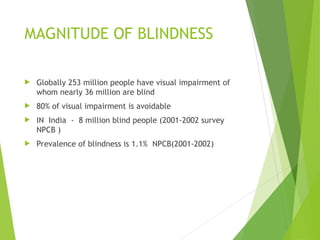
MAGNITUDE OF BLINDNESS
Globally 253 million people have visual impairment of
whom nearly 36 million are blind
80% of visual impairment is avoidable
IN India - 8 million blind people (2001-2002 survey
NPCB )
Prevalence of blindness is 1.1% NPCB(2001-2002)
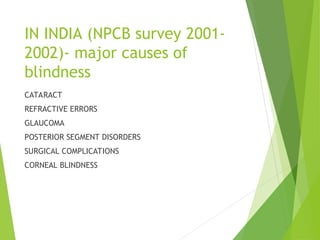
IN INDIA (NPCBsurvey 2001-
2002)- major causes of
blindness
CATARACT
REFRACTIVE ERRORS
GLAUCOMA
POSTERIOR SEGMENT DISORDERS
SURGICAL COMPLICATIONS
CORNEAL BLINDNESS
9.
Global Initiatives For
PreventionOf Blindness
Prevention of Blindness Programme (PBP)- WHO 1978
Vision 2020 – The right to sight
Vision for the future VFTF (2001)
Universal Eye Health: Global Action Plan
10.
National Programme For
ControlOf Blindness
India was the first country in the in the world to launch
the NPCB in the year 1976 as a 100% centrally sponsored
programme
It incoporated the earlier Trachoma control programme
and Vitamin A prophylaxis programme
11.
OBJECTIVES
To providecomprehensive eye care
facilities for primary , secondary & tertiary
levels of eye health care
To reduce the prevalence of blindness in
population from 1.38% to 0.31% by 2000
12.
PLAN OF ACTION&
ACTVITIES
(A) EXTENTION OF EYE CARE
SERVICES
through eye camps and mobile eye units
13.
(B) Establishmentof permanent
infrastructure
Primary eye care at peripheral level
Secondary eye care at intermediate level
Tertiary eye care at central level
Center of excellence at apex level
14.
(1) Establishment ofperipheral sector for primary
eye care
A wide number of eye conditions can be
treated/prevented at the grass-root level by locally
trained primary health workers who are the first to
make contact with the community
PHC strengthened by
- providing necessary equipment
- posting a paramedical ophthalmic assistant
- organising refresher courses for doctors &
and other staff of PHC on prevention of
blindness
15.
Establishment ofintermediate sector for
Secondary eye care
Development of Diagnostic & Treatment facilities at
district & subdivisional levels under the charge of an
eye specialist
16.
Establishment ofcentral level for tertiary eye care
Sophisticated eye care
Upgradation of eye departments of state medical
colleges & by establishments of RIO
17.
(4) Establishmentof an Apex National Institute Of
Ophthalmology
- at Dr Rajendra Prasad Centre for Ophthalmic
Sciences,New Delhi
- provides overall leadership , supervision & guidance
in technical matters to all services and institutions
18.
(C) Intensification ofeye health education
Important long term measure in order to create
community awareness of the problem
Done through mass communication – TV talks , radio
talks , films , seminars & books
school teachers, social workers , community leaders
19.
PROGRAMME
ORGANISATION
1) Central level
Responsibilityof National Programme Management cell
Located in the office of Director of General health
services
Dept of health, Govt of India
2) State level
NPCB is implemented through State Ophthalmic Cell
State Programme Officer is in charge of NPCB
20.
3) DistrictBlindness Control Society
To plan , implement & monitor the blindness control
activities comprehensively at the district level
under overall guidance of the NPCB
21.
DBCS wasestablished because
1) District can be designated as a unit for implementing
various development activities
2) To simplify administration & financial procedures
3) To enhance participation of the community & the
private sector
22.
DBCS
Maximum 20members
Chairman
Vice chairman
Member secretary: District Programme Manager (DPM)
Advisor of the society is State Programme Manager
Technical guidance is provided by the Chief Ophthalmic
Surgeon/ Head of the Ophthalmology Department of
Medical College
23.
VISION 2020 :The Right to
Sight
Global initiative launched by WHO on Feb 18 , 1999 in
Geneva in broad coalition with a
Task Force of International Non-Governmental
Organisations (NGOs)
OBJECTIVE
Eliminate Avoidable Blindness by the year 2020 and to
reduce the global burden of blindness
24.
VISION 2020will be implemented through four phases
of five year plans , the first started in 2000
WHO has identified five major blinding eye conditions
for immediate action which are
Cataract , Childhood Blindness , Trachoma , Refractive
Errors and Low Vision & Onchocerciasis
25.
CATARACT
Aim isto decrease the number of cataract blinds
in the world
Strategy is to increase the Cataract Surgery Rate
(CSR) i.e. number of cataract surgeries per million
population per year
26.
CHILDHOOD BLINDNESS
Considereda priority because of the number of
years of blindness that ensues
Prevalence 0.5 – 1 per 1000 children aged 0 – 15
years
Globally there are 1.4 million blind children
Causes
– Vitamin A def
- Measles
- Conjunctivitis
- Ophthalmia neonatorum
- Congenital cataract
- Retinopathy of prematurity(ROP)
27.
STRATERGIES AND ACTIVITIES
1)Elimination of preventable blindness by
- Measles immunisation
- Vit A supplementation
- Monitoring use of oxygen in
premature newborn
-Promoting school screening programmes
for diagnosis and management of
refractive errors and trachoma
- Promoting eye health education in
schools
28.
2) Managementof surgically avoidable causes of
childhood blindness such as cataract , glaucoma & ROP
29.
TRACHOMA
Effective interventionshave been demonstrated
using SAFE stratergy:
Surgery to correct lid deformity and prevent
blindness
Antibiotics for acute infections and community
control
Facial hygiene
Environmental change including improved access
to water and sanitation and health education
30.
REFRACTIVE ERRORS AND
LOWVISION
Screening to identify individuals with poor vision which
can be improved by spectacles or other optical devices
Refraction services to those identified with significant
refractive errors
Ensure optical services to provide affordable spectacles
Low vision services and low vision aids to be provided
for all those in need
31.
ONCHOCERCIASIS
0.3 millionpeople blind due to onchocerciases world
wide
About 95% of infected persons reside in Africa
Target – to develop National Onchocerciasis Control
Programme with satisfactory coverage in all the 37
countries where the disease is endemic
Stratergy – to introduce community directed treatment
with annual doses of Ivermectin
32.
ROLE OF EYECAMPS
2 types of eye camps
Comprehensive eye care camps
Screening eye camps
Patients are provided comprehensive eye care services
including refraction, cataract surgery
33.
EYE BANKING
Eyebank is an organization which deals with the collection,
storage and distribution of cornea for the purpose of
corneal grafting
Functions
Increase awareness about eye donation
Registration of the pledger for eye donation
Collection of donated eyes
Receiving and processing of donor eyes
Preservation of the tissue
Distribution of the donor tissues to corneal surgeons
Research activities
34.
Eye bank personnel
Eye bank in charge- qualified ophthalmologist
Eye bank technician
Clerk cum store keeper
Medical social worker or Public Relation Officer
Driver cum projectionist
35.
Eye collection centres
Peripheral satellites of an eye bank for better
functioning
About 4-5 eye collection centres are attached with each
eye bank
Functions
• Local publicity of ye donation
• Registration of donors
• Arrangement for collection of eyes
• Initial processing, packing and transportation of eyes to
eye bank
36.
Rehabilitation of theblind
Medical rehabilitation- Low vision aids
Training and psychosocial rehabilitation
Mobility training, training in daily living skills
Educational rehabilitation- blind schools
Vocational rehabilitation





![CTEV [ clubfoot] DR ARUN LAL ,DR MOHAMED ASHRAF travancore medical college k...](https://cdn.slidesharecdn.com/ss_thumbnails/ctevclubfootdrarunlaldrmohamedashraftravancoremedicalcollegekollamkeralaindia-260208063247-18fc466c-thumbnail.jpg?width=640&height=640&fit=bounds)


![ONFH[AVN HIP] -TRIPLE REGIME -A NOVAL SURGICAL CONCEPT .pptx](https://cdn.slidesharecdn.com/ss_thumbnails/onfhavnhip2026koaconcalicutdrgokuldevdrmashraf-260210064517-213ec005-thumbnail.jpg?width=640&height=640&fit=bounds)

