Charlotte Chaze
The phenomenon that applied shearing force
that produces flow in a fluid is resisted by a
force that is proportional to the gradient of
flow velocity in that fluid1
In other words: viscosity is resistance to flow
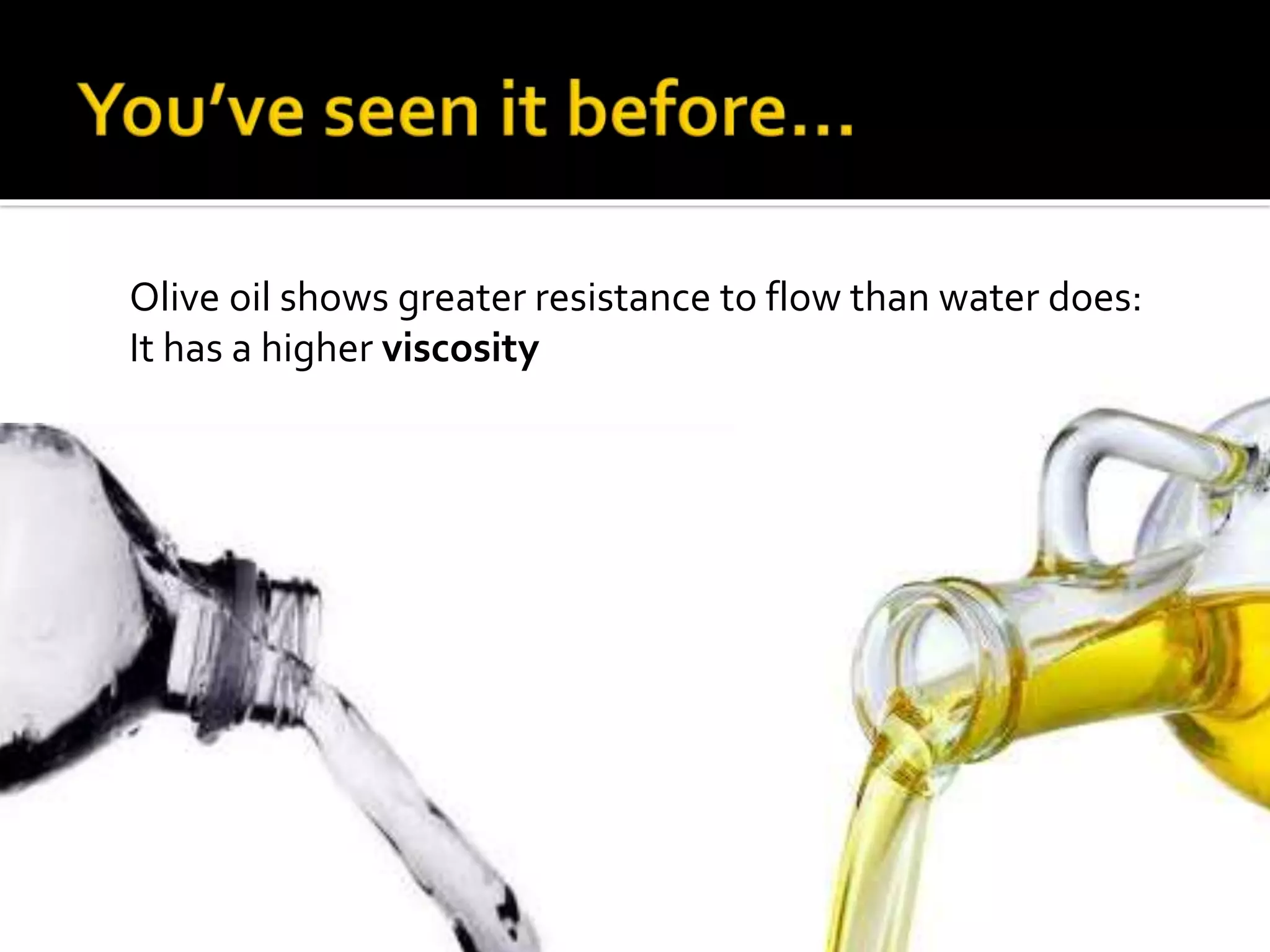
Olive oil shows greater resistance to flow than water does:
It has a higher viscosity
Determine viscosities of homologous series
of compounds
 Ethanol
 1-propanol
 1-butanol
 1-hexanol
 1-octanol
Show a useful correlation between viscosity
and physical properties
 Molecular weight
 Density
 Boiling point
 Enthalpy of vaporization
 Entropy of vaporization
The cause of differential viscosity between compounds
Remember freshman year?
Attraction felt between polar molecules due
to opposite charges
 In 1° alcohols: hydrogen bonds
▪ H on electronegative atom + lone e- pair on another
electronegative atom
 Hydrogen is a small atom, allowing a small bond
length between it and oxygen
▪ strong dipole-dipole interaction
δ+
δ+
δ-
δ-
δ+
δ+
δ-
δ-
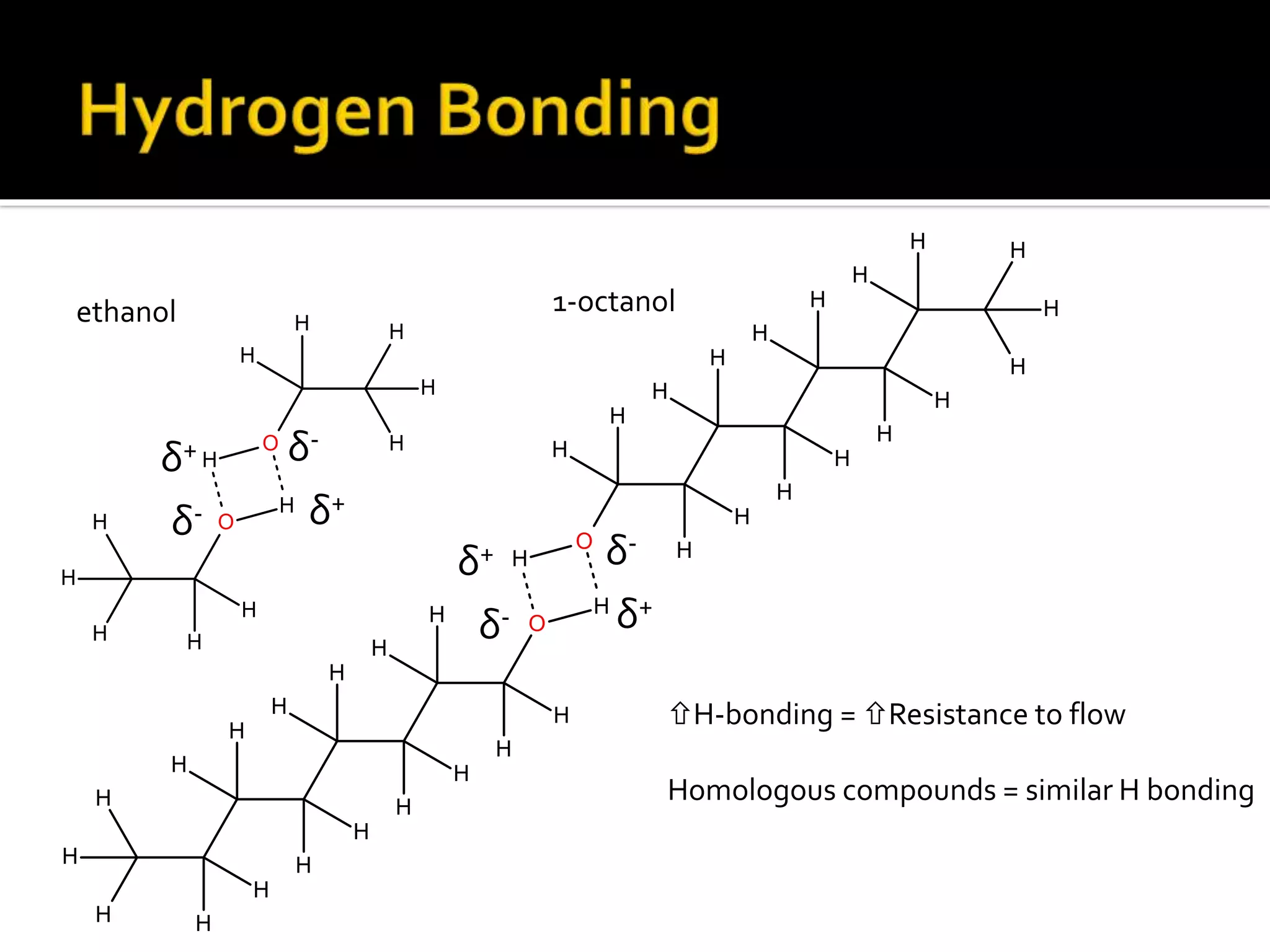
ethanol 1-octanol
H-bonding = Resistance to flow
Homologous compounds = similar H bonding
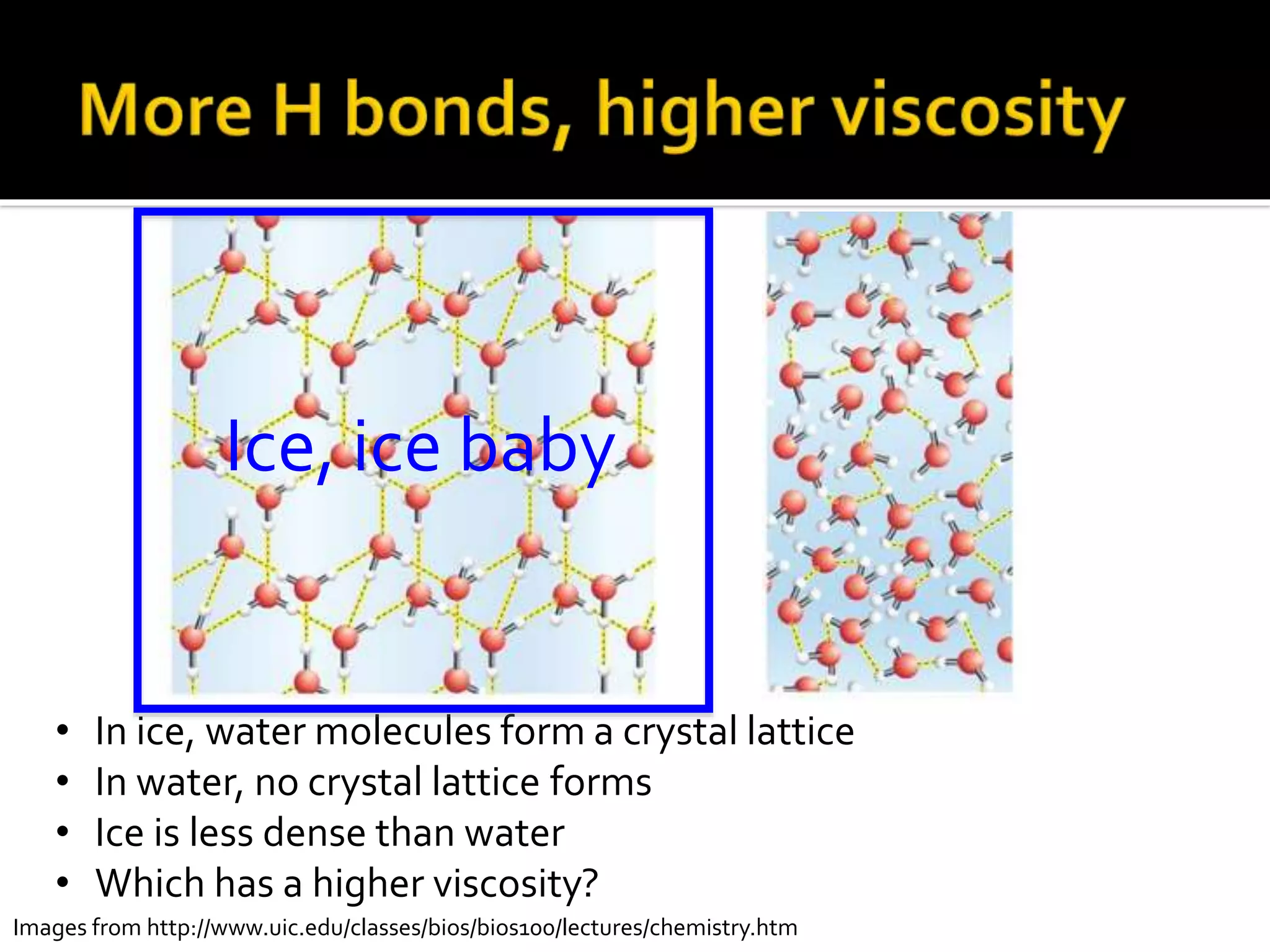
Images from http://www.uic.edu/classes/bios/bios100/lectures/chemistry.htm
• In ice, water molecules form a crystal lattice
• In water, no crystal lattice forms
• Ice is less dense than water
• Which has a higher viscosity?
Ice, ice baby
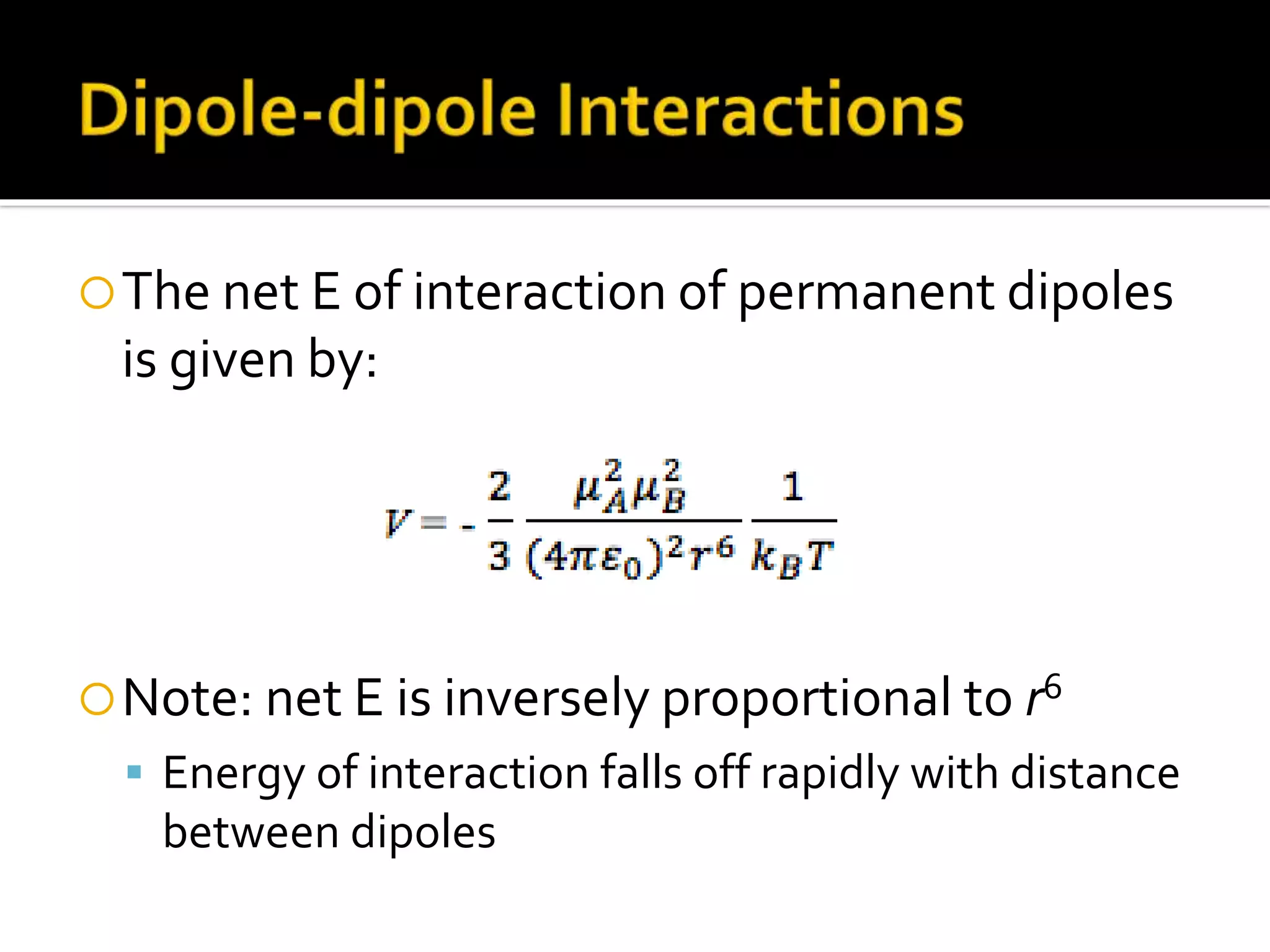
The net E of interaction of permanent dipoles
is given by:
Note: net E is inversely proportional to r6
 Energy of interaction falls off rapidly with distance
between dipoles
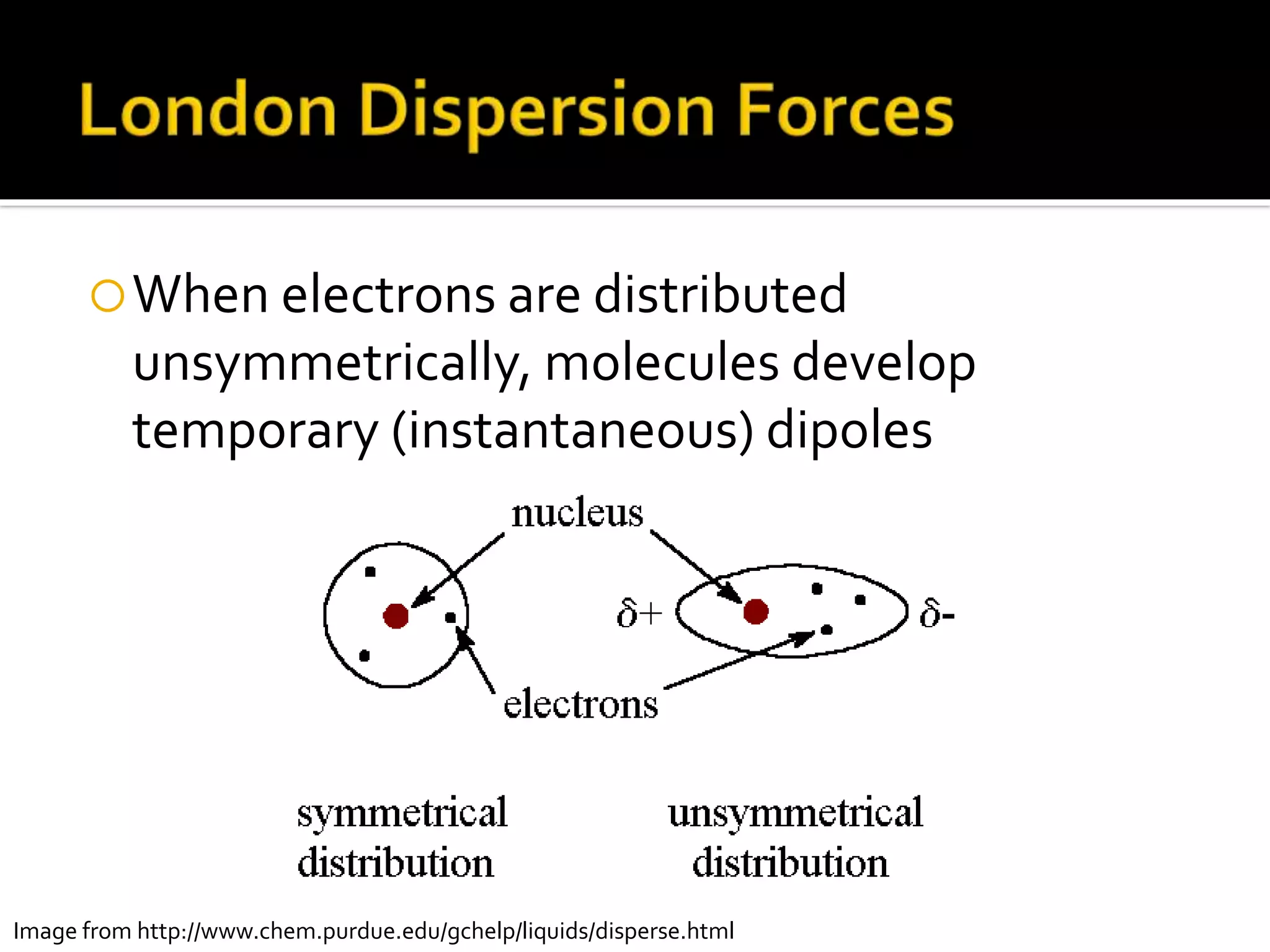
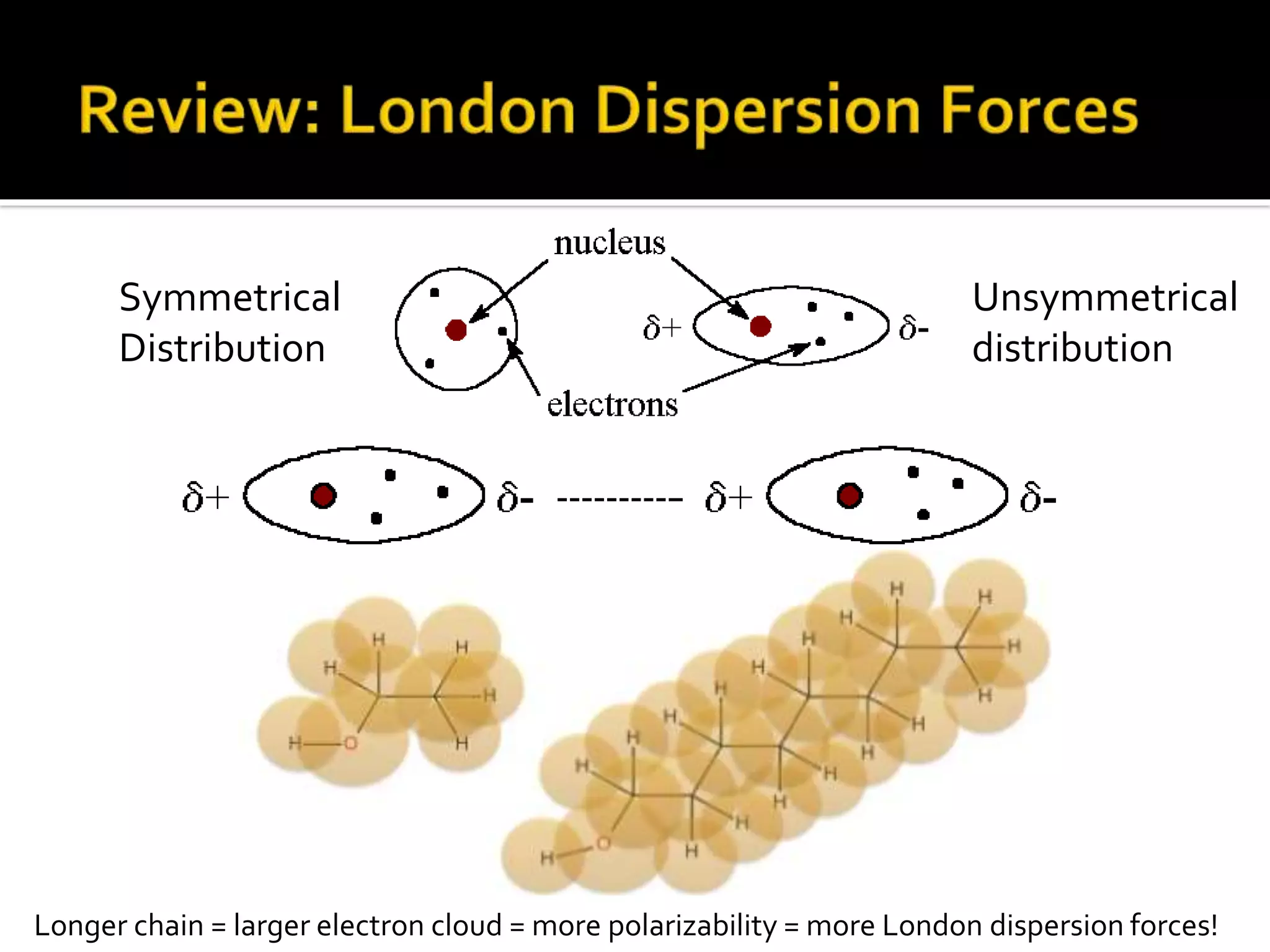
When electrons are distributed
unsymmetrically, molecules develop
temporary (instantaneous) dipoles
Image from http://www.chem.purdue.edu/gchelp/liquids/disperse.html
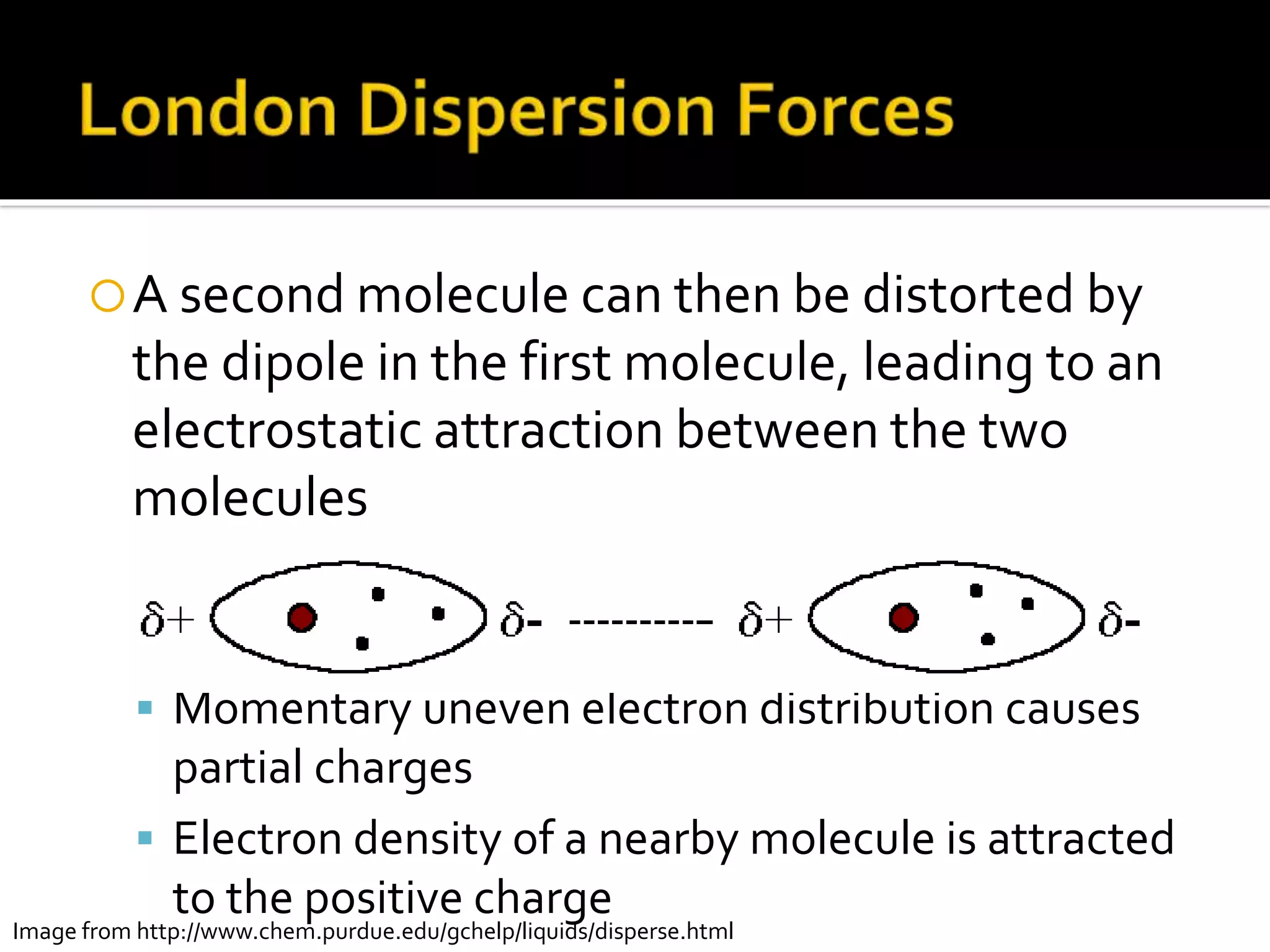
A second molecule can then be distorted by
the dipole in the first molecule, leading to an
electrostatic attraction between the two
molecules
 Momentary uneven electron distribution causes
partial charges
 Electron density of a nearby molecule is attracted
to the positive charge
Image from http://www.chem.purdue.edu/gchelp/liquids/disperse.html
Larger, heavier molecules exhibit stronger
dispersion forces
 In larger molecules, the valence electrons are
farther from the nuclei
▪ They are less tightly held and can more easily form
temporary dipoles
The ease with which the electron distribution
around a molecule can be distorted is called
polarizability
Larger molecules are more polarizable and
thus more viscous
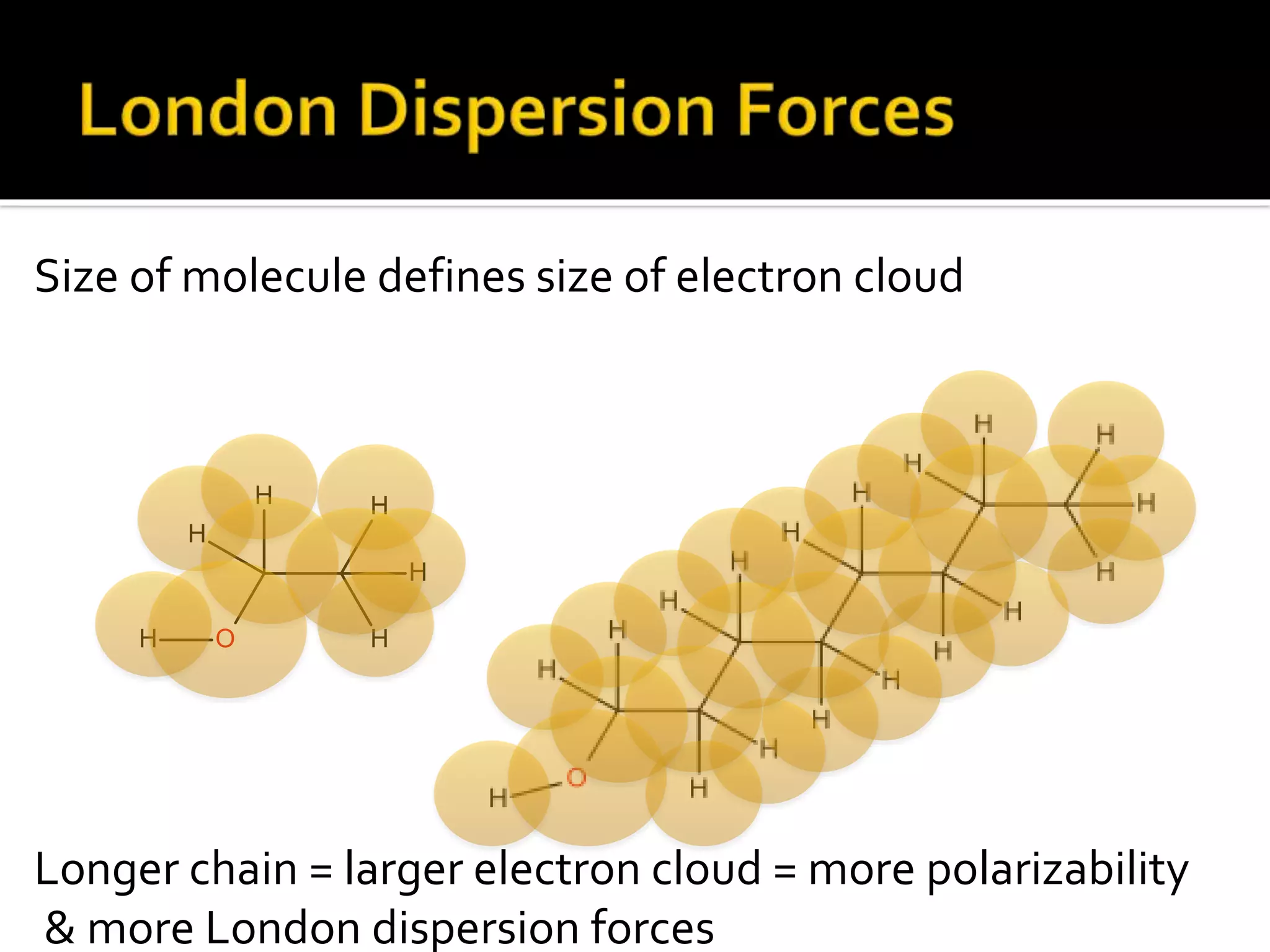
Size of molecule defines size of electron cloud
Longer chain = larger electron cloud = more polarizability
& more London dispersion forces
When molecules are more polarizable, the δ+
and δ- of different molecules is stronger, and
tightly packs the molecules into a more
viscous solution
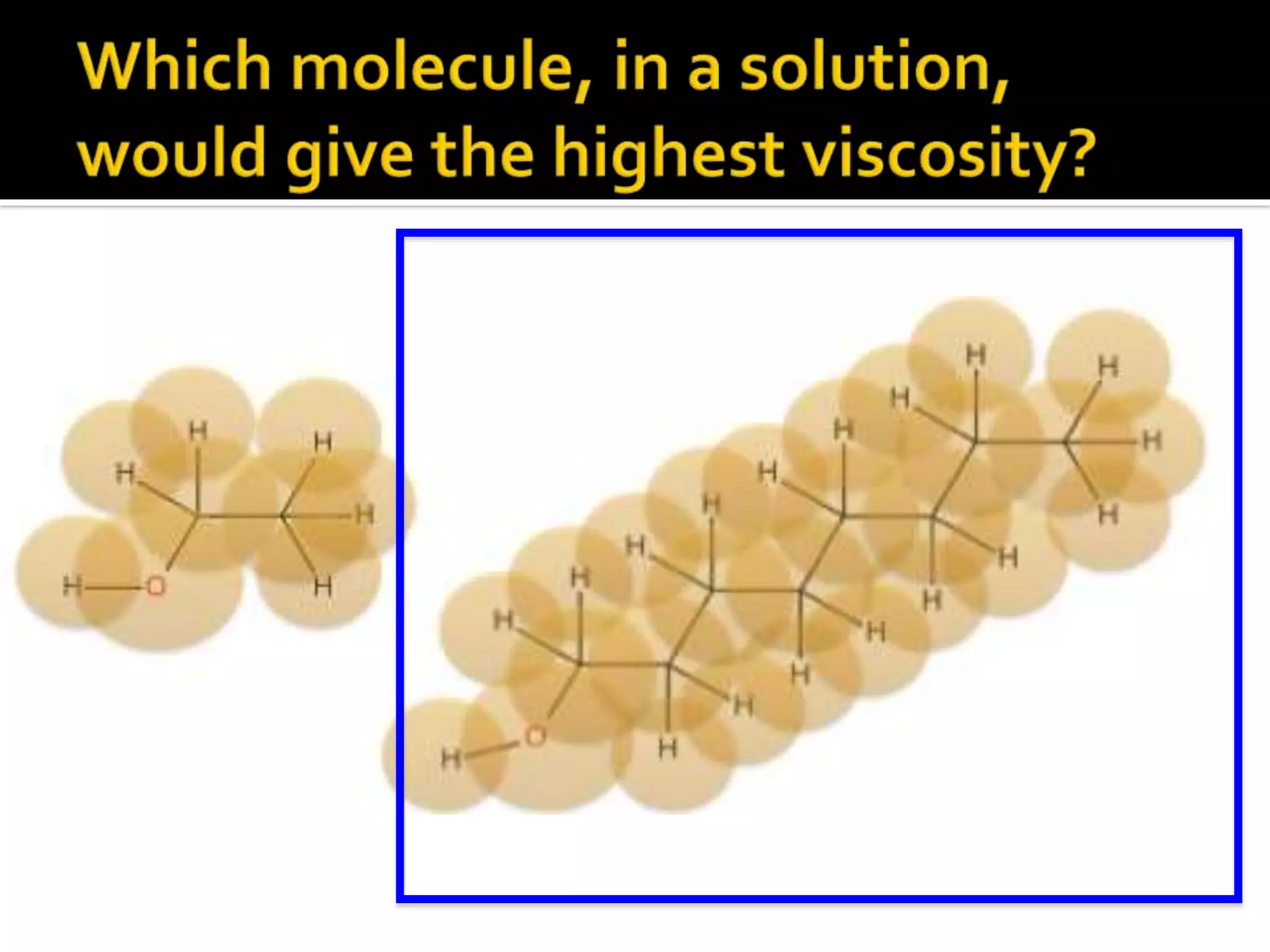
1-octanol should be most viscous, ethanol
should be least viscous
Measuring a homologous series of compounds
Warning: measuring viscosity requires long periods of waiting
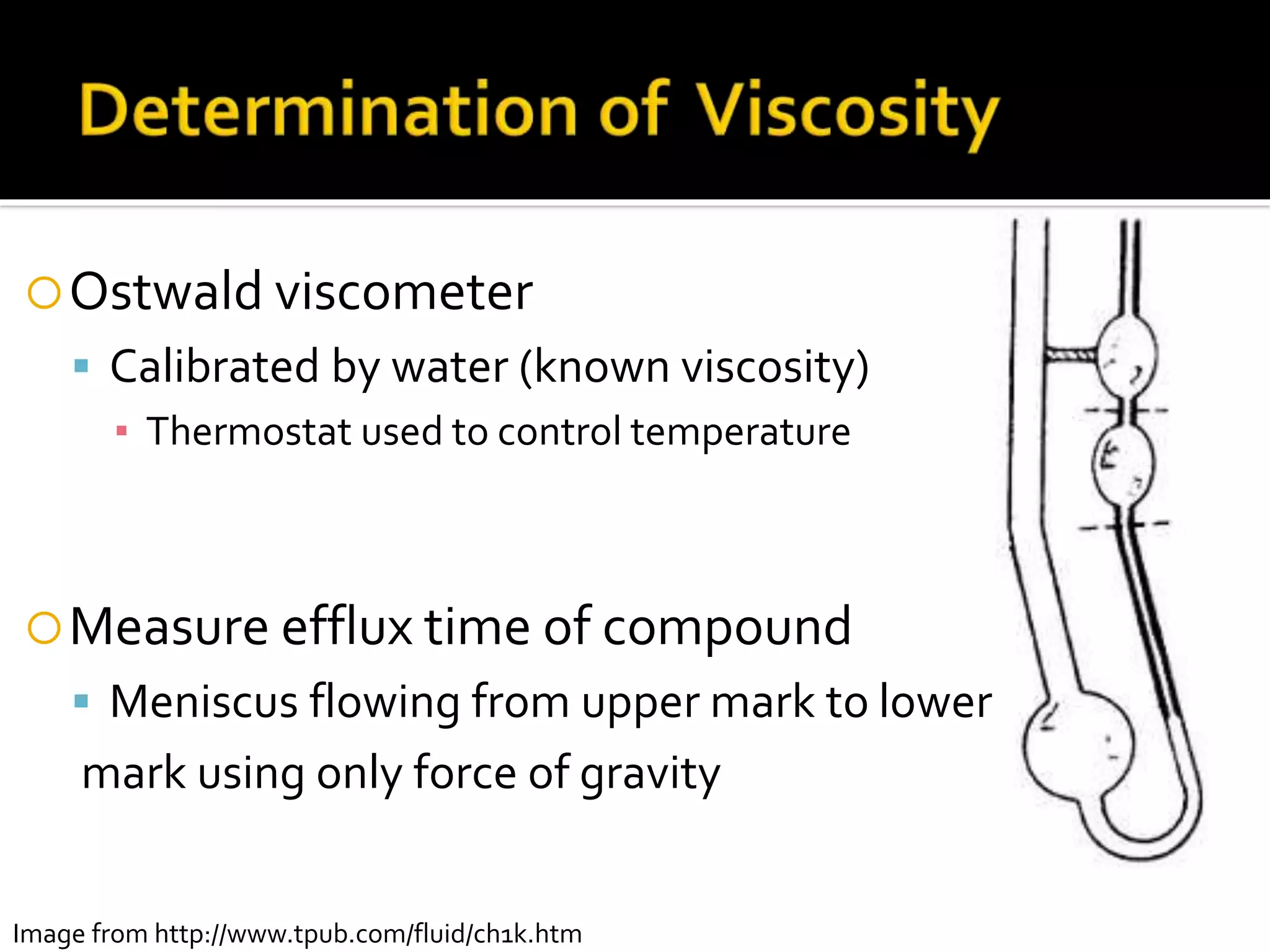
Ostwald viscometer
 Calibrated by water (known viscosity)
▪ Thermostat used to control temperature
Measure efflux time of compound
 Meniscus flowing from upper mark to lower
mark using only force of gravity
Image from http://www.tpub.com/fluid/ch1k.htm
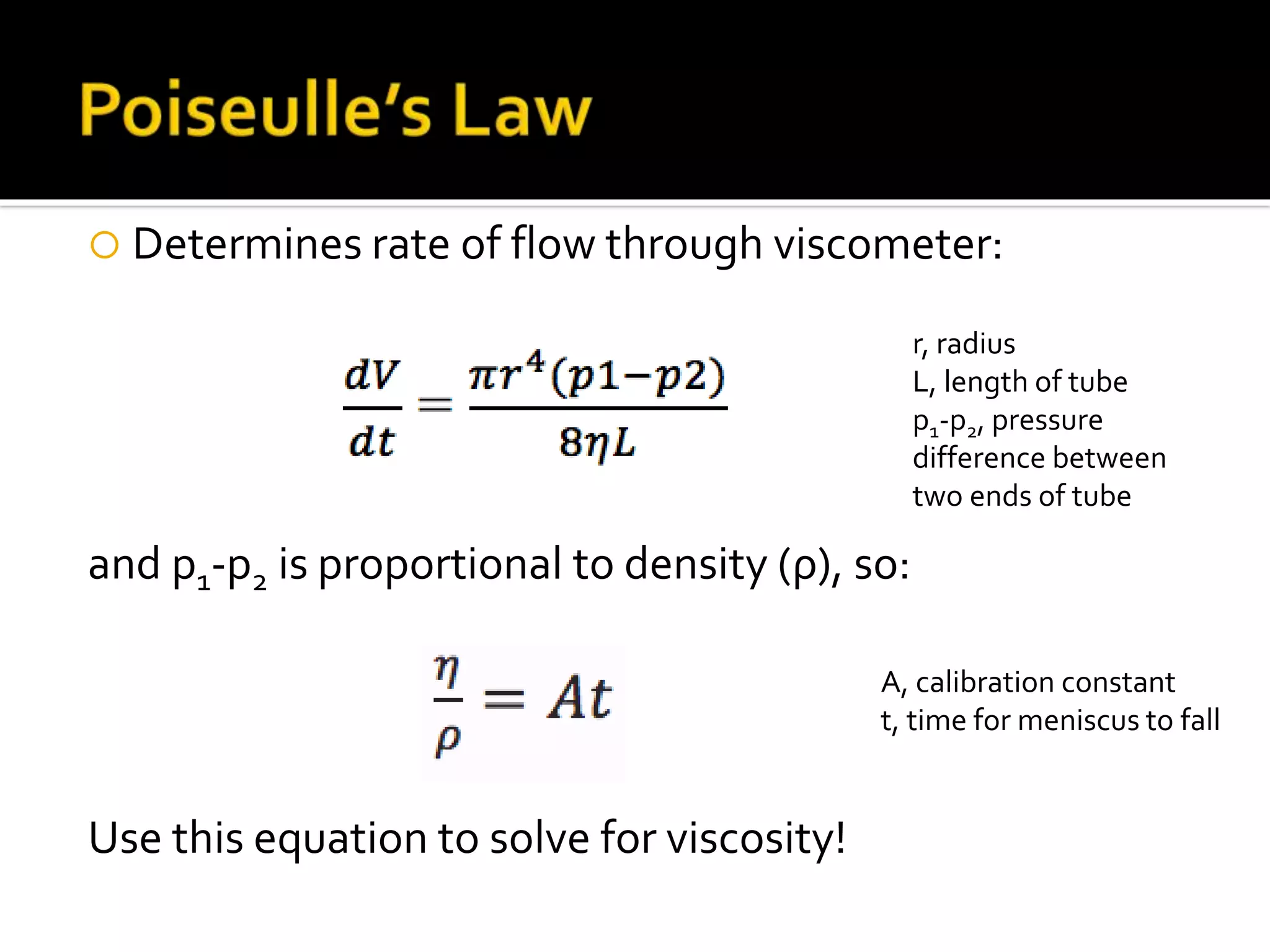
 Determines rate of flow through viscometer:
and p1-p2 is proportional to density (ρ), so:
Use this equation to solve for viscosity!
r, radius
L, length of tube
p1-p2, pressure
difference between
two ends of tube
A, calibration constant
t, time for meniscus to fall
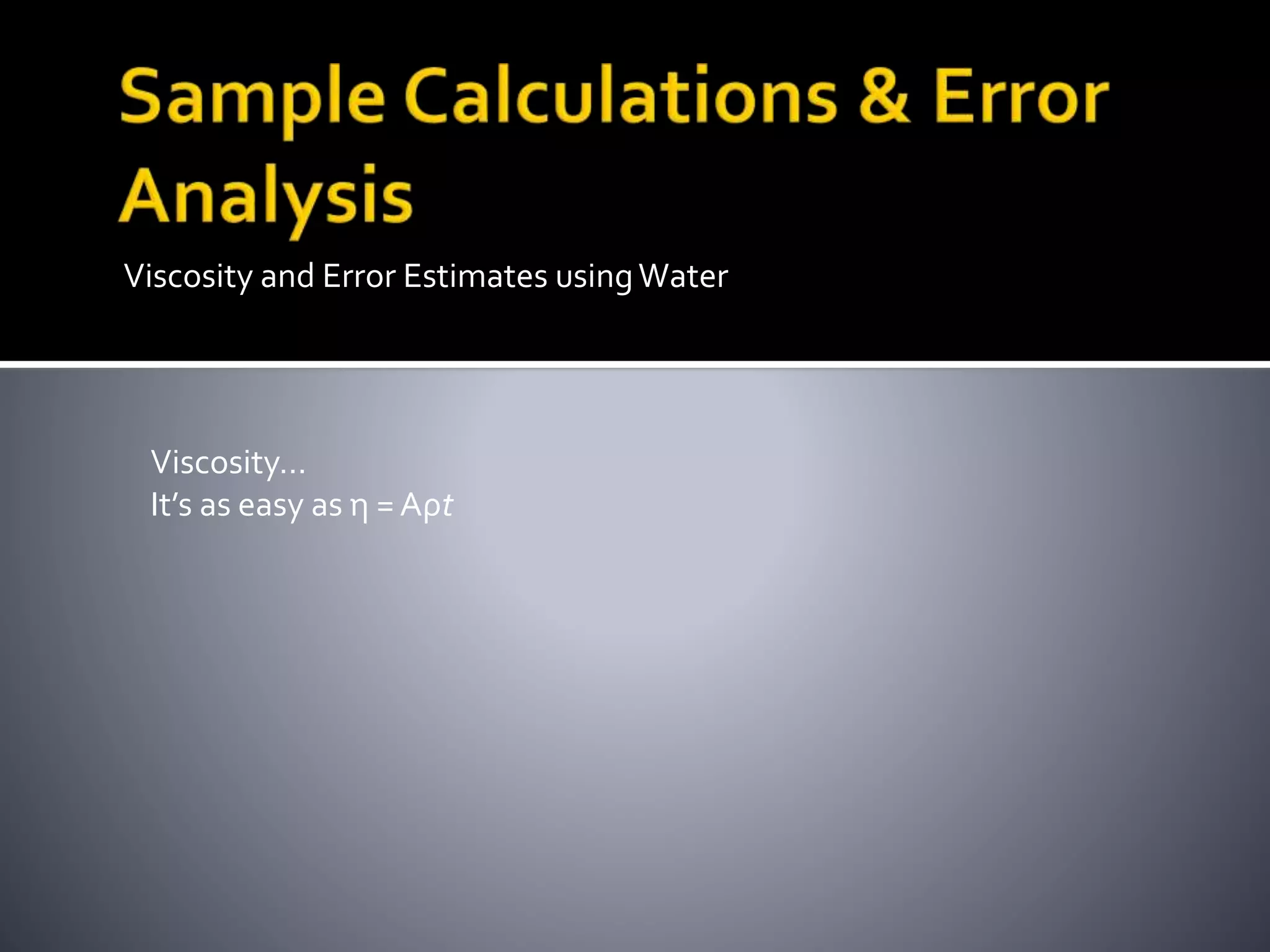
Viscosity and Error Estimates usingWater
Viscosity…
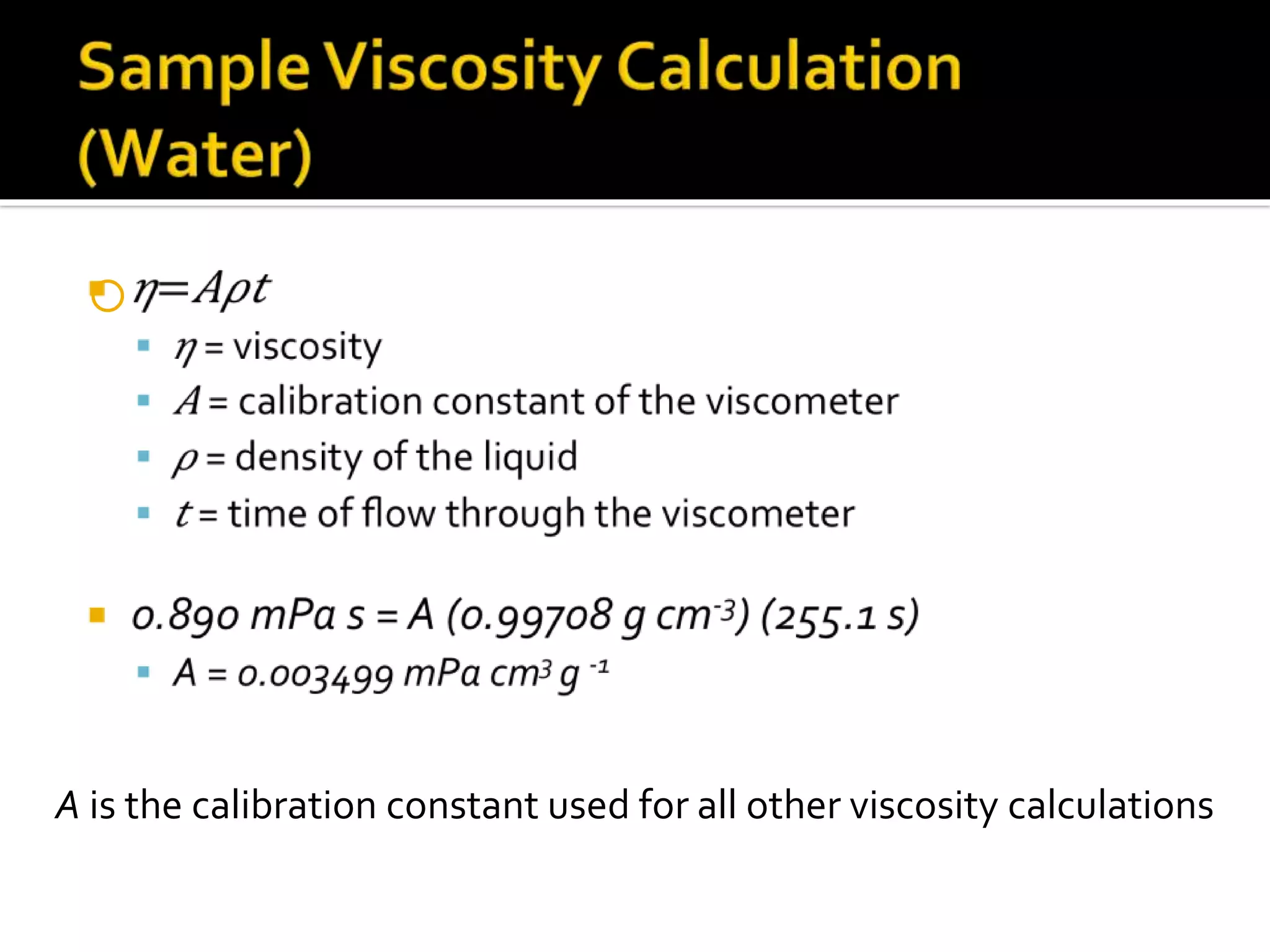
It’s as easy as η = Aρt

A is the calibration constant used for all other viscosity calculations
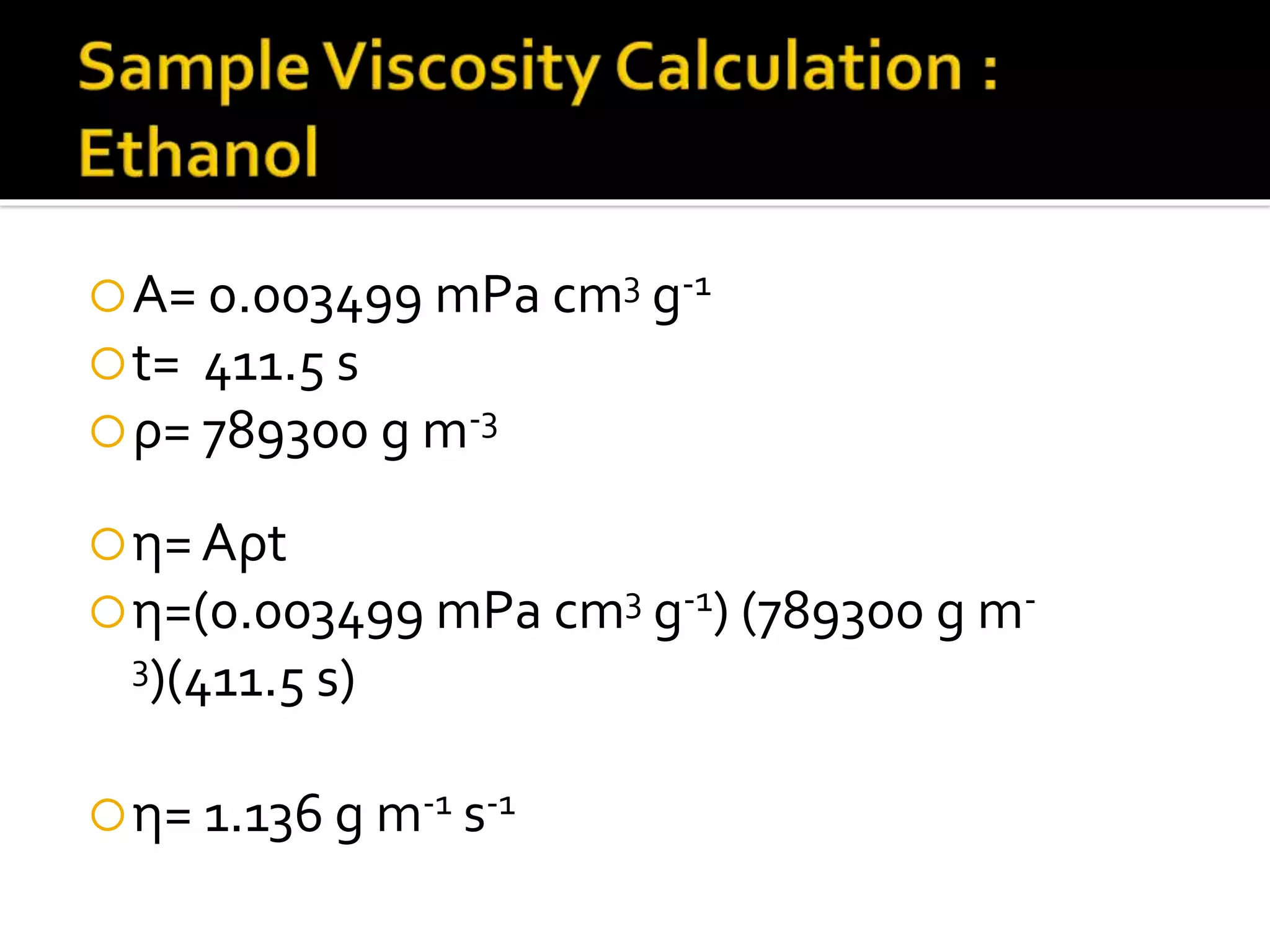
A= 0.003499 mPa cm3 g-1
t= 411.5 s
ρ= 789300 g m-3
η= Aρt
η=(0.003499 mPa cm3 g-1) (789300 g m-
3)(411.5 s)
η= 1.136 g m-1 s-1
Δ%A = (ΔA /A) x 100
Δ%A = (1.3996 x 10⁻⁶ mPa cm3 g-1 / 3.499 x 10⁻³ mPa cm3 g-1) x100
Δ%A= 0.04%
Δ%t = (Δt /t) x 100
Δ%t = (0.1 s / 255.1 s) x100
Δ%t = 0.04%
Δ%η= √[(0.04%)2 + (0.04%)2]
Δ%η= 0.05657%

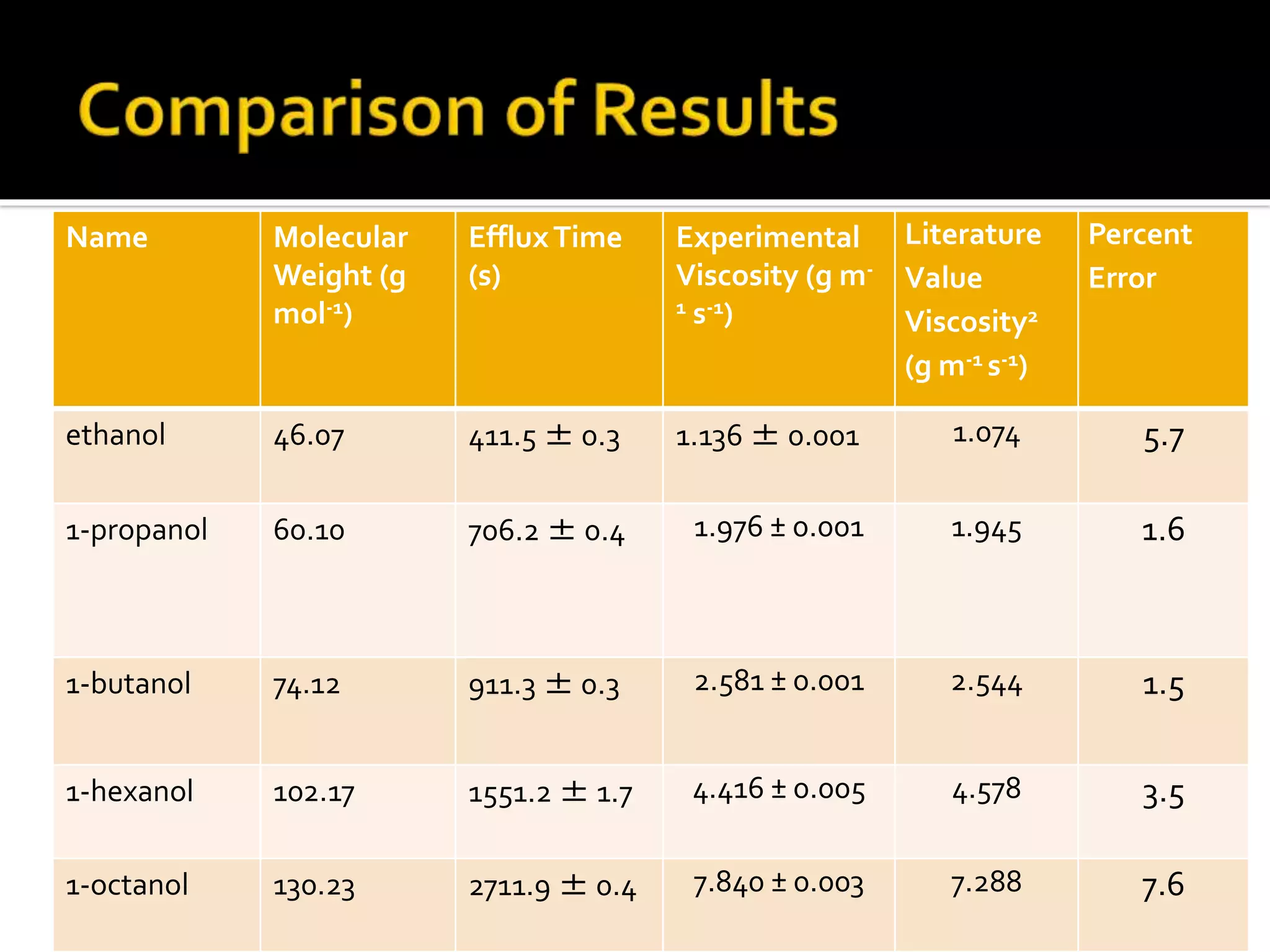
Experimental vs. literature viscosity values and factors contributing to
viscosity values
Name Molecular
Weight (g
mol-1)
EffluxTime
(s)
Experimental
Viscosity (g m-
1 s-1)
Literature
Value
Viscosity2
(g m-1 s-1)
Percent
Error
ethanol 46.07 411.5 ± 0.3 1.136 ± 0.001 1.074 5.7
1-propanol 60.10 706.2 ± 0.4 1.976 ± 0.001 1.945 1.6
1-butanol 74.12 911.3 ± 0.3 2.581 ± 0.001 2.544 1.5
1-hexanol 102.17 1551.2 ± 1.7 4.416 ± 0.005 4.578 3.5
1-octanol 130.23 2711.9 ± 0.4 7.840 ± 0.003 7.288 7.6
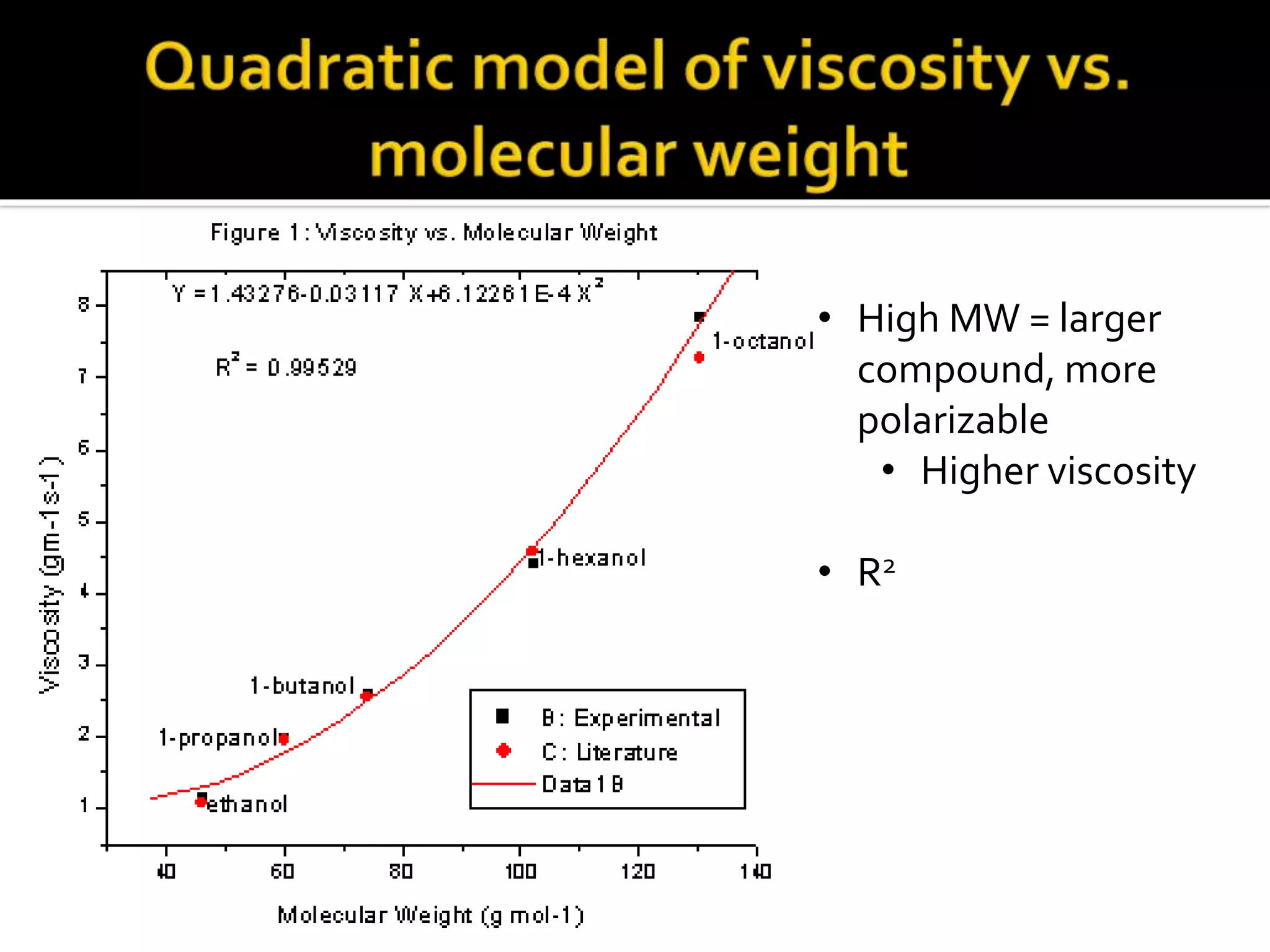
• High MW = larger
compound, more
polarizable
• Higher viscosity
• R2
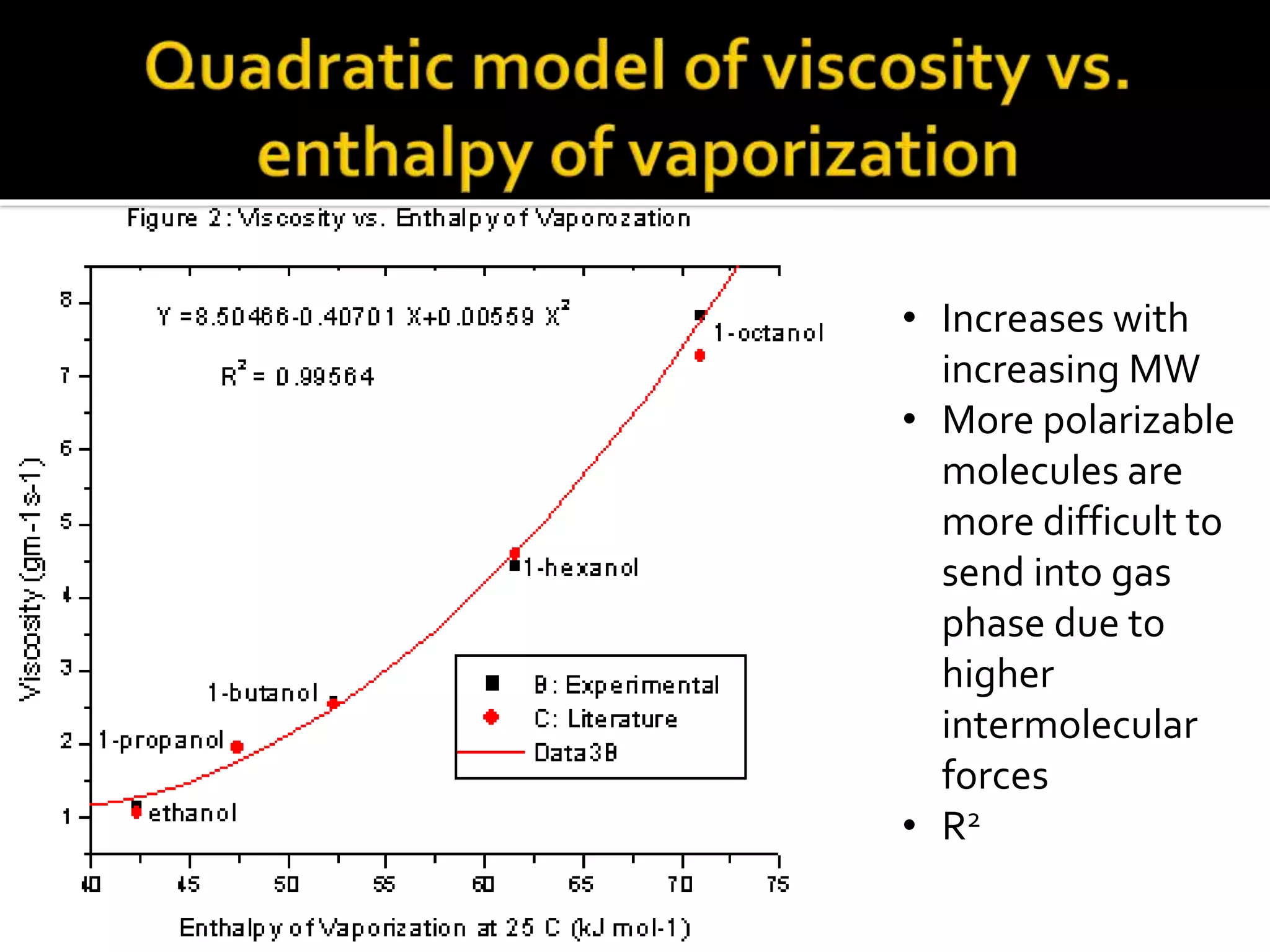
• Increases with
increasing MW
• More polarizable
molecules are
more difficult to
send into gas
phase due to
higher
intermolecular
forces
• R2
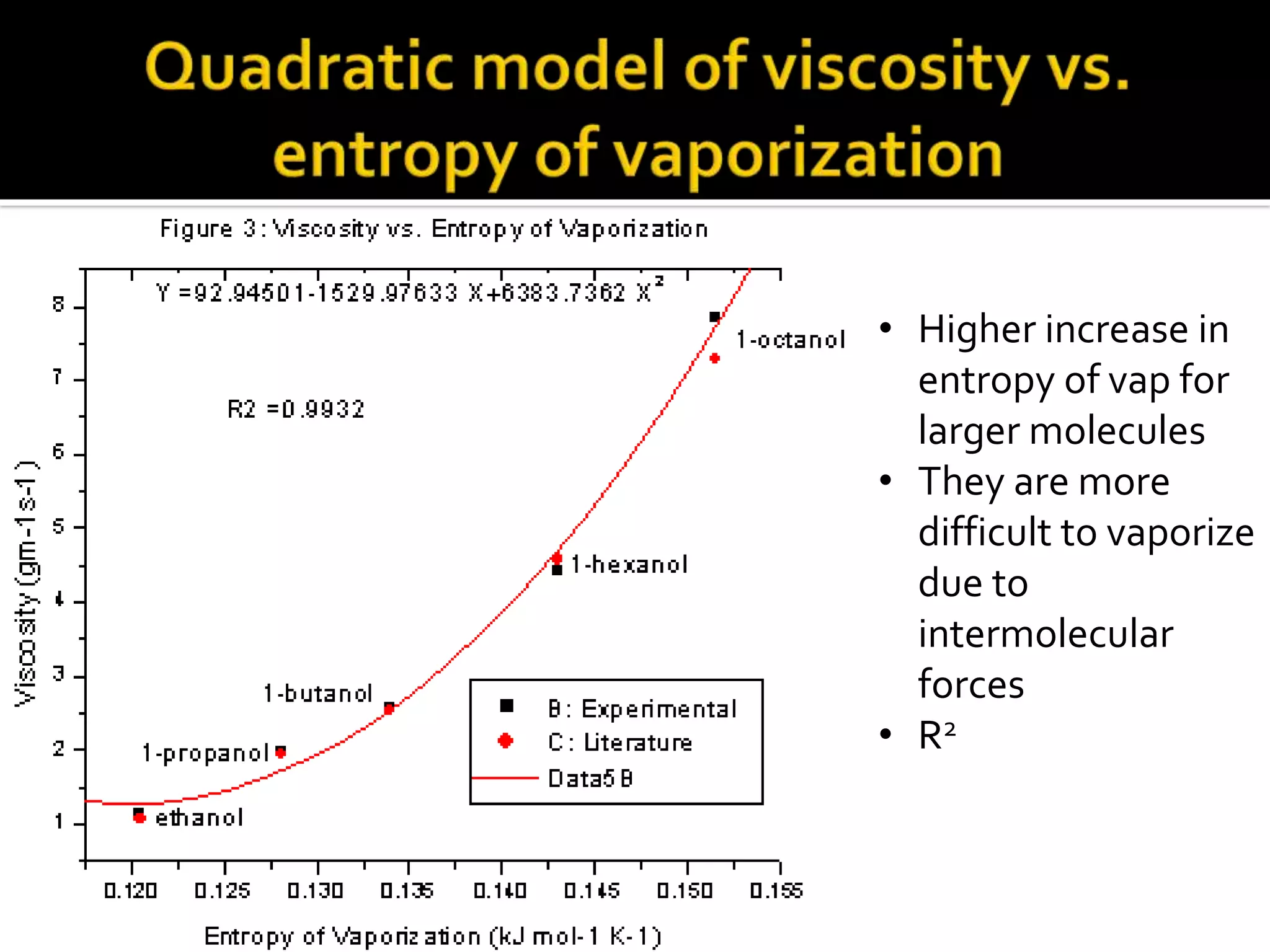
• Higher increase in
entropy of vap for
larger molecules
• They are more
difficult to vaporize
due to
intermolecular
forces
• R2
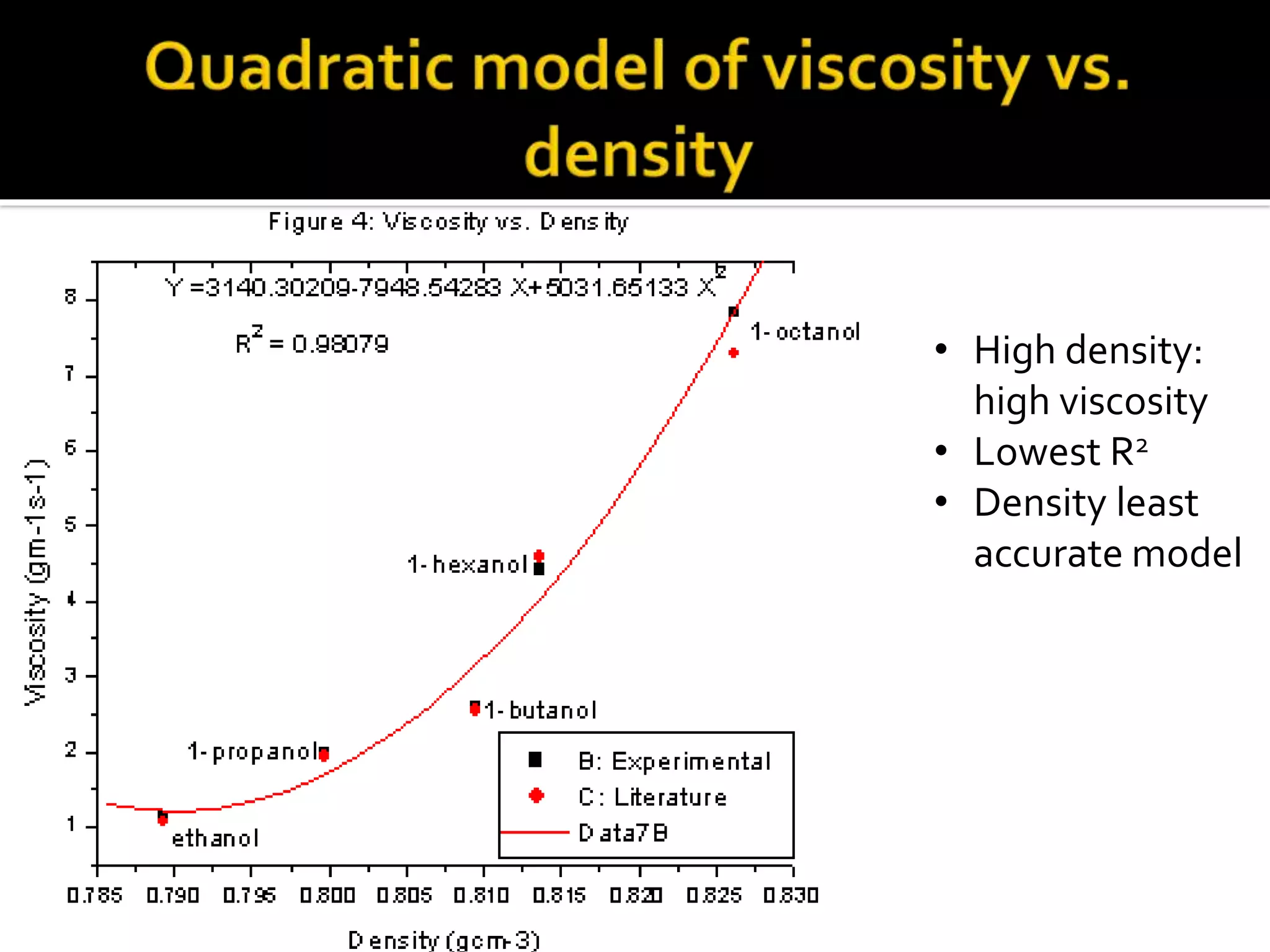
• High density:
high viscosity
• Lowest R2
• Density least
accurate model
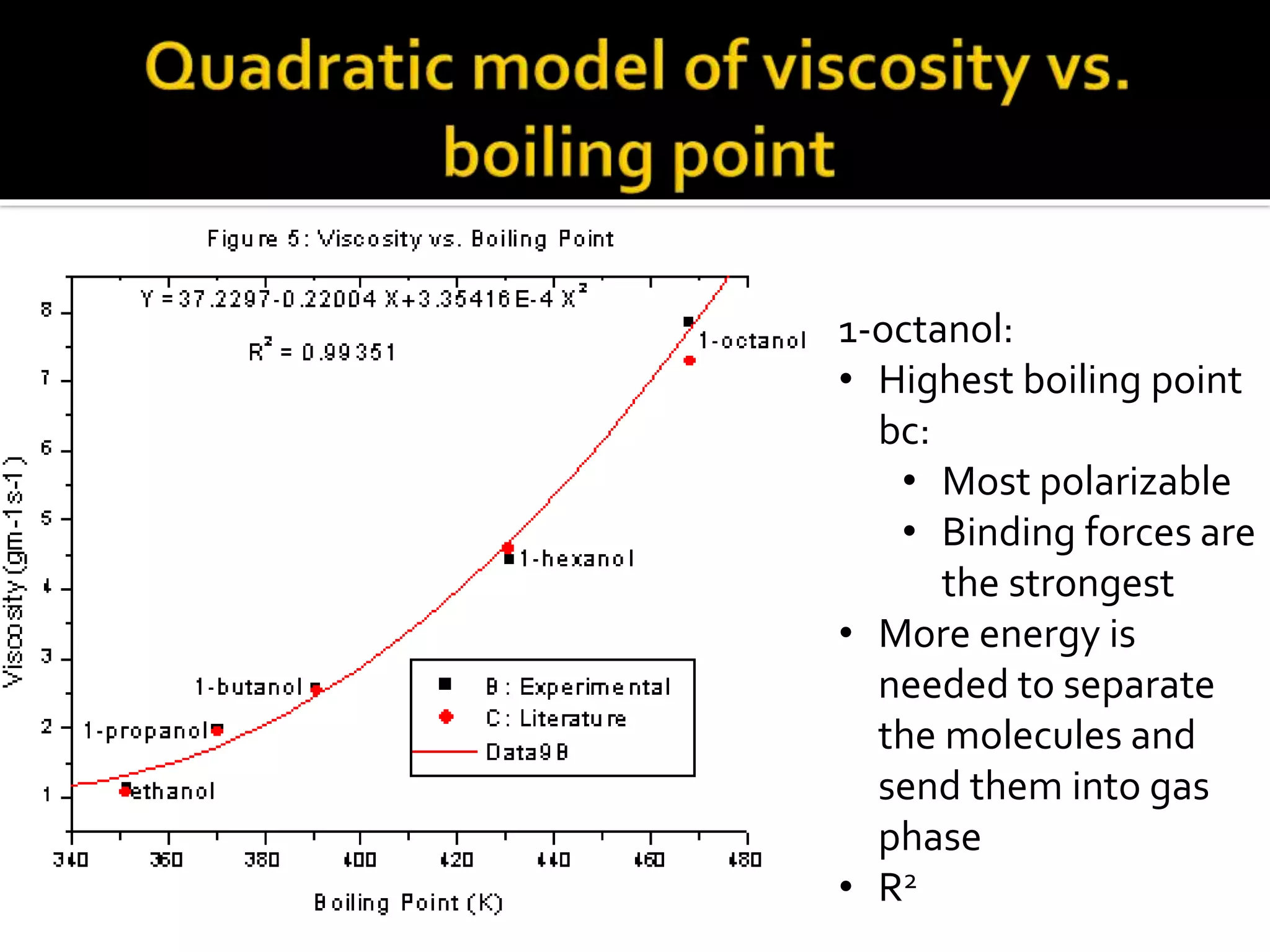
1-octanol:
• Highest boiling point
bc:
• Most polarizable
• Binding forces are
the strongest
• More energy is
needed to separate
the molecules and
send them into gas
phase
• R2
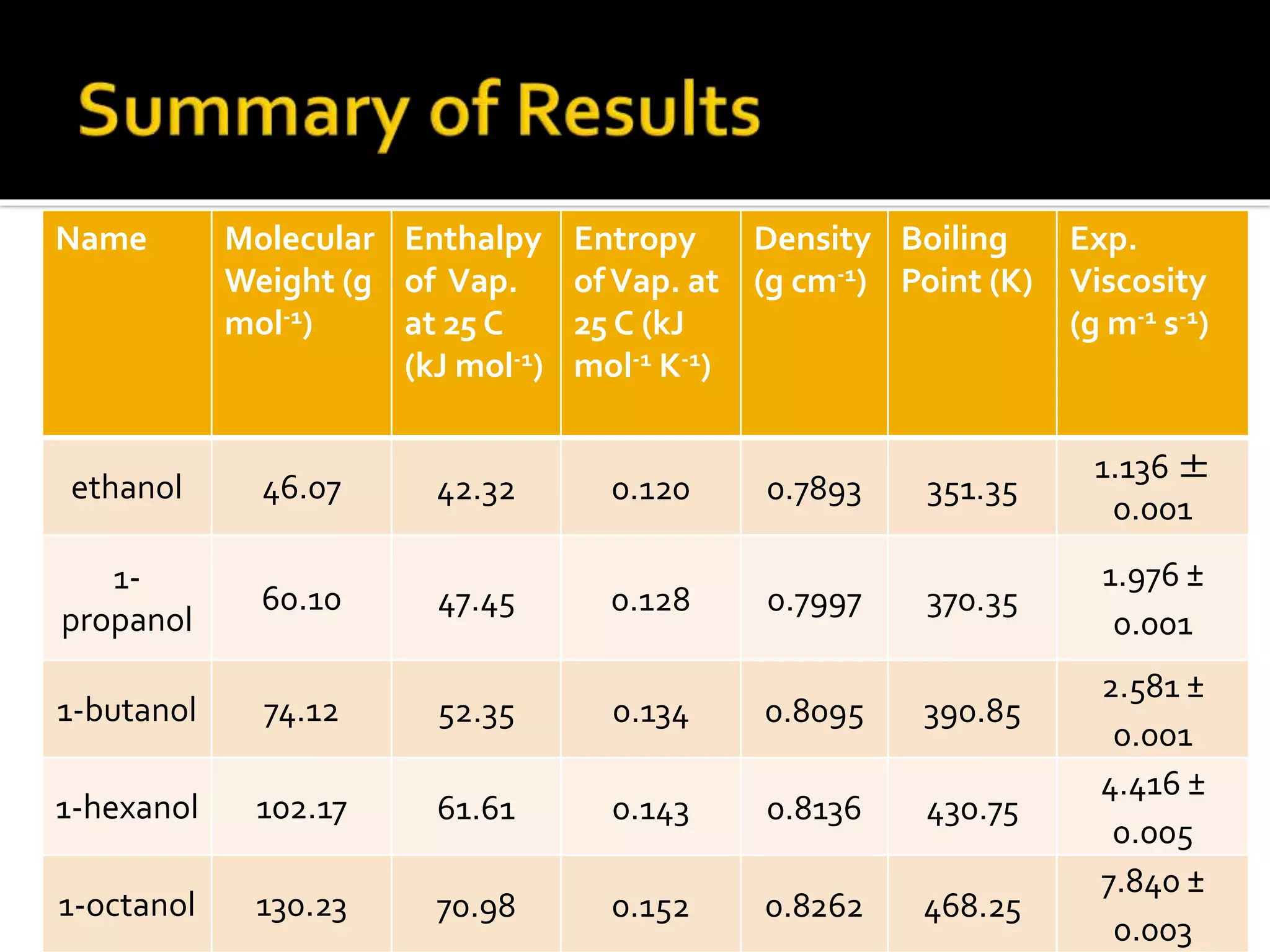
Name Molecular
Weight (g
mol-1)
Enthalpy
of Vap.
at 25 C
(kJ mol-1)
Entropy
ofVap. at
25 C (kJ
mol-1 K-1)
Density
(g cm-1)
Boiling
Point (K)
Exp.
Viscosity
(g m-1 s-1)
ethanol 46.07 42.32 0.120 0.7893 351.35
1.136 ±
0.001
1-
propanol
60.10 47.45 0.128 0.7997 370.35
1.976 ±
0.001
1-butanol 74.12 52.35 0.134 0.8095 390.85
2.581 ±
0.001
1-hexanol 102.17 61.61 0.143 0.8136 430.75
4.416 ±
0.005
1-octanol 130.23 70.98 0.152 0.8262 468.25
7.840 ±
0.003
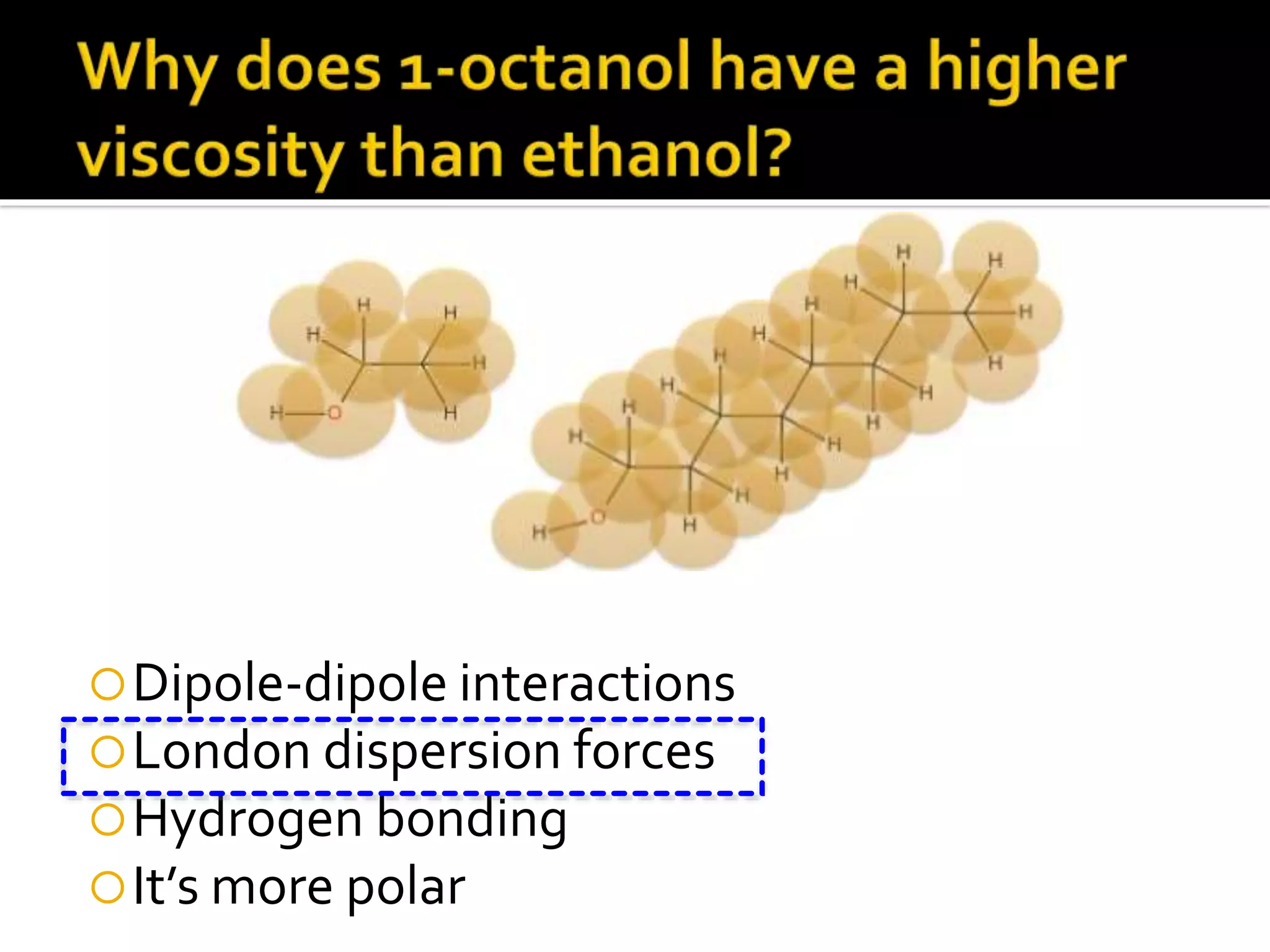
Dipole-dipole interactions
London dispersion forces
Hydrogen bonding
It’s more polar
Unsymmetrical
distribution
Symmetrical
Distribution
Longer chain = larger electron cloud = more polarizability = more London dispersion forces!
Intermolecular forces and viscosity
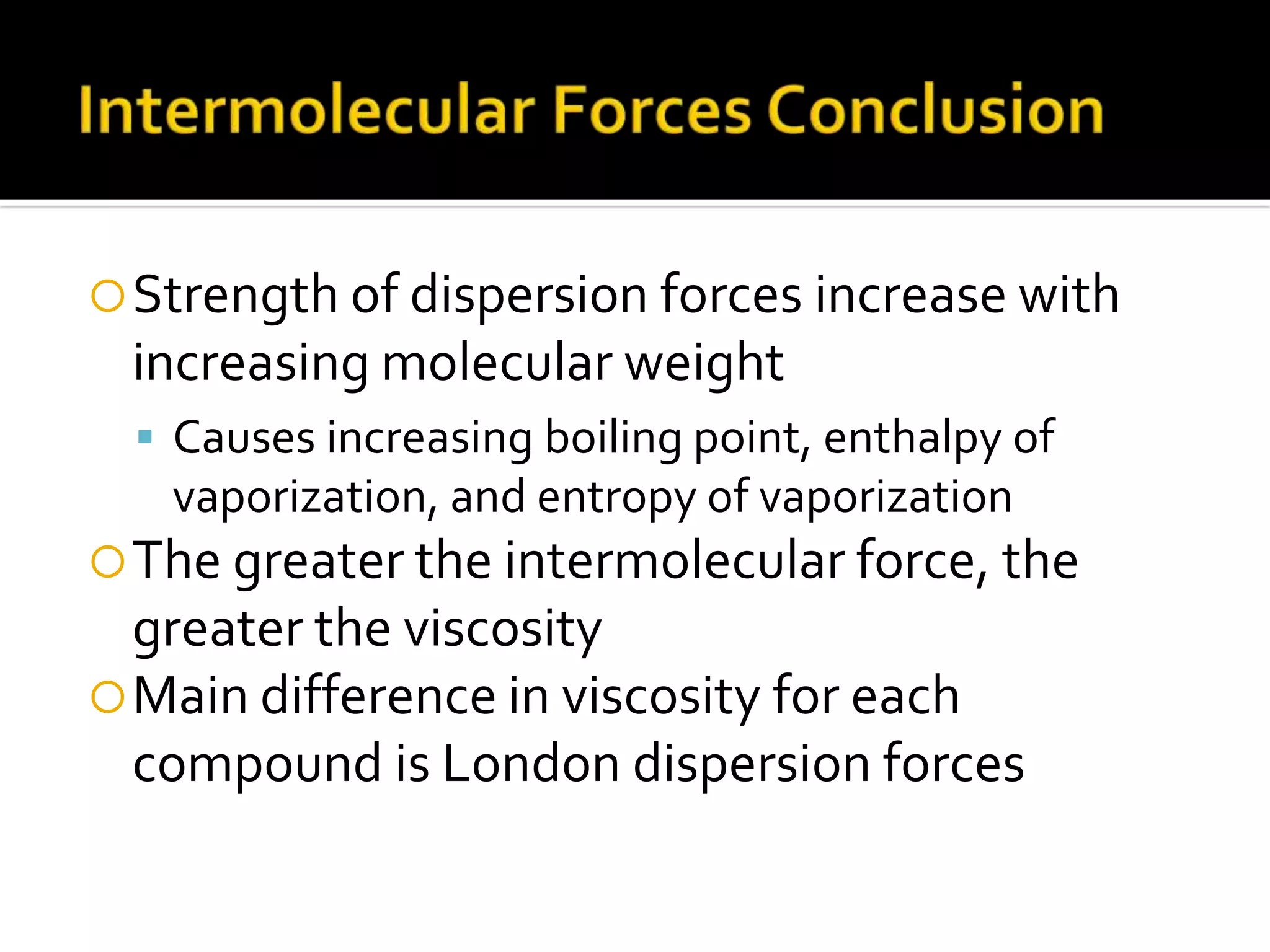
Strength of dispersion forces increase with
increasing molecular weight
 Causes increasing boiling point, enthalpy of
vaporization, and entropy of vaporization
The greater the intermolecular force, the
greater the viscosity
Main difference in viscosity for each
compound is London dispersion forces
Viscosity increases with increasing:
 Molecular weight
 Enthalpy of vaporization
 Entropy of vaporization
 Density
 Boiling point
Mostly due to London dispersion forces
1. Garland, C.; Nibler, J.; Shoemaker, D. Spectroscopy. Experiments in Physical
Chemistry; McGraw-Hill Higher Education: NewYork, NY, 2009; pp. 129-130, 320-
326.
2. Physical Constants of Organic Compounds. Handbook of Chemistry and Physics,
Lide, D., Ed.; CRC Press: Boca Raton FL, 2008; 89th edition, pp. 3-4 to 3-522.

Viscosity Variations with Molecular Structure

  • 1.
  • 2.
    The phenomenon thatapplied shearing force that produces flow in a fluid is resisted by a force that is proportional to the gradient of flow velocity in that fluid1 In other words: viscosity is resistance to flow
  • 3.
    Olive oil showsgreater resistance to flow than water does: It has a higher viscosity
  • 4.
    Determine viscosities ofhomologous series of compounds  Ethanol  1-propanol  1-butanol  1-hexanol  1-octanol
  • 5.
    Show a usefulcorrelation between viscosity and physical properties  Molecular weight  Density  Boiling point  Enthalpy of vaporization  Entropy of vaporization
  • 6.
    The cause ofdifferential viscosity between compounds Remember freshman year?
  • 7.
    Attraction felt betweenpolar molecules due to opposite charges  In 1° alcohols: hydrogen bonds ▪ H on electronegative atom + lone e- pair on another electronegative atom  Hydrogen is a small atom, allowing a small bond length between it and oxygen ▪ strong dipole-dipole interaction
  • 8.
    δ+ δ+ δ- δ- δ+ δ+ δ- δ- ethanol 1-octanol H-bonding =Resistance to flow Homologous compounds = similar H bonding
  • 9.
    Images from http://www.uic.edu/classes/bios/bios100/lectures/chemistry.htm •In ice, water molecules form a crystal lattice • In water, no crystal lattice forms • Ice is less dense than water • Which has a higher viscosity? Ice, ice baby
  • 10.
    The net Eof interaction of permanent dipoles is given by: Note: net E is inversely proportional to r6  Energy of interaction falls off rapidly with distance between dipoles
  • 11.
    When electrons aredistributed unsymmetrically, molecules develop temporary (instantaneous) dipoles Image from http://www.chem.purdue.edu/gchelp/liquids/disperse.html
  • 12.
    A second moleculecan then be distorted by the dipole in the first molecule, leading to an electrostatic attraction between the two molecules  Momentary uneven electron distribution causes partial charges  Electron density of a nearby molecule is attracted to the positive charge Image from http://www.chem.purdue.edu/gchelp/liquids/disperse.html
  • 13.
    Larger, heavier moleculesexhibit stronger dispersion forces  In larger molecules, the valence electrons are farther from the nuclei ▪ They are less tightly held and can more easily form temporary dipoles The ease with which the electron distribution around a molecule can be distorted is called polarizability Larger molecules are more polarizable and thus more viscous
  • 14.
    Size of moleculedefines size of electron cloud Longer chain = larger electron cloud = more polarizability & more London dispersion forces
  • 15.
    When molecules aremore polarizable, the δ+ and δ- of different molecules is stronger, and tightly packs the molecules into a more viscous solution 1-octanol should be most viscous, ethanol should be least viscous
  • 16.
    Measuring a homologousseries of compounds Warning: measuring viscosity requires long periods of waiting
  • 17.
    Ostwald viscometer  Calibratedby water (known viscosity) ▪ Thermostat used to control temperature Measure efflux time of compound  Meniscus flowing from upper mark to lower mark using only force of gravity Image from http://www.tpub.com/fluid/ch1k.htm
  • 18.
     Determines rateof flow through viscometer: and p1-p2 is proportional to density (ρ), so: Use this equation to solve for viscosity! r, radius L, length of tube p1-p2, pressure difference between two ends of tube A, calibration constant t, time for meniscus to fall
  • 19.
    Viscosity and ErrorEstimates usingWater Viscosity… It’s as easy as η = Aρt
  • 20.
     A is thecalibration constant used for all other viscosity calculations
  • 21.
    A= 0.003499 mPacm3 g-1 t= 411.5 s ρ= 789300 g m-3 η= Aρt η=(0.003499 mPa cm3 g-1) (789300 g m- 3)(411.5 s) η= 1.136 g m-1 s-1
  • 22.
    Δ%A = (ΔA/A) x 100 Δ%A = (1.3996 x 10⁻⁶ mPa cm3 g-1 / 3.499 x 10⁻³ mPa cm3 g-1) x100 Δ%A= 0.04% Δ%t = (Δt /t) x 100 Δ%t = (0.1 s / 255.1 s) x100 Δ%t = 0.04% Δ%η= √[(0.04%)2 + (0.04%)2] Δ%η= 0.05657% 
  • 23.
    Experimental vs. literatureviscosity values and factors contributing to viscosity values
  • 24.
    Name Molecular Weight (g mol-1) EffluxTime (s) Experimental Viscosity(g m- 1 s-1) Literature Value Viscosity2 (g m-1 s-1) Percent Error ethanol 46.07 411.5 ± 0.3 1.136 ± 0.001 1.074 5.7 1-propanol 60.10 706.2 ± 0.4 1.976 ± 0.001 1.945 1.6 1-butanol 74.12 911.3 ± 0.3 2.581 ± 0.001 2.544 1.5 1-hexanol 102.17 1551.2 ± 1.7 4.416 ± 0.005 4.578 3.5 1-octanol 130.23 2711.9 ± 0.4 7.840 ± 0.003 7.288 7.6
  • 25.
    • High MW= larger compound, more polarizable • Higher viscosity • R2
  • 26.
    • Increases with increasingMW • More polarizable molecules are more difficult to send into gas phase due to higher intermolecular forces • R2
  • 27.
    • Higher increasein entropy of vap for larger molecules • They are more difficult to vaporize due to intermolecular forces • R2
  • 28.
    • High density: highviscosity • Lowest R2 • Density least accurate model
  • 29.
    1-octanol: • Highest boilingpoint bc: • Most polarizable • Binding forces are the strongest • More energy is needed to separate the molecules and send them into gas phase • R2
  • 30.
    Name Molecular Weight (g mol-1) Enthalpy ofVap. at 25 C (kJ mol-1) Entropy ofVap. at 25 C (kJ mol-1 K-1) Density (g cm-1) Boiling Point (K) Exp. Viscosity (g m-1 s-1) ethanol 46.07 42.32 0.120 0.7893 351.35 1.136 ± 0.001 1- propanol 60.10 47.45 0.128 0.7997 370.35 1.976 ± 0.001 1-butanol 74.12 52.35 0.134 0.8095 390.85 2.581 ± 0.001 1-hexanol 102.17 61.61 0.143 0.8136 430.75 4.416 ± 0.005 1-octanol 130.23 70.98 0.152 0.8262 468.25 7.840 ± 0.003
  • 32.
    Dipole-dipole interactions London dispersionforces Hydrogen bonding It’s more polar
  • 33.
    Unsymmetrical distribution Symmetrical Distribution Longer chain =larger electron cloud = more polarizability = more London dispersion forces!
  • 34.
  • 35.
    Strength of dispersionforces increase with increasing molecular weight  Causes increasing boiling point, enthalpy of vaporization, and entropy of vaporization The greater the intermolecular force, the greater the viscosity Main difference in viscosity for each compound is London dispersion forces
  • 36.
    Viscosity increases withincreasing:  Molecular weight  Enthalpy of vaporization  Entropy of vaporization  Density  Boiling point Mostly due to London dispersion forces
  • 37.
    1. Garland, C.;Nibler, J.; Shoemaker, D. Spectroscopy. Experiments in Physical Chemistry; McGraw-Hill Higher Education: NewYork, NY, 2009; pp. 129-130, 320- 326. 2. Physical Constants of Organic Compounds. Handbook of Chemistry and Physics, Lide, D., Ed.; CRC Press: Boca Raton FL, 2008; 89th edition, pp. 3-4 to 3-522.