1
Prepared for
A S M Sayeam
Instructor,
Department of Mechanical Engineering
Prepared By
MD. Sumon Ahmed
ID#14207045
Serial No. 22
2
Contents
Summary
Definition
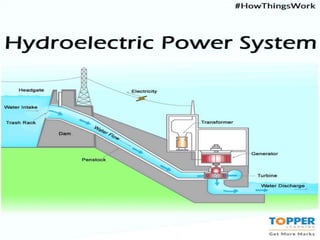
Parts of Hydro-Electric power plant
General arrangement Type Hydro-Electric Project in operation
Performance of water turbine
Advantages of a Hydro-Electric power plant
Disadvantages of a Hydro-Electric power plant
Conclusion
3
11 March
2018
4
Hydroelectric power plants are the most efficient
means of producing electric energy. Since water is the most
abundant resource in the world, the most efficient way to
harness the power of water is to collect the potential
energy. This is done by damming up a body of flowing
water. The turbine is made up of a shaft with blades
attached. As a fluid flows through the blades a rotational
force is created. This force causes a torque on the shaft.
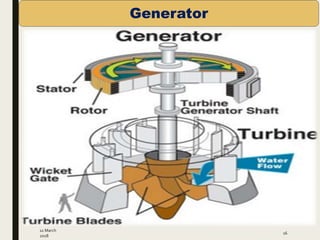
The turbine shaft is coupled to a generator, where
electricity is produced. An electric generator is “any
machine that converts mechanical energy into electricity
for transmission and distribution.” The generator works by
spinning a rotor that is turned by a turbine.
Hydropower ( from hydro meaning water) is energy that
comes from the force moving water. The fall and
movement of water is part of a continuous natural cycle
called the water cycle.
Harvesting the energy of moving water to produce
electricity for our own needs.
Hydroelectricity is the term referring to electricity
generated by hydropower; the production of electrical
power through the use of the gravitational force of falling
or flowing water.
11 March
2018
5
What is Hydroelectric Power?
11 March
2018
6
11 March
2018
7
■ The water
reservoir
is the place behind
the
Dam where water is
stored.
11 March
2018
8
Reservoir
11 March
2018
9
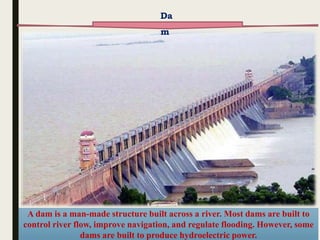
A dam is a man-made structure built across a river. Most dams are built to
control river flow, improve navigation, and regulate flooding. However, some
dams are built to produce hydroelectric power.
Da
m
11 March
2018
10
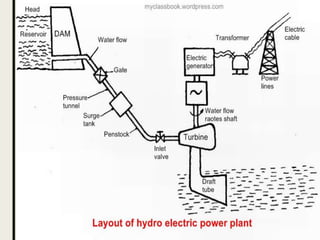
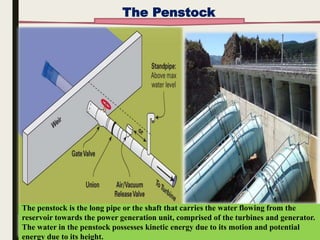
The penstock is the long pipe or the shaft that carries the water flowing from the
reservoir towards the power generation unit, comprised of the turbines and generator.
The water in the penstock possesses kinetic energy due to its motion and potential
energy due to its height.
The Penstock
11 March
2018
11
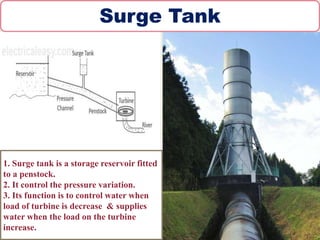
1. Surge tank is a storage reservoir fitted
to a penstock.
2. It control the pressure variation.
3. Its function is to control water when
load of turbine is decrease & supplies
water when the load on the turbine
increase.
Surge Tank
11 March
2018
12
Spillway
11 March
2018
13
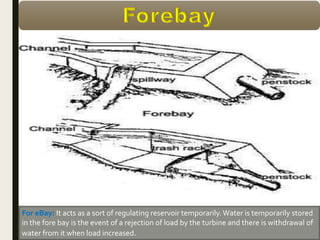
For eBay: It acts as a sort of regulating reservoir temporarily.Water is temporarily stored
in the fore bay is the event of a rejection of load by the turbine and there is withdrawal of
water from it when load increased.
11 March
2018
14
Turbine
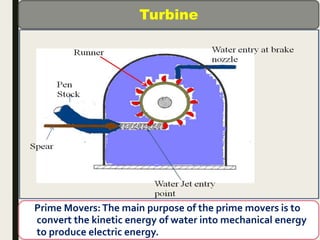
Prime Movers:The main purpose of the prime movers is to
convert the kinetic energy of water into mechanical energy
to produce electric energy.
11 March
2018
15
Turbine
11 March
2018
16
Generator
11 March
2018
17
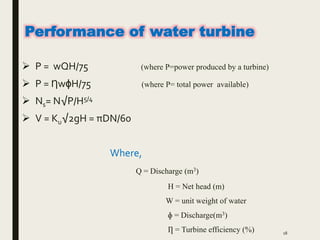
 P = wQH/75 (where P=power produced by a turbine)
 P = ȠwɸH/75 (where P= total power available)
 Ns= N√P/H5/4
 V = Ku√2gH = πDN/60
Where,
Q = Discharge (m3)
H = Net head (m)
W = unit weight of water
ɸ = Discharge(m3)
Ƞ = Turbine efficiency (%) 18
Performance of water turbine
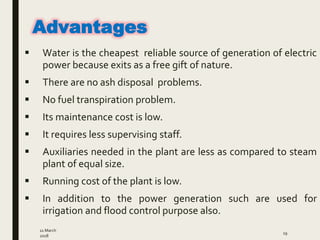
 Water is the cheapest reliable source of generation of electric
power because exits as a free gift of nature.
 There are no ash disposal problems.
 No fuel transpiration problem.
 Its maintenance cost is low.
 It requires less supervising staff.
 Auxiliaries needed in the plant are less as compared to steam
plant of equal size.
 Running cost of the plant is low.
 In addition to the power generation such are used for
irrigation and flood control purpose also.
11 March
2018
19
Advantages
■ Drought
■ Impact on Local Environment and Land Use
■ Preservation Concerns
■ Initial cost of the plant is high.
■ It takes fairly long time for the creation of such plant
11 March
2018
20
Disadvantages
11 March
2018
21
22

Hydrolic power plant.ppt

  • 1.
    1 Prepared for A SM Sayeam Instructor, Department of Mechanical Engineering Prepared By MD. Sumon Ahmed ID#14207045 Serial No. 22
  • 2.
  • 3.
    Contents Summary Definition Parts of Hydro-Electricpower plant General arrangement Type Hydro-Electric Project in operation Performance of water turbine Advantages of a Hydro-Electric power plant Disadvantages of a Hydro-Electric power plant Conclusion 3
  • 4.
    11 March 2018 4 Hydroelectric powerplants are the most efficient means of producing electric energy. Since water is the most abundant resource in the world, the most efficient way to harness the power of water is to collect the potential energy. This is done by damming up a body of flowing water. The turbine is made up of a shaft with blades attached. As a fluid flows through the blades a rotational force is created. This force causes a torque on the shaft. The turbine shaft is coupled to a generator, where electricity is produced. An electric generator is “any machine that converts mechanical energy into electricity for transmission and distribution.” The generator works by spinning a rotor that is turned by a turbine.
  • 5.
    Hydropower ( fromhydro meaning water) is energy that comes from the force moving water. The fall and movement of water is part of a continuous natural cycle called the water cycle. Harvesting the energy of moving water to produce electricity for our own needs. Hydroelectricity is the term referring to electricity generated by hydropower; the production of electrical power through the use of the gravitational force of falling or flowing water. 11 March 2018 5 What is Hydroelectric Power?
  • 6.
  • 7.
  • 8.
    ■ The water reservoir isthe place behind the Dam where water is stored. 11 March 2018 8 Reservoir
  • 9.
    11 March 2018 9 A damis a man-made structure built across a river. Most dams are built to control river flow, improve navigation, and regulate flooding. However, some dams are built to produce hydroelectric power. Da m
  • 10.
    11 March 2018 10 The penstockis the long pipe or the shaft that carries the water flowing from the reservoir towards the power generation unit, comprised of the turbines and generator. The water in the penstock possesses kinetic energy due to its motion and potential energy due to its height. The Penstock
  • 11.
    11 March 2018 11 1. Surgetank is a storage reservoir fitted to a penstock. 2. It control the pressure variation. 3. Its function is to control water when load of turbine is decrease & supplies water when the load on the turbine increase. Surge Tank
  • 12.
  • 13.
    11 March 2018 13 For eBay:It acts as a sort of regulating reservoir temporarily.Water is temporarily stored in the fore bay is the event of a rejection of load by the turbine and there is withdrawal of water from it when load increased.
  • 14.
    11 March 2018 14 Turbine Prime Movers:Themain purpose of the prime movers is to convert the kinetic energy of water into mechanical energy to produce electric energy.
  • 15.
  • 16.
  • 17.
  • 18.
     P =wQH/75 (where P=power produced by a turbine)  P = ȠwɸH/75 (where P= total power available)  Ns= N√P/H5/4  V = Ku√2gH = πDN/60 Where, Q = Discharge (m3) H = Net head (m) W = unit weight of water ɸ = Discharge(m3) Ƞ = Turbine efficiency (%) 18 Performance of water turbine
  • 19.
     Water isthe cheapest reliable source of generation of electric power because exits as a free gift of nature.  There are no ash disposal problems.  No fuel transpiration problem.  Its maintenance cost is low.  It requires less supervising staff.  Auxiliaries needed in the plant are less as compared to steam plant of equal size.  Running cost of the plant is low.  In addition to the power generation such are used for irrigation and flood control purpose also. 11 March 2018 19 Advantages
  • 20.
    ■ Drought ■ Impacton Local Environment and Land Use ■ Preservation Concerns ■ Initial cost of the plant is high. ■ It takes fairly long time for the creation of such plant 11 March 2018 20 Disadvantages
  • 21.
  • 22.