GENERAL CHEMISTRY 2
Subject Teacher
AILENE H. CALAMLAM
Intermolecular Forces
Intramolecular force
versus
Intermolecular force
Intramolecular Forces
- forces “within” molecules
Intermolecular Forces
- the attractive forces that
exist between molecules
Intermolecular Forces
- the attractive forces that
exist between molecules
- Intermolecular forces are
weak compared to
intramolecular forces
7
Intermolecular Forces
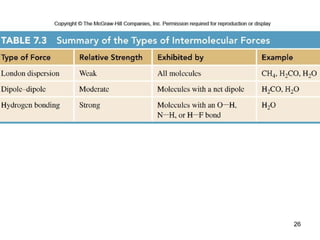
In order of increasing strength, these are:
•London dispersion forces
•dipole–dipole interactions
•hydrogen bonding
8
Intermolecular Forces
The strength of the intermolecular
forces determines whether a
compound has a high or low
melting point and boiling point,
and thus whether it is a solid,
liquid, or gas at a given
temperature.
9
London Dispersion Forces
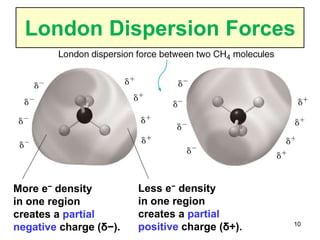
London dispersion forces are
very weak interactions due to
the momentary changes in
electron density in a molecule.
10
More e− density
in one region
creates a partial
negative charge (δ−).
Less e− density
in one region
creates a partial
positive charge (δ+).
London Dispersion Forces
11
London Dispersion Forces
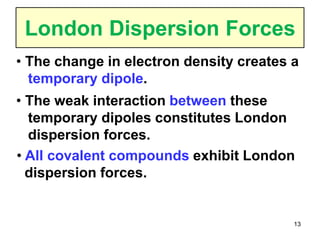
• The change in electron density creates a
temporary dipole.
12
London Dispersion Forces
• The change in electron density creates a
temporary dipole.
• The weak interaction between these
temporary dipoles constitutes London
dispersion forces.
13
London Dispersion Forces
• The change in electron density creates a
temporary dipole.
• All covalent compounds exhibit London
dispersion forces.
• The weak interaction between these
temporary dipoles constitutes London
dispersion forces.
14
London Dispersion Forces
• The change in electron density creates a
temporary dipole.
• All covalent compounds exhibit London
dispersion forces.
• The weak interaction between these
temporary dipoles constitutes London
dispersion forces.
• The larger the molecule, the larger the
attractive force, and the stronger the
intermolecular forces.
15
16
Dipole–Dipole Interactions
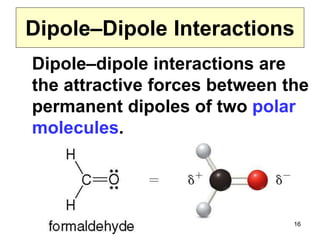
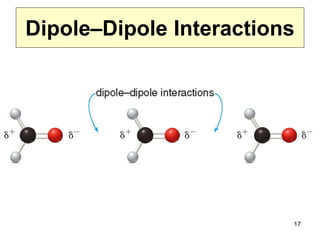
Dipole–dipole interactions are
the attractive forces between the
permanent dipoles of two polar
molecules.
17
Dipole–Dipole Interactions
18
Dipole–Dipole Interactions
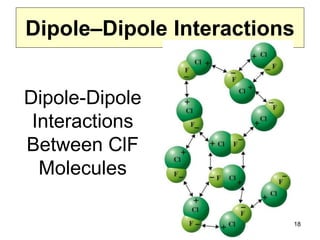
Dipole-Dipole
Interactions
Between ClF
Molecules
19
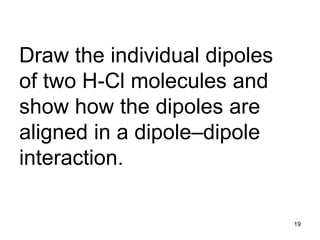
Draw the individual dipoles
of two H-Cl molecules and
show how the dipoles are
aligned in a dipole–dipole
interaction.
20
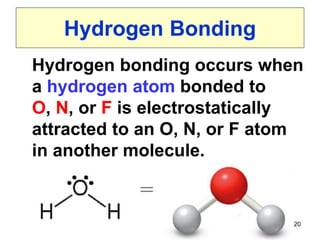
Hydrogen Bonding
Hydrogen bonding occurs when
a hydrogen atom bonded to
O, N, or F is electrostatically
attracted to an O, N, or F atom
in another molecule.
21
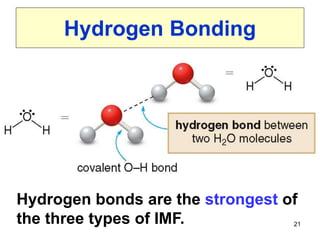
Hydrogen Bonding
Hydrogen bonds are the strongest of
the three types of IMF.
22
Hydrogen Bonding
23
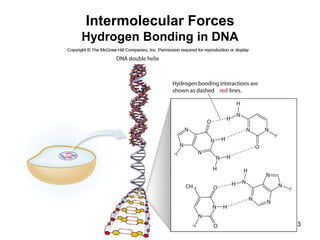
Intermolecular Forces
Hydrogen Bonding in DNA
24
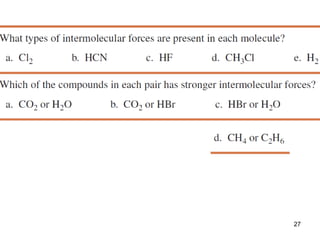
25
26
27
28
Concept Check
Which are stronger,
intramolecular bonds or
intermolecular forces?
29
Concept Check
Which are stronger,
intramolecular bonds or
intermolecular forces?
30
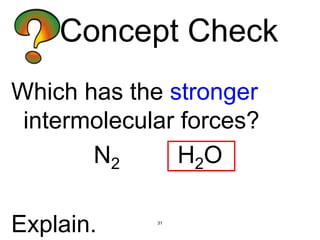
Which has the stronger
intermolecular forces?
N2 H2O
Explain.
Concept Check
31
Which has the stronger
intermolecular forces?
N2 H2O
Explain.
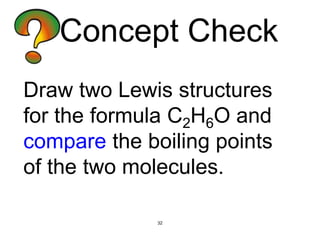
Concept Check
32
Draw two Lewis structures
for the formula C2H6O and
compare the boiling points
of the two molecules.
Concept Check
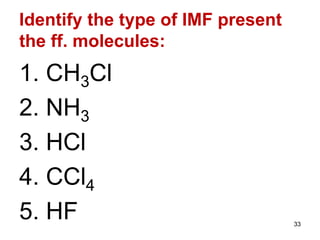
Identify the type of IMF present
the ff. molecules:
1. CH3Cl
2. NH3
3. HCl
4. CCl4
5. HF 33
v
34
6. 7.
8. 9.
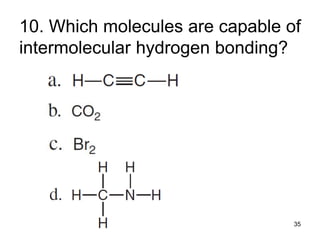
10. Which molecules are capable of
intermolecular hydrogen bonding?
35
36
Boiling Point and Melting Point
• The boiling point is the
temperature at which a liquid is
converted to the gas phase.
• The melting point is the
temperature at which a solid is
converted to the liquid phase.
37
Boiling Point and Melting Point
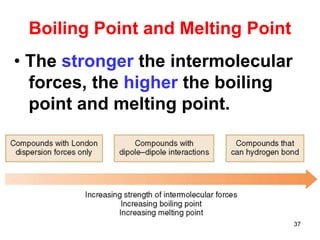
• The stronger the intermolecular
forces, the higher the boiling
point and melting point.
38
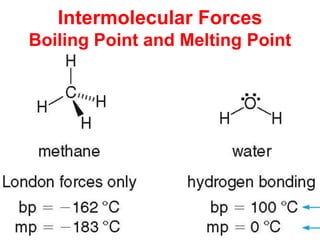
Intermolecular Forces
Boiling Point and Melting Point
39
Intermolecular Forces
Boiling Point and Melting Point
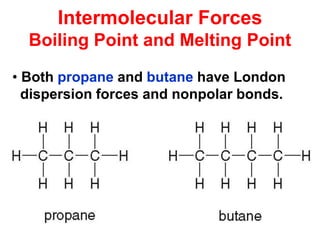
• Both propane and butane have London
dispersion forces and nonpolar bonds.
40
Intermolecular Forces
Boiling Point and Melting Point
• In this case, the larger molecule will
have stronger attractive forces.
41
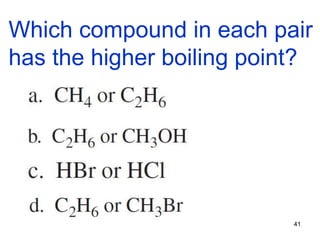
Which compound in each pair
has the higher boiling point?
42
Which compound in each pair
has the higher melting point?
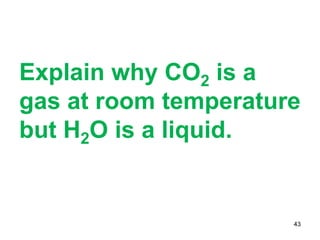
Explain why CO2 is a
gas at room temperature
but H2O is a liquid.
43
44
Vapor Pressure
• Evaporation is the conversion of
liquids into the gas phase.
•Evaporation is endothermic—it
absorbs heat from the
surroundings.
45
Vapor Pressure
• Condensation is the
conversion of gases into the
liquid phase.
• Condensation is exothermic—
it gives off heat to the
surroundings.
46
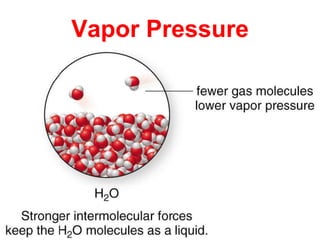
Vapor Pressure
Vapor pressure
is the pressure
exerted by gas
molecules in
equilibrium with
the liquid phase.
47
Vapor Pressure
Vapor pressure
increases with
increasing
temperature.
48
•The stronger the intermolecular
forces, the lower the vapor pressure at
a given temperature.
Vapor Pressure
49
Vapor Pressure
50
Vapor Pressure
Which molecule in each pair
has the higher vapor pressure
at a given temperature?
a. CH4 or NH3
b. CH4 or C2H6
c. C2H6 or CH3OH
51
52
Viscosity
Viscosity is a measure of a
fluid’s resistance to flow freely.
•A viscous liquid feels “thick.”
53
Viscosity
• Compounds with strong
intermolecular forces tend to
be more viscous than
compounds with weaker
forces.
54
Viscosity
• Substances composed of
large molecules tend to be
more viscous, too, because
large molecules do not slide
past each other as freely.
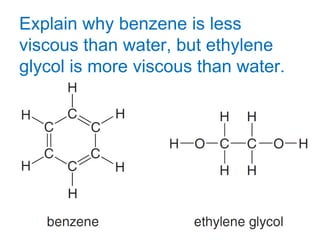
Explain why benzene is less
viscous than water, but ethylene
glycol is more viscous than water.
55
56
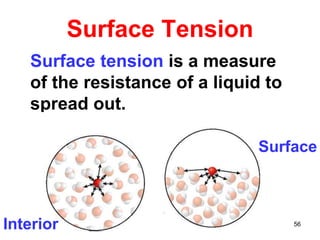
Surface Tension
Surface tension is a measure
of the resistance of a liquid to
spread out.
Interior
Surface
57
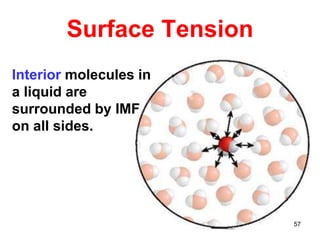
Surface Tension
Interior molecules in
a liquid are
surrounded by IMF
on all sides.
58
Surface Tension
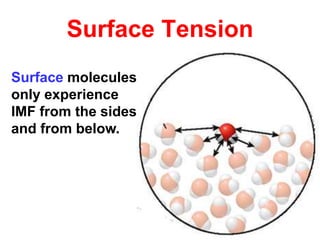
Surface molecules
only experience
IMF from the sides
and from below.
59
Surface Tension
•The stronger the intermolecular
forces, the stronger the surface
molecules are pulled down
toward the interior of a liquid and
the higher the surface tension.
60
Surface Tension
•The stronger the intermolecular
forces, the stronger the surface
molecules are pulled down
toward the interior of a liquid and
the higher the surface tension.
•Water has a very high surface
tension because of its strong
intermolecular hydrogen bonding.
61
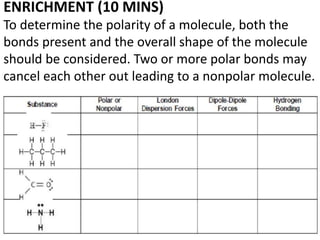
ENRICHMENT (10 MINS)
To determine the polarity of a molecule, both the
bonds present and the overall shape of the molecule
should be considered. Two or more polar bonds may
cancel each other out leading to a nonpolar molecule.
62

01_Intermolecular Forces (IMF).pptx