6/2/2023
1
Polymers Engineering Fundamentals
PE-2102
Week 9
Lecture 25-28
Rheology
• Rheology is a Greek word (first used by
Bingham and Crawford)
• Rheo – to flow
• ology – the study of
• Rheology is the study of the flow and
deformation of materials that behave in usual or
unusual manner.
• Unusual materials such as mayonnaise, peanut
butter, chocolate, bread dough, paints, inks,
road building materials, cosmetics, dairy
products, etc.
1
2
6/2/2023
2
Rheology
Deformation of Materials
- Stress and Strain
3
4
6/2/2023
3
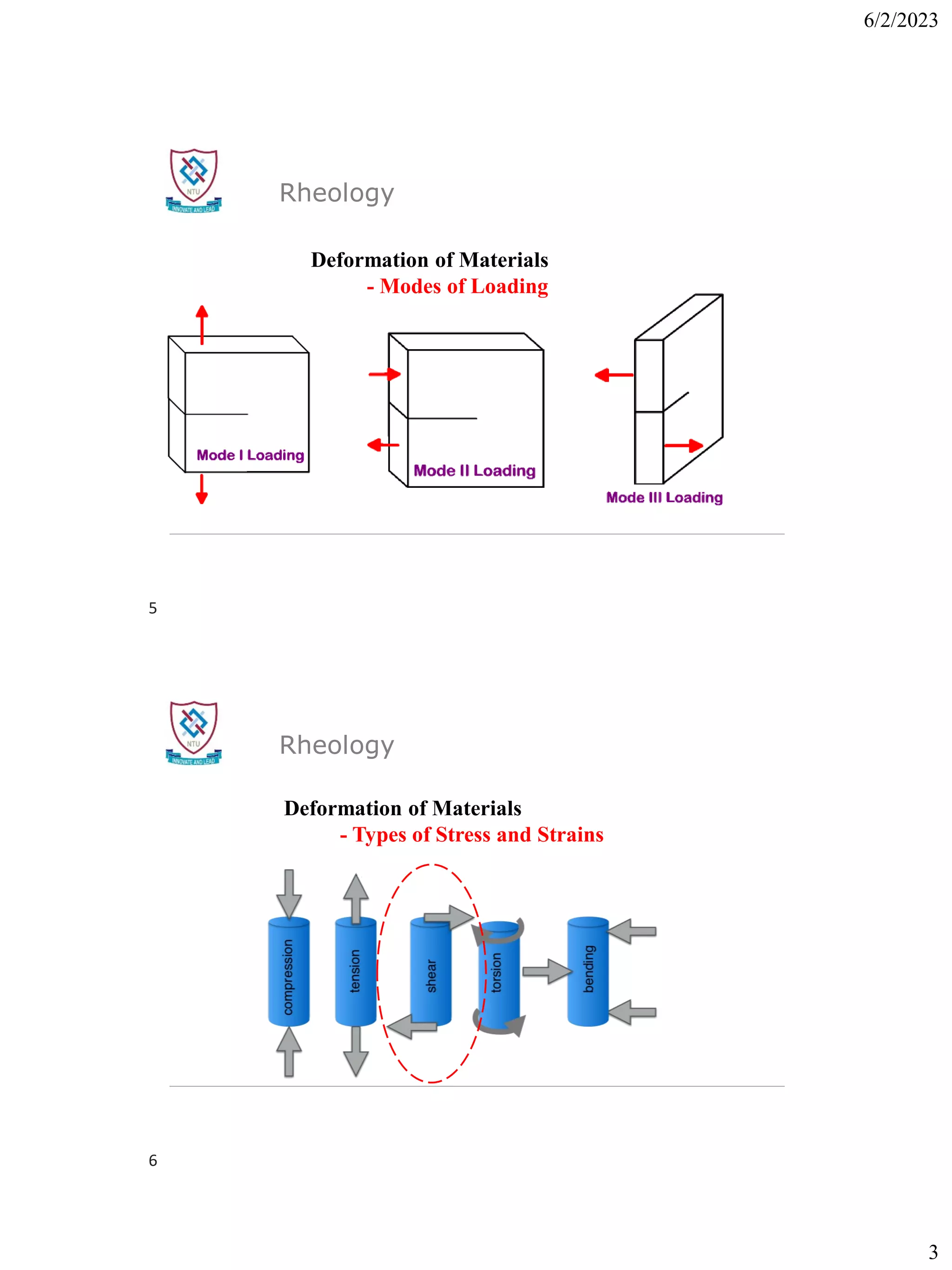
Deformation of Materials
- Modes of Loading
Rheology
Deformation of Materials
- Types of Stress and Strains
Rheology
5
6
6/2/2023
4
Deformation of Materials
- Elastic and Plastic Deformation
Rheology
• Newton was the first
to study the flow
properties of liquids
in quantitative
terms.
• Liquids that obey
Newton’s law of
flow are called as
Newtonian fluids.
F=nG
Flow of Materials
- Newtonian and Non-Newtonians Fluids
Rheology
7
8
6/2/2023
5
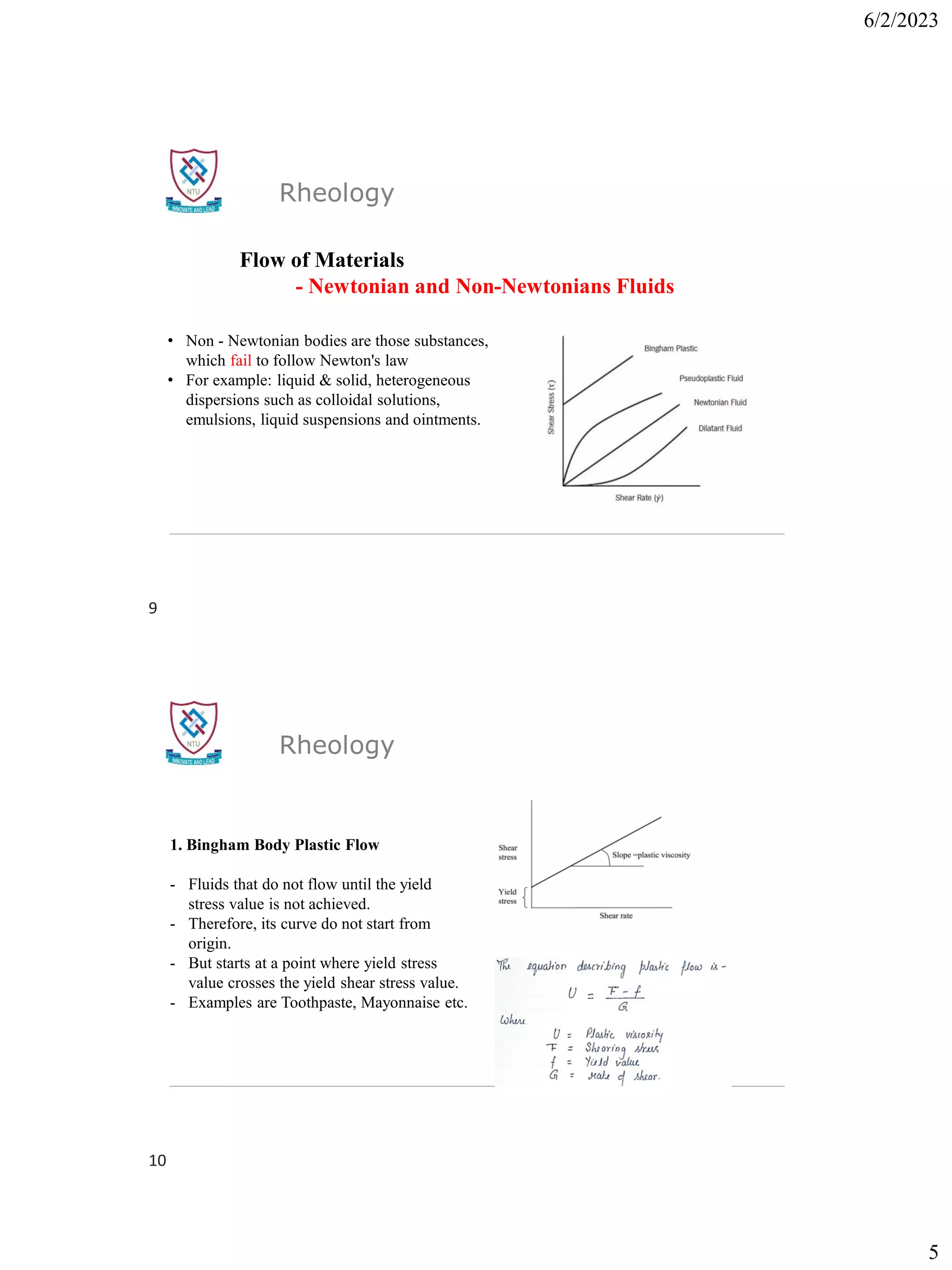
• Non - Newtonian bodies are those substances,
which fail to follow Newton's law
• For example: liquid & solid, heterogeneous
dispersions such as colloidal solutions,
emulsions, liquid suspensions and ointments.
Flow of Materials
- Newtonian and Non-Newtonians Fluids
Rheology
1. Bingham Body Plastic Flow
- Fluids that do not flow until the yield
stress value is not achieved.
- Therefore, its curve do not start from
origin.
- But starts at a point where yield stress
value crosses the yield shear stress value.
- Examples are Toothpaste, Mayonnaise etc.
Rheology
9
10
6/2/2023
6
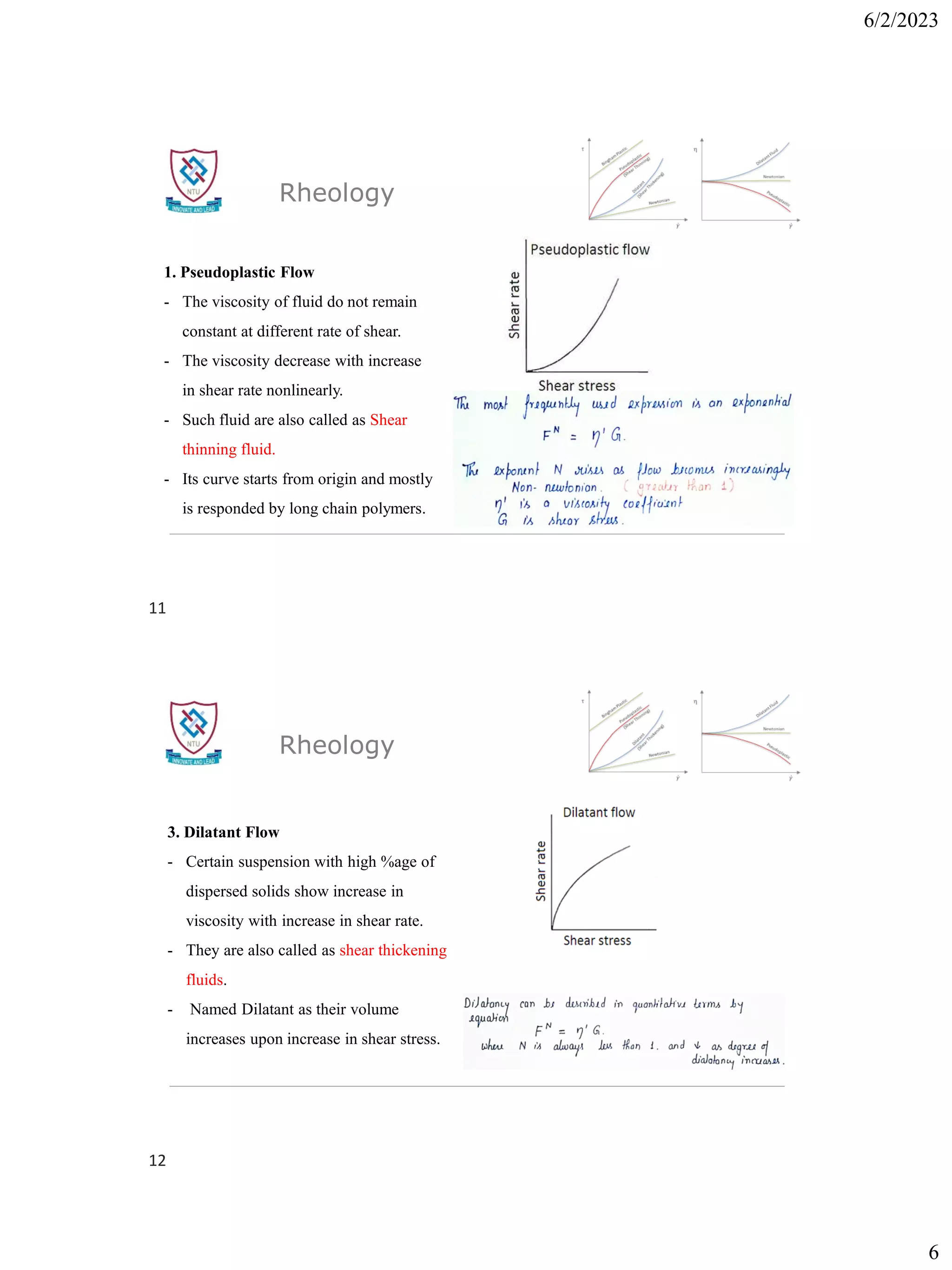
1. Pseudoplastic Flow
- The viscosity of fluid do not remain
constant at different rate of shear.
- The viscosity decrease with increase
in shear rate nonlinearly.
- Such fluid are also called as Shear
thinning fluid.
- Its curve starts from origin and mostly
is responded by long chain polymers.
Rheology
3. Dilatant Flow
- Certain suspension with high %age of
dispersed solids show increase in
viscosity with increase in shear rate.
- They are also called as shear thickening
fluids.
- Named Dilatant as their volume
increases upon increase in shear stress.
Rheology
11
12
6/2/2023
7
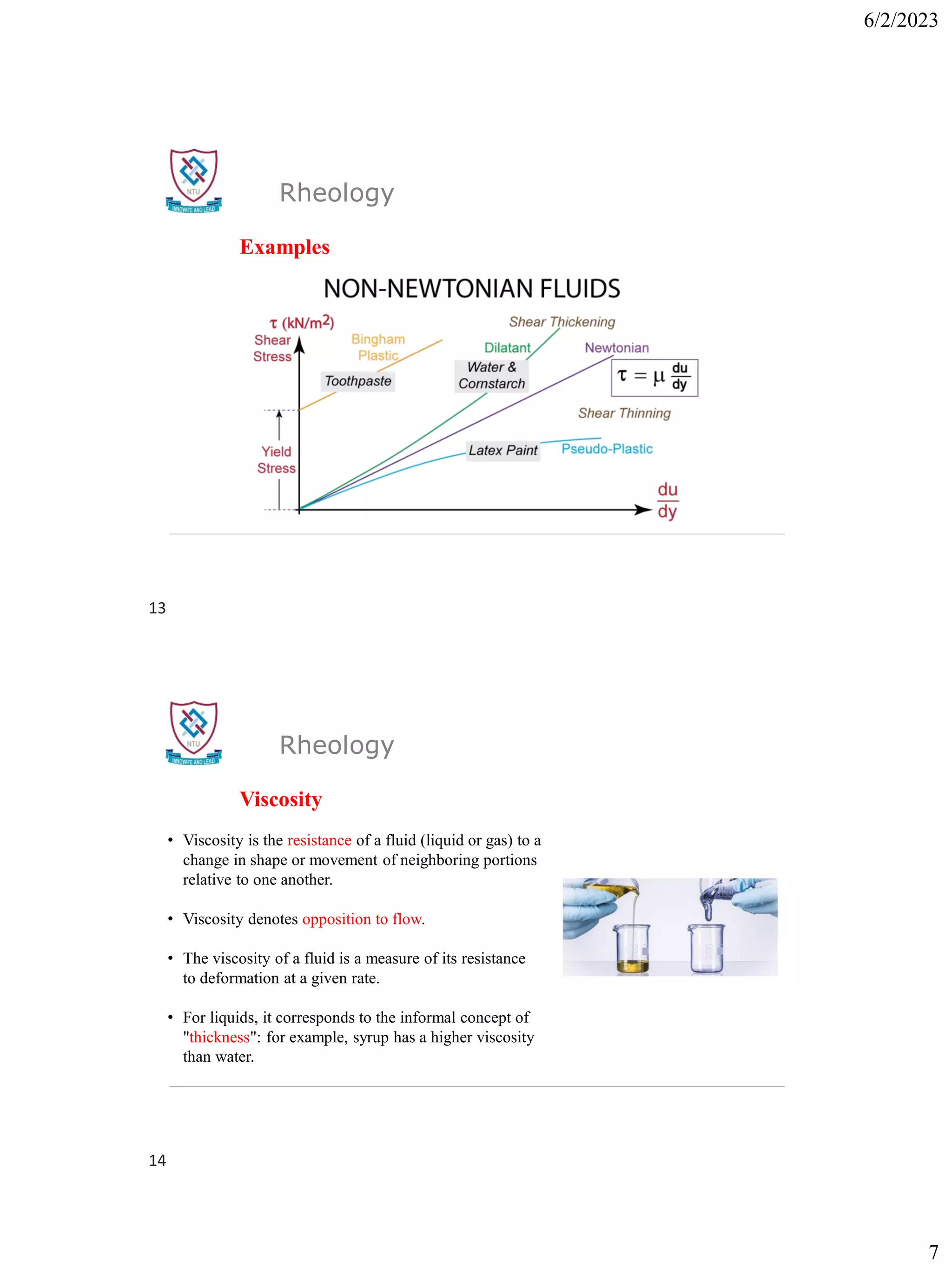
Examples
Rheology
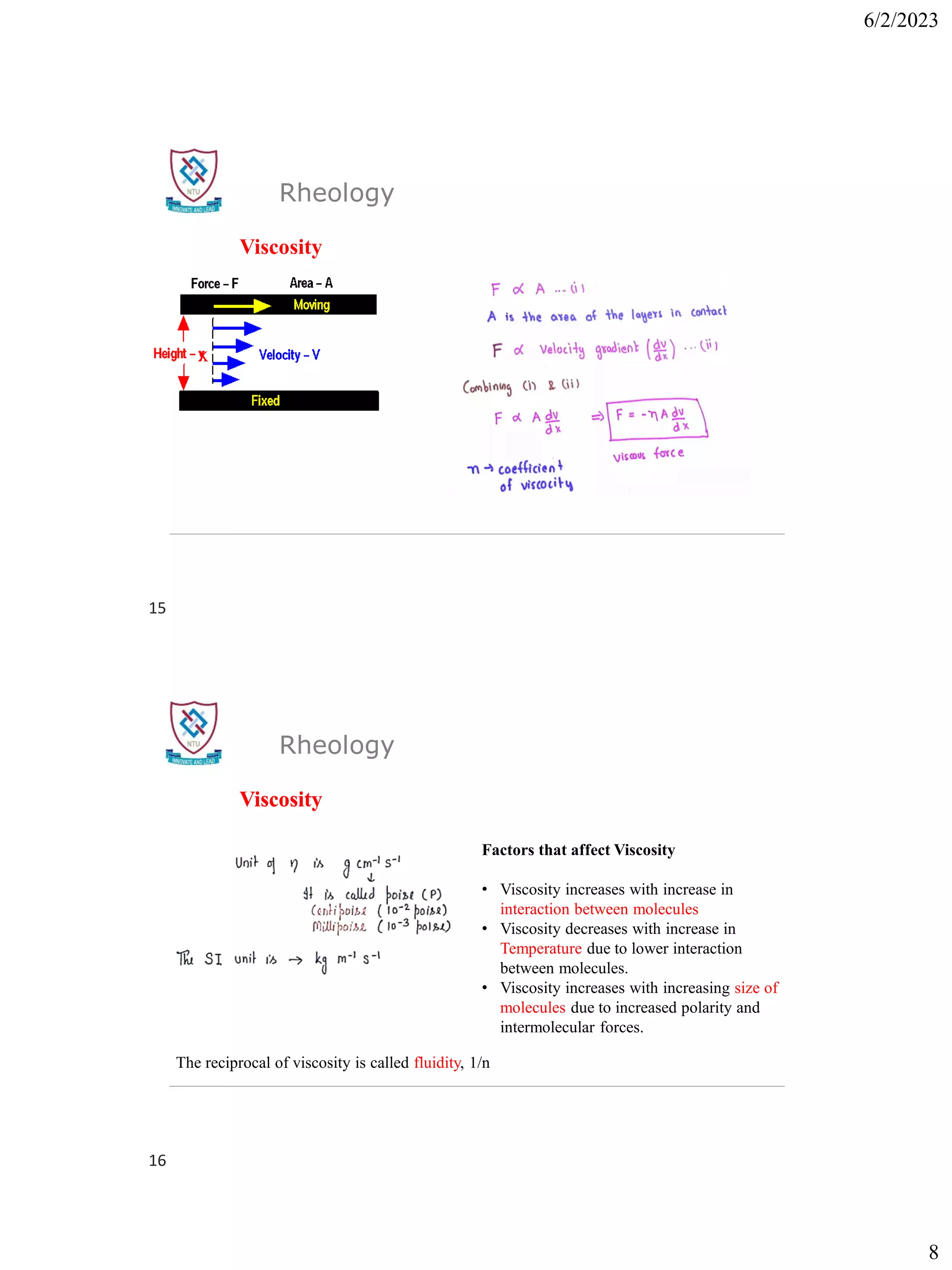
Viscosity
• Viscosity is the resistance of a fluid (liquid or gas) to a
change in shape or movement of neighboring portions
relative to one another.
• Viscosity denotes opposition to flow.
• The viscosity of a fluid is a measure of its resistance
to deformation at a given rate.
• For liquids, it corresponds to the informal concept of
"thickness": for example, syrup has a higher viscosity
than water.
Rheology
13
14
6/2/2023
8
Viscosity
x
Rheology
Factors that affect Viscosity
• Viscosity increases with increase in
interaction between molecules
• Viscosity decreases with increase in
Temperature due to lower interaction
between molecules.
• Viscosity increases with increasing size of
molecules due to increased polarity and
intermolecular forces.
The reciprocal of viscosity is called fluidity, 1/n
Viscosity
Viscosity
Rheology
15
16
6/2/2023
9
Visco-Elastic Behavior/property of Materials
Rheology
Visco-Elastic Behavior/property of Materials
Rheology
17
18
6/2/2023
10
Why polymers show Visco-Elastic Behavior?
Rheology
Why polymers show Visco-Elastic Behavior?
Rheology
19
20
6/2/2023
11
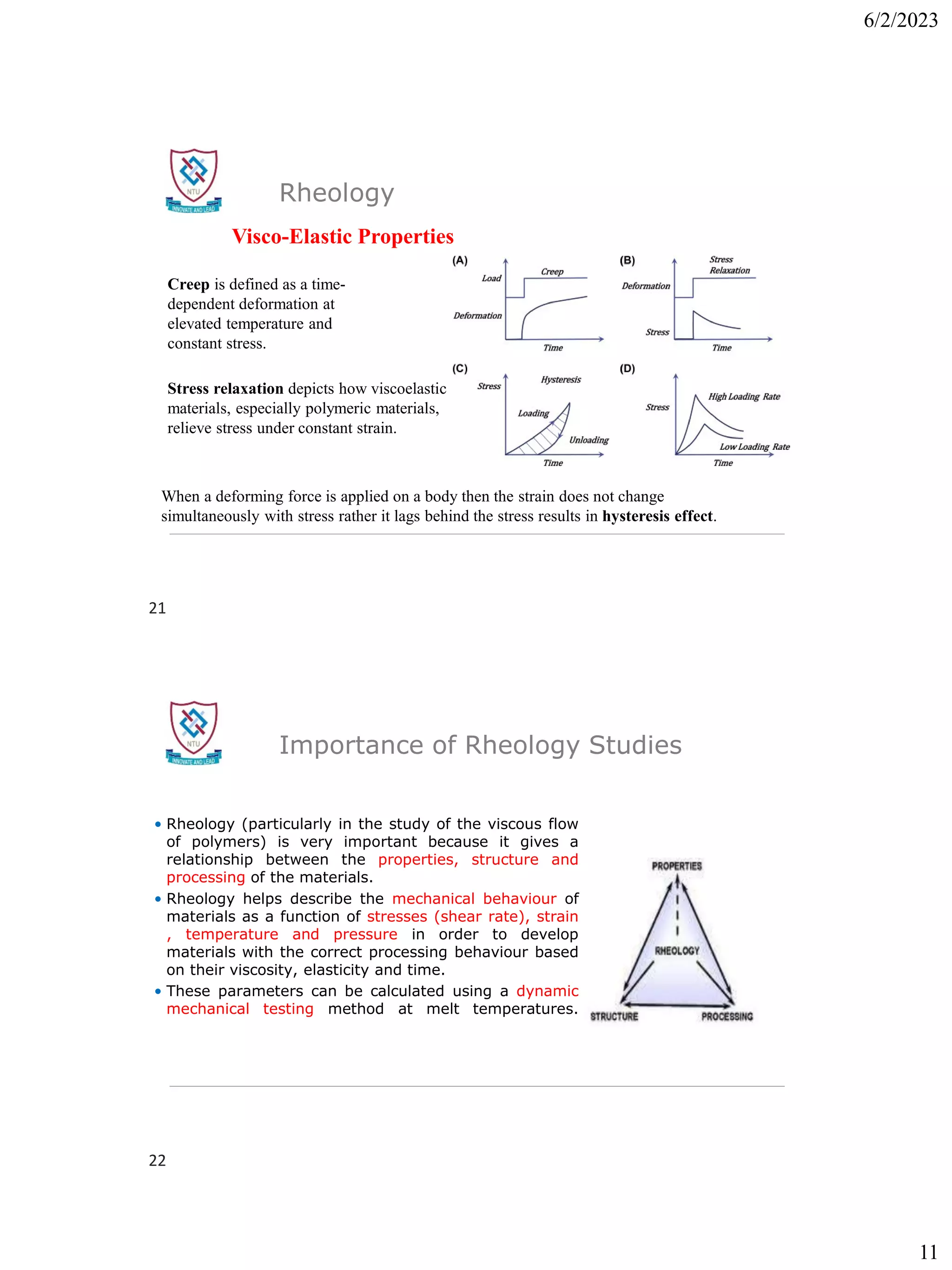
Creep is defined as a time-
dependent deformation at
elevated temperature and
constant stress.
Stress relaxation depicts how viscoelastic
materials, especially polymeric materials,
relieve stress under constant strain.
When a deforming force is applied on a body then the strain does not change
simultaneously with stress rather it lags behind the stress results in hysteresis effect.
Visco-Elastic Properties
Rheology
Importance of Rheology Studies
• Rheology (particularly in the study of the viscous flow
of polymers) is very important because it gives a
relationship between the properties, structure and
processing of the materials.
• Rheology helps describe the mechanical behaviour of
materials as a function of stresses (shear rate), strain
, temperature and pressure in order to develop
materials with the correct processing behaviour based
on their viscosity, elasticity and time.
• These parameters can be calculated using a dynamic
mechanical testing method at melt temperatures.
21
22
6/2/2023
12
• The use of rheometers or viscometers
to determine the rheological
properties of materials with the
measured values based on force,
length and time.
• Rheometers are devices use to
determine both the viscous and
viscoelastic properties of materials
depending on the force exerted in
both the rotational and oscillatory
test.
• While on the other hand viscometers
are devices use to determine the
viscosity depending on the rotation,
temperature and time.
Measurement of Rheological properties
• In a rotational rheometer the sample is
sheared between two plates or a cone
and plate geometry.
• The viscosity is calculated as the ratio of
the applied stress and the applied
deformation rate (rotation speed).
• This instrument in the case of polymers is
used to extract information about the
average molecular weight and molecular
weight distribution via measurement of
the viscoelastic properties and thus
determine how this affects the processing
characteristics of the material.
Measurement of Rheological properties
23
24
6/2/2023
13
Measurement of Rheological properties
Melt Flow Indexer
Melt Flow
Indexer
Measurement of Rheological properties
25
26
6/2/2023
14
Viscosity by Viscometer
Measurement of Rheological properties
Step 1
Step 2
Step 3
Viscosity by Viscometer
Measurement of Rheological properties
27
28
6/2/2023
15
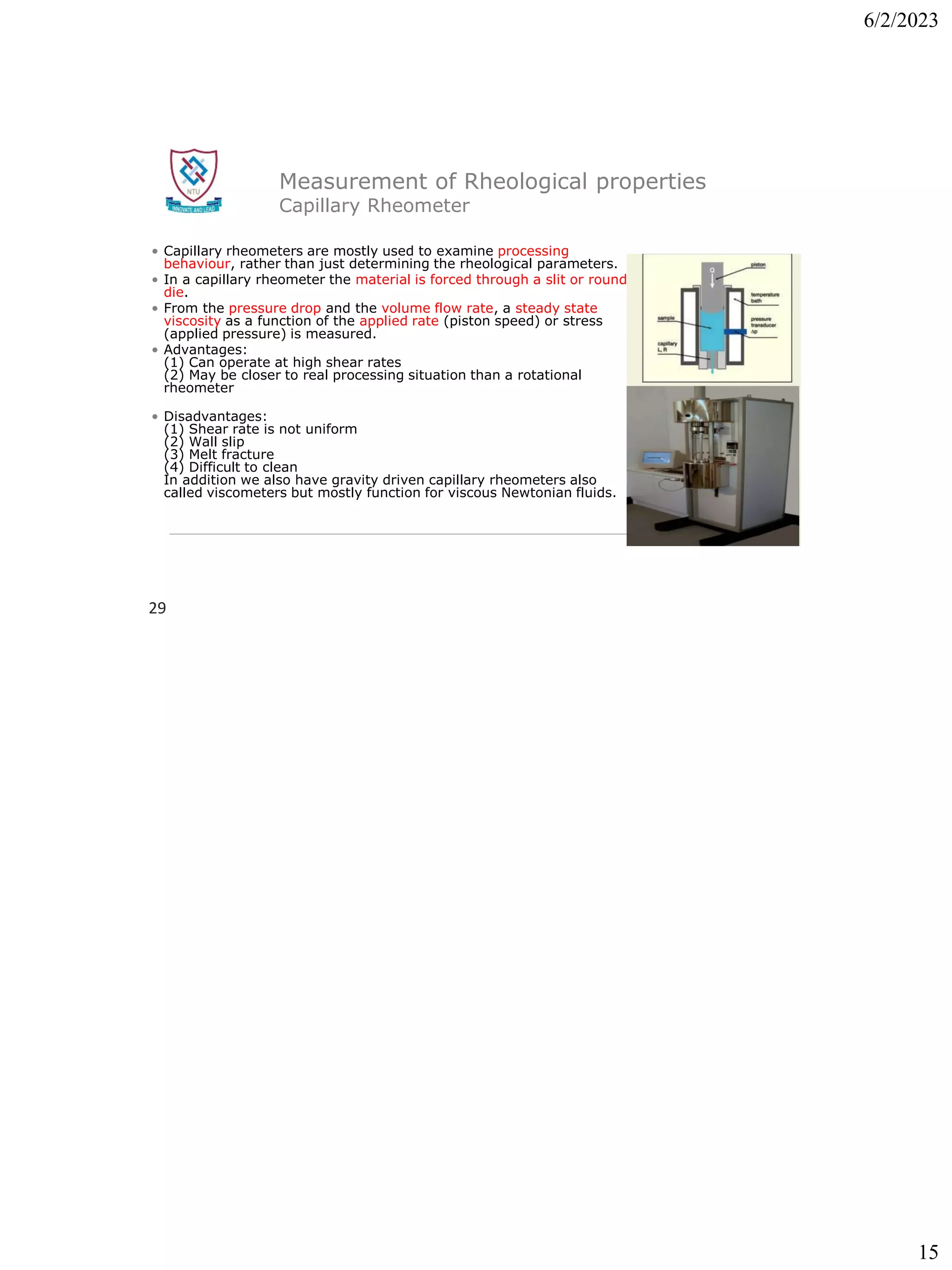
• Capillary rheometers are mostly used to examine processing
behaviour, rather than just determining the rheological parameters.
• In a capillary rheometer the material is forced through a slit or round
die.
• From the pressure drop and the volume flow rate, a steady state
viscosity as a function of the applied rate (piston speed) or stress
(applied pressure) is measured.
• Advantages:
(1) Can operate at high shear rates
(2) May be closer to real processing situation than a rotational
rheometer
• Disadvantages:
(1) Shear rate is not uniform
(2) Wall slip
(3) Melt fracture
(4) Difficult to clean
In addition we also have gravity driven capillary rheometers also
called viscometers but mostly function for viscous Newtonian fluids.
Measurement of Rheological properties
Capillary Rheometer
29

Lec 25-29 Polymer Rheology.pdf

  • 1.
    6/2/2023 1 Polymers Engineering Fundamentals PE-2102 Week9 Lecture 25-28 Rheology • Rheology is a Greek word (first used by Bingham and Crawford) • Rheo – to flow • ology – the study of • Rheology is the study of the flow and deformation of materials that behave in usual or unusual manner. • Unusual materials such as mayonnaise, peanut butter, chocolate, bread dough, paints, inks, road building materials, cosmetics, dairy products, etc. 1 2
  • 2.
  • 3.
    6/2/2023 3 Deformation of Materials -Modes of Loading Rheology Deformation of Materials - Types of Stress and Strains Rheology 5 6
  • 4.
    6/2/2023 4 Deformation of Materials -Elastic and Plastic Deformation Rheology • Newton was the first to study the flow properties of liquids in quantitative terms. • Liquids that obey Newton’s law of flow are called as Newtonian fluids. F=nG Flow of Materials - Newtonian and Non-Newtonians Fluids Rheology 7 8
  • 5.
    6/2/2023 5 • Non -Newtonian bodies are those substances, which fail to follow Newton's law • For example: liquid & solid, heterogeneous dispersions such as colloidal solutions, emulsions, liquid suspensions and ointments. Flow of Materials - Newtonian and Non-Newtonians Fluids Rheology 1. Bingham Body Plastic Flow - Fluids that do not flow until the yield stress value is not achieved. - Therefore, its curve do not start from origin. - But starts at a point where yield stress value crosses the yield shear stress value. - Examples are Toothpaste, Mayonnaise etc. Rheology 9 10
  • 6.
    6/2/2023 6 1. Pseudoplastic Flow -The viscosity of fluid do not remain constant at different rate of shear. - The viscosity decrease with increase in shear rate nonlinearly. - Such fluid are also called as Shear thinning fluid. - Its curve starts from origin and mostly is responded by long chain polymers. Rheology 3. Dilatant Flow - Certain suspension with high %age of dispersed solids show increase in viscosity with increase in shear rate. - They are also called as shear thickening fluids. - Named Dilatant as their volume increases upon increase in shear stress. Rheology 11 12
  • 7.
    6/2/2023 7 Examples Rheology Viscosity • Viscosity isthe resistance of a fluid (liquid or gas) to a change in shape or movement of neighboring portions relative to one another. • Viscosity denotes opposition to flow. • The viscosity of a fluid is a measure of its resistance to deformation at a given rate. • For liquids, it corresponds to the informal concept of "thickness": for example, syrup has a higher viscosity than water. Rheology 13 14
  • 8.
    6/2/2023 8 Viscosity x Rheology Factors that affectViscosity • Viscosity increases with increase in interaction between molecules • Viscosity decreases with increase in Temperature due to lower interaction between molecules. • Viscosity increases with increasing size of molecules due to increased polarity and intermolecular forces. The reciprocal of viscosity is called fluidity, 1/n Viscosity Viscosity Rheology 15 16
  • 9.
    6/2/2023 9 Visco-Elastic Behavior/property ofMaterials Rheology Visco-Elastic Behavior/property of Materials Rheology 17 18
  • 10.
    6/2/2023 10 Why polymers showVisco-Elastic Behavior? Rheology Why polymers show Visco-Elastic Behavior? Rheology 19 20
  • 11.
    6/2/2023 11 Creep is definedas a time- dependent deformation at elevated temperature and constant stress. Stress relaxation depicts how viscoelastic materials, especially polymeric materials, relieve stress under constant strain. When a deforming force is applied on a body then the strain does not change simultaneously with stress rather it lags behind the stress results in hysteresis effect. Visco-Elastic Properties Rheology Importance of Rheology Studies • Rheology (particularly in the study of the viscous flow of polymers) is very important because it gives a relationship between the properties, structure and processing of the materials. • Rheology helps describe the mechanical behaviour of materials as a function of stresses (shear rate), strain , temperature and pressure in order to develop materials with the correct processing behaviour based on their viscosity, elasticity and time. • These parameters can be calculated using a dynamic mechanical testing method at melt temperatures. 21 22
  • 12.
    6/2/2023 12 • The useof rheometers or viscometers to determine the rheological properties of materials with the measured values based on force, length and time. • Rheometers are devices use to determine both the viscous and viscoelastic properties of materials depending on the force exerted in both the rotational and oscillatory test. • While on the other hand viscometers are devices use to determine the viscosity depending on the rotation, temperature and time. Measurement of Rheological properties • In a rotational rheometer the sample is sheared between two plates or a cone and plate geometry. • The viscosity is calculated as the ratio of the applied stress and the applied deformation rate (rotation speed). • This instrument in the case of polymers is used to extract information about the average molecular weight and molecular weight distribution via measurement of the viscoelastic properties and thus determine how this affects the processing characteristics of the material. Measurement of Rheological properties 23 24
  • 13.
    6/2/2023 13 Measurement of Rheologicalproperties Melt Flow Indexer Melt Flow Indexer Measurement of Rheological properties 25 26
  • 14.
    6/2/2023 14 Viscosity by Viscometer Measurementof Rheological properties Step 1 Step 2 Step 3 Viscosity by Viscometer Measurement of Rheological properties 27 28
  • 15.
    6/2/2023 15 • Capillary rheometersare mostly used to examine processing behaviour, rather than just determining the rheological parameters. • In a capillary rheometer the material is forced through a slit or round die. • From the pressure drop and the volume flow rate, a steady state viscosity as a function of the applied rate (piston speed) or stress (applied pressure) is measured. • Advantages: (1) Can operate at high shear rates (2) May be closer to real processing situation than a rotational rheometer • Disadvantages: (1) Shear rate is not uniform (2) Wall slip (3) Melt fracture (4) Difficult to clean In addition we also have gravity driven capillary rheometers also called viscometers but mostly function for viscous Newtonian fluids. Measurement of Rheological properties Capillary Rheometer 29