© 2016 Proprietary material; do not use without permission of author
Lab Report Template
Workstream
<Enter here>
Target launch date
<Enter here>
Experiment summary
<Enter here>
© 2016 Proprietary material; do not use without permission of author
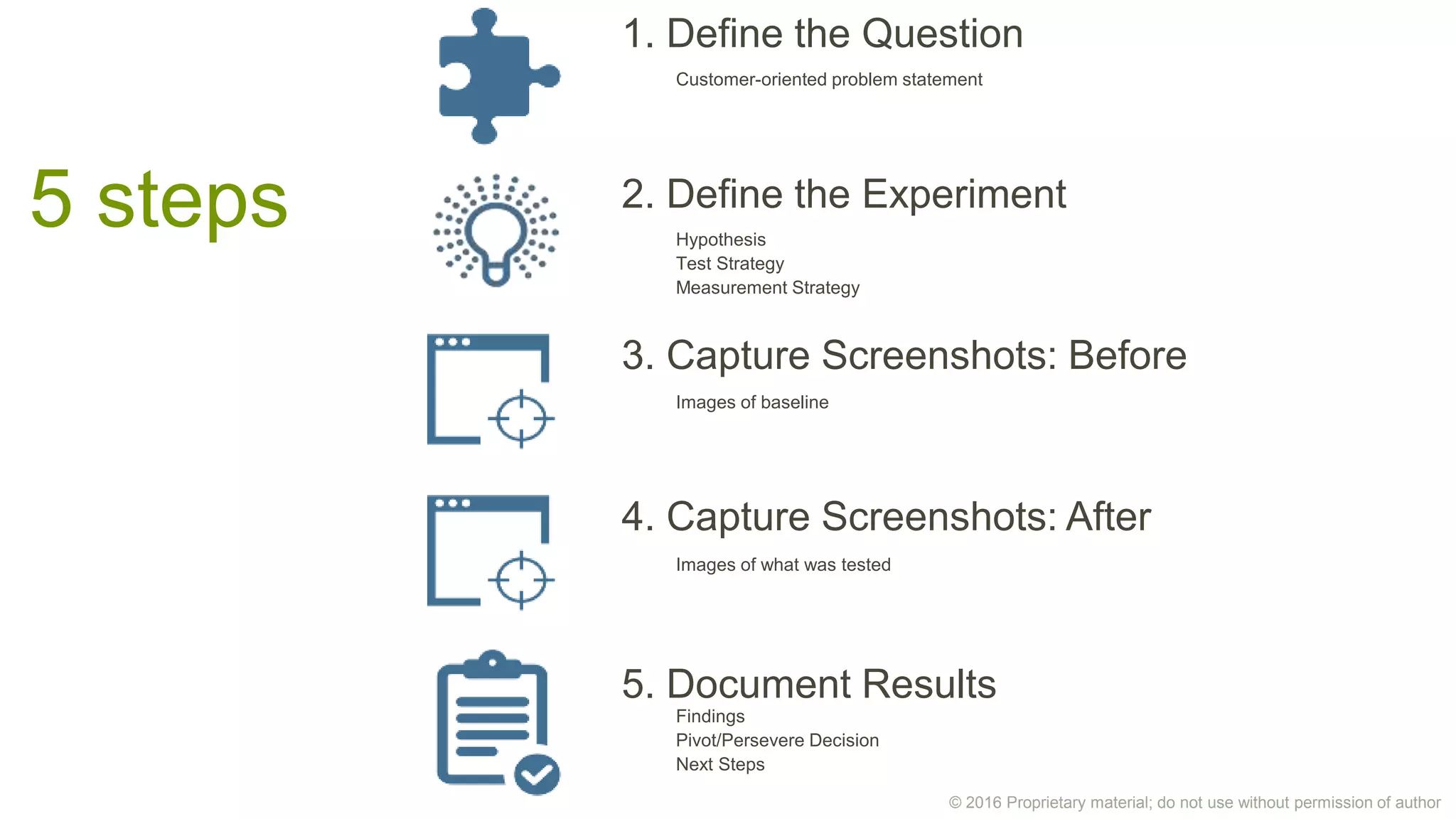
5 steps
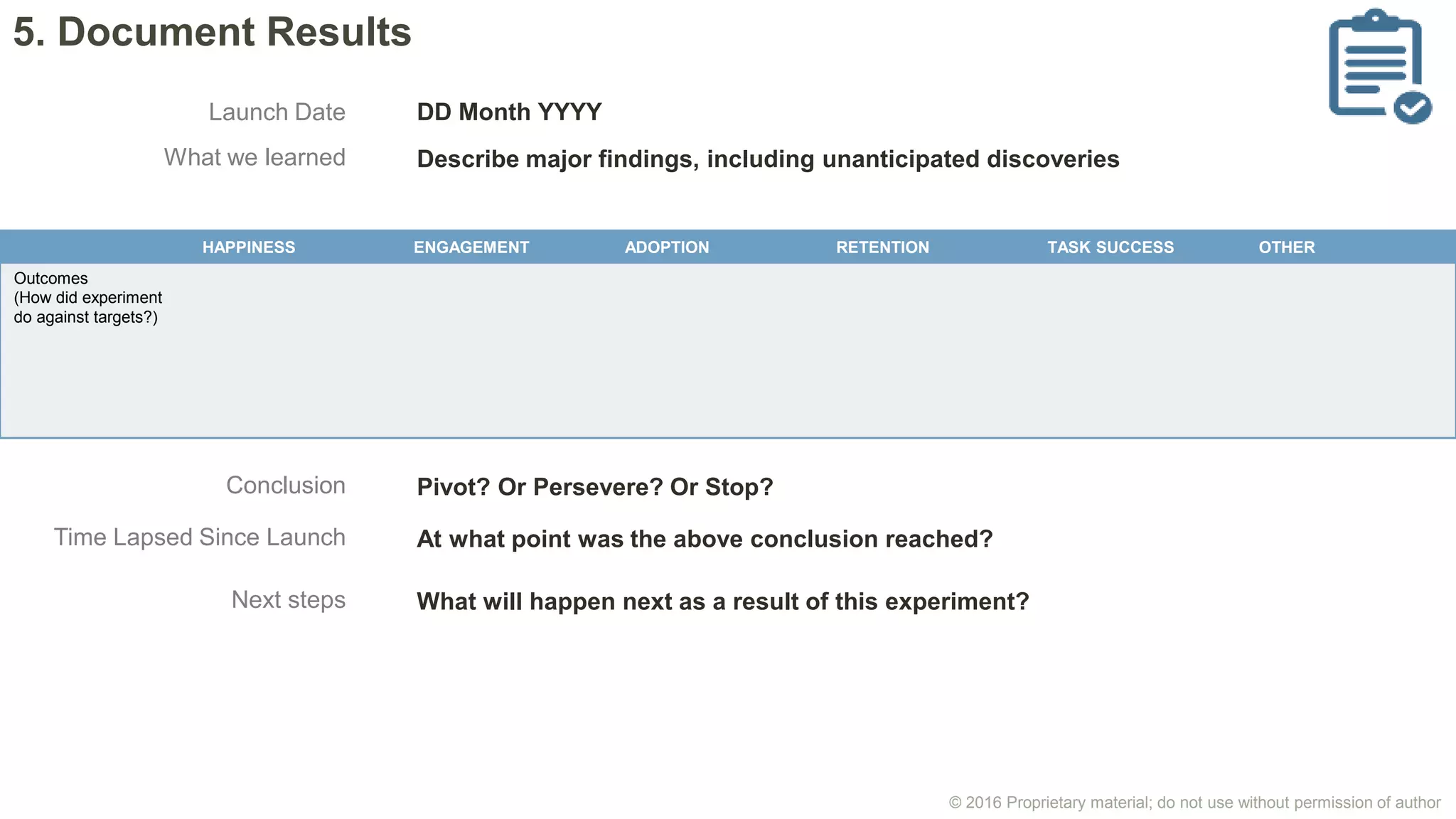
5. Document Results
Findings
Pivot/Persevere Decision
Next Steps
2. Define the Experiment
Hypothesis
Test Strategy
Measurement Strategy
1. Define the Question
Customer-oriented problem statement
3. Capture Screenshots: Before
Images of baseline
4. Capture Screenshots: After
Images of what was tested
© 2016 Proprietary material; do not use without permission of author
Enter yours here.WHAT
The overarching issue driving the research.
• It frames the problem in terms of business or
customer value.
• It is NOT a proposal for HOW the problem will
be addressed.
SYNTAX
1. I am [customer] trying to [accomplish goal].
2. But [insert problem] because [insert cause].
3. This makes me feel [emotion].
4. The consequence for [my team/company] is
[adverse effect]
5. How might we…
1. Define the Question
© 2016 Proprietary material; do not use without permission of author
Enter yours here:
1. Hypothesis
2. Test Strategy
3. Measurement Strategy
WHAT
An experiment definition has three parts:
1. How the issue will be addressed (hypothesis)
2. What we’ll build to address it (a test strategy)
3. How we’ll know it works (a measurement
strategy)
SYNTAX
1. Hypothesis
“[This change] will enable [who] to achieve
[what], leading to [value].”
2. Test Strategy
“The simplest way to test this is to [test
strategy].”
3. Measurement Strategy
“We will know we’ve succeeded when we
observe [HEART feedback].
2. Define the Experiment
© 2016 Proprietary material; do not use without permission of author
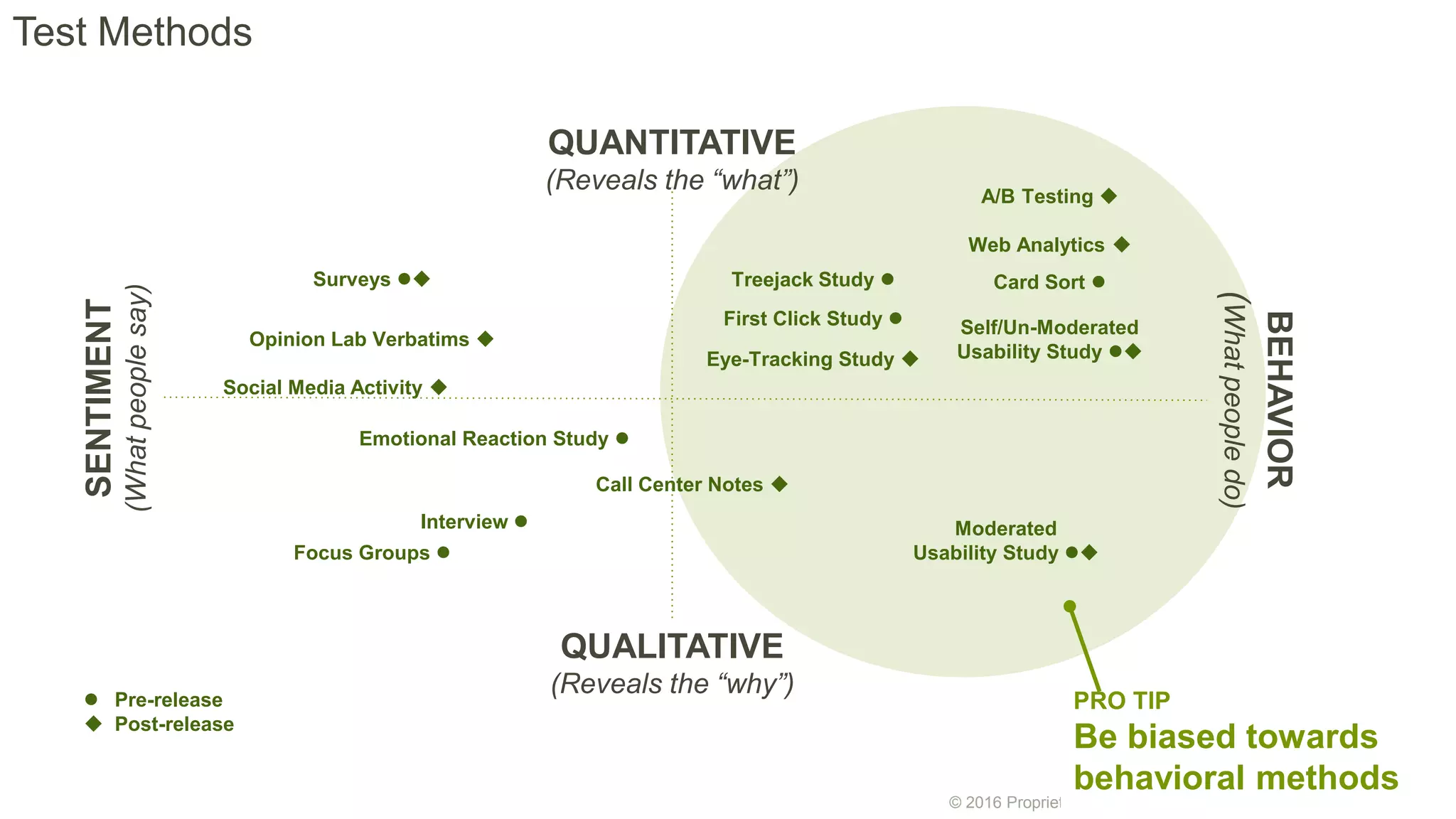
SENTIMENT
(Whatpeoplesay)
BEHAVIOR
(Whatpeopledo)
QUANTITATIVE
(Reveals the “what”)
QUALITATIVE
(Reveals the “why”)
Surveys 
Moderated
Usability Study 
A/B Testing 
Self/Un-Moderated
Usability Study 
Opinion Lab Verbatims 
Focus Groups 
Interview 
Call Center Notes 
Social Media Activity 
Web Analytics 
Emotional Reaction Study 
Card Sort Treejack Study 
First Click Study 
Eye-Tracking Study 
PRO TIP
Be biased towards
behavioral methods
 Pre-release
 Post-release
Test Methods
© 2016 Proprietary material; do not use without permission of author
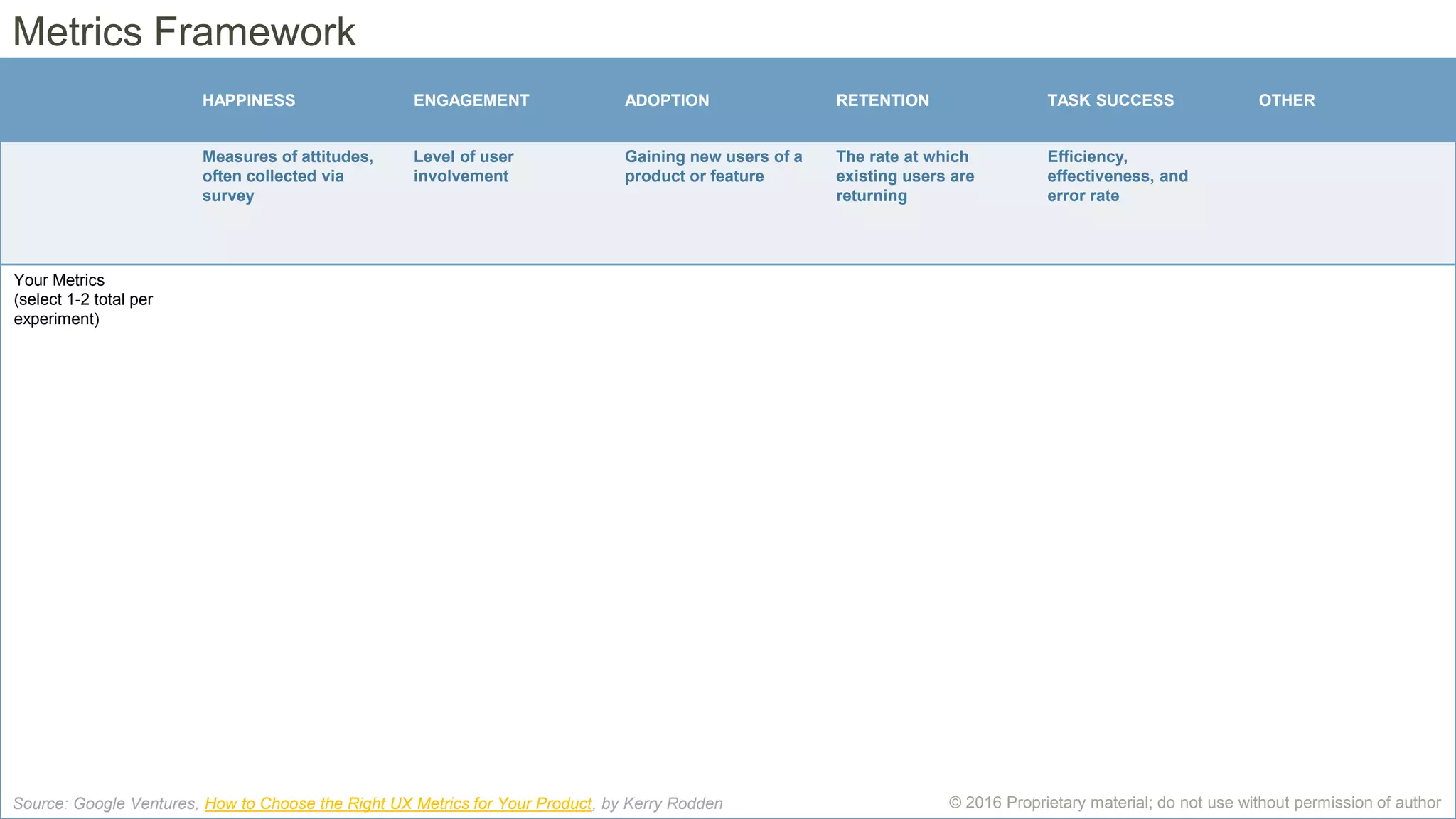
HAPPINESS ENGAGEMENT ADOPTION RETENTION TASK SUCCESS OTHER
Measures of attitudes,
often collected via
survey
Level of user
involvement
Gaining new users of a
product or feature
The rate at which
existing users are
returning
Efficiency,
effectiveness, and
error rate
Your Metrics
(select 1-2 total per
experiment)
Metrics Framework
Source: Google Ventures, How to Choose the Right UX Metrics for Your Product, by Kerry Rodden
© 2016 Proprietary material; do not use without permission of author
3. Capture screenshots: Before
Document current state so you have a picture of your baseline
© 2016 Proprietary material; do not use without permission of author
4. Capture screenshots: After
Include screenshots of what was tested.
© 2016 Proprietary material; do not use without permission of author
HAPPINESS ENGAGEMENT ADOPTION RETENTION TASK SUCCESS OTHER
Outcomes
(How did experiment
do against targets?)
5. Document Results
What we learned Describe major findings, including unanticipated discoveries
Pivot? Or Persevere? Or Stop?
At what point was the above conclusion reached?Time Lapsed Since Launch
Conclusion
What will happen next as a result of this experiment?Next steps
DD Month YYYYLaunch Date
© 2016 Proprietary material; do not use without permission of author
Send your questions, comments, & feedback to
Julie Casanave
julie.casanave@fmr.com
@jcasanave
Thank you!

Lab Report Template

  • 1.
    © 2016 Proprietarymaterial; do not use without permission of author Lab Report Template Workstream <Enter here> Target launch date <Enter here> Experiment summary <Enter here>
  • 2.
    © 2016 Proprietarymaterial; do not use without permission of author 5 steps 5. Document Results Findings Pivot/Persevere Decision Next Steps 2. Define the Experiment Hypothesis Test Strategy Measurement Strategy 1. Define the Question Customer-oriented problem statement 3. Capture Screenshots: Before Images of baseline 4. Capture Screenshots: After Images of what was tested
  • 3.
    © 2016 Proprietarymaterial; do not use without permission of author Enter yours here.WHAT The overarching issue driving the research. • It frames the problem in terms of business or customer value. • It is NOT a proposal for HOW the problem will be addressed. SYNTAX 1. I am [customer] trying to [accomplish goal]. 2. But [insert problem] because [insert cause]. 3. This makes me feel [emotion]. 4. The consequence for [my team/company] is [adverse effect] 5. How might we… 1. Define the Question
  • 4.
    © 2016 Proprietarymaterial; do not use without permission of author Enter yours here: 1. Hypothesis 2. Test Strategy 3. Measurement Strategy WHAT An experiment definition has three parts: 1. How the issue will be addressed (hypothesis) 2. What we’ll build to address it (a test strategy) 3. How we’ll know it works (a measurement strategy) SYNTAX 1. Hypothesis “[This change] will enable [who] to achieve [what], leading to [value].” 2. Test Strategy “The simplest way to test this is to [test strategy].” 3. Measurement Strategy “We will know we’ve succeeded when we observe [HEART feedback]. 2. Define the Experiment
  • 5.
    © 2016 Proprietarymaterial; do not use without permission of author SENTIMENT (Whatpeoplesay) BEHAVIOR (Whatpeopledo) QUANTITATIVE (Reveals the “what”) QUALITATIVE (Reveals the “why”) Surveys  Moderated Usability Study  A/B Testing  Self/Un-Moderated Usability Study  Opinion Lab Verbatims  Focus Groups  Interview  Call Center Notes  Social Media Activity  Web Analytics  Emotional Reaction Study  Card Sort Treejack Study  First Click Study  Eye-Tracking Study  PRO TIP Be biased towards behavioral methods  Pre-release  Post-release Test Methods
  • 6.
    © 2016 Proprietarymaterial; do not use without permission of author HAPPINESS ENGAGEMENT ADOPTION RETENTION TASK SUCCESS OTHER Measures of attitudes, often collected via survey Level of user involvement Gaining new users of a product or feature The rate at which existing users are returning Efficiency, effectiveness, and error rate Your Metrics (select 1-2 total per experiment) Metrics Framework Source: Google Ventures, How to Choose the Right UX Metrics for Your Product, by Kerry Rodden
  • 7.
    © 2016 Proprietarymaterial; do not use without permission of author 3. Capture screenshots: Before Document current state so you have a picture of your baseline
  • 8.
    © 2016 Proprietarymaterial; do not use without permission of author 4. Capture screenshots: After Include screenshots of what was tested.
  • 9.
    © 2016 Proprietarymaterial; do not use without permission of author HAPPINESS ENGAGEMENT ADOPTION RETENTION TASK SUCCESS OTHER Outcomes (How did experiment do against targets?) 5. Document Results What we learned Describe major findings, including unanticipated discoveries Pivot? Or Persevere? Or Stop? At what point was the above conclusion reached?Time Lapsed Since Launch Conclusion What will happen next as a result of this experiment?Next steps DD Month YYYYLaunch Date
  • 10.
    © 2016 Proprietarymaterial; do not use without permission of author Send your questions, comments, & feedback to Julie Casanave julie.casanave@fmr.com @jcasanave Thank you!

Editor's Notes