Dr. N. Banu, Associate Professor
Vels University
• use of the centrifugal force for the separation
of mixtures
• More-dense components migrate away from
the axis of the centrifuge
• less-dense components migrate towards the
axis.
3
Centrifugation is used to separate materials of different
density when a force greater than gravity is desired
The type of industrial centrifugation unit:
• Tubular bowl centrifuge (Narrow tubular bowl centrifuge or
ultracentrifuge, decanter centrifuge, etc). Simple and widely
applied in food and pharmaceutical industry. Operates at
13000-16000 G, 105-106 G for ultracentrifuge
• Disc-stack bowl centrifuge. This type is common in
bioprocess. The developed forces is 5000-15000 G with
minimal density difference between solid and liquid is 0.01-
0.03 kg/m3. The minimum particle diameter is 5 µm
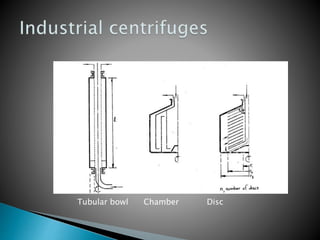
Tubular bowl Chamber Disc
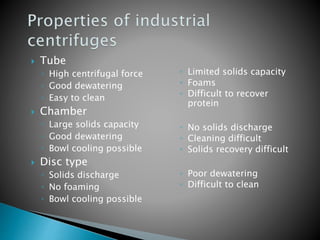
 Tube
◦ High centrifugal force
◦ Good dewatering
◦ Easy to clean
 Chamber
◦ Large solids capacity
◦ Good dewatering
◦ Bowl cooling possible
 Disc type
◦ Solids discharge
◦ No foaming
◦ Bowl cooling possible
◦ Limited solids capacity
◦ Foams
◦ Difficult to recover
protein
◦ No solids discharge
◦ Cleaning difficult
◦ Solids recovery difficult
◦ Poor dewatering
◦ Difficult to clean
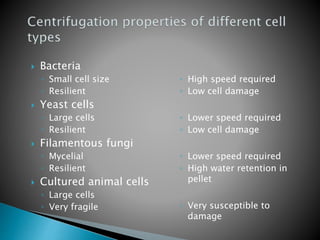
 Bacteria
◦ Small cell size
◦ Resilient
 Yeast cells
◦ Large cells
◦ Resilient
 Filamentous fungi
◦ Mycelial
◦ Resilient
 Cultured animal cells
◦ Large cells
◦ Very fragile
◦ High speed required
◦ Low cell damage
◦ Lower speed required
◦ Low cell damage
◦ Lower speed required
◦ High water retention in
pellet
◦ Very susceptible to
damage
a key role in many industrial processes, including the
production of insulin, is to separate liquid phases and
solids from each other
centrifugation can be utilized to separate the cellular debris
from the released protein
purpose of the centrifugation
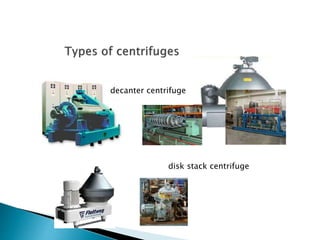
decanter centrifuge
disk stack centrifuge
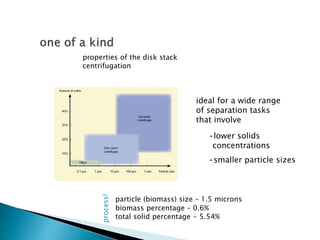
properties of the disk stack
centrifugation
ideal for a wide range
of separation tasks
that involve
particle (biomass) size – 1.5 microns
biomass percentage – 0.6%
total solid percentage - 5.54%
process!
•lower solids
concentrations
•smaller particle sizes
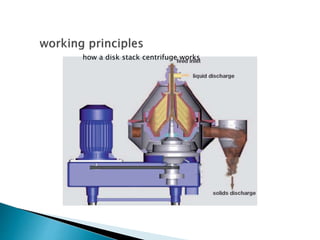
how a disk stack centrifuge works
• separates solids and liquid phases in a continuous process
• uses extremely high centrifugal forces
• denser solids are forced outwards against the solid bowl
wall
• less dense liquid phases form concentric inner layers
• inserting special plates provides additional surface settling
area
how a disk stack centrifuge works
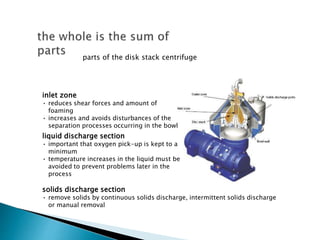
parts of the disk stack centrifuge
inlet zone
• reduces shear forces and amount of
foaming
• increases and avoids disturbances of the
separation processes occurring in the bowl
liquid discharge section
• important that oxygen pick-up is kept to a
minimum
• temperature increases in the liquid must be
avoided to prevent problems later in the
process
solids discharge section
• remove solids by continuous solids discharge, intermittent solids discharge
or manual removal
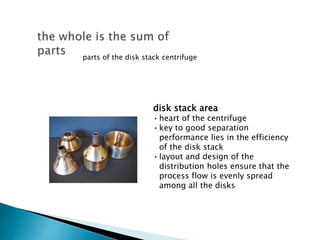
parts of the disk stack centrifuge
disk stack area
•heart of the centrifuge
•key to good separation
performance lies in the efficiency
of the disk stack
•layout and design of the
distribution holes ensure that the
process flow is evenly spread
among all the disks
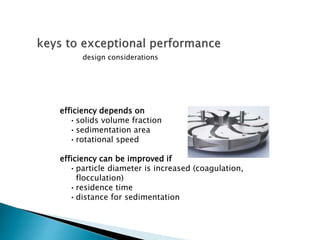
design considerations
efficiency depends on
•solids volume fraction
•sedimentation area
•rotational speed
efficiency can be improved if
•particle diameter is increased (coagulation,
flocculation)
•residence time
•distance for sedimentation
gDu p
fp
g
2
18
 

rDu p
fp
c
22
18


 

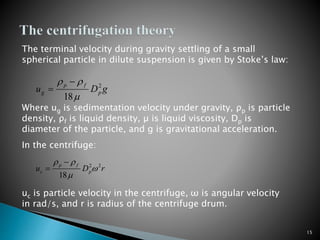
15
The terminal velocity during gravity settling of a small
spherical particle in dilute suspension is given by Stoke’s law:
Where ug is sedimentation velocity under gravity, ρp is particle
density, ρf is liquid density, µ is liquid viscosity, Dp is
diameter of the particle, and g is gravitational acceleration.
In the centrifuge:
uc is particle velocity in the centrifuge, ω is angular velocity
in rad/s, and r is radius of the centrifuge drum.
  3
1
3
2
2
tan3
12
rr
g
N





 2
1
2
2
2
3
2
rr
g
b


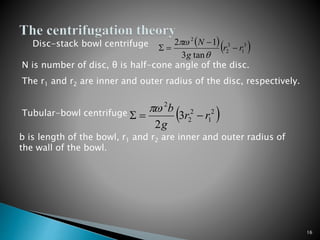
16
Disc-stack bowl centrifuge
N is number of disc, θ is half-cone angle of the disc.
The r1 and r2 are inner and outer radius of the disc, respectively.
Tubular-bowl centrifuge
b is length of the bowl, r1 and r2 are inner and outer radius of
the wall of the bowl.

Centrifugation

  • 1.
    Dr. N. Banu,Associate Professor Vels University
  • 2.
    • use ofthe centrifugal force for the separation of mixtures • More-dense components migrate away from the axis of the centrifuge • less-dense components migrate towards the axis.
  • 3.
    3 Centrifugation is usedto separate materials of different density when a force greater than gravity is desired The type of industrial centrifugation unit: • Tubular bowl centrifuge (Narrow tubular bowl centrifuge or ultracentrifuge, decanter centrifuge, etc). Simple and widely applied in food and pharmaceutical industry. Operates at 13000-16000 G, 105-106 G for ultracentrifuge • Disc-stack bowl centrifuge. This type is common in bioprocess. The developed forces is 5000-15000 G with minimal density difference between solid and liquid is 0.01- 0.03 kg/m3. The minimum particle diameter is 5 µm
  • 4.
  • 5.
     Tube ◦ Highcentrifugal force ◦ Good dewatering ◦ Easy to clean  Chamber ◦ Large solids capacity ◦ Good dewatering ◦ Bowl cooling possible  Disc type ◦ Solids discharge ◦ No foaming ◦ Bowl cooling possible ◦ Limited solids capacity ◦ Foams ◦ Difficult to recover protein ◦ No solids discharge ◦ Cleaning difficult ◦ Solids recovery difficult ◦ Poor dewatering ◦ Difficult to clean
  • 6.
     Bacteria ◦ Smallcell size ◦ Resilient  Yeast cells ◦ Large cells ◦ Resilient  Filamentous fungi ◦ Mycelial ◦ Resilient  Cultured animal cells ◦ Large cells ◦ Very fragile ◦ High speed required ◦ Low cell damage ◦ Lower speed required ◦ Low cell damage ◦ Lower speed required ◦ High water retention in pellet ◦ Very susceptible to damage
  • 7.
    a key rolein many industrial processes, including the production of insulin, is to separate liquid phases and solids from each other centrifugation can be utilized to separate the cellular debris from the released protein purpose of the centrifugation
  • 8.
  • 9.
    properties of thedisk stack centrifugation ideal for a wide range of separation tasks that involve particle (biomass) size – 1.5 microns biomass percentage – 0.6% total solid percentage - 5.54% process! •lower solids concentrations •smaller particle sizes
  • 10.
    how a diskstack centrifuge works • separates solids and liquid phases in a continuous process • uses extremely high centrifugal forces • denser solids are forced outwards against the solid bowl wall • less dense liquid phases form concentric inner layers • inserting special plates provides additional surface settling area
  • 11.
    how a diskstack centrifuge works
  • 12.
    parts of thedisk stack centrifuge inlet zone • reduces shear forces and amount of foaming • increases and avoids disturbances of the separation processes occurring in the bowl liquid discharge section • important that oxygen pick-up is kept to a minimum • temperature increases in the liquid must be avoided to prevent problems later in the process solids discharge section • remove solids by continuous solids discharge, intermittent solids discharge or manual removal
  • 13.
    parts of thedisk stack centrifuge disk stack area •heart of the centrifuge •key to good separation performance lies in the efficiency of the disk stack •layout and design of the distribution holes ensure that the process flow is evenly spread among all the disks
  • 14.
    design considerations efficiency dependson •solids volume fraction •sedimentation area •rotational speed efficiency can be improved if •particle diameter is increased (coagulation, flocculation) •residence time •distance for sedimentation
  • 15.
    gDu p fp g 2 18    rDup fp c 22 18      15 The terminal velocity during gravity settling of a small spherical particle in dilute suspension is given by Stoke’s law: Where ug is sedimentation velocity under gravity, ρp is particle density, ρf is liquid density, µ is liquid viscosity, Dp is diameter of the particle, and g is gravitational acceleration. In the centrifuge: uc is particle velocity in the centrifuge, ω is angular velocity in rad/s, and r is radius of the centrifuge drum.
  • 16.
      3 1 3 2 2 tan3 12 rr g N      2 1 2 2 2 3 2 rr g b   16 Disc-stack bowl centrifuge N is number of disc, θ is half-cone angle of the disc. The r1 and r2 are inner and outer radius of the disc, respectively. Tubular-bowl centrifuge b is length of the bowl, r1 and r2 are inner and outer radius of the wall of the bowl.