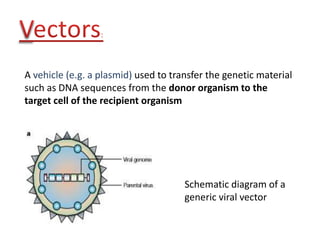
A vehicle (e.g. a plasmid) used to transfer the genetic material
such as DNA sequences from the donor organism to the
target cell of the recipient organism
Schematic diagram of a
generic viral vector
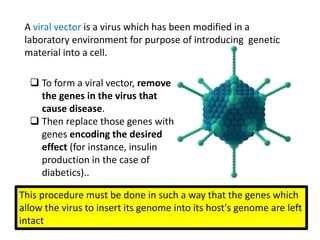
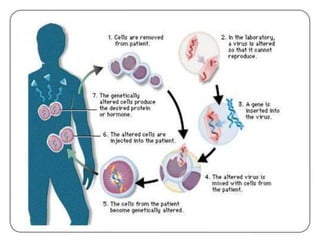
A viral vector is a virus which has been modified in a
laboratory environment for purpose of introducing genetic
material into a cell.
 To form a viral vector, remove
the genes in the virus that
cause disease.
 Then replace those genes with
genes encoding the desired
effect (for instance, insulin
production in the case of
diabetics)..
This procedure must be done in such a way that the genes which
allow the virus to insert its genome into its host's genome are left
intact
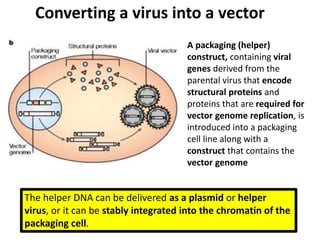
Converting a virus into a vector
A packaging (helper)
construct, containing viral
genes derived from the
parental virus that encode
structural proteins and
proteins that are required for
vector genome replication, is
introduced into a packaging
cell line along with a
construct that contains the
vector genome
The helper DNA can be delivered as a plasmid or helper
virus, or it can be stably integrated into the chromatin of the
packaging cell.
Pathogenicity functions and the sequences that are required for
encapsidation are eliminated from the helper construct so that it
cannot be packaged into a viral particle.
The vector genome contains the transgenic expression cassette and is
flanked by inverted terminal repeats and cis acting sequences that are
required for genome encapsidation.
Some vector genomes retain viral genes that are relatively inactive, as
a result of the elimination of viral early genes that are required for their
transcription.
Viral structural proteins and proteins that are required for replication
of the vector DNA are expressed from the packaging construct and the
replicated vector genomes are packaged into virus particles
6
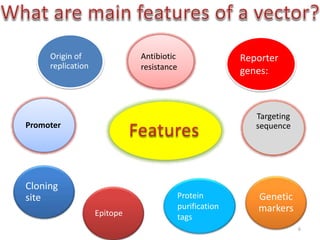
Origin of
replication
Promoter
Cloning
site Protein
purification
tags
Reporter
genes:
Targeting
sequence
Antibiotic
resistance
Epitope
Genetic
markers
7
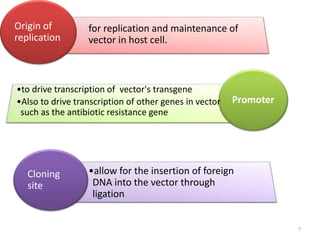
Origin of
replication
Promoter
Cloning
site
for replication and maintenance of
vector in host cell.
•to drive transcription of vector's transgene
•Also to drive transcription of other genes in vector
such as the antibiotic resistance gene
•allow for the insertion of foreign
DNA into the vector through
ligation
8
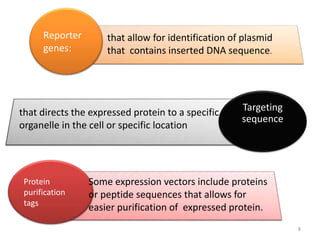
Protein
purification
tags
Some expression vectors include proteins
or peptide sequences that allows for
easier purification of expressed protein.
Reporter
genes:
Targeting
sequence
that allow for identification of plasmid
that contains inserted DNA sequence.
that directs the expressed protein to a specific
organelle in the cell or specific location
9
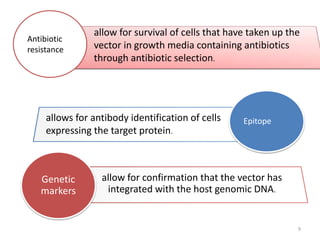
Antibiotic
resistance
Epitope
allow for survival of cells that have taken up the
vector in growth media containing antibiotics
through antibiotic selection.
allows for antibody identification of cells
expressing the target protein.
Genetic
markers
allow for confirmation that the vector has
integrated with the host genomic DNA.
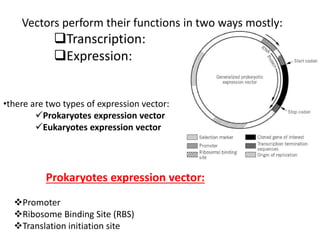
Vectors perform their functions in two ways mostly:
Transcription:
Expression:
Prokaryotes expression vector:
Promoter
Ribosome Binding Site (RBS)
Translation initiation site
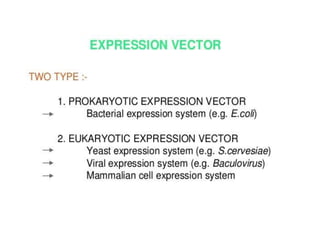
•there are two types of expression vector:
Prokaryotes expression vector
Eukaryotes expression vector
 Viruses are highly evolved natural vectors for the transfer of
foreign genetic information into cells.
 But to improve safety, they need to be replication defective.
 So the viruses can be used as vehicles to carry 'good' genes
into a human cell.
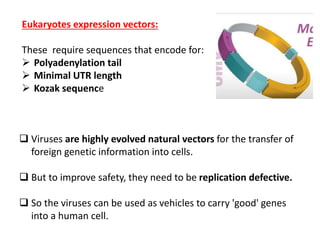
Eukaryotes expression vectors:
These require sequences that encode for:
 Polyadenylation tail
 Minimal UTR length
 Kozak sequence
1/7/2017 13
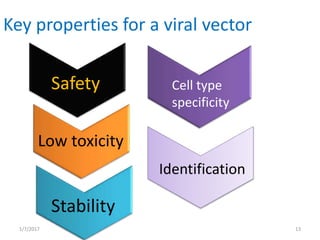
Key properties for a viral vector
Safety
Low toxicity
Stability
Cell type
specificity
Identification
1/7/2017 14
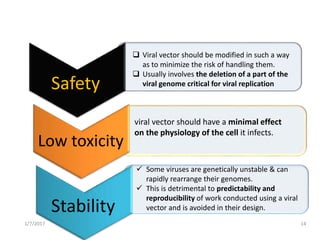
Safety
 Viral vector should be modified in such a way
as to minimize the risk of handling them.
 Usually involves the deletion of a part of the
viral genome critical for viral replication
Low toxicity
viral vector should have a minimal effect
on the physiology of the cell it infects.
Stability
 Some viruses are genetically unstable & can
rapidly rearrange their genomes.
 This is detrimental to predictability and
reproducibility of work conducted using a viral
vector and is avoided in their design.
1/7/2017 15
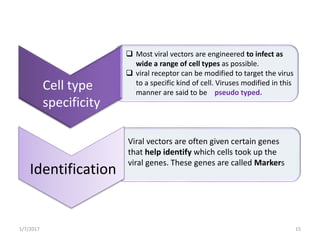
Cell type
specificity
 Most viral vectors are engineered to infect as
wide a range of cell types as possible.
 viral receptor can be modified to target the virus
to a specific kind of cell. Viruses modified in this
manner are said to be pseudo typed.
Identification
Viral vectors are often given certain genes
that help identify which cells took up the
viral genes. These genes are called Markers
1/7/2017 16
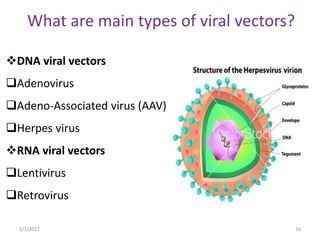
What are main types of viral vectors?
DNA viral vectors
Adenovirus
Adeno-Associated virus (AAV)
Herpes virus
RNA viral vectors
Lentivirus
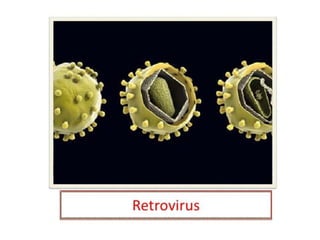
Retrovirus
Retroviral Vectors
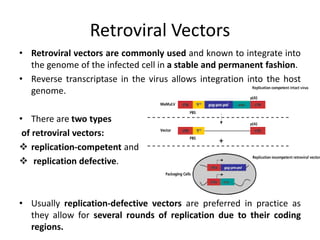
• Retroviral vectors are commonly used and known to integrate into
the genome of the infected cell in a stable and permanent fashion.
• Reverse transcriptase in the virus allows integration into the host
genome.
• There are two types
of retroviral vectors:
 replication-competent and
 replication defective.
• Usually replication-defective vectors are preferred in practice as
they allow for several rounds of replication due to their coding
regions.
Lentiviral Vectors
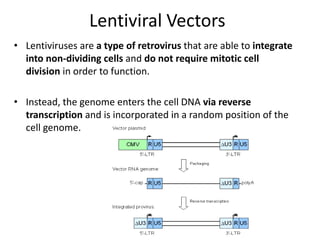
• Lentiviruses are a type of retrovirus that are able to integrate
into non-dividing cells and do not require mitotic cell
division in order to function.
• Instead, the genome enters the cell DNA via reverse
transcription and is incorporated in a random position of the
cell genome.
Adenoviral Vectors
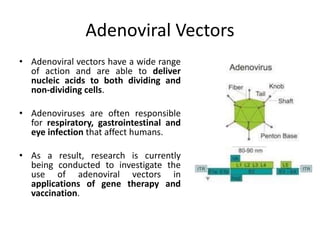
• Adenoviral vectors have a wide range
of action and are able to deliver
nucleic acids to both dividing and
non-dividing cells.
• Adenoviruses are often responsible
for respiratory, gastrointestinal and
eye infection that affect humans.
• As a result, research is currently
being conducted to investigate the
use of adenoviral vectors in
applications of gene therapy and
vaccination.
Adeno-associated viral vectors
• Similarly to adenoviral vectors, adeno-associated viral (AAV)
vectors can deliver genetic material to dividing and non-
dividing cells.
• It is a small virus that is known to affect humans with a very
mild immune response.
• As a result AAV vectors have beneficial properties for gene
therapy that are effective with limited negative effects.
However, the utility of this type of vector is significantly
limited by its restricted capacity of DNA.
Herpes Simplex Virus Vectors
• This type of viral vector has the ability to deliver
large-scale quantities of exogenous DNA.
• The primary concerns with the use of herpes
simplex virus to deliver genetic material are
cytotoxicity and the maintenance of transgene
expression.
1/7/2017
22
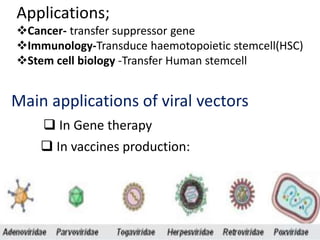
 In Gene therapy
 In vaccines production:
Main applications of viral vectors
Applications;
Cancer- transfer suppressor gene
Immunology-Transduce haemotopoietic stemcell(HSC)
Stem cell biology -Transfer Human stemcell
1/7/2017 23
 In Gene therapy:
 Gene therapy is a technique for
correcting defective genes
responsible for disease
development.
 There are following delivery system
for gene therapy:
• Physical methods
• Non-viral vectors
• Viral vectors
 Virus is usually ā€œcrippledā€ to
disable its ability to cause disease
and viral methods have proved to
be the most efficient to date
25
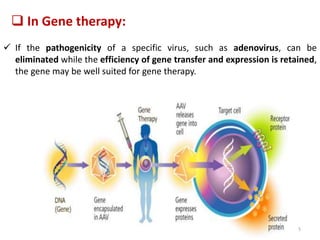
 In Gene therapy:
 If the pathogenicity of a specific virus, such as adenovirus, can be
eliminated while the efficiency of gene transfer and expression is retained,
the gene may be well suited for gene therapy.
28
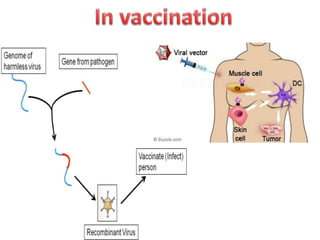
 In vaccines production:
 Viruses expressing pathogen proteins are currently being developed
as vaccines against these pathogens, based on the same rationale as
DNA vaccines.
 T-lymphocytes recognize cells infected with intracellular parasites
based on the foreign proteins produced within the cell.
 A viral vaccine induces expression of pathogen proteins within host
cells. Since viral vaccines contain only a small fraction of pathogen
genes, they are much safer and sporadic infection by the pathogen is
impossible.
 Adenoviruses are being actively developed as vaccines.
1/7/2017 29
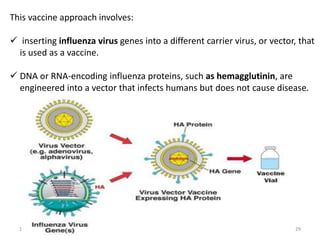
This vaccine approach involves:
 inserting influenza virus genes into a different carrier virus, or vector, that
is used as a vaccine.
 DNA or RNA-encoding influenza proteins, such as hemagglutinin, are
engineered into a vector that infects humans but does not cause disease.
 With a microbial vector vaccine, the vector itself, including the
influenza genetic material, is injected directly into a person.
 The harmless vector virus can then express the proteins necessary to
prompt an immune response.
1/7/2017 32
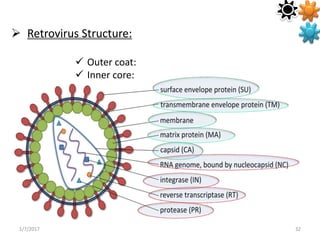
 Retrovirus Structure:
 Outer coat:
 Inner core:
33
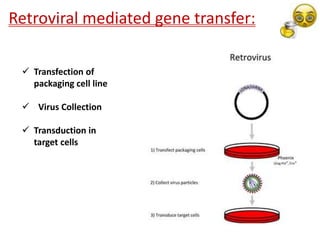
Retroviral mediated gene transfer:
 Transfection of
packaging cell line
 Virus Collection
 Transduction in
target cells
 The production of replication defective
virus is accomplished when packaging cells
are transfected with plasmids that express
all of the viral proteins necessary to
generate infectious particles,
 as well as the nucleic acid sequence of
interest that will be packaged within them
for delivery.
 retroviral vectors produce replication
defective, or self-inactivating, particles.
 This allows for delivery of the desired
sequence, without continued viral
replication in the target cells.
1.Transfection of packaging cell line
1/7/2017 35
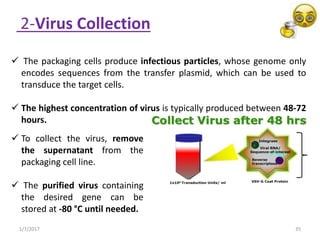
 The packaging cells produce infectious particles, whose genome only
encodes sequences from the transfer plasmid, which can be used to
transduce the target cells.
 The highest concentration of virus is typically produced between 48-72
hours.
2-Virus Collection
 To collect the virus, remove
the supernatant from the
packaging cell line.
 The purified virus containing
the desired gene can be
stored at -80 °C until needed.
36
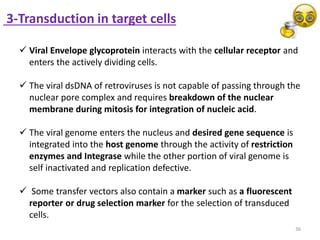
3-Transduction in target cells
 Viral Envelope glycoprotein interacts with the cellular receptor and
enters the actively dividing cells.
 The viral dsDNA of retroviruses is not capable of passing through the
nuclear pore complex and requires breakdown of the nuclear
membrane during mitosis for integration of nucleic acid.
 The viral genome enters the nucleus and desired gene sequence is
integrated into the host genome through the activity of restriction
enzymes and Integrase while the other portion of viral genome is
self inactivated and replication defective.
 Some transfer vectors also contain a marker such as a fluorescent
reporter or drug selection marker for the selection of transduced
cells.
1/7/2017 38
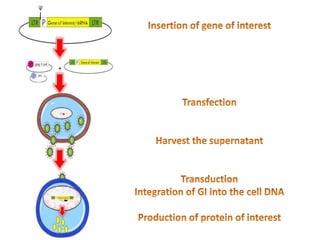
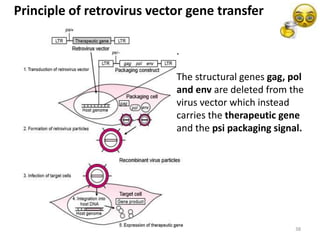
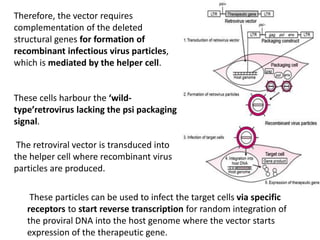
Principle of retrovirus vector gene transfer
.
The structural genes gag, pol
and env are deleted from the
virus vector which instead
carries the therapeutic gene
and the psi packaging signal.
Therefore, the vector requires
complementation of the deleted
structural genes for formation of
recombinant infectious virus particles,
which is mediated by the helper cell.
These cells harbour the ā€˜wild-
type’retrovirus lacking the psi packaging
signal.
The retroviral vector is transduced into
the helper cell where recombinant virus
particles are produced.
These particles can be used to infect the target cells via specific
receptors to start reverse transcription for random integration of
the proviral DNA into the host genome where the vector starts
expression of the therapeutic gene.
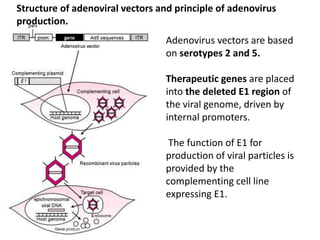
Adenovirus vectors are based
on serotypes 2 and 5.
Therapeutic genes are placed
into the deleted E1 region of
the viral genome, driven by
internal promoters.
The function of E1 for
production of viral particles is
provided by the
complementing cell line
expressing E1.
Structure of adenoviral vectors and principle of adenovirus
production.
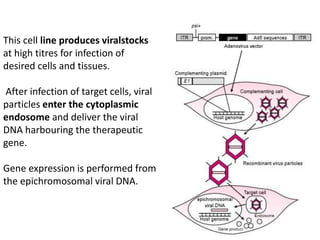
This cell line produces viralstocks
at high titres for infection of
desired cells and tissues.
After infection of target cells, viral
particles enter the cytoplasmic
endosome and deliver the viral
DNA harbouring the therapeutic
gene.
Gene expression is performed from
the epichromosomal viral DNA.
The wild-type AAV consists of the viral genes rep and cap coding
for the different rep (Rep78, Rep68, Rep52, Rep42) and cap (VP1,
VP2, VP3) proteins, the AAV promoters (p5, p19, p40), the
polyadenylation site (pA) and the inverted terminal repeats (ITR).
In rAAV vectors, the viral rep and cap genes are replaced by a
transgene cassette carrying the promoter, the transgene and the
pA-site.
Structure of adeno-associated virus (AAV) vectors
Comparison between bacterial & viral
mediated gene transfer:
Viral mediated
 DNA insert length is upto
30kbp
 More transfection
effeciency
 Long term persistence and
stable gene transfer
Bacterial mediated
 DNA insert length is upto 10
kbp
 comparitively less
transfection effeciency
1/7/2017 44
Viral vectors in virology

Viral vectors in virology

  • 2.
    A vehicle (e.g.a plasmid) used to transfer the genetic material such as DNA sequences from the donor organism to the target cell of the recipient organism Schematic diagram of a generic viral vector
  • 3.
    A viral vectoris a virus which has been modified in a laboratory environment for purpose of introducing genetic material into a cell.  To form a viral vector, remove the genes in the virus that cause disease.  Then replace those genes with genes encoding the desired effect (for instance, insulin production in the case of diabetics).. This procedure must be done in such a way that the genes which allow the virus to insert its genome into its host's genome are left intact
  • 4.
    Converting a virusinto a vector A packaging (helper) construct, containing viral genes derived from the parental virus that encode structural proteins and proteins that are required for vector genome replication, is introduced into a packaging cell line along with a construct that contains the vector genome The helper DNA can be delivered as a plasmid or helper virus, or it can be stably integrated into the chromatin of the packaging cell.
  • 5.
    Pathogenicity functions andthe sequences that are required for encapsidation are eliminated from the helper construct so that it cannot be packaged into a viral particle. The vector genome contains the transgenic expression cassette and is flanked by inverted terminal repeats and cis acting sequences that are required for genome encapsidation. Some vector genomes retain viral genes that are relatively inactive, as a result of the elimination of viral early genes that are required for their transcription. Viral structural proteins and proteins that are required for replication of the vector DNA are expressed from the packaging construct and the replicated vector genomes are packaged into virus particles
  • 6.
  • 7.
    7 Origin of replication Promoter Cloning site for replicationand maintenance of vector in host cell. •to drive transcription of vector's transgene •Also to drive transcription of other genes in vector such as the antibiotic resistance gene •allow for the insertion of foreign DNA into the vector through ligation
  • 8.
    8 Protein purification tags Some expression vectorsinclude proteins or peptide sequences that allows for easier purification of expressed protein. Reporter genes: Targeting sequence that allow for identification of plasmid that contains inserted DNA sequence. that directs the expressed protein to a specific organelle in the cell or specific location
  • 9.
    9 Antibiotic resistance Epitope allow for survivalof cells that have taken up the vector in growth media containing antibiotics through antibiotic selection. allows for antibody identification of cells expressing the target protein. Genetic markers allow for confirmation that the vector has integrated with the host genomic DNA.
  • 10.
    Vectors perform theirfunctions in two ways mostly: Transcription: Expression: Prokaryotes expression vector: Promoter Ribosome Binding Site (RBS) Translation initiation site •there are two types of expression vector: Prokaryotes expression vector Eukaryotes expression vector
  • 12.
     Viruses arehighly evolved natural vectors for the transfer of foreign genetic information into cells.  But to improve safety, they need to be replication defective.  So the viruses can be used as vehicles to carry 'good' genes into a human cell. Eukaryotes expression vectors: These require sequences that encode for:  Polyadenylation tail  Minimal UTR length  Kozak sequence
  • 13.
    1/7/2017 13 Key propertiesfor a viral vector Safety Low toxicity Stability Cell type specificity Identification
  • 14.
    1/7/2017 14 Safety  Viralvector should be modified in such a way as to minimize the risk of handling them.  Usually involves the deletion of a part of the viral genome critical for viral replication Low toxicity viral vector should have a minimal effect on the physiology of the cell it infects. Stability  Some viruses are genetically unstable & can rapidly rearrange their genomes.  This is detrimental to predictability and reproducibility of work conducted using a viral vector and is avoided in their design.
  • 15.
    1/7/2017 15 Cell type specificity Most viral vectors are engineered to infect as wide a range of cell types as possible.  viral receptor can be modified to target the virus to a specific kind of cell. Viruses modified in this manner are said to be pseudo typed. Identification Viral vectors are often given certain genes that help identify which cells took up the viral genes. These genes are called Markers
  • 16.
    1/7/2017 16 What aremain types of viral vectors? DNA viral vectors Adenovirus Adeno-Associated virus (AAV) Herpes virus RNA viral vectors Lentivirus Retrovirus
  • 17.
    Retroviral Vectors • Retroviralvectors are commonly used and known to integrate into the genome of the infected cell in a stable and permanent fashion. • Reverse transcriptase in the virus allows integration into the host genome. • There are two types of retroviral vectors:  replication-competent and  replication defective. • Usually replication-defective vectors are preferred in practice as they allow for several rounds of replication due to their coding regions.
  • 18.
    Lentiviral Vectors • Lentivirusesare a type of retrovirus that are able to integrate into non-dividing cells and do not require mitotic cell division in order to function. • Instead, the genome enters the cell DNA via reverse transcription and is incorporated in a random position of the cell genome.
  • 19.
    Adenoviral Vectors • Adenoviralvectors have a wide range of action and are able to deliver nucleic acids to both dividing and non-dividing cells. • Adenoviruses are often responsible for respiratory, gastrointestinal and eye infection that affect humans. • As a result, research is currently being conducted to investigate the use of adenoviral vectors in applications of gene therapy and vaccination.
  • 20.
    Adeno-associated viral vectors •Similarly to adenoviral vectors, adeno-associated viral (AAV) vectors can deliver genetic material to dividing and non- dividing cells. • It is a small virus that is known to affect humans with a very mild immune response. • As a result AAV vectors have beneficial properties for gene therapy that are effective with limited negative effects. However, the utility of this type of vector is significantly limited by its restricted capacity of DNA.
  • 21.
    Herpes Simplex VirusVectors • This type of viral vector has the ability to deliver large-scale quantities of exogenous DNA. • The primary concerns with the use of herpes simplex virus to deliver genetic material are cytotoxicity and the maintenance of transgene expression.
  • 22.
    1/7/2017 22  In Genetherapy  In vaccines production: Main applications of viral vectors Applications; Cancer- transfer suppressor gene Immunology-Transduce haemotopoietic stemcell(HSC) Stem cell biology -Transfer Human stemcell
  • 23.
    1/7/2017 23  InGene therapy:  Gene therapy is a technique for correcting defective genes responsible for disease development.  There are following delivery system for gene therapy: • Physical methods • Non-viral vectors • Viral vectors  Virus is usually ā€œcrippledā€ to disable its ability to cause disease and viral methods have proved to be the most efficient to date
  • 25.
    25  In Genetherapy:  If the pathogenicity of a specific virus, such as adenovirus, can be eliminated while the efficiency of gene transfer and expression is retained, the gene may be well suited for gene therapy.
  • 28.
    28  In vaccinesproduction:  Viruses expressing pathogen proteins are currently being developed as vaccines against these pathogens, based on the same rationale as DNA vaccines.  T-lymphocytes recognize cells infected with intracellular parasites based on the foreign proteins produced within the cell.  A viral vaccine induces expression of pathogen proteins within host cells. Since viral vaccines contain only a small fraction of pathogen genes, they are much safer and sporadic infection by the pathogen is impossible.  Adenoviruses are being actively developed as vaccines.
  • 29.
    1/7/2017 29 This vaccineapproach involves:  inserting influenza virus genes into a different carrier virus, or vector, that is used as a vaccine.  DNA or RNA-encoding influenza proteins, such as hemagglutinin, are engineered into a vector that infects humans but does not cause disease.
  • 30.
     With amicrobial vector vaccine, the vector itself, including the influenza genetic material, is injected directly into a person.  The harmless vector virus can then express the proteins necessary to prompt an immune response.
  • 32.
    1/7/2017 32  RetrovirusStructure:  Outer coat:  Inner core:
  • 33.
    33 Retroviral mediated genetransfer:  Transfection of packaging cell line  Virus Collection  Transduction in target cells
  • 34.
     The productionof replication defective virus is accomplished when packaging cells are transfected with plasmids that express all of the viral proteins necessary to generate infectious particles,  as well as the nucleic acid sequence of interest that will be packaged within them for delivery.  retroviral vectors produce replication defective, or self-inactivating, particles.  This allows for delivery of the desired sequence, without continued viral replication in the target cells. 1.Transfection of packaging cell line
  • 35.
    1/7/2017 35  Thepackaging cells produce infectious particles, whose genome only encodes sequences from the transfer plasmid, which can be used to transduce the target cells.  The highest concentration of virus is typically produced between 48-72 hours. 2-Virus Collection  To collect the virus, remove the supernatant from the packaging cell line.  The purified virus containing the desired gene can be stored at -80 °C until needed.
  • 36.
    36 3-Transduction in targetcells  Viral Envelope glycoprotein interacts with the cellular receptor and enters the actively dividing cells.  The viral dsDNA of retroviruses is not capable of passing through the nuclear pore complex and requires breakdown of the nuclear membrane during mitosis for integration of nucleic acid.  The viral genome enters the nucleus and desired gene sequence is integrated into the host genome through the activity of restriction enzymes and Integrase while the other portion of viral genome is self inactivated and replication defective.  Some transfer vectors also contain a marker such as a fluorescent reporter or drug selection marker for the selection of transduced cells.
  • 38.
    1/7/2017 38 Principle ofretrovirus vector gene transfer . The structural genes gag, pol and env are deleted from the virus vector which instead carries the therapeutic gene and the psi packaging signal.
  • 39.
    Therefore, the vectorrequires complementation of the deleted structural genes for formation of recombinant infectious virus particles, which is mediated by the helper cell. These cells harbour the ā€˜wild- type’retrovirus lacking the psi packaging signal. The retroviral vector is transduced into the helper cell where recombinant virus particles are produced. These particles can be used to infect the target cells via specific receptors to start reverse transcription for random integration of the proviral DNA into the host genome where the vector starts expression of the therapeutic gene.
  • 41.
    Adenovirus vectors arebased on serotypes 2 and 5. Therapeutic genes are placed into the deleted E1 region of the viral genome, driven by internal promoters. The function of E1 for production of viral particles is provided by the complementing cell line expressing E1. Structure of adenoviral vectors and principle of adenovirus production.
  • 42.
    This cell lineproduces viralstocks at high titres for infection of desired cells and tissues. After infection of target cells, viral particles enter the cytoplasmic endosome and deliver the viral DNA harbouring the therapeutic gene. Gene expression is performed from the epichromosomal viral DNA.
  • 43.
    The wild-type AAVconsists of the viral genes rep and cap coding for the different rep (Rep78, Rep68, Rep52, Rep42) and cap (VP1, VP2, VP3) proteins, the AAV promoters (p5, p19, p40), the polyadenylation site (pA) and the inverted terminal repeats (ITR). In rAAV vectors, the viral rep and cap genes are replaced by a transgene cassette carrying the promoter, the transgene and the pA-site. Structure of adeno-associated virus (AAV) vectors
  • 44.
    Comparison between bacterial& viral mediated gene transfer: Viral mediated  DNA insert length is upto 30kbp  More transfection effeciency  Long term persistence and stable gene transfer Bacterial mediated  DNA insert length is upto 10 kbp  comparitively less transfection effeciency 1/7/2017 44

Editor's Notes

  • #29Ā T cell immunity is crucial for protection against viral infections and such diseases as malaria.