Victorian Literature 
By : 
 Maidaturrohmaniah 
 Anisyah Zulvia 
 Isnaini Ainun Rinayati
The Victorian Age 
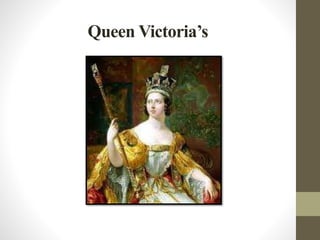
• “The Victorian” era of British history was the period of Queen 
Victoria’s reign from 1837 until her death in 1901. It was a long 
period of peace, prosperity, refined culture, great advancements in 
technology, and national self-confidence for Britain. 
• During theVictorian age, Britain was the worlds most powerful 
nation. By the end of Victorias reign, the British empire extended 
over about one-fifth of the earths surface. Like Elizabethan 
England, Victorian England saw great expansion of wealth, power, 
and culture. But as Victorian England was a time of great ambition 
and grandeur, it was also a time of misery, squalor, and urban 
ugliness.
Queen Victoria’s
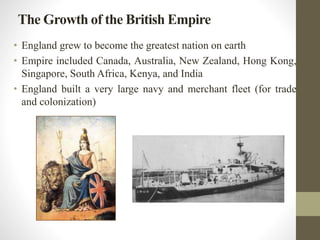
The Growth of the British Empire 
• England grew to become the greatest nation on earth 
• Empire included Canada, Australia, New Zealand, Hong Kong, 
Singapore, South Africa, Kenya, and India 
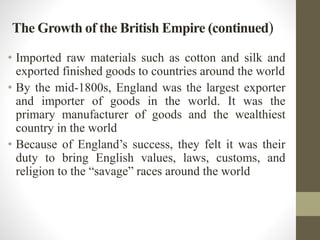
• England built a very large navy and merchant fleet (for trade 
and colonization)
The Growth of the British Empire (continued) 
• Imported raw materials such as cotton and silk and 
exported finished goods to countries around the world 
• By the mid-1800s, England was the largest exporter 
and importer of goods in the world. It was the 
primary manufacturer of goods and the wealthiest 
country in the world 
• Because of England’s success, they felt it was their 
duty to bring English values, laws, customs, and 
religion to the “savage” races around the world
The Industrial Revolution 
• It started at the end of the eigh teenth century, when theoretical 
knowledge and practical technology were connected. Scientific 
ideas were applied to the making of machines that transformed 
the way things were made and dramatically changed people’s 
lifestyles. A formerly agricultural nation was now based on urban 
and industrial growth. Butas industry grew, it was accompanied 
by a rapid increase in the numbers of the urban working-classpoor. 
Workers in the cities lived in miserableconditions. 
Urban squalor and misery were signs ofa massive change in the 
English society. 
• The Age of Steam 
• Mass Production
• The Impact of the Industrial Revolutions : 
• I. The Emergence of Over crowded Cities One result of the 
advance of technology was the unprecedented growth of cities. 
People, in search of work left the country side to work in 
factories in the different cities of Britain. They had to live in 
very dirty and unhealthy conditions. There were too many 
workers and not enough houses. People were living like 
animals. Diseases raged, hunger, poverty, and deprivation 
prevailed, crime accelerated, and misery increased. 
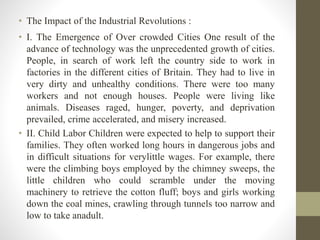
• II. Child Labor Children were expected to help to support their 
families. They often worked long hours in dangerous jobs and 
in difficult situations for verylittle wages. For example, there 
were the climbing boys employed by the chimney sweeps, the 
little children who could scramble under the moving 
machinery to retrieve the cotton fluff; boys and girls working 
down the coal mines, crawling through tunnels too narrow and 
low to take anadult.
Victorian Thinkers 
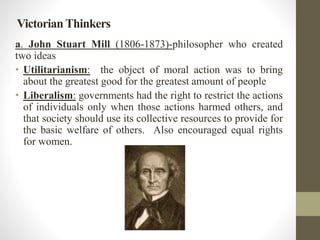
a. John Stuart Mill (1806-1873)-philosopher who created 
two ideas 
• Utilitarianism: the object of moral action was to bring 
about the greatest good for the greatest amount of people 
• Liberalism: governments had the right to restrict the actions 
of individuals only when those actions harmed others, and 
that society should use its collective resources to provide for 
the basic welfare of others. Also encouraged equal rights 
for women.
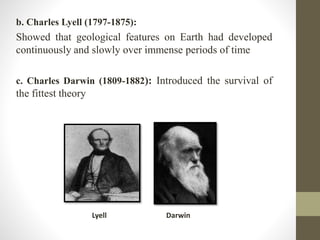
b. Charles Lyell (1797-1875): 
Showed that geological features on Earth had developed 
continuously and slowly over immense periods of time 
c. Charles Darwin (1809-1882): Introduced the survival of 
the fittest theory 
Lyell Darwin
• d. John ruskin 
• The most Romantic prose of the Victorian (1819-1900) 
• Ruskin’s greatness is as striking as his singularity, an 
instance of the effect of Evangelicalism and Romanticism 
on an only child. 
• e. John Henry Newman 
• The master of Victorian Non-Fictional prose (1801-90) 
• f. Herbert Spencer (1820-1903): Applied Darwinism to 
human society: as in nature, survival properly belongs to 
the fittest, those most able to survive. Social Darwinism 
was used by many Victorians to justify social inequalities 
based on race, social or economic class, or gender 
• g. Adam Smith - 18th century economist, held that the 
best government economic policy was to leave the market 
alone—to follow a laissez faire or “let it be” policy of 
little or no gov’t intervention
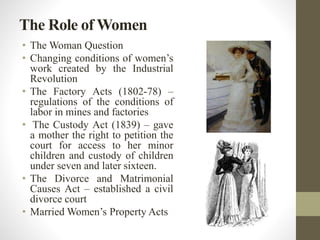
The Role of Women 
• TheWoman Question 
• Changing conditions of women’s 
work created by the Industrial 
Revolution 
• The Factory Acts (1802-78) – 
regulations of the conditions of 
labor in mines and factories 
• The Custody Act (1839) – gave 
a mother the right to petition the 
court for access to her minor 
children and custody of children 
under seven and later sixteen. 
• The Divorce and Matrimonial 
Causes Act – established a civil 
divorce court 
• Married Women’s Property Acts
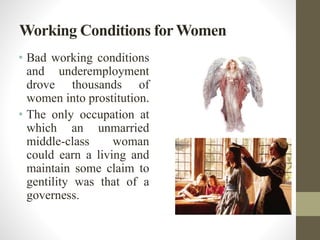
Working Conditions for Women 
• Bad working conditions 
and underemployment 
drove thousands of 
women into prostitution. 
• The only occupation at 
which an unmarried 
middle-class woman 
could earn a living and 
maintain some claim to 
gentility was that of a 
governess.
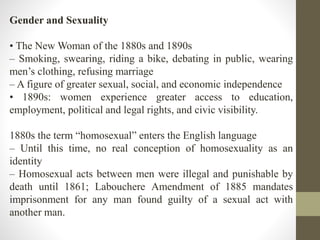
Gender and Sexuality 
• The NewWoman of the 1880s and 1890s 
– Smoking, swearing, riding a bike, debating in public, wearing 
men’s clothing, refusing marriage 
– A figure of greater sexual, social, and economic independence 
• 1890s: women experience greater access to education, 
employment, political and legal rights, and civic visibility. 
1880s the term “homosexual” enters the English language 
– Until this time, no real conception of homosexuality as an 
identity 
– Homosexual acts between men were illegal and punishable by 
death until 1861; Labouchere Amendment of 1885 mandates 
imprisonment for any man found guilty of a sexual act with 
another man.
The term “lesbian” emerges in the 1890s, but do not suffer the 
same persecution as gay men 
– Rationale: women unmotivated by sexual desire, intense, 
passionate “friendships” seen as innocent 
• End result: feminized male characters (the dandy, the aesthete, 
the fop) and masculinized female characters (the New Woman) 
in literature.
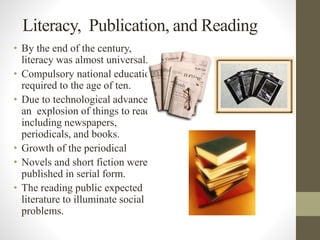
Literacy, Publication, and Reading 
• By the end of the century, 
literacy was almost universal. 
• Compulsory national education 
required to the age of ten. 
• Due to technological advances, 
an explosion of things to read, 
including newspapers, 
periodicals, and books. 
• Growth of the periodical 
• Novels and short fiction were 
published in serial form. 
• The reading public expected 
literature to illuminate social 
problems.
• Victorian Literature 
• • Novels: dominant literary form; “social problem” novel, 
“domestic” novel 
• • Poetry: influenced by Romantic period; 
• – dramatic monologue: a lyric poem in the voice of a speaker 
who is not the poet 
• • Drama: frivolous, romantic, witty; mocked contemporary 
values (satirical) 
• • Non-fiction: essays, criticism, history, biography,newspapers, 
and magazines 
• – “The Age of Periodicals” 
• – “The Age of Reading”
1. Novel 
• A. EARLY-VICTORIAN NOVEL (or social-problem novel) 
dealing with social and humanitarian themes 
• realism, criticism of social evils but faith in progress, general 
optimism 
• The main representative was CHARLES DICKENS. 
• B. MID-VICTORIAN NOVEL (novel of purpose) 
• showing Romantic and Gothic elements and a psychological 
interest. The main representative writers were the BRONTË 
sisters and ROBERT LOUIS STEVENSON. 
• C. LATE- VICTORIAN NOVEL (naturalistic novel near to 
European Naturalism) showing a scientific look at human life, 
objectivity of observation, dissatisfaction with Victorian 
values. The main representative writers were THOMAS 
HARDY and OSCAR WILDE.
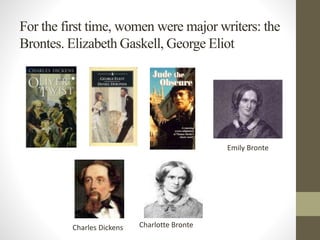
For the first time, women were major writers: the 
Brontes. ElizabethGaskell,George Eliot 
Emily Bronte 
Charles Dickens Charlotte Bronte
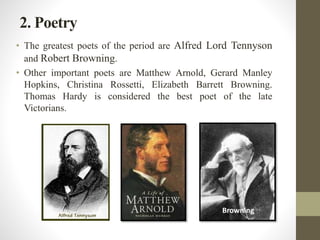
2. Poetry 
• The greatest poets of the period are Alfred Lord Tennyson 
and Robert Browning. 
• Other important poets are Matthew Arnold, Gerard Manley 
Hopkins, Christina Rossetti, Elizabeth Barrett Browning. 
Thomas Hardy is considered the best poet of the late 
Victorians. 
Browning
3. Drama 
• The theater was a flourishing and popular institution during the 
Victorian period. 
• The popularity of theater influenced other genres. 
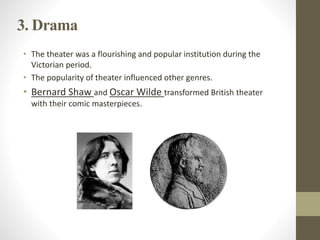
• Bernard Shaw and Oscar Wilde transformed British theater 
with their comic masterpieces.
Thank You  
For your attention...

Victorian Era

  • 1.
    Victorian Literature By:  Maidaturrohmaniah  Anisyah Zulvia  Isnaini Ainun Rinayati
  • 2.
    The Victorian Age • “The Victorian” era of British history was the period of Queen Victoria’s reign from 1837 until her death in 1901. It was a long period of peace, prosperity, refined culture, great advancements in technology, and national self-confidence for Britain. • During theVictorian age, Britain was the worlds most powerful nation. By the end of Victorias reign, the British empire extended over about one-fifth of the earths surface. Like Elizabethan England, Victorian England saw great expansion of wealth, power, and culture. But as Victorian England was a time of great ambition and grandeur, it was also a time of misery, squalor, and urban ugliness.
  • 3.
  • 4.
    The Growth ofthe British Empire • England grew to become the greatest nation on earth • Empire included Canada, Australia, New Zealand, Hong Kong, Singapore, South Africa, Kenya, and India • England built a very large navy and merchant fleet (for trade and colonization)
  • 5.
    The Growth ofthe British Empire (continued) • Imported raw materials such as cotton and silk and exported finished goods to countries around the world • By the mid-1800s, England was the largest exporter and importer of goods in the world. It was the primary manufacturer of goods and the wealthiest country in the world • Because of England’s success, they felt it was their duty to bring English values, laws, customs, and religion to the “savage” races around the world
  • 6.
    The Industrial Revolution • It started at the end of the eigh teenth century, when theoretical knowledge and practical technology were connected. Scientific ideas were applied to the making of machines that transformed the way things were made and dramatically changed people’s lifestyles. A formerly agricultural nation was now based on urban and industrial growth. Butas industry grew, it was accompanied by a rapid increase in the numbers of the urban working-classpoor. Workers in the cities lived in miserableconditions. Urban squalor and misery were signs ofa massive change in the English society. • The Age of Steam • Mass Production
  • 7.
    • The Impactof the Industrial Revolutions : • I. The Emergence of Over crowded Cities One result of the advance of technology was the unprecedented growth of cities. People, in search of work left the country side to work in factories in the different cities of Britain. They had to live in very dirty and unhealthy conditions. There were too many workers and not enough houses. People were living like animals. Diseases raged, hunger, poverty, and deprivation prevailed, crime accelerated, and misery increased. • II. Child Labor Children were expected to help to support their families. They often worked long hours in dangerous jobs and in difficult situations for verylittle wages. For example, there were the climbing boys employed by the chimney sweeps, the little children who could scramble under the moving machinery to retrieve the cotton fluff; boys and girls working down the coal mines, crawling through tunnels too narrow and low to take anadult.
  • 8.
    Victorian Thinkers a.John Stuart Mill (1806-1873)-philosopher who created two ideas • Utilitarianism: the object of moral action was to bring about the greatest good for the greatest amount of people • Liberalism: governments had the right to restrict the actions of individuals only when those actions harmed others, and that society should use its collective resources to provide for the basic welfare of others. Also encouraged equal rights for women.
  • 9.
    b. Charles Lyell(1797-1875): Showed that geological features on Earth had developed continuously and slowly over immense periods of time c. Charles Darwin (1809-1882): Introduced the survival of the fittest theory Lyell Darwin
  • 10.
    • d. Johnruskin • The most Romantic prose of the Victorian (1819-1900) • Ruskin’s greatness is as striking as his singularity, an instance of the effect of Evangelicalism and Romanticism on an only child. • e. John Henry Newman • The master of Victorian Non-Fictional prose (1801-90) • f. Herbert Spencer (1820-1903): Applied Darwinism to human society: as in nature, survival properly belongs to the fittest, those most able to survive. Social Darwinism was used by many Victorians to justify social inequalities based on race, social or economic class, or gender • g. Adam Smith - 18th century economist, held that the best government economic policy was to leave the market alone—to follow a laissez faire or “let it be” policy of little or no gov’t intervention
  • 11.
    The Role ofWomen • TheWoman Question • Changing conditions of women’s work created by the Industrial Revolution • The Factory Acts (1802-78) – regulations of the conditions of labor in mines and factories • The Custody Act (1839) – gave a mother the right to petition the court for access to her minor children and custody of children under seven and later sixteen. • The Divorce and Matrimonial Causes Act – established a civil divorce court • Married Women’s Property Acts
  • 12.
    Working Conditions forWomen • Bad working conditions and underemployment drove thousands of women into prostitution. • The only occupation at which an unmarried middle-class woman could earn a living and maintain some claim to gentility was that of a governess.
  • 13.
    Gender and Sexuality • The NewWoman of the 1880s and 1890s – Smoking, swearing, riding a bike, debating in public, wearing men’s clothing, refusing marriage – A figure of greater sexual, social, and economic independence • 1890s: women experience greater access to education, employment, political and legal rights, and civic visibility. 1880s the term “homosexual” enters the English language – Until this time, no real conception of homosexuality as an identity – Homosexual acts between men were illegal and punishable by death until 1861; Labouchere Amendment of 1885 mandates imprisonment for any man found guilty of a sexual act with another man.
  • 14.
    The term “lesbian”emerges in the 1890s, but do not suffer the same persecution as gay men – Rationale: women unmotivated by sexual desire, intense, passionate “friendships” seen as innocent • End result: feminized male characters (the dandy, the aesthete, the fop) and masculinized female characters (the New Woman) in literature.
  • 15.
    Literacy, Publication, andReading • By the end of the century, literacy was almost universal. • Compulsory national education required to the age of ten. • Due to technological advances, an explosion of things to read, including newspapers, periodicals, and books. • Growth of the periodical • Novels and short fiction were published in serial form. • The reading public expected literature to illuminate social problems.
  • 16.
    • Victorian Literature • • Novels: dominant literary form; “social problem” novel, “domestic” novel • • Poetry: influenced by Romantic period; • – dramatic monologue: a lyric poem in the voice of a speaker who is not the poet • • Drama: frivolous, romantic, witty; mocked contemporary values (satirical) • • Non-fiction: essays, criticism, history, biography,newspapers, and magazines • – “The Age of Periodicals” • – “The Age of Reading”
  • 17.
    1. Novel •A. EARLY-VICTORIAN NOVEL (or social-problem novel) dealing with social and humanitarian themes • realism, criticism of social evils but faith in progress, general optimism • The main representative was CHARLES DICKENS. • B. MID-VICTORIAN NOVEL (novel of purpose) • showing Romantic and Gothic elements and a psychological interest. The main representative writers were the BRONTË sisters and ROBERT LOUIS STEVENSON. • C. LATE- VICTORIAN NOVEL (naturalistic novel near to European Naturalism) showing a scientific look at human life, objectivity of observation, dissatisfaction with Victorian values. The main representative writers were THOMAS HARDY and OSCAR WILDE.
  • 18.
    For the firsttime, women were major writers: the Brontes. ElizabethGaskell,George Eliot Emily Bronte Charles Dickens Charlotte Bronte
  • 19.
    2. Poetry •The greatest poets of the period are Alfred Lord Tennyson and Robert Browning. • Other important poets are Matthew Arnold, Gerard Manley Hopkins, Christina Rossetti, Elizabeth Barrett Browning. Thomas Hardy is considered the best poet of the late Victorians. Browning
  • 20.
    3. Drama •The theater was a flourishing and popular institution during the Victorian period. • The popularity of theater influenced other genres. • Bernard Shaw and Oscar Wilde transformed British theater with their comic masterpieces.
  • 21.
    Thank You  For your attention...